Hospital dietis an essential part of modern therapy
in all medical depts. It comprises both the normal
diets and the various forms of modified nutrition.
The type of diet prescribed depends on the patients
need and restriction.
It is a part of a clinical treatment and in some cases
can be the principal treatment of the condition.
3
HOSPITAL DIET
3.
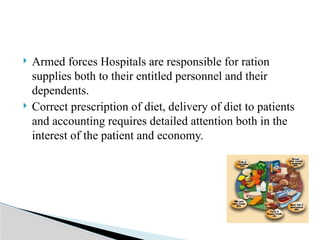
Armed forcesHospitals are responsible for ration
supplies both to their entitled personnel and their
dependents.
Correct prescription of diet, delivery of diet to patients
and accounting requires detailed attention both in the
interest of the patient and economy.
4.
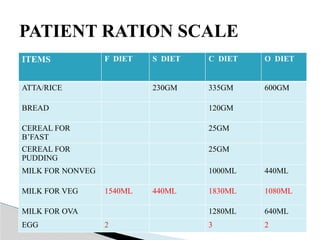
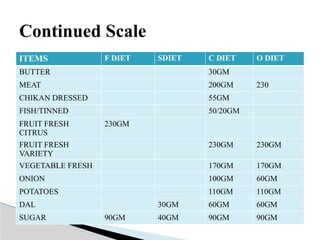
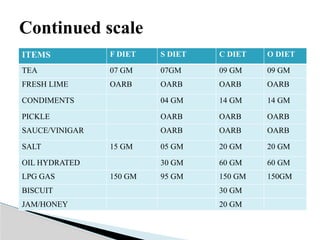
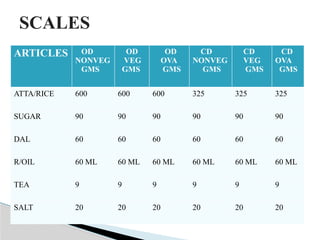
All patientsadmitted in the hospital are authorized
hospital diets and extras according to the scales given
in AI 94/76
The daily scales of diet for patients have been made as
comprehensive as possible to suit the requirement of
majority of patients to be treated in service hospitals.
Authorization of Hospital Diets in Armed
Forces
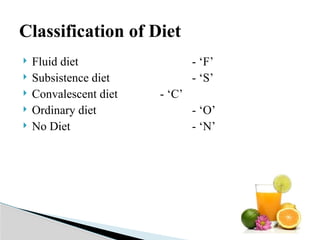
FLUID DIET (FDIET):-
It is given to those patients who are unable to take solid
food.
It can include any liquid foods like soup, juices, and
milk ,egg flip, pureed dal and vegetables etc. These
may be given orally or through nasogastric tube.
7.
Fluid diet
Clear fluiddiet
No residue fluids
Nutritionally inadequate
Indications
First step to restarting oral feeds after
oral/abdominal surgeries
Fluid and electrolyte replacement in patients
with diarrhoea and dehydration
Before specific investigations
400kcal/day
8.
SUBSISTENCE DIET (SDIET):-
It is given to those patients who are admitted
after 1200hrs till 1800hrs.
It is like ordinary diet but the scales of items are less
It is demanded from MI Room.
9.
CONVALESCENT DIET(C DIET):-
This is a high-energy, high protein diet given to the
patients who require growth and building up of tissues.
The patients who are given this diet include
postoperative patients, burns patients, patients who are
critically ill and recovering after major illness.
10.
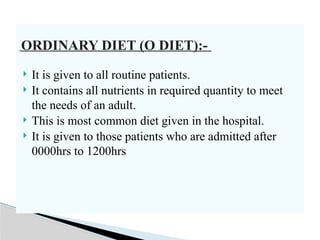
ORDINARY DIET (ODIET):-
It is given to all routine patients.
It contains all nutrients in required quantity to meet
the needs of an adult.
This is most common diet given in the hospital.
It is given to those patients who are admitted after
0000hrs to 1200hrs
11.
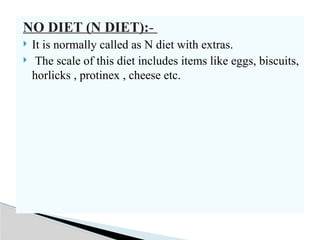
NO DIET (NDIET):-
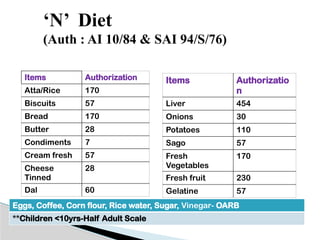
It is normally called as N diet with extras.
The scale of this diet includes items like eggs, biscuits,
horlicks , protinex , cheese etc.
12.
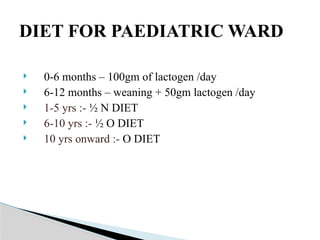
0-6 months– 100gm of lactogen /day
6-12 months – weaning + 50gm lactogen /day
1-5 yrs :- ½ N DIET
6-10 yrs :- ½ O DIET
10 yrs onward :- O DIET
DIET FOR PAEDIATRIC WARD
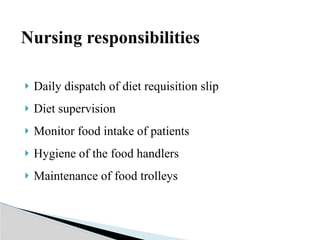
Nursing responsibilities
Dailydispatch of diet requisition slip
Diet supervision
Monitor food intake of patients
Hygiene of the food handlers
Maintenance of food trolleys
22.
Contd…
Prevention ofpilferage of food items
Maintenance of diet registers
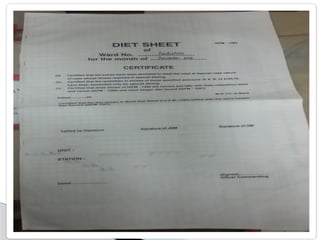
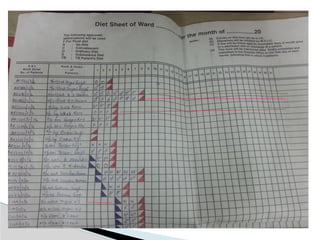
Monthly submission of diet sheet (IAFM-1282)
Suggestion book & Patient satisfaction survey
23.
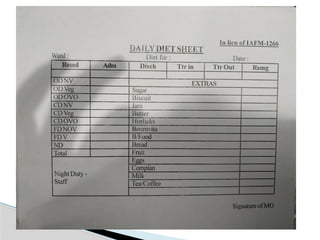
IAFM-1266 –Daily Diet Requisition
IAFM-1282– Monthly Diet Requisition
◦ Ward submits the daily requisition for the following day
normally after the morning ward round.
◦ The diet requisition should tally with the entries in the ward
diet sheet (IAFM-1282).
◦ MO i/c verifies that the diet prescribed are issued and
consumed by the patient for whom it is prescribed.
How to demand the Diet
24.
Particulars ofpatients and A &D No are correctly
entered
The patients are physically present in the ward.
Diet prescribed and requisition are correctly shown.
Extras prescribed are correctly entered.
Diet requisition IAFM-1266 tallies with entries in
IAFM-1282.
Cutting and over writing are avoided
IAFM-1266 signed by MO I/c daily
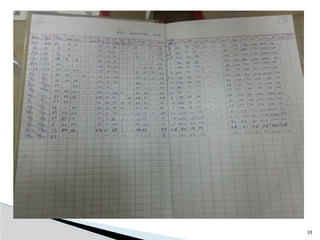
IAFM-1282 monthly and thereafter by Commandant
Maintenance of IAFM-1282
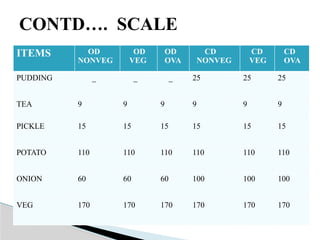
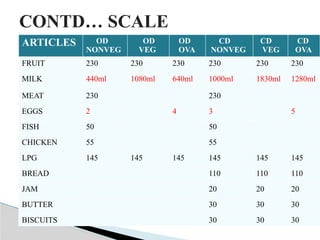
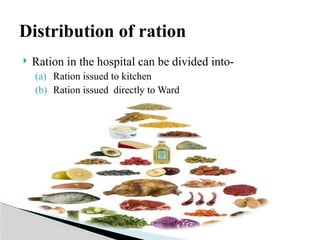
Ration inthe hospital can be divided into-
(a) Ration issued to kitchen
(b) Ration issued directly to Ward
Distribution of ration
30.
The following itemsare directly issued to wards
Eggs
Fruit
Butter
Bread
Jam/honey/cheese
Extras as ordered (e.g horlicks, proteinx, etc)
The Nursing Officer ensures that these items are
duly received and distributed to the patient as per
diet ordered.
Issue to wards
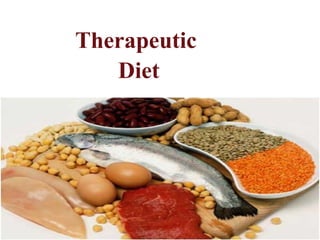
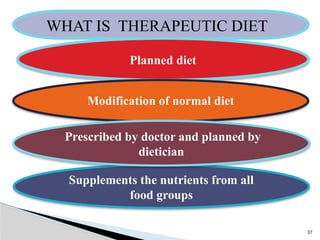
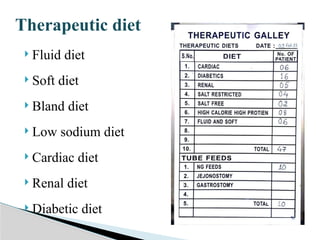
WHAT IS THERAPEUTICDIET
37
Planned diet
Modification of normal diet
Supplements the nutrients from all
food groups
Prescribed by doctor and planned by
dietician
33.
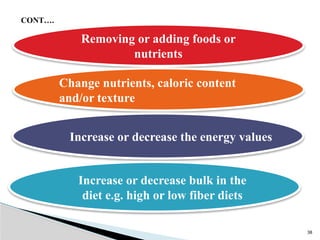
38
Removing or addingfoods or
nutrients
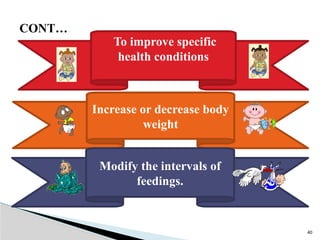
CONT….
Change nutrients, caloric content
and/or texture
Increase or decrease bulk in the
diet e.g. high or low fiber diets
Increase or decrease the energy values
34.
.
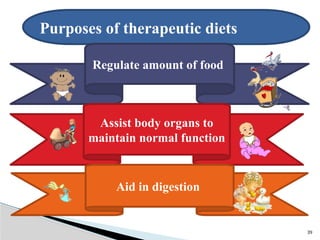
Purposes of therapeuticdiets
Regulate amount of food
Assist body organs to
maintain normal function
Aid in digestion
39
Fluid diet
Itincludes liquid foods with smooth
consistency.
It is a bridge between clear fluid diet and
soft diet.
It is easy to digest and leaves a little food
in stomach and intestines.
38.
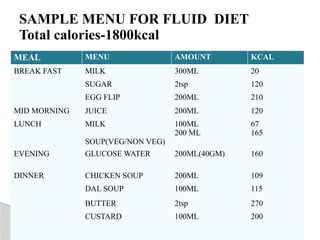
MEAL MENU AMOUNTKCAL
BREAK FAST MILK 300ML 20
SUGAR 2tsp 120
EGG FLIP 200ML 210
MID MORNING JUICE 200ML 120
LUNCH MILK
SOUP(VEG/NON VEG)
100ML
200 ML
67
165
EVENING GLUCOSE WATER 200ML(40GM) 160
DINNER CHICKEN SOUP 200ML 109
DAL SOUP 100ML 115
BUTTER 2tsp 270
CUSTARD 100ML 200
SAMPLE MENU FOR FLUID DIET
Total calories-1800kcal
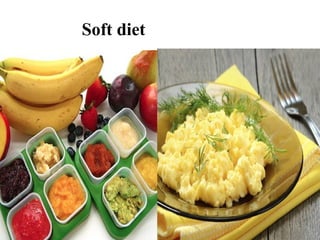
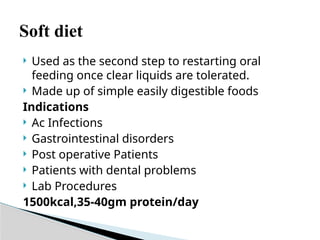
Soft diet
Usedas the second step to restarting oral
feeding once clear liquids are tolerated.
Made up of simple easily digestible foods
Indications
Ac Infections
Gastrointestinal disorders
Post operative Patients
Patients with dental problems
Lab Procedures
1500kcal,35-40gm protein/day
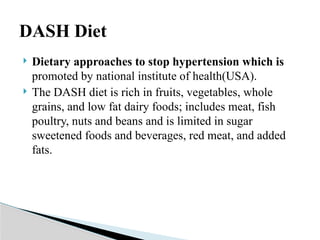
Dietary approachesto stop hypertension which is
promoted by national institute of health(USA).
The DASH diet is rich in fruits, vegetables, whole
grains, and low fat dairy foods; includes meat, fish
poultry, nuts and beans and is limited in sugar
sweetened foods and beverages, red meat, and added
fats.
DASH Diet
43.
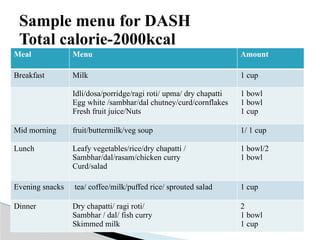
Meal Menu Amount
BreakfastMilk 1 cup
Idli/dosa/porridge/ragi roti/ upma/ dry chapatti
Egg white /sambhar/dal chutney/curd/cornflakes
Fresh fruit juice/Nuts
1 bowl
1 bowl
1 cup
Mid morning fruit/buttermilk/veg soup 1/ 1 cup
Lunch Leafy vegetables/rice/dry chapatti /
Sambhar/dal/rasam/chicken curry
Curd/salad
1 bowl/2
1 bowl
Evening snacks tea/ coffee/milk/puffed rice/ sprouted salad 1 cup
Dinner Dry chapatti/ ragi roti/
Sambhar / dal/ fish curry
Skimmed milk
2
1 bowl
1 cup
Sample menu for DASH
Total calorie-2000kcal
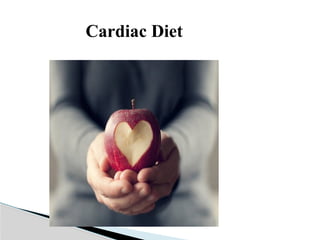
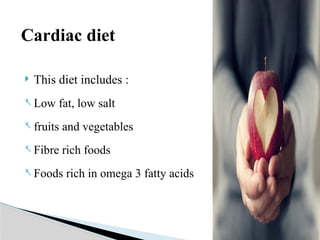
Cardiac diet
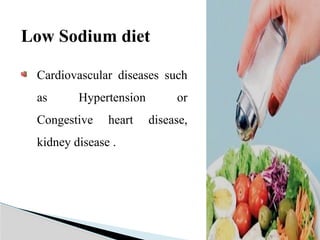
Thisdiet includes :
- Low fat, low salt
- fruits and vegetables
- Fibre rich foods
- Foods rich in omega 3 fatty acids
46.
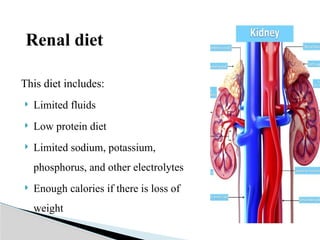
Renal diet
This dietincludes:
Limited fluids
Low protein diet
Limited sodium, potassium,
phosphorus, and other electrolytes
Enough calories if there is loss of
weight
47.
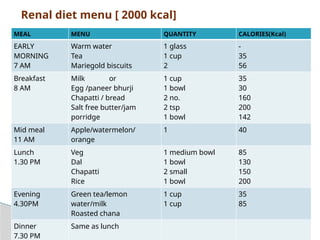
Renal diet menu[ 2000 kcal]
MEAL MENU QUANTITY CALORIES(Kcal)
EARLY
MORNING
7 AM
Warm water
Tea
Mariegold biscuits
1 glass
1 cup
2
-
35
56
Breakfast
8 AM
Milk or
Egg /paneer bhurji
Chapatti / bread
Salt free butter/jam
porridge
1 cup
1 bowl
2 no.
2 tsp
1 bowl
35
30
160
200
142
Mid meal
11 AM
Apple/watermelon/
orange
1 40
Lunch
1.30 PM
Veg
Dal
Chapatti
Rice
1 medium bowl
1 bowl
2 small
1 bowl
85
130
150
200
Evening
4.30PM
Green tea/lemon
water/milk
Roasted chana
1 cup
1 cup
35
85
Dinner
7.30 PM
Same as lunch
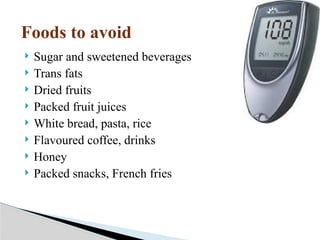
Foods to avoid
Sugar and sweetened beverages
Trans fats
Dried fruits
Packed fruit juices
White bread, pasta, rice
Flavoured coffee, drinks
Honey
Packed snacks, French fries
51.
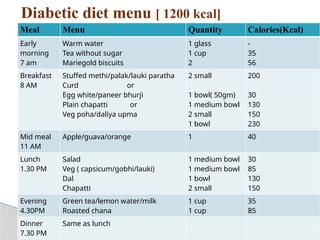
Diabetic diet menu[ 1200 kcal]
Meal Menu Quantity Calories(Kcal)
Early
morning
7 am
Warm water
Tea without sugar
Mariegold biscuits
1 glass
1 cup
2
-
35
56
Breakfast
8 AM
Stuffed methi/palak/lauki paratha
Curd or
Egg white/paneer bhurji
Plain chapatti or
Veg poha/daliya upma
2 small
1 bowl( 50gm)
1 medium bowl
2 small
1 bowl
200
30
130
150
230
Mid meal
11 AM
Apple/guava/orange 1 40
Lunch
1.30 PM
Salad
Veg ( capsicum/gobhi/lauki)
Dal
Chapatti
1 medium bowl
1 medium bowl
1 bowl
2 small
30
85
130
150
Evening
4.30PM
Green tea/lemon water/milk
Roasted chana
1 cup
1 cup
35
85
Dinner
7.30 PM
Same as lunch
52.
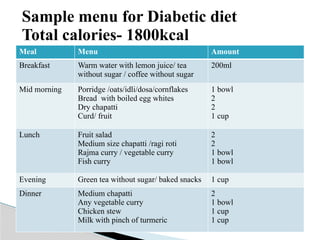
Meal Menu Amount
BreakfastWarm water with lemon juice/ tea
without sugar / coffee without sugar
200ml
Mid morning Porridge /oats/idli/dosa/cornflakes
Bread with boiled egg whites
Dry chapatti
Curd/ fruit
1 bowl
2
2
1 cup
Lunch Fruit salad
Medium size chapatti /ragi roti
Rajma curry / vegetable curry
Fish curry
2
2
1 bowl
1 bowl
Evening Green tea without sugar/ baked snacks 1 cup
Dinner Medium chapatti
Any vegetable curry
Chicken stew
Milk with pinch of turmeric
2
1 bowl
1 cup
1 cup
Sample menu for Diabetic diet
Total calories- 1800kcal
53.
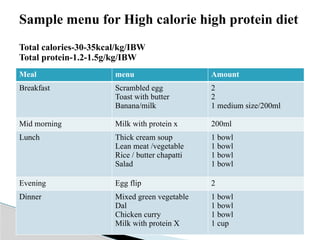
Meal menu Amount
BreakfastScrambled egg
Toast with butter
Banana/milk
2
2
1 medium size/200ml
Mid morning Milk with protein x 200ml
Lunch Thick cream soup
Lean meat /vegetable
Rice / butter chapatti
Salad
1 bowl
1 bowl
1 bowl
1 bowl
Evening Egg flip 2
Dinner Mixed green vegetable
Dal
Chicken curry
Milk with protein X
1 bowl
1 bowl
1 bowl
1 cup
Sample menu for High calorie high protein diet
Total calories-30-35kcal/kg/IBW
Total protein-1.2-1.5g/kg/IBW
54.
Conclusion
Important supportiveservice
Ensure good quality nourishing food, of right
type, in right quantity and at right time
Close monitoring by Hospital authorities
55.
Let food bethy medicine,
Thy medicine shall be thy food
56.
THANK YOU
“Yourdiet is a bank account. Good food choices are good
investments”- B Frankel
“Take care of your body. It’s the only place you have to live”
-Jim Rohn
“The doctor of the future will no longer treat the human frame
with drugs, but rather will cure and prevent disease with
nutrition” - Thomas Edison
 Most read
 Most read