THERAPEUTIC
DIETS
24-NOV-2019
1
Dr.R.KalavaThy
Adjunct Associate professor
GMU
Objectives
At the end of the session, students will be able to-
Identify the therapeutic diet
Explain about the daily requirements for each food
group
What is a therapeutic diet?
A therapeutic diet is a meal plan that controls
the intake of certain foods or nutrients. It is part
of the treatment of a medical condition and are
normally prescribed by a physician and planned
by a dietician. A therapeutic diet is usually a
modification of a regular diet.
May 9, 2022 3
What is a therapeutic diet?
It involves removing or adding some foods.
Changing nutrients/calorie content and texture
of foods
Increase or decrease the fibre in the diet
May 9, 2022 4
Purpose of therapeutic diets
Regulate the amount of food.
Assist body organs to function normally
Aid in digestion
To improve specific health conditions
Increase or decrease body weight
Modify diet patterns
These diets are useful in managing diseases, improves immunity, act
as prevention or supplemental treatment.
May 9, 2022 5
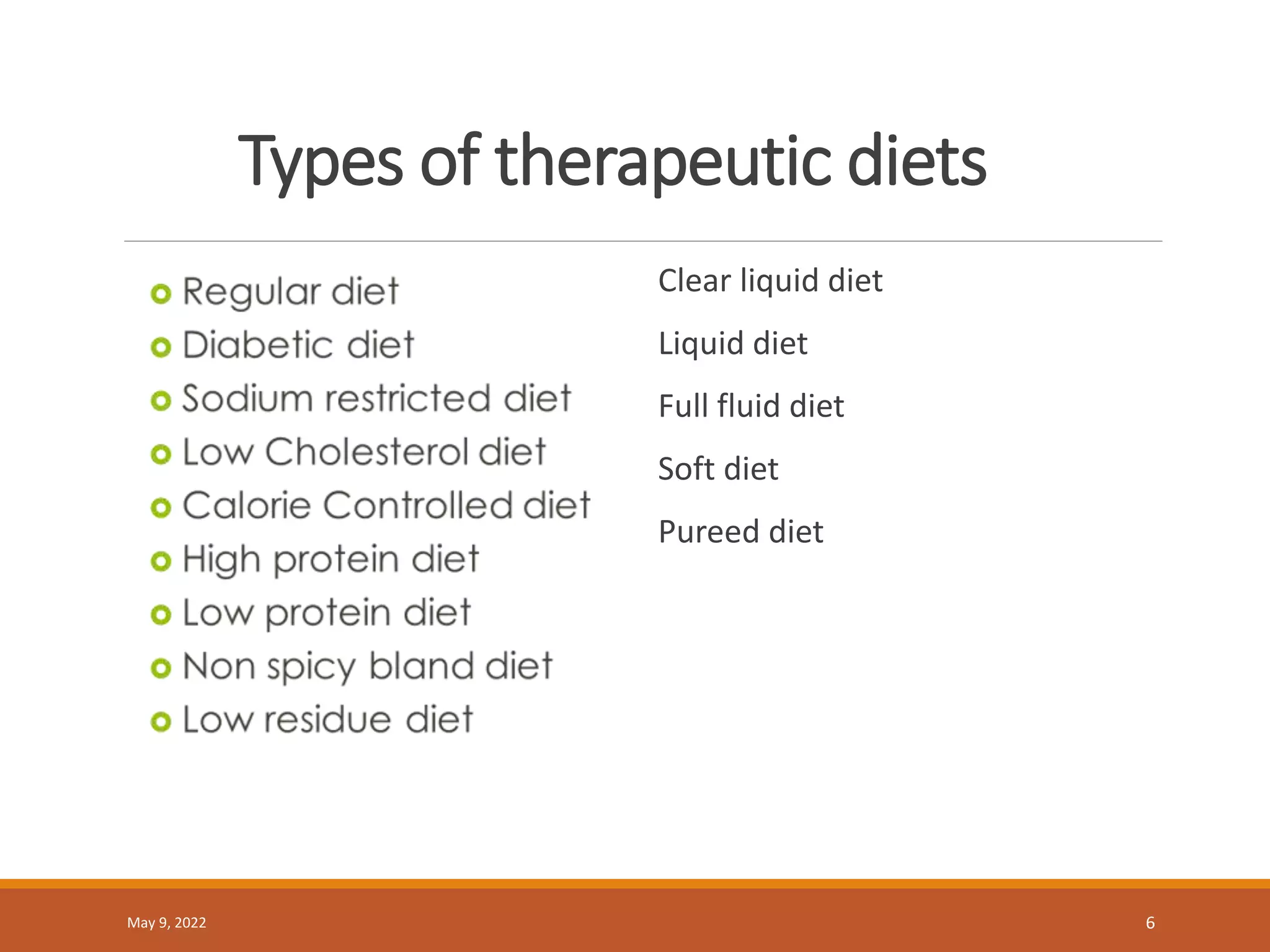
Types of therapeutic diets
Clear liquid diet
Liquid diet
Full fluid diet
Soft diet
Pureed diet
May 9, 2022 6
Regular diet: Balanced diet usually used for
ambulatory patients with no serious chronic
disorders.
Liquid diet: Nutritionally inadequate. Used for short
period of times after surgeries.
Full fluid diet: Includes liquids along with smooth
textured fluids at room temp such as custards,
eggnog, thick soups, pudding etc. Generally used for
grade 1 dysphagia, dehydration,etc.
May 9, 2022 7
Clear liquid diet: water, apple juice, plain gelatine, fat free broth, ginger
ale, tea, coffee, etc.
Soft diet: Similar to regular diet but most foods required little chewing
and be easy to digest. Avoid tough meats, shell fish, raw fruits and
vegetables, nuts, coconuts and spicy foods
Low residue diet: used for patients with digestive diseases and rectal
diseases such as colitis and diarrhoea. Eliminates or limits high bulk
foods such as raw veg, fruits, nuts, coconut, tough meats, fried foods,
beans , seeds, whole grains.
May 9, 2022 8
Diabetic diet: Diet for hyperglycaemia. Diet contains
exchange lists to match carbohydrate intake as per
pts. needs
Low calorie diet: Diet for patients with overweight.
Avoids fatty foods, sugars, high fat meats, etc.
High Calorie diet: Diet for patient’s with underweight,
anorexia, hyperthyroidism, cancer etc. Includes
calorie dense foods and avoids high bulk foods which
reduce appetite.
May 9, 2022 9
Low Cholesterol diet: Diet for pts. With
atherosclerosis and heart diseases. Diet limits foods
rich in saturated fats.
Low Sodium diet: used for patients with
cardiovascular diseases, hypertension, oedema and
renal diseases. Avoids or limits salt in food along wit
restriction on processed foods, preserved foods, fried
items, pickles and processed cheese.
May 9, 2022 10
High protein diet: Regular Diet with added protein rich foods like milk,
eggs, etc. Used for growing age groups, pregnancy and lactation, pre and
post surgery, pts. With burns, infections and fever.
Low Protein diet: Diet for patients with certain kidney diseases, allergies.
Avoids high protein foods.
Bland diet: Diet for patient’s with ulcers and other digestive diseases.
Avoids foods that irritate GI tracts. Avoid coarse foods, highly seasoned
foods, tea, coffee, oily foods, spicy foods, salted meats and fish
May 9, 2022 11
ROLE OF NURSE IN NUTRITIONAL
CARE
Coordinator
Communicator
Counselor
Teacher
Motivator
May 9, 2022 12
THE ROLE OF THE NURSE IN IMPLEMENTATION OF
THERAPEUTIC NUTRITION
May 9, 2022 13
1. Reinforce the importance of therapeutic
diet.
2. Identify and communicate needed changes
in the patient’s diet.
3. Identify and implement changes in method
of feeding & time of feeding.
4. Reinforce the meal plan with the patient
and the patient's family.
The role of the nurse in implementation of
therapeutic nutrition
May 9, 2022 14
5. Encourage the patient to depend on
himself (the restorative approach).
6. Encourage the patient to eat, provide
adaptive equipment, and right
atmosphere.
7. Make sure that all health care
professionals are consulted with respect
to diet plan and implementation.
NUTRITION IN
CARDIO VASCULAR DISEASES
May 9, 2022 15
Objectives of dietary management
To relieve strain to the heart
To prevent further damage to the heart
To restore the damaged heart
May 9, 2022 16
Recommended foods
Skimmed milk
Cottage cheese
Whole grains
Fruits and vegetables
High fiber and soluble fibers like pectin and gum
Lean meat, egg whites, fish
Honey, jaggery
May 9, 2022 17
Foods to be Avoided/ to limit
Cholesterol rich foods
Whole cream, butter, cream cheese
Heavy sweets, bakery products
Organ meat
Fried foods
Alcohol
High sodium processed foods
High fat convenience meals
May 9, 2022 18
Prevention and Treatment of CVD
HTN: DASH Diet
Individuals should adopt the Dietary Approaches to Stop
Hypertension (DASH) dietary pattern which is rich in
fruits, vegetables, low-fat dairy, and nuts; low in
sodium, total fat, and saturated fat; and adequate in
calories for weight management. The DASH dietary
pattern reduces systolic blood pressure by 8-14 mmHg.
DASH: Major Food Groups
Fruit: Melons, bananas, papaya,
prunes, oranges (Mg, K), fortified
juices (Ca), fiber
4-5 servings per day
Vegetables: broccoli (vit A), Soy
(Ca, K), beets, mushrooms,
potatoes (B6), green
leafy/spinach (vit A, Mg, Ca),
tomatoes, (K, Mg) (fiber)
4-5 Servings per day
NUTRITION MANAGEMENT
IN
DIABETES
May 9, 2022 21
Objectives of dietary management
To improve glycemic control
To prevent diabetes related complications such as retinopathy,
nephropathy
To improve nutritional quality of life and reduce morbidity and
mortality
May 9, 2022 22
Nutrition Intervention options for Diabetes
Reduce energy and fat intake
Carbohydrate counting
Simplified meal plans
Healthy food choices
Individualized meal planning strategies
Exchange lists
Insulin-to-carbohydrate ratios
Physical activity and behavioral strategies
Prevention and Treatment of CVD & Diabetes
Recommendations:
Very High Triglycerides (>500)
◦ Very low-fat diet less than or equal to15% fat),
◦ Weight management
◦ Physical activity
◦ Alcohol restriction
Elevated Triglycerides (≥ 150) and Macronutrients
◦ Calorie controlled
◦ Complex Carbohydrates
◦ Limit refined sugar
◦ Limit Alcohol
◦ Weight loss of 7 to 10% of body weight
◦ Physical Activity
CHOLESTEROL PROFILE
IMPROVEMENT STRATEGY
Foods to increase
1 bowl of oat bran at breakfast with oatmeal. (Note that Psyllium also
decreases total cholesterol)
Fresh vegetables, avocados (rich in good fat), artichokes, lentils and beans,
chick peas (high in isoflavones), rice bran, citrus fruits, strawberries, apples
(rich in pectin) and apple pulp (rich in soluble fiber)
Mulberries, raspberries (rich in resveratrol)
Almonds, pecans, walnuts, hazelnuts, macadamia, pistachios, peanuts.
Almonds can reduce the ratio LDL to HDL up to 12% after 4 weeks (Journal
of the American Heart Association). Eat them natural or “dry roasted”
without added oils or salts. Most of their fat is polyunsaturated or mono-
unsaturated.
Glycemic Index
• A scale that ranks carbohydrates by how much they raise blood
glucose levels compared to a reference food.
1. Low 0 – 55
2. Moderate 56 – 69
3. High 70 or more
Pictures of Low/High GI Meals & Snacks
GI = 60 GL = 48 GI = 42 GL = 31
Pictures of Low/High GI Meals & Snacks
GI = 85 GL = 48 GI = 39 GL = 22
NUTRITION ACTION PLAN FOR CVD & DM
1. Eat meat sparingly
2. Add fish to your diet
3. Eat fruits and vegetables
4. Go for nuts
5. Increase complex carbohydrates and fiber
6. Opt for low-fat dairy products
7. Cut down on saturated fat in cooking
8. Avoid palm and coconut oils
9. Avoid trans fats
10. Reduce dietary cholesterol
11. Reduce salt and sugar intake
12. Watch the snacks
13. Drink alcohol only in moderation
14. Read labels carefully
References
1. Mann J, Truswell S, editors. Essentials of human nutrition.
5th ed. London, England: Oxford University Press; 2017.
Chapter - 43, pp – 670-678
2. Bender DA. Introduction to nutrition and metabolism,
fourth edition. 4th ed. Boca Raton, FL: CRC Press; 2007.
Chapter - 6, pp- 178-186
THANK YOU
May 9, 2022 31

L12-Therapeutic diets (1).pptx

  • 1.
  • 2.
    Objectives At the endof the session, students will be able to- Identify the therapeutic diet Explain about the daily requirements for each food group
  • 3.
    What is atherapeutic diet? A therapeutic diet is a meal plan that controls the intake of certain foods or nutrients. It is part of the treatment of a medical condition and are normally prescribed by a physician and planned by a dietician. A therapeutic diet is usually a modification of a regular diet. May 9, 2022 3
  • 4.
    What is atherapeutic diet? It involves removing or adding some foods. Changing nutrients/calorie content and texture of foods Increase or decrease the fibre in the diet May 9, 2022 4
  • 5.
    Purpose of therapeuticdiets Regulate the amount of food. Assist body organs to function normally Aid in digestion To improve specific health conditions Increase or decrease body weight Modify diet patterns These diets are useful in managing diseases, improves immunity, act as prevention or supplemental treatment. May 9, 2022 5
  • 6.
    Types of therapeuticdiets Clear liquid diet Liquid diet Full fluid diet Soft diet Pureed diet May 9, 2022 6
  • 7.
    Regular diet: Balanceddiet usually used for ambulatory patients with no serious chronic disorders. Liquid diet: Nutritionally inadequate. Used for short period of times after surgeries. Full fluid diet: Includes liquids along with smooth textured fluids at room temp such as custards, eggnog, thick soups, pudding etc. Generally used for grade 1 dysphagia, dehydration,etc. May 9, 2022 7
  • 8.
    Clear liquid diet:water, apple juice, plain gelatine, fat free broth, ginger ale, tea, coffee, etc. Soft diet: Similar to regular diet but most foods required little chewing and be easy to digest. Avoid tough meats, shell fish, raw fruits and vegetables, nuts, coconuts and spicy foods Low residue diet: used for patients with digestive diseases and rectal diseases such as colitis and diarrhoea. Eliminates or limits high bulk foods such as raw veg, fruits, nuts, coconut, tough meats, fried foods, beans , seeds, whole grains. May 9, 2022 8
  • 9.
    Diabetic diet: Dietfor hyperglycaemia. Diet contains exchange lists to match carbohydrate intake as per pts. needs Low calorie diet: Diet for patients with overweight. Avoids fatty foods, sugars, high fat meats, etc. High Calorie diet: Diet for patient’s with underweight, anorexia, hyperthyroidism, cancer etc. Includes calorie dense foods and avoids high bulk foods which reduce appetite. May 9, 2022 9
  • 10.
    Low Cholesterol diet:Diet for pts. With atherosclerosis and heart diseases. Diet limits foods rich in saturated fats. Low Sodium diet: used for patients with cardiovascular diseases, hypertension, oedema and renal diseases. Avoids or limits salt in food along wit restriction on processed foods, preserved foods, fried items, pickles and processed cheese. May 9, 2022 10
  • 11.
    High protein diet:Regular Diet with added protein rich foods like milk, eggs, etc. Used for growing age groups, pregnancy and lactation, pre and post surgery, pts. With burns, infections and fever. Low Protein diet: Diet for patients with certain kidney diseases, allergies. Avoids high protein foods. Bland diet: Diet for patient’s with ulcers and other digestive diseases. Avoids foods that irritate GI tracts. Avoid coarse foods, highly seasoned foods, tea, coffee, oily foods, spicy foods, salted meats and fish May 9, 2022 11
  • 12.
    ROLE OF NURSEIN NUTRITIONAL CARE Coordinator Communicator Counselor Teacher Motivator May 9, 2022 12
  • 13.
    THE ROLE OFTHE NURSE IN IMPLEMENTATION OF THERAPEUTIC NUTRITION May 9, 2022 13 1. Reinforce the importance of therapeutic diet. 2. Identify and communicate needed changes in the patient’s diet. 3. Identify and implement changes in method of feeding & time of feeding. 4. Reinforce the meal plan with the patient and the patient's family.
  • 14.
    The role ofthe nurse in implementation of therapeutic nutrition May 9, 2022 14 5. Encourage the patient to depend on himself (the restorative approach). 6. Encourage the patient to eat, provide adaptive equipment, and right atmosphere. 7. Make sure that all health care professionals are consulted with respect to diet plan and implementation.
  • 15.
    NUTRITION IN CARDIO VASCULARDISEASES May 9, 2022 15
  • 16.
    Objectives of dietarymanagement To relieve strain to the heart To prevent further damage to the heart To restore the damaged heart May 9, 2022 16
  • 17.
    Recommended foods Skimmed milk Cottagecheese Whole grains Fruits and vegetables High fiber and soluble fibers like pectin and gum Lean meat, egg whites, fish Honey, jaggery May 9, 2022 17
  • 18.
    Foods to beAvoided/ to limit Cholesterol rich foods Whole cream, butter, cream cheese Heavy sweets, bakery products Organ meat Fried foods Alcohol High sodium processed foods High fat convenience meals May 9, 2022 18
  • 19.
    Prevention and Treatmentof CVD HTN: DASH Diet Individuals should adopt the Dietary Approaches to Stop Hypertension (DASH) dietary pattern which is rich in fruits, vegetables, low-fat dairy, and nuts; low in sodium, total fat, and saturated fat; and adequate in calories for weight management. The DASH dietary pattern reduces systolic blood pressure by 8-14 mmHg.
  • 20.
    DASH: Major FoodGroups Fruit: Melons, bananas, papaya, prunes, oranges (Mg, K), fortified juices (Ca), fiber 4-5 servings per day Vegetables: broccoli (vit A), Soy (Ca, K), beets, mushrooms, potatoes (B6), green leafy/spinach (vit A, Mg, Ca), tomatoes, (K, Mg) (fiber) 4-5 Servings per day
  • 21.
  • 22.
    Objectives of dietarymanagement To improve glycemic control To prevent diabetes related complications such as retinopathy, nephropathy To improve nutritional quality of life and reduce morbidity and mortality May 9, 2022 22
  • 23.
    Nutrition Intervention optionsfor Diabetes Reduce energy and fat intake Carbohydrate counting Simplified meal plans Healthy food choices Individualized meal planning strategies Exchange lists Insulin-to-carbohydrate ratios Physical activity and behavioral strategies
  • 24.
    Prevention and Treatmentof CVD & Diabetes Recommendations: Very High Triglycerides (>500) ◦ Very low-fat diet less than or equal to15% fat), ◦ Weight management ◦ Physical activity ◦ Alcohol restriction Elevated Triglycerides (≥ 150) and Macronutrients ◦ Calorie controlled ◦ Complex Carbohydrates ◦ Limit refined sugar ◦ Limit Alcohol ◦ Weight loss of 7 to 10% of body weight ◦ Physical Activity
  • 25.
    CHOLESTEROL PROFILE IMPROVEMENT STRATEGY Foodsto increase 1 bowl of oat bran at breakfast with oatmeal. (Note that Psyllium also decreases total cholesterol) Fresh vegetables, avocados (rich in good fat), artichokes, lentils and beans, chick peas (high in isoflavones), rice bran, citrus fruits, strawberries, apples (rich in pectin) and apple pulp (rich in soluble fiber) Mulberries, raspberries (rich in resveratrol) Almonds, pecans, walnuts, hazelnuts, macadamia, pistachios, peanuts. Almonds can reduce the ratio LDL to HDL up to 12% after 4 weeks (Journal of the American Heart Association). Eat them natural or “dry roasted” without added oils or salts. Most of their fat is polyunsaturated or mono- unsaturated.
  • 26.
    Glycemic Index • Ascale that ranks carbohydrates by how much they raise blood glucose levels compared to a reference food. 1. Low 0 – 55 2. Moderate 56 – 69 3. High 70 or more
  • 27.
    Pictures of Low/HighGI Meals & Snacks GI = 60 GL = 48 GI = 42 GL = 31
  • 28.
    Pictures of Low/HighGI Meals & Snacks GI = 85 GL = 48 GI = 39 GL = 22
  • 29.
    NUTRITION ACTION PLANFOR CVD & DM 1. Eat meat sparingly 2. Add fish to your diet 3. Eat fruits and vegetables 4. Go for nuts 5. Increase complex carbohydrates and fiber 6. Opt for low-fat dairy products 7. Cut down on saturated fat in cooking 8. Avoid palm and coconut oils 9. Avoid trans fats 10. Reduce dietary cholesterol 11. Reduce salt and sugar intake 12. Watch the snacks 13. Drink alcohol only in moderation 14. Read labels carefully
  • 30.
    References 1. Mann J,Truswell S, editors. Essentials of human nutrition. 5th ed. London, England: Oxford University Press; 2017. Chapter - 43, pp – 670-678 2. Bender DA. Introduction to nutrition and metabolism, fourth edition. 4th ed. Boca Raton, FL: CRC Press; 2007. Chapter - 6, pp- 178-186
  • 31.