
Assignment Topic : Catering Services
 Group Members of EPGDHA Batch 2013-2014
1. Dr. Susan Fernandes
2. Dr. Allan Pereira
3. Dr. Sreya Joseph
4. Mrs. Elizabeth David
5. Ms. Diana Vincent
6. Mr. Tapan Doshi
7. Mr. Sameer Shinde
Hospital Catering Services
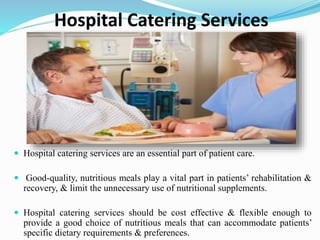
 Hospital catering services are an essential part of patient care.
 Good-quality, nutritious meals play a vital part in patients’ rehabilitation &
recovery, & limit the unnecessary use of nutritional supplements.
 Hospital catering services should be cost effective & flexible enough to
provide a good choice of nutritious meals that can accommodate patients’
specific dietary requirements & preferences.
Core Objectives of Catering Department
1. Control catering budget & contract: food, beverages & snacks
2. Choose & order ingredients .
3. Develop Recipes, menu’s taking into consideration dietetic advice,
patients age, culture, religion & medical condition.
4. Prepare food to Quality approved standards
5. Deliver food to wards, patients & staff restaurants
6. Serve food to patients at ward level (Nurses/ Hostesses)
7. Provide snacks
8. Maintain & supervise food hygiene at all times.
9. Consider development of patient restaurants or other novel food
delivery / outlets.
10. Control cost & monitor waste
11. Audit &develop service delivery
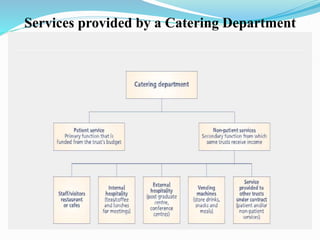
Services provided by a Catering Department
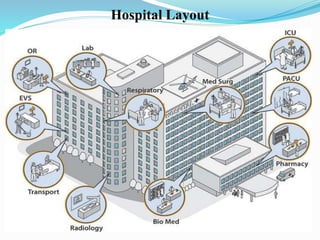
Hospital Layout
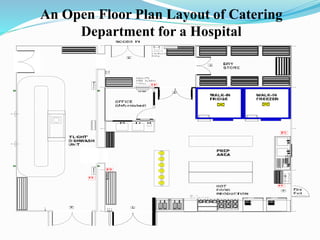
An Open Floor Plan Layout of Catering
Department for a Hospital
Location & Size
 The Catering Service Department should ideally be in the
ground floor
 Away from normal traffic flow.
 Access to trolleys & lorries coming to unload regular
supplies.
 The area requirement for the kitchen varies as per the type &
size of the hospital.
1. Upto 200beds = 20sqft/bed
2. 200- 400 beds = 16sqft/bed
3. 500 & above = 15sqft/bed
Additional Physical Facilities
Physical facilities can be divided into two components:
 Peripheral component
1. Collection of diet demand
2. Distribution of diet
 Central component
1. Administrative area
2. Cooking area
3. Preparation area
4. Service area
5. Receiving area
6. Dry Ration storage
7. Cold rooms for perishable food items
8. Garbage collection area
9. Toilets
10. Washing Area
a. Dish Washing area
b. Trolley Washing area
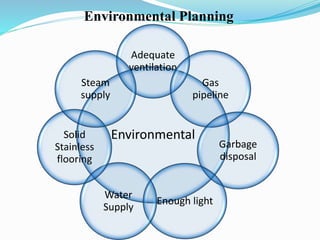
Environmental
Adequate
ventilation
Gas
pipeline
Garbage
disposal
Enough light
Water
Supply
Solid
Stainless
flooring
Steam
supply
Environmental Planning
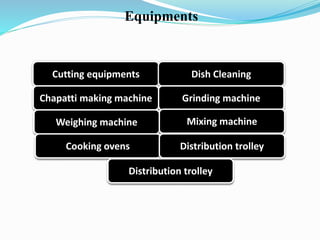
Cutting equipments Dish Cleaning
Chapatti making machine Grinding machine
Weighing machine Mixing machine
Cooking ovens Distribution trolley
Distribution trolley
Equipments
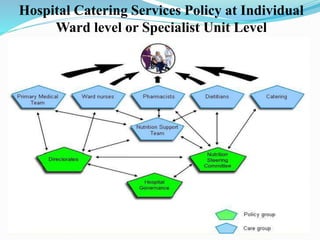
Hospital Catering Services Policy at Individual
Ward level or Specialist Unit Level
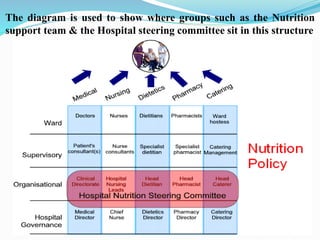
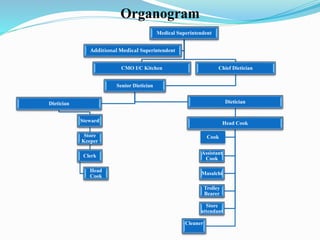
The diagram is used to show where groups such as the Nutrition
support team & the Hospital steering committee sit in this structure
Organogram
Medical Superintendent
CMO I/C Kitchen Chief Dietician
Senior Dietician
Dietician
Steward
Store
Keeper
Clerk
Head
Cook
Dietician
Head Cook
Assistant
Cook
Masalchi
Trolley
Bearer
Store
attendant
Cleaner
Cook
Additional Medical Superintendent
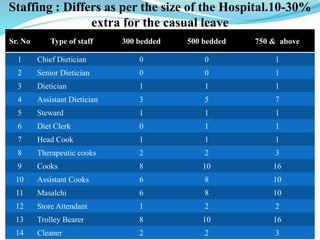
Staffing : Differs as per the size of the Hospital.10-30%
extra for the casual leave
Sr. No Type of staff 300 bedded 500 bedded 750 & above
1 Chief Dietician 0 0 1
2 Senior Dietician 0 0 1
3 Dietician 1 1 1
4 Assistant Dietician 3 5 7
5 Steward 1 1 1
6 Diet Clerk 0 1 1
7 Head Cook 1 1 1
8 Therapeutic cooks 2 2 3
9 Cooks 8 10 16
10 Assistant Cooks 6 8 10
11 Masalchi 6 8 10
12 Store Attendant 1 2 2
13 Trolley Bearer 8 10 16
14 Cleaner 2 2 3
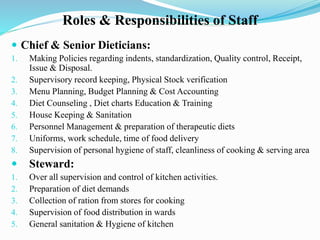
Roles & Responsibilities of Staff
 Chief & Senior Dieticians:
1. Making Policies regarding indents, standardization, Quality control, Receipt,
Issue & Disposal.
2. Supervisory record keeping, Physical Stock verification
3. Menu Planning, Budget Planning & Cost Accounting
4. Diet Counseling , Diet charts Education & Training
5. House Keeping & Sanitation
6. Personnel Management & preparation of therapeutic diets
7. Uniforms, work schedule, time of food delivery
8. Supervision of personal hygiene of staff, cleanliness of cooking & serving area
 Steward:
1. Over all supervision and control of kitchen activities.
2. Preparation of diet demands
3. Collection of ration from stores for cooking
4. Supervision of food distribution in wards
5. General sanitation & Hygiene of kitchen
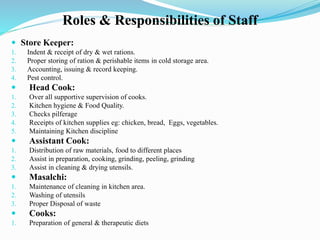
Roles & Responsibilities of Staff
 Store Keeper:
1. Indent & receipt of dry & wet rations.
2. Proper storing of ration & perishable items in cold storage area.
3. Accounting, issuing & record keeping.
4. Pest control.
 Head Cook:
1. Over all supportive supervision of cooks.
2. Kitchen hygiene & Food Quality.
3. Checks pilferage
4. Receipts of kitchen supplies eg: chicken, bread, Eggs, vegetables.
5. Maintaining Kitchen discipline
 Assistant Cook:
1. Distribution of raw materials, food to different places
2. Assist in preparation, cooking, grinding, peeling, grinding
3. Assist in cleaning & drying utensils.
 Masalchi:
1. Maintenance of cleaning in kitchen area.
2. Washing of utensils
3. Proper Disposal of waste
 Cooks:
1. Preparation of general & therapeutic diets
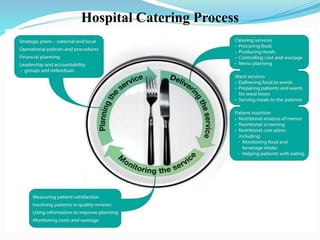
Hospital Catering Process
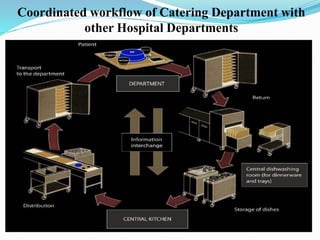
Coordinated workflow of Catering Department with
other Hospital Departments
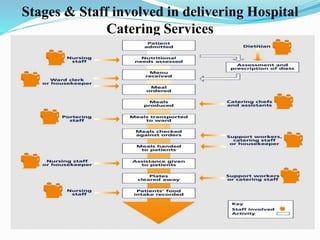
Stages & Staff involved in delivering Hospital
Catering Services
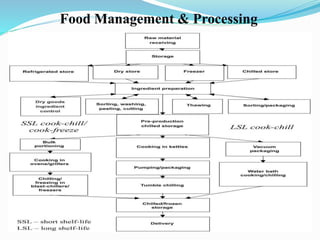
Food Management & Processing
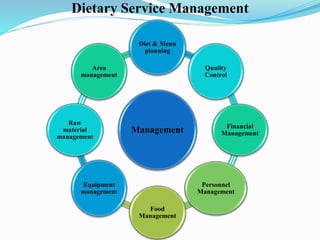
Dietary Service Management
Management
Diet & Menu
planning
Quality
Control
Financial
Management
Personnel
Management
Food
Management
Equipment
management
Raw
material
management
Area
management
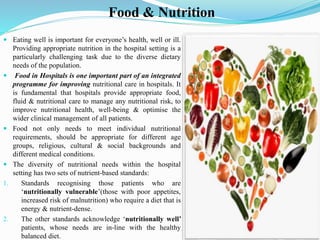
Food & Nutrition
 Eating well is important for everyone’s health, well or ill.
Providing appropriate nutrition in the hospital setting is a
particularly challenging task due to the diverse dietary
needs of the population.
 Food in Hospitals is one important part of an integrated
programme for improving nutritional care in hospitals. It
is fundamental that hospitals provide appropriate food,
fluid & nutritional care to manage any nutritional risk, to
improve nutritional health, well-being & optimise the
wider clinical management of all patients.
 Food not only needs to meet individual nutritional
requirements, should be appropriate for different age
groups, religious, cultural & social backgrounds and
different medical conditions.
 The diversity of nutritional needs within the hospital
setting has two sets of nutrient-based standards:
1. Standards recognising those patients who are
‘nutritionally vulnerable’(those with poor appetites,
increased risk of malnutrition) who require a diet that is
energy & nutrient-dense.
2. The other standards acknowledge ‘nutritionally well’
patients, whose needs are in-line with the healthy
balanced diet.
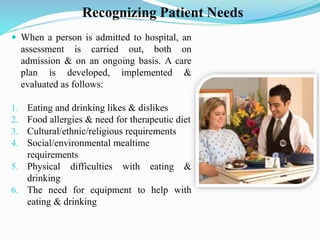
Recognizing Patient Needs
 When a person is admitted to hospital, an
assessment is carried out, both on
admission & on an ongoing basis. A care
plan is developed, implemented &
evaluated as follows:
1. Eating and drinking likes & dislikes
2. Food allergies & need for therapeutic diet
3. Cultural/ethnic/religious requirements
4. Social/environmental mealtime
requirements
5. Physical difficulties with eating &
drinking
6. The need for equipment to help with
eating & drinking
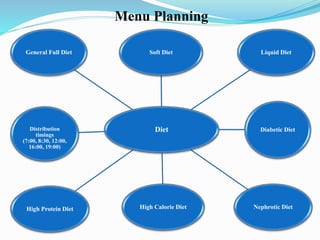
Menu Planning
Diet
Soft Diet
Diabetic Diet
Liquid Diet
Nephrotic DietHigh Calorie DietHigh Protein Diet
Distribution
timings
(7:00, 8:30, 12:00,
16:00, 19:00)
General Full Diet
Menu Planning
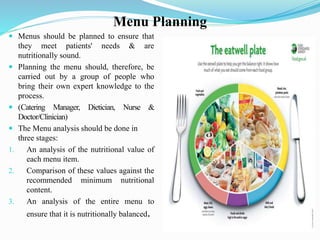
 Menus should be planned to ensure that
they meet patients' needs & are
nutritionally sound.
 Planning the menu should, therefore, be
carried out by a group of people who
bring their own expert knowledge to the
process.
 (Catering Manager, Dietician, Nurse &
Doctor/Clinician)
 The Menu analysis should be done in
three stages:
1. An analysis of the nutritional value of
each menu item.
2. Comparison of these values against the
recommended minimum nutritional
content.
3. An analysis of the entire menu to
ensure that it is nutritionally balanced.
Material Management
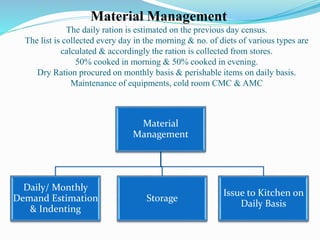
The daily ration is estimated on the previous day census.
The list is collected every day in the morning & no. of diets of various types are
calculated & accordingly the ration is collected from stores.
50% cooked in morning & 50% cooked in evening.
Dry Ration procured on monthly basis & perishable items on daily basis.
Maintenance of equipments, cold room CMC & AMC
Material
Management
Daily/ Monthly
Demand Estimation
& Indenting
Storage
Issue to Kitchen on
Daily Basis
Costing of Catering Services
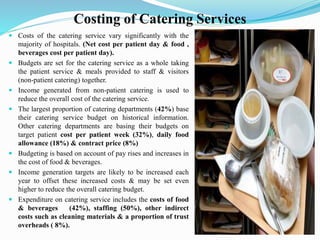
 Costs of the catering service vary significantly with the
majority of hospitals. (Net cost per patient day & food ,
beverages cost per patient day).
 Budgets are set for the catering service as a whole taking
the patient service & meals provided to staff & visitors
(non-patient catering) together.
 Income generated from non-patient catering is used to
reduce the overall cost of the catering service.
 The largest proportion of catering departments (42%) base
their catering service budget on historical information.
Other catering departments are basing their budgets on
target patient cost per patient week (32%), daily food
allowance (18%) & contract price (8%)
 Budgeting is based on account of pay rises and increases in
the cost of food & beverages.
 Income generation targets are likely to be increased each
year to offset these increased costs & may be set even
higher to reduce the overall catering budget.
 Expenditure on catering service includes the costs of food
& beverages (42%), staffing (50%), other indirect
costs such as cleaning materials & a proportion of trust
overheads ( 8%).
Food Wastage
 The levels of food wastage affects the cost of a catering
service.
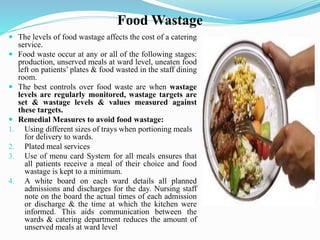
 Food waste occur at any or all of the following stages:
production, unserved meals at ward level, uneaten food
left on patients’ plates & food wasted in the staff dining
room.
 The best controls over food waste are when wastage
levels are regularly monitored, wastage targets are
set & wastage levels & values measured against
these targets.
 Remedial Measures to avoid food wastage:
1. Using different sizes of trays when portioning meals
for delivery to wards.
2. Plated meal services
3. Use of menu card System for all meals ensures that
all patients receive a meal of their choice and food
wastage is kept to a minimum.
4. A white board on each ward details all planned
admissions and discharges for the day. Nursing staff
note on the board the actual times of each admission
or discharge & the time at which the kitchen were
informed. This aids communication between the
wards & catering department reduces the amount of
unserved meals at ward level
Food Safety & Hygiene is Everybody’s
Business
The provision of safe & nutritious food in hospitals for patients & staff is a major
undertaking based on points listed below:
1. A food safety control system in place with specific guidelines & policies in placed.
2. Food is prepared & served in accordance with recognised food safety procedures &
legislation
3. Combination of Good Management Team.
4. Staff trained in safe hygiene practices & catering skills,
5. Appropriate Quality Controls
6. Monitoring of Food quality temperature failures at the point of serving meals to
patients.
7. Using microwaves at ward level
8. Schedule of cleaning of kitchen area & implementing pest control program.
9. Health checkup of staff & vaccination status at time of recruitment & periodically.
10. Periodical inspection & auditing of the catering department
Challenges & Remedial Measures in Managing
Catering Services
 Challenges faced by management
1. Sickness absence,
2. Staff turnover rate
3. Staff vacancy rates
 Remedial Measures to overcome the
challenges:
1. Incorporate career development opportunities
or
2. Boost employee morale & motivation by
awarding a bonus depending on the
department’s performance & sickness absence
of the individual, against the prior year’s
budget.
3. Hospital management should monitor staff
vacancy & turnover rates on a regular basis
4. Survey to be conducted to analyze pay rates
offered by local competitors, the nature of the
work, the location of the hospital & incentives
offered to staff for retention policy.
Performance Indicators
 Various Indicators used for Evaluation:
1. No. of Complaints on Food Received
2. No .of Cases of Food Poisoning
3. Instances of False Diet Distribution
4. Non Serving/ Inadequate Serving Complaints
5. Wastages & Pilferage Incidences
6. Pest & Rodents
7. Feedback Proforma
8. Interview at the time of Discharge
Conclusion
.....Cost is not always a barrier to higher quality.
 To improve the quality of the catering service to patients'
nutritional needs are to be identified & fulfilled, timeliness of
meals, provide dietary assistance.
 More effective communication between the catering
department & other staff involved in the catering chain will be
crucial in raising & then maintaining the quality of service
delivered.
 Continual improvement, patient satisfaction must be closely
monitored.
 Audit Mechanism to be incorporated to keep a check on food
quality & services provided.
References
Research Articles
 AUDIT COMMISSION (2001) Acute hospital portfolio: Review of national findings, Wetherby: Audit Commission
Publications.
 Review Article on Catering for Patients prepared for the Auditor General of Scotland ,November 2003.
 Food in Hospitals National Catering and Nutrition Specification for Food and Fluid Provision in Hospitals in
Scotland published by the Scottish Government, June, 2008
 Food service in hospital: development of a theoretical model for patient experience and satisfaction using one
hospital in the UK NHS as a case study. H.J. Hartwell, J.S.A. Edwards and C. Symonds.
 Managing Food Waste in NHS copyright 2005
 Hospital Catering and Patient Nutrition: Report presented by the Auditor General for Wales to the National
Assembly for Wales on 24 March 2011
 Organization of food & nutritional support in hospitals: Bapen Advancing Clinical Nutrition.
 Patients’ nutritional care in hospital: An ethnographic study of nurses’ role and patients’ experience, Final report
May 2005
Websites
 www.google.com
 www.slideshare.net
Catering Services in a Hospital

Catering Services in a Hospital

  • 1.
    Assignment Topic :Catering Services  Group Members of EPGDHA Batch 2013-2014 1. Dr. Susan Fernandes 2. Dr. Allan Pereira 3. Dr. Sreya Joseph 4. Mrs. Elizabeth David 5. Ms. Diana Vincent 6. Mr. Tapan Doshi 7. Mr. Sameer Shinde
  • 2.
    Hospital Catering Services Hospital catering services are an essential part of patient care.  Good-quality, nutritious meals play a vital part in patients’ rehabilitation & recovery, & limit the unnecessary use of nutritional supplements.  Hospital catering services should be cost effective & flexible enough to provide a good choice of nutritious meals that can accommodate patients’ specific dietary requirements & preferences.
  • 3.
    Core Objectives ofCatering Department 1. Control catering budget & contract: food, beverages & snacks 2. Choose & order ingredients . 3. Develop Recipes, menu’s taking into consideration dietetic advice, patients age, culture, religion & medical condition. 4. Prepare food to Quality approved standards 5. Deliver food to wards, patients & staff restaurants 6. Serve food to patients at ward level (Nurses/ Hostesses) 7. Provide snacks 8. Maintain & supervise food hygiene at all times. 9. Consider development of patient restaurants or other novel food delivery / outlets. 10. Control cost & monitor waste 11. Audit &develop service delivery
  • 4.
    Services provided bya Catering Department
  • 5.
  • 6.
    An Open FloorPlan Layout of Catering Department for a Hospital
  • 7.
    Location & Size The Catering Service Department should ideally be in the ground floor  Away from normal traffic flow.  Access to trolleys & lorries coming to unload regular supplies.  The area requirement for the kitchen varies as per the type & size of the hospital. 1. Upto 200beds = 20sqft/bed 2. 200- 400 beds = 16sqft/bed 3. 500 & above = 15sqft/bed
  • 8.
    Additional Physical Facilities Physicalfacilities can be divided into two components:  Peripheral component 1. Collection of diet demand 2. Distribution of diet  Central component 1. Administrative area 2. Cooking area 3. Preparation area 4. Service area 5. Receiving area 6. Dry Ration storage 7. Cold rooms for perishable food items 8. Garbage collection area 9. Toilets 10. Washing Area a. Dish Washing area b. Trolley Washing area
  • 9.
  • 10.
    Cutting equipments DishCleaning Chapatti making machine Grinding machine Weighing machine Mixing machine Cooking ovens Distribution trolley Distribution trolley Equipments
  • 11.
    Hospital Catering ServicesPolicy at Individual Ward level or Specialist Unit Level
  • 12.
    The diagram isused to show where groups such as the Nutrition support team & the Hospital steering committee sit in this structure
  • 13.
    Organogram Medical Superintendent CMO I/CKitchen Chief Dietician Senior Dietician Dietician Steward Store Keeper Clerk Head Cook Dietician Head Cook Assistant Cook Masalchi Trolley Bearer Store attendant Cleaner Cook Additional Medical Superintendent
  • 14.
    Staffing : Differsas per the size of the Hospital.10-30% extra for the casual leave Sr. No Type of staff 300 bedded 500 bedded 750 & above 1 Chief Dietician 0 0 1 2 Senior Dietician 0 0 1 3 Dietician 1 1 1 4 Assistant Dietician 3 5 7 5 Steward 1 1 1 6 Diet Clerk 0 1 1 7 Head Cook 1 1 1 8 Therapeutic cooks 2 2 3 9 Cooks 8 10 16 10 Assistant Cooks 6 8 10 11 Masalchi 6 8 10 12 Store Attendant 1 2 2 13 Trolley Bearer 8 10 16 14 Cleaner 2 2 3
  • 15.
    Roles & Responsibilitiesof Staff  Chief & Senior Dieticians: 1. Making Policies regarding indents, standardization, Quality control, Receipt, Issue & Disposal. 2. Supervisory record keeping, Physical Stock verification 3. Menu Planning, Budget Planning & Cost Accounting 4. Diet Counseling , Diet charts Education & Training 5. House Keeping & Sanitation 6. Personnel Management & preparation of therapeutic diets 7. Uniforms, work schedule, time of food delivery 8. Supervision of personal hygiene of staff, cleanliness of cooking & serving area  Steward: 1. Over all supervision and control of kitchen activities. 2. Preparation of diet demands 3. Collection of ration from stores for cooking 4. Supervision of food distribution in wards 5. General sanitation & Hygiene of kitchen
  • 16.
    Roles & Responsibilitiesof Staff  Store Keeper: 1. Indent & receipt of dry & wet rations. 2. Proper storing of ration & perishable items in cold storage area. 3. Accounting, issuing & record keeping. 4. Pest control.  Head Cook: 1. Over all supportive supervision of cooks. 2. Kitchen hygiene & Food Quality. 3. Checks pilferage 4. Receipts of kitchen supplies eg: chicken, bread, Eggs, vegetables. 5. Maintaining Kitchen discipline  Assistant Cook: 1. Distribution of raw materials, food to different places 2. Assist in preparation, cooking, grinding, peeling, grinding 3. Assist in cleaning & drying utensils.  Masalchi: 1. Maintenance of cleaning in kitchen area. 2. Washing of utensils 3. Proper Disposal of waste  Cooks: 1. Preparation of general & therapeutic diets
  • 17.
  • 18.
    Coordinated workflow ofCatering Department with other Hospital Departments
  • 19.
    Stages & Staffinvolved in delivering Hospital Catering Services
  • 20.
  • 21.
    Dietary Service Management Management Diet& Menu planning Quality Control Financial Management Personnel Management Food Management Equipment management Raw material management Area management
  • 22.
    Food & Nutrition Eating well is important for everyone’s health, well or ill. Providing appropriate nutrition in the hospital setting is a particularly challenging task due to the diverse dietary needs of the population.  Food in Hospitals is one important part of an integrated programme for improving nutritional care in hospitals. It is fundamental that hospitals provide appropriate food, fluid & nutritional care to manage any nutritional risk, to improve nutritional health, well-being & optimise the wider clinical management of all patients.  Food not only needs to meet individual nutritional requirements, should be appropriate for different age groups, religious, cultural & social backgrounds and different medical conditions.  The diversity of nutritional needs within the hospital setting has two sets of nutrient-based standards: 1. Standards recognising those patients who are ‘nutritionally vulnerable’(those with poor appetites, increased risk of malnutrition) who require a diet that is energy & nutrient-dense. 2. The other standards acknowledge ‘nutritionally well’ patients, whose needs are in-line with the healthy balanced diet.
  • 23.
    Recognizing Patient Needs When a person is admitted to hospital, an assessment is carried out, both on admission & on an ongoing basis. A care plan is developed, implemented & evaluated as follows: 1. Eating and drinking likes & dislikes 2. Food allergies & need for therapeutic diet 3. Cultural/ethnic/religious requirements 4. Social/environmental mealtime requirements 5. Physical difficulties with eating & drinking 6. The need for equipment to help with eating & drinking
  • 24.
    Menu Planning Diet Soft Diet DiabeticDiet Liquid Diet Nephrotic DietHigh Calorie DietHigh Protein Diet Distribution timings (7:00, 8:30, 12:00, 16:00, 19:00) General Full Diet
  • 25.
    Menu Planning  Menusshould be planned to ensure that they meet patients' needs & are nutritionally sound.  Planning the menu should, therefore, be carried out by a group of people who bring their own expert knowledge to the process.  (Catering Manager, Dietician, Nurse & Doctor/Clinician)  The Menu analysis should be done in three stages: 1. An analysis of the nutritional value of each menu item. 2. Comparison of these values against the recommended minimum nutritional content. 3. An analysis of the entire menu to ensure that it is nutritionally balanced.
  • 26.
    Material Management The dailyration is estimated on the previous day census. The list is collected every day in the morning & no. of diets of various types are calculated & accordingly the ration is collected from stores. 50% cooked in morning & 50% cooked in evening. Dry Ration procured on monthly basis & perishable items on daily basis. Maintenance of equipments, cold room CMC & AMC Material Management Daily/ Monthly Demand Estimation & Indenting Storage Issue to Kitchen on Daily Basis
  • 27.
    Costing of CateringServices  Costs of the catering service vary significantly with the majority of hospitals. (Net cost per patient day & food , beverages cost per patient day).  Budgets are set for the catering service as a whole taking the patient service & meals provided to staff & visitors (non-patient catering) together.  Income generated from non-patient catering is used to reduce the overall cost of the catering service.  The largest proportion of catering departments (42%) base their catering service budget on historical information. Other catering departments are basing their budgets on target patient cost per patient week (32%), daily food allowance (18%) & contract price (8%)  Budgeting is based on account of pay rises and increases in the cost of food & beverages.  Income generation targets are likely to be increased each year to offset these increased costs & may be set even higher to reduce the overall catering budget.  Expenditure on catering service includes the costs of food & beverages (42%), staffing (50%), other indirect costs such as cleaning materials & a proportion of trust overheads ( 8%).
  • 28.
    Food Wastage  Thelevels of food wastage affects the cost of a catering service.  Food waste occur at any or all of the following stages: production, unserved meals at ward level, uneaten food left on patients’ plates & food wasted in the staff dining room.  The best controls over food waste are when wastage levels are regularly monitored, wastage targets are set & wastage levels & values measured against these targets.  Remedial Measures to avoid food wastage: 1. Using different sizes of trays when portioning meals for delivery to wards. 2. Plated meal services 3. Use of menu card System for all meals ensures that all patients receive a meal of their choice and food wastage is kept to a minimum. 4. A white board on each ward details all planned admissions and discharges for the day. Nursing staff note on the board the actual times of each admission or discharge & the time at which the kitchen were informed. This aids communication between the wards & catering department reduces the amount of unserved meals at ward level
  • 29.
    Food Safety &Hygiene is Everybody’s Business The provision of safe & nutritious food in hospitals for patients & staff is a major undertaking based on points listed below: 1. A food safety control system in place with specific guidelines & policies in placed. 2. Food is prepared & served in accordance with recognised food safety procedures & legislation 3. Combination of Good Management Team. 4. Staff trained in safe hygiene practices & catering skills, 5. Appropriate Quality Controls 6. Monitoring of Food quality temperature failures at the point of serving meals to patients. 7. Using microwaves at ward level 8. Schedule of cleaning of kitchen area & implementing pest control program. 9. Health checkup of staff & vaccination status at time of recruitment & periodically. 10. Periodical inspection & auditing of the catering department
  • 30.
    Challenges & RemedialMeasures in Managing Catering Services  Challenges faced by management 1. Sickness absence, 2. Staff turnover rate 3. Staff vacancy rates  Remedial Measures to overcome the challenges: 1. Incorporate career development opportunities or 2. Boost employee morale & motivation by awarding a bonus depending on the department’s performance & sickness absence of the individual, against the prior year’s budget. 3. Hospital management should monitor staff vacancy & turnover rates on a regular basis 4. Survey to be conducted to analyze pay rates offered by local competitors, the nature of the work, the location of the hospital & incentives offered to staff for retention policy.
  • 31.
    Performance Indicators  VariousIndicators used for Evaluation: 1. No. of Complaints on Food Received 2. No .of Cases of Food Poisoning 3. Instances of False Diet Distribution 4. Non Serving/ Inadequate Serving Complaints 5. Wastages & Pilferage Incidences 6. Pest & Rodents 7. Feedback Proforma 8. Interview at the time of Discharge
  • 32.
    Conclusion .....Cost is notalways a barrier to higher quality.  To improve the quality of the catering service to patients' nutritional needs are to be identified & fulfilled, timeliness of meals, provide dietary assistance.  More effective communication between the catering department & other staff involved in the catering chain will be crucial in raising & then maintaining the quality of service delivered.  Continual improvement, patient satisfaction must be closely monitored.  Audit Mechanism to be incorporated to keep a check on food quality & services provided.
  • 33.
    References Research Articles  AUDITCOMMISSION (2001) Acute hospital portfolio: Review of national findings, Wetherby: Audit Commission Publications.  Review Article on Catering for Patients prepared for the Auditor General of Scotland ,November 2003.  Food in Hospitals National Catering and Nutrition Specification for Food and Fluid Provision in Hospitals in Scotland published by the Scottish Government, June, 2008  Food service in hospital: development of a theoretical model for patient experience and satisfaction using one hospital in the UK NHS as a case study. H.J. Hartwell, J.S.A. Edwards and C. Symonds.  Managing Food Waste in NHS copyright 2005  Hospital Catering and Patient Nutrition: Report presented by the Auditor General for Wales to the National Assembly for Wales on 24 March 2011  Organization of food & nutritional support in hospitals: Bapen Advancing Clinical Nutrition.  Patients’ nutritional care in hospital: An ethnographic study of nurses’ role and patients’ experience, Final report May 2005 Websites  www.google.com  www.slideshare.net