IHSS Training Academy 1
Types of Therapeutic Diets
A therapeutic diet is a meal plan that controls the intake of certain foods or
nutrients. It is part of the treatment of a medical condition and are normally
prescribed by a physician and planned by a dietician. A therapeutic diet is
usually a modification of a regular diet. It is modified or tailored to fit the
nutrition needs of a particular person.
Therapeutic diets are modified for (1) nutrients, (2) texture, and/or (3) food
allergies or food intolerances.
Common reasons therapeutic diets may be ordered:
• To maintain nutritional status
• To restore nutritional status
• To correct nutritional status
• To decrease calories for weight control
• To provide extra calories for weight gain
• To balance amounts of carbohydrates, fat and protein for control of
diabetes
• To provide a greater amount of a nutrient such as protein
• To decrease the amount of a nutrient such as sodium
• To exclude foods due to allergies or food intolerance
• To provide texture modifications due to problems with chewing and/or
swallowing
Common therapeutic diets include:
1. Nutrient modifications
• No concentrated sweets diet
• Diabetic diets
• No added salt diet
• Low sodium diet
• Low fat diet and/or low cholesterol diet
• High fiber diet
• Renal diet
2. Texture modification
• Mechanical soft diet
• Puree diet
IHSS Training Academy 2
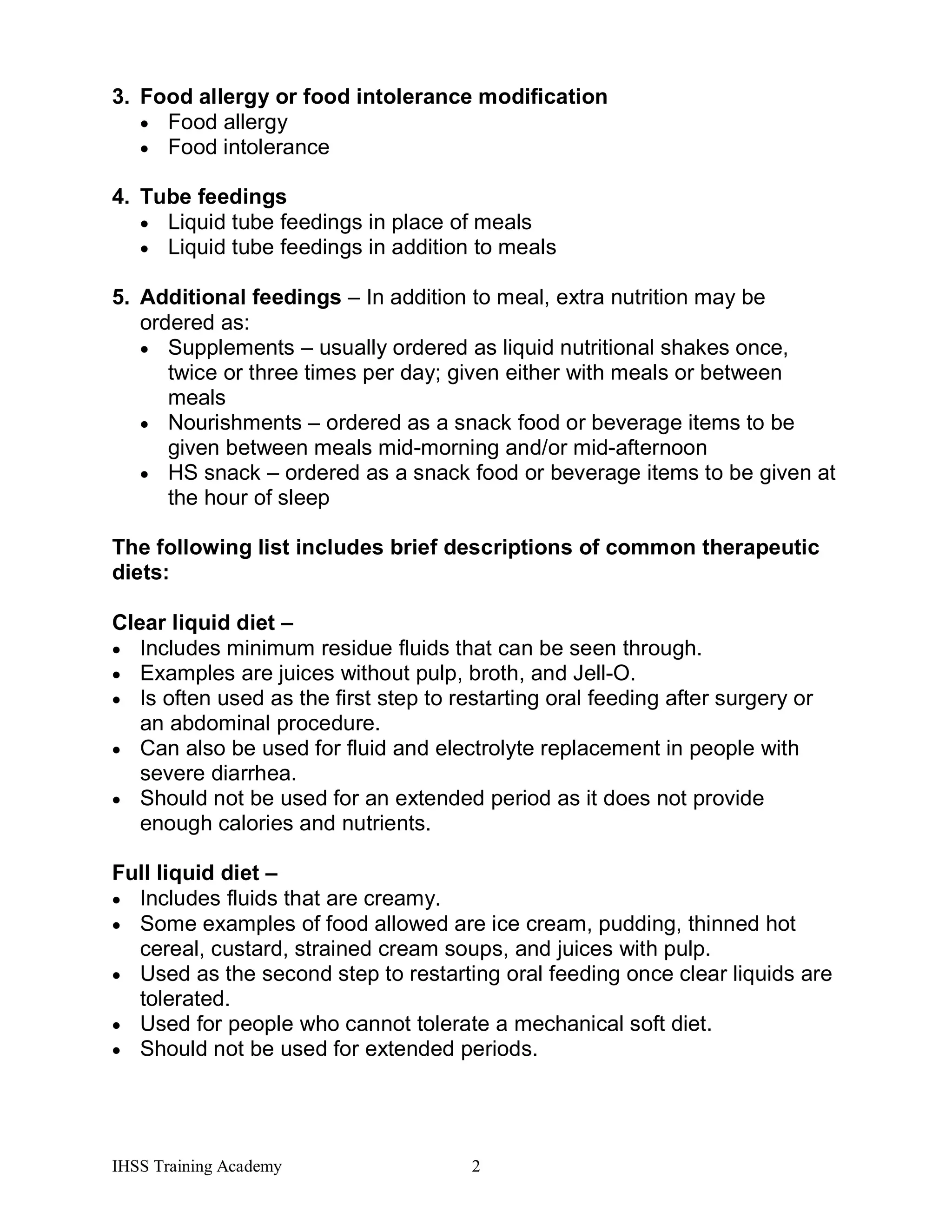
3. Food allergy or food intolerance modification
• Food allergy
• Food intolerance
4. Tube feedings
• Liquid tube feedings in place of meals
• Liquid tube feedings in addition to meals
5. Additional feedings – In addition to meal, extra nutrition may be
ordered as:
• Supplements – usually ordered as liquid nutritional shakes once,
twice or three times per day; given either with meals or between
meals
• Nourishments – ordered as a snack food or beverage items to be
given between meals mid-morning and/or mid-afternoon
• HS snack – ordered as a snack food or beverage items to be given at
the hour of sleep
The following list includes brief descriptions of common therapeutic
diets:
Clear liquid diet –
• Includes minimum residue fluids that can be seen through.
• Examples are juices without pulp, broth, and Jell-O.
• Is often used as the first step to restarting oral feeding after surgery or
an abdominal procedure.
• Can also be used for fluid and electrolyte replacement in people with
severe diarrhea.
• Should not be used for an extended period as it does not provide
enough calories and nutrients.
Full liquid diet –
• Includes fluids that are creamy.
• Some examples of food allowed are ice cream, pudding, thinned hot
cereal, custard, strained cream soups, and juices with pulp.
• Used as the second step to restarting oral feeding once clear liquids are
tolerated.
• Used for people who cannot tolerate a mechanical soft diet.
• Should not be used for extended periods.
IHSS Training Academy 3
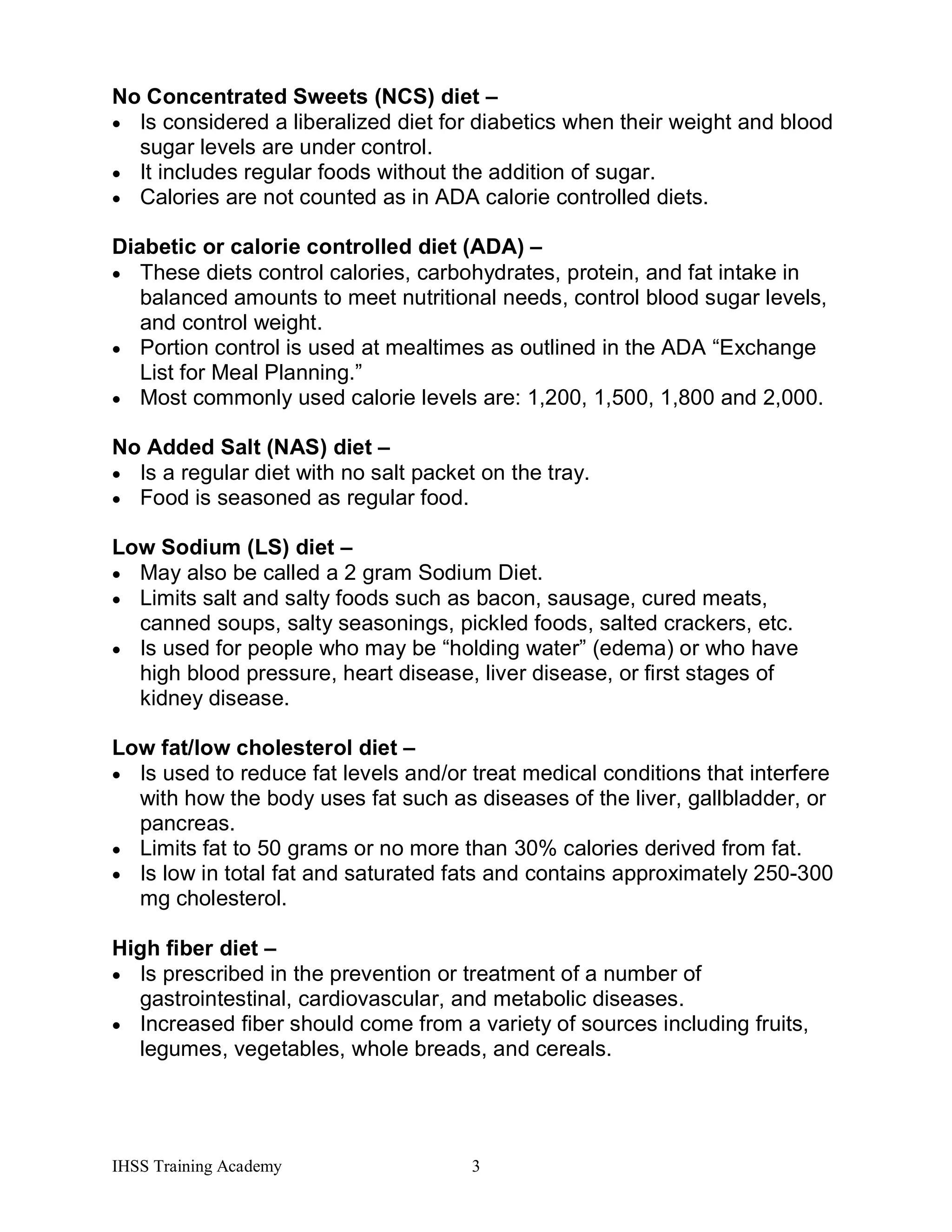
No Concentrated Sweets (NCS) diet –
• Is considered a liberalized diet for diabetics when their weight and blood
sugar levels are under control.
• It includes regular foods without the addition of sugar.
• Calories are not counted as in ADA calorie controlled diets.
Diabetic or calorie controlled diet (ADA) –
• These diets control calories, carbohydrates, protein, and fat intake in
balanced amounts to meet nutritional needs, control blood sugar levels,
and control weight.
• Portion control is used at mealtimes as outlined in the ADA “Exchange
List for Meal Planning.”
• Most commonly used calorie levels are: 1,200, 1,500, 1,800 and 2,000.
No Added Salt (NAS) diet –
• Is a regular diet with no salt packet on the tray.
• Food is seasoned as regular food.
Low Sodium (LS) diet –
• May also be called a 2 gram Sodium Diet.
• Limits salt and salty foods such as bacon, sausage, cured meats,
canned soups, salty seasonings, pickled foods, salted crackers, etc.
• Is used for people who may be “holding water” (edema) or who have
high blood pressure, heart disease, liver disease, or first stages of
kidney disease.
Low fat/low cholesterol diet –
• Is used to reduce fat levels and/or treat medical conditions that interfere
with how the body uses fat such as diseases of the liver, gallbladder, or
pancreas.
• Limits fat to 50 grams or no more than 30% calories derived from fat.
• Is low in total fat and saturated fats and contains approximately 250-300
mg cholesterol.
High fiber diet –
• Is prescribed in the prevention or treatment of a number of
gastrointestinal, cardiovascular, and metabolic diseases.
• Increased fiber should come from a variety of sources including fruits,
legumes, vegetables, whole breads, and cereals.
IHSS Training Academy 4
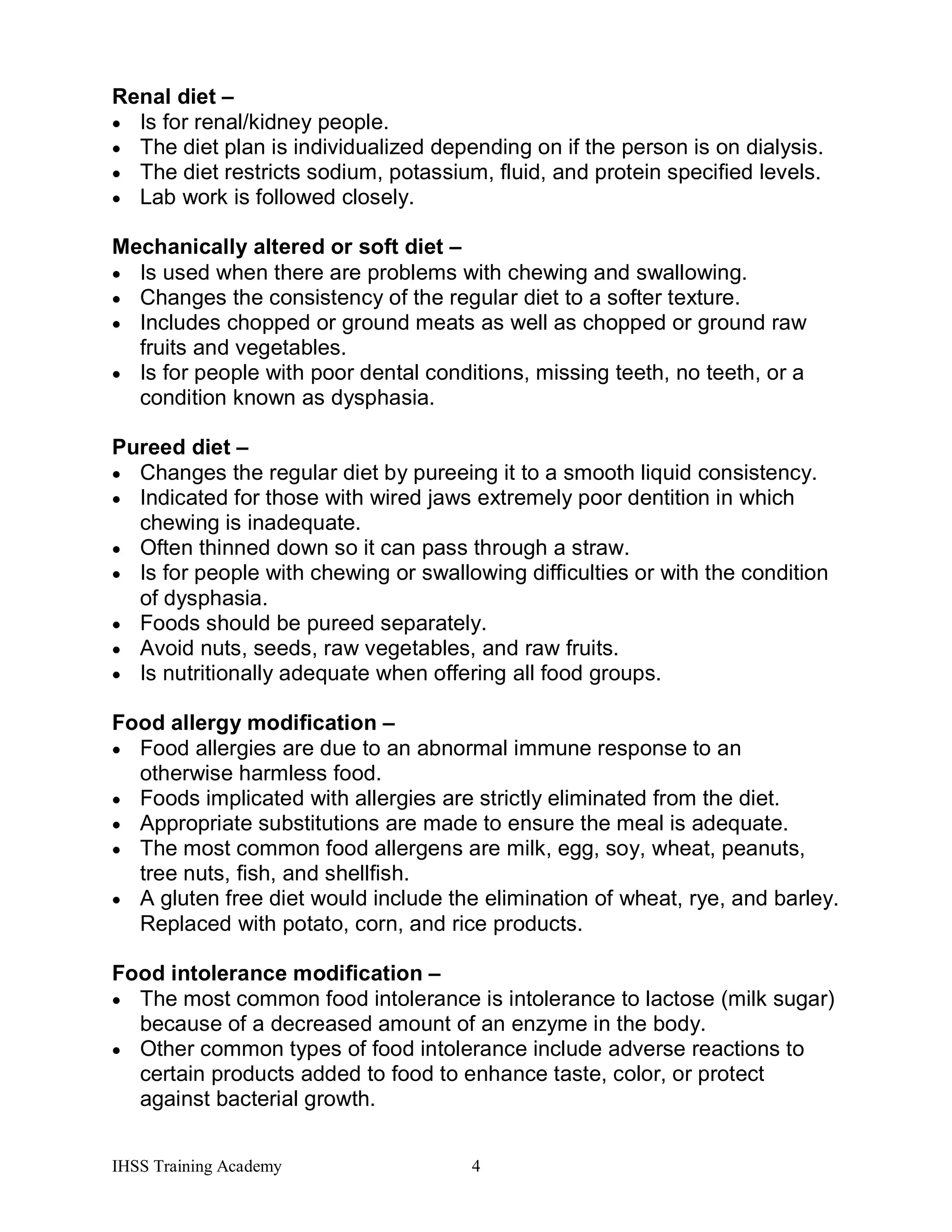
Renal diet –
• Is for renal/kidney people.
• The diet plan is individualized depending on if the person is on dialysis.
• The diet restricts sodium, potassium, fluid, and protein specified levels.
• Lab work is followed closely.
Mechanically altered or soft diet –
• Is used when there are problems with chewing and swallowing.
• Changes the consistency of the regular diet to a softer texture.
• Includes chopped or ground meats as well as chopped or ground raw
fruits and vegetables.
• Is for people with poor dental conditions, missing teeth, no teeth, or a
condition known as dysphasia.
Pureed diet –
• Changes the regular diet by pureeing it to a smooth liquid consistency.
• Indicated for those with wired jaws extremely poor dentition in which
chewing is inadequate.
• Often thinned down so it can pass through a straw.
• Is for people with chewing or swallowing difficulties or with the condition
of dysphasia.
• Foods should be pureed separately.
• Avoid nuts, seeds, raw vegetables, and raw fruits.
• Is nutritionally adequate when offering all food groups.
Food allergy modification –
• Food allergies are due to an abnormal immune response to an
otherwise harmless food.
• Foods implicated with allergies are strictly eliminated from the diet.
• Appropriate substitutions are made to ensure the meal is adequate.
• The most common food allergens are milk, egg, soy, wheat, peanuts,
tree nuts, fish, and shellfish.
• A gluten free diet would include the elimination of wheat, rye, and barley.
Replaced with potato, corn, and rice products.
Food intolerance modification –
• The most common food intolerance is intolerance to lactose (milk sugar)
because of a decreased amount of an enzyme in the body.
• Other common types of food intolerance include adverse reactions to
certain products added to food to enhance taste, color, or protect
against bacterial growth.
IHSS Training Academy 5
• Common symptoms involving food intolerances are vomiting, diarrhea,
abdominal pain, and headaches.
Tube feedings –
• Tube feedings are used for people who cannot take adequate food or
fluids by mouth.
• All or parts of nutritional needs are met through tube feedings.
• Some people may receive food by mouth if they can swallow safely and
are working to be weaned off the tube feeding.

Types of therapeutic_diets

  • 1.
    IHSS Training Academy1 Types of Therapeutic Diets A therapeutic diet is a meal plan that controls the intake of certain foods or nutrients. It is part of the treatment of a medical condition and are normally prescribed by a physician and planned by a dietician. A therapeutic diet is usually a modification of a regular diet. It is modified or tailored to fit the nutrition needs of a particular person. Therapeutic diets are modified for (1) nutrients, (2) texture, and/or (3) food allergies or food intolerances. Common reasons therapeutic diets may be ordered: • To maintain nutritional status • To restore nutritional status • To correct nutritional status • To decrease calories for weight control • To provide extra calories for weight gain • To balance amounts of carbohydrates, fat and protein for control of diabetes • To provide a greater amount of a nutrient such as protein • To decrease the amount of a nutrient such as sodium • To exclude foods due to allergies or food intolerance • To provide texture modifications due to problems with chewing and/or swallowing Common therapeutic diets include: 1. Nutrient modifications • No concentrated sweets diet • Diabetic diets • No added salt diet • Low sodium diet • Low fat diet and/or low cholesterol diet • High fiber diet • Renal diet 2. Texture modification • Mechanical soft diet • Puree diet
  • 2.
    IHSS Training Academy2 3. Food allergy or food intolerance modification • Food allergy • Food intolerance 4. Tube feedings • Liquid tube feedings in place of meals • Liquid tube feedings in addition to meals 5. Additional feedings – In addition to meal, extra nutrition may be ordered as: • Supplements – usually ordered as liquid nutritional shakes once, twice or three times per day; given either with meals or between meals • Nourishments – ordered as a snack food or beverage items to be given between meals mid-morning and/or mid-afternoon • HS snack – ordered as a snack food or beverage items to be given at the hour of sleep The following list includes brief descriptions of common therapeutic diets: Clear liquid diet – • Includes minimum residue fluids that can be seen through. • Examples are juices without pulp, broth, and Jell-O. • Is often used as the first step to restarting oral feeding after surgery or an abdominal procedure. • Can also be used for fluid and electrolyte replacement in people with severe diarrhea. • Should not be used for an extended period as it does not provide enough calories and nutrients. Full liquid diet – • Includes fluids that are creamy. • Some examples of food allowed are ice cream, pudding, thinned hot cereal, custard, strained cream soups, and juices with pulp. • Used as the second step to restarting oral feeding once clear liquids are tolerated. • Used for people who cannot tolerate a mechanical soft diet. • Should not be used for extended periods.
  • 3.
    IHSS Training Academy3 No Concentrated Sweets (NCS) diet – • Is considered a liberalized diet for diabetics when their weight and blood sugar levels are under control. • It includes regular foods without the addition of sugar. • Calories are not counted as in ADA calorie controlled diets. Diabetic or calorie controlled diet (ADA) – • These diets control calories, carbohydrates, protein, and fat intake in balanced amounts to meet nutritional needs, control blood sugar levels, and control weight. • Portion control is used at mealtimes as outlined in the ADA “Exchange List for Meal Planning.” • Most commonly used calorie levels are: 1,200, 1,500, 1,800 and 2,000. No Added Salt (NAS) diet – • Is a regular diet with no salt packet on the tray. • Food is seasoned as regular food. Low Sodium (LS) diet – • May also be called a 2 gram Sodium Diet. • Limits salt and salty foods such as bacon, sausage, cured meats, canned soups, salty seasonings, pickled foods, salted crackers, etc. • Is used for people who may be “holding water” (edema) or who have high blood pressure, heart disease, liver disease, or first stages of kidney disease. Low fat/low cholesterol diet – • Is used to reduce fat levels and/or treat medical conditions that interfere with how the body uses fat such as diseases of the liver, gallbladder, or pancreas. • Limits fat to 50 grams or no more than 30% calories derived from fat. • Is low in total fat and saturated fats and contains approximately 250-300 mg cholesterol. High fiber diet – • Is prescribed in the prevention or treatment of a number of gastrointestinal, cardiovascular, and metabolic diseases. • Increased fiber should come from a variety of sources including fruits, legumes, vegetables, whole breads, and cereals.
  • 4.
    IHSS Training Academy4 Renal diet – • Is for renal/kidney people. • The diet plan is individualized depending on if the person is on dialysis. • The diet restricts sodium, potassium, fluid, and protein specified levels. • Lab work is followed closely. Mechanically altered or soft diet – • Is used when there are problems with chewing and swallowing. • Changes the consistency of the regular diet to a softer texture. • Includes chopped or ground meats as well as chopped or ground raw fruits and vegetables. • Is for people with poor dental conditions, missing teeth, no teeth, or a condition known as dysphasia. Pureed diet – • Changes the regular diet by pureeing it to a smooth liquid consistency. • Indicated for those with wired jaws extremely poor dentition in which chewing is inadequate. • Often thinned down so it can pass through a straw. • Is for people with chewing or swallowing difficulties or with the condition of dysphasia. • Foods should be pureed separately. • Avoid nuts, seeds, raw vegetables, and raw fruits. • Is nutritionally adequate when offering all food groups. Food allergy modification – • Food allergies are due to an abnormal immune response to an otherwise harmless food. • Foods implicated with allergies are strictly eliminated from the diet. • Appropriate substitutions are made to ensure the meal is adequate. • The most common food allergens are milk, egg, soy, wheat, peanuts, tree nuts, fish, and shellfish. • A gluten free diet would include the elimination of wheat, rye, and barley. Replaced with potato, corn, and rice products. Food intolerance modification – • The most common food intolerance is intolerance to lactose (milk sugar) because of a decreased amount of an enzyme in the body. • Other common types of food intolerance include adverse reactions to certain products added to food to enhance taste, color, or protect against bacterial growth.
  • 5.
    IHSS Training Academy5 • Common symptoms involving food intolerances are vomiting, diarrhea, abdominal pain, and headaches. Tube feedings – • Tube feedings are used for people who cannot take adequate food or fluids by mouth. • All or parts of nutritional needs are met through tube feedings. • Some people may receive food by mouth if they can swallow safely and are working to be weaned off the tube feeding.