Global Symposium on Soil Organic Carbon
21-23 March 2017, Rome
Dr Anne Larigauderie
Executive Secretary
IPBES
Outline
1- What is IPBES?
2- The IPBES Land degradation and restoration assessment
3- Opportunities to contribute
What is IPBES?1.
The Intergovernmental Science-Policy Platform
on Biodiversity and Ecosystem Services
 Objective: IPBES provides policy relevant knowledge on
biodiversity and ecosystem services to inform decision making
 An independent intergovernmental body: 126 Members (Governments)
 Collaborative Partnership arrangement with UNEP, FAO, UNESCO and
UNDP
 Currently implementing its first Work Programme (2014-2018)
 Secretariat hosted by Germany in Bonn
www.ipbes.net
The 4 functions of IPBES
• Assessment
Deliver global, regional and thematic assessments on
biodiversity and ecosystem services
• Knowledge
generation
catalysis
Catalyse efforts to generate new knowledge
• Policy support
tools
Identify policy relevant tools/methodologies, facilitate their
use, and promote and catalyse their further development
• Capacity
building
e.g. early career fellow(s) in each chapter of each assessment
(currently 49 fellows)
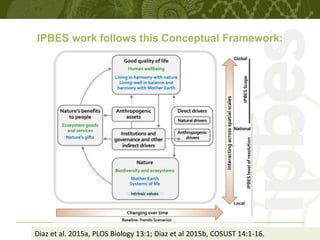
IPBES work follows this Conceptual Framework:
Diaz et al. 2015a, PLOS Biology 13:1; Diaz et al 2015b, COSUST 14:1-16.
The first two products of IPBES (1:2)
 The Thematic Assessment on Pollinators,
Pollination & Food Production
- Result of 2 years of work by 80 experts
- Cites about 3,000 scientific papers
- Includes indigenous & local knowledge from
more than 60 locations
- Summary for Policymakers (SPM) approved
by the IPBES Plenary (Feb 2016)
 Publications from this assessment:
- Potts, S. G. et al. 2016. Safeguarding Pollinators and Their Values to Human Well-
Being. Nature 540 (7632): 220-229
- Dicks, L. V. et al. 2016. Ten policies for pollinators. Science 354 (6315): 975-976.
DOI: 10.1126/science.aai9226
- Settele, J. et al. 2016. Climate change impacts on pollination. Nature Plants 2: 16092
- Breeze, T. D. et al. 2016. Economic Measures of Pollination Services: Shortcomings
and Future Directions. Trends in Ecology and Evolution 31(12): 927–939
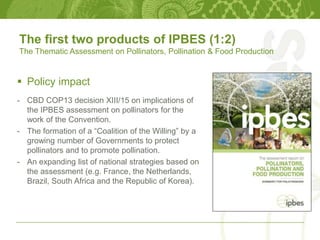
The first two products of IPBES (1:2)
The Thematic Assessment on Pollinators, Pollination & Food Production
 Policy impact
- CBD COP13 decision XIII/15 on implications of
the IPBES assessment on pollinators for the
work of the Convention.
- The formation of a “Coalition of the Willing” by a
growing number of Governments to protect
pollinators and to promote pollination.
- An expanding list of national strategies based on
the assessment (e.g. France, the Netherlands,
Brazil, South Africa and the Republic of Korea).
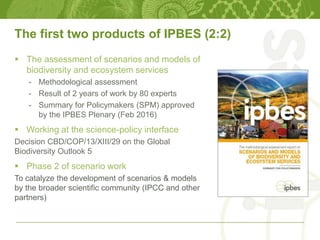
The first two products of IPBES (2:2)
 The assessment of scenarios and models of
biodiversity and ecosystem services
- Methodological assessment
- Result of 2 years of work by 80 experts
- Summary for Policymakers (SPM) approved
by the IPBES Plenary (Feb 2016)
 Working at the science-policy interface
Decision CBD/COP/13/XIII/29 on the Global
Biodiversity Outlook 5
 Phase 2 of scenario work
To catalyze the development of scenarios & models
by the broader scientific community (IPCC and other
partners)
Six assessments currently being produced
 Global assessment on biodiversity and ecosystem services (May 2019)
 4 regional assessments on biodiversity and ecosystem services (March
2018)
− Africa
− Americas
− Asia-Pacific
− Europe and Central Asia
 Land degradation and restoration (March 2018)
42
2. The land degradation and
restoration assessment
Land degradation and restoration assessment
 In response to original requests from:
-CBD
-UNCCD
-Countries (China, France, Italy, Norway)
-Non-governmental stakeholders
 Overall policy context
- Aichi targets 5 , 7, 14 and 15
- SDG target 15: Protect, restore and promote sustainable use of terrestrial
ecosystems, sustainably manage forests, combat desertification and halt
and reverse land degradation and halt biodiversity loss
- Target 15.3 on Land Degradation Neutrality
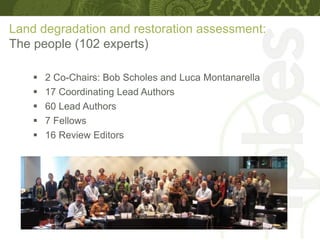
Land degradation and restoration assessment:
The people (102 experts)
 2 Co-Chairs: Bob Scholes and Luca Montanarella
 17 Coordinating Lead Authors
 60 Lead Authors
 7 Fellows
 16 Review Editors
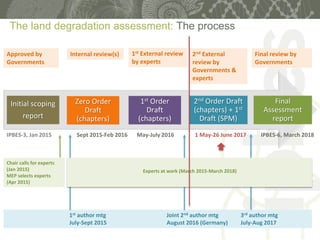
The land degradation assessment: The process
IPBES-3, Jan 2015 Sept 2015-Feb 2016 May-July 2016 1 May-26 June 2017 IPBES-6, March 2018
Approved by
Governments
Chair calls for experts
(Jan 2015)
MEP selects experts
(Apr 2015)
1st author mtg Joint 2nd author mtg 3rd author mtg
July-Sept 2015 August 2016 (Germany) July-Aug 2017
Final review by
Governments
Initial scoping
report
Internal review(s) 1st External review
by experts
2nd External
review by
Governments &
experts
Zero Order
Draft
(chapters)
1st Order
Draft
(chapters)
2nd Order Draft
(chapters) + 1st
Draft (SPM)
Final
Assessment
report
Experts at work (March 2015-March 2018)
Land degradation and restoration assessment:
The report
 A set of 8 chapters
Chapter 1- Benefits to people from avoidance of land degradation and restoration
of degraded land
Chapter 2 - Concepts and perceptions of land degradation and restoration
Chapter 3: Direct and indirect drivers of land degradation and restoration
Chapter 4. Status and trends of land degradation and restoration and associated
changes in biodiversity and ecosystem functions
Chapter 5: Land degradation and restoration associated with changes in
ecosystem services and functions, and human well-being and good quality of life
Chapter 6: Responses to avoid land degradation and restore degraded land
Chapter 7: Scenarios of land degradation and restoration
Chapter 8: Decision support to address land degradation and support restoration
of degraded land
 + a Summary for policymakers (key messages)
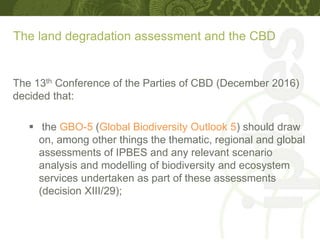
The land degradation assessment and the CBD
The 13th Conference of the Parties of CBD (December 2016)
decided that:
 the GBO-5 (Global Biodiversity Outlook 5) should draw
on, among other things the thematic, regional and global
assessments of IPBES and any relevant scenario
analysis and modelling of biodiversity and ecosystem
services undertaken as part of these assessments
(decision XIII/29);
The land degradation assessment and other key
partners
 UNCCD
 IPCC (Special report on climate change and land)
3. Opportunities to
contribute
Opportunities to contribute to the land degradation
assessment
 Second external review of the land degradation assessment:
-Second order drafts of the chapters
-First order drafts of the Summary for Policy Makers
1 May until 26 June 2017
 Webinars to explain the key findings of the chapters and the
key messages of the Summary for Policymakers will take
place at the end of May.
Thank you!
IPBES Secretariat, UN Campus
Platz der Vereinten Nationen 1, D-53113 Bonn, Germany
secretariat@ipbes.net www.ipbes.net
@IPBES
Updated
Strategic Plan
and related
decisions
GBO-5
IPBES Global
Assessment
NBSAP
implement-
ation
national
scope
global
scope
2018-
2019-
2020
BIP / GEO-
BON
Literature
Data,
methods,
capacity
6th National
Reports
IPBES Thematic
Assessments
IPBES
Subregional /
Regional
Assessments
Information
CBD/UNEP/SBSTTA/19/9
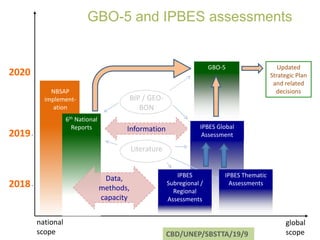
GBO-5 and IPBES assessments
The land degradation assessment and the CBD
(a) Decision XIII/5 on ecosystem restoration, in which the Conference of the Parties noted
deliverable 3(b)(i) of IPBES related to the thematic assessment on land degradation and
restoration. In the same decision, the Conference of the Parties adopted a short-term action
plan on ecosystem restoration and requested the Executive Secretary of the Convention on
Biological Diversity to bring this decision to the attention of the Platform so that it could be
 The land degaradtion will form one of the building blocks of the Global Biodiversity
Outl;ook 5 of CBD CBD-COP13 (December 2016) The Conference of the Parties
initiated the preparation of the fifth edition of the Global Biodiversity Outlook (GBO-5)
through its decision XIII/29. In this decision, it also welcomed the decision of IPBES to
undertake a global assessment on biodiversity and ecosystem services, and re-emphasized
the importance of this global assessment for analysing progress towards the
implementation of the Strategic Plan for Biodiversity 2011-2020 and the Aichi
Biodiversity Targets.
The fifth edition of the Global Biodiversity Outlook will provide a concise final report on the
implementation of the Strategic Plan for Biodiversity 2011-2020 and provide a basis for the
follow-up strategy to be considered by the Conference of the Parties at its fifteenth meeting.
The Conference of the Parties, in decision XIII/29, decided that the GBO-5 should draw on,
among other things the thematic, regional and global assessments of IPBES and any relevant
scenario analysis and modelling of biodiversity and ecosystem services undertaken as part of
these assessments

Ipbes

  • 1.
    Global Symposium onSoil Organic Carbon 21-23 March 2017, Rome Dr Anne Larigauderie Executive Secretary IPBES
  • 2.
    Outline 1- What isIPBES? 2- The IPBES Land degradation and restoration assessment 3- Opportunities to contribute
  • 3.
  • 4.
    The Intergovernmental Science-PolicyPlatform on Biodiversity and Ecosystem Services  Objective: IPBES provides policy relevant knowledge on biodiversity and ecosystem services to inform decision making  An independent intergovernmental body: 126 Members (Governments)  Collaborative Partnership arrangement with UNEP, FAO, UNESCO and UNDP  Currently implementing its first Work Programme (2014-2018)  Secretariat hosted by Germany in Bonn www.ipbes.net
  • 5.
    The 4 functionsof IPBES • Assessment Deliver global, regional and thematic assessments on biodiversity and ecosystem services • Knowledge generation catalysis Catalyse efforts to generate new knowledge • Policy support tools Identify policy relevant tools/methodologies, facilitate their use, and promote and catalyse their further development • Capacity building e.g. early career fellow(s) in each chapter of each assessment (currently 49 fellows)
  • 6.
    IPBES work followsthis Conceptual Framework: Diaz et al. 2015a, PLOS Biology 13:1; Diaz et al 2015b, COSUST 14:1-16.
  • 7.
    The first twoproducts of IPBES (1:2)  The Thematic Assessment on Pollinators, Pollination & Food Production - Result of 2 years of work by 80 experts - Cites about 3,000 scientific papers - Includes indigenous & local knowledge from more than 60 locations - Summary for Policymakers (SPM) approved by the IPBES Plenary (Feb 2016)  Publications from this assessment: - Potts, S. G. et al. 2016. Safeguarding Pollinators and Their Values to Human Well- Being. Nature 540 (7632): 220-229 - Dicks, L. V. et al. 2016. Ten policies for pollinators. Science 354 (6315): 975-976. DOI: 10.1126/science.aai9226 - Settele, J. et al. 2016. Climate change impacts on pollination. Nature Plants 2: 16092 - Breeze, T. D. et al. 2016. Economic Measures of Pollination Services: Shortcomings and Future Directions. Trends in Ecology and Evolution 31(12): 927–939
  • 8.
    The first twoproducts of IPBES (1:2) The Thematic Assessment on Pollinators, Pollination & Food Production  Policy impact - CBD COP13 decision XIII/15 on implications of the IPBES assessment on pollinators for the work of the Convention. - The formation of a “Coalition of the Willing” by a growing number of Governments to protect pollinators and to promote pollination. - An expanding list of national strategies based on the assessment (e.g. France, the Netherlands, Brazil, South Africa and the Republic of Korea).
  • 9.
    The first twoproducts of IPBES (2:2)  The assessment of scenarios and models of biodiversity and ecosystem services - Methodological assessment - Result of 2 years of work by 80 experts - Summary for Policymakers (SPM) approved by the IPBES Plenary (Feb 2016)  Working at the science-policy interface Decision CBD/COP/13/XIII/29 on the Global Biodiversity Outlook 5  Phase 2 of scenario work To catalyze the development of scenarios & models by the broader scientific community (IPCC and other partners)
  • 10.
    Six assessments currentlybeing produced  Global assessment on biodiversity and ecosystem services (May 2019)  4 regional assessments on biodiversity and ecosystem services (March 2018) − Africa − Americas − Asia-Pacific − Europe and Central Asia  Land degradation and restoration (March 2018)
  • 11.
    42 2. The landdegradation and restoration assessment
  • 12.
    Land degradation andrestoration assessment  In response to original requests from: -CBD -UNCCD -Countries (China, France, Italy, Norway) -Non-governmental stakeholders  Overall policy context - Aichi targets 5 , 7, 14 and 15 - SDG target 15: Protect, restore and promote sustainable use of terrestrial ecosystems, sustainably manage forests, combat desertification and halt and reverse land degradation and halt biodiversity loss - Target 15.3 on Land Degradation Neutrality
  • 13.
    Land degradation andrestoration assessment: The people (102 experts)  2 Co-Chairs: Bob Scholes and Luca Montanarella  17 Coordinating Lead Authors  60 Lead Authors  7 Fellows  16 Review Editors
  • 14.
    The land degradationassessment: The process IPBES-3, Jan 2015 Sept 2015-Feb 2016 May-July 2016 1 May-26 June 2017 IPBES-6, March 2018 Approved by Governments Chair calls for experts (Jan 2015) MEP selects experts (Apr 2015) 1st author mtg Joint 2nd author mtg 3rd author mtg July-Sept 2015 August 2016 (Germany) July-Aug 2017 Final review by Governments Initial scoping report Internal review(s) 1st External review by experts 2nd External review by Governments & experts Zero Order Draft (chapters) 1st Order Draft (chapters) 2nd Order Draft (chapters) + 1st Draft (SPM) Final Assessment report Experts at work (March 2015-March 2018)
  • 15.
    Land degradation andrestoration assessment: The report  A set of 8 chapters Chapter 1- Benefits to people from avoidance of land degradation and restoration of degraded land Chapter 2 - Concepts and perceptions of land degradation and restoration Chapter 3: Direct and indirect drivers of land degradation and restoration Chapter 4. Status and trends of land degradation and restoration and associated changes in biodiversity and ecosystem functions Chapter 5: Land degradation and restoration associated with changes in ecosystem services and functions, and human well-being and good quality of life Chapter 6: Responses to avoid land degradation and restore degraded land Chapter 7: Scenarios of land degradation and restoration Chapter 8: Decision support to address land degradation and support restoration of degraded land  + a Summary for policymakers (key messages)
  • 16.
    The land degradationassessment and the CBD The 13th Conference of the Parties of CBD (December 2016) decided that:  the GBO-5 (Global Biodiversity Outlook 5) should draw on, among other things the thematic, regional and global assessments of IPBES and any relevant scenario analysis and modelling of biodiversity and ecosystem services undertaken as part of these assessments (decision XIII/29);
  • 17.
    The land degradationassessment and other key partners  UNCCD  IPCC (Special report on climate change and land)
  • 18.
  • 19.
    Opportunities to contributeto the land degradation assessment  Second external review of the land degradation assessment: -Second order drafts of the chapters -First order drafts of the Summary for Policy Makers 1 May until 26 June 2017  Webinars to explain the key findings of the chapters and the key messages of the Summary for Policymakers will take place at the end of May.
  • 20.
    Thank you! IPBES Secretariat,UN Campus Platz der Vereinten Nationen 1, D-53113 Bonn, Germany secretariat@ipbes.net www.ipbes.net @IPBES
  • 21.
    Updated Strategic Plan and related decisions GBO-5 IPBESGlobal Assessment NBSAP implement- ation national scope global scope 2018- 2019- 2020 BIP / GEO- BON Literature Data, methods, capacity 6th National Reports IPBES Thematic Assessments IPBES Subregional / Regional Assessments Information CBD/UNEP/SBSTTA/19/9 GBO-5 and IPBES assessments
  • 22.
    The land degradationassessment and the CBD (a) Decision XIII/5 on ecosystem restoration, in which the Conference of the Parties noted deliverable 3(b)(i) of IPBES related to the thematic assessment on land degradation and restoration. In the same decision, the Conference of the Parties adopted a short-term action plan on ecosystem restoration and requested the Executive Secretary of the Convention on Biological Diversity to bring this decision to the attention of the Platform so that it could be  The land degaradtion will form one of the building blocks of the Global Biodiversity Outl;ook 5 of CBD CBD-COP13 (December 2016) The Conference of the Parties initiated the preparation of the fifth edition of the Global Biodiversity Outlook (GBO-5) through its decision XIII/29. In this decision, it also welcomed the decision of IPBES to undertake a global assessment on biodiversity and ecosystem services, and re-emphasized the importance of this global assessment for analysing progress towards the implementation of the Strategic Plan for Biodiversity 2011-2020 and the Aichi Biodiversity Targets. The fifth edition of the Global Biodiversity Outlook will provide a concise final report on the implementation of the Strategic Plan for Biodiversity 2011-2020 and provide a basis for the follow-up strategy to be considered by the Conference of the Parties at its fifteenth meeting. The Conference of the Parties, in decision XIII/29, decided that the GBO-5 should draw on, among other things the thematic, regional and global assessments of IPBES and any relevant scenario analysis and modelling of biodiversity and ecosystem services undertaken as part of these assessments

Editor's Notes

  • #7 Díaz et al. (2015) "A Rosetta Stone for Nature’s Benefits to People." PLOS Biology 13: 1 Read more about Díaz et al. (2015) "A Rosetta Stone for Nature’s Benefits to People." PLOS Biology 13: 1 Díaz et al. (2015) “The IPBES Conceptual Framework - connecting nature and people.” Current Opinion in Environmental Sustainability 14: 1–16.
  • #9 XIII/15. Implications of the IPBES assessment on pollinators, pollination and food production for the work of the Convention
  • #10 Timing: from March until now (10 months)
  • #18 Say a word on GLO (as part of UNCCD)
  • #20 Can mention that Luca is also on ITPS, that we have 1 Review Editor and 2 Contributing Authors from ITPS. Both ITPS members and SPI members submitted comments into first external review, as did UNCCD (Victor).