MOTIVATION
AND ATTITUDE
MOTIVATION
Motivaition is the quality
that lead people to achieve
their goal.
MOTIVATION IN SECOND LANGUAGE LEARNING
Are learners, highly
motivated because they
are successful?
Are they successful
because they are
motivated?
TYPES OF MOTIVATION
Instrumental motivation
Desire to achieve practical goals
 Pass a test
 Get a job
TYPES OF MOTIVATION
 Integrative motivation
Desire to become a part of the second language
community
 Cultural enrichment
 Citizenship
MOTIVATION IN SECOND LANGUAGE LEARNING
 Learning the majority or minority language has
a different attitude and motivation.
MOTIVATION IN CLASSROOM SETTING
 Motivated students:
Are usually those who participate actively in
class, express interest in the subject matter
and study a great deal.
MOTIVATION IN CLASSROOM SETTING
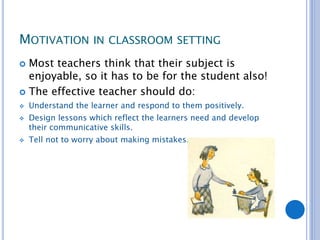
 Most teachers think that their subject is
enjoyable, so it has to be for the student also!
 The effective teacher should do:
 Understand the learner and respond to them positively.
 Design lessons which reflect the learners need and develop
their communicative skills.
 Tell not to worry about making mistakes.
MOTIVATION IN CLASSROOM
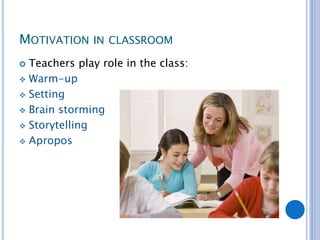
 Teachers play role in the class:
 Warm-up
 Setting
 Brain storming
 Storytelling
 Apropos
MOTIVATION IN THE CLASSROOM
 Motivating student is one of the greatest
challenges that teachers face, teachers always
play a vital role to influence the students,
indeed teachers instructional choices can make
a positive impact on student motivation.
MOTIVATION IN CLASSROOM
 How to increase students' motivation:
1) Motivating students into lessons.
At the opening stages of lessons and among transition.
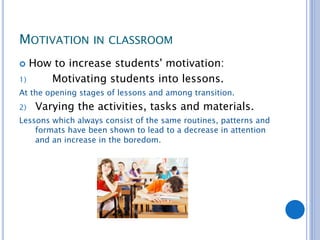
2) Varying the activities, tasks and materials.
Lessons which always consist of the same routines, patterns and
formats have been shown to lead to a decrease in attention
and an increase in the boredom.
MOTIVATION IN CLASSROOM
3) Using co-operative rather than competitive
goals
Co-operation task forces the students work in groups to
complete a task or solve a problem, it will increase the self
confidence and knowing that their classmates count of them
can increase motivation.

motivation and attitude

  • 1.
  • 2.
    MOTIVATION Motivaition is thequality that lead people to achieve their goal.
  • 3.
    MOTIVATION IN SECONDLANGUAGE LEARNING Are learners, highly motivated because they are successful? Are they successful because they are motivated?
  • 4.
    TYPES OF MOTIVATION Instrumentalmotivation Desire to achieve practical goals  Pass a test  Get a job
  • 5.
    TYPES OF MOTIVATION Integrative motivation Desire to become a part of the second language community  Cultural enrichment  Citizenship
  • 6.
    MOTIVATION IN SECONDLANGUAGE LEARNING  Learning the majority or minority language has a different attitude and motivation.
  • 7.
    MOTIVATION IN CLASSROOMSETTING  Motivated students: Are usually those who participate actively in class, express interest in the subject matter and study a great deal.
  • 8.
    MOTIVATION IN CLASSROOMSETTING  Most teachers think that their subject is enjoyable, so it has to be for the student also!  The effective teacher should do:  Understand the learner and respond to them positively.  Design lessons which reflect the learners need and develop their communicative skills.  Tell not to worry about making mistakes.
  • 9.
    MOTIVATION IN CLASSROOM Teachers play role in the class:  Warm-up  Setting  Brain storming  Storytelling  Apropos
  • 10.
    MOTIVATION IN THECLASSROOM  Motivating student is one of the greatest challenges that teachers face, teachers always play a vital role to influence the students, indeed teachers instructional choices can make a positive impact on student motivation.
  • 11.
    MOTIVATION IN CLASSROOM How to increase students' motivation: 1) Motivating students into lessons. At the opening stages of lessons and among transition. 2) Varying the activities, tasks and materials. Lessons which always consist of the same routines, patterns and formats have been shown to lead to a decrease in attention and an increase in the boredom.
  • 12.
    MOTIVATION IN CLASSROOM 3)Using co-operative rather than competitive goals Co-operation task forces the students work in groups to complete a task or solve a problem, it will increase the self confidence and knowing that their classmates count of them can increase motivation.