Robert M. Emmerichs
Cheryl Y. Marcum
Albert A. Robbert
An
Operational
Process
for
Workforce
Planning
Prepared for the Office of the Secretary of Defense
R
National Defense Research Institute
Approved for public release; distribution unlimited
The research described in this report was sponsored by the Office of
the Secretary of Defense (OSD). The research was conducted in
the RAND National Defense Research Institute, a federally funded
research and development center supported by the OSD, the Joint Staff,
the unified commands, and the defense agencies under Contract
DASW01-01-C-0004.
© Copyright 2004 RAND Corporation
All rights reserved. No part of this book may be reproduced in any form
by any electronic or mechanical means (including photocopying,
recording, or information storage and retrieval) without permission in
writing from RAND.
Published 2004 by RAND
1700 Main Street, P.O. Box 2138, Santa Monica, CA 90407-2138
1200 South Hayes Street, Arlington, VA 22202-5050
201 North Craig Street, Suite 202, Pittsburgh, PA 15213-1516
RAND URL: http://www.rand.org/
To order RAND documents or to obtain additional information, contact
Distribution Services: Telephone: (310) 451-7002;
Fax: (310) 451-6915; Email: order@rand.org
Library of Congress Cataloging-in-Publication Data
Emmerichs, Robert M.
An operational process for workforce planning / Robert M. Emmerichs,
Cheryl Y. Marcum, Albert A. Robbert.
p. cm.
“MR-1684/1.”
Includes bibliographical references.
ISBN 0-8330-3452-9 (pbk.)
1. United States. Dept. of Defense—Procurement—Planning. I. Marcum,
Cheryl Y. II. Robbert, Albert A., 1944– III.Title.
UC263.E28 2003
355.6'1'0973—dc22
2003015748
The RAND Corporation is a nonprofit research organization providing
objective analysis and effective solutions that address the challenges
facing the public and private sectors around the world. RAND’s
publications do not necessarily reflect the opinions of its research clients
and sponsors.
R® is a registered trademark.
Cover design by Barbara Angell Caslon
ix
SUMMARY
Workforce planning is an organizational activity intended to ensure
that investment in human capital results in the timely capability to
effectively carry out the organization’s strategic intent.1 This report
describes a RAND-developed methodology for conducting workforce
planning applicable in any organization. We describe the methodol-
ogy primarily in terms of its application at a business unit level. We
recognize that workforce planning activities can be accomplished at
other organizational levels (for example, major divisions within large
organizations or even at corporate headquarters). We believe
strongly, however, that workforce planning, if not conducted by a
business unit itself, nevertheless benefits extensively from the active
participation and input of business units.
This report is based on our review of workforce planning in govern-
mental and private-sector organizations and our analysis of the re-
sults of the initial application of workforce planning in the DoD
acquisition community.2 In addition to the active involvement of
______________
1We define strategic intent as an expression (sometimes explicit, but often implicit) of
what business the organization is in (or wants to be in) and how the organization’s
leaders plan to carry out that business. Leaders usually express strategic intent in the
organization’s strategic planning documents. In particular, the business the
organization is in (or wants to be in) is often outlined in a vision, mission, and/or
purpose statement. How the leaders choose to carry out the business is often captured
in goals, guiding principles, and/or strategies. A major task for workforce planners is to
identify explicitly those elements of strategic intent that workforce characteristics help
accomplish.
2Six DoD components completed an initial application of the structured workforce
planning process described herein for its acquisition community during the summer
of 2001.
x An Operational Process for Workforce Planning
business units, we identified three key factors contributing to
successful workforce planning:
• enthusiastic executive and line manager participation
• accurate and relevant data
• sophisticated workload models (which help translate expected
workloads into requirements for workers) and inventory projec-
tion models (which depict how the expected composition of a
workforce will change over time).
Different perspectives provide insight into the degree to which these
factors influence the effectiveness of the workforce planning activity.
Therefore, we structured this report around three points of view: a
goal-oriented view—addressing why an organization should conduct
workforce planning; a structural view—addressing what questions an
organization can answer with workforce planning and the informa-
tion needed to do so; and a process view—addressing how an organi-
zation can effectively focus the contributions of its key participants
in conducting workforce planning.
The goal-oriented view sets the stage. It identifies three purposes of
workforce planning:
• to obtain a clear representation of the workforce needed to ac-
complish the organization’s strategic intent
• to develop an aligned set of human resource management poli-
cies and practices3—in other words, a comprehensive plan of
action—that will ensure the appropriate workforce will be avail-
able when needed
• to establish a convincing rationale—a business case—for acquir-
ing new authority and marshalling resources to implement the
human resource management policies and programs needed to
accomplish the organization’s strategic intent.
______________
3An aligned set of policies and practices supports the leaders’ strategic intent (i.e., the
policies and practices are vertically aligned) and are mutually reinforcing (i.e., they are
horizontally aligned).
Summary xi
In this context, accomplishing strategic intent is the central goal of
workforce planning. The leaders’ strategic intent focuses workforce
planning. Because strategic intent is best defined and articulated by
corporate and business unit executives and line managers, the clarity
and quality of their input represents a critical factor in successful
workforce planning.
The structural view expounds on the purposes of workforce plan-
ning. Four central questions capture the major structural themes of
workforce planning:
1. What critical workforce characteristics will the organization need
in the future to accomplish its strategic intent, and what is the de-
sired distribution of these characteristics?
2. What is the distribution—in today’s workforce—of the workforce
characteristics needed for the future?
3. If the organization maintains current policies and programs, what
distribution of characteristics will the future workforce possess?
4. What changes to human resource management policies and prac-
tices, resource decisions, and other actions will eliminate or alle-
viate gaps (overages or shortages) between the future desired dis-
tribution and the projected future inventory?4
Figure S.1 shows a blueprint portraying the interrelationship of the
questions and the information needed to obtain the answers. It
highlights the three key success factors mentioned earlier. Executive
and line judgments are critical to questions 1 and 4; data availability
is essential to question 2; and a modeling capability is necessary to
answer questions 3 and 4.
______________
4We employ the term inventory in this report in the commonplace usage of the DoD to
refer to the people in the workforce. For example, current inventory represents the
number of people currently working in the organization described in terms of such
characteristics as length of service, grade, occupation, etc.; future inventory represents
the number of people expected to be working in the organization at a specified future
time described in terms of such characteristics. An inventory (or workforce) projection
model is an analytic tool for deriving an estimate of the future inventory based on the
current inventory.
Utopia R Zapf
RAND MR1684/1-S.1
Corporate/
local
databases
Corporate guidance
Functional guidance
Business unit
strategic intent
Critical
workforce
characteristics
Future desired
distribution
Future inventory
with current policies
Gap with
current policies
Future inventory with
proposed policies
Proposed policies
– Training plan
– Hiring plan
– Rotation plan
Gap with
proposed policies
Current desired
distribution
Current
inventory
Environmental
scan
Current
policies
Inventory
projection
Inventory
projection
Question 1:
What characteristics
will we need?
Question 2:
What critical
characteristics
do we have today?
Question 3:
What critical
characteristics will
we have if we do
nothing different?
Executive and
line manager
input key
Data
availability
key
Modeling
capability
key
Line and
human
resource
manager
input
key
Question 4:
What actions
will close
the gap?
Figure S.1—A Blueprint for Workforce Planning
xii
An
Operational
Process
for
Workforce
Planning
Summary xiii
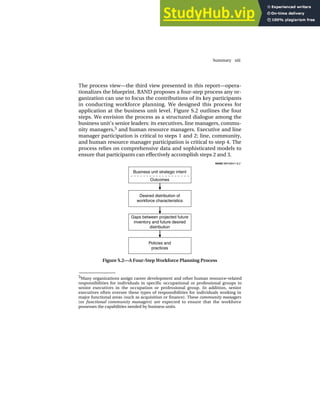
The process view—the third view presented in this report—opera-
tionalizes the blueprint. RAND proposes a four-step process any or-
ganization can use to focus the contributions of its key participants
in conducting workforce planning. We designed this process for
application at the business unit level. Figure S.2 outlines the four
steps. We envision the process as a structured dialogue among the
business unit’s senior leaders: its executives, line managers, commu-
nity managers,5 and human resource managers. Executive and line
manager participation is critical to steps 1 and 2; line, community,
and human resource manager participation is critical to step 4. The
process relies on comprehensive data and sophisticated models to
ensure that participants can effectively accomplish steps 2 and 3.
RAND MR1684/1-S.2
Business unit strategic intent
Outcomes
Desired distribution of
workforce characteristics
Gaps between projected future
inventory and future desired
distribution
Policies and
practices
Figure S.2—A Four-Step Workforce Planning Process
______________
5Many organizations assign career development and other human resource–related
responsibilities for individuals in specific occupational or professional groups to
senior executives in the occupation or professional group. In addition, senior
executives often oversee these types of responsibilities for individuals working in
major functional areas (such as acquisition or finance). These community managers
(or functional community managers) are expected to ensure that the workforce
possesses the capabilities needed by business units.
xiv An Operational Process for Workforce Planning
RECOMMENDATIONS
Importantly, an organization’s senior leaders control the three key
factors that lead to successful workforce planning.
Active Executive and Line Participation. Business unit executives
and line managers are uniquely positioned to assess how their busi-
ness will be carried out and to identify the human capital capabilities
needed to do so effectively. Leaders at levels above the business unit
play different but important roles—in translating higher-level direc-
tion into clear guidance for line organizations, integrating the results
of workforce planning across business units, and supporting the re-
sults of workforce planning at the lower levels. We recommend that
senior leaders (above the business unit level) delineate explicitly the
roles and responsibilities of executives involved throughout the or-
ganization in the workforce planning activity, and in particular, en-
courage and reward business unit executives and line managers for
active participation in the workforce planning activity.
Accurate and Relevant Data. Data on workforce characteristics are
the common language of workforce planning. Although many facets
of workforce planning are best carried out by individual business
units, the kind of data needed is similar throughout the organization
(across business units). We recommend that the organization’s cor-
porate headquarters lead the development of the functional specifi-
cations for a human resource information system to support work-
force planning.
Sophisticated Workload and Inventory Projection Models. Insight
into how the composition of the workforce may change over time
informs human capital decisions. As with data, the kind of models
needed to make such estimates may be similar throughout the orga-
nization. We recommend that the organization’s corporate head-
quarters evaluate the availability, costs, and benefits of comprehen-
sive, integrated workload and inventory projection models for all
categories of employees (including contractors, where contractor
personnel are integrated with civil service employees).

An Operational Process For Workforce Planning

  • 1.
    Robert M. Emmerichs CherylY. Marcum Albert A. Robbert An Operational Process for Workforce Planning Prepared for the Office of the Secretary of Defense R National Defense Research Institute Approved for public release; distribution unlimited
  • 2.
    The research describedin this report was sponsored by the Office of the Secretary of Defense (OSD). The research was conducted in the RAND National Defense Research Institute, a federally funded research and development center supported by the OSD, the Joint Staff, the unified commands, and the defense agencies under Contract DASW01-01-C-0004. © Copyright 2004 RAND Corporation All rights reserved. No part of this book may be reproduced in any form by any electronic or mechanical means (including photocopying, recording, or information storage and retrieval) without permission in writing from RAND. Published 2004 by RAND 1700 Main Street, P.O. Box 2138, Santa Monica, CA 90407-2138 1200 South Hayes Street, Arlington, VA 22202-5050 201 North Craig Street, Suite 202, Pittsburgh, PA 15213-1516 RAND URL: http://www.rand.org/ To order RAND documents or to obtain additional information, contact Distribution Services: Telephone: (310) 451-7002; Fax: (310) 451-6915; Email: order@rand.org Library of Congress Cataloging-in-Publication Data Emmerichs, Robert M. An operational process for workforce planning / Robert M. Emmerichs, Cheryl Y. Marcum, Albert A. Robbert. p. cm. “MR-1684/1.” Includes bibliographical references. ISBN 0-8330-3452-9 (pbk.) 1. United States. Dept. of Defense—Procurement—Planning. I. Marcum, Cheryl Y. II. Robbert, Albert A., 1944– III.Title. UC263.E28 2003 355.6'1'0973—dc22 2003015748 The RAND Corporation is a nonprofit research organization providing objective analysis and effective solutions that address the challenges facing the public and private sectors around the world. RAND’s publications do not necessarily reflect the opinions of its research clients and sponsors. R® is a registered trademark. Cover design by Barbara Angell Caslon
  • 3.
    ix SUMMARY Workforce planning isan organizational activity intended to ensure that investment in human capital results in the timely capability to effectively carry out the organization’s strategic intent.1 This report describes a RAND-developed methodology for conducting workforce planning applicable in any organization. We describe the methodol- ogy primarily in terms of its application at a business unit level. We recognize that workforce planning activities can be accomplished at other organizational levels (for example, major divisions within large organizations or even at corporate headquarters). We believe strongly, however, that workforce planning, if not conducted by a business unit itself, nevertheless benefits extensively from the active participation and input of business units. This report is based on our review of workforce planning in govern- mental and private-sector organizations and our analysis of the re- sults of the initial application of workforce planning in the DoD acquisition community.2 In addition to the active involvement of ______________ 1We define strategic intent as an expression (sometimes explicit, but often implicit) of what business the organization is in (or wants to be in) and how the organization’s leaders plan to carry out that business. Leaders usually express strategic intent in the organization’s strategic planning documents. In particular, the business the organization is in (or wants to be in) is often outlined in a vision, mission, and/or purpose statement. How the leaders choose to carry out the business is often captured in goals, guiding principles, and/or strategies. A major task for workforce planners is to identify explicitly those elements of strategic intent that workforce characteristics help accomplish. 2Six DoD components completed an initial application of the structured workforce planning process described herein for its acquisition community during the summer of 2001.
  • 4.
    x An OperationalProcess for Workforce Planning business units, we identified three key factors contributing to successful workforce planning: • enthusiastic executive and line manager participation • accurate and relevant data • sophisticated workload models (which help translate expected workloads into requirements for workers) and inventory projec- tion models (which depict how the expected composition of a workforce will change over time). Different perspectives provide insight into the degree to which these factors influence the effectiveness of the workforce planning activity. Therefore, we structured this report around three points of view: a goal-oriented view—addressing why an organization should conduct workforce planning; a structural view—addressing what questions an organization can answer with workforce planning and the informa- tion needed to do so; and a process view—addressing how an organi- zation can effectively focus the contributions of its key participants in conducting workforce planning. The goal-oriented view sets the stage. It identifies three purposes of workforce planning: • to obtain a clear representation of the workforce needed to ac- complish the organization’s strategic intent • to develop an aligned set of human resource management poli- cies and practices3—in other words, a comprehensive plan of action—that will ensure the appropriate workforce will be avail- able when needed • to establish a convincing rationale—a business case—for acquir- ing new authority and marshalling resources to implement the human resource management policies and programs needed to accomplish the organization’s strategic intent. ______________ 3An aligned set of policies and practices supports the leaders’ strategic intent (i.e., the policies and practices are vertically aligned) and are mutually reinforcing (i.e., they are horizontally aligned).
  • 5.
    Summary xi In thiscontext, accomplishing strategic intent is the central goal of workforce planning. The leaders’ strategic intent focuses workforce planning. Because strategic intent is best defined and articulated by corporate and business unit executives and line managers, the clarity and quality of their input represents a critical factor in successful workforce planning. The structural view expounds on the purposes of workforce plan- ning. Four central questions capture the major structural themes of workforce planning: 1. What critical workforce characteristics will the organization need in the future to accomplish its strategic intent, and what is the de- sired distribution of these characteristics? 2. What is the distribution—in today’s workforce—of the workforce characteristics needed for the future? 3. If the organization maintains current policies and programs, what distribution of characteristics will the future workforce possess? 4. What changes to human resource management policies and prac- tices, resource decisions, and other actions will eliminate or alle- viate gaps (overages or shortages) between the future desired dis- tribution and the projected future inventory?4 Figure S.1 shows a blueprint portraying the interrelationship of the questions and the information needed to obtain the answers. It highlights the three key success factors mentioned earlier. Executive and line judgments are critical to questions 1 and 4; data availability is essential to question 2; and a modeling capability is necessary to answer questions 3 and 4. ______________ 4We employ the term inventory in this report in the commonplace usage of the DoD to refer to the people in the workforce. For example, current inventory represents the number of people currently working in the organization described in terms of such characteristics as length of service, grade, occupation, etc.; future inventory represents the number of people expected to be working in the organization at a specified future time described in terms of such characteristics. An inventory (or workforce) projection model is an analytic tool for deriving an estimate of the future inventory based on the current inventory.
  • 6.
    Utopia R Zapf RANDMR1684/1-S.1 Corporate/ local databases Corporate guidance Functional guidance Business unit strategic intent Critical workforce characteristics Future desired distribution Future inventory with current policies Gap with current policies Future inventory with proposed policies Proposed policies – Training plan – Hiring plan – Rotation plan Gap with proposed policies Current desired distribution Current inventory Environmental scan Current policies Inventory projection Inventory projection Question 1: What characteristics will we need? Question 2: What critical characteristics do we have today? Question 3: What critical characteristics will we have if we do nothing different? Executive and line manager input key Data availability key Modeling capability key Line and human resource manager input key Question 4: What actions will close the gap? Figure S.1—A Blueprint for Workforce Planning xii An Operational Process for Workforce Planning
  • 7.
    Summary xiii The processview—the third view presented in this report—opera- tionalizes the blueprint. RAND proposes a four-step process any or- ganization can use to focus the contributions of its key participants in conducting workforce planning. We designed this process for application at the business unit level. Figure S.2 outlines the four steps. We envision the process as a structured dialogue among the business unit’s senior leaders: its executives, line managers, commu- nity managers,5 and human resource managers. Executive and line manager participation is critical to steps 1 and 2; line, community, and human resource manager participation is critical to step 4. The process relies on comprehensive data and sophisticated models to ensure that participants can effectively accomplish steps 2 and 3. RAND MR1684/1-S.2 Business unit strategic intent Outcomes Desired distribution of workforce characteristics Gaps between projected future inventory and future desired distribution Policies and practices Figure S.2—A Four-Step Workforce Planning Process ______________ 5Many organizations assign career development and other human resource–related responsibilities for individuals in specific occupational or professional groups to senior executives in the occupation or professional group. In addition, senior executives often oversee these types of responsibilities for individuals working in major functional areas (such as acquisition or finance). These community managers (or functional community managers) are expected to ensure that the workforce possesses the capabilities needed by business units.
  • 8.
    xiv An OperationalProcess for Workforce Planning RECOMMENDATIONS Importantly, an organization’s senior leaders control the three key factors that lead to successful workforce planning. Active Executive and Line Participation. Business unit executives and line managers are uniquely positioned to assess how their busi- ness will be carried out and to identify the human capital capabilities needed to do so effectively. Leaders at levels above the business unit play different but important roles—in translating higher-level direc- tion into clear guidance for line organizations, integrating the results of workforce planning across business units, and supporting the re- sults of workforce planning at the lower levels. We recommend that senior leaders (above the business unit level) delineate explicitly the roles and responsibilities of executives involved throughout the or- ganization in the workforce planning activity, and in particular, en- courage and reward business unit executives and line managers for active participation in the workforce planning activity. Accurate and Relevant Data. Data on workforce characteristics are the common language of workforce planning. Although many facets of workforce planning are best carried out by individual business units, the kind of data needed is similar throughout the organization (across business units). We recommend that the organization’s cor- porate headquarters lead the development of the functional specifi- cations for a human resource information system to support work- force planning. Sophisticated Workload and Inventory Projection Models. Insight into how the composition of the workforce may change over time informs human capital decisions. As with data, the kind of models needed to make such estimates may be similar throughout the orga- nization. We recommend that the organization’s corporate head- quarters evaluate the availability, costs, and benefits of comprehen- sive, integrated workload and inventory projection models for all categories of employees (including contractors, where contractor personnel are integrated with civil service employees).