WORKFORCE PLANNING GUIDE:
DEFINITION, IMPORTANCE & BEST
PRACTICES
deflytics.com
Visit Our Website:
About Worfroce Planning
In today's rapidly evolving business environment, organizations
face a multitude of challenges, from talent shortages to
unpredictable market conditions. Workforce planning emerges
as a vital strategic tool that helps organizations align their human
capital with business objectives. In this comprehensive blog, we
will explore the importance of workforce planning, discuss various
types of workforce planning, delve into the key elements involved,
highlight best practices for effective implementation, and outline
the wide-ranging benefits it offers.
◎Strategic Workforce Planning
◎Operational Workforce Planning
Workforce planning can take different forms based on an organization's goals and context. Let's explore two
common types of workforce planning:
Strategic Workforce Planning: This type of planning aligns an organization's human capital strategy with its
long-term business objectives. Strategic workforce planning focuses on identifying critical roles and
competencies necessary to achieve strategic goals. It involves analyzing internal and external factors, such as
demographic trends, talent availability, and technological advancements, to ensure the organization has the
right talent to succeed in the future.
Operational Workforce Planning: Operational workforce planning concentrates on short-term workforce
requirements to meet immediate operational needs. It involves analyzing current staffing levels, skills gaps,
workload distribution, and seasonal variations. Operational workforce planning ensures that day-to-day
operations run smoothly by balancing workloads, managing leave schedules, and responding to short-term
fluctuations in demand.
Major Types of Workforce Planning
Importance of Workforce Planning
in Today's Business Environment
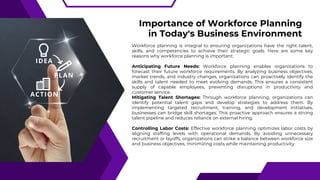
Workforce planning is integral to ensuring organizations have the right talent,
skills, and competencies to achieve their strategic goals. Here are some key
reasons why workforce planning is important:
Anticipating Future Needs: Workforce planning enables organizations to
forecast their future workforce requirements. By analyzing business objectives,
market trends, and industry changes, organizations can proactively identify the
skills and talent needed to meet evolving demands. This ensures a consistent
supply of capable employees, preventing disruptions in productivity and
customer service.
Mitigating Talent Shortages: Through workforce planning, organizations can
identify potential talent gaps and develop strategies to address them. By
implementing targeted recruitment, training, and development initiatives,
businesses can bridge skill shortages. This proactive approach ensures a strong
talent pipeline and reduces reliance on external hiring.
Controlling Labor Costs: Effective workforce planning optimizes labor costs by
aligning staffing levels with operational demands. By avoiding unnecessary
recruitment or layoffs, organizations can strike a balance between workforce size
and business objectives, minimizing costs while maintaining productivity
Key Elements of Effective
Workforce Planning
To implement effective workforce planning, organizations should consider the following key
elements:
Data Analysis: Workforce planning relies on accurate and reliable data to forecast future
needs. Organizations should collect and analyze data related to workforce demographics,
turnover rates, skills inventory, performance metrics, and market trends. This data-driven
approach provides insights for making informed decisions.
Collaboration: Successful workforce planning requires collaboration between HR, finance,
operations, and other key stakeholders. Engaging these departments ensures a
comprehensive understanding of business objectives, financial constraints, and operational
realities. Collaboration fosters alignment and increases the chances of successful workforce
planning implementation.
Succession Planning: Identifying and developing future leaders is a critical aspect of
workforce planning. Organizations should establish a robust succession planning process to
ensure a smooth transition of key roles and minimize disruptions. By cultivating a talent
pipeline, businesses can prepare for potential leadership gaps and ensure continuity.
Talent Acquisition and Development: Workforce planning goes beyond hiring. It includes
strategies for attracting top talent, developing existing employees, and creating a learning
culture. Organizations should implement effective recruitment and onboarding processes,
provide continuous training and development opportunities, and promote internal mobility
Best Practice for Workforce
Planning
To optimize the outcomes of workforce planning, organizations should consider the following best
practices:
Align Workforce Planning with Business Strategy: Workforce planning should be integrated with the
overall business strategy. This alignment ensures that the organization's human capital strategy
supports its strategic objectives. Regularly review and update the workforce plan to reflect changes in
business goals and market conditions.
Involve Key Stakeholders: Engage senior leadership, department heads, and line managers in the
workforce planning process. Their insights and perspectives are invaluable for understanding the
current and future workforce needs of their respective areas. Collaboration fosters ownership and
enhances the accuracy of the planning process.
Use Scenario Planning: Develop multiple scenarios to assess the impact of different workforce planning
strategies. Consider factors such as technological advancements, industry disruptions, and economic
shifts. By exploring various scenarios, organizations can anticipate potential challenges and devise agile
workforce strategies to respond effectively.
Invest in Workforce Analytics: Leverage advanced analytics tools to analyze and interpret workforce
data. This allows organizations to gain deep insights into workforce demographics, skills gaps, and
performance metrics. Workforce analytics enables data-driven decision-making and facilitates proactive
planning.
Implementing effective workforce planning offers numerous benefits for organizations:
Enhanced Agility and Adaptability: Workforce planning enables organizations to adapt swiftly to changing
market conditions. By identifying potential skill gaps and aligning talent with emerging needs, businesses can
stay ahead of competitors and seize new opportunities.
Improved Employee Engagement and Retention: Workforce planning emphasizes the development and
growth of employees. By providing clear career paths, training opportunities, and succession planning,
organizations can foster a culture of engagement, motivating employees to stay and contribute to long-term
success.
Cost Optimization: Workforce planning helps optimize labor costs by ensuring the right number of employees
with the right skills are available when needed. By avoiding unnecessary recruitment or layoffs, organizations can
minimize expenses while maintaining productivity levels.
Talent Pipeline Development: Workforce planning facilitates the identification and development of high-
potential employees. By nurturing internal talent, organizations can build a strong talent pipeline and reduce
reliance on external hiring, saving recruitment costs and ensuring continuity.
Workforce planning is a critical strategic tool that enables organizations to align their human capital with
business objectives. By anticipating future needs, mitigating talent shortages, and optimizing labor costs,
workforce planning positions organizations for success in an ever-changing marketplace. By incorporating the
key elements and best practices discussed in this blog, businesses can unlock the full potential of their workforce
and drive sustainable growth.
How To Measure The Success
Of A Business Strategy
Implementing effective workforce planning offers numerous benefits for organizations:
Enhanced Agility and Adaptability: Workforce planning enables organizations to adapt swiftly to changing
market conditions. By identifying potential skill gaps and aligning talent with emerging needs, businesses
can stay ahead of competitors and seize new opportunities.
Improved Employee Engagement and Retention: Workforce planning emphasizes the development and
growth of employees. By providing clear career paths, training opportunities, and succession planning,
organizations can foster a culture of engagement, motivating employees to stay and contribute to long-
term success.
Cost Optimization: Workforce planning helps optimize labor costs by ensuring the right number of
employees with the right skills are available when needed. By avoiding unnecessary recruitment or layoffs,
organizations can minimize expenses while maintaining productivity levels.
Talent Pipeline Development: Workforce planning facilitates the identification and development of high-
potential employees. By nurturing internal talent, organizations can build a strong talent pipeline and
reduce reliance on external hiring, saving recruitment costs and ensuring continuity.
Workforce planning is a critical strategic tool that enables organizations to align their human capital with
business objectives. By anticipating future needs, mitigating talent shortages, and optimizing labor costs,
workforce planning positions organizations for success in an ever-changing marketplace. By incorporating
the key elements and best practices discussed in this blog, businesses can unlock the full potential of their
workforce and drive sustainable growth.
Benefits of Implementing a Workforce
Planning Strategy
Developing a successful workforce planning process requires careful planning and execution. Here are the
steps to follow:
Define Strategic Objectives: Start by aligning your workforce planning process with the organization's
strategic objectives. Understand the long-term goals and business priorities to identify the workforce
capabilities required to achieve them.
Gather and Analyze Data: Collect relevant data about your current workforce, including demographics,
skills, performance, turnover rates, and future workforce needs. Use workforce analytics tools to analyze
the data and identify trends and gaps.
Conduct Workforce Analysis: Analyze the data to understand your organization's current and future
workforce requirements. Identify areas of strengths and weaknesses, critical roles, and skills gaps. Consider
both internal and external factors that may impact your workforce, such as market trends, technological
advancements, and regulatory changes.
Steps to Develop a Successful Workforce
Planning Process
Develop Workforce Strategies: Based on the analysis, develop strategies to address the identified gaps and meet future
workforce needs. This may include strategies for recruitment, training and development, succession planning, talent acquisition,
and retention. Align these strategies with the organization's goals and budget constraints.
Collaborate with Stakeholders: Involve key stakeholders, including senior leadership, department heads, and HR
representatives, in the workforce planning process. Seek their input and ensure alignment with the organization's overall
strategy. Collaboration enhances buy-in, ownership, and the accuracy of the planning process.
Implement Actionable Plans: Translate the workforce strategies into actionable plans with clear objectives, timelines, and
responsibilities. Identify specific initiatives and programs to address the identified gaps and support the organization's long-term
goals. Allocate resources, budget, and track progress regularly.
Monitor and Evaluate: Regularly monitor and evaluate the effectiveness of the implemented workforce planning initiatives.
Review key metrics, such as employee turnover, skills development, and performance, to assess the impact of the workforce
strategies. Make adjustments and refinements as needed to optimize outcomes.
Foster a Learning Culture: Encourage a culture of continuous learning and development within the organization. Offer training
programs, mentorship opportunities, and career advancement paths to nurture talent and increase employee engagement.
Monitor and support the development of high-potential employees for future leadership positions.
Stay Agile and Flexible: Workforce planning is an ongoing process that needs to adapt to changing business
environments. Continuously monitor market trends, industry disruptions, and evolving workforce needs. Be
prepared to adjust your strategies and plans accordingly to ensure alignment with the organization's goals.
Communicate and Engage: Effective communication is crucial throughout the workforce planning process.
Transparently communicate the objectives, progress, and outcomes of the workforce planning initiatives to
all employees. Involve them in the decision-making process when appropriate, and seek their feedback and
suggestions.
By following these steps, organizations can develop a successful workforce planning process that aligns the
workforce with strategic objectives, addresses skills gaps, and positions the organization for future success.
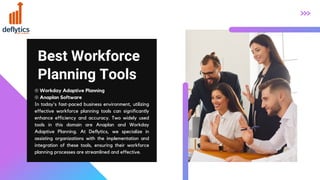
Best Workforce
Planning Tools
⊛ Workday Adaptive Planning
⊛ Anaplan Software
In today's fast-paced business environment, utilizing
effective workforce planning tools can significantly
enhance efficiency and accuracy. Two widely used
tools in this domain are Anaplan and Workday
Adaptive Planning. At Deflytics, we specialize in
assisting organizations with the implementation and
integration of these tools, ensuring their workforce
planning processes are streamlined and effective.
ANAPLAN: CONNECTING REAL-TIME COLLABORATION
AND ACCURATE FORECASTING
Anaplan stands out for its "connected planning" approach, facilitating real-time collaborations across
all business functions. By harnessing the power of hyperscale computing, Anaplan enables more precise
and accurate forecasting. This feature is invaluable for organizations seeking to make data-driven
decisions based on real-time insights.
One of the key strengths of Anaplan is its ability to narrow down the best candidates within a company.
Using attributes such as time in role, years of experience, and skills, the software helps identify the
most suitable individuals for specific positions. Anaplan also offers compensation modeling, which
allows organizations to work on retention strategies with a focus on diversity, equity, and inclusion
(DEI).
Furthermore, Anaplan Strategic HR Planning seamlessly integrates with other software solutions such as
Boomi, DocuSign, Salesforce, and OneCloud. This integration capability enhances the overall efficiency
and effectiveness of the workforce planning process.
CUSTOMERS
WORKDAY ADAPTIVE PLANNING: REAL-TIME MODELING
AND SEAMLESS INTEGRATION
Workday Adaptive Planning empowers organizations to model various what-if scenarios in real time, providing valuable
insights into the potential impacts of different workforce planning strategies. By enabling planning based on levels,
departments, skills, project locations, and more, organizations can create comprehensive and adaptable workforce plans.
A notable feature of Workday Adaptive Planning is its ability to sync plans and budgets with financial plans in real time.
This eliminates the need for back-and-forth email exchanges and ensures alignment between workforce planning and
financial objectives. The software also allows for rapid modeling in critical situations like mergers or restructuring,
enabling organizations to respond effectively to significant events.
In terms of integration, Workday Adaptive Planning seamlessly connects with any HR system and other Workday-related
products within an organization's ecosystem. This integration capability ensures smooth data flow and enhances the
overall efficiency of the workforce planning process.
In the realm of strategic workforce planning, leveraging powerful tools like Anaplan and Workday Adaptive Planning offers
numerous benefits. These tools reduce manual effort, optimize resource allocation, and enable faster and more accurate
workforce planning outcomes. However, effectively utilizing multiple workforce planning tools can pose a challenge. At
Deflytics, we are dedicated to helping organizations overcome this challenge by providing implementation support and
expertise in integrating these tools into their existing systems. With the right tools and expert assistance, organizations
can enhance the effectiveness and efficiency of their workforce planning processes, ultimately leading to improved
business performance.
FREQUENTLY ASKED QUESTIONS
ABOUT WORKFORCE PLANNING
deflytics.com
Q. WHAT ARE EXAMPLES OF WORKFORCE PLANNING?
Ans. Strategic workforce planning and Operational workforce
planning are two examples of workforce planning
Q. WHAT IS THE IMPORTANCE OF WORKFORCE PLANNING?
Ans. Workforce planning gives organization the ability to link their
resource plans to their revenue objectives and change the workforce
mix to ever-changing business demand.
Q. WHAT ARE EFFECTIVE WORKFORCE PLANNING TOOLS?
Ans. Anaplan and Workday Adaptive Planning are two of the most
widely used Workforce planning platforms.
Q. WHAT IS SUCCESSION PLANNING, AND WHY IS IT CRUCIAL IN
WORKFORCE PLANNING?
Ans. Even after taking care of its employees it is likely that some may decide to leave for various reasons. Similarly
some employees may be nearing their working tenure. Thus organizations need to proactively work on identifying
candidates, both internally and externally, who will be able to take up the roles left vacant. This is succession
planning. Succession planning is important because without it organizations will be left with roles but no people
to execute them literally impacting the their chances of meeting the annual plan.
Thank You
For Your Attention
deflytics.com/
Visit Our Website

Workforce Planning Guide Definition, Importance & Best Practicess.pdf

  • 1.
    WORKFORCE PLANNING GUIDE: DEFINITION,IMPORTANCE & BEST PRACTICES deflytics.com Visit Our Website:
  • 2.
    About Worfroce Planning Intoday's rapidly evolving business environment, organizations face a multitude of challenges, from talent shortages to unpredictable market conditions. Workforce planning emerges as a vital strategic tool that helps organizations align their human capital with business objectives. In this comprehensive blog, we will explore the importance of workforce planning, discuss various types of workforce planning, delve into the key elements involved, highlight best practices for effective implementation, and outline the wide-ranging benefits it offers.
  • 3.
    ◎Strategic Workforce Planning ◎OperationalWorkforce Planning Workforce planning can take different forms based on an organization's goals and context. Let's explore two common types of workforce planning: Strategic Workforce Planning: This type of planning aligns an organization's human capital strategy with its long-term business objectives. Strategic workforce planning focuses on identifying critical roles and competencies necessary to achieve strategic goals. It involves analyzing internal and external factors, such as demographic trends, talent availability, and technological advancements, to ensure the organization has the right talent to succeed in the future. Operational Workforce Planning: Operational workforce planning concentrates on short-term workforce requirements to meet immediate operational needs. It involves analyzing current staffing levels, skills gaps, workload distribution, and seasonal variations. Operational workforce planning ensures that day-to-day operations run smoothly by balancing workloads, managing leave schedules, and responding to short-term fluctuations in demand. Major Types of Workforce Planning
  • 4.
    Importance of WorkforcePlanning in Today's Business Environment Workforce planning is integral to ensuring organizations have the right talent, skills, and competencies to achieve their strategic goals. Here are some key reasons why workforce planning is important: Anticipating Future Needs: Workforce planning enables organizations to forecast their future workforce requirements. By analyzing business objectives, market trends, and industry changes, organizations can proactively identify the skills and talent needed to meet evolving demands. This ensures a consistent supply of capable employees, preventing disruptions in productivity and customer service. Mitigating Talent Shortages: Through workforce planning, organizations can identify potential talent gaps and develop strategies to address them. By implementing targeted recruitment, training, and development initiatives, businesses can bridge skill shortages. This proactive approach ensures a strong talent pipeline and reduces reliance on external hiring. Controlling Labor Costs: Effective workforce planning optimizes labor costs by aligning staffing levels with operational demands. By avoiding unnecessary recruitment or layoffs, organizations can strike a balance between workforce size and business objectives, minimizing costs while maintaining productivity
  • 5.
    Key Elements ofEffective Workforce Planning To implement effective workforce planning, organizations should consider the following key elements: Data Analysis: Workforce planning relies on accurate and reliable data to forecast future needs. Organizations should collect and analyze data related to workforce demographics, turnover rates, skills inventory, performance metrics, and market trends. This data-driven approach provides insights for making informed decisions. Collaboration: Successful workforce planning requires collaboration between HR, finance, operations, and other key stakeholders. Engaging these departments ensures a comprehensive understanding of business objectives, financial constraints, and operational realities. Collaboration fosters alignment and increases the chances of successful workforce planning implementation. Succession Planning: Identifying and developing future leaders is a critical aspect of workforce planning. Organizations should establish a robust succession planning process to ensure a smooth transition of key roles and minimize disruptions. By cultivating a talent pipeline, businesses can prepare for potential leadership gaps and ensure continuity. Talent Acquisition and Development: Workforce planning goes beyond hiring. It includes strategies for attracting top talent, developing existing employees, and creating a learning culture. Organizations should implement effective recruitment and onboarding processes, provide continuous training and development opportunities, and promote internal mobility
  • 6.
    Best Practice forWorkforce Planning To optimize the outcomes of workforce planning, organizations should consider the following best practices: Align Workforce Planning with Business Strategy: Workforce planning should be integrated with the overall business strategy. This alignment ensures that the organization's human capital strategy supports its strategic objectives. Regularly review and update the workforce plan to reflect changes in business goals and market conditions. Involve Key Stakeholders: Engage senior leadership, department heads, and line managers in the workforce planning process. Their insights and perspectives are invaluable for understanding the current and future workforce needs of their respective areas. Collaboration fosters ownership and enhances the accuracy of the planning process. Use Scenario Planning: Develop multiple scenarios to assess the impact of different workforce planning strategies. Consider factors such as technological advancements, industry disruptions, and economic shifts. By exploring various scenarios, organizations can anticipate potential challenges and devise agile workforce strategies to respond effectively. Invest in Workforce Analytics: Leverage advanced analytics tools to analyze and interpret workforce data. This allows organizations to gain deep insights into workforce demographics, skills gaps, and performance metrics. Workforce analytics enables data-driven decision-making and facilitates proactive planning.
  • 7.
    Implementing effective workforceplanning offers numerous benefits for organizations: Enhanced Agility and Adaptability: Workforce planning enables organizations to adapt swiftly to changing market conditions. By identifying potential skill gaps and aligning talent with emerging needs, businesses can stay ahead of competitors and seize new opportunities. Improved Employee Engagement and Retention: Workforce planning emphasizes the development and growth of employees. By providing clear career paths, training opportunities, and succession planning, organizations can foster a culture of engagement, motivating employees to stay and contribute to long-term success. Cost Optimization: Workforce planning helps optimize labor costs by ensuring the right number of employees with the right skills are available when needed. By avoiding unnecessary recruitment or layoffs, organizations can minimize expenses while maintaining productivity levels. Talent Pipeline Development: Workforce planning facilitates the identification and development of high- potential employees. By nurturing internal talent, organizations can build a strong talent pipeline and reduce reliance on external hiring, saving recruitment costs and ensuring continuity. Workforce planning is a critical strategic tool that enables organizations to align their human capital with business objectives. By anticipating future needs, mitigating talent shortages, and optimizing labor costs, workforce planning positions organizations for success in an ever-changing marketplace. By incorporating the key elements and best practices discussed in this blog, businesses can unlock the full potential of their workforce and drive sustainable growth. How To Measure The Success Of A Business Strategy
  • 8.
    Implementing effective workforceplanning offers numerous benefits for organizations: Enhanced Agility and Adaptability: Workforce planning enables organizations to adapt swiftly to changing market conditions. By identifying potential skill gaps and aligning talent with emerging needs, businesses can stay ahead of competitors and seize new opportunities. Improved Employee Engagement and Retention: Workforce planning emphasizes the development and growth of employees. By providing clear career paths, training opportunities, and succession planning, organizations can foster a culture of engagement, motivating employees to stay and contribute to long- term success. Cost Optimization: Workforce planning helps optimize labor costs by ensuring the right number of employees with the right skills are available when needed. By avoiding unnecessary recruitment or layoffs, organizations can minimize expenses while maintaining productivity levels. Talent Pipeline Development: Workforce planning facilitates the identification and development of high- potential employees. By nurturing internal talent, organizations can build a strong talent pipeline and reduce reliance on external hiring, saving recruitment costs and ensuring continuity. Workforce planning is a critical strategic tool that enables organizations to align their human capital with business objectives. By anticipating future needs, mitigating talent shortages, and optimizing labor costs, workforce planning positions organizations for success in an ever-changing marketplace. By incorporating the key elements and best practices discussed in this blog, businesses can unlock the full potential of their workforce and drive sustainable growth. Benefits of Implementing a Workforce Planning Strategy
  • 9.
    Developing a successfulworkforce planning process requires careful planning and execution. Here are the steps to follow: Define Strategic Objectives: Start by aligning your workforce planning process with the organization's strategic objectives. Understand the long-term goals and business priorities to identify the workforce capabilities required to achieve them. Gather and Analyze Data: Collect relevant data about your current workforce, including demographics, skills, performance, turnover rates, and future workforce needs. Use workforce analytics tools to analyze the data and identify trends and gaps. Conduct Workforce Analysis: Analyze the data to understand your organization's current and future workforce requirements. Identify areas of strengths and weaknesses, critical roles, and skills gaps. Consider both internal and external factors that may impact your workforce, such as market trends, technological advancements, and regulatory changes. Steps to Develop a Successful Workforce Planning Process
  • 10.
    Develop Workforce Strategies:Based on the analysis, develop strategies to address the identified gaps and meet future workforce needs. This may include strategies for recruitment, training and development, succession planning, talent acquisition, and retention. Align these strategies with the organization's goals and budget constraints. Collaborate with Stakeholders: Involve key stakeholders, including senior leadership, department heads, and HR representatives, in the workforce planning process. Seek their input and ensure alignment with the organization's overall strategy. Collaboration enhances buy-in, ownership, and the accuracy of the planning process. Implement Actionable Plans: Translate the workforce strategies into actionable plans with clear objectives, timelines, and responsibilities. Identify specific initiatives and programs to address the identified gaps and support the organization's long-term goals. Allocate resources, budget, and track progress regularly. Monitor and Evaluate: Regularly monitor and evaluate the effectiveness of the implemented workforce planning initiatives. Review key metrics, such as employee turnover, skills development, and performance, to assess the impact of the workforce strategies. Make adjustments and refinements as needed to optimize outcomes. Foster a Learning Culture: Encourage a culture of continuous learning and development within the organization. Offer training programs, mentorship opportunities, and career advancement paths to nurture talent and increase employee engagement. Monitor and support the development of high-potential employees for future leadership positions.
  • 11.
    Stay Agile andFlexible: Workforce planning is an ongoing process that needs to adapt to changing business environments. Continuously monitor market trends, industry disruptions, and evolving workforce needs. Be prepared to adjust your strategies and plans accordingly to ensure alignment with the organization's goals. Communicate and Engage: Effective communication is crucial throughout the workforce planning process. Transparently communicate the objectives, progress, and outcomes of the workforce planning initiatives to all employees. Involve them in the decision-making process when appropriate, and seek their feedback and suggestions. By following these steps, organizations can develop a successful workforce planning process that aligns the workforce with strategic objectives, addresses skills gaps, and positions the organization for future success.
  • 12.
    Best Workforce Planning Tools ⊛Workday Adaptive Planning ⊛ Anaplan Software In today's fast-paced business environment, utilizing effective workforce planning tools can significantly enhance efficiency and accuracy. Two widely used tools in this domain are Anaplan and Workday Adaptive Planning. At Deflytics, we specialize in assisting organizations with the implementation and integration of these tools, ensuring their workforce planning processes are streamlined and effective.
  • 13.
    ANAPLAN: CONNECTING REAL-TIMECOLLABORATION AND ACCURATE FORECASTING Anaplan stands out for its "connected planning" approach, facilitating real-time collaborations across all business functions. By harnessing the power of hyperscale computing, Anaplan enables more precise and accurate forecasting. This feature is invaluable for organizations seeking to make data-driven decisions based on real-time insights. One of the key strengths of Anaplan is its ability to narrow down the best candidates within a company. Using attributes such as time in role, years of experience, and skills, the software helps identify the most suitable individuals for specific positions. Anaplan also offers compensation modeling, which allows organizations to work on retention strategies with a focus on diversity, equity, and inclusion (DEI). Furthermore, Anaplan Strategic HR Planning seamlessly integrates with other software solutions such as Boomi, DocuSign, Salesforce, and OneCloud. This integration capability enhances the overall efficiency and effectiveness of the workforce planning process. CUSTOMERS
  • 14.
    WORKDAY ADAPTIVE PLANNING:REAL-TIME MODELING AND SEAMLESS INTEGRATION Workday Adaptive Planning empowers organizations to model various what-if scenarios in real time, providing valuable insights into the potential impacts of different workforce planning strategies. By enabling planning based on levels, departments, skills, project locations, and more, organizations can create comprehensive and adaptable workforce plans. A notable feature of Workday Adaptive Planning is its ability to sync plans and budgets with financial plans in real time. This eliminates the need for back-and-forth email exchanges and ensures alignment between workforce planning and financial objectives. The software also allows for rapid modeling in critical situations like mergers or restructuring, enabling organizations to respond effectively to significant events. In terms of integration, Workday Adaptive Planning seamlessly connects with any HR system and other Workday-related products within an organization's ecosystem. This integration capability ensures smooth data flow and enhances the overall efficiency of the workforce planning process. In the realm of strategic workforce planning, leveraging powerful tools like Anaplan and Workday Adaptive Planning offers numerous benefits. These tools reduce manual effort, optimize resource allocation, and enable faster and more accurate workforce planning outcomes. However, effectively utilizing multiple workforce planning tools can pose a challenge. At Deflytics, we are dedicated to helping organizations overcome this challenge by providing implementation support and expertise in integrating these tools into their existing systems. With the right tools and expert assistance, organizations can enhance the effectiveness and efficiency of their workforce planning processes, ultimately leading to improved business performance.
  • 15.
    FREQUENTLY ASKED QUESTIONS ABOUTWORKFORCE PLANNING deflytics.com
  • 16.
    Q. WHAT AREEXAMPLES OF WORKFORCE PLANNING? Ans. Strategic workforce planning and Operational workforce planning are two examples of workforce planning Q. WHAT IS THE IMPORTANCE OF WORKFORCE PLANNING? Ans. Workforce planning gives organization the ability to link their resource plans to their revenue objectives and change the workforce mix to ever-changing business demand.
  • 17.
    Q. WHAT AREEFFECTIVE WORKFORCE PLANNING TOOLS? Ans. Anaplan and Workday Adaptive Planning are two of the most widely used Workforce planning platforms. Q. WHAT IS SUCCESSION PLANNING, AND WHY IS IT CRUCIAL IN WORKFORCE PLANNING? Ans. Even after taking care of its employees it is likely that some may decide to leave for various reasons. Similarly some employees may be nearing their working tenure. Thus organizations need to proactively work on identifying candidates, both internally and externally, who will be able to take up the roles left vacant. This is succession planning. Succession planning is important because without it organizations will be left with roles but no people to execute them literally impacting the their chances of meeting the annual plan.
  • 18.
    Thank You For YourAttention deflytics.com/ Visit Our Website