Your Mission – Our PassionDriving Workforce Transformation Through MetricsPresent by:Russell M. Klosk, MBA, SPHR, GPHRPaul Thornton, Ph. D.
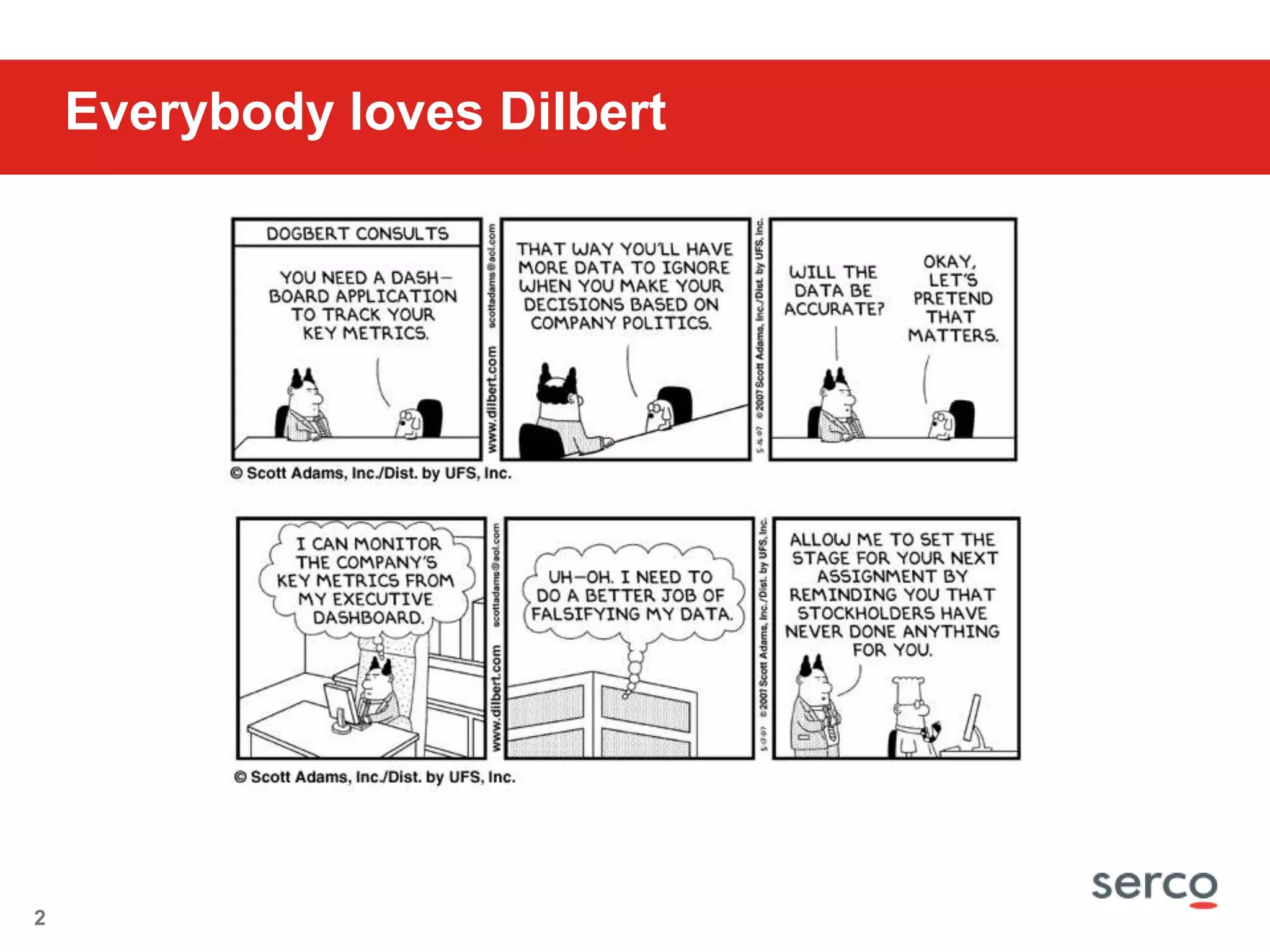
Everybody loves Dilbert
What are we going to cover?What are leaders asking of the HR organization?  How do metrics support this?The role of Metrics as an enablement mechanism in HR TransformationAre you measuring the right things?Real world examplesIn other wordsWhich key data should be shared and highlighted to your executive team Review your data to determine what changes will spur new innovation and growth (Transformational data)Architecture &  tools to help accomplish thisUnderstand where your workforce resources should be allocatedWhat does it look like
About UsSercoFortune 500 company with over $6B annual sales
More than 70,000 employees globally
UK Headquartered and operating in 50 countries around the world
US Headquarters in Reston, VA
Over 11,000 US Based skilled and dedicated professionals
Professional service firms offering a full range of Management Consulting services.
We embed metrics into everything we do, both HR metrics and performance metrics.
30+ years corporate experience driving HR TransformationRussell Klosk, MBA, SPHR, GPHRPaul Thornton, Ph.D.We are a leading provider of professional, technology and management services.Advise   |   Design   |   Integrate   |   Deliver
Organizational priorities are changingShift from transactional to strategic Mission attainment is leadership’s top priority - and innovation is required to enable itResponsiveness and agility are the new key competencies, requiring innovation across three areas:Offerings and services Operation of core functional areasOverall enterprise model (especially collaboration)Operatingmodelinnovation is becoming as important as traditional offering and service innovation. Organizations that outperform focus on this But, collaboration and model reinvention require strong leadership of change, notably in the areas of: CultureRewardsIntegration of process and technologySource: 456 CEOs, IBM Global CEO Study, 2004765 CEOs, IBM Global CEO Study 2006
The Question Leaders Aren’t AskingHow do I make decisions about human resources with the same rigor as I do about finance or operations?What types of  metrics and dashboards empower me (leaders) to accomplish this?
These priorities shape the new Human Capital agendaHR Executives are challenged to ensure the right balance between strategic effectiveness of HR and operational efficiency of the functionAs people challenges including cultural development, leadership and collaboration become a critical part of achieving innovation, the Human Capital agenda must evolveA variable and efficient cost model for the HR function with high service levels is required
Organizations require many delivery channels to ensure employee and manager access
CHROs must be able to demonstrate the link between Human Capital activities and business results
The decision to build or buy skills becomes central
Retaining key people when facing a shortage of supply is critical
Work must transform to shortages
Organizations must measure and reward executives and the HR function by how they deliver on the critical talent agenda
Developing skills to support growth, innovation, differentiation and customer satisfaction becomes a top priority
Collaboration across the company, channels, and citizens is needed to transform workWhat key data should be shared?There is no one magic bulletYou must determine what metrics drive organizational capability given your unique business environment If you are looking for a single metric or data element that is everything your HR Executives need you are missing the markIt is entirely about looking at all the relevant data and getting to those that tell a meaningful story for what you are trying to accomplishHow do get to this?
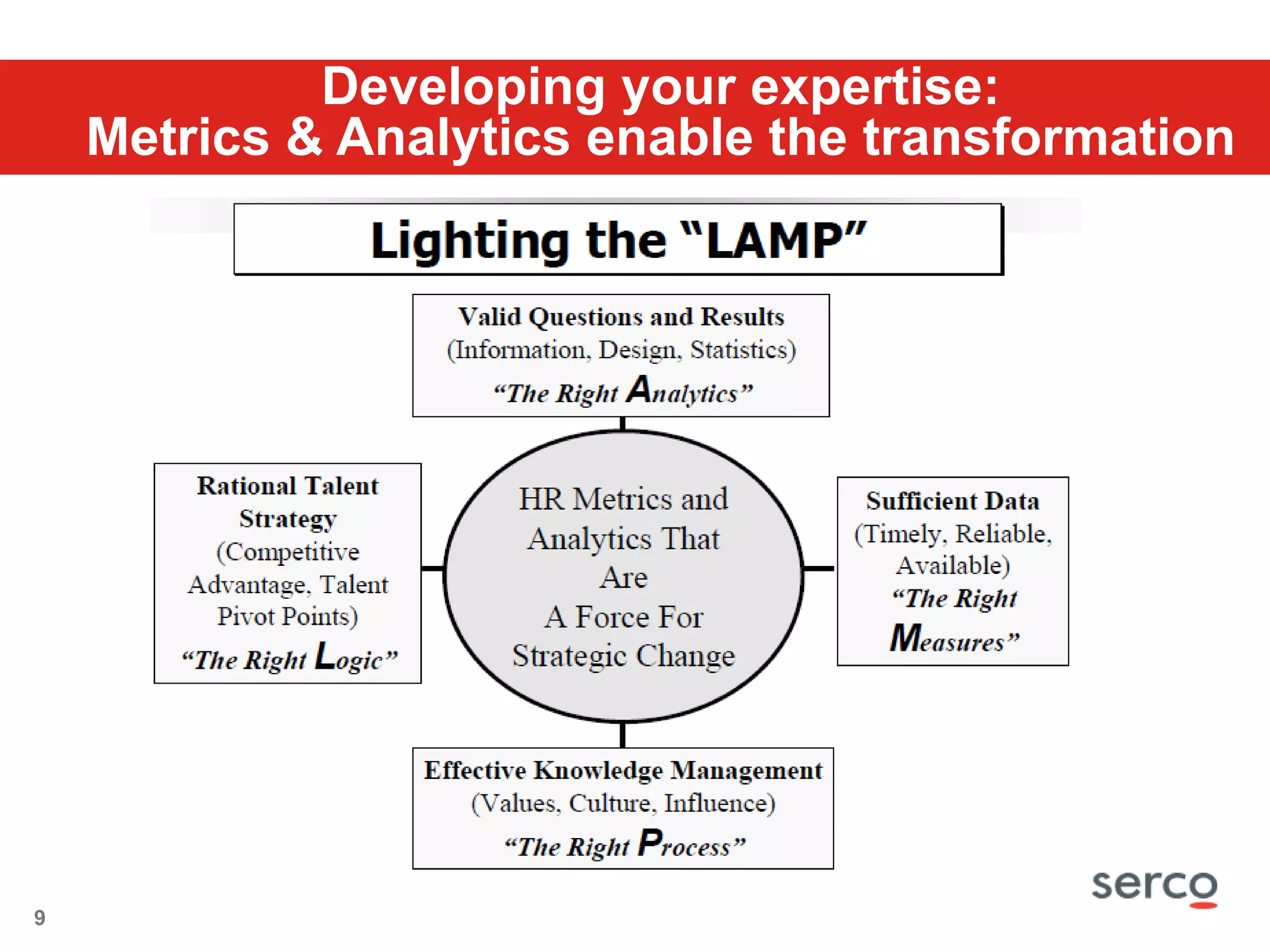
Developing your expertise:Metrics & Analytics enable the transformation

Driving Hr Transformation With Metrics V7

  • 1.
    Your Mission –Our PassionDriving Workforce Transformation Through MetricsPresent by:Russell M. Klosk, MBA, SPHR, GPHRPaul Thornton, Ph. D.
  • 2.
  • 3.
    What are wegoing to cover?What are leaders asking of the HR organization? How do metrics support this?The role of Metrics as an enablement mechanism in HR TransformationAre you measuring the right things?Real world examplesIn other wordsWhich key data should be shared and highlighted to your executive team Review your data to determine what changes will spur new innovation and growth (Transformational data)Architecture & tools to help accomplish thisUnderstand where your workforce resources should be allocatedWhat does it look like
  • 4.
    About UsSercoFortune 500company with over $6B annual sales
  • 5.
    More than 70,000employees globally
  • 6.
    UK Headquartered andoperating in 50 countries around the world
  • 7.
  • 8.
    Over 11,000 USBased skilled and dedicated professionals
  • 9.
    Professional service firmsoffering a full range of Management Consulting services.
  • 10.
    We embed metricsinto everything we do, both HR metrics and performance metrics.
  • 11.
    30+ years corporateexperience driving HR TransformationRussell Klosk, MBA, SPHR, GPHRPaul Thornton, Ph.D.We are a leading provider of professional, technology and management services.Advise | Design | Integrate | Deliver
  • 12.
    Organizational priorities arechangingShift from transactional to strategic Mission attainment is leadership’s top priority - and innovation is required to enable itResponsiveness and agility are the new key competencies, requiring innovation across three areas:Offerings and services Operation of core functional areasOverall enterprise model (especially collaboration)Operatingmodelinnovation is becoming as important as traditional offering and service innovation. Organizations that outperform focus on this But, collaboration and model reinvention require strong leadership of change, notably in the areas of: CultureRewardsIntegration of process and technologySource: 456 CEOs, IBM Global CEO Study, 2004765 CEOs, IBM Global CEO Study 2006
  • 13.
    The Question LeadersAren’t AskingHow do I make decisions about human resources with the same rigor as I do about finance or operations?What types of metrics and dashboards empower me (leaders) to accomplish this?
  • 14.
    These priorities shapethe new Human Capital agendaHR Executives are challenged to ensure the right balance between strategic effectiveness of HR and operational efficiency of the functionAs people challenges including cultural development, leadership and collaboration become a critical part of achieving innovation, the Human Capital agenda must evolveA variable and efficient cost model for the HR function with high service levels is required
  • 15.
    Organizations require manydelivery channels to ensure employee and manager access
  • 16.
    CHROs must beable to demonstrate the link between Human Capital activities and business results
  • 17.
    The decision tobuild or buy skills becomes central
  • 18.
    Retaining key peoplewhen facing a shortage of supply is critical
  • 19.
  • 20.
    Organizations must measureand reward executives and the HR function by how they deliver on the critical talent agenda
  • 21.
    Developing skills tosupport growth, innovation, differentiation and customer satisfaction becomes a top priority
  • 22.
    Collaboration across thecompany, channels, and citizens is needed to transform workWhat key data should be shared?There is no one magic bulletYou must determine what metrics drive organizational capability given your unique business environment If you are looking for a single metric or data element that is everything your HR Executives need you are missing the markIt is entirely about looking at all the relevant data and getting to those that tell a meaningful story for what you are trying to accomplishHow do get to this?
  • 23.
    Developing your expertise:Metrics& Analytics enable the transformation
  • 24.
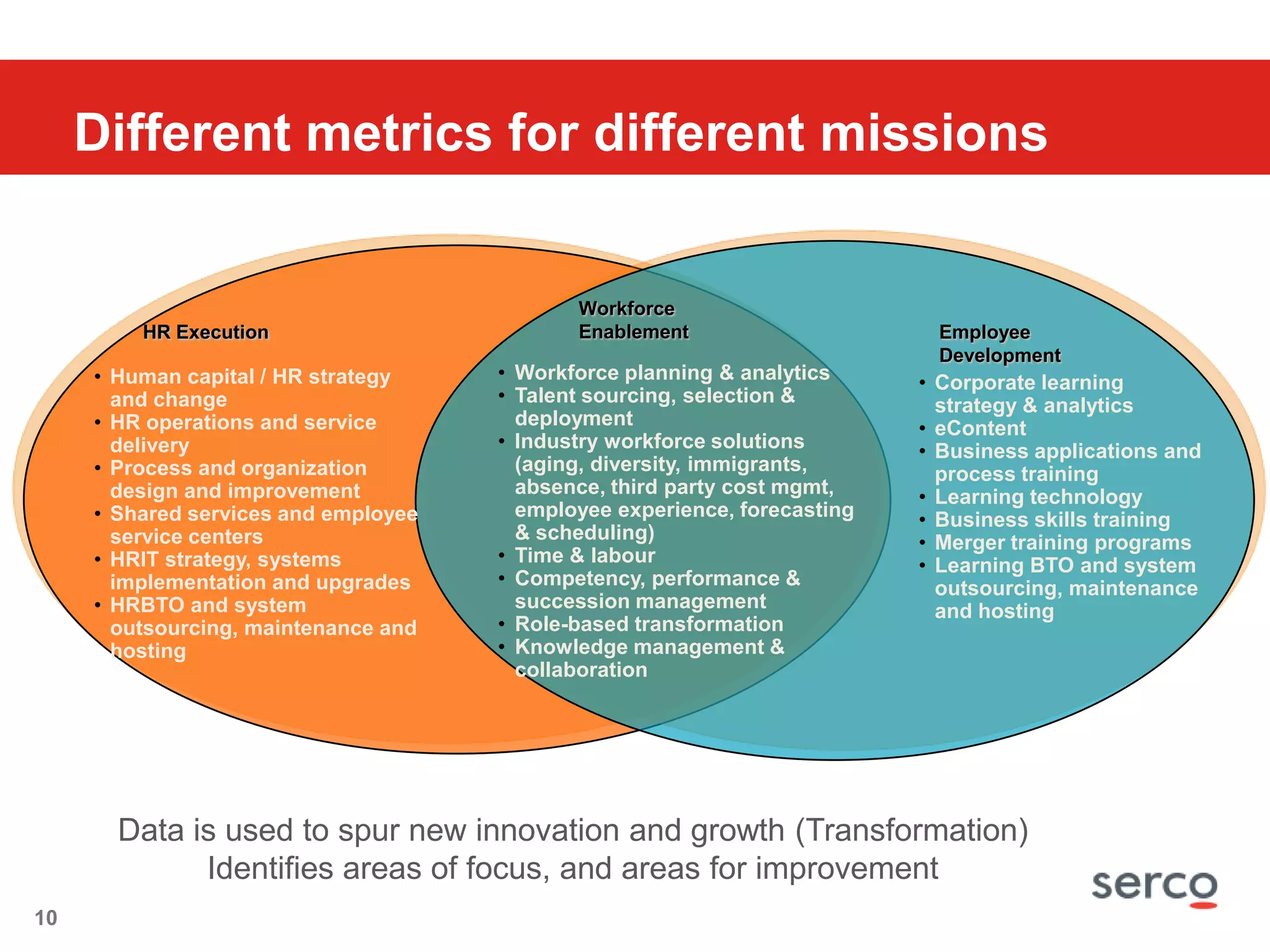
    Different metrics fordifferent missionsWorkforce EnablementHR ExecutionEmployee DevelopmentWorkforce planning & analytics
  • 25.
  • 26.
    Industry workforce solutions(aging, diversity, immigrants, absence, third party cost mgmt, employee experience, forecasting & scheduling)
  • 27.
  • 28.
    Competency, performance &succession management
  • 29.
  • 30.
  • 31.
    Human capital /HR strategy and change
  • 32.
    HR operations andservice delivery
  • 33.
    Process and organizationdesign and improvement
  • 34.
    Shared services andemployee service centers
  • 35.
    HRIT strategy, systemsimplementation and upgrades
  • 36.
    HRBTO and systemoutsourcing, maintenance and hosting
  • 37.
  • 38.
  • 39.
  • 40.
  • 41.
  • 42.
  • 43.
    Learning BTO andsystem outsourcing, maintenance and hostingData is used to spur new innovation and growth (Transformation)Identifies areas of focus, and areas for improvement
  • 44.
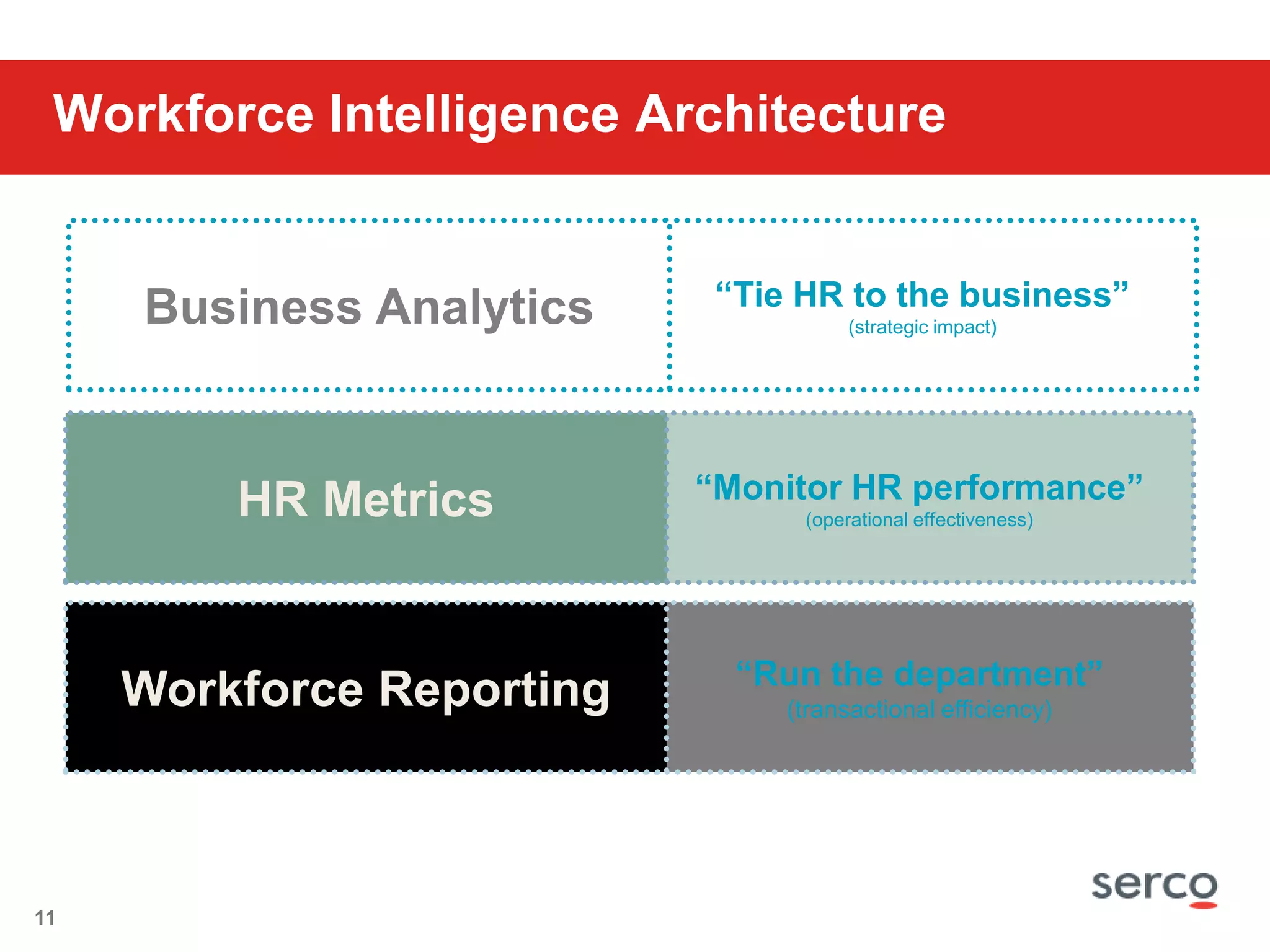
    Workforce Intelligence Architecture“TieHR to the business”(strategic impact)Business Analytics“Monitor HR performance”(operational effectiveness)HR Metrics“Run the department”(transactional efficiency)Workforce Reporting
  • 45.
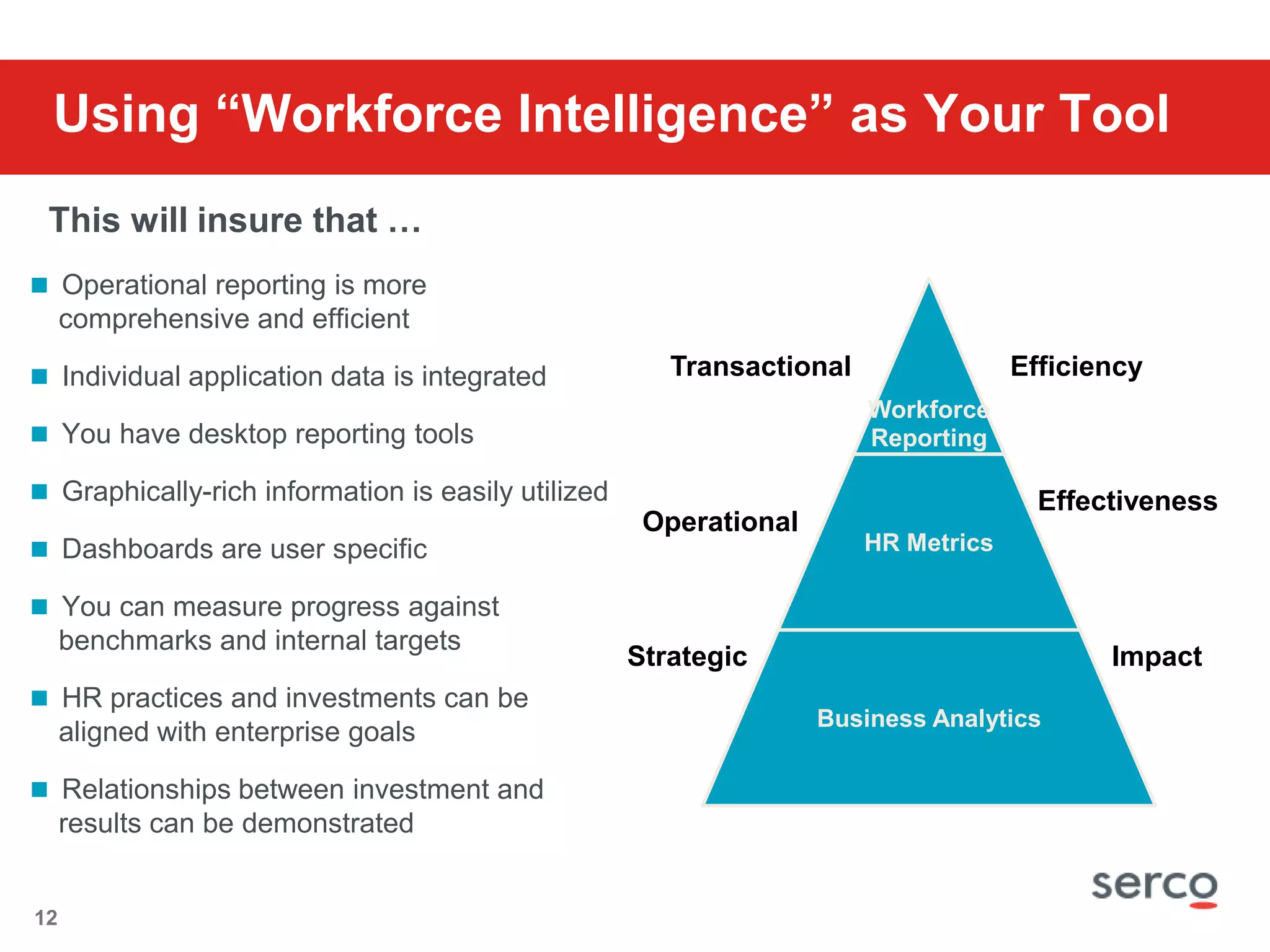
    Using “Workforce Intelligence”as Your Tool This will insure that … Operational reporting is more comprehensive and efficientIndividual application data is integrated You have desktop reporting toolsGraphically-rich information is easily utilized Dashboards are user specific You can measure progress against benchmarks and internal targetsHR practices and investments can be aligned with enterprise goalsRelationships between investment and results can be demonstratedEfficiencyTransactionalEffectivenessOperationalStrategicImpact
  • 46.
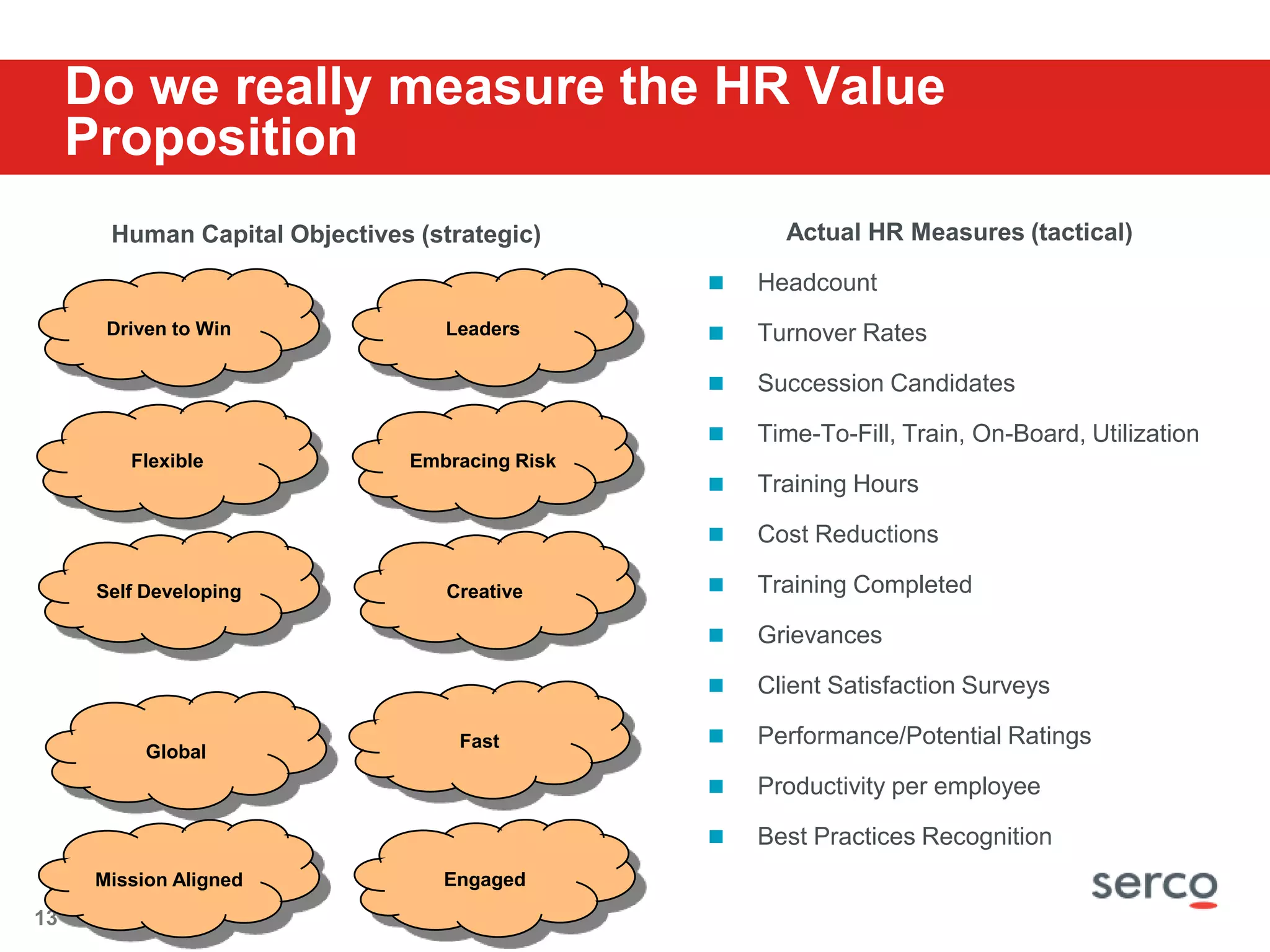
    Do we reallymeasure the HR Value PropositionActual HR Measures (tactical)HeadcountTurnover RatesSuccession CandidatesTime-To-Fill, Train, On-Board, UtilizationTraining HoursCost ReductionsTraining CompletedGrievancesClient Satisfaction SurveysPerformance/Potential RatingsProductivity per employeeBest Practices RecognitionHuman Capital Objectives (strategic)Driven to WinLeadersFlexibleEmbracing RiskSelf DevelopingCreativeFastGlobalEngagedMission Aligned
  • 47.
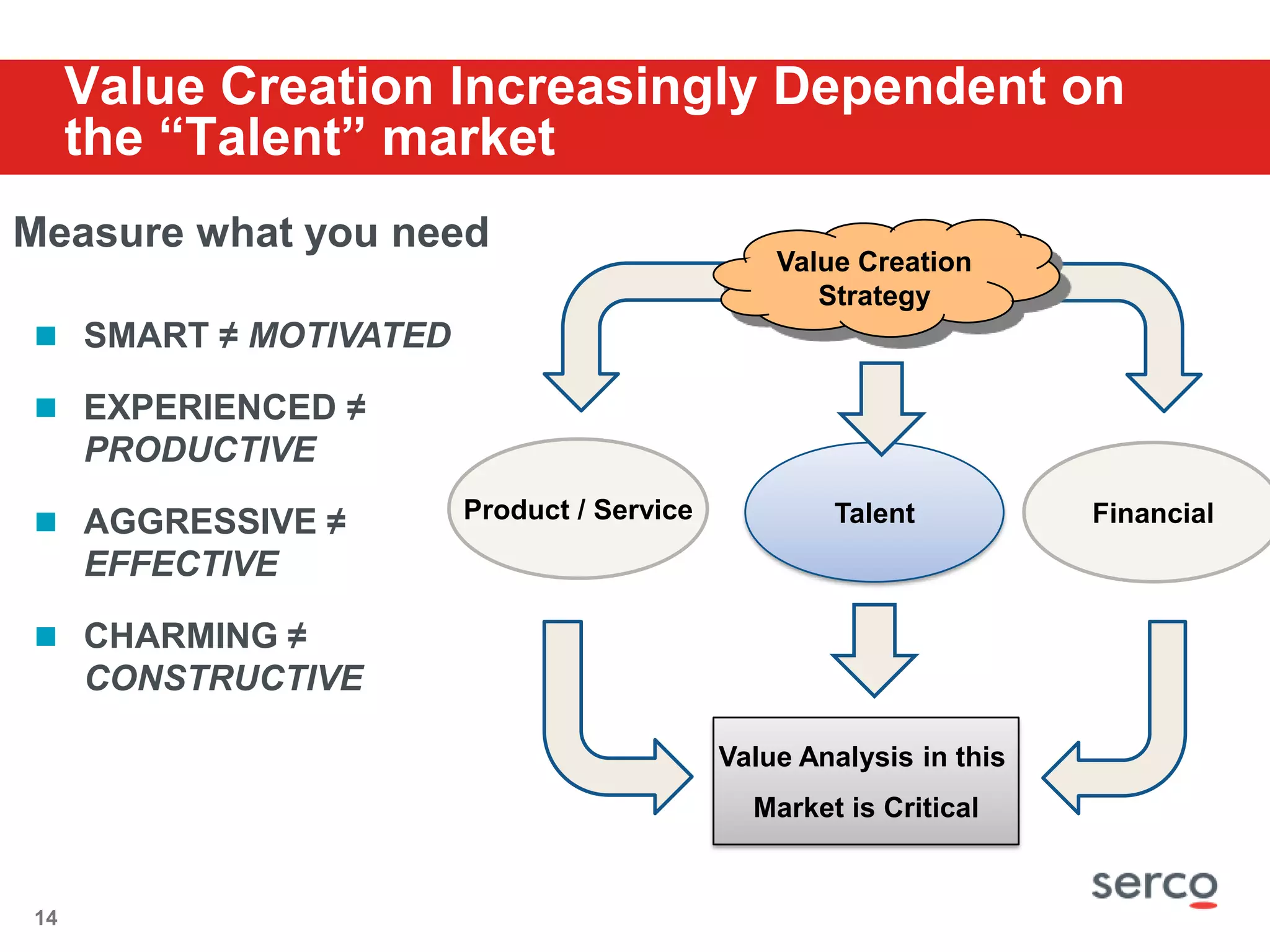
    Value Creation IncreasinglyDependent on the “Talent” marketMeasure what you needValue Creation StrategySMART ≠ MOTIVATEDEXPERIENCED ≠ PRODUCTIVEAGGRESSIVE ≠ EFFECTIVECHARMING ≠ CONSTRUCTIVEProduct / ServiceFinancialTalentValue Analysis in thisMarket is Critical
  • 48.
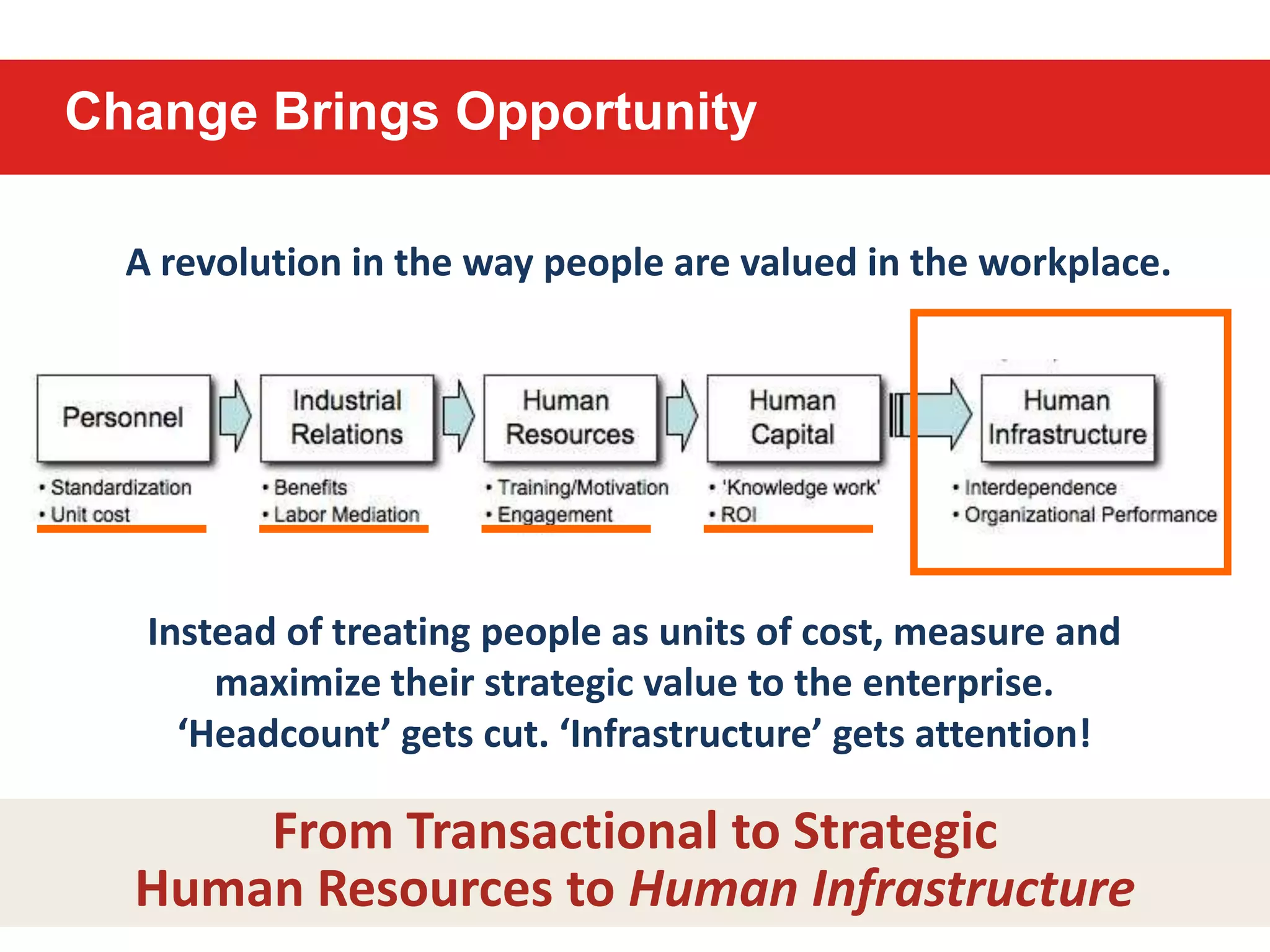
    Change Brings OpportunityArevolution in the way people are valued in the workplace.Instead of treating people as units of cost, measure and maximize their strategic value to the enterprise. ‘Headcount’ gets cut. ‘Infrastructure’ gets attention!From Transactional to StrategicHuman Resources to Human Infrastructure
  • 49.
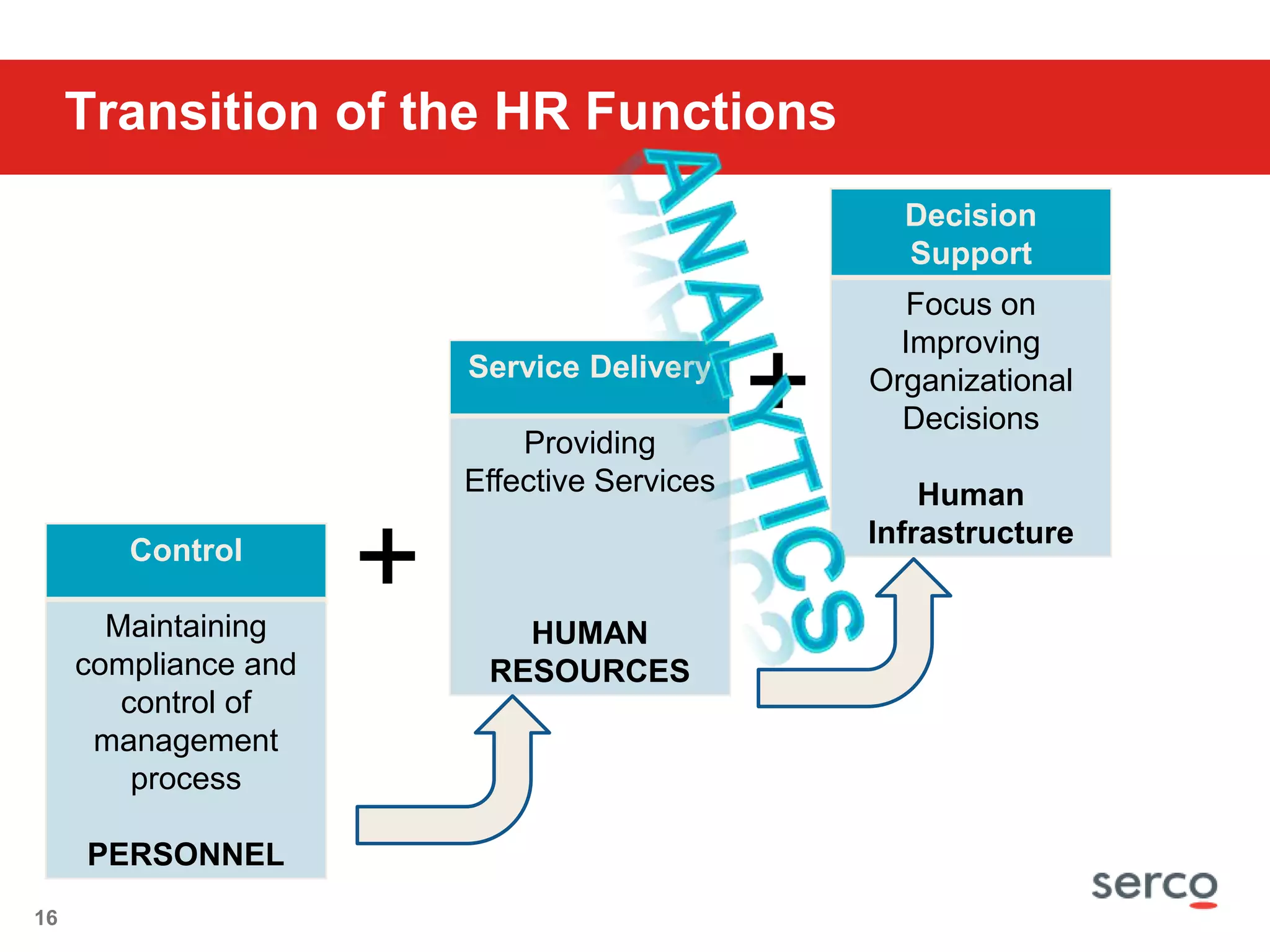
    Transition of theHR Functions+Analytics+
  • 50.
    Business Analytics Understanding how your workforce resources are allocated is what the analytics do for you.Identify top workforce drivers and allocate appropriate investments to drive company success.Align workforce performance with business strategic goals.Focus workforce practices on critical business success levers. Focus is on certifications, qualifications, competency and performance, measure not only performance but potential, maximize investments.
  • 51.
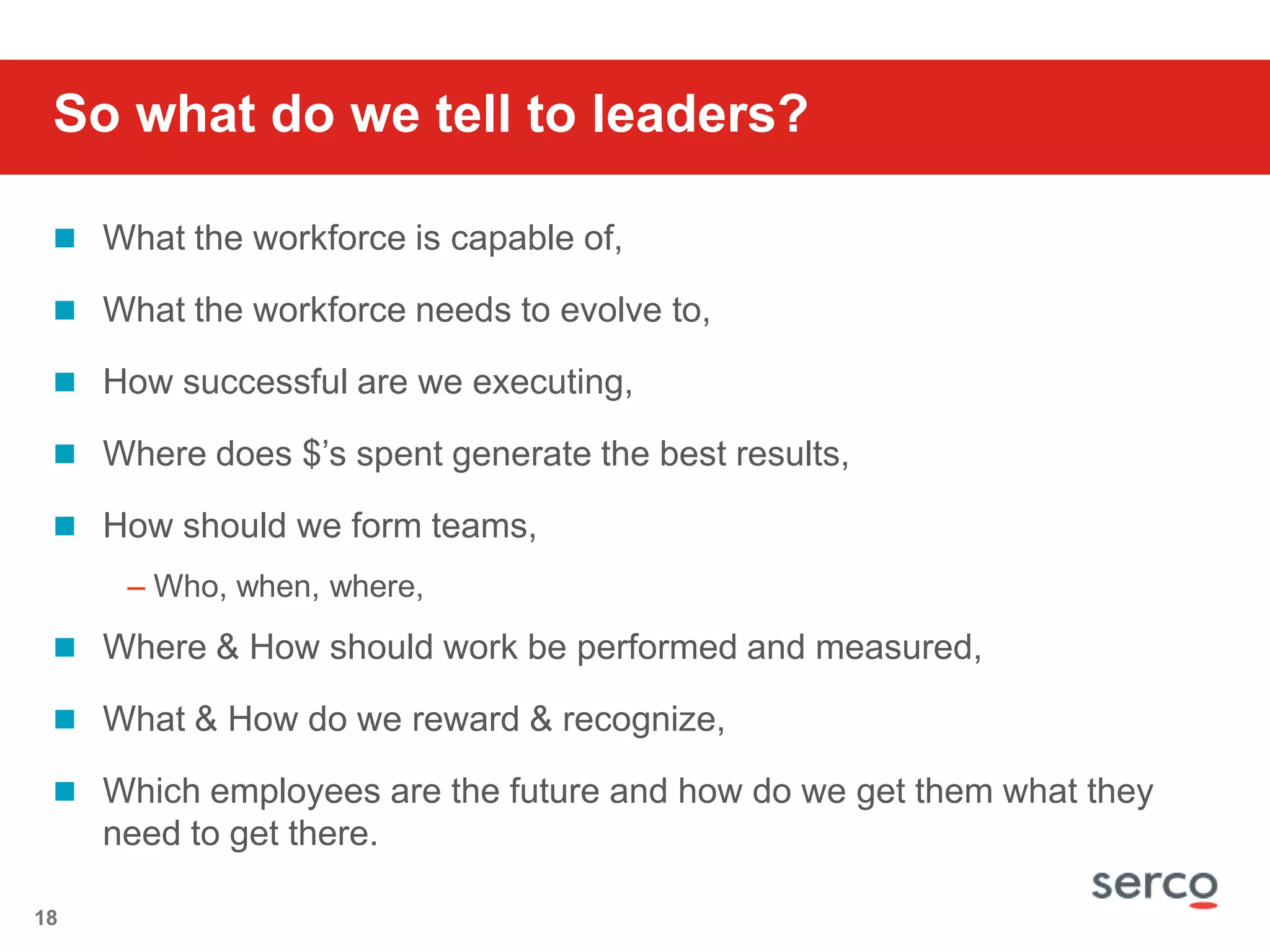
    So what dowe tell to leaders? What the workforce is capable of,What the workforce needs to evolve to,How successful are we executing,Where does $’s spent generate the best results,How should we form teams, Who, when, where,Where & How should work be performed and measured,What & How do we reward & recognize,Which employees are the future and how do we get them what they need to get there.
  • 52.
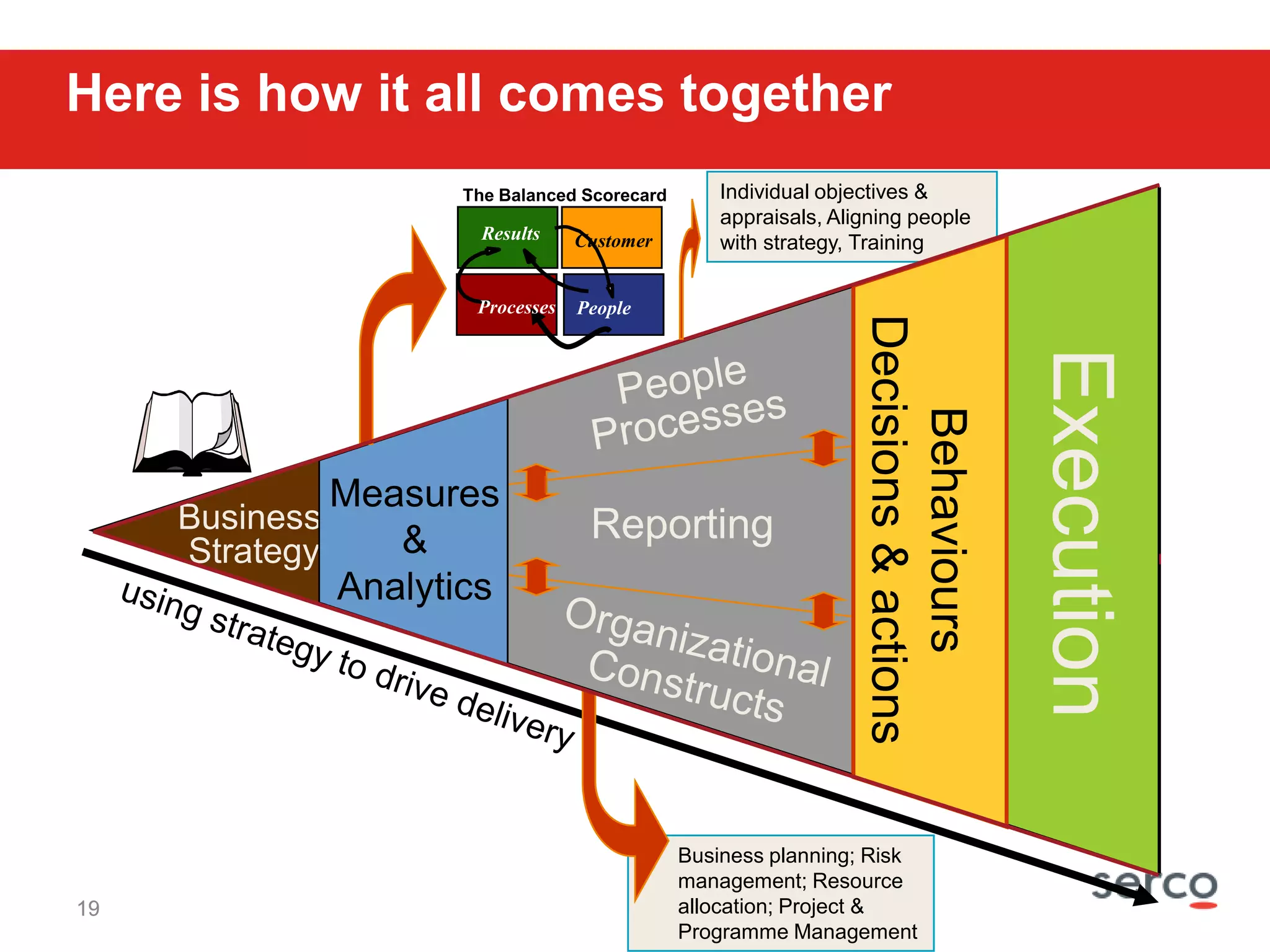
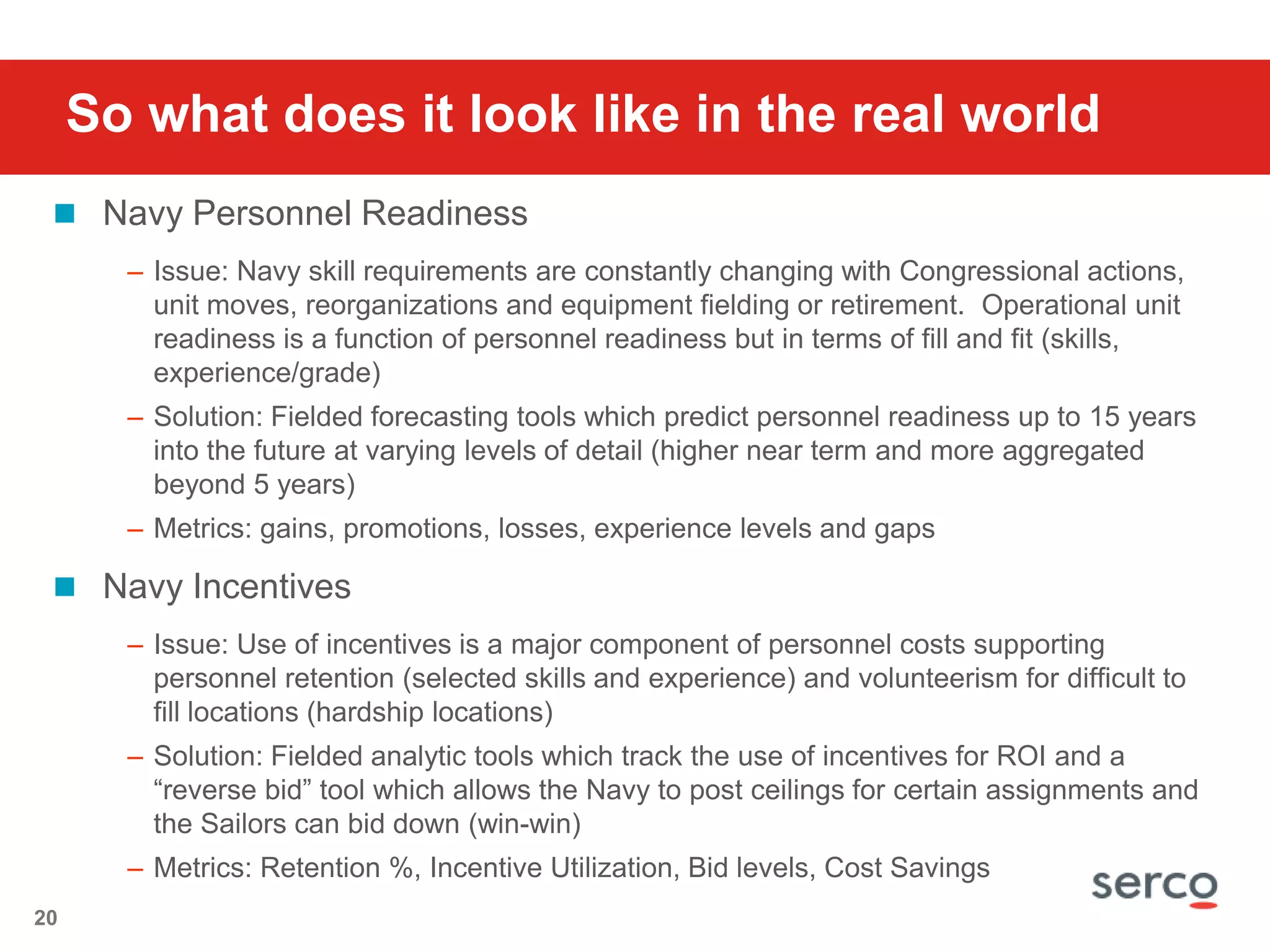
    The Balanced ScorecardResultsCustomerProcessesPeopleHereis how it all comes togetherIndividual objectives & appraisals, Aligning people with strategy, TrainingPeopleProcessesMeasures & AnalyticsBehavioursDecisions & actionsExecutionBusiness StrategyReportingOrganizationalConstructsusing strategy to drive deliveryBusiness planning; Risk management; Resource allocation; Project & Programme ManagementSo what does it look like in the real worldNavy Personnel ReadinessIssue: Navy skill requirements are constantly changing with Congressional actions, unit moves, reorganizations and equipment fielding or retirement. Operational unit readiness is a function of personnel readiness but in terms of fill and fit (skills, experience/grade) Solution: Fielded forecasting tools which predict personnel readiness up to 15 years into the future at varying levels of detail (higher near term and more aggregated beyond 5 years)Metrics: gains, promotions, losses, experience levels and gaps Navy IncentivesIssue: Use of incentives is a major component of personnel costs supporting personnel retention (selected skills and experience) and volunteerism for difficult to fill locations (hardship locations)Solution: Fielded analytic tools which track the use of incentives for ROI and a “reverse bid” tool which allows the Navy to post ceilings for certain assignments and the Sailors can bid down (win-win)Metrics: Retention %, Incentive Utilization, Bid levels, Cost Savings
  • 53.
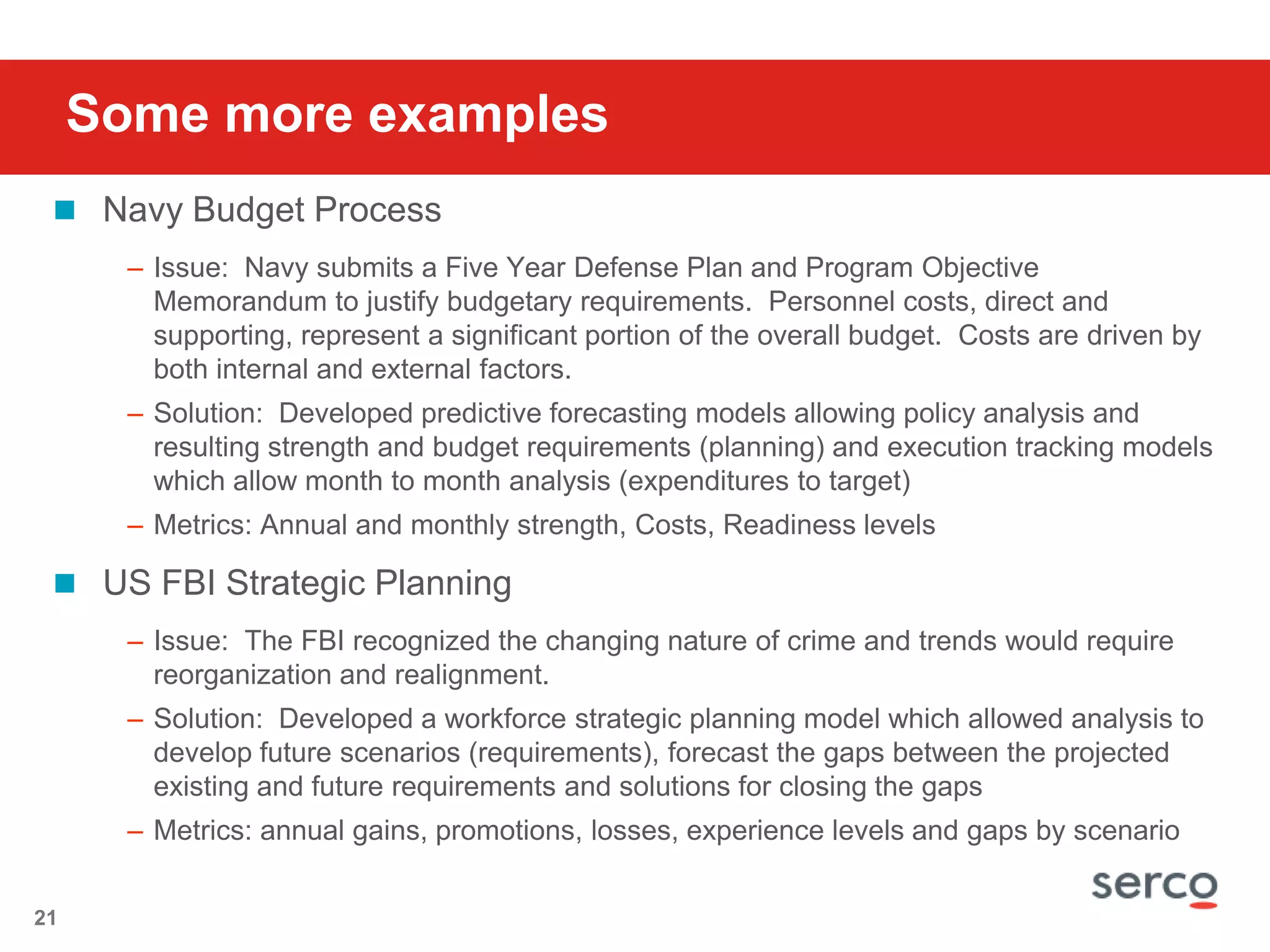
    Some more examplesNavyBudget ProcessIssue: Navy submits a Five Year Defense Plan and Program Objective Memorandum to justify budgetary requirements. Personnel costs, direct and supporting, represent a significant portion of the overall budget. Costs are driven by both internal and external factors.Solution: Developed predictive forecasting models allowing policy analysis and resulting strength and budget requirements (planning) and execution tracking models which allow month to month analysis (expenditures to target)Metrics: Annual and monthly strength, Costs, Readiness levelsUS FBI Strategic PlanningIssue: The FBI recognized the changing nature of crime and trends would require reorganization and realignment. Solution: Developed a workforce strategic planning model which allowed analysis to develop future scenarios (requirements), forecast the gaps between the projected existing and future requirements and solutions for closing the gapsMetrics: annual gains, promotions, losses, experience levels and gaps by scenario
  • 54.
  • 55.

Editor's Notes

  • #4 An overview of what we’re going to cover today. We’ve taken an approach that may be a little different from the others that you’ve seen, while we are going to go through our technical approach to all of the tasks and address the key elements of your evaluation criteria we are going to shuffle the order slightly. We understand from your instruction that you may chose to award this contract to either a single vendor, or break parts of it into multiple awards. While we firmly believe we are positioned to produce maximum efficiencies and optimal results to VA as a single provider, and that this is the best approach for the VA to take we also see the benefits to the government in multiple awards and are prepared to deliver world class results in either structure. As you here our technical approach you will see that we have shuffled the order somewhat as we believe there are core elements, such as the underlying competency model, communications and change management, that are foundational to the entire effort and which must be executed on effectively in order for success to be achieved in any of the tasks and regardless of who has ultimate responsibility for each individual tasking.
  • #7 This is what leaders should be asking, if they aren’t HR needs to help them understand why they should, and how HR can support answering these questions through the use of metrics & analyticsBecause HR needs to play this role for sr. leaders the competency models are shifting, we as practioners, need to get smart on what competencies we need
  • #10 The model is not as important as the expertise on how to Models such as LAMP have been around for a long time, we use lamp as a guiding framework, but it is entirely about the execution, not the model. Understanding what you are trying to get to, and more importantly why you are trying to get to it allows you to look at the different elements of this, or any other, framework in the right way.
  • #11 So what metrics do I want to pull. We are pulling all kinds of employee data into our systems. As you look at the different HR missions you just need to look at what your trying to do, and then pick metrics that help empower measurment of results in that function.Impacts the futureDemonstrate the value of current and past workforce investments to guide prioritization and decision-making.Optimizes assetsUse workforce investments to drive competitive advantage.Connects the dotsTie workforce performance to enterprise key performance indicators (KPI’s).Delivers efficient & accurate reportingQuickly deliver accurate reports across the enterprise through a variety of channels.Provides contextHelp leaders to better understand effective behavior, measure and improve results, and provide feedback.Once you’ve determined what you want to measure and how that drives to your focus, how do you actually dilineate what will get you there
  • #14 You still need the tactical level markers & measurements, but it is about shifting the conversation to the strategic. We all know what the items on the right say, but it is the items on the left that enable organizations to drive mission. The shift of how you use the tactical data points to drive the strategic mission is the art.Illustrative examples of some possible metrics. These are the outcomes from Workforce Intelligence Architectures and tools like LAMP, you get metrics that can answer the questions on strategic measures like these. Focus on the difference from tactical to strategic.What I hope you’re all thinking about now is not the measures of the past on the right, but the metrics of the future on the left
  • #17 Most organizations are straddling the line. We are reported and measured to death, we have 360 reviews, and dashboards, etc. but we’re still functioning as a transactional organization, what the power of analytics is revolves around how you apply the data, how you change the relationship of what you do with the data to drive transformation of the workforce.We still do both, but in a more mature organization the balance of where time is spent shifts more to the strategic and less on the tacticalMost organizations today spend 80-90% of their time providing service, 10-20% assisting decision enablement, the delta is to shift the balance to more of a 50/50 proposition
  • #20 Summation of everything we coveredRe walk through salient pointsSo now lets talk about some real life examples