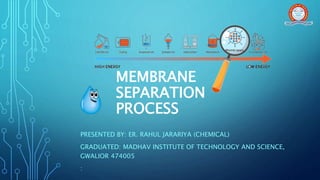

MEMBRANE
SEPARATION
PROCESS
PRESENTED BY: ER. RAHUL JARARIYA (CHEMICAL)
GRADUATED: MADHAV INSTITUTE OF TECHNOLOGY AND SCIENCE,
GWALIOR 474005
:
OVERVIEW OF MEMBRANE SEPARATION
PROCESS
• Separation is a part of downstream operation in Chemical,
petrochemical, biochemical, food and several other allied
industries.
• Mostly the separation process required to obtain hight- value
products in the food and pharmaceutical industries.
• The separation process works on the matter to be separated
size, shape, vapour pressure, solubility and so on.
WHAT IS A MEMBRANE?
• Membrane means Skin.
• A membrane is defined as a structure having lateral dimensions
much greater than its thickness.
• A membrane defined by what it does (function), not by what it is.
• A membrane can be homogeneous or heterogenous, symmetric or
asymmetric in structure.
• The membrane thickness may be from as small as 100 micron to
several millimetres.
Classification of Membrane
Processes
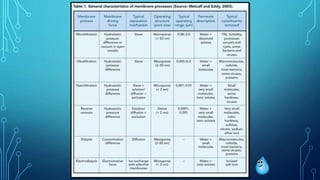
1. Pressure driven membrane
process:
• a. Reverse Osmosis (RO). d.
Microfiltration(MF).
• b. Nanofiltration (NF). e. Pervaporation (PV)
• c. Ultrafiltration (UF). f. Membrane gas
separation.
2. Concentration gradient driven
membrane process:
• a. Dialysis.
•b. Membrane extraction.
3. Electrical potential driven
membrane process:
a. Electrodialysis (ED)
CHARACTERISTICS OF MEMBRANE
SEPARATION PROCESSES:
• Separation goal.
• Nature of species retained (size of the species).
• Nature of the species transported through membrane, electrolytic or
volatile.
• Minor or major species of feed solution transported through
membrane.
• Driving force.
• Mechanism for transport/selectivity.
• Phase of feed and permeate streams.
MEMBRANE SEPARATION PROCESSES:
ADVANTAGES
• Clean Technology with operational
ease.
• Replace the conventional processes.
• Recovery of high value products.
• Greater flexibility in designing
systems.
• Hybrid process development.
• Applicable energy savings.
DISADVANTAGES
• Membrane fouling: (Especially for
hollow fibre modules).
• Upper solid limits in RO.
• Expensive: (Fabrication method).
APPLICATIONS OF MEMBRANE SEPARATION
PROCESSES:
Chemical
Industry
Pharmaceutical
Industry
Food and Dairy
Industry
Biotechnology
Industry
CHEMICAL INDUSTRY
• Production of process water for Industrial
use.
• Waste water treatment.
• Desalination of food, acid and reactive
dyes.
• Concentration of all types of dyes.
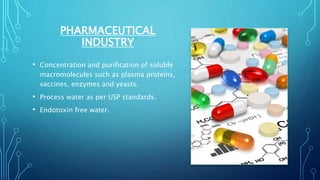
PHARMACEUTICAL
INDUSTRY
• Concentration and purification of soluble
macromolecules such as plasma proteins,
vaccines, enzymes and yeasts.
• Process water as per USP standards.
• Endotoxin free water.
FOOD AND DAIRY INDUSTRY
• Lactose and protein concentration.
• Concentration of whole and skin milk.
• Lactose protein separation.
• Gelatin Concentration.
• Papine enzyme concentration.
• Fractionation and concentration of egg
albumin and animal and fish oils and
proteins.
• Concentration of extracts of vanilla, lemon
peel, malt, etc.
BIOTECHNOLOGY INDUSTRY
• Enzyme concentration.
• Fermentation broth clarification.
• Separation of micro solutes like antibiotics
and vitamins.
• Purification and concentration of vitamins.
• Tissue culture reactor systems.
• Bioremediation: The most significant
emerging application of members in
bioremediation involve the use of members
to selectively separate hydrophobic organic
pollutants from contaminated.
TYPES OF SYNTHETIC MEMBRANES:
Synthetic
Membrane
Inorgan
ic
Electrically
Charged
Thin film
Composite
Asymmetric
(Skinned)
Microporo
us
Isotropic
Anisotro
pic
MICROPOROUS MEMBRANE
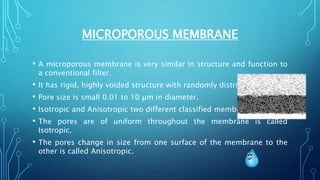
• A microporous membrane is very similar in structure and function to
a conventional filter.
• It has rigid, highly voided structure with randomly distributed.
• Pore size is small 0.01 to 10 µm in diameter.
• Isotropic and Anisotropic two different classified membranes.
• The pores are of uniform throughout the membrane is called
Isotropic.
• The pores change in size from one surface of the membrane to the
other is called Anisotropic.
ASYMMETRIC MEMBRANE
• Asymmetric also know as Skinned membrane.
• Size is 0.1 to 1.0 micron skin on the surface of the
membrane.
• The skin may consist of voids which serve to support
the skin layer.
• Porous sub layer acts as a support for the thin, fragile
skin and has little effect on the separation
characteristics.
• Two types of asymmetric are: Integrally and Non-
Integrally skinned.
• The skin layers resulting from phase inversion process,
which are porous is called Integrally.
• The skin layers are deposited from solution and are
homogenous in nature is called Non-Integrally.
THE FILM COMPOSITE
• Primarily developed for RO and NF applications composites
have a thin polymer skin formed over a microporous support
film.
• The membrane brought about a sustainable improvement of RO
technology since they were superior to cellulose acetate (CA)
membrane.
• They have a greater biofouling tendency than CA membrane.
ELECTRICALLY CHARGED
• These are necessarily ion charged membranes consisting of highly
swollen gels carrying fixed positive or negative charges. These are
mainly used in the Electrodialysis.
• It can be dense or microporous.
• A membrane with fixed positively charged ions is referred to as an
anion exchange membrane.
• A membrane containing fixed negatively charged ions is called a
cation exchange membrane.
INORGANIC MEMBRANES
• Inorganic membrane are also known as ceramic membrane.
• Inorganic membranes are versatile and can be operated at elevated
temperatures ranging form 500-800 ºC and ceramic membrane
usable over at 1000 ºC.
• Inorganic membranes compete with organic membranes for
commercial use.
• Ceramic membranes normally have an asymmetrical structure
composed of at least two, but mostly three, different porosity levels.
• Inorganic membranes manufactured because of particle dispersion
and slip casting, phase separation and leaching, anodic oxidation,
thin film deposition.
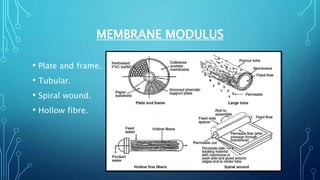
MEMBRANE MODULUS
• Plate and frame.
• Tubular.
• Spiral wound.
• Hollow fibre.
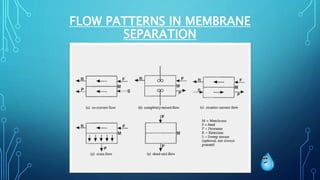
FLOW PATTERNS IN MEMBRANE
SEPARATION
MEMBRANE MATERIALS
Rubbery Polymer
Glassy polymer
Ion exchange
polymer
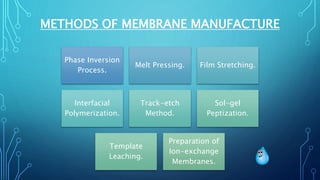
METHODS OF MEMBRANE MANUFACTURE
Phase Inversion
Process.
Melt Pressing. Film Stretching.
Interfacial
Polymerization.
Track-etch
Method.
Sol-gel
Peptization.
Template
Leaching.
Preparation of
Ion-exchange
Membranes.
MEASUREMENTS AND INTERPOLATION OF
SURFACE PROPERTIES:
Surface
Properties
Surface
Energy
Streaming
potential
Surface
Texture
Solute-
membrane
affinity
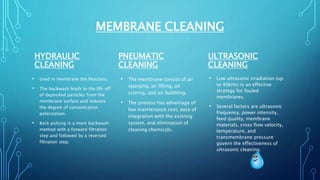
MEMBRANE CLEANING
HYDRAULIC
CLEANING
• Used in membrane bio Reactors.
• The backwash leads to the lift-off
of deposited particles from the
membrane surface and reduces
the degree of concentration
polarization.
• Back pulsing is a more backwash
method with a forward filtration
step and followed by a reversed
filtration step.
PNEUMATIC
CLEANING
• The membrane consist of air
sparging, air lifting, air
scoring, and air bubbling.
• The process has advantage of
low maintenance cost, ease of
integration with the existing
system, and elimination of
cleaning chemicals.
ULTRASONIC
CLEANING
• Low ultrasonic irradiation (up
to 40kHz) is an effective
strategy for fouled
membranes.
• Several factors are ultrasonic
frequency, power intensity,
feed quality, membrane
materials, cross flow velocity,
temperature, and
transmembrane pressure
govern the effectiveness of
ultrasonic cleaning.
THANK YOU

Membrane separation process

  • 1.
    MEMBRANE SEPARATION PROCESS PRESENTED BY: ER.RAHUL JARARIYA (CHEMICAL) GRADUATED: MADHAV INSTITUTE OF TECHNOLOGY AND SCIENCE, GWALIOR 474005 :
  • 2.
    OVERVIEW OF MEMBRANESEPARATION PROCESS • Separation is a part of downstream operation in Chemical, petrochemical, biochemical, food and several other allied industries. • Mostly the separation process required to obtain hight- value products in the food and pharmaceutical industries. • The separation process works on the matter to be separated size, shape, vapour pressure, solubility and so on.
  • 3.
    WHAT IS AMEMBRANE? • Membrane means Skin. • A membrane is defined as a structure having lateral dimensions much greater than its thickness. • A membrane defined by what it does (function), not by what it is. • A membrane can be homogeneous or heterogenous, symmetric or asymmetric in structure. • The membrane thickness may be from as small as 100 micron to several millimetres.
  • 4.
    Classification of Membrane Processes 1.Pressure driven membrane process: • a. Reverse Osmosis (RO). d. Microfiltration(MF). • b. Nanofiltration (NF). e. Pervaporation (PV) • c. Ultrafiltration (UF). f. Membrane gas separation. 2. Concentration gradient driven membrane process: • a. Dialysis. •b. Membrane extraction. 3. Electrical potential driven membrane process: a. Electrodialysis (ED)
  • 5.
    CHARACTERISTICS OF MEMBRANE SEPARATIONPROCESSES: • Separation goal. • Nature of species retained (size of the species). • Nature of the species transported through membrane, electrolytic or volatile. • Minor or major species of feed solution transported through membrane. • Driving force. • Mechanism for transport/selectivity. • Phase of feed and permeate streams.
  • 8.
    MEMBRANE SEPARATION PROCESSES: ADVANTAGES •Clean Technology with operational ease. • Replace the conventional processes. • Recovery of high value products. • Greater flexibility in designing systems. • Hybrid process development. • Applicable energy savings. DISADVANTAGES • Membrane fouling: (Especially for hollow fibre modules). • Upper solid limits in RO. • Expensive: (Fabrication method).
  • 9.
    APPLICATIONS OF MEMBRANESEPARATION PROCESSES: Chemical Industry Pharmaceutical Industry Food and Dairy Industry Biotechnology Industry
  • 10.
    CHEMICAL INDUSTRY • Productionof process water for Industrial use. • Waste water treatment. • Desalination of food, acid and reactive dyes. • Concentration of all types of dyes.
  • 11.
    PHARMACEUTICAL INDUSTRY • Concentration andpurification of soluble macromolecules such as plasma proteins, vaccines, enzymes and yeasts. • Process water as per USP standards. • Endotoxin free water.
  • 12.
    FOOD AND DAIRYINDUSTRY • Lactose and protein concentration. • Concentration of whole and skin milk. • Lactose protein separation. • Gelatin Concentration. • Papine enzyme concentration. • Fractionation and concentration of egg albumin and animal and fish oils and proteins. • Concentration of extracts of vanilla, lemon peel, malt, etc.
  • 13.
    BIOTECHNOLOGY INDUSTRY • Enzymeconcentration. • Fermentation broth clarification. • Separation of micro solutes like antibiotics and vitamins. • Purification and concentration of vitamins. • Tissue culture reactor systems. • Bioremediation: The most significant emerging application of members in bioremediation involve the use of members to selectively separate hydrophobic organic pollutants from contaminated.
  • 14.
    TYPES OF SYNTHETICMEMBRANES: Synthetic Membrane Inorgan ic Electrically Charged Thin film Composite Asymmetric (Skinned) Microporo us Isotropic Anisotro pic
  • 15.
    MICROPOROUS MEMBRANE • Amicroporous membrane is very similar in structure and function to a conventional filter. • It has rigid, highly voided structure with randomly distributed. • Pore size is small 0.01 to 10 µm in diameter. • Isotropic and Anisotropic two different classified membranes. • The pores are of uniform throughout the membrane is called Isotropic. • The pores change in size from one surface of the membrane to the other is called Anisotropic.
  • 16.
    ASYMMETRIC MEMBRANE • Asymmetricalso know as Skinned membrane. • Size is 0.1 to 1.0 micron skin on the surface of the membrane. • The skin may consist of voids which serve to support the skin layer. • Porous sub layer acts as a support for the thin, fragile skin and has little effect on the separation characteristics. • Two types of asymmetric are: Integrally and Non- Integrally skinned. • The skin layers resulting from phase inversion process, which are porous is called Integrally. • The skin layers are deposited from solution and are homogenous in nature is called Non-Integrally.
  • 17.
    THE FILM COMPOSITE •Primarily developed for RO and NF applications composites have a thin polymer skin formed over a microporous support film. • The membrane brought about a sustainable improvement of RO technology since they were superior to cellulose acetate (CA) membrane. • They have a greater biofouling tendency than CA membrane.
  • 18.
    ELECTRICALLY CHARGED • Theseare necessarily ion charged membranes consisting of highly swollen gels carrying fixed positive or negative charges. These are mainly used in the Electrodialysis. • It can be dense or microporous. • A membrane with fixed positively charged ions is referred to as an anion exchange membrane. • A membrane containing fixed negatively charged ions is called a cation exchange membrane.
  • 20.
    INORGANIC MEMBRANES • Inorganicmembrane are also known as ceramic membrane. • Inorganic membranes are versatile and can be operated at elevated temperatures ranging form 500-800 ºC and ceramic membrane usable over at 1000 ºC. • Inorganic membranes compete with organic membranes for commercial use. • Ceramic membranes normally have an asymmetrical structure composed of at least two, but mostly three, different porosity levels. • Inorganic membranes manufactured because of particle dispersion and slip casting, phase separation and leaching, anodic oxidation, thin film deposition.
  • 21.
    MEMBRANE MODULUS • Plateand frame. • Tubular. • Spiral wound. • Hollow fibre.
  • 22.
    FLOW PATTERNS INMEMBRANE SEPARATION
  • 23.
    MEMBRANE MATERIALS Rubbery Polymer Glassypolymer Ion exchange polymer
  • 24.
    METHODS OF MEMBRANEMANUFACTURE Phase Inversion Process. Melt Pressing. Film Stretching. Interfacial Polymerization. Track-etch Method. Sol-gel Peptization. Template Leaching. Preparation of Ion-exchange Membranes.
  • 25.
    MEASUREMENTS AND INTERPOLATIONOF SURFACE PROPERTIES: Surface Properties Surface Energy Streaming potential Surface Texture Solute- membrane affinity
  • 26.
    MEMBRANE CLEANING HYDRAULIC CLEANING • Usedin membrane bio Reactors. • The backwash leads to the lift-off of deposited particles from the membrane surface and reduces the degree of concentration polarization. • Back pulsing is a more backwash method with a forward filtration step and followed by a reversed filtration step. PNEUMATIC CLEANING • The membrane consist of air sparging, air lifting, air scoring, and air bubbling. • The process has advantage of low maintenance cost, ease of integration with the existing system, and elimination of cleaning chemicals. ULTRASONIC CLEANING • Low ultrasonic irradiation (up to 40kHz) is an effective strategy for fouled membranes. • Several factors are ultrasonic frequency, power intensity, feed quality, membrane materials, cross flow velocity, temperature, and transmembrane pressure govern the effectiveness of ultrasonic cleaning.
  • 27.