Membrane processing
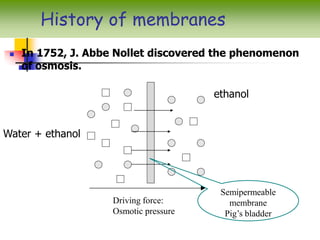
 In 1752, J. Abbe Nollet discovered the phenomenon
of osmosis.
History of membranes
ethanol
Water + ethanol
Semipermeable
membrane
Pig’s bladder
Driving force:
Osmotic pressure
Definition of a membrane
 An intervening structure separating two
phases and/or acting as an active or
passive barrier to the transport of matter
between the phases adjacent to it.
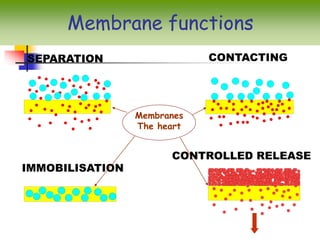
SEPARATION CONTACTING
IMMOBILISATION
CONTROLLED RELEASE
Membranes
The heart
Membrane functions
Membrane structures
Symmetric
The structure and
transport properties
are identical over the
entire cross-section
The total thickness
determines the flux
Dialysis and
electrodialysis.
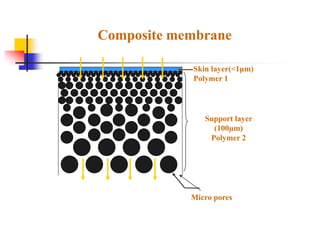
Micro pores
Support layer
(100μm)
Polymer 2
Skin layer(<1μm)
Polymer 1
Composite membrane
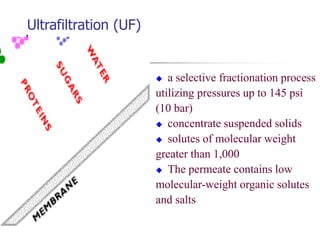
Ultrafiltration (UF)
 a selective fractionation process
utilizing pressures up to 145 psi
(10 bar)
 concentrate suspended solids
 solutes of molecular weight
greater than 1,000
 The permeate contains low
molecular-weight organic solutes
and salts
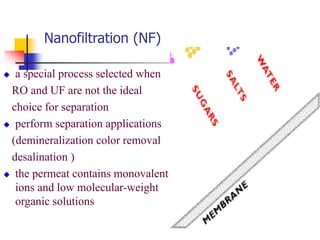
Nanofiltration (NF)
 a special process selected when
RO and UF are not the ideal
choice for separation
 perform separation applications
(demineralization color removal
desalination )
 the permeat contains monovalent
ions and low molecular-weight
organic solutions
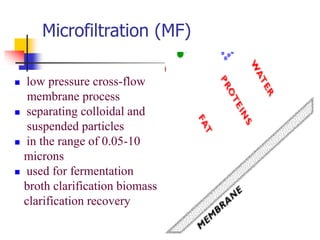
Microfiltration (MF)
 low pressure cross-flow
membrane process
 separating colloidal and
suspended particles
 in the range of 0.05-10
microns
 used for fermentation
broth clarification biomass
clarification recovery
Reverse Osmosis (RO)
 high pressure energy-efficient
technique
 dewatering process streams
 concentrating low-molecular-
weight substances in solution
(purifying wastewater)
 concentrate all dissolved and
suspended solids
 permeate contains a very low
concentration of dissolved solids
 widely used in the desalination
of seawater
RO
Membrane separations are applied
 concentration (removal of a diluting solvent such
as water)
 purification (separation of contaminants)
 fractionation (resolution into two or more
component substances)
applications of micro-filtration
• cold sterilization of beverages
• clarification of fruit juices, beers and wines
• continuous fermentation
• separation of oil- water emulsions
• wastewater treatment
• beer, milk, whey, brine, etc
MF---cold sterilization
BactocatchR from Tetra Alcross (Pully
Switzerland) www.tetrapak.com
Ceramic
membranes
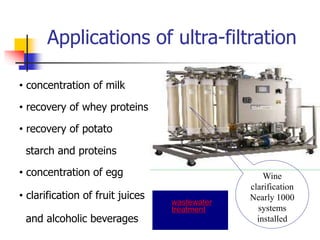
Applications of ultra-filtration
• concentration of milk
• recovery of whey proteins
• recovery of potato
starch and proteins
• concentration of egg
• clarification of fruit juices
and alcoholic beverages
Wine
clarification
Nearly 1000
systems
installed
wastewater
treatment
UF-Whey protein concentrate manufacture
• removal of micro-pollutants
• water softening
• waste water treatment.
Main application of nano-filtration
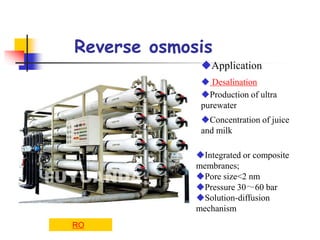
Reverse osmosis
Integrated or composite
membranes;
Pore size<2 nm
Pressure 30~60 bar
Solution-diffusion
mechanism
RO
 Desalination
Production of ultra
purewater
Concentration of juice
and milk
Application
Equipment of our campus
Plant visit of enzyme mill
Concentration of the enzyme
Advantages
 No phase change;
 Energy efficient;
 A higher quality product;
 Environmentally friendly;
 Easy to scale-up
Advantages and limitations of
membrane technologies
Limitations
 Long-term reliability not
proven;
 Excessive pretreatment;
 Concentration polarization
and membrane fouling;
 Replacement of
membranes;

Membrane Processing Technology; Microfiltration, ultrafiltration, nanofiltration

  • 1.
  • 2.
     In 1752,J. Abbe Nollet discovered the phenomenon of osmosis. History of membranes ethanol Water + ethanol Semipermeable membrane Pig’s bladder Driving force: Osmotic pressure
  • 3.
    Definition of amembrane  An intervening structure separating two phases and/or acting as an active or passive barrier to the transport of matter between the phases adjacent to it.
  • 4.
  • 5.
    Membrane structures Symmetric The structureand transport properties are identical over the entire cross-section The total thickness determines the flux Dialysis and electrodialysis.
  • 6.
    Micro pores Support layer (100μm) Polymer2 Skin layer(<1μm) Polymer 1 Composite membrane
  • 7.
    Ultrafiltration (UF)  aselective fractionation process utilizing pressures up to 145 psi (10 bar)  concentrate suspended solids  solutes of molecular weight greater than 1,000  The permeate contains low molecular-weight organic solutes and salts
  • 8.
    Nanofiltration (NF)  aspecial process selected when RO and UF are not the ideal choice for separation  perform separation applications (demineralization color removal desalination )  the permeat contains monovalent ions and low molecular-weight organic solutions
  • 9.
    Microfiltration (MF)  lowpressure cross-flow membrane process  separating colloidal and suspended particles  in the range of 0.05-10 microns  used for fermentation broth clarification biomass clarification recovery
  • 10.
    Reverse Osmosis (RO) high pressure energy-efficient technique  dewatering process streams  concentrating low-molecular- weight substances in solution (purifying wastewater)  concentrate all dissolved and suspended solids  permeate contains a very low concentration of dissolved solids  widely used in the desalination of seawater RO
  • 11.
    Membrane separations areapplied  concentration (removal of a diluting solvent such as water)  purification (separation of contaminants)  fractionation (resolution into two or more component substances)
  • 12.
    applications of micro-filtration •cold sterilization of beverages • clarification of fruit juices, beers and wines • continuous fermentation • separation of oil- water emulsions • wastewater treatment • beer, milk, whey, brine, etc
  • 13.
    MF---cold sterilization BactocatchR fromTetra Alcross (Pully Switzerland) www.tetrapak.com Ceramic membranes
  • 14.
    Applications of ultra-filtration •concentration of milk • recovery of whey proteins • recovery of potato starch and proteins • concentration of egg • clarification of fruit juices and alcoholic beverages Wine clarification Nearly 1000 systems installed wastewater treatment
  • 15.
  • 16.
    • removal ofmicro-pollutants • water softening • waste water treatment. Main application of nano-filtration
  • 17.
    Reverse osmosis Integrated orcomposite membranes; Pore size<2 nm Pressure 30~60 bar Solution-diffusion mechanism RO  Desalination Production of ultra purewater Concentration of juice and milk Application
  • 18.
  • 21.
    Plant visit ofenzyme mill Concentration of the enzyme
  • 22.
    Advantages  No phasechange;  Energy efficient;  A higher quality product;  Environmentally friendly;  Easy to scale-up Advantages and limitations of membrane technologies Limitations  Long-term reliability not proven;  Excessive pretreatment;  Concentration polarization and membrane fouling;  Replacement of membranes;