
By: Satyam Bharati
Engineer- Water & Wastewater Treatment
Table of contents
 Introduction
 Working principle
 Membrane modules
 Membrane separation processes
 Factors that effects membrane performance
 Membrane cleaning
 Conclusion
Introduction
Membrane technology is widely in use nowadays to get
high quality purified water (drinking/Potable), it is
also used to treat industrial/municipal waste.
Membrane technology has become a dignified
separation technology over the past decennia. The
main force of membrane technology is the fact that it
works without the addition of chemicals, with a
relatively low energy use and easy and well-arranged
process conductions.
Working principle
The principle is quite simple:
The membrane acts as a very specific filter that will
pass water through it, by pushing water through semi
permeable membrane. while it does not allow to pass
suspended solids and other substances like
macromolecules, bacteria, microbial cells, proteins, oil
& grease etc.
Modules of Membrane
Mainly membranes are two types
1. Hollow fine fiber
2. Spiral wound
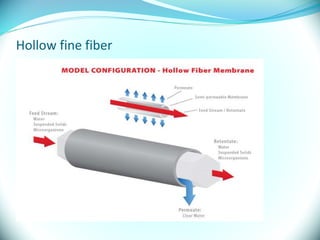
Hollow fine fiber
Cont..
 Hollow fine fiber membranes are artificial membranes
containing a semi-permeable barrier in the form of a
hollow fiber.
 As shown in the previous slide there are lot of hollow
fine fibers are in a single membrane.
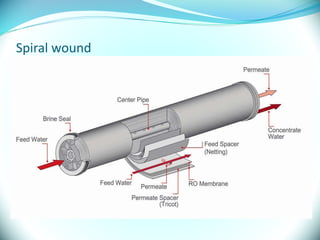
Spiral wound
Cont..
 Spiral wound modules consist of a sandwich of flat
sheet membranes, spacers and porous permeate flow
material wrapped around a central permeate collecting
tube.
 Feed solution passes axially along the sandwich in the
channels formed by the spacers. This channel is of the
order of 1.0 mm in thickness and the cross flow
velocities used generally give laminar flow, although
the spacer material may act as a turbulence promoter
and thus reduce concentration polarisation.
Cont..
 The permeate flows through the membrane in cross
flow to the feed solution, that is radically inwards
towards the central collecting tube.
Membrane separation processes
 Microfiltration
 Ultrafiltration
 Nanofiltration
 Reverse Osmosis
These are the membranes of different sizes.
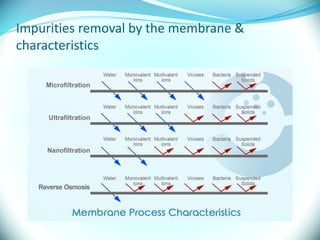
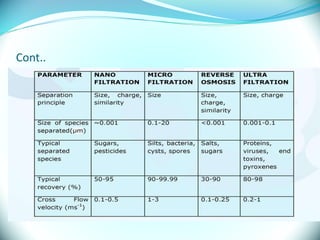
Impurities removal by the membrane &
characteristics
Cont..
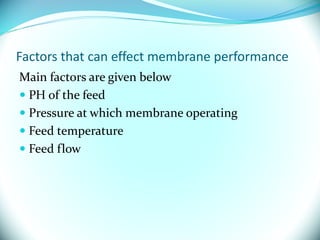
Factors that can effect membrane performance
Main factors are given below
 PH of the feed
 Pressure at which membrane operating
 Feed temperature
 Feed flow
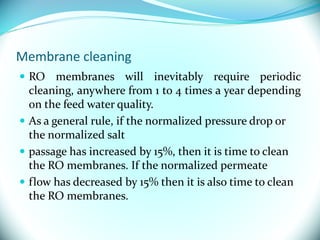
Membrane cleaning
 RO membranes will inevitably require periodic
cleaning, anywhere from 1 to 4 times a year depending
on the feed water quality.
 As a general rule, if the normalized pressure drop or
the normalized salt
 passage has increased by 15%, then it is time to clean
the RO membranes. If the normalized permeate
 flow has decreased by 15% then it is also time to clean
the RO membranes.
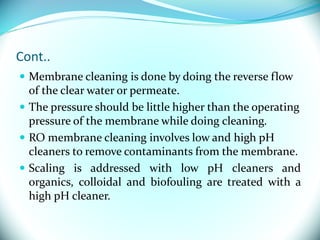
Cont..
 Membrane cleaning is done by doing the reverse flow
of the clear water or permeate.
 The pressure should be little higher than the operating
pressure of the membrane while doing cleaning.
 RO membrane cleaning involves low and high pH
cleaners to remove contaminants from the membrane.
 Scaling is addressed with low pH cleaners and
organics, colloidal and biofouling are treated with a
high pH cleaner.
Summary
 Reverse Osmosis is an effective and proven technology
to produce water that is suitable for many industrial
applications that require deionized water. Further post
treatment after the RO system such as mixed bed
deionization can increase the quality of the RO
permeate and make it suitable for the most demanding
applications. Proper pretreatment and monitoring of
an RO system is crucial to preventing costly repairs
and unscheduled maintenance. With the correct
system design, maintenance program, and
experienced service support, your RO system should
provide many years of high purity water.
THANKS

Membrane technology

  • 1.
    By: Satyam Bharati Engineer-Water & Wastewater Treatment
  • 2.
    Table of contents Introduction  Working principle  Membrane modules  Membrane separation processes  Factors that effects membrane performance  Membrane cleaning  Conclusion
  • 3.
    Introduction Membrane technology iswidely in use nowadays to get high quality purified water (drinking/Potable), it is also used to treat industrial/municipal waste. Membrane technology has become a dignified separation technology over the past decennia. The main force of membrane technology is the fact that it works without the addition of chemicals, with a relatively low energy use and easy and well-arranged process conductions.
  • 4.
    Working principle The principleis quite simple: The membrane acts as a very specific filter that will pass water through it, by pushing water through semi permeable membrane. while it does not allow to pass suspended solids and other substances like macromolecules, bacteria, microbial cells, proteins, oil & grease etc.
  • 5.
    Modules of Membrane Mainlymembranes are two types 1. Hollow fine fiber 2. Spiral wound
  • 6.
  • 7.
    Cont..  Hollow finefiber membranes are artificial membranes containing a semi-permeable barrier in the form of a hollow fiber.  As shown in the previous slide there are lot of hollow fine fibers are in a single membrane.
  • 8.
  • 9.
    Cont..  Spiral woundmodules consist of a sandwich of flat sheet membranes, spacers and porous permeate flow material wrapped around a central permeate collecting tube.  Feed solution passes axially along the sandwich in the channels formed by the spacers. This channel is of the order of 1.0 mm in thickness and the cross flow velocities used generally give laminar flow, although the spacer material may act as a turbulence promoter and thus reduce concentration polarisation.
  • 10.
    Cont..  The permeateflows through the membrane in cross flow to the feed solution, that is radically inwards towards the central collecting tube.
  • 11.
    Membrane separation processes Microfiltration  Ultrafiltration  Nanofiltration  Reverse Osmosis These are the membranes of different sizes.
  • 12.
    Impurities removal bythe membrane & characteristics
  • 13.
  • 14.
    Factors that caneffect membrane performance Main factors are given below  PH of the feed  Pressure at which membrane operating  Feed temperature  Feed flow
  • 15.
    Membrane cleaning  ROmembranes will inevitably require periodic cleaning, anywhere from 1 to 4 times a year depending on the feed water quality.  As a general rule, if the normalized pressure drop or the normalized salt  passage has increased by 15%, then it is time to clean the RO membranes. If the normalized permeate  flow has decreased by 15% then it is also time to clean the RO membranes.
  • 16.
    Cont..  Membrane cleaningis done by doing the reverse flow of the clear water or permeate.  The pressure should be little higher than the operating pressure of the membrane while doing cleaning.  RO membrane cleaning involves low and high pH cleaners to remove contaminants from the membrane.  Scaling is addressed with low pH cleaners and organics, colloidal and biofouling are treated with a high pH cleaner.
  • 17.
    Summary  Reverse Osmosisis an effective and proven technology to produce water that is suitable for many industrial applications that require deionized water. Further post treatment after the RO system such as mixed bed deionization can increase the quality of the RO permeate and make it suitable for the most demanding applications. Proper pretreatment and monitoring of an RO system is crucial to preventing costly repairs and unscheduled maintenance. With the correct system design, maintenance program, and experienced service support, your RO system should provide many years of high purity water.
  • 18.