FE-247
FOOD PROCESSING
EQUIPMENT - II
Mechanical Separation
Shelke G.N
Assistant Professor
Department of Food Engineering
CFT Ashti,
Maharashtra 414202
Phone: +919561777282
E-mail: shelkeganesh838@gmail.com
Processes which depend primarily on physical forces to accomplish the
desired separation of components
Mechanical Separation
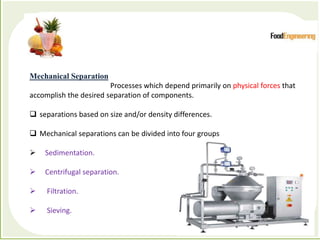
Processes which depend primarily on physical forces that
accomplish the desired separation of components.
 separations based on size and/or density differences.
 Mechanical separations can be divided into four groups
 Sedimentation.
 Centrifugal separation.
 Filtration.
 Sieving.
Processes which depend primarily forces to accomplish the
desired separation of components
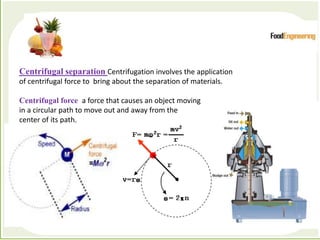
Centrifugal separation Centrifugation involves the application
of centrifugal force to bring about the separation of materials.
Centrifugal force a force that causes an object moving
in a circular path to move out and away from the
center of its path.
Processes which depend primarily forces to accomplish the
desired separation of components
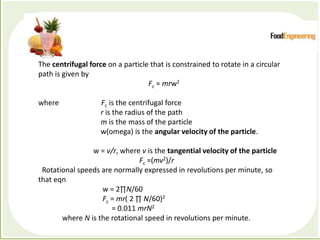
The centrifugal force on a particle that is constrained to rotate in a circular
path is given by
Fc = mrw2
where Fc is the centrifugal force
r is the radius of the path
m is the mass of the particle
w(omega) is the angular velocity of the particle.
w = v/r, where v is the tangential velocity of the particle
Fc =(mv2)/r
Rotational speeds are normally expressed in revolutions per minute, so
that eqn
w = 2∏N/60
Fc = mr( 2 ∏ N/60)2
= 0.011 mrN2
where N is the rotational speed in revolutions per minute.
Processes which depend primarily forces to accomplish the
desired separation of components
Principal & Working
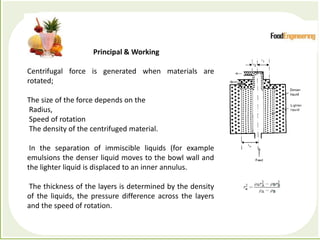
Centrifugal force is generated when materials are
rotated;
The size of the force depends on the
Radius,
Speed of rotation
The density of the centrifuged material.
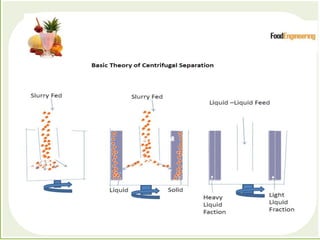
In the separation of immiscible liquids (for example
emulsions the denser liquid moves to the bowl wall and
the lighter liquid is displaced to an inner annulus.
The thickness of the layers is determined by the density
of the liquids, the pressure difference across the layers
and the speed of rotation.
Processes which depend primarily forces to accomplish the
desired separation of components
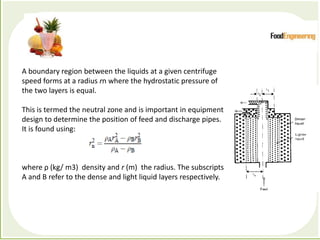
A boundary region between the liquids at a given centrifuge
speed forms at a radius rn where the hydrostatic pressure of
the two layers is equal.
This is termed the neutral zone and is important in equipment
design to determine the position of feed and discharge pipes.
It is found using:
where ρ (kg/ m3) density and r (m) the radius. The subscripts
A and B refer to the dense and light liquid layers respectively.
Processes which depend primarily forces to accomplish the
desired separation of components
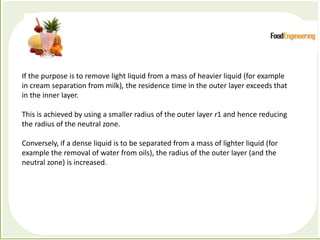
If the purpose is to remove light liquid from a mass of heavier liquid (for example
in cream separation from milk), the residence time in the outer layer exceeds that
in the inner layer.
This is achieved by using a smaller radius of the outer layer r1 and hence reducing
the radius of the neutral zone.
Conversely, if a dense liquid is to be separated from a mass of lighter liquid (for
example the removal of water from oils), the radius of the outer layer (and the
neutral zone) is increased.
Processes which depend primarily forces to accomplish the
desired separation of components
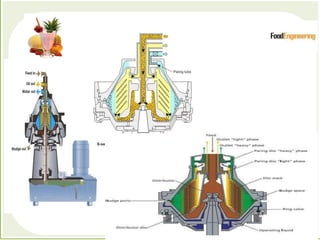
Processes which depend primarily forces to accomplish the
desired separation of components
A decanter centrifuge separates solid materials from liquids in slurry and
therefore plays an important role in wastewater treatment, chemical, oil and food
processing industries.
Operating principle
The operating principle of a decanter centrifuge is based on separation via buoyancy.
Naturally, a component with a higher density would fall to the bottom of a mixture,
while the less dense component would be suspended above it.
Edible animal fat
Plant oils such as olive oil and vegetable oil
Wine (clarification)
Fruit juice
Soy protein
Dairy (recovery of lactose, whey fines and cheese fines)
Coffee and tea
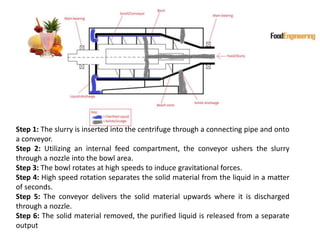
Step 1: The slurry is inserted into the centrifuge through a connecting pipe and onto
a conveyor.
Step 2: Utilizing an internal feed compartment, the conveyor ushers the slurry
through a nozzle into the bowl area.
Step 3: The bowl rotates at high speeds to induce gravitational forces.
Step 4: High speed rotation separates the solid material from the liquid in a matter
of seconds.
Step 5: The conveyor delivers the solid material upwards where it is discharged
through a nozzle.
Step 6: The solid material removed, the purified liquid is released from a separate
output
IF YOU LIKE THIS VIDEO PLEASE
SUBSCRIBE MY CHANEL .
PLEASE LIKE, COMENTS AND SHARE
THANK’S

mechanical separation centrifugal seperation

  • 1.
    FE-247 FOOD PROCESSING EQUIPMENT -II Mechanical Separation Shelke G.N Assistant Professor Department of Food Engineering CFT Ashti, Maharashtra 414202 Phone: +919561777282 E-mail: shelkeganesh838@gmail.com
  • 2.
    Processes which dependprimarily on physical forces to accomplish the desired separation of components Mechanical Separation Processes which depend primarily on physical forces that accomplish the desired separation of components.  separations based on size and/or density differences.  Mechanical separations can be divided into four groups  Sedimentation.  Centrifugal separation.  Filtration.  Sieving.
  • 3.
    Processes which dependprimarily forces to accomplish the desired separation of components Centrifugal separation Centrifugation involves the application of centrifugal force to bring about the separation of materials. Centrifugal force a force that causes an object moving in a circular path to move out and away from the center of its path.
  • 4.
    Processes which dependprimarily forces to accomplish the desired separation of components The centrifugal force on a particle that is constrained to rotate in a circular path is given by Fc = mrw2 where Fc is the centrifugal force r is the radius of the path m is the mass of the particle w(omega) is the angular velocity of the particle. w = v/r, where v is the tangential velocity of the particle Fc =(mv2)/r Rotational speeds are normally expressed in revolutions per minute, so that eqn w = 2∏N/60 Fc = mr( 2 ∏ N/60)2 = 0.011 mrN2 where N is the rotational speed in revolutions per minute.
  • 5.
    Processes which dependprimarily forces to accomplish the desired separation of components Principal & Working Centrifugal force is generated when materials are rotated; The size of the force depends on the Radius, Speed of rotation The density of the centrifuged material. In the separation of immiscible liquids (for example emulsions the denser liquid moves to the bowl wall and the lighter liquid is displaced to an inner annulus. The thickness of the layers is determined by the density of the liquids, the pressure difference across the layers and the speed of rotation.
  • 6.
    Processes which dependprimarily forces to accomplish the desired separation of components A boundary region between the liquids at a given centrifuge speed forms at a radius rn where the hydrostatic pressure of the two layers is equal. This is termed the neutral zone and is important in equipment design to determine the position of feed and discharge pipes. It is found using: where ρ (kg/ m3) density and r (m) the radius. The subscripts A and B refer to the dense and light liquid layers respectively.
  • 7.
    Processes which dependprimarily forces to accomplish the desired separation of components If the purpose is to remove light liquid from a mass of heavier liquid (for example in cream separation from milk), the residence time in the outer layer exceeds that in the inner layer. This is achieved by using a smaller radius of the outer layer r1 and hence reducing the radius of the neutral zone. Conversely, if a dense liquid is to be separated from a mass of lighter liquid (for example the removal of water from oils), the radius of the outer layer (and the neutral zone) is increased.
  • 8.
    Processes which dependprimarily forces to accomplish the desired separation of components
  • 9.
    Processes which dependprimarily forces to accomplish the desired separation of components
  • 10.
    A decanter centrifugeseparates solid materials from liquids in slurry and therefore plays an important role in wastewater treatment, chemical, oil and food processing industries. Operating principle The operating principle of a decanter centrifuge is based on separation via buoyancy. Naturally, a component with a higher density would fall to the bottom of a mixture, while the less dense component would be suspended above it. Edible animal fat Plant oils such as olive oil and vegetable oil Wine (clarification) Fruit juice Soy protein Dairy (recovery of lactose, whey fines and cheese fines) Coffee and tea
  • 11.
    Step 1: Theslurry is inserted into the centrifuge through a connecting pipe and onto a conveyor. Step 2: Utilizing an internal feed compartment, the conveyor ushers the slurry through a nozzle into the bowl area. Step 3: The bowl rotates at high speeds to induce gravitational forces. Step 4: High speed rotation separates the solid material from the liquid in a matter of seconds. Step 5: The conveyor delivers the solid material upwards where it is discharged through a nozzle. Step 6: The solid material removed, the purified liquid is released from a separate output
  • 12.
    IF YOU LIKETHIS VIDEO PLEASE SUBSCRIBE MY CHANEL . PLEASE LIKE, COMENTS AND SHARE THANK’S