Welding
Distortion
Control
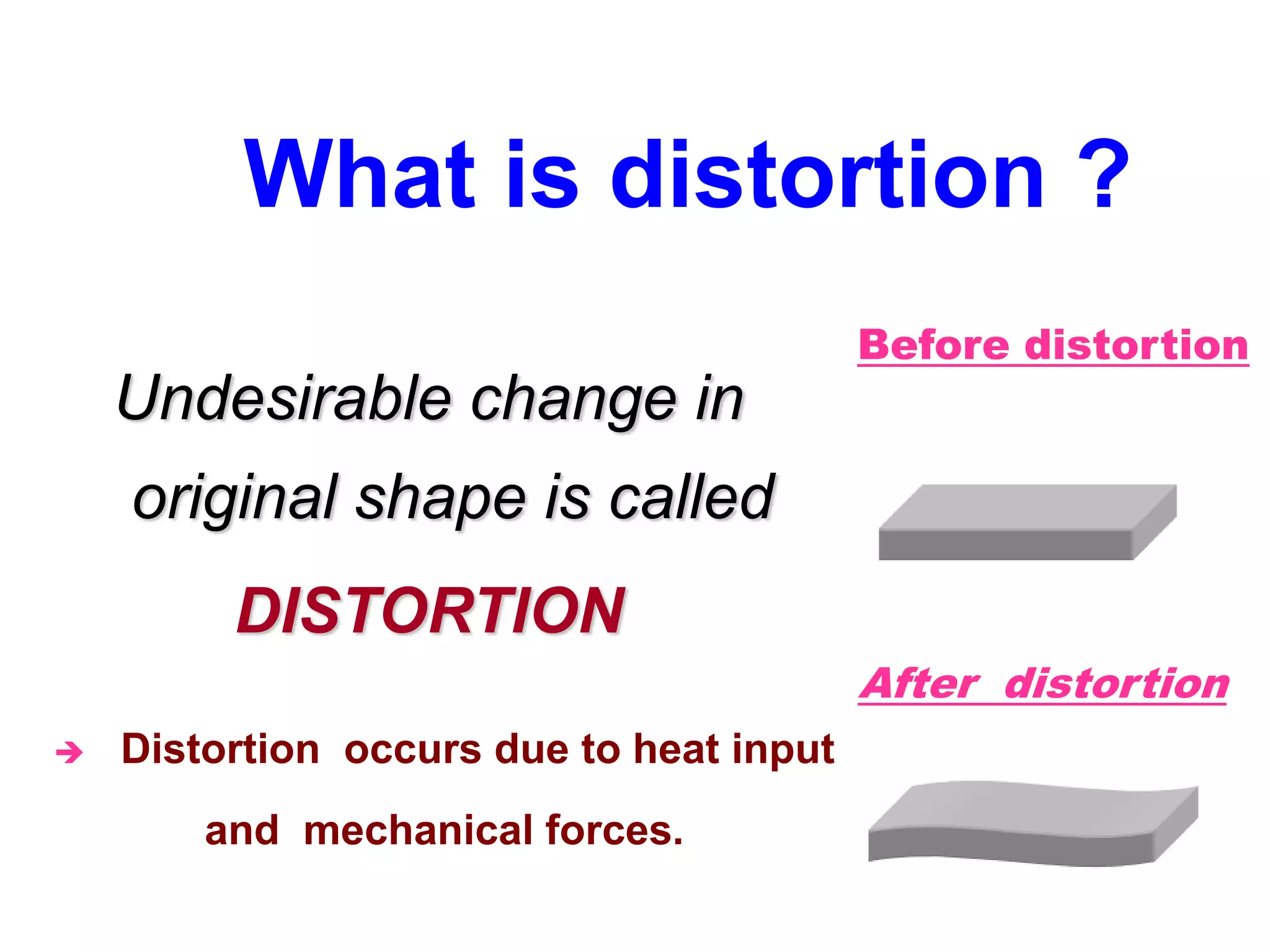
What is distortion ?
Undesirable change in
original shape is called
DISTORTION
Before distortion
After distortion
 Distortion occurs due to heat input
and mechanical forces.
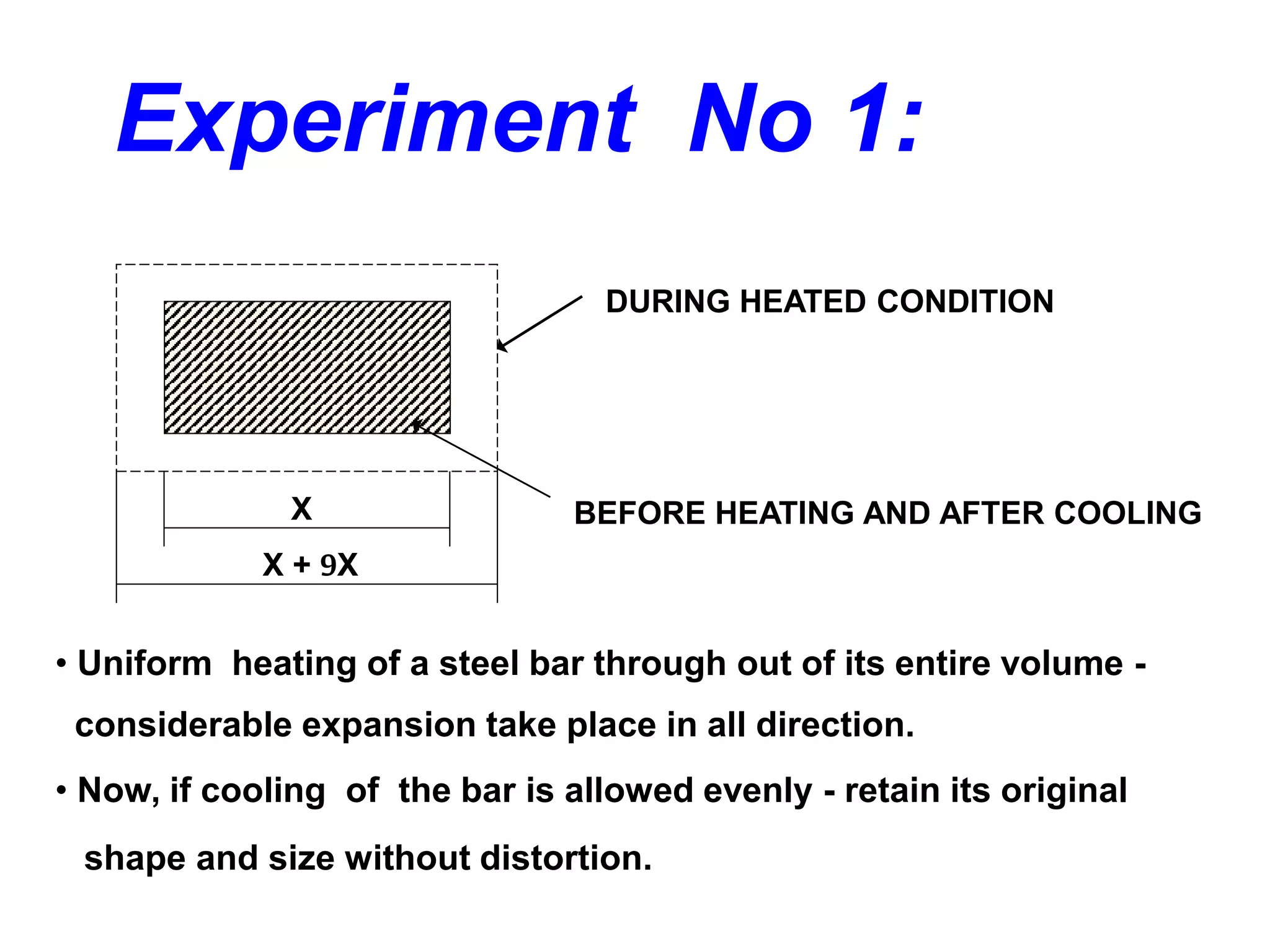
• Uniform heating of a steel bar through out of its entire volume -
considerable expansion take place in all direction.
• Now, if cooling of the bar is allowed evenly - retain its original
shape and size without distortion.
DURING HEATED CONDITION
X
X + 9X
BEFORE HEATING AND AFTER COOLING
Experiment No 1:
So, we can say that,
“ Uniform heating and cooling of a
component that can expand and
contract does not cause any
appreciable distortion ”
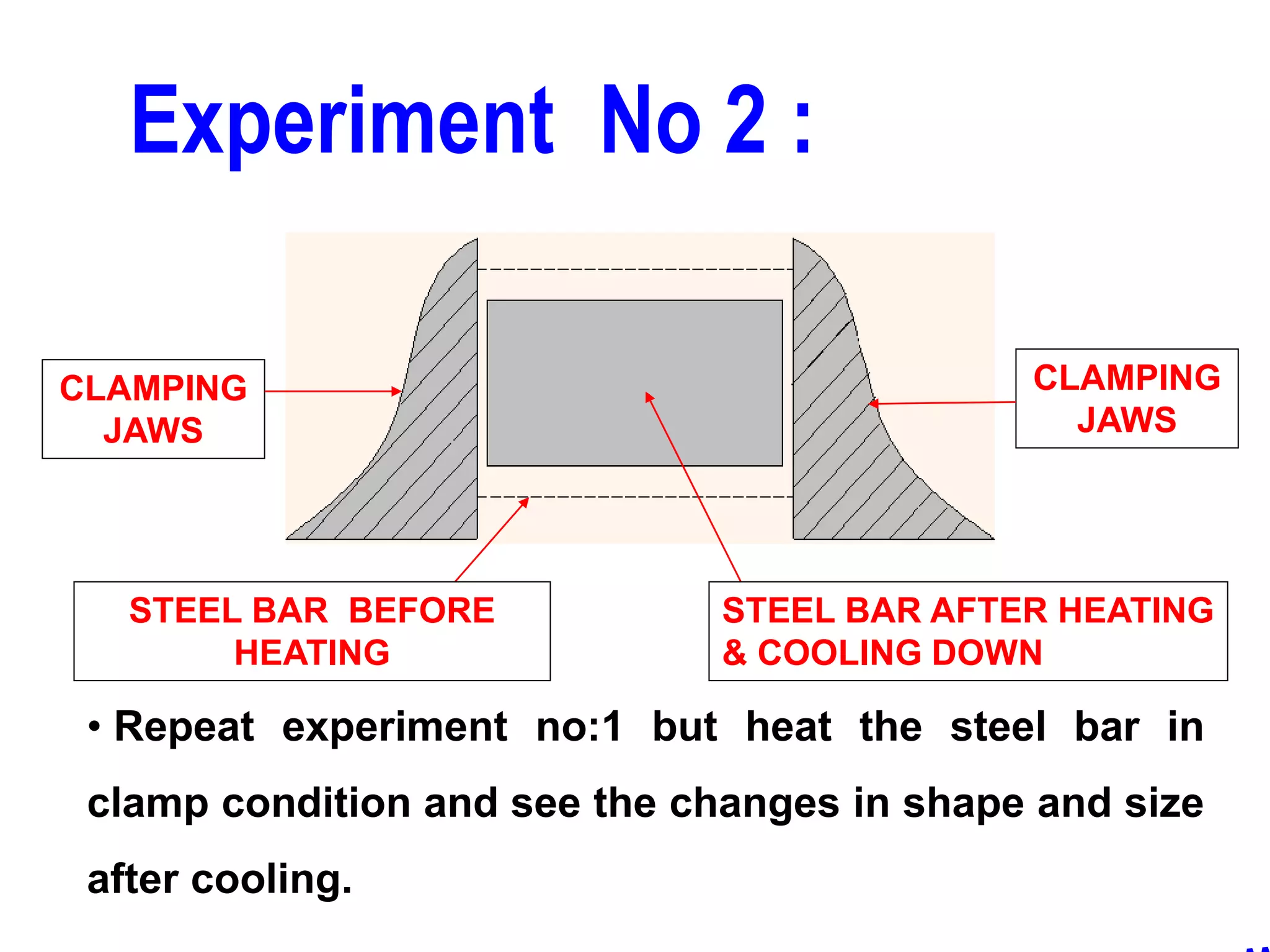
• Repeat experiment no:1 but heat the steel bar in
clamp condition and see the changes in shape and size
after cooling.
STEEL BAR AFTER HEATING
& COOLING DOWN
STEEL BAR BEFORE
HEATING
CLAMPING
JAWS
CLAMPING
JAWS
Experiment No 2 :
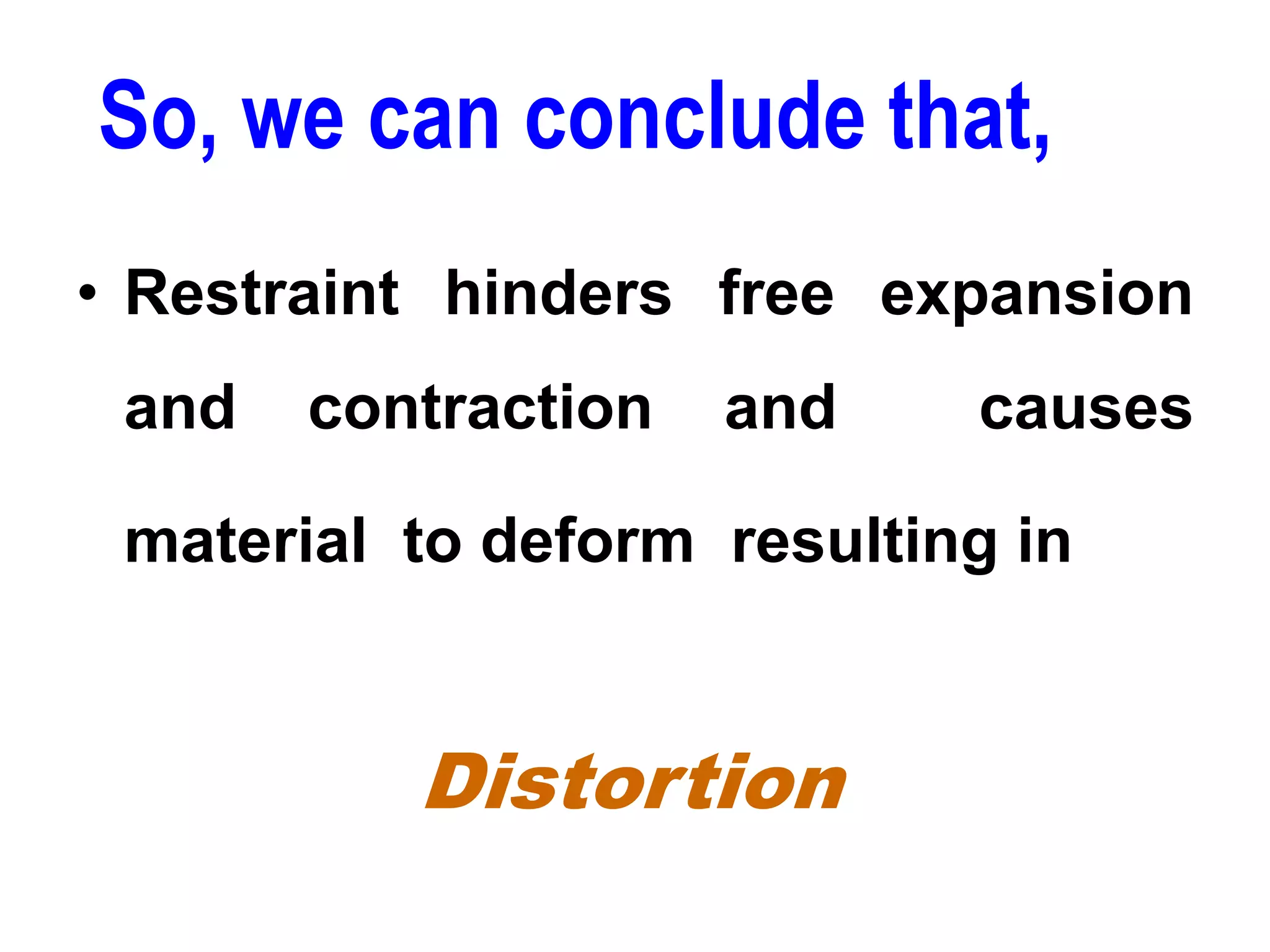
So, we can conclude that,
• Restraint hinders free expansion
and contraction and causes
material to deform resulting in
Distortion
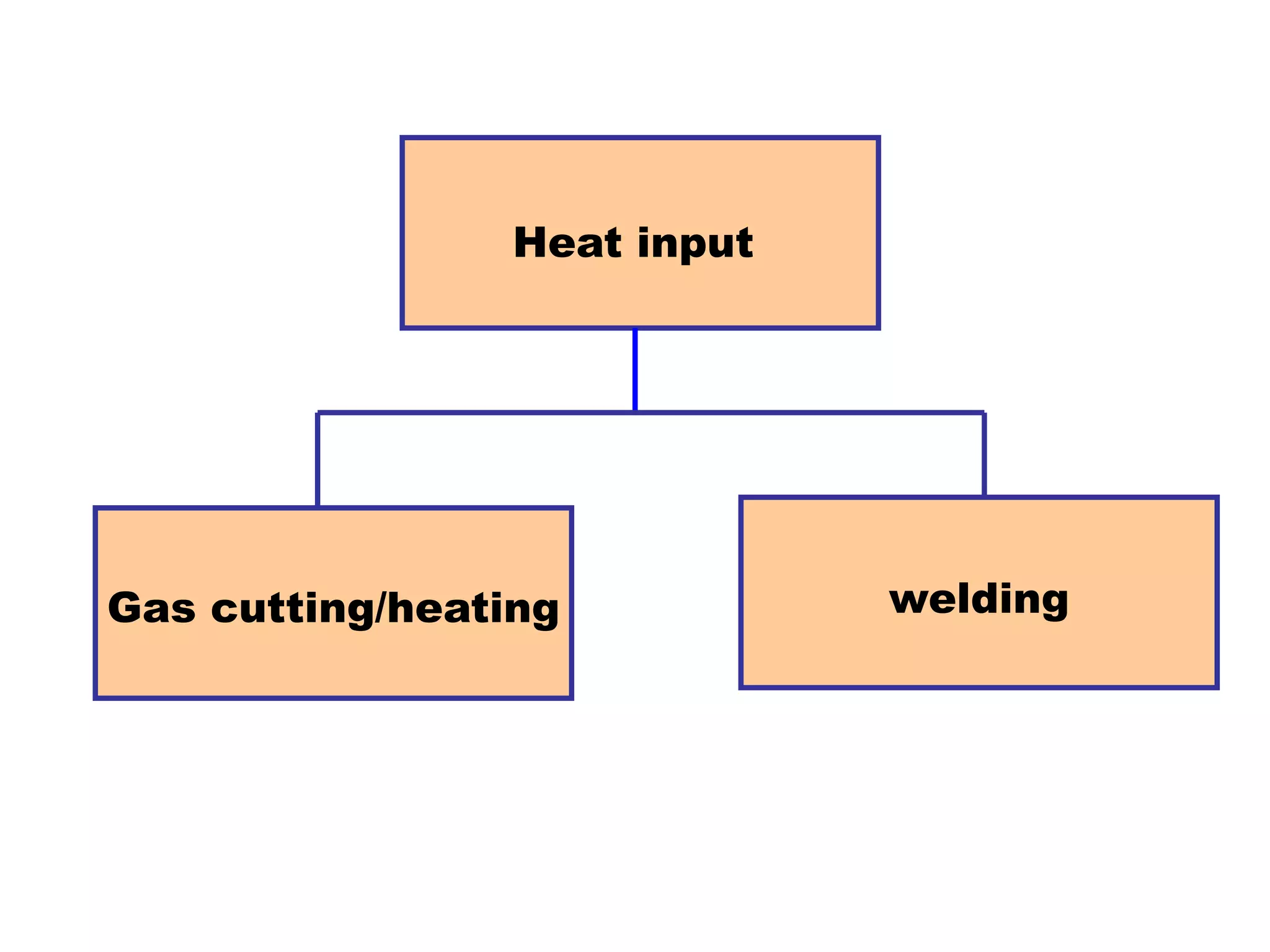
Gas cutting/heating welding
Heat input
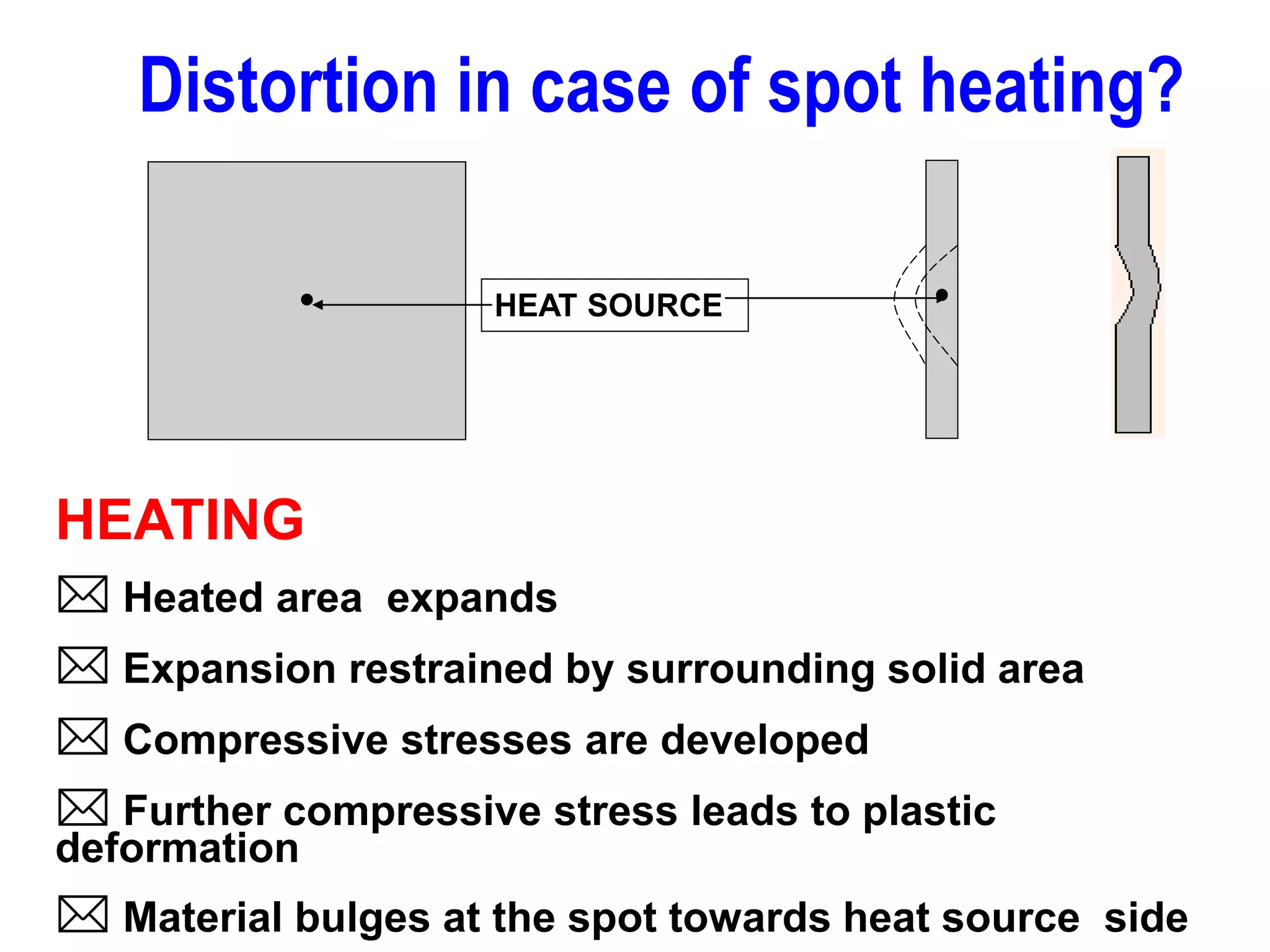
HEATING
 Heated area expands
 Expansion restrained by surrounding solid area
 Compressive stresses are developed
 Further compressive stress leads to plastic
deformation
 Material bulges at the spot towards heat source side
HEAT SOURCE
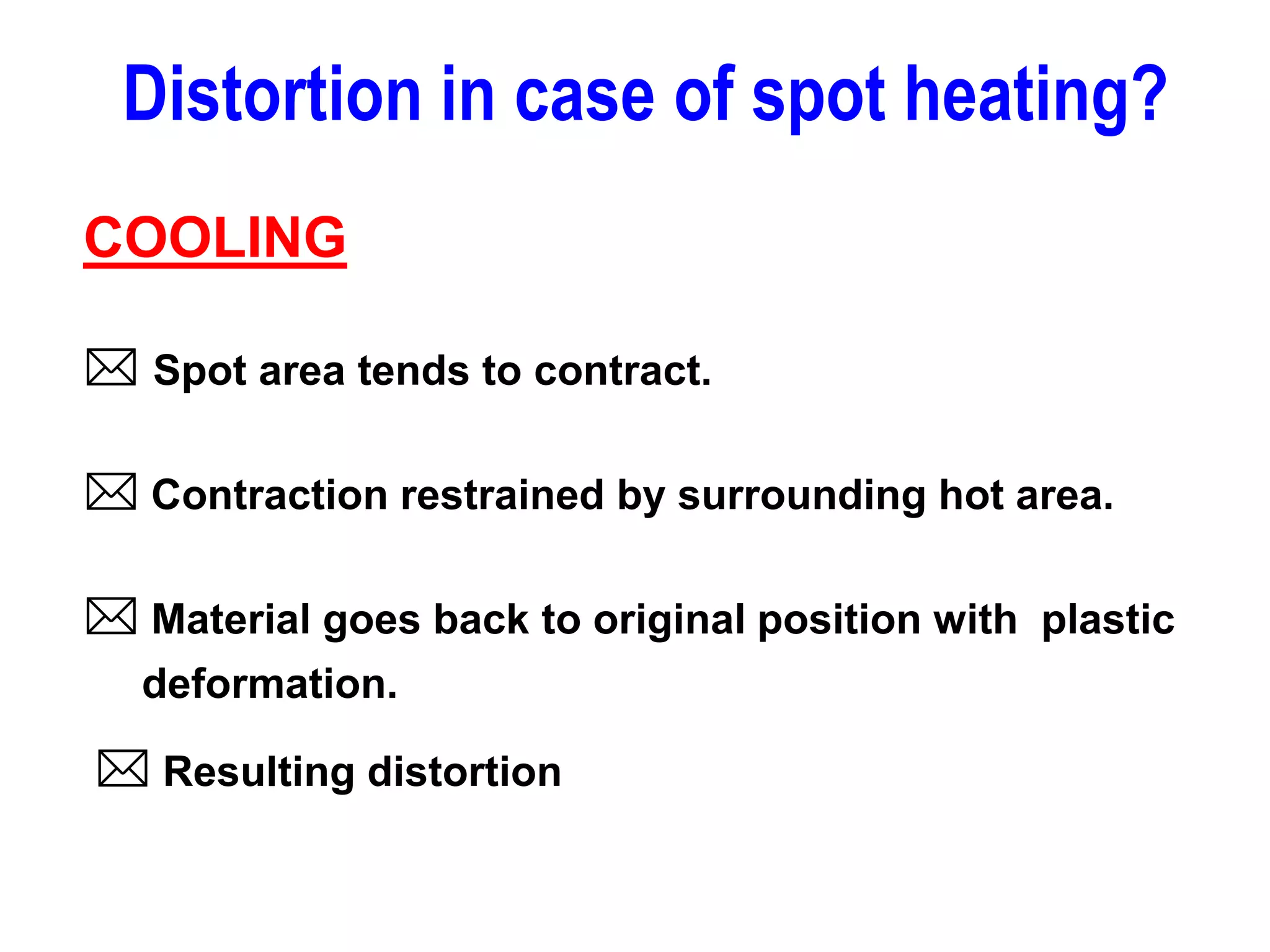
Distortion in case of spot heating?
COOLING
 Spot area tends to contract.
 Contraction restrained by surrounding hot area.
 Material goes back to original position with plastic
deformation.
 Resulting distortion
Distortion in case of spot heating?
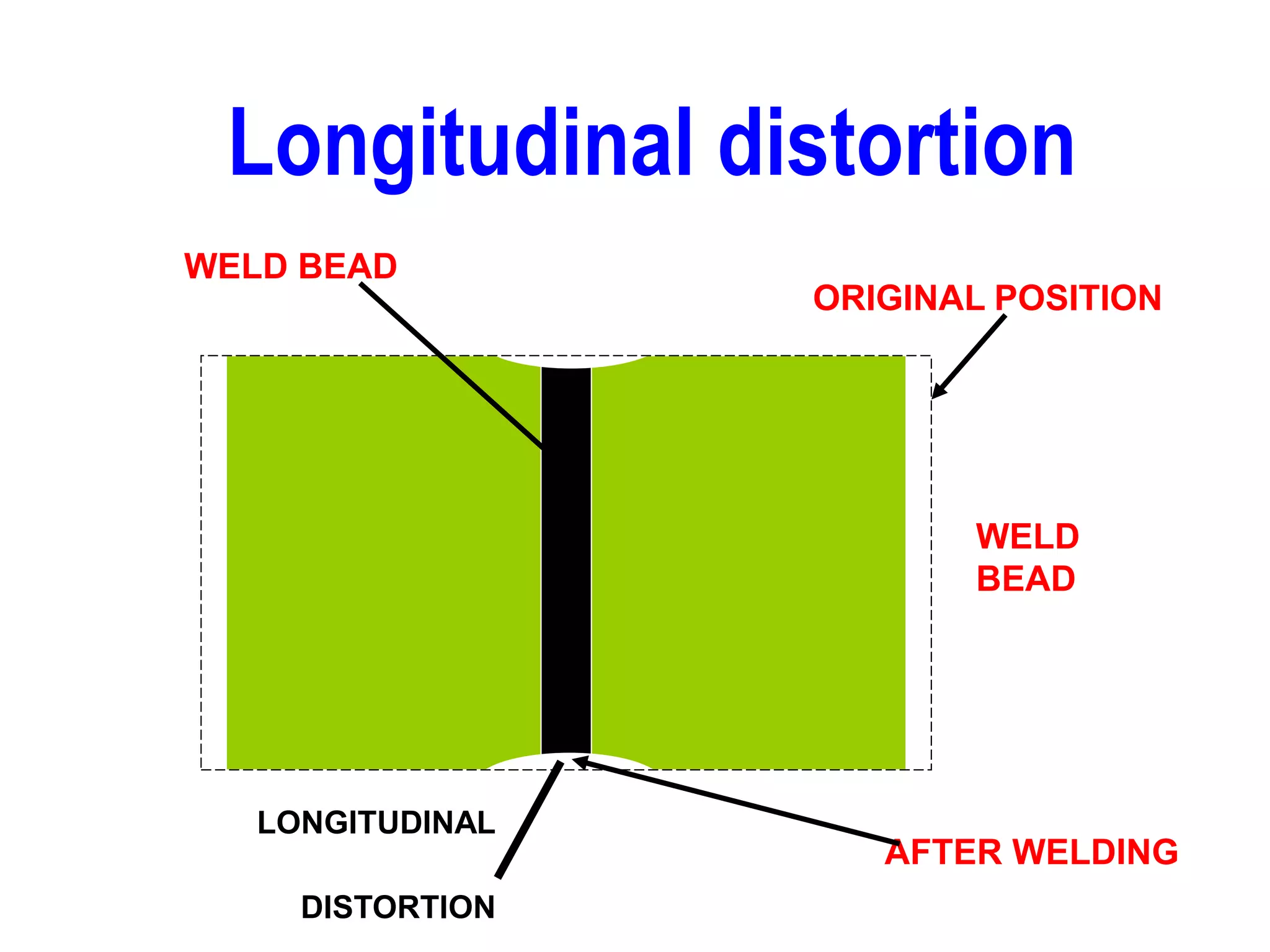
WELD
BEAD
ORIGINAL POSITION
AFTER WELDING
Longitudinal distortion
WELD BEAD
LONGITUDINAL
DISTORTION
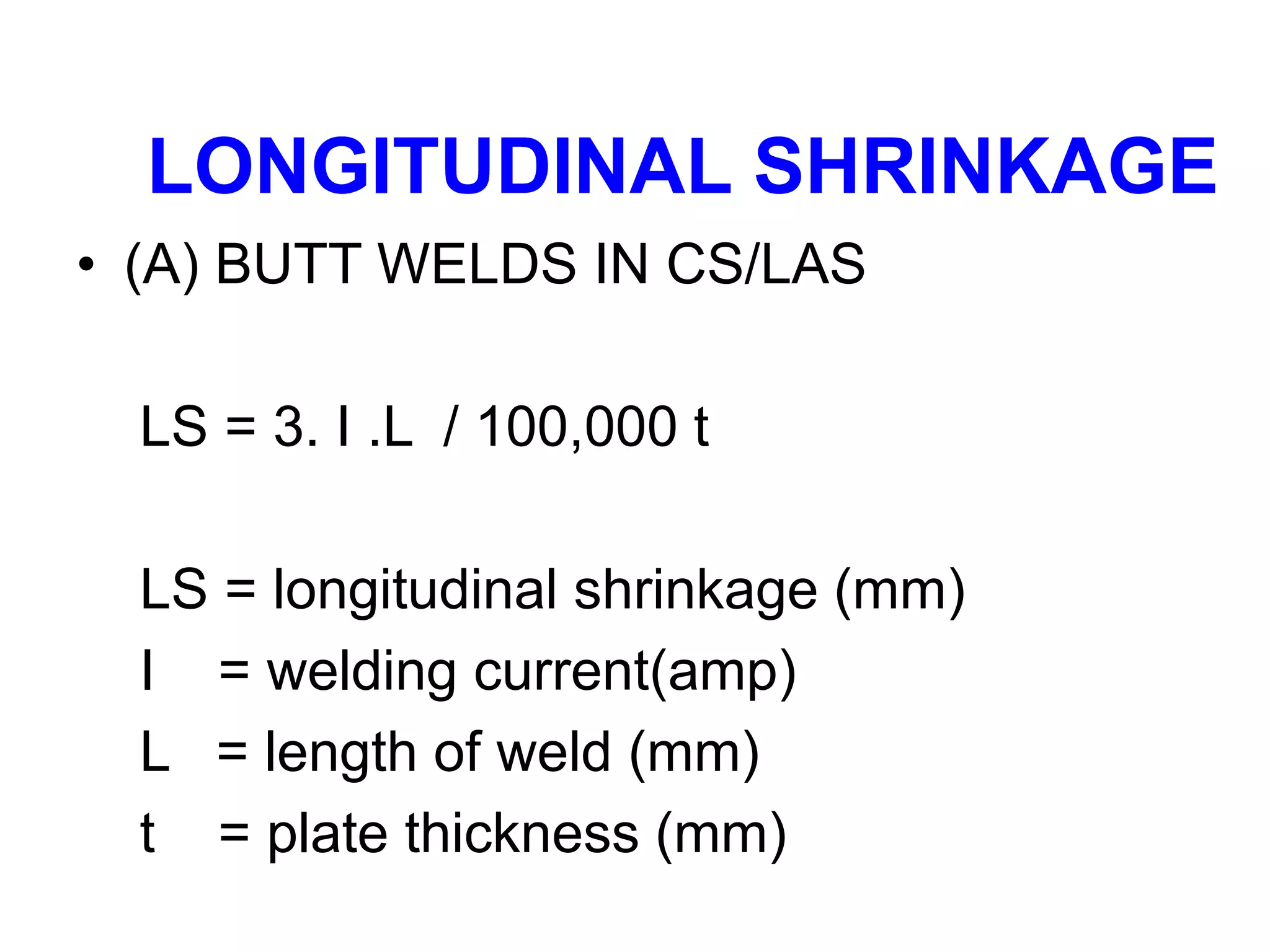
LONGITUDINAL SHRINKAGE
• (A) BUTT WELDS IN CS/LAS
LS = 3. I .L / 100,000 t
LS = longitudinal shrinkage (mm)
I = welding current(amp)
L = length of weld (mm)
t = plate thickness (mm)
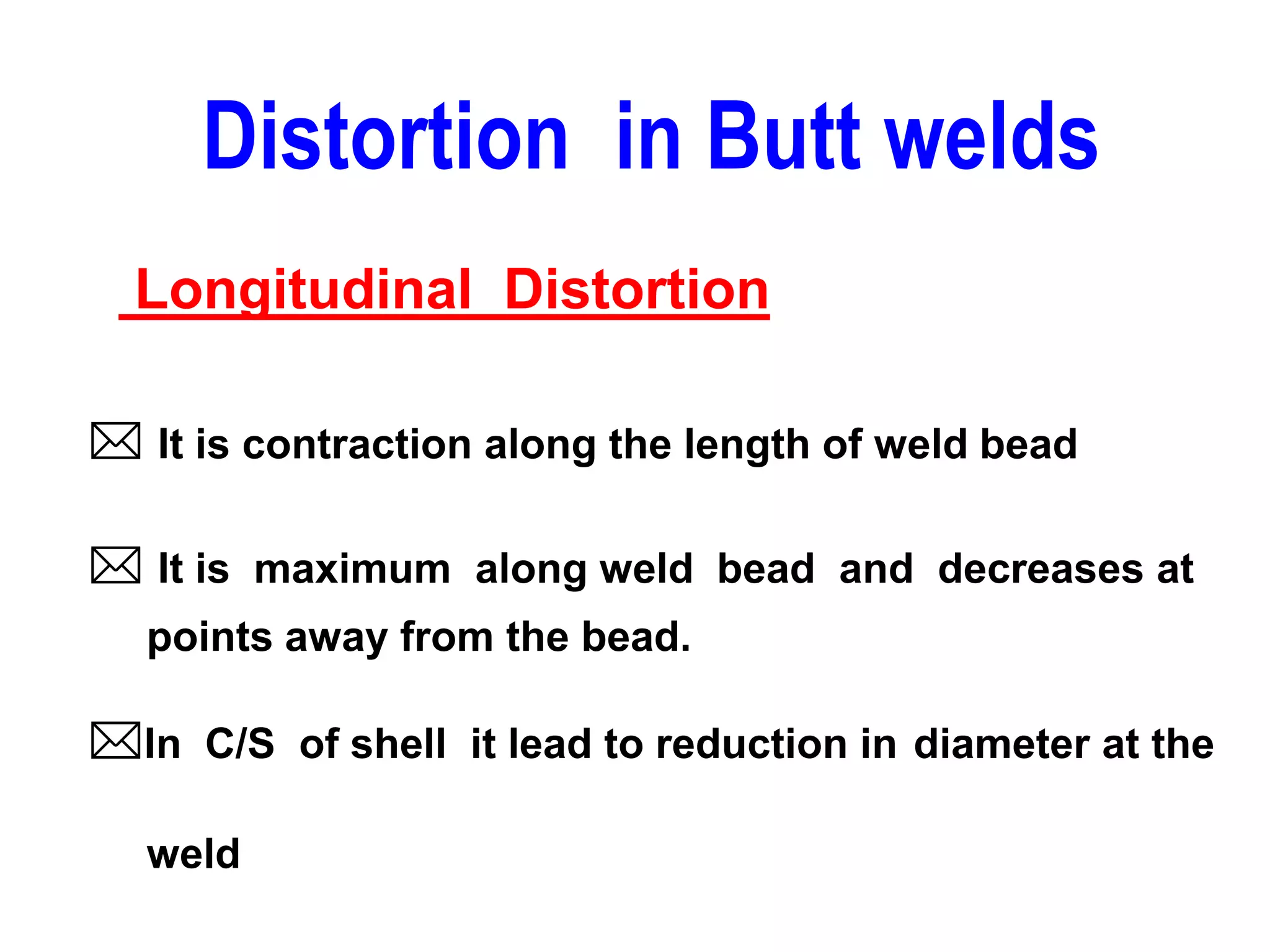
 It is contraction along the length of weld bead
 It is maximum along weld bead and decreases at
points away from the bead.
In C/S of shell it lead to reduction in diameter at the
weld
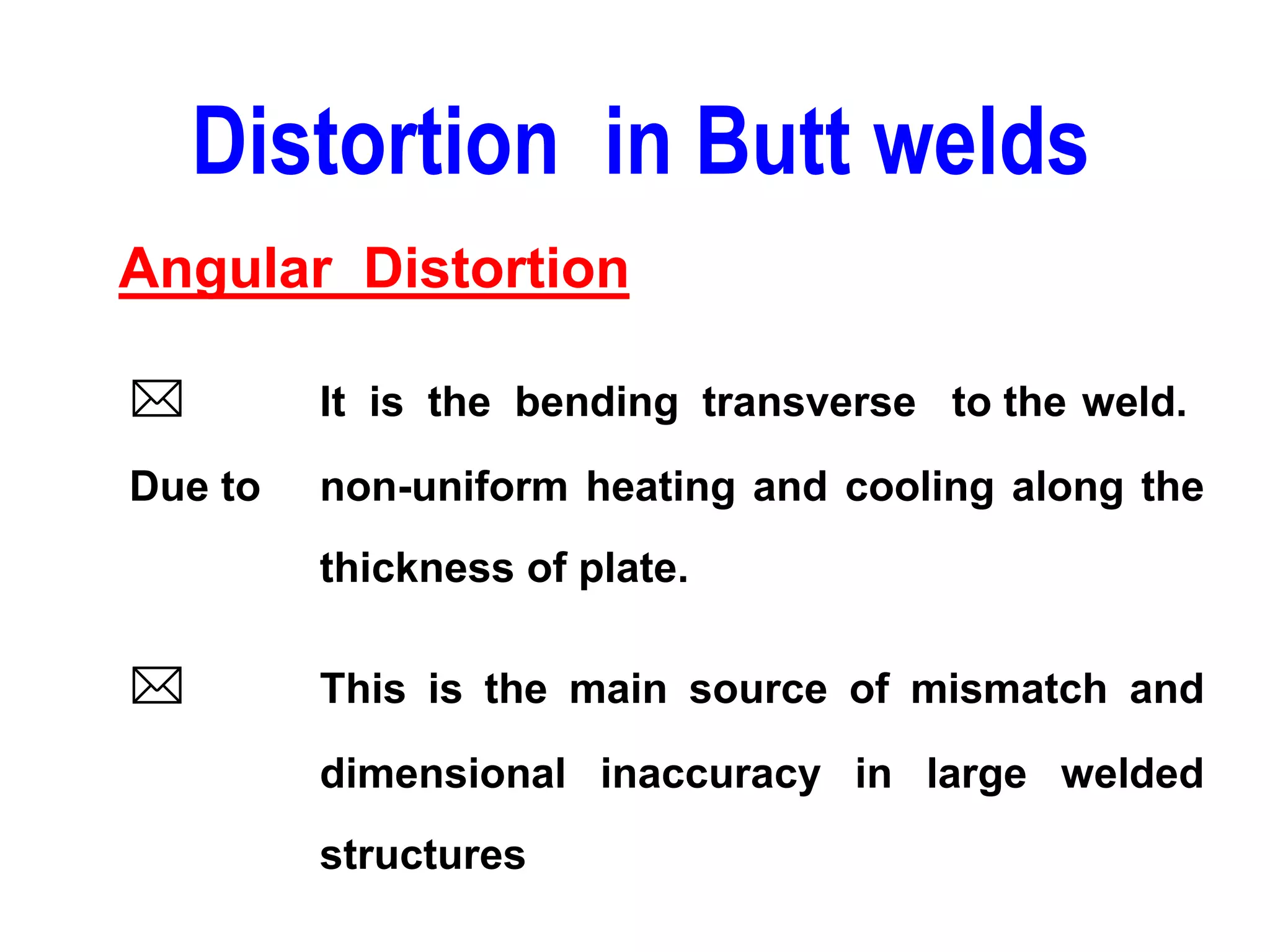
Distortion in Butt welds
Longitudinal Distortion
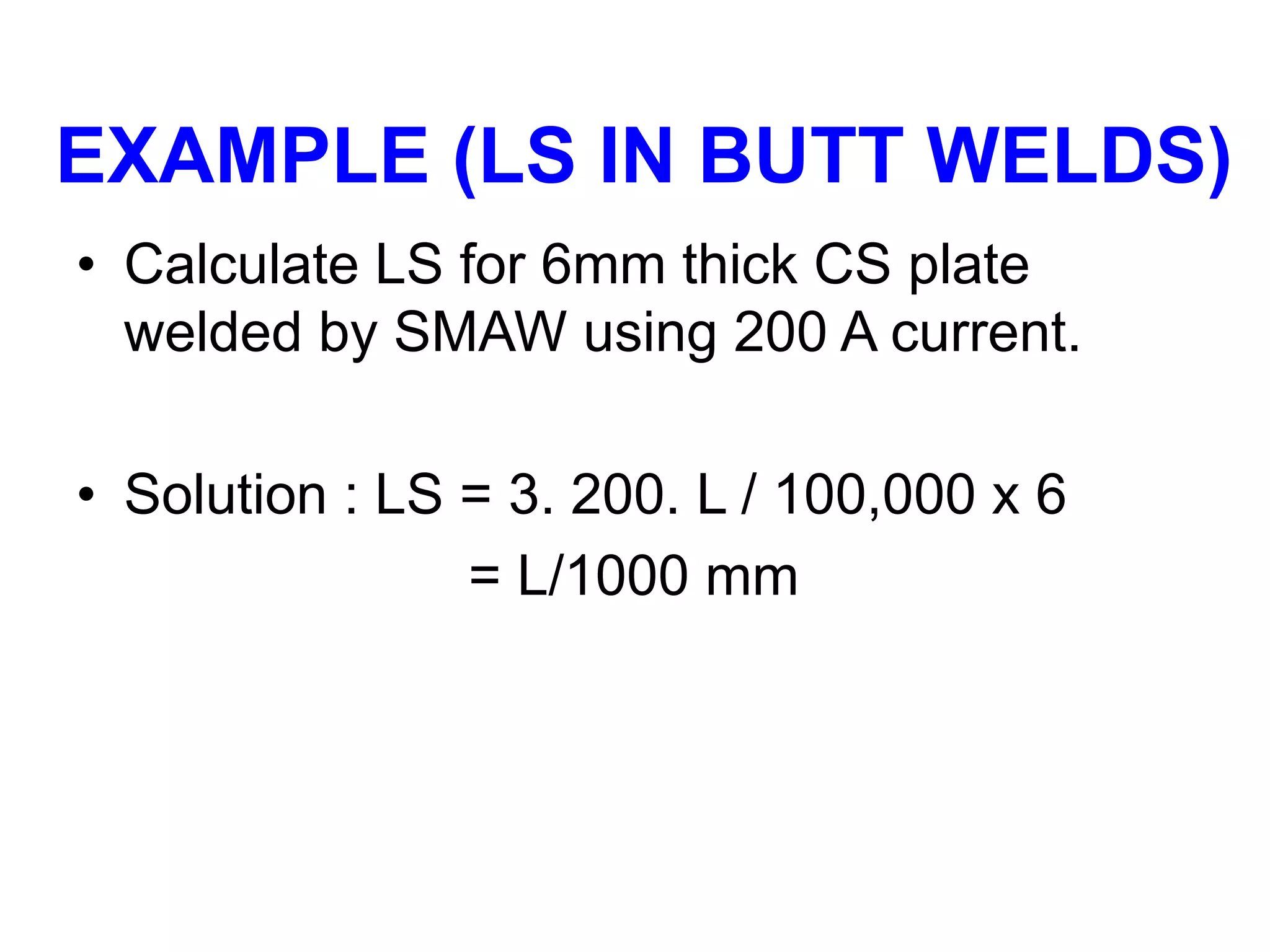
EXAMPLE (LS IN BUTT WELDS)
• Calculate LS for 6mm thick CS plate
welded by SMAW using 200 A current.
• Solution : LS = 3. 200. L / 100,000 x 6
= L/1000 mm
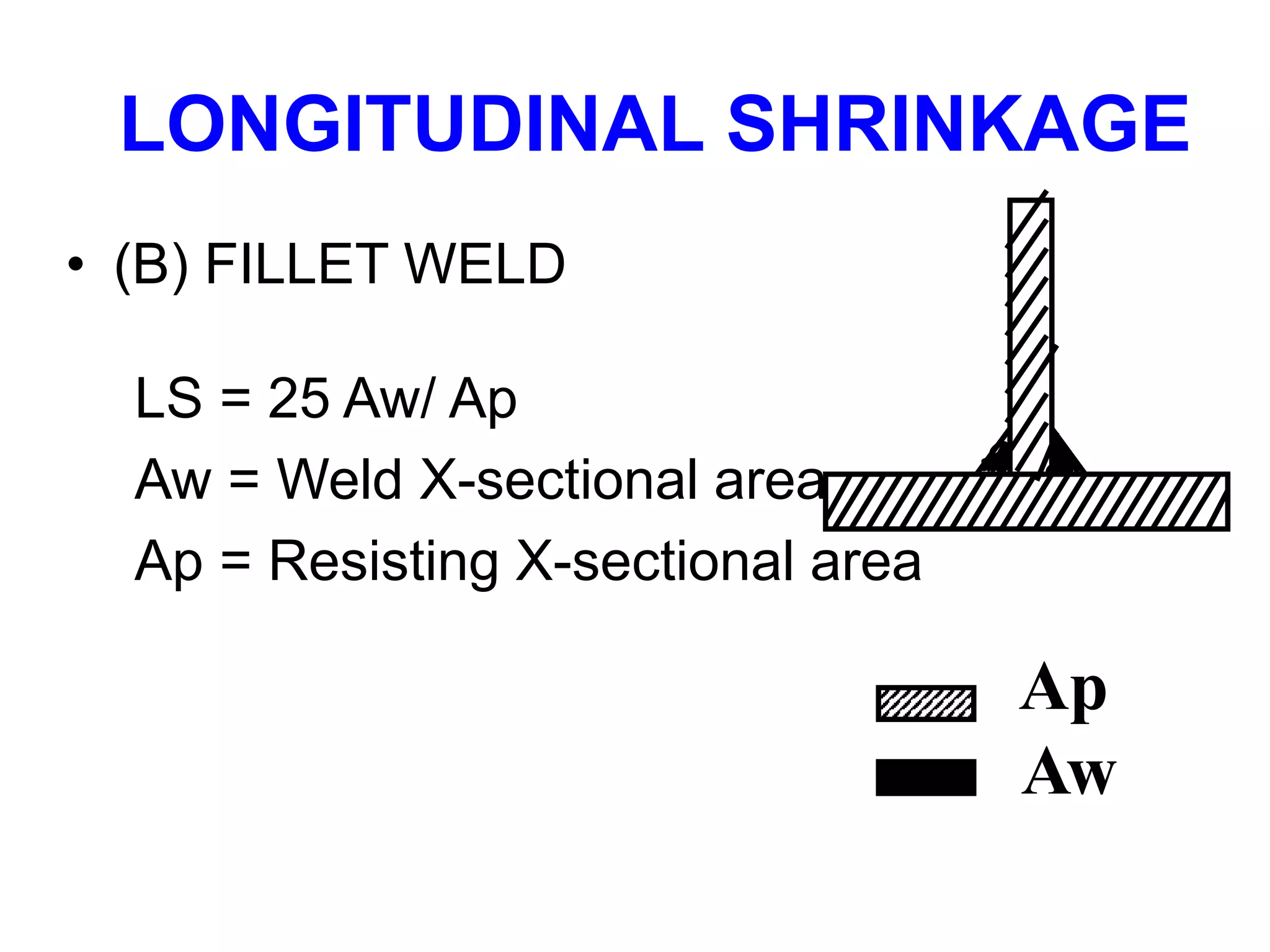
LONGITUDINAL SHRINKAGE
LS = 25 Aw/ Ap
Aw = Weld X-sectional area
Ap = Resisting X-sectional area
Ap
Aw
• (B) FILLET WELD
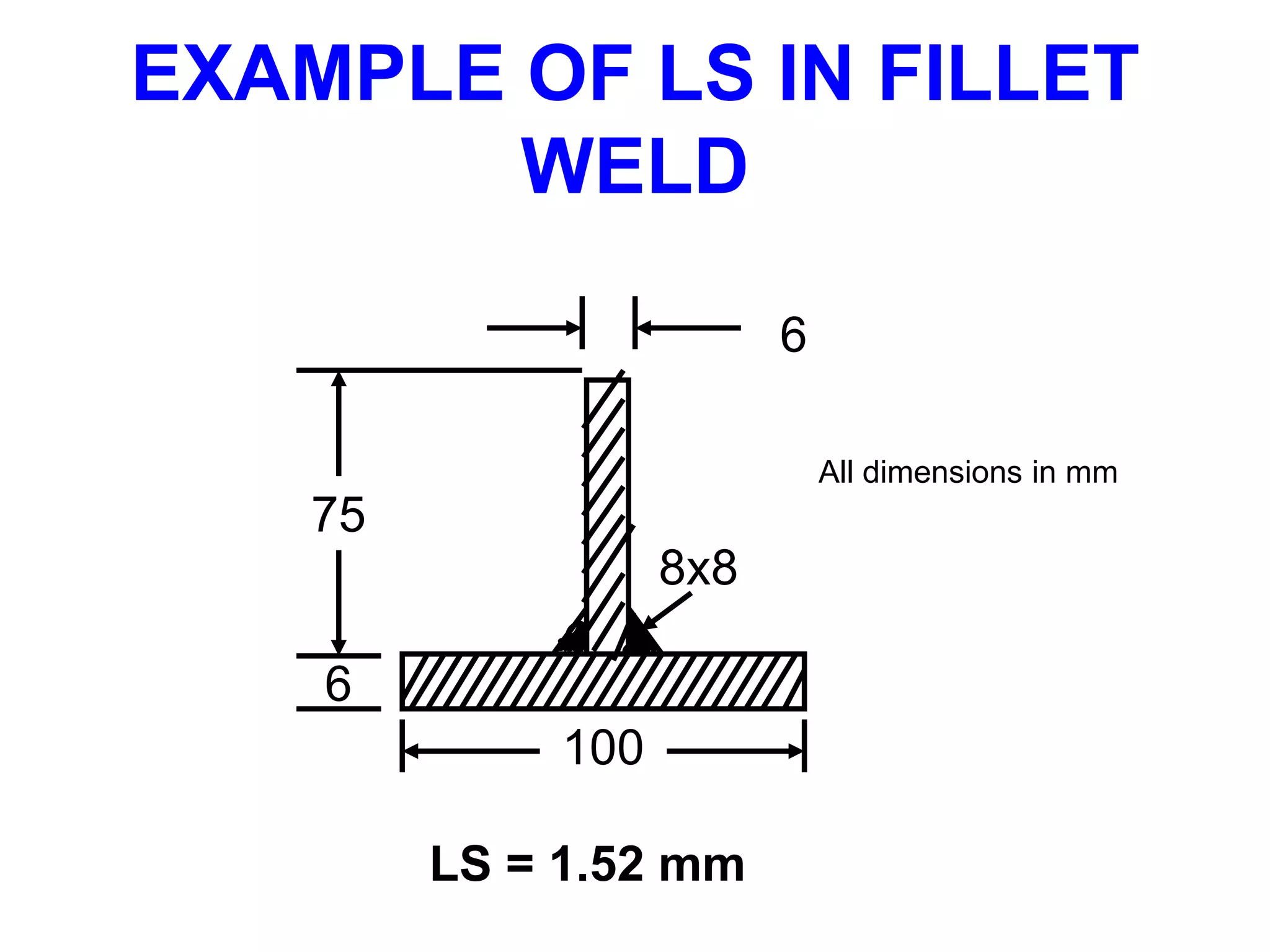
EXAMPLE OF LS IN FILLET
WELD
100
75
6
6
8x8
All dimensions in mm
LS = 1.52 mm
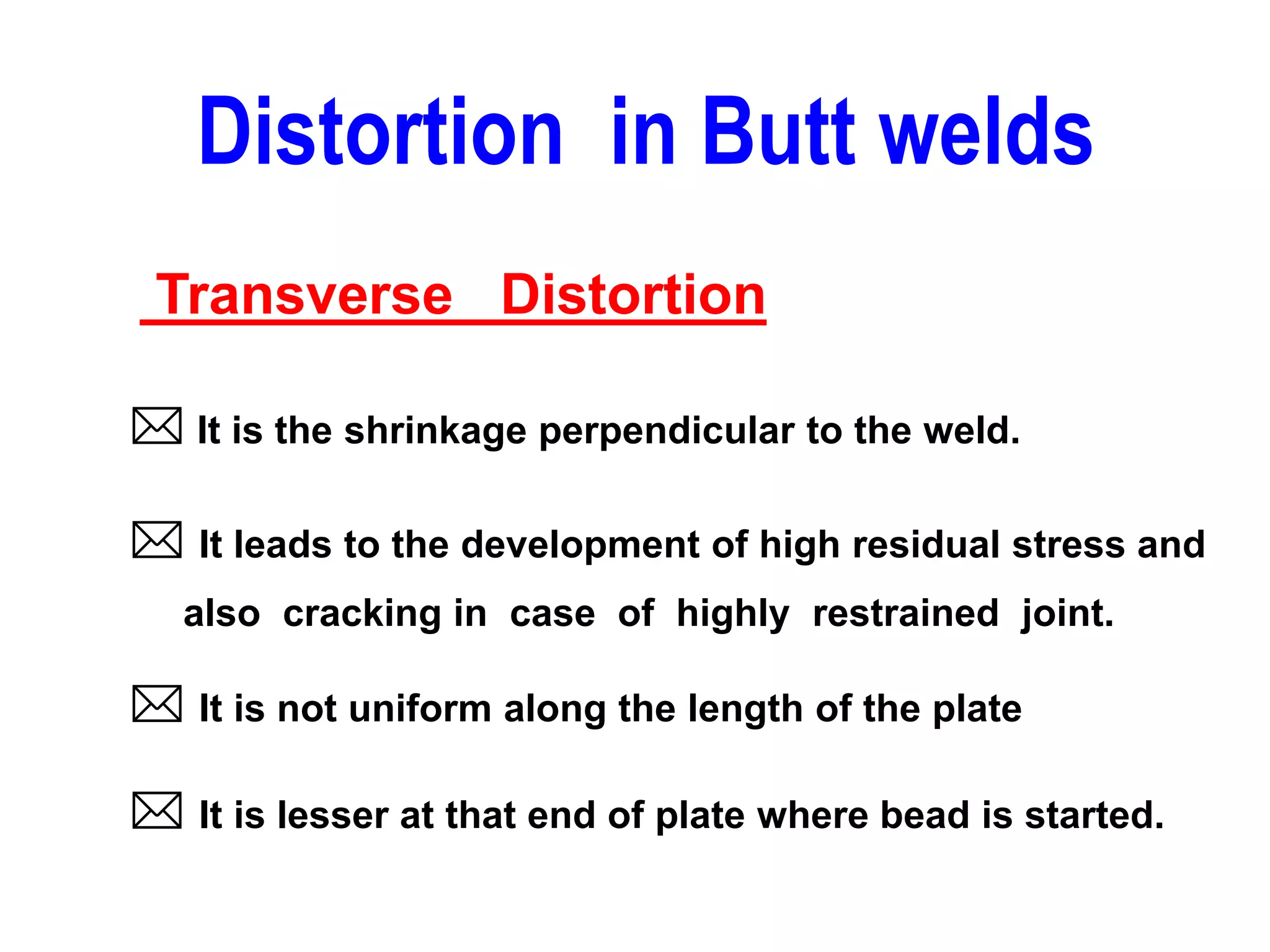
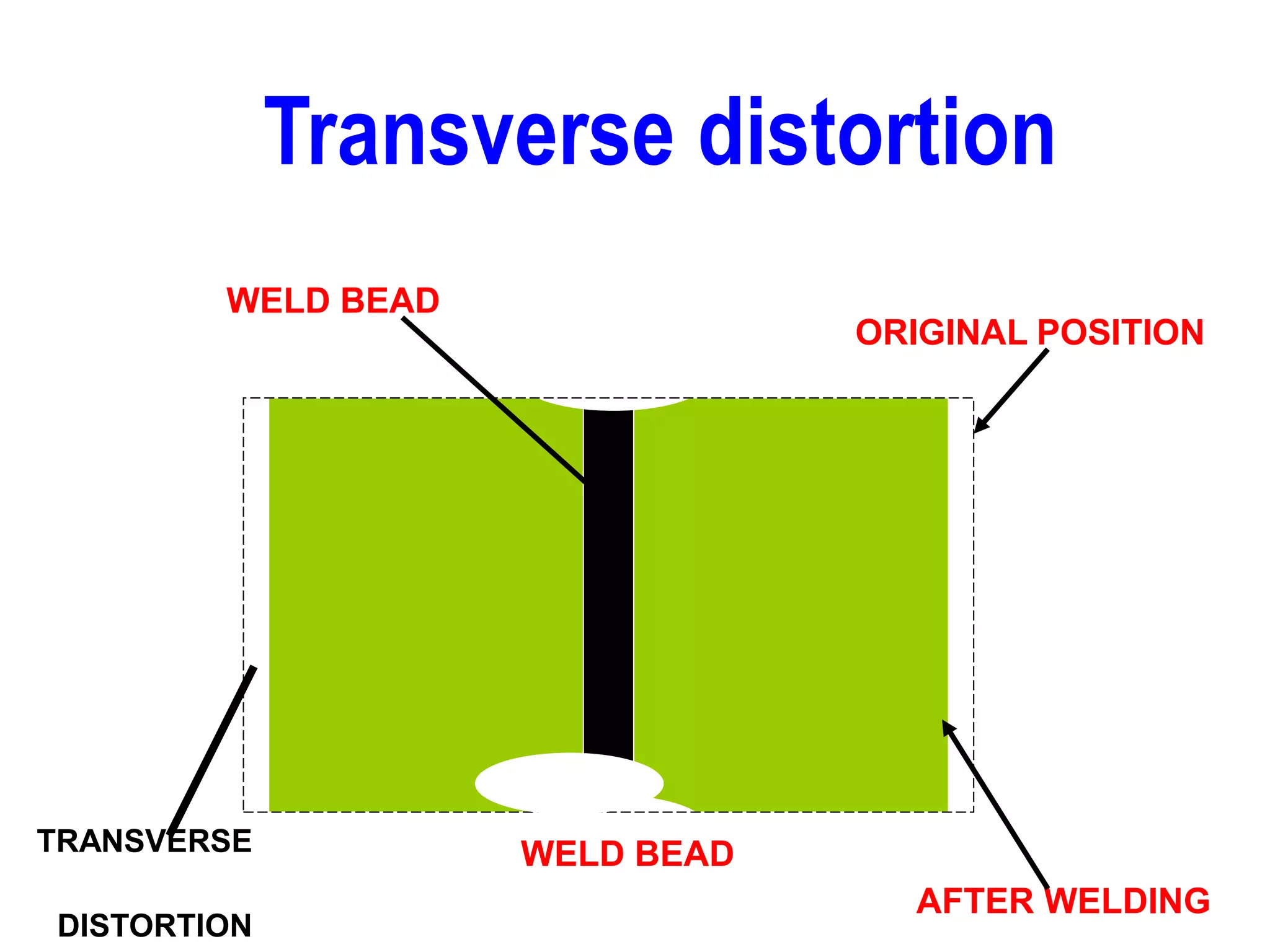
 It is the shrinkage perpendicular to the weld.
 It leads to the development of high residual stress and
also cracking in case of highly restrained joint.
 It is not uniform along the length of the plate
 It is lesser at that end of plate where bead is started.
Distortion in Butt welds
Transverse Distortion
ORIGINAL POSITION
AFTER WELDING
Transverse distortion
WELD BEAD
WELD BEAD
TRANSVERSE
DISTORTION
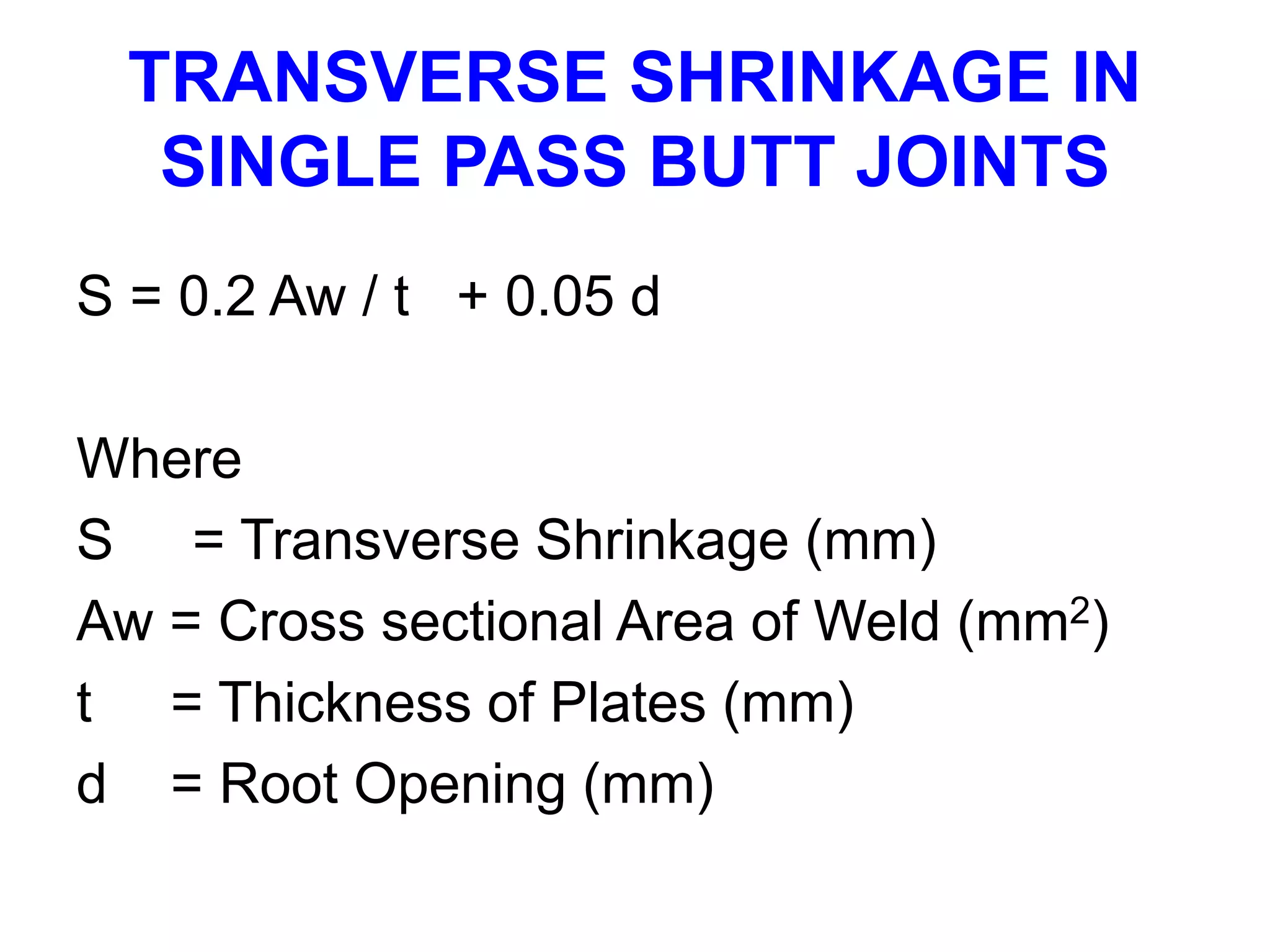
TRANSVERSE SHRINKAGE IN
SINGLE PASS BUTT JOINTS
S = 0.2 Aw / t + 0.05 d
Where
S = Transverse Shrinkage (mm)
Aw = Cross sectional Area of Weld (mm2)
t = Thickness of Plates (mm)
d = Root Opening (mm)
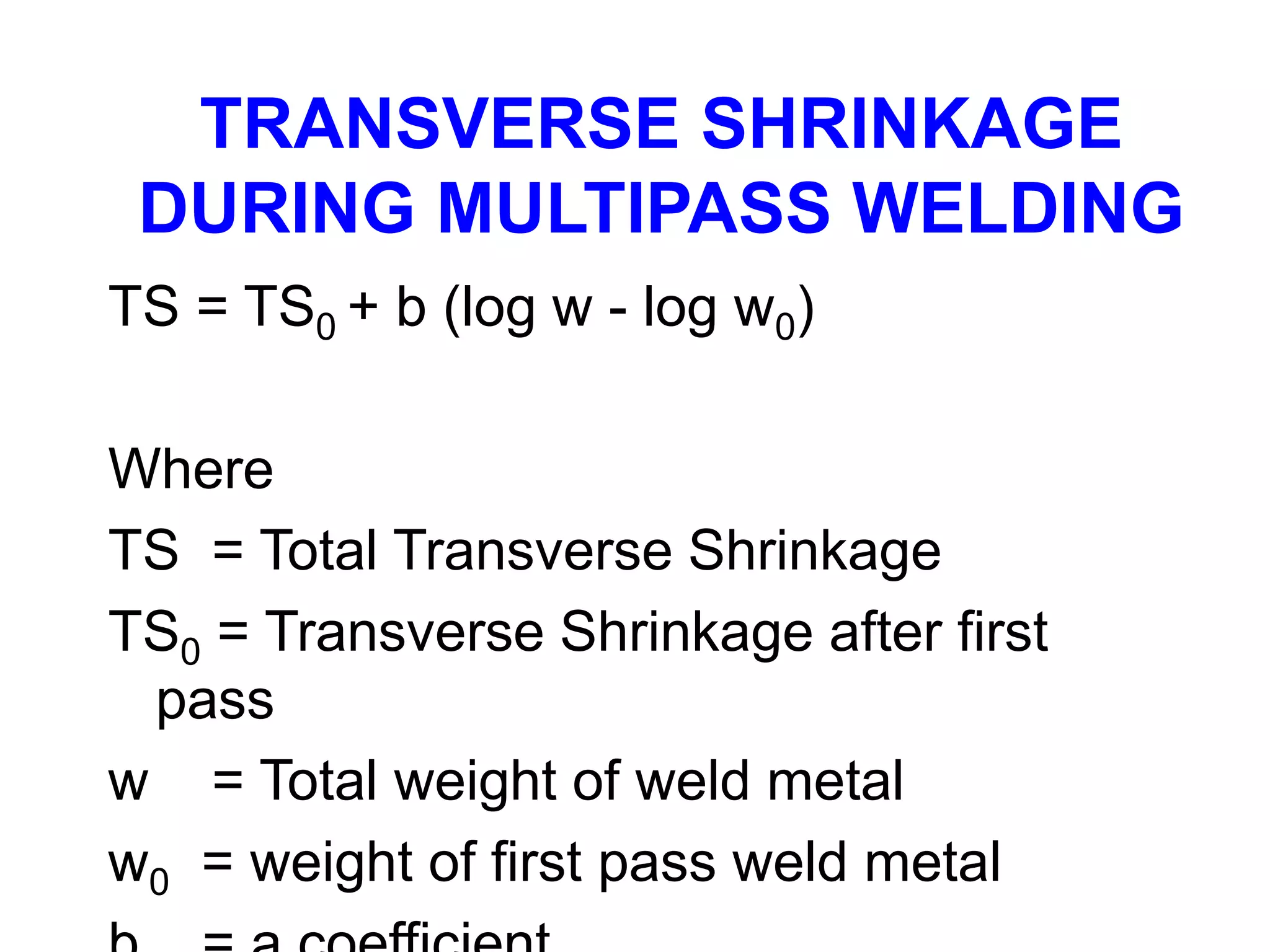
TRANSVERSE SHRINKAGE
DURING MULTIPASS WELDING
TS = TS0 + b (log w - log w0)
Where
TS = Total Transverse Shrinkage
TS0 = Transverse Shrinkage after first
pass
w = Total weight of weld metal
w0 = weight of first pass weld metal
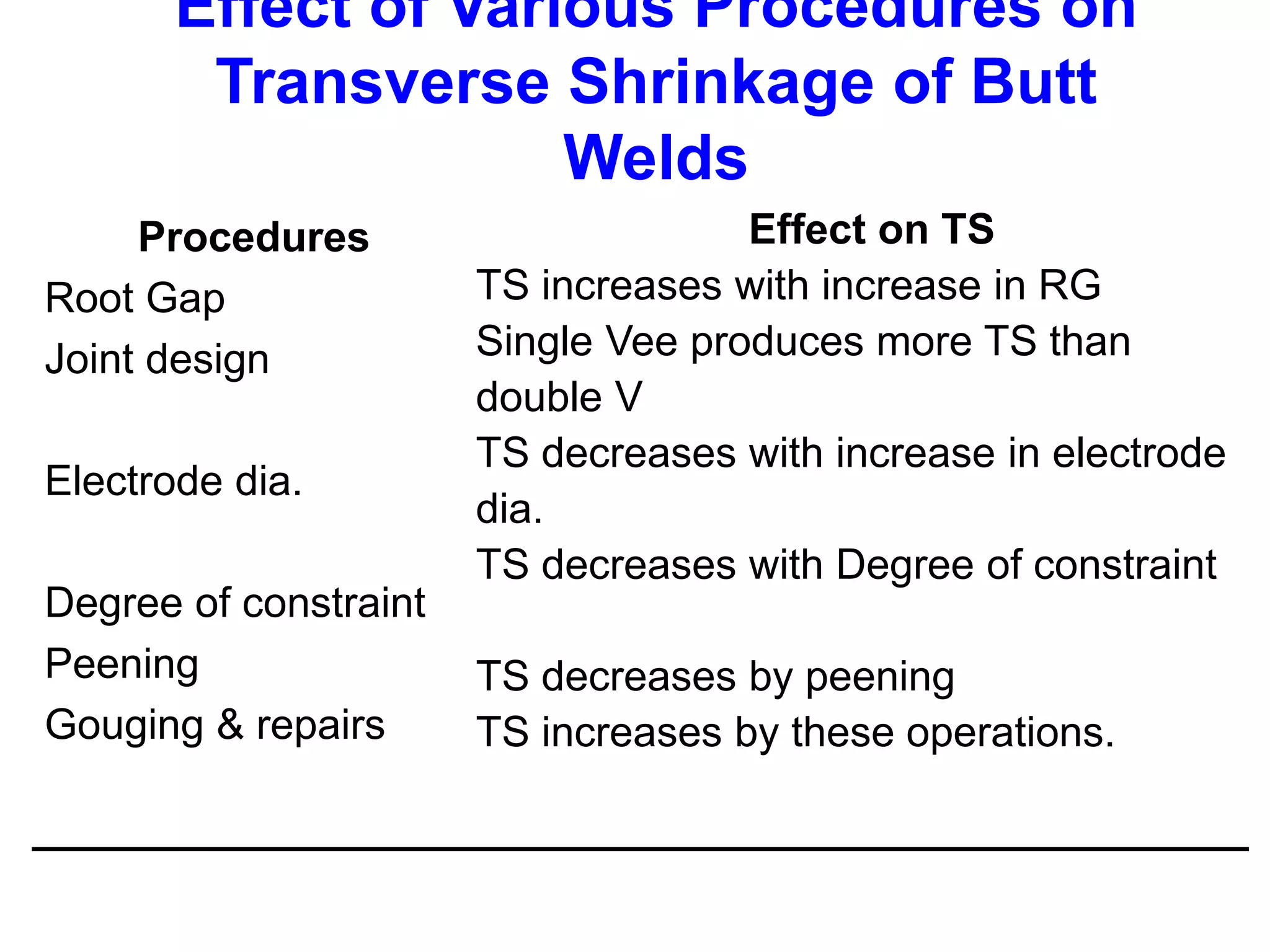
Effect of Various Procedures on
Transverse Shrinkage of Butt
Welds
Procedures
Root Gap
Joint design
Electrode dia.
Degree of constraint
Peening
Gouging & repairs
Effect on TS
TS increases with increase in RG
Single Vee produces more TS than
double V
TS decreases with increase in electrode
dia.
TS decreases with Degree of constraint
TS decreases by peening
TS increases by these operations.
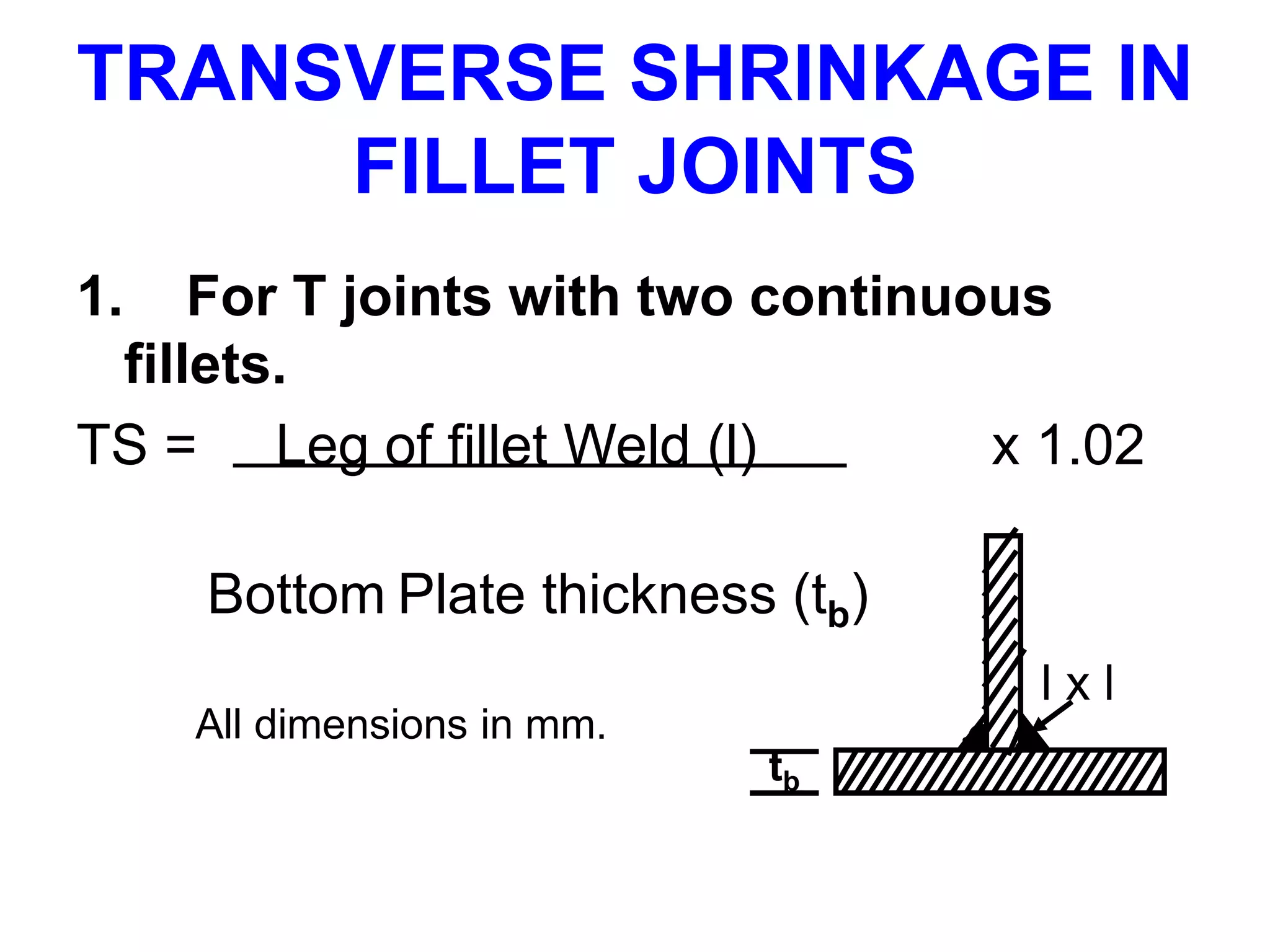
TRANSVERSE SHRINKAGE IN
FILLET JOINTS
1. For T joints with two continuous
fillets.
TS = Leg of fillet Weld (l) x 1.02
Bottom Plate thickness (tb)
All dimensions in mm.
tb
l x l
2. For intermittent fillet welds , a correcting
factor of proportional length of fillet weld
to
total length of joint should be used.
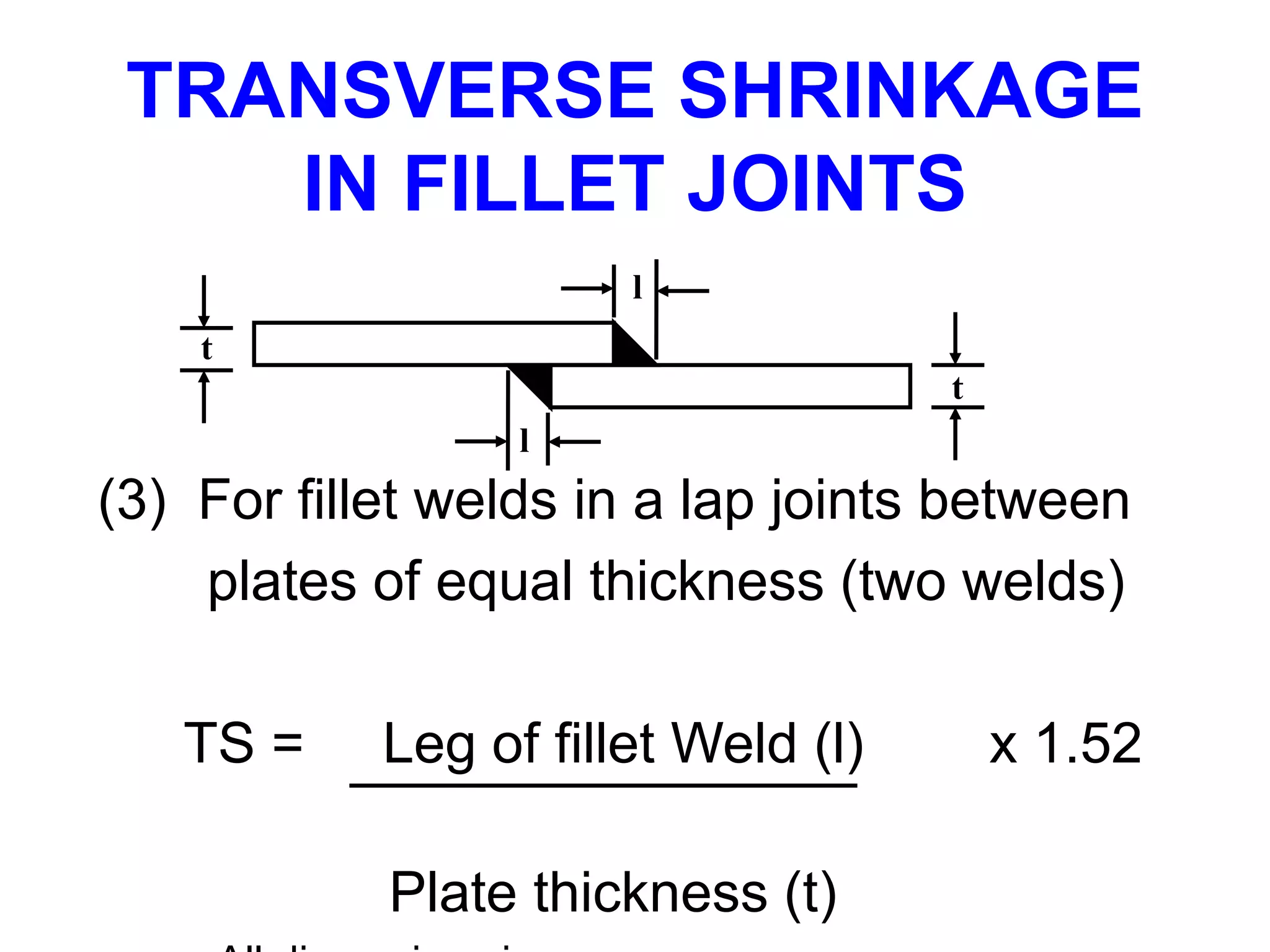
TRANSVERSE SHRINKAGE IN
FILLET JOINTS
(3) For fillet welds in a lap joints between
plates of equal thickness (two welds)
TS = Leg of fillet Weld (l) x 1.52
Plate thickness (t)
TRANSVERSE SHRINKAGE
IN FILLET JOINTS
l
l
t
t
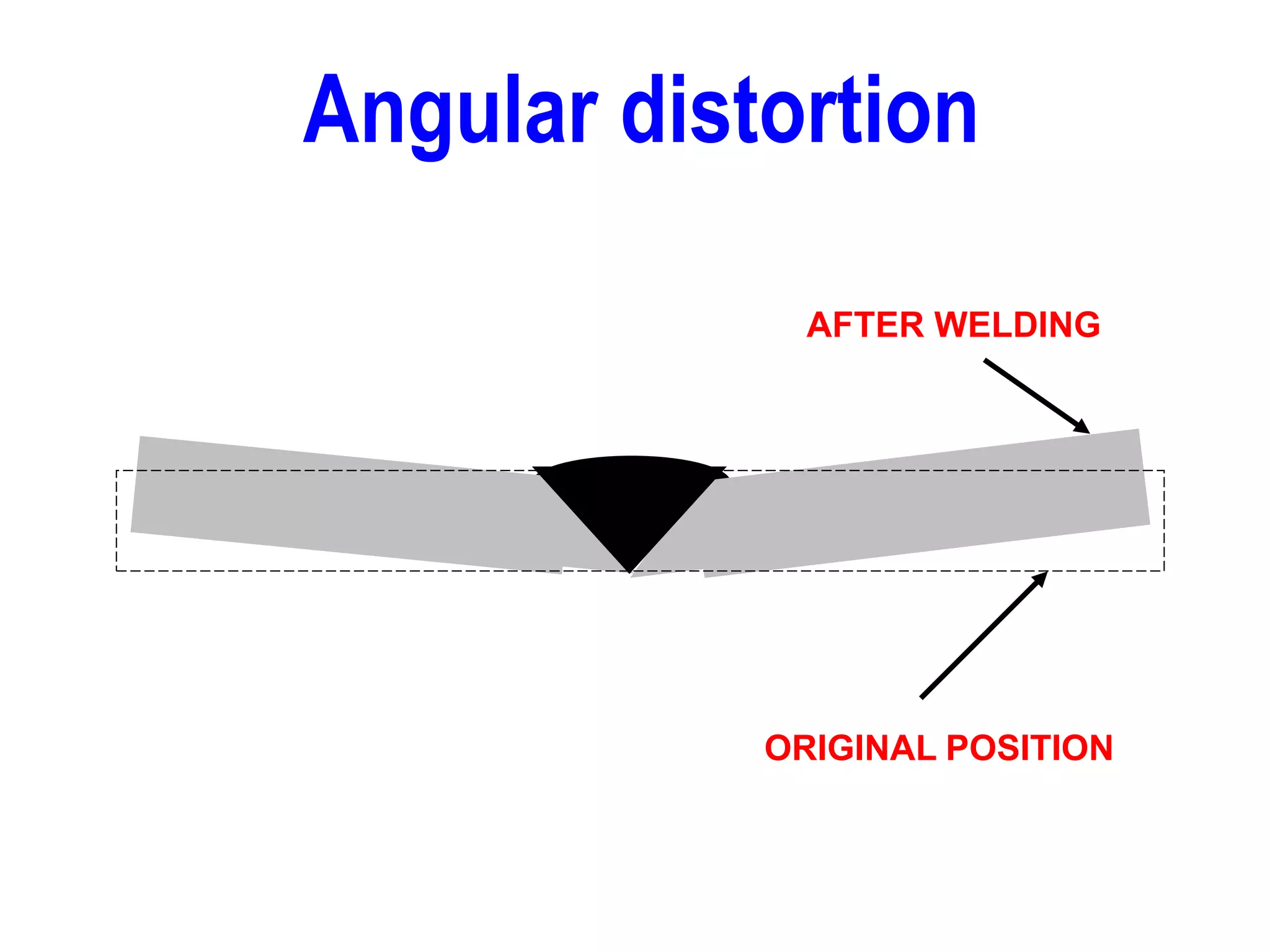
ORIGINAL POSITION
AFTER WELDING
Angular distortion
 It is the bending transverse to the weld.
Due to non-uniform heating and cooling along the
thickness of plate.
 This is the main source of mismatch and
dimensional inaccuracy in large welded
structures
Distortion in Butt welds
Angular Distortion
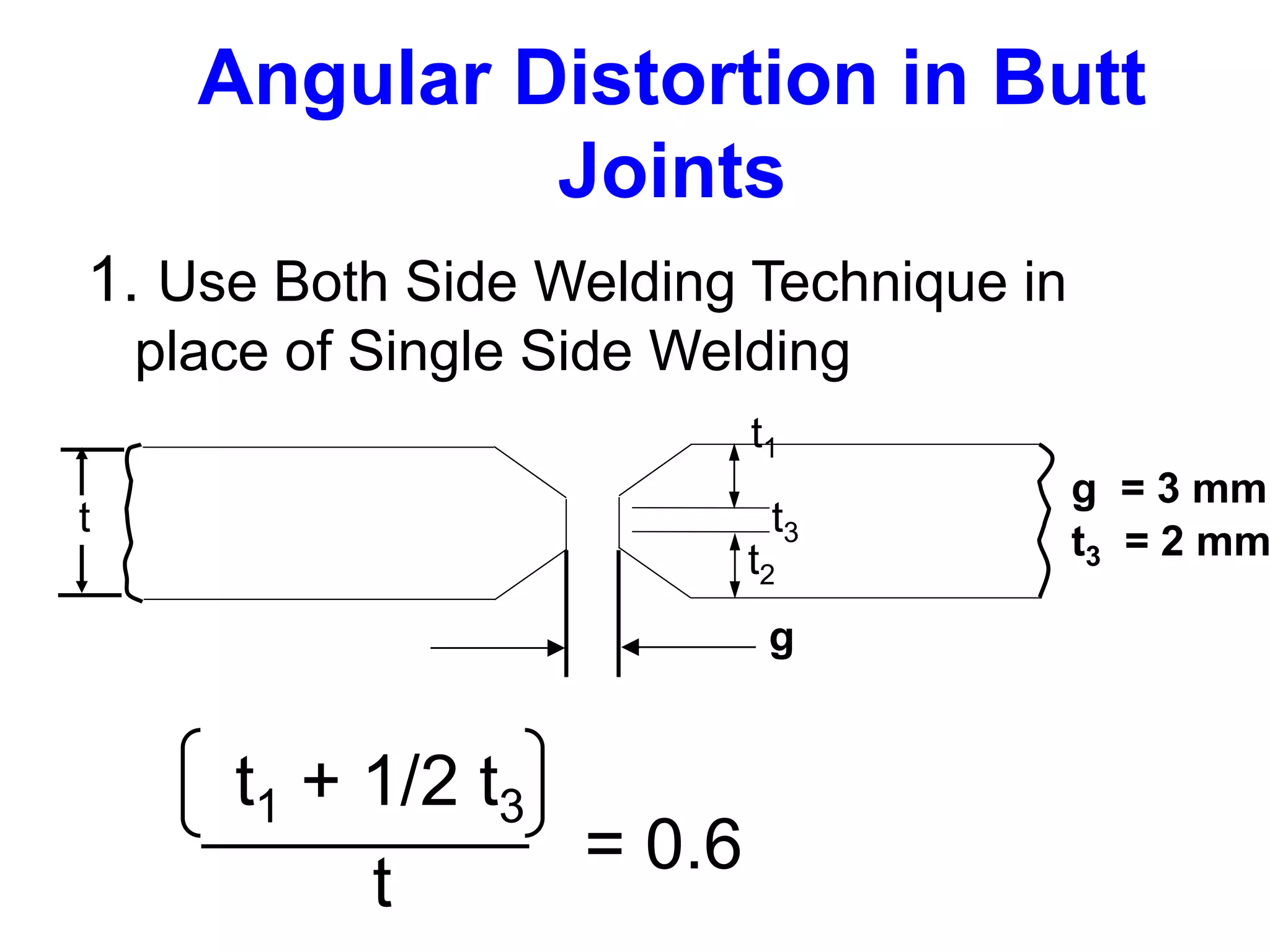
Angular Distortion in Butt
Joints
t1
t2
t3
g
g = 3 mm
t3 = 2 mm
t
t1 + 1/2 t3
t
= 0.6
1. Use Both Side Welding Technique in
place of Single Side Welding
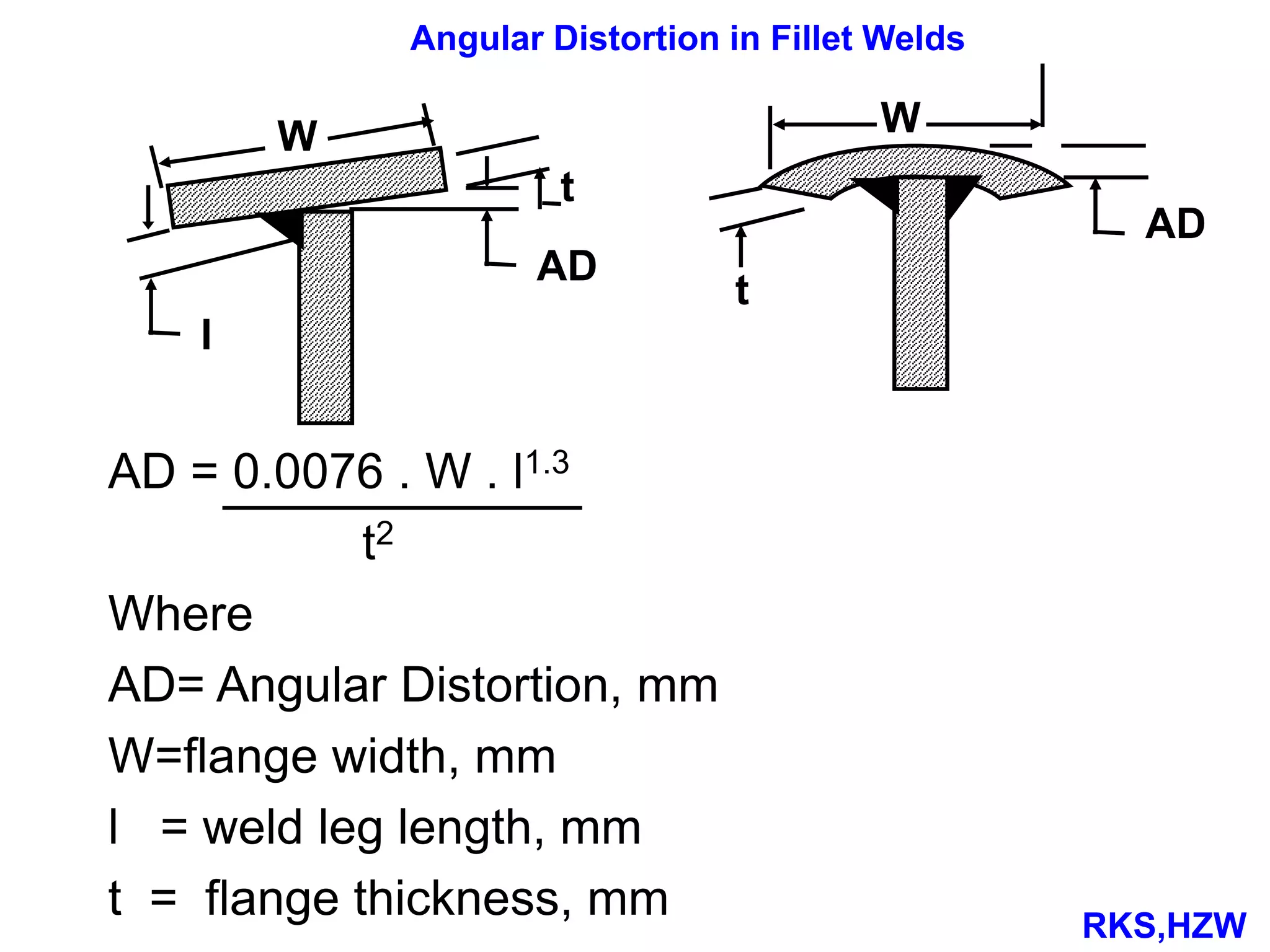
AD = 0.0076 . W . l1.3
t2
Where
AD= Angular Distortion, mm
W=flange width, mm
l = weld leg length, mm
t = flange thickness, mm
Angular Distortion in Fillet Welds
W W
AD
AD
t
l
t
RKS,HZW
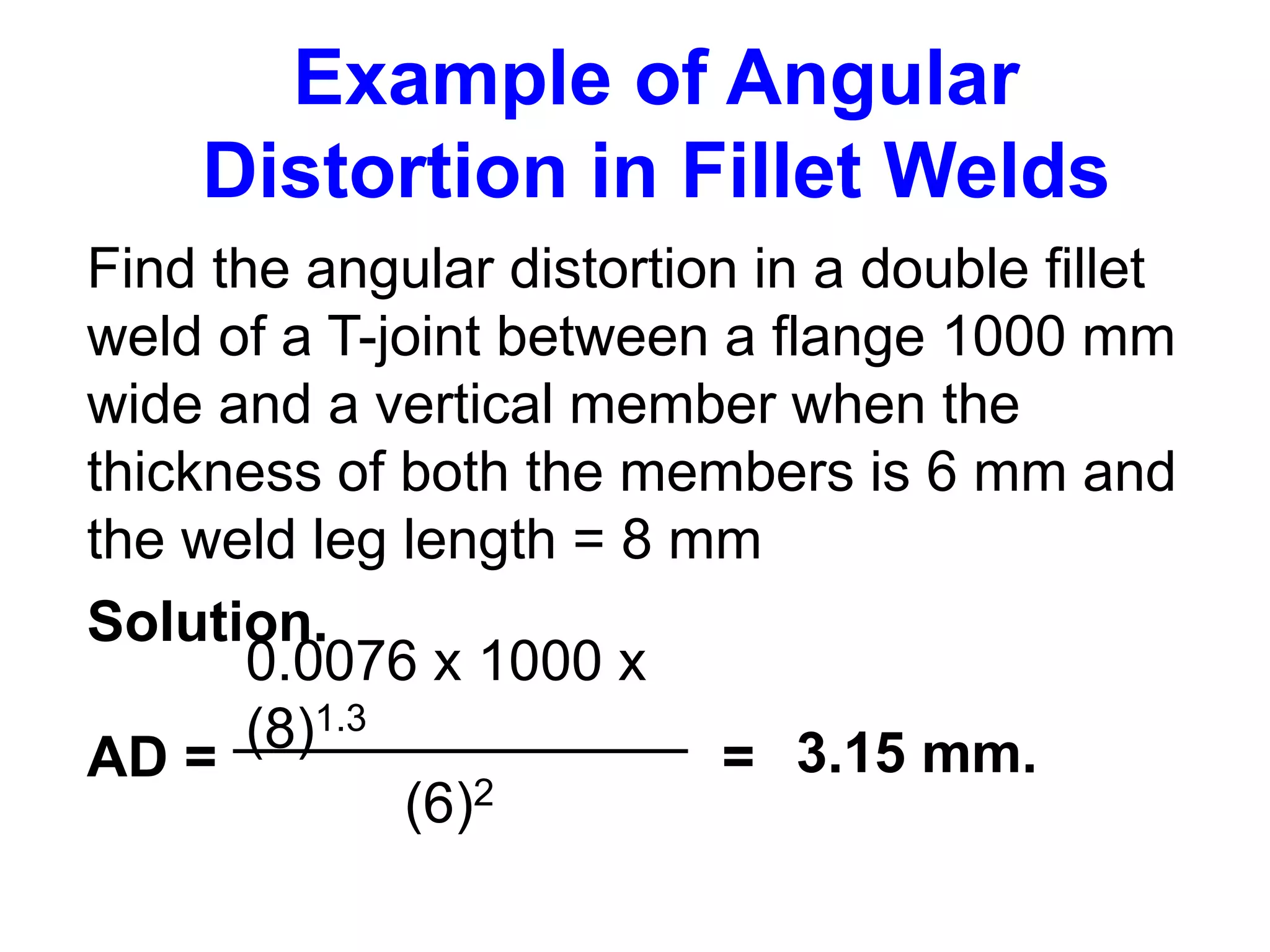
Example of Angular
Distortion in Fillet Welds
Find the angular distortion in a double fillet
weld of a T-joint between a flange 1000 mm
wide and a vertical member when the
thickness of both the members is 6 mm and
the weld leg length = 8 mm
Solution.
AD = =
0.0076 x 1000 x
(8)1.3
(6)2
3.15 mm.
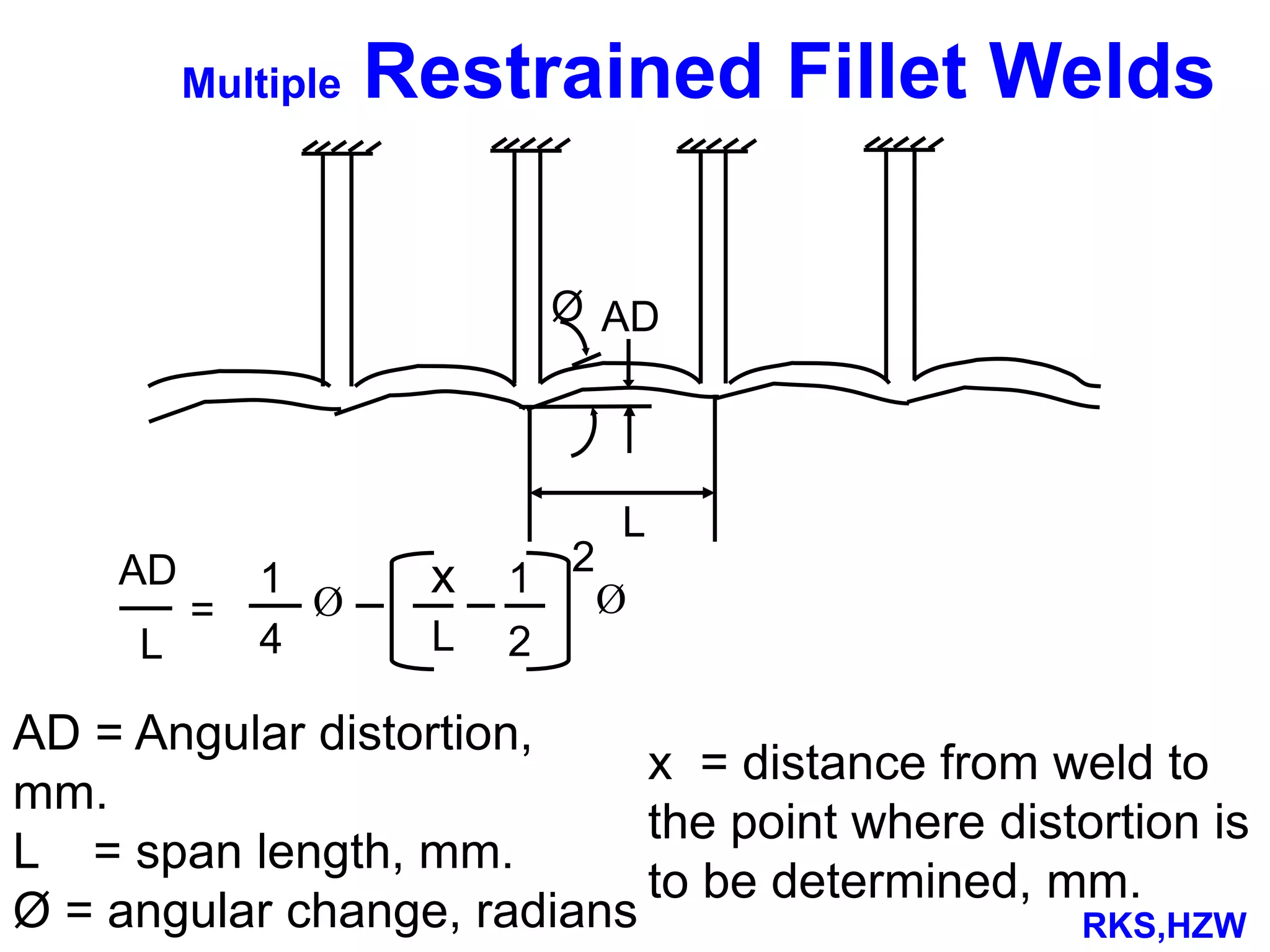
Multiple Restrained Fillet Welds
AD
Ø
L
AD
L
1
4
= Ø
x
L
1
2
2
Ø
AD = Angular distortion,
mm.
L = span length, mm.
Ø = angular change, radians
x = distance from weld to
the point where distortion is
to be determined, mm.
RKS,HZW
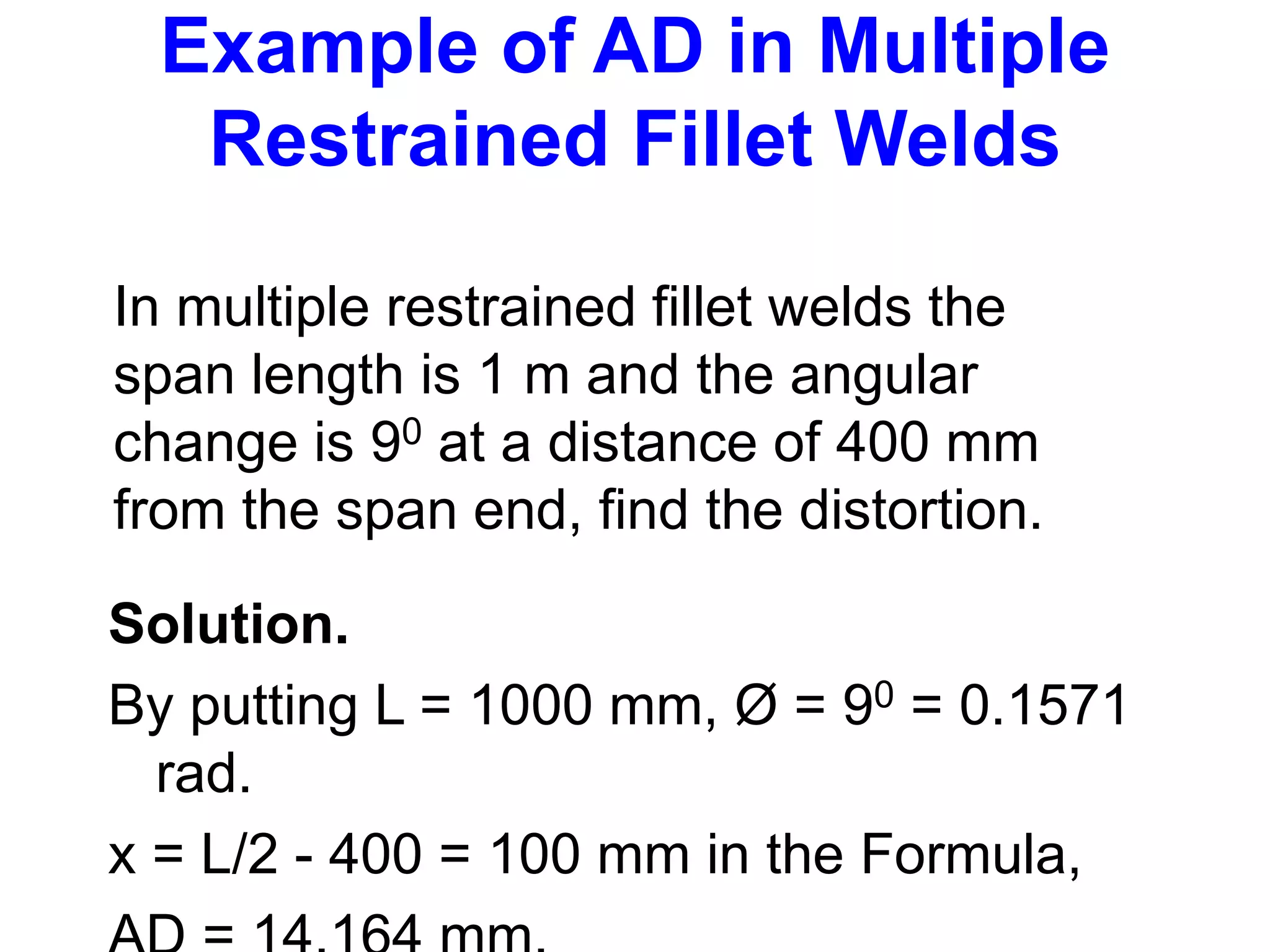
Example of AD in Multiple
Restrained Fillet Welds
In multiple restrained fillet welds the
span length is 1 m and the angular
change is 90 at a distance of 400 mm
from the span end, find the distortion.
Solution.
By putting L = 1000 mm, Ø = 90 = 0.1571
rad.
x = L/2 - 400 = 100 mm in the Formula,
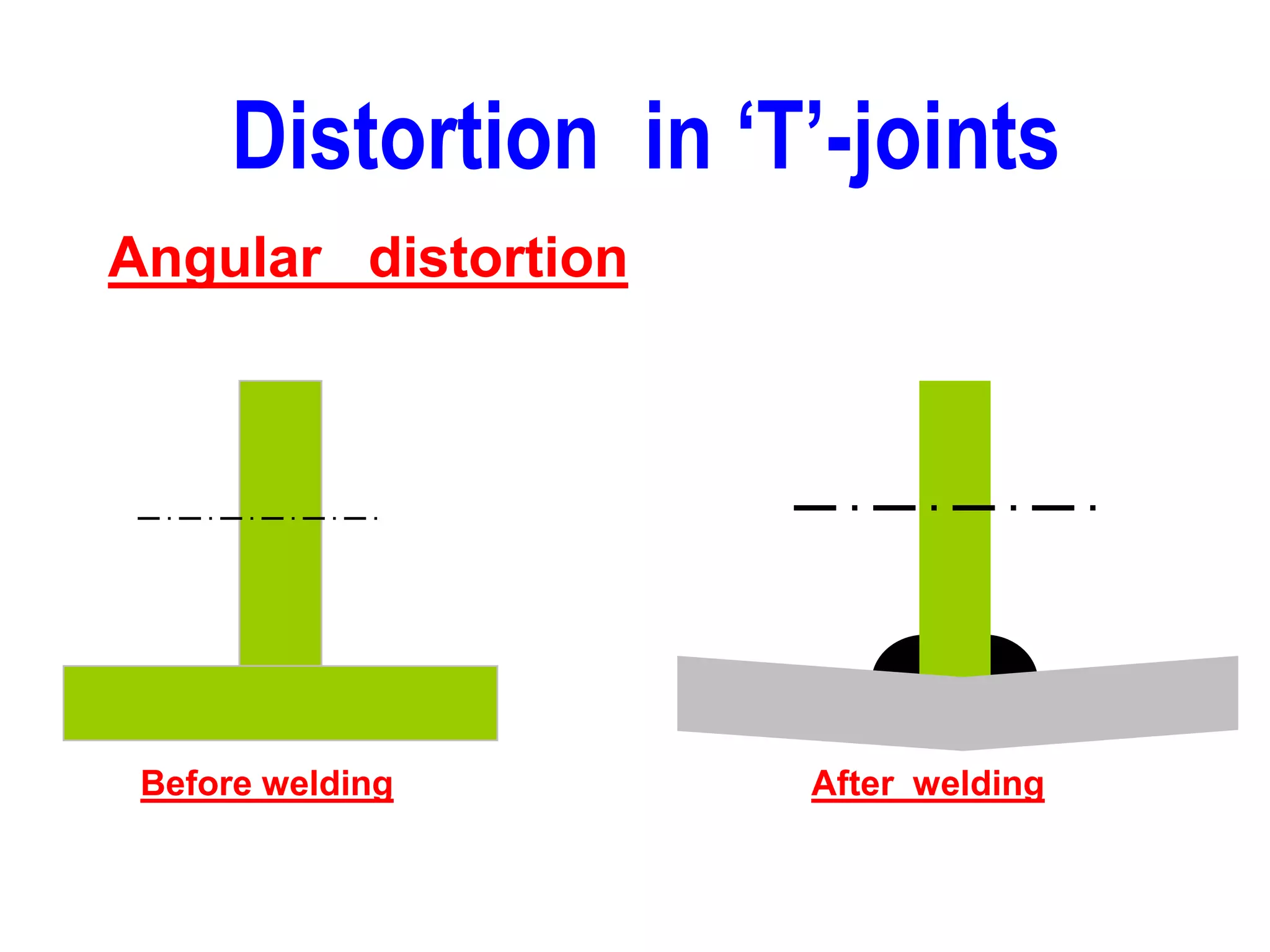
Distortion in ‘T’-joints
Angular distortion
Before welding After welding
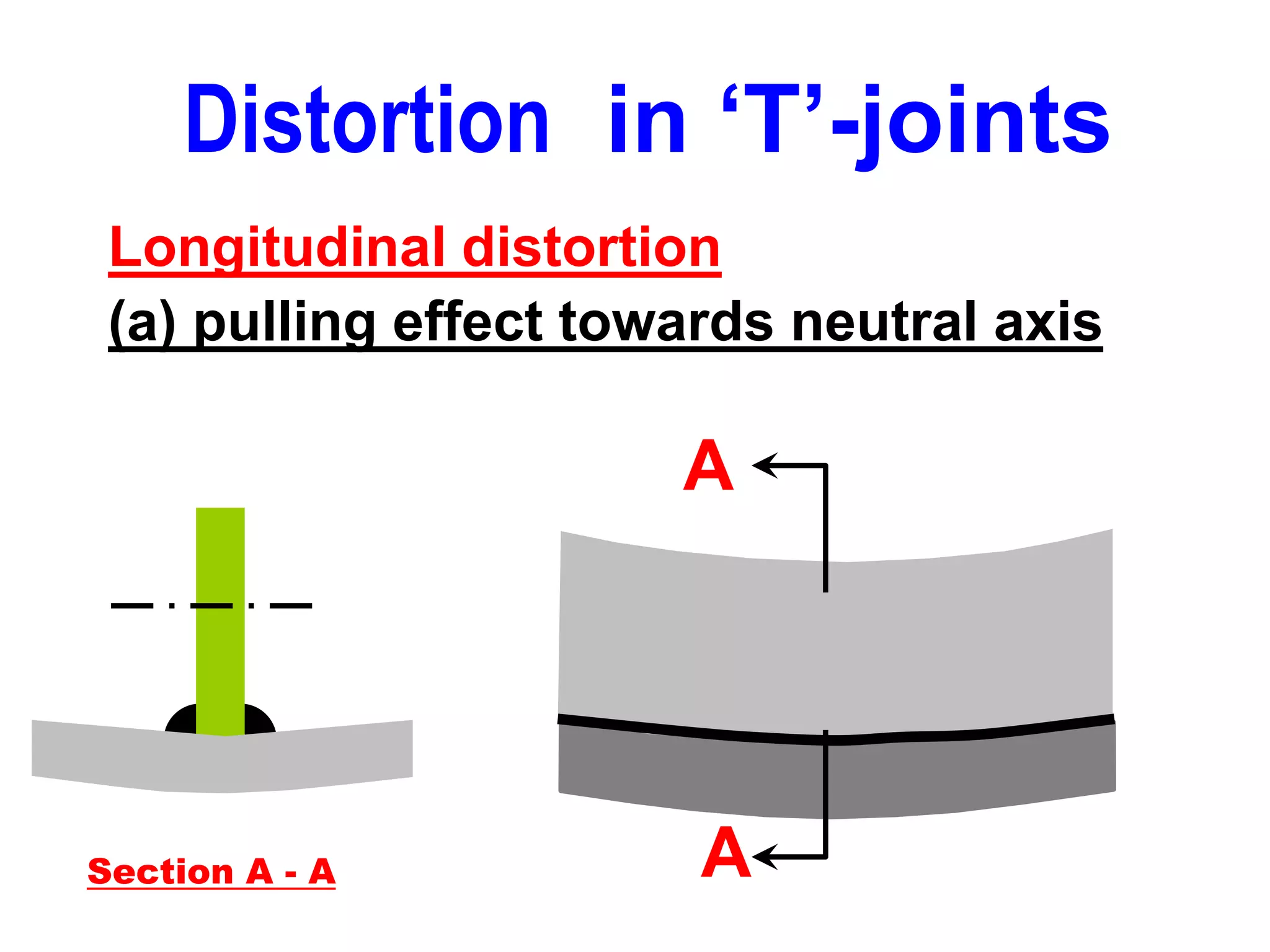
Distortion in ‘T’-joints
Longitudinal distortion
(a) pulling effect towards neutral axis
A
A
Section A - A
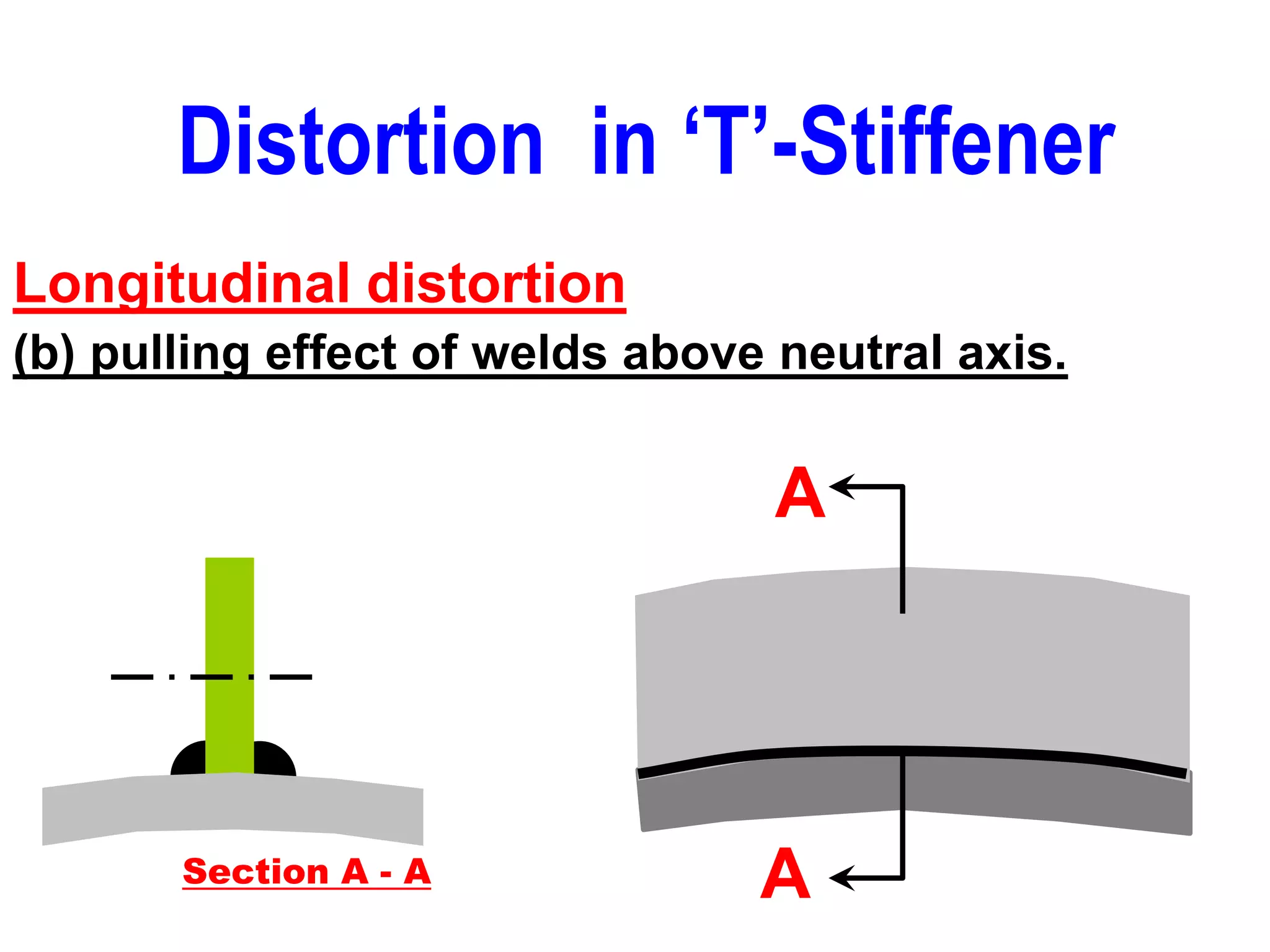
Distortion in ‘T’-Stiffener
Longitudinal distortion
(b) pulling effect of welds above neutral axis.
Section A - A A
A
To prevent distortion :-
(A)
Reduce the effective
shrinkage force.
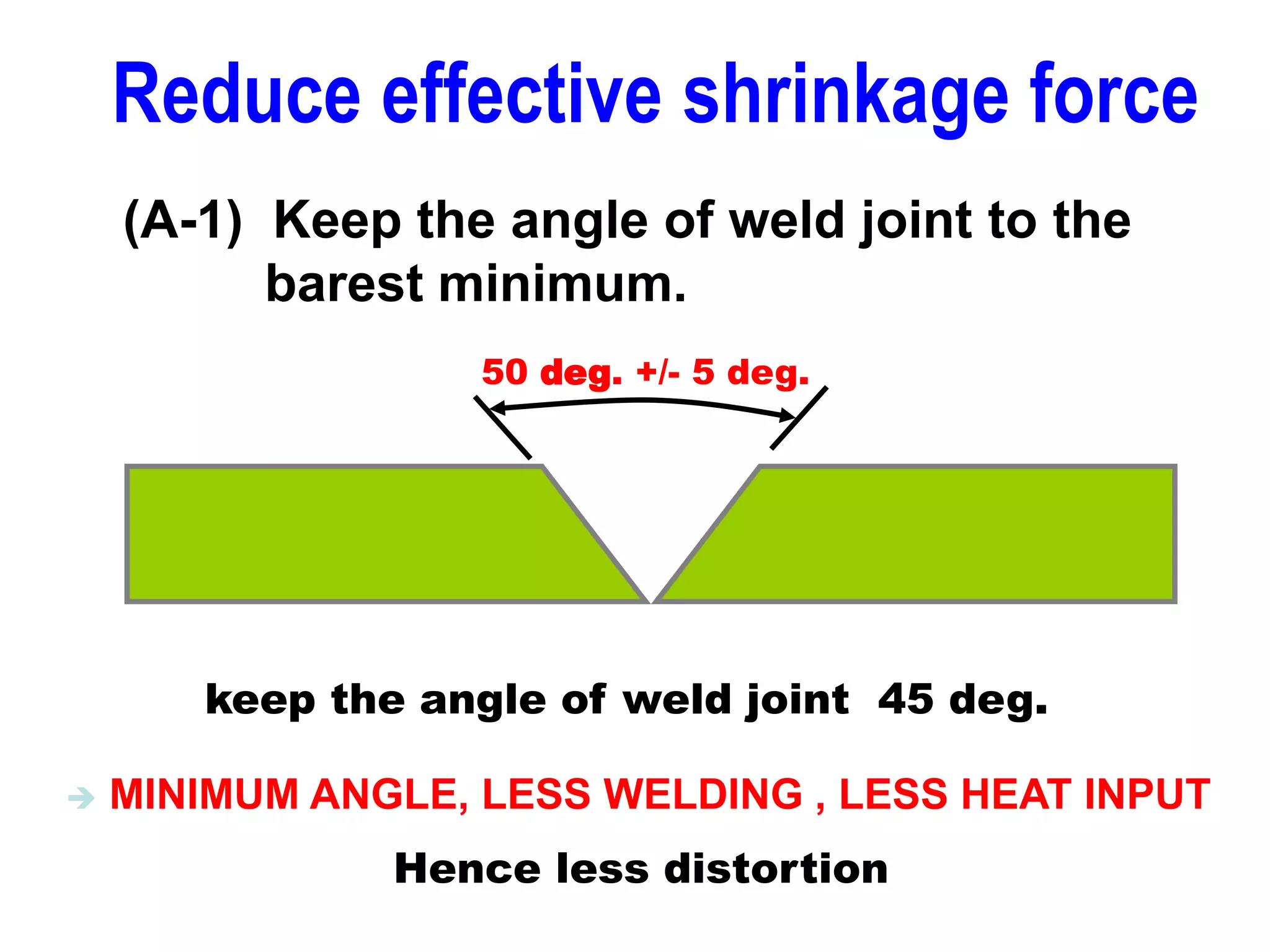
Reduce effective shrinkage force
(A-1) Keep the angle of weld joint to the
barest minimum.
keep the angle of weld joint 45 deg.
 MINIMUM ANGLE, LESS WELDING , LESS HEAT INPUT
Hence less distortion
50 deg. +/- 5 deg.
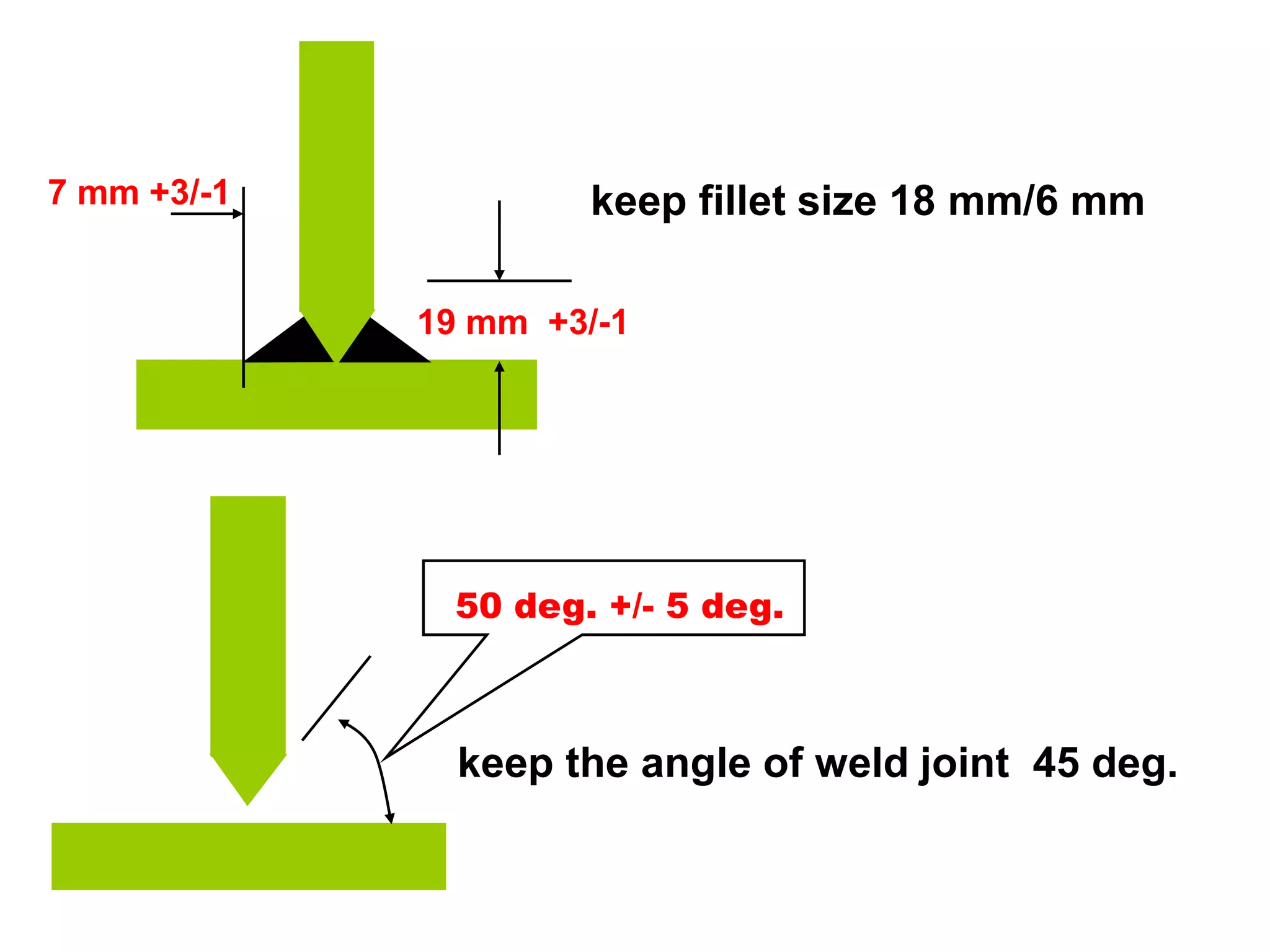
50 deg. +/- 5 deg.
keep the angle of weld joint 45 deg.
keep fillet size 18 mm/6 mm
19 mm +3/-1
7 mm +3/-1
(A-4) Minimize no of passes larger size of
electrodes
Reduce effective shrinkage force
MORE NO OF PASSES LESS NO OF PASSES
(A-5) Place welds near the neutral axis
N. A.
Reduce effective shrinkage force
To prevent distortion :-
(B)
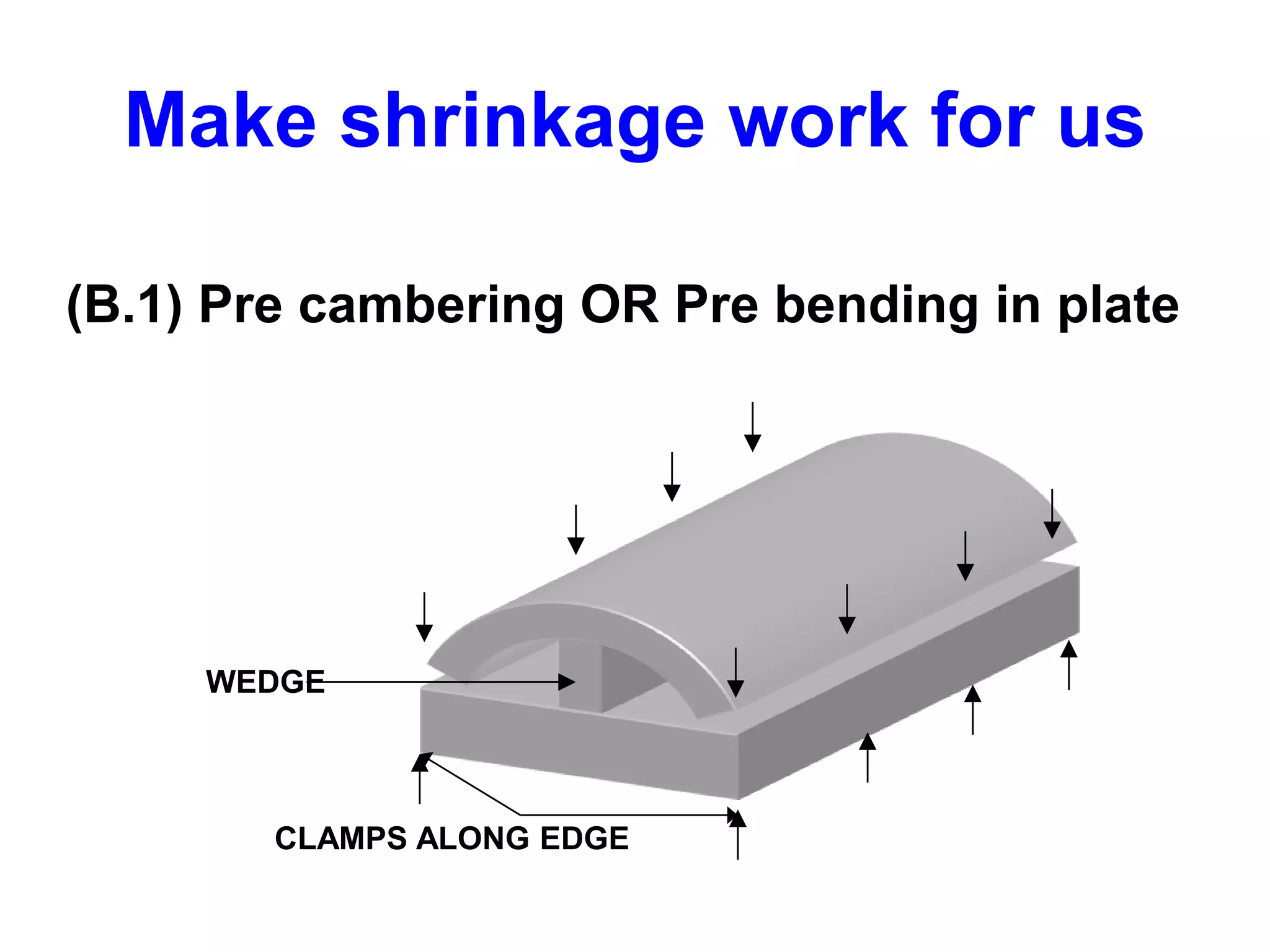
Make shrinkage work
for us
WEDGE
CLAMPS ALONG EDGE
Make shrinkage work for us
(B.1) Pre cambering OR Pre bending in plate
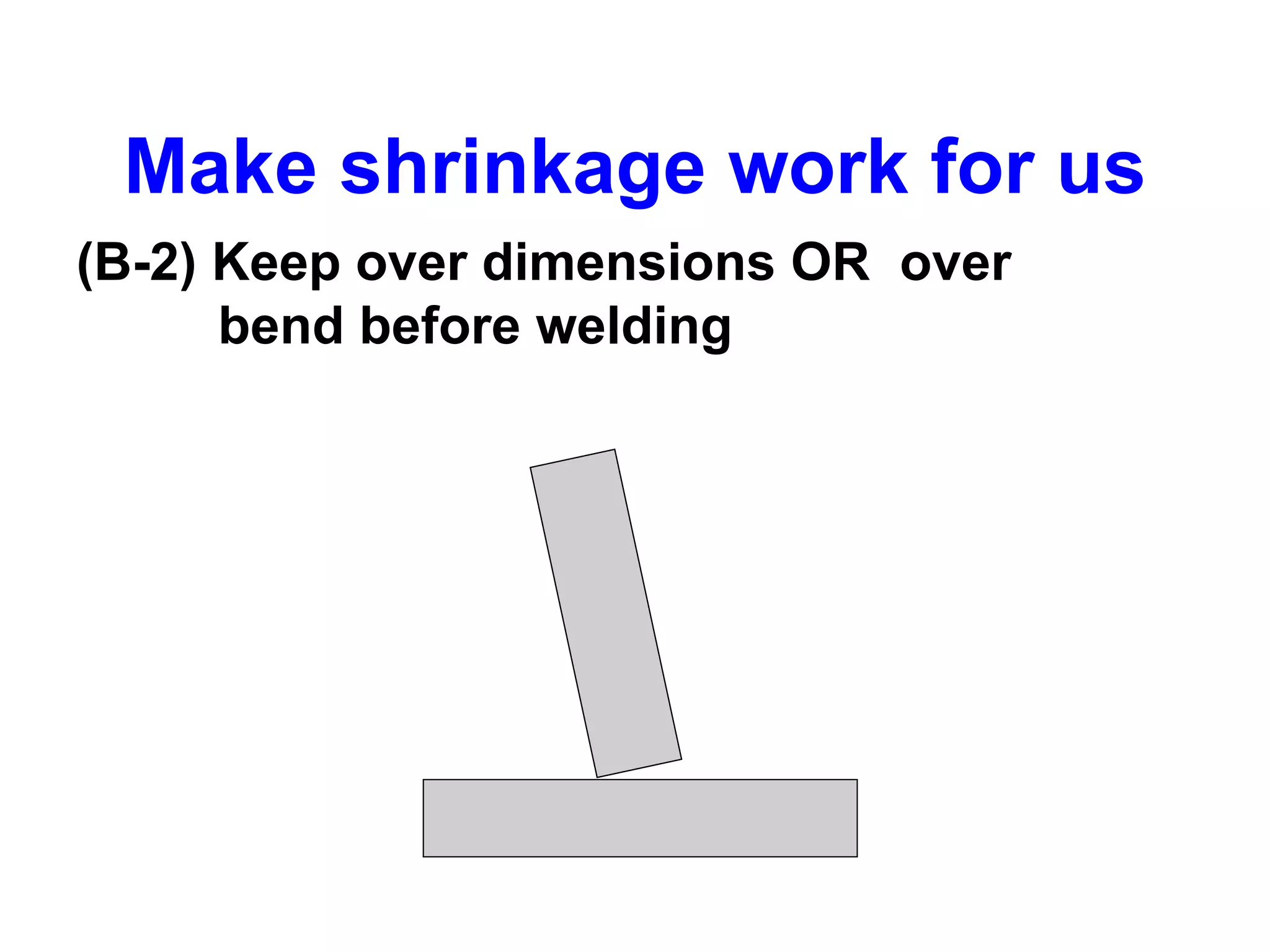
Make shrinkage work for us
(B-2) Keep over dimensions OR over
bend before welding
To prevent distortion :-
(C)
Balance shrinkage
force with other
forces
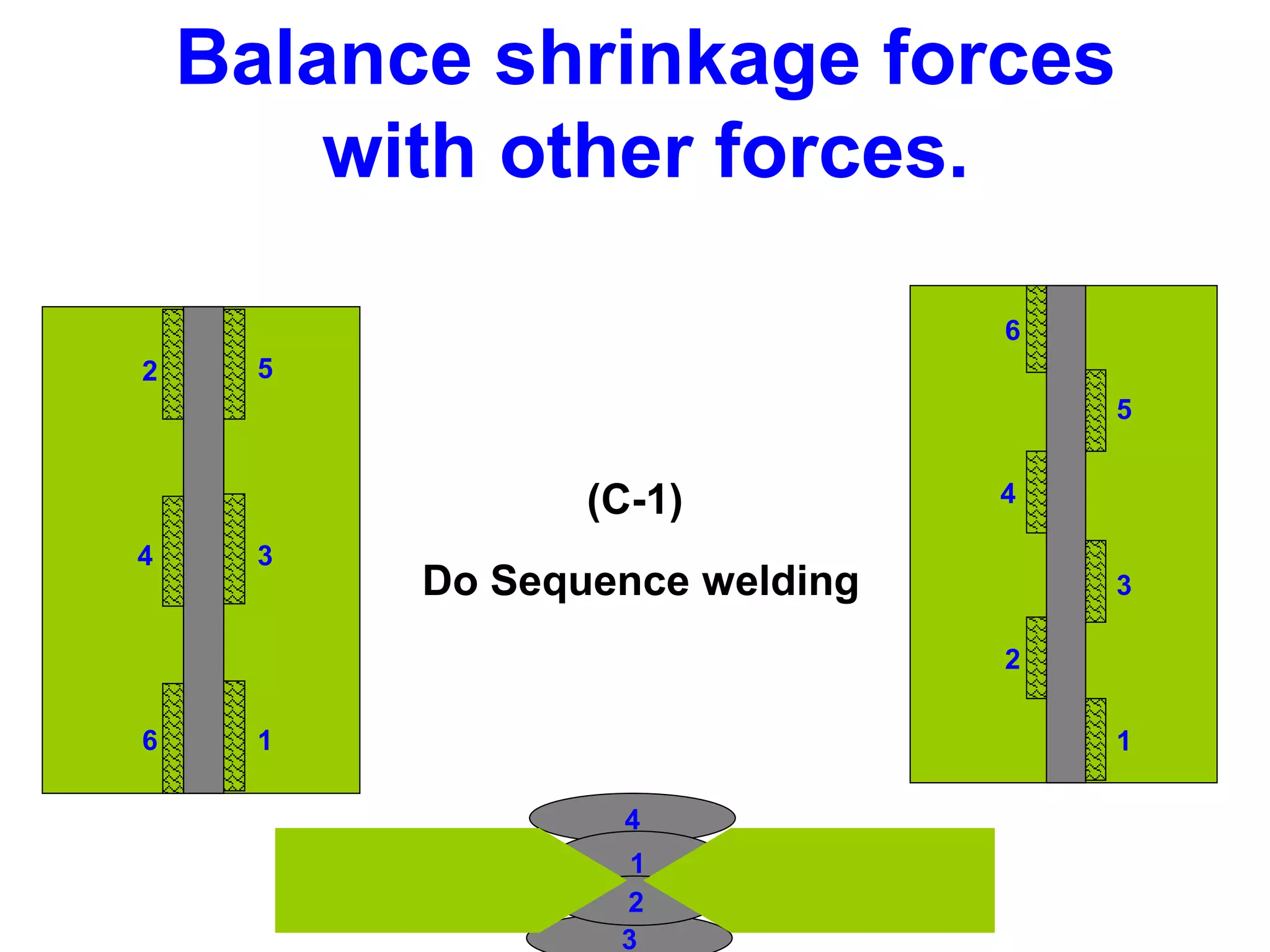
4
3
1
2
1
3
5
2
4
6 1
3
5
6
4
2
(C-1)
Do Sequence welding
Balance shrinkage forces
with other forces.
 Balance shrinkage forces
with other forces
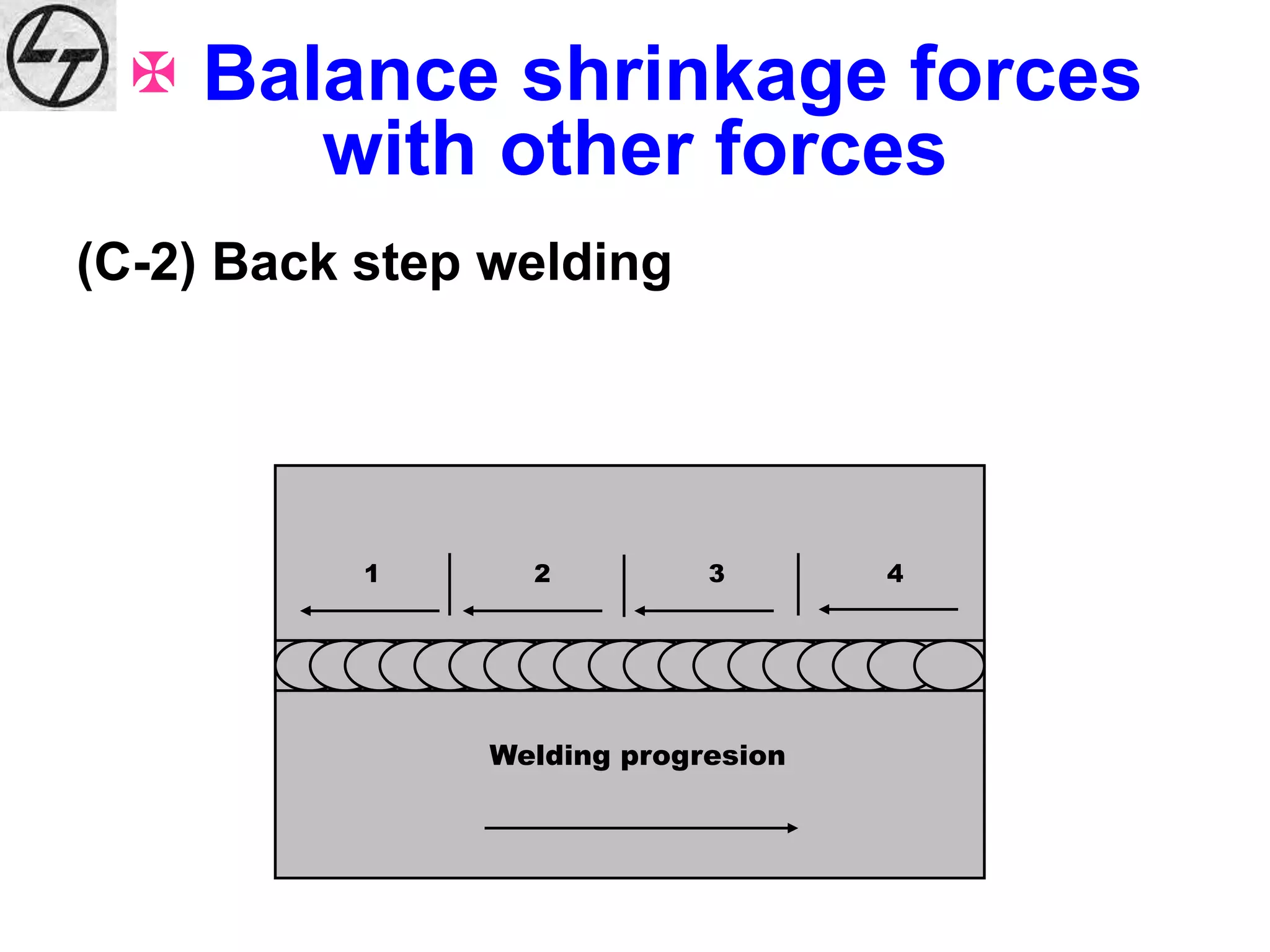
(C-2) Back step welding
1 2 3 4
Welding progresion
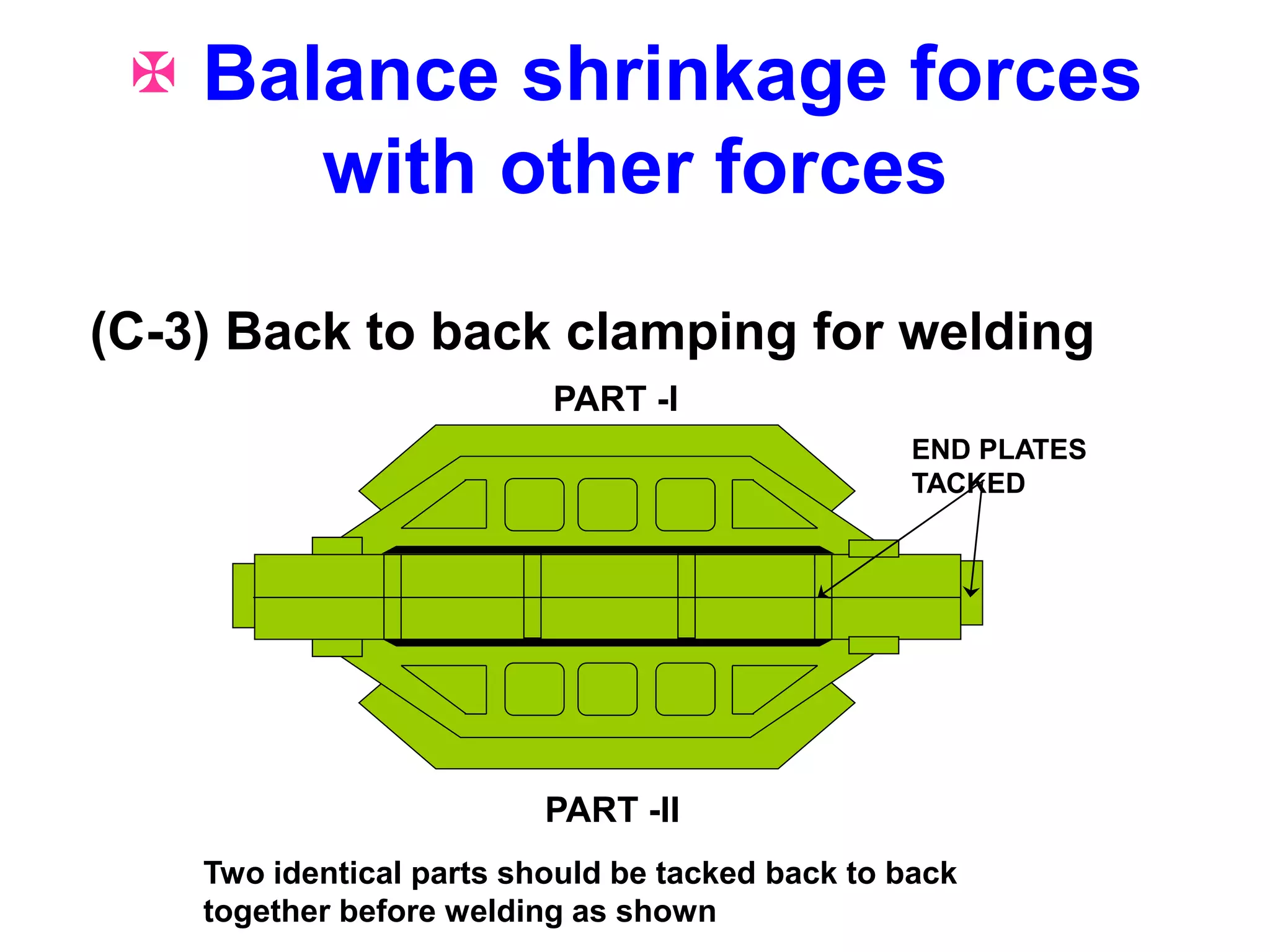
Two identical parts should be tacked back to back
together before welding as shown
PART -II
PART -I
END PLATES
TACKED
(C-3) Back to back clamping for welding
 Balance shrinkage forces
with other forces
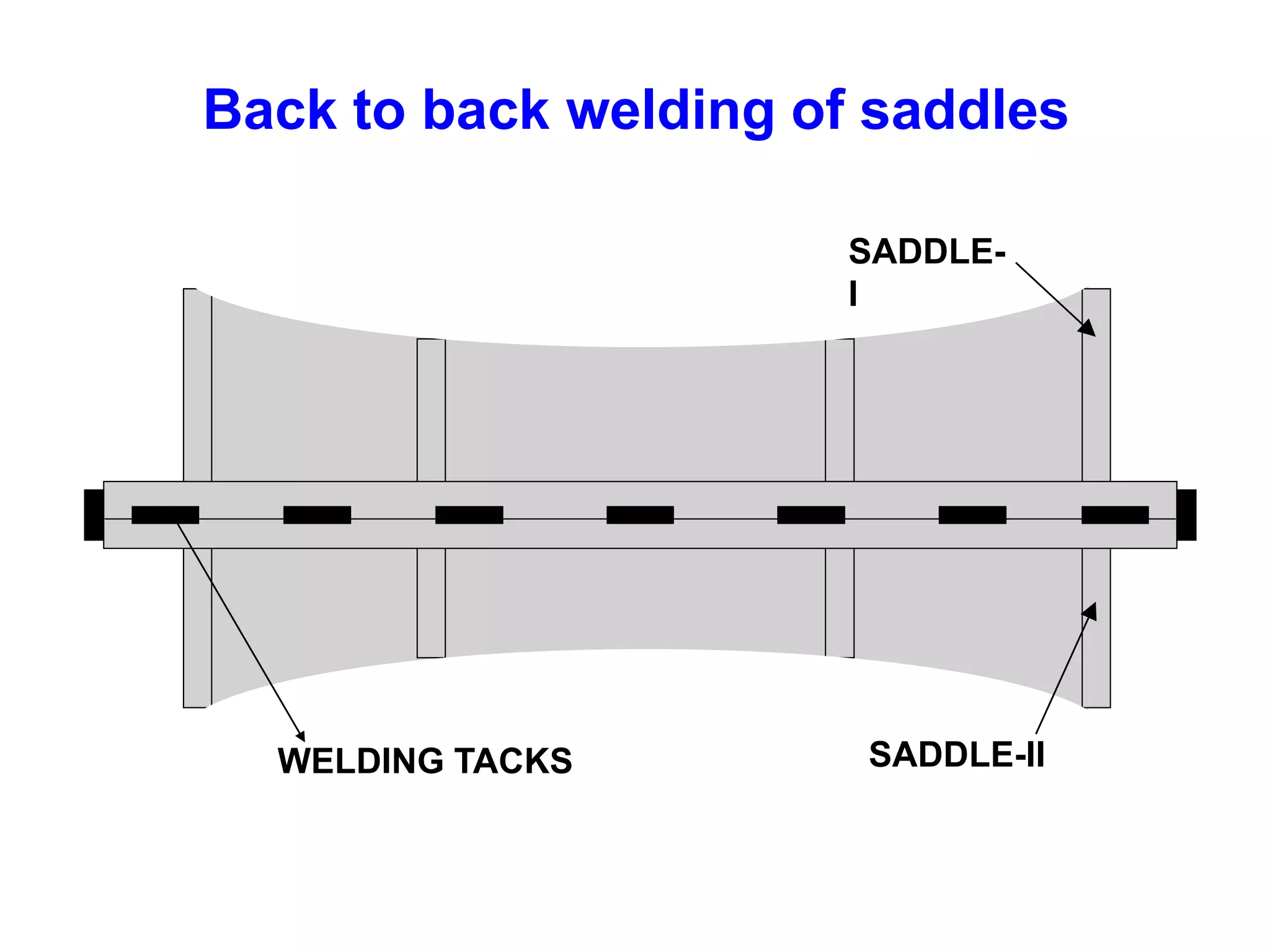
SADDLE-
I
SADDLE-II
WELDING TACKS
Back to back welding of saddles
Good working
methods for
welding distortion
in our routine work
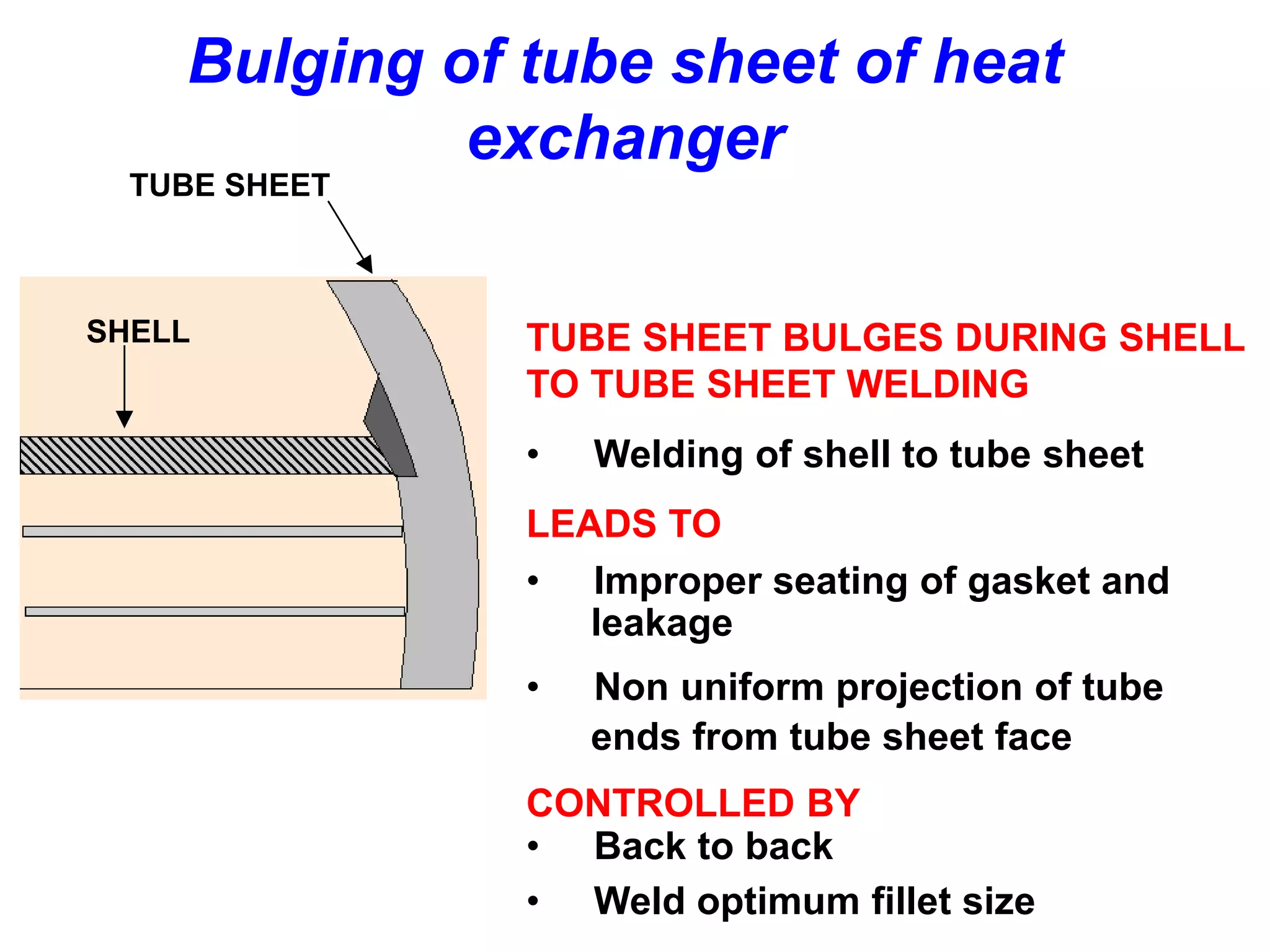
Bulging of tube sheet of heat
exchanger
TUBE SHEET BULGES DURING SHELL
TO TUBE SHEET WELDING
• Welding of shell to tube sheet
LEADS TO
• Improper seating of gasket and
leakage
• Non uniform projection of tube
ends from tube sheet face
CONTROLLED BY
• Back to back
• Weld optimum fillet size
TUBE SHEET
SHELL
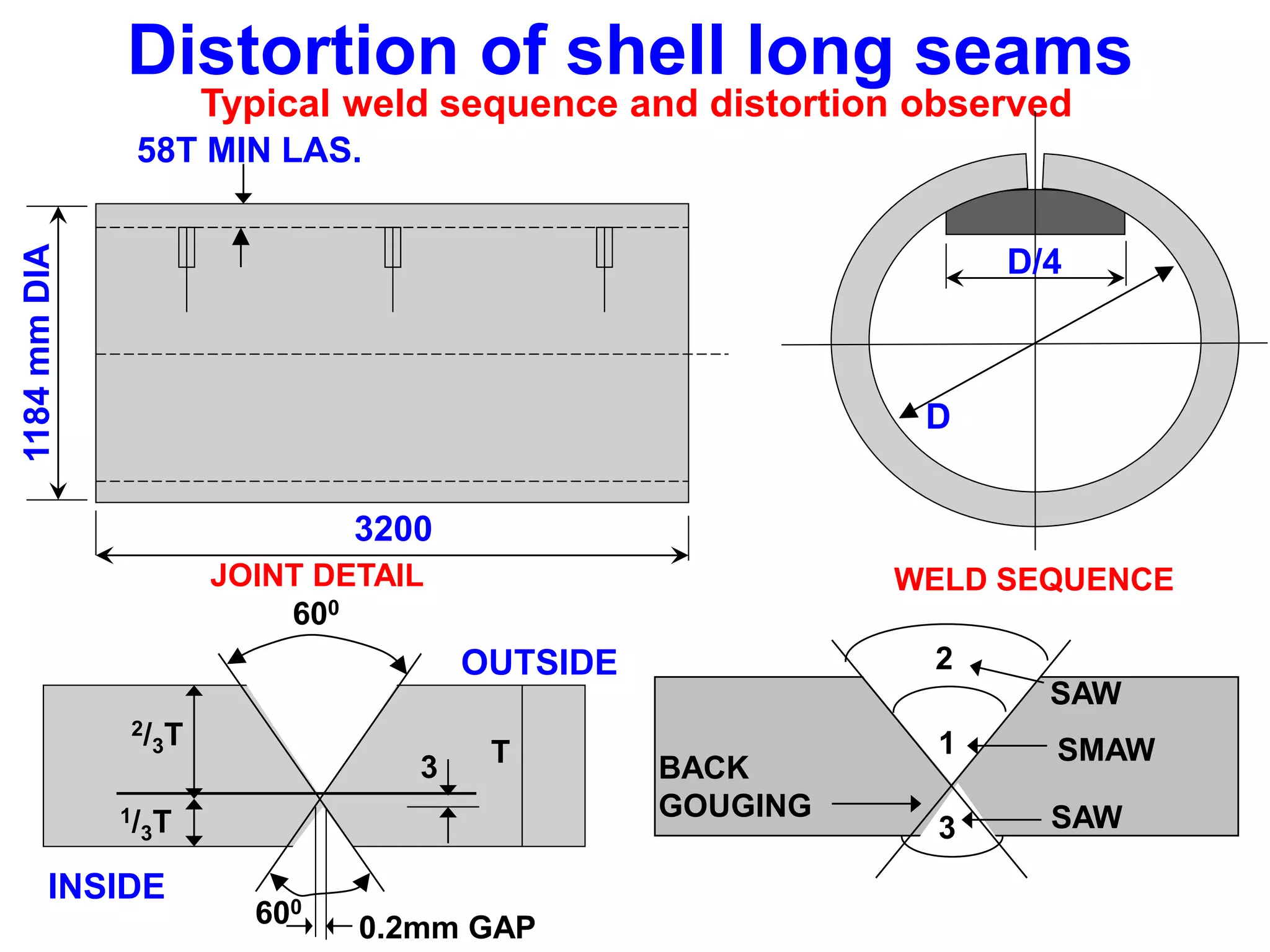
Distortion of shell long seams
Typical weld sequence and distortion observed
1184
mm
DIA
58T MIN LAS.
3200
D/4
D
INSIDE
OUTSIDE
600
2/3T
1/3T
T
600
0.2mm GAP
3
JOINT DETAIL WELD SEQUENCE
1
2
3
SMAW
SAW
SAW
BACK
GOUGING
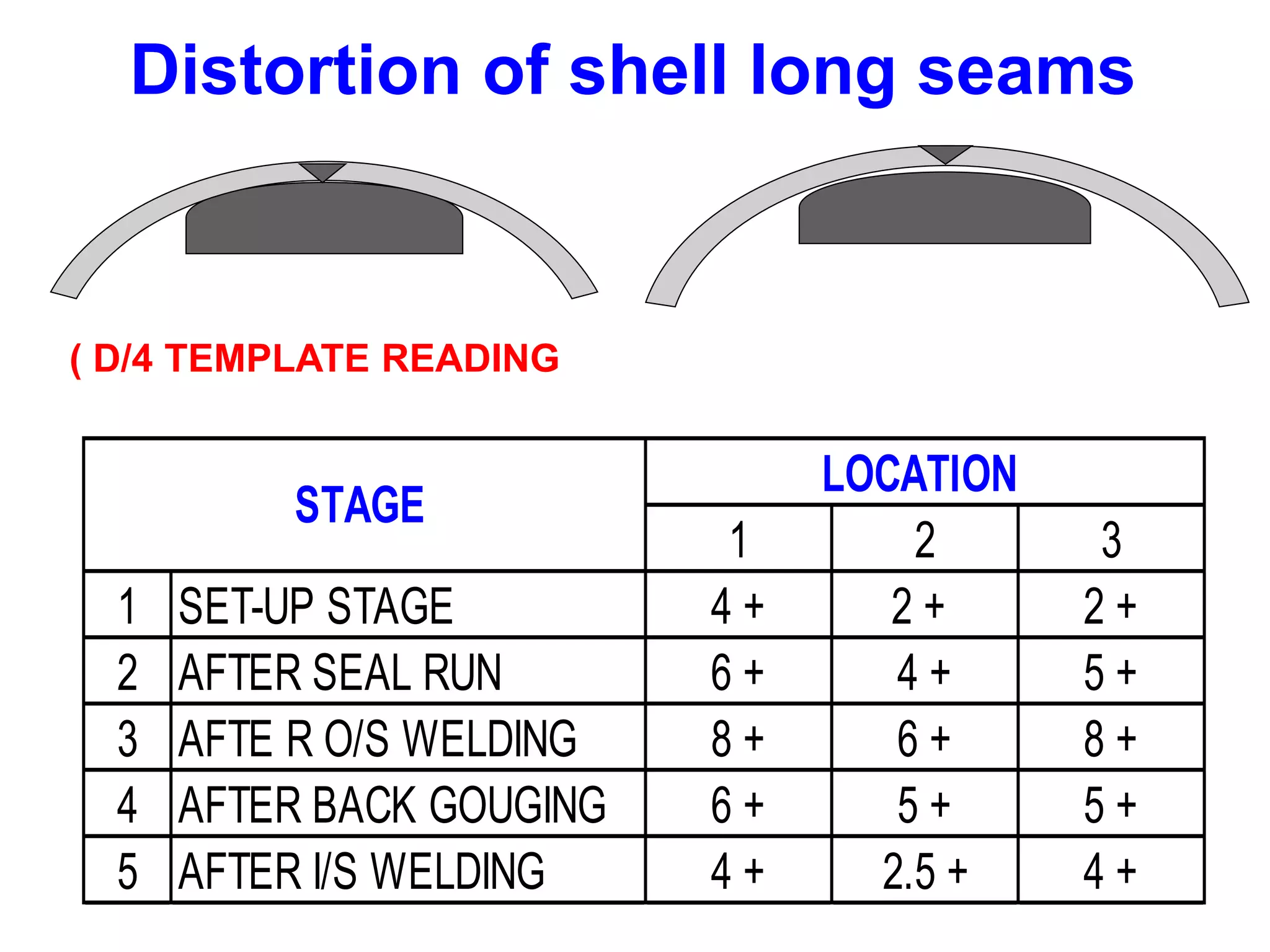
Distortion of shell long seams
1 2 3
1 SET-UP STAGE 4 + 2 + 2 +
2 AFTER SEAL RUN 6 + 4 + 5 +
3 AFTE R O/S WELDING 8 + 6 + 8 +
4 AFTER BACK GOUGING 6 + 5 + 5 +
5 AFTER I/S WELDING 4 + 2.5 + 4 +
LOCATION
STAGE
( D/4 TEMPLATE READING
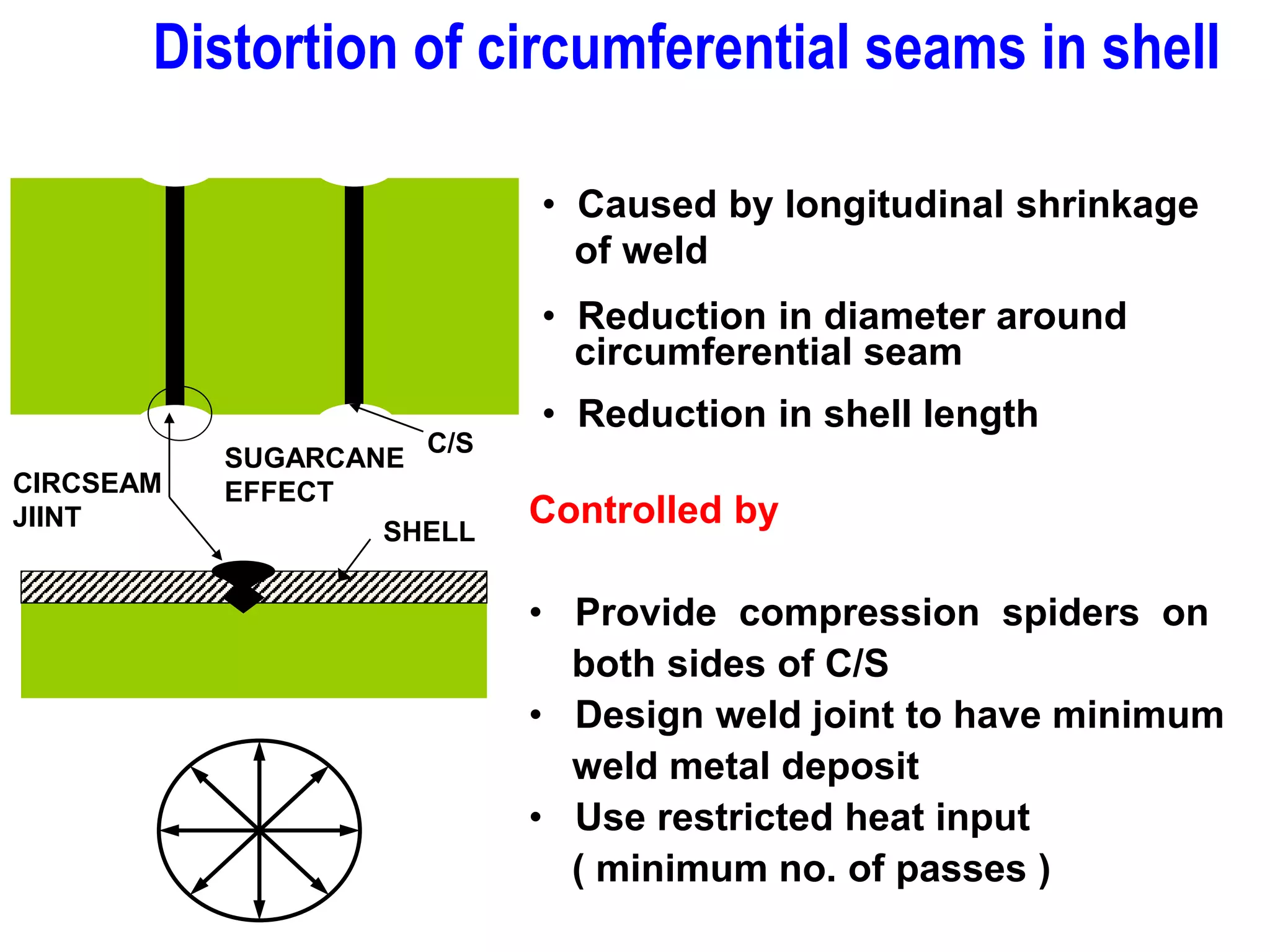
• Caused by longitudinal shrinkage
of weld
• Reduction in diameter around
circumferential seam
• Reduction in shell length
Controlled by
• Provide compression spiders on
both sides of C/S
• Design weld joint to have minimum
weld metal deposit
• Use restricted heat input
( minimum no. of passes )
CIRCSEAM
JIINT
SHELL
SUGARCANE
EFFECT
Distortion of circumferential seams in shell
C/S
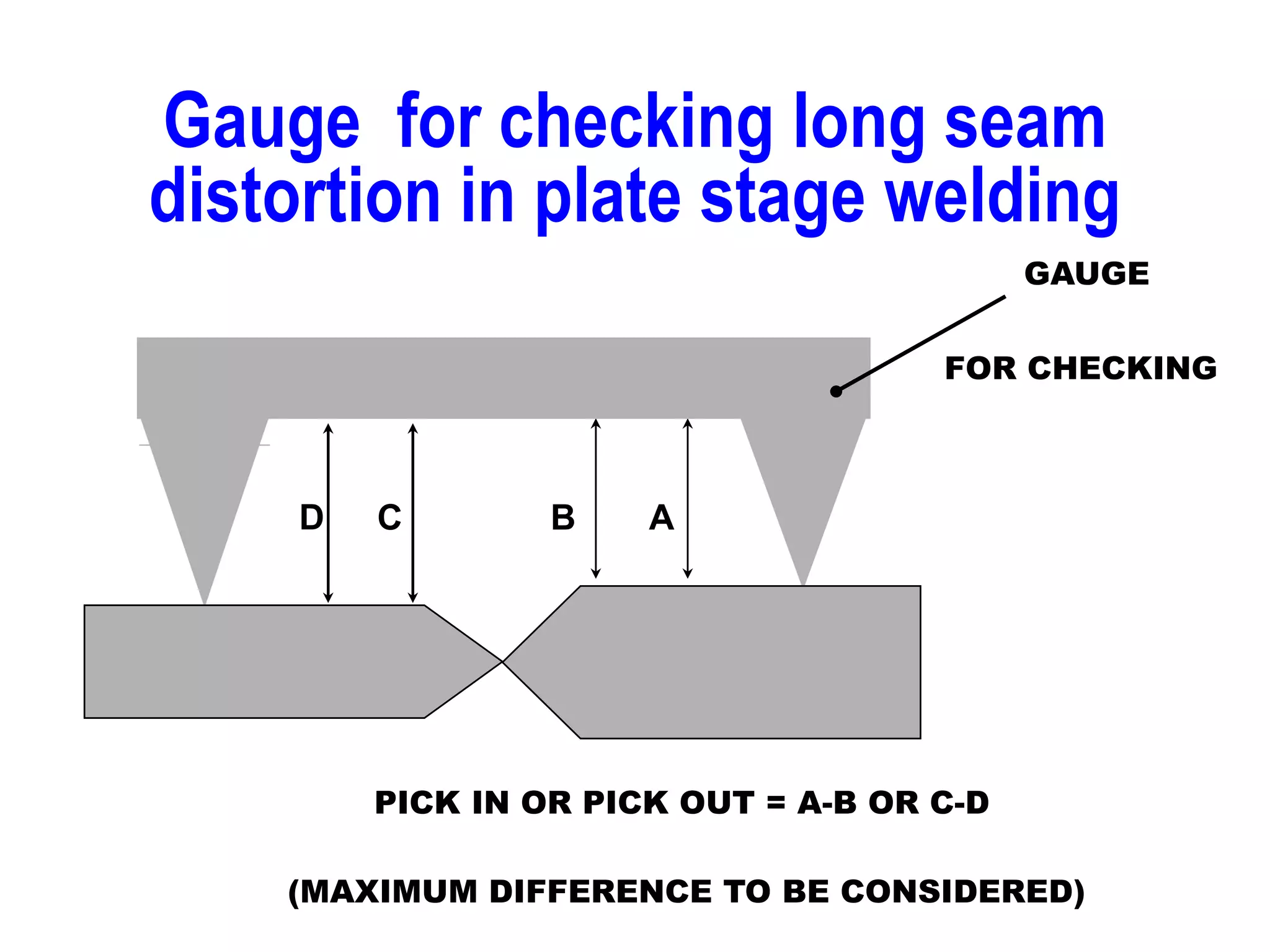
Gauge for checking long seam
distortion in plate stage welding
PICK IN OR PICK OUT = A-B OR C-D
(MAXIMUM DIFFERENCE TO BE CONSIDERED)
GAUGE
FOR CHECKING
A
B
C
D
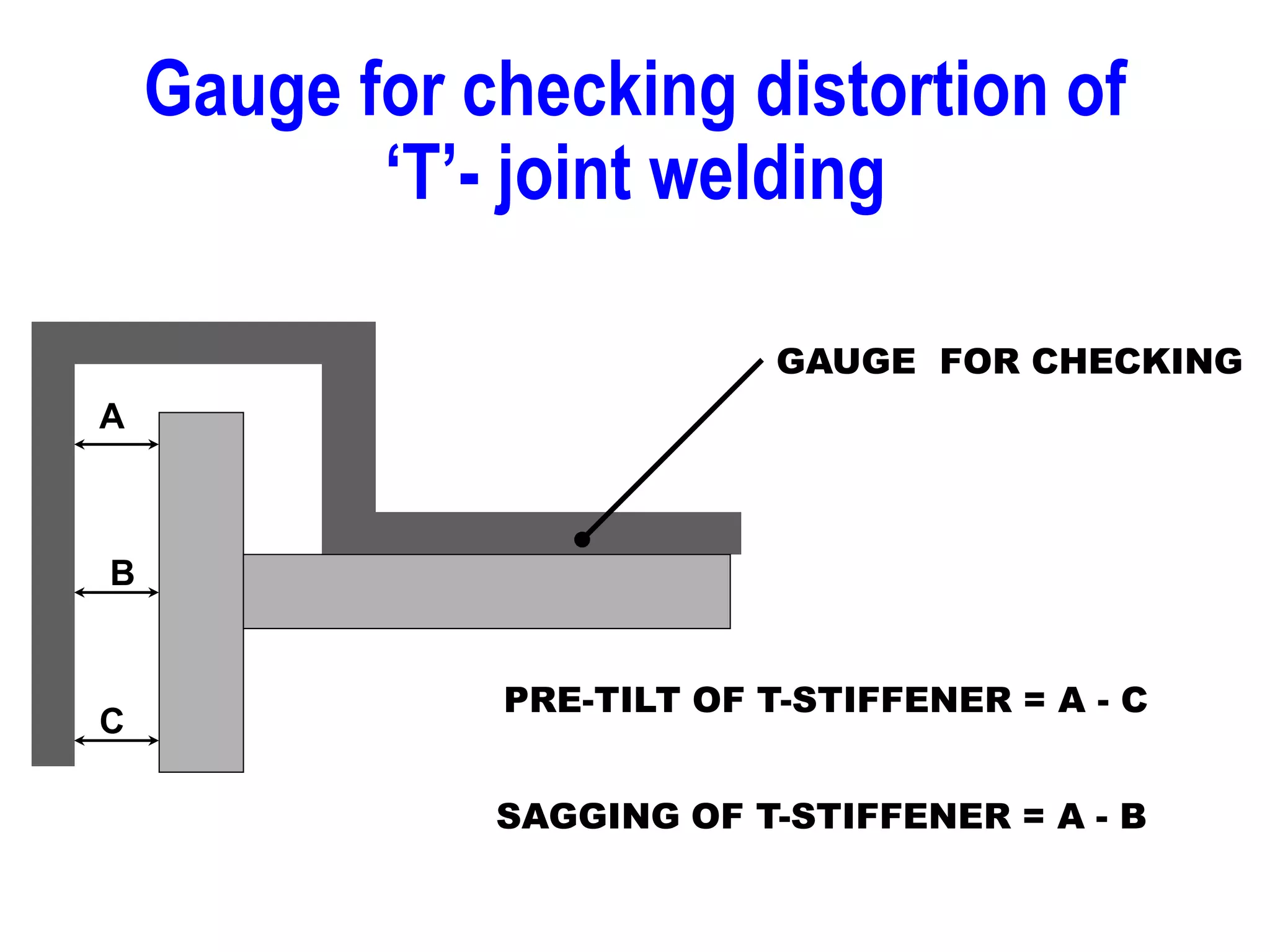
Gauge for checking distortion of
‘T’- joint welding
PRE-TILT OF T-STIFFENER = A - C
SAGGING OF T-STIFFENER = A - B
GAUGE FOR CHECKING
A
B
C
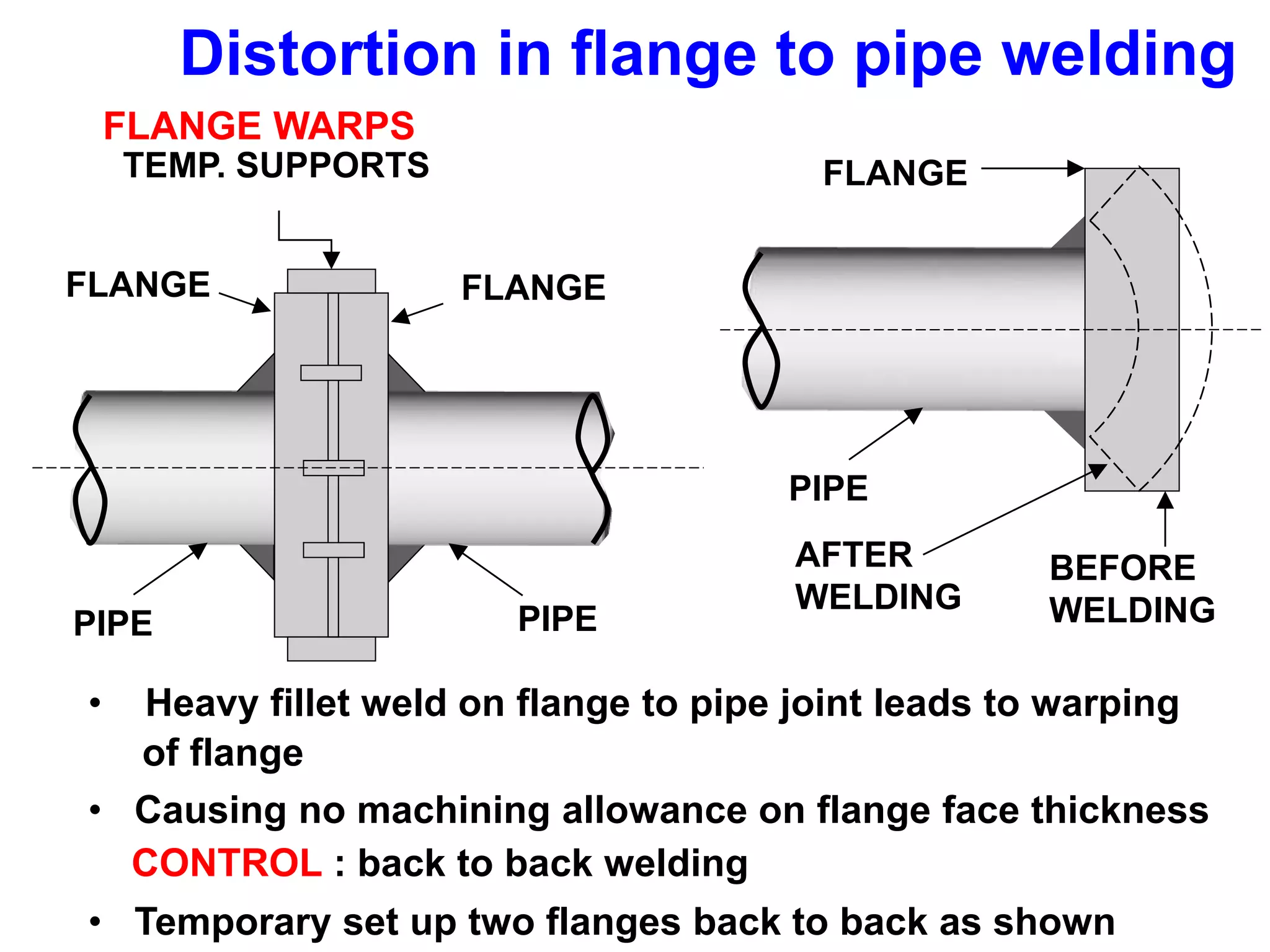
Distortion in flange to pipe welding
FLANGE
BEFORE
WELDING
AFTER
WELDING
PIPE
FLANGE WARPS
FLANGE FLANGE
PIPE PIPE
TEMP. SUPPORTS
• Heavy fillet weld on flange to pipe joint leads to warping
of flange
• Causing no machining allowance on flange face thickness
CONTROL : back to back welding
• Temporary set up two flanges back to back as shown
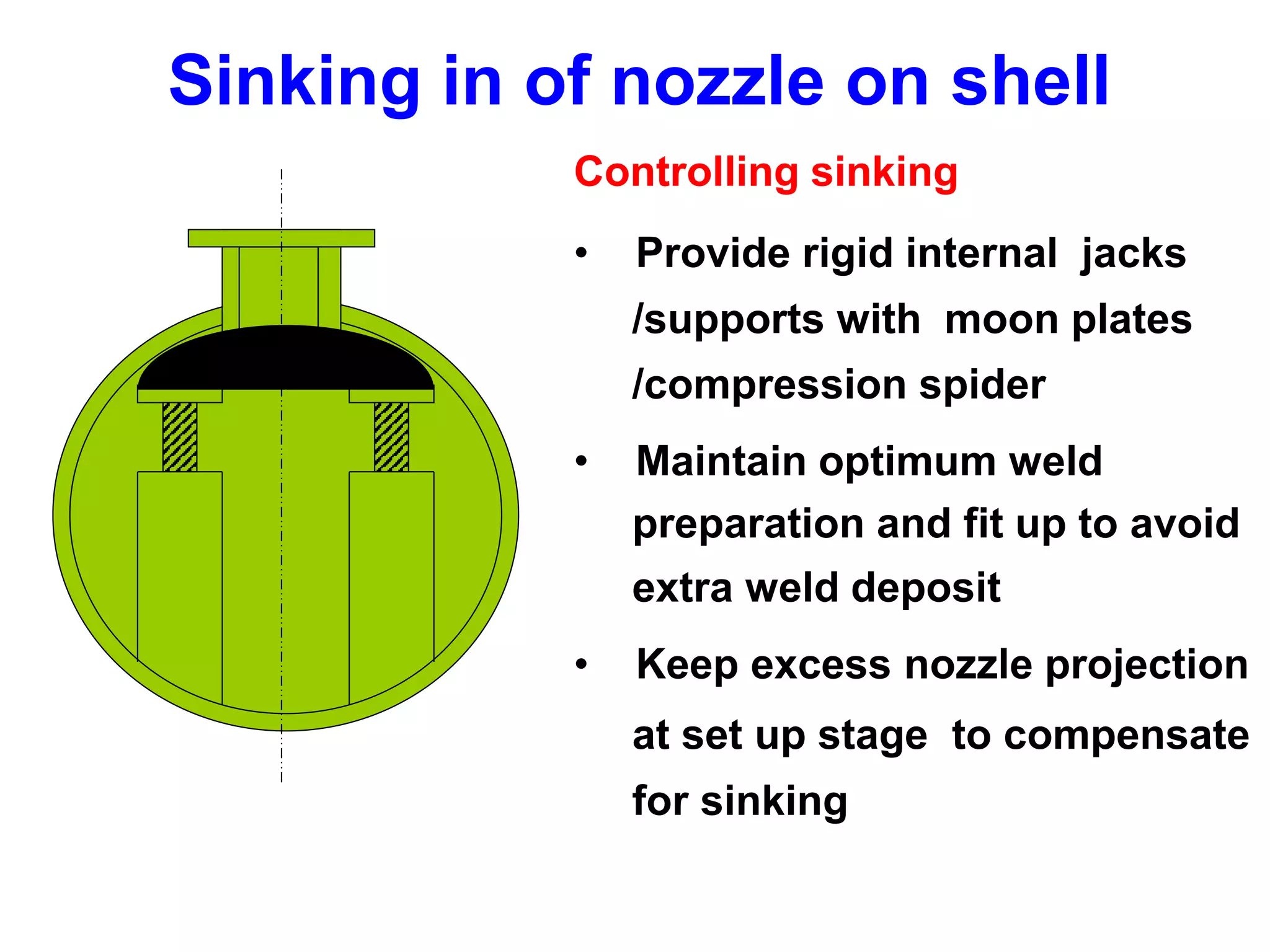
Sinking in of nozzle on shell
Controlling sinking
• Provide rigid internal jacks
/supports with moon plates
/compression spider
• Maintain optimum weld
preparation and fit up to avoid
extra weld deposit
• Keep excess nozzle projection
at set up stage to compensate
for sinking
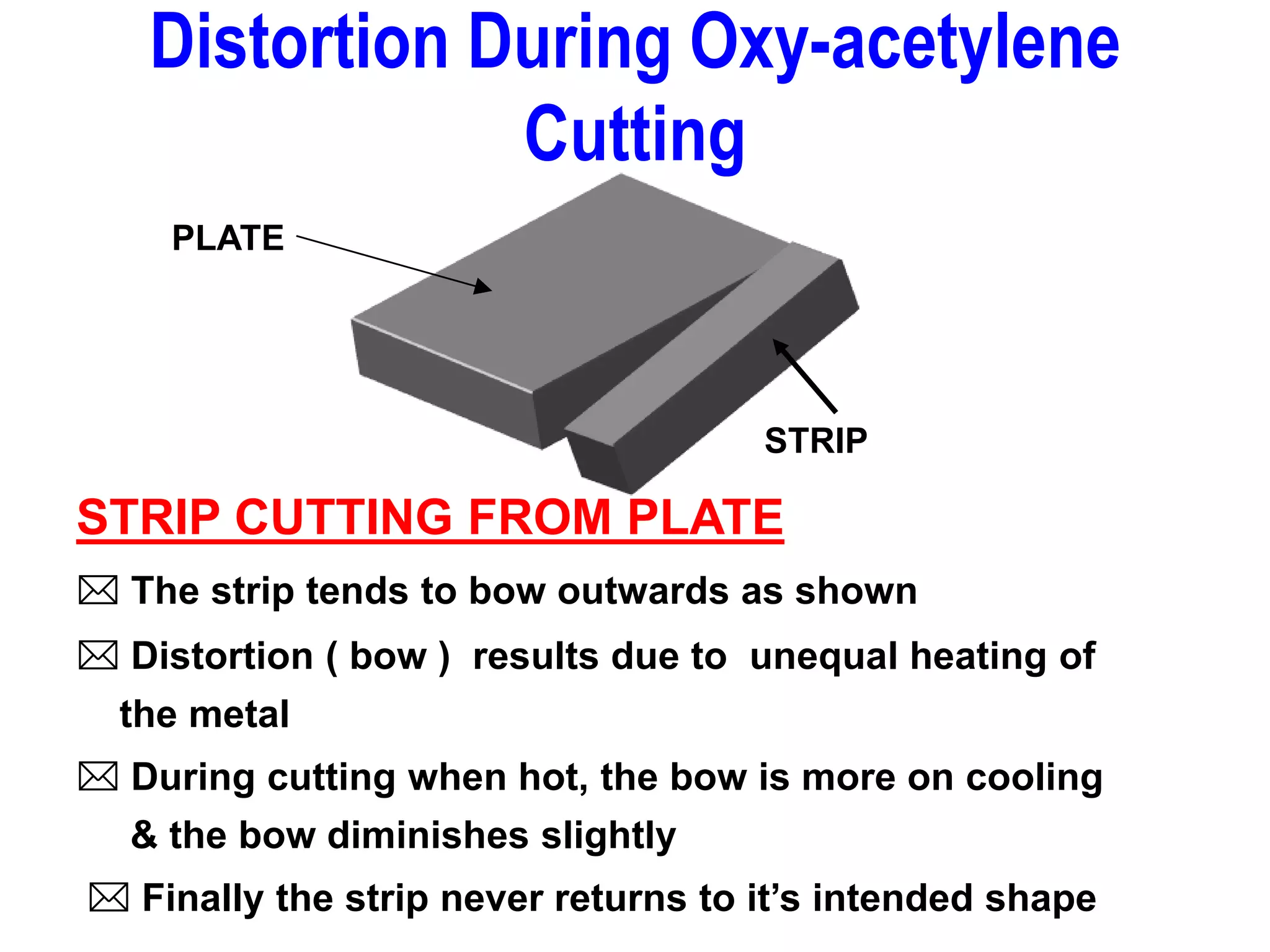
STRIP CUTTING FROM PLATE
 The strip tends to bow outwards as shown
 Distortion ( bow ) results due to unequal heating of
the metal
 During cutting when hot, the bow is more on cooling
& the bow diminishes slightly
 Finally the strip never returns to it’s intended shape
PLATE
STRIP
Distortion During Oxy-acetylene
Cutting
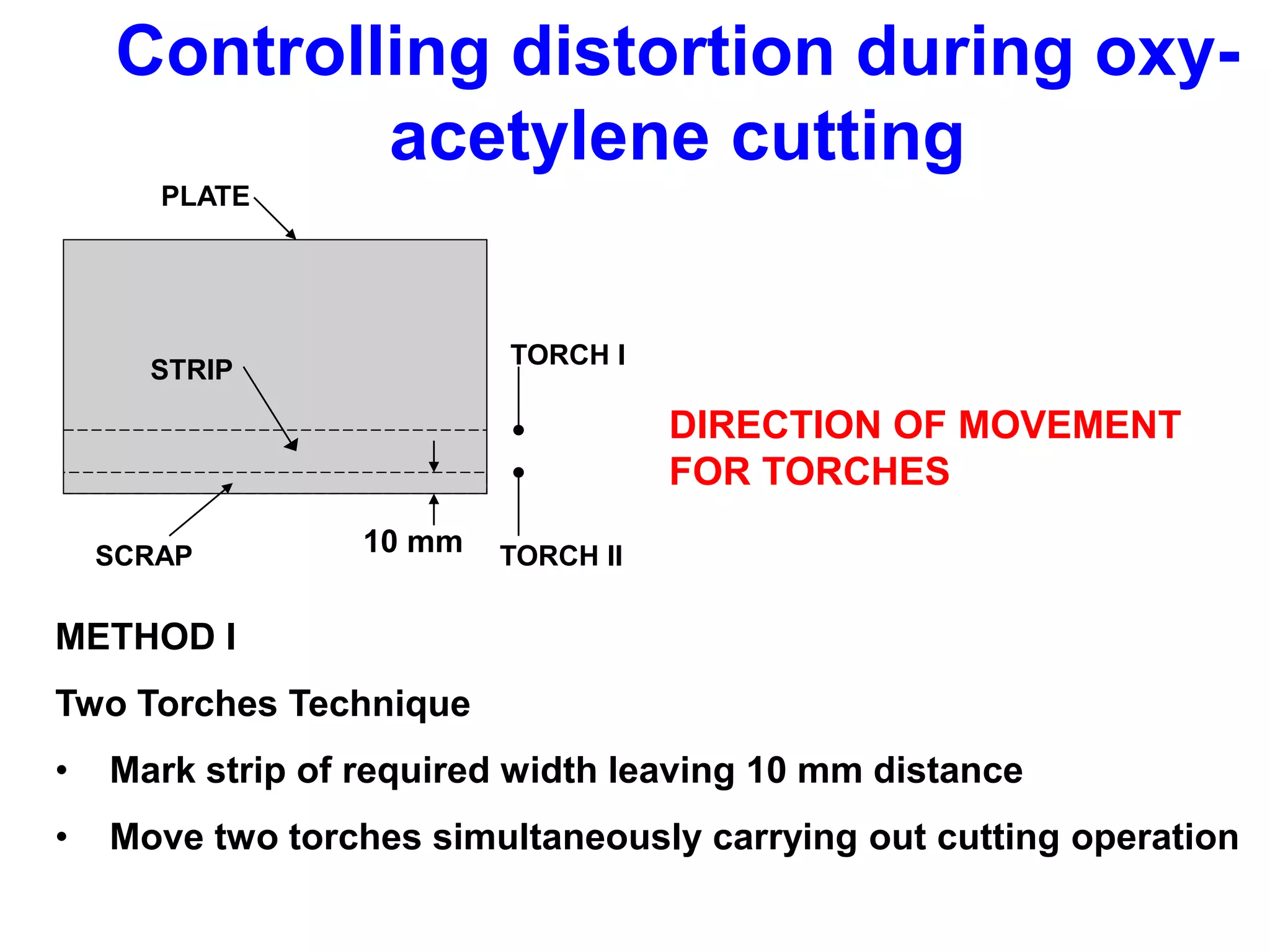
Controlling distortion during oxy-
acetylene cutting
METHOD I
Two Torches Technique
• Mark strip of required width leaving 10 mm distance
• Move two torches simultaneously carrying out cutting operation
SCRAP 10 mm
TORCH I
TORCH II
STRIP
PLATE
DIRECTION OF MOVEMENT
FOR TORCHES
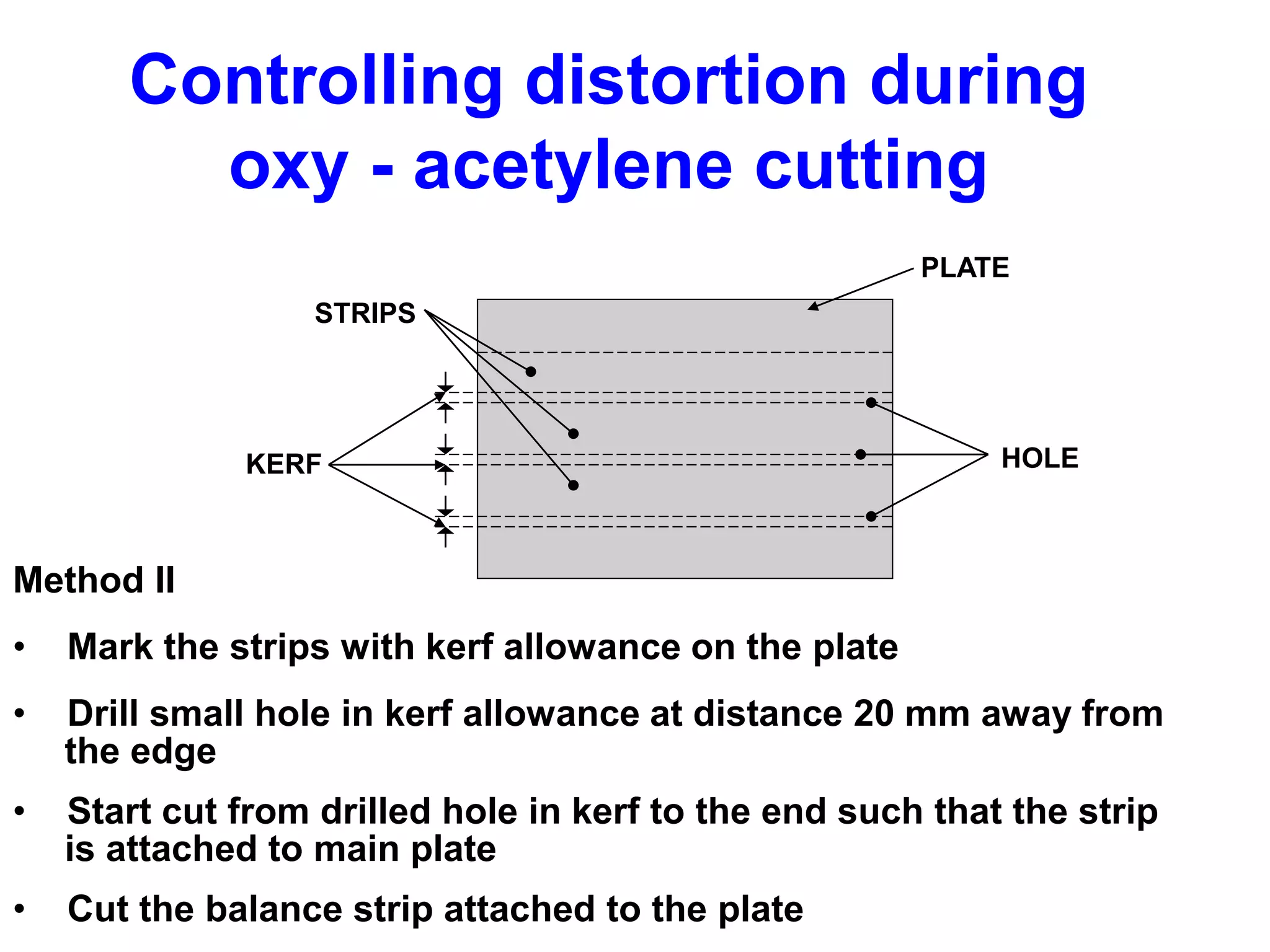
Controlling distortion during
oxy - acetylene cutting
Method II
• Mark the strips with kerf allowance on the plate
• Drill small hole in kerf allowance at distance 20 mm away from
the edge
• Start cut from drilled hole in kerf to the end such that the strip
is attached to main plate
• Cut the balance strip attached to the plate
HOLE
PLATE
STRIPS
KERF
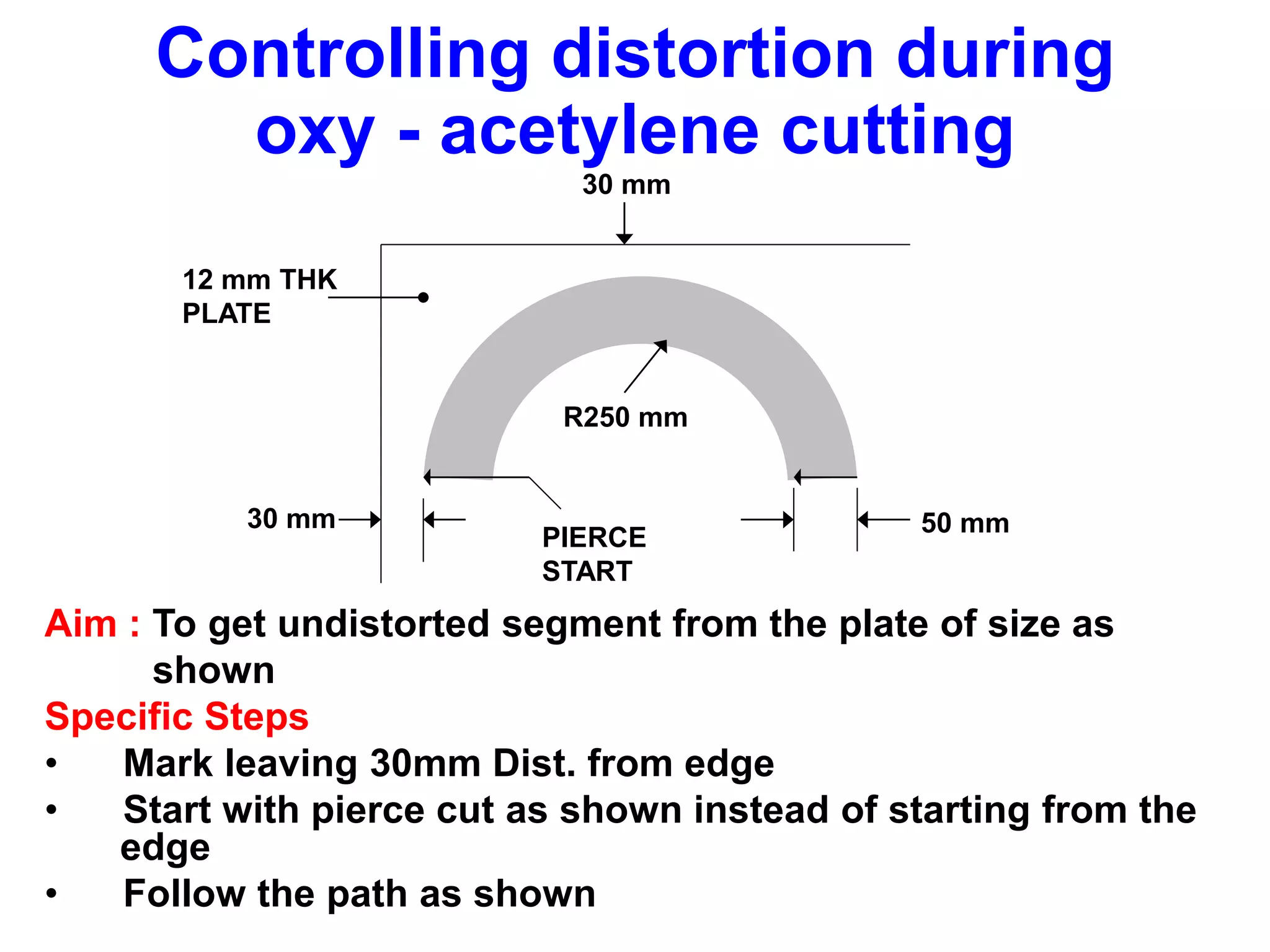
Controlling distortion during
oxy - acetylene cutting
Aim : To get undistorted segment from the plate of size as
shown
Specific Steps
• Mark leaving 30mm Dist. from edge
• Start with pierce cut as shown instead of starting from the
edge
• Follow the path as shown
30 mm
30 mm
12 mm THK
PLATE
50 mm
PIERCE
START
R250 mm
Reduction in distortion
• Less weld edge preparation.
• Less welding current as per WPS.
• Higher base metal thickness.
• Lesser welding passes
• Do not over weld
• More distortion in stainless steel then
carbon steel.
• Less offset-Lesser welding-Lower
distortion
• Provide intermittent welding
• Place weld near the neutral axis
• Balancing weld around neutral axis
• Back-step welding
• Sequence welding
• Pre bending OR Pre cambering
• Back to back clamping
• Double operator welding technique
Reduction in distortion

Welding Distortion Control.ppt

  • 1.
  • 2.
    What is distortion? Undesirable change in original shape is called DISTORTION Before distortion After distortion  Distortion occurs due to heat input and mechanical forces.
  • 3.
    • Uniform heatingof a steel bar through out of its entire volume - considerable expansion take place in all direction. • Now, if cooling of the bar is allowed evenly - retain its original shape and size without distortion. DURING HEATED CONDITION X X + 9X BEFORE HEATING AND AFTER COOLING Experiment No 1:
  • 4.
    So, we cansay that, “ Uniform heating and cooling of a component that can expand and contract does not cause any appreciable distortion ”
  • 5.
    • Repeat experimentno:1 but heat the steel bar in clamp condition and see the changes in shape and size after cooling. STEEL BAR AFTER HEATING & COOLING DOWN STEEL BAR BEFORE HEATING CLAMPING JAWS CLAMPING JAWS Experiment No 2 :
  • 6.
    So, we canconclude that, • Restraint hinders free expansion and contraction and causes material to deform resulting in Distortion
  • 7.
  • 8.
    HEATING  Heated areaexpands  Expansion restrained by surrounding solid area  Compressive stresses are developed  Further compressive stress leads to plastic deformation  Material bulges at the spot towards heat source side HEAT SOURCE Distortion in case of spot heating?
  • 9.
    COOLING  Spot areatends to contract.  Contraction restrained by surrounding hot area.  Material goes back to original position with plastic deformation.  Resulting distortion Distortion in case of spot heating?
  • 10.
    WELD BEAD ORIGINAL POSITION AFTER WELDING Longitudinaldistortion WELD BEAD LONGITUDINAL DISTORTION
  • 11.
    LONGITUDINAL SHRINKAGE • (A)BUTT WELDS IN CS/LAS LS = 3. I .L / 100,000 t LS = longitudinal shrinkage (mm) I = welding current(amp) L = length of weld (mm) t = plate thickness (mm)
  • 12.
     It iscontraction along the length of weld bead  It is maximum along weld bead and decreases at points away from the bead. In C/S of shell it lead to reduction in diameter at the weld Distortion in Butt welds Longitudinal Distortion
  • 13.
    EXAMPLE (LS INBUTT WELDS) • Calculate LS for 6mm thick CS plate welded by SMAW using 200 A current. • Solution : LS = 3. 200. L / 100,000 x 6 = L/1000 mm
  • 14.
    LONGITUDINAL SHRINKAGE LS =25 Aw/ Ap Aw = Weld X-sectional area Ap = Resisting X-sectional area Ap Aw • (B) FILLET WELD
  • 15.
    EXAMPLE OF LSIN FILLET WELD 100 75 6 6 8x8 All dimensions in mm LS = 1.52 mm
  • 16.
     It isthe shrinkage perpendicular to the weld.  It leads to the development of high residual stress and also cracking in case of highly restrained joint.  It is not uniform along the length of the plate  It is lesser at that end of plate where bead is started. Distortion in Butt welds Transverse Distortion
  • 17.
    ORIGINAL POSITION AFTER WELDING Transversedistortion WELD BEAD WELD BEAD TRANSVERSE DISTORTION
  • 18.
    TRANSVERSE SHRINKAGE IN SINGLEPASS BUTT JOINTS S = 0.2 Aw / t + 0.05 d Where S = Transverse Shrinkage (mm) Aw = Cross sectional Area of Weld (mm2) t = Thickness of Plates (mm) d = Root Opening (mm)
  • 19.
    TRANSVERSE SHRINKAGE DURING MULTIPASSWELDING TS = TS0 + b (log w - log w0) Where TS = Total Transverse Shrinkage TS0 = Transverse Shrinkage after first pass w = Total weight of weld metal w0 = weight of first pass weld metal
  • 20.
    Effect of VariousProcedures on Transverse Shrinkage of Butt Welds Procedures Root Gap Joint design Electrode dia. Degree of constraint Peening Gouging & repairs Effect on TS TS increases with increase in RG Single Vee produces more TS than double V TS decreases with increase in electrode dia. TS decreases with Degree of constraint TS decreases by peening TS increases by these operations.
  • 21.
    TRANSVERSE SHRINKAGE IN FILLETJOINTS 1. For T joints with two continuous fillets. TS = Leg of fillet Weld (l) x 1.02 Bottom Plate thickness (tb) All dimensions in mm. tb l x l
  • 22.
    2. For intermittentfillet welds , a correcting factor of proportional length of fillet weld to total length of joint should be used. TRANSVERSE SHRINKAGE IN FILLET JOINTS
  • 23.
    (3) For filletwelds in a lap joints between plates of equal thickness (two welds) TS = Leg of fillet Weld (l) x 1.52 Plate thickness (t) TRANSVERSE SHRINKAGE IN FILLET JOINTS l l t t
  • 24.
  • 25.
     It isthe bending transverse to the weld. Due to non-uniform heating and cooling along the thickness of plate.  This is the main source of mismatch and dimensional inaccuracy in large welded structures Distortion in Butt welds Angular Distortion
  • 26.
    Angular Distortion inButt Joints t1 t2 t3 g g = 3 mm t3 = 2 mm t t1 + 1/2 t3 t = 0.6 1. Use Both Side Welding Technique in place of Single Side Welding
  • 27.
    AD = 0.0076. W . l1.3 t2 Where AD= Angular Distortion, mm W=flange width, mm l = weld leg length, mm t = flange thickness, mm Angular Distortion in Fillet Welds W W AD AD t l t RKS,HZW
  • 28.
    Example of Angular Distortionin Fillet Welds Find the angular distortion in a double fillet weld of a T-joint between a flange 1000 mm wide and a vertical member when the thickness of both the members is 6 mm and the weld leg length = 8 mm Solution. AD = = 0.0076 x 1000 x (8)1.3 (6)2 3.15 mm.
  • 29.
    Multiple Restrained FilletWelds AD Ø L AD L 1 4 = Ø x L 1 2 2 Ø AD = Angular distortion, mm. L = span length, mm. Ø = angular change, radians x = distance from weld to the point where distortion is to be determined, mm. RKS,HZW
  • 30.
    Example of ADin Multiple Restrained Fillet Welds In multiple restrained fillet welds the span length is 1 m and the angular change is 90 at a distance of 400 mm from the span end, find the distortion. Solution. By putting L = 1000 mm, Ø = 90 = 0.1571 rad. x = L/2 - 400 = 100 mm in the Formula,
  • 31.
    Distortion in ‘T’-joints Angulardistortion Before welding After welding
  • 32.
    Distortion in ‘T’-joints Longitudinaldistortion (a) pulling effect towards neutral axis A A Section A - A
  • 33.
    Distortion in ‘T’-Stiffener Longitudinaldistortion (b) pulling effect of welds above neutral axis. Section A - A A A
  • 34.
    To prevent distortion:- (A) Reduce the effective shrinkage force.
  • 35.
    Reduce effective shrinkageforce (A-1) Keep the angle of weld joint to the barest minimum. keep the angle of weld joint 45 deg.  MINIMUM ANGLE, LESS WELDING , LESS HEAT INPUT Hence less distortion 50 deg. +/- 5 deg.
  • 36.
    50 deg. +/-5 deg. keep the angle of weld joint 45 deg. keep fillet size 18 mm/6 mm 19 mm +3/-1 7 mm +3/-1
  • 37.
    (A-4) Minimize noof passes larger size of electrodes Reduce effective shrinkage force MORE NO OF PASSES LESS NO OF PASSES
  • 38.
    (A-5) Place weldsnear the neutral axis N. A. Reduce effective shrinkage force
  • 39.
    To prevent distortion:- (B) Make shrinkage work for us
  • 40.
    WEDGE CLAMPS ALONG EDGE Makeshrinkage work for us (B.1) Pre cambering OR Pre bending in plate
  • 41.
    Make shrinkage workfor us (B-2) Keep over dimensions OR over bend before welding
  • 42.
    To prevent distortion:- (C) Balance shrinkage force with other forces
  • 43.
    4 3 1 2 1 3 5 2 4 6 1 3 5 6 4 2 (C-1) Do Sequencewelding Balance shrinkage forces with other forces.
  • 44.
     Balance shrinkageforces with other forces (C-2) Back step welding 1 2 3 4 Welding progresion
  • 45.
    Two identical partsshould be tacked back to back together before welding as shown PART -II PART -I END PLATES TACKED (C-3) Back to back clamping for welding  Balance shrinkage forces with other forces
  • 46.
  • 47.
    Good working methods for weldingdistortion in our routine work
  • 48.
    Bulging of tubesheet of heat exchanger TUBE SHEET BULGES DURING SHELL TO TUBE SHEET WELDING • Welding of shell to tube sheet LEADS TO • Improper seating of gasket and leakage • Non uniform projection of tube ends from tube sheet face CONTROLLED BY • Back to back • Weld optimum fillet size TUBE SHEET SHELL
  • 49.
    Distortion of shelllong seams Typical weld sequence and distortion observed 1184 mm DIA 58T MIN LAS. 3200 D/4 D INSIDE OUTSIDE 600 2/3T 1/3T T 600 0.2mm GAP 3 JOINT DETAIL WELD SEQUENCE 1 2 3 SMAW SAW SAW BACK GOUGING
  • 50.
    Distortion of shelllong seams 1 2 3 1 SET-UP STAGE 4 + 2 + 2 + 2 AFTER SEAL RUN 6 + 4 + 5 + 3 AFTE R O/S WELDING 8 + 6 + 8 + 4 AFTER BACK GOUGING 6 + 5 + 5 + 5 AFTER I/S WELDING 4 + 2.5 + 4 + LOCATION STAGE ( D/4 TEMPLATE READING
  • 51.
    • Caused bylongitudinal shrinkage of weld • Reduction in diameter around circumferential seam • Reduction in shell length Controlled by • Provide compression spiders on both sides of C/S • Design weld joint to have minimum weld metal deposit • Use restricted heat input ( minimum no. of passes ) CIRCSEAM JIINT SHELL SUGARCANE EFFECT Distortion of circumferential seams in shell C/S
  • 52.
    Gauge for checkinglong seam distortion in plate stage welding PICK IN OR PICK OUT = A-B OR C-D (MAXIMUM DIFFERENCE TO BE CONSIDERED) GAUGE FOR CHECKING A B C D
  • 53.
    Gauge for checkingdistortion of ‘T’- joint welding PRE-TILT OF T-STIFFENER = A - C SAGGING OF T-STIFFENER = A - B GAUGE FOR CHECKING A B C
  • 54.
    Distortion in flangeto pipe welding FLANGE BEFORE WELDING AFTER WELDING PIPE FLANGE WARPS FLANGE FLANGE PIPE PIPE TEMP. SUPPORTS • Heavy fillet weld on flange to pipe joint leads to warping of flange • Causing no machining allowance on flange face thickness CONTROL : back to back welding • Temporary set up two flanges back to back as shown
  • 55.
    Sinking in ofnozzle on shell Controlling sinking • Provide rigid internal jacks /supports with moon plates /compression spider • Maintain optimum weld preparation and fit up to avoid extra weld deposit • Keep excess nozzle projection at set up stage to compensate for sinking
  • 56.
    STRIP CUTTING FROMPLATE  The strip tends to bow outwards as shown  Distortion ( bow ) results due to unequal heating of the metal  During cutting when hot, the bow is more on cooling & the bow diminishes slightly  Finally the strip never returns to it’s intended shape PLATE STRIP Distortion During Oxy-acetylene Cutting
  • 57.
    Controlling distortion duringoxy- acetylene cutting METHOD I Two Torches Technique • Mark strip of required width leaving 10 mm distance • Move two torches simultaneously carrying out cutting operation SCRAP 10 mm TORCH I TORCH II STRIP PLATE DIRECTION OF MOVEMENT FOR TORCHES
  • 58.
    Controlling distortion during oxy- acetylene cutting Method II • Mark the strips with kerf allowance on the plate • Drill small hole in kerf allowance at distance 20 mm away from the edge • Start cut from drilled hole in kerf to the end such that the strip is attached to main plate • Cut the balance strip attached to the plate HOLE PLATE STRIPS KERF
  • 59.
    Controlling distortion during oxy- acetylene cutting Aim : To get undistorted segment from the plate of size as shown Specific Steps • Mark leaving 30mm Dist. from edge • Start with pierce cut as shown instead of starting from the edge • Follow the path as shown 30 mm 30 mm 12 mm THK PLATE 50 mm PIERCE START R250 mm
  • 60.
    Reduction in distortion •Less weld edge preparation. • Less welding current as per WPS. • Higher base metal thickness. • Lesser welding passes • Do not over weld • More distortion in stainless steel then carbon steel. • Less offset-Lesser welding-Lower distortion
  • 61.
    • Provide intermittentwelding • Place weld near the neutral axis • Balancing weld around neutral axis • Back-step welding • Sequence welding • Pre bending OR Pre cambering • Back to back clamping • Double operator welding technique Reduction in distortion