PRACTICAL RESEARCH
1
Module 1:Importance of Research in
Daily Life
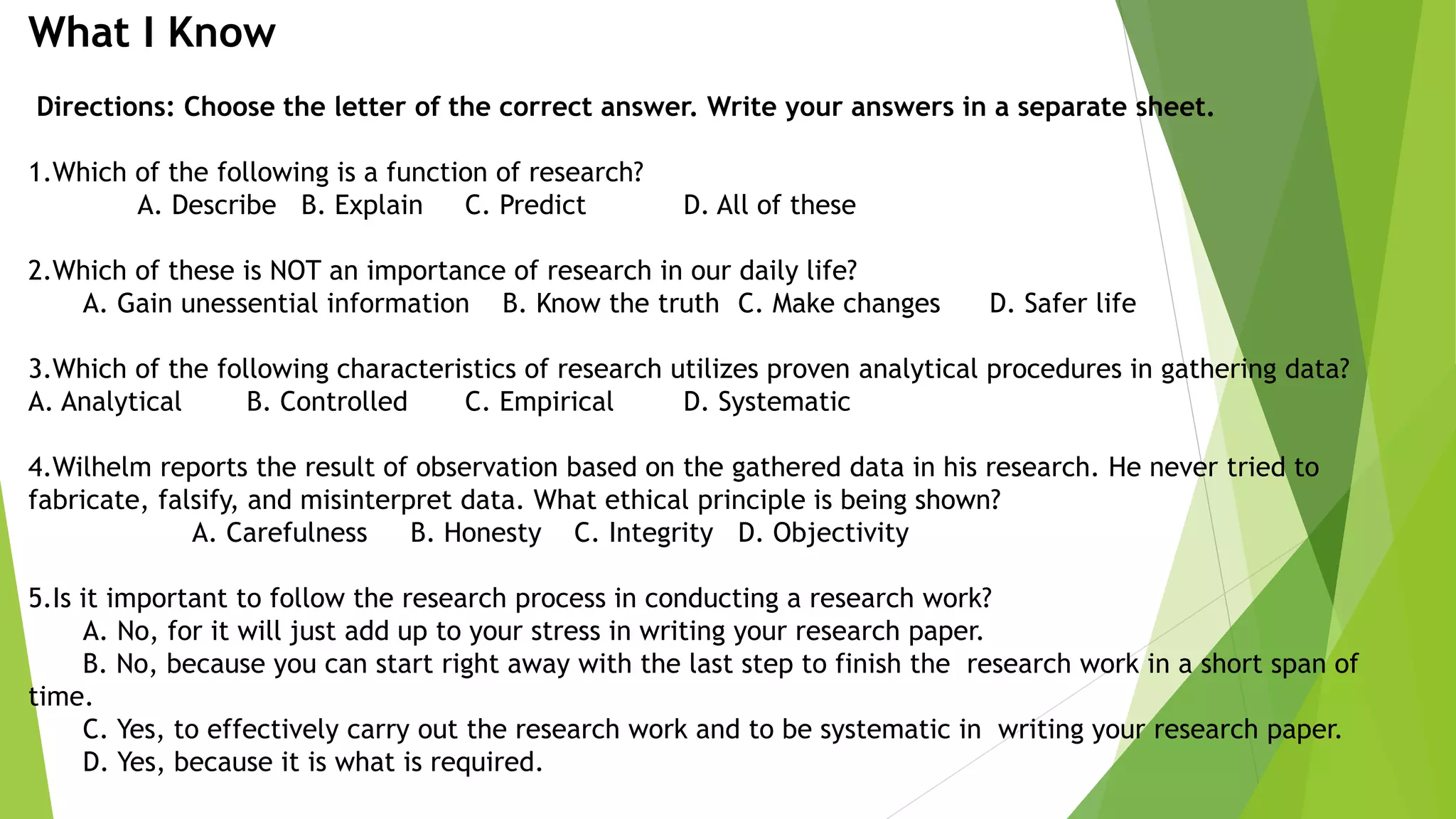
What I Know
Directions: Choose the letter of the correct answer. Write your answers in a separate sheet.
1.Which of the following is a function of research?
A. Describe B. Explain C. Predict D. All of these
2.Which of these is NOT an importance of research in our daily life?
A. Gain unessential information B. Know the truth C. Make changes D. Safer life
3.Which of the following characteristics of research utilizes proven analytical procedures in gathering data?
A. Analytical B. Controlled C. Empirical D. Systematic
4.Wilhelm reports the result of observation based on the gathered data in his research. He never tried to
fabricate, falsify, and misinterpret data. What ethical principle is being shown?
A. Carefulness B. Honesty C. Integrity D. Objectivity
5.Is it important to follow the research process in conducting a research work?
A. No, for it will just add up to your stress in writing your research paper.
B. No, because you can start right away with the last step to finish the research work in a short span of
time.
C. Yes, to effectively carry out the research work and to be systematic in writing your research paper.
D. Yes, because it is what is required.
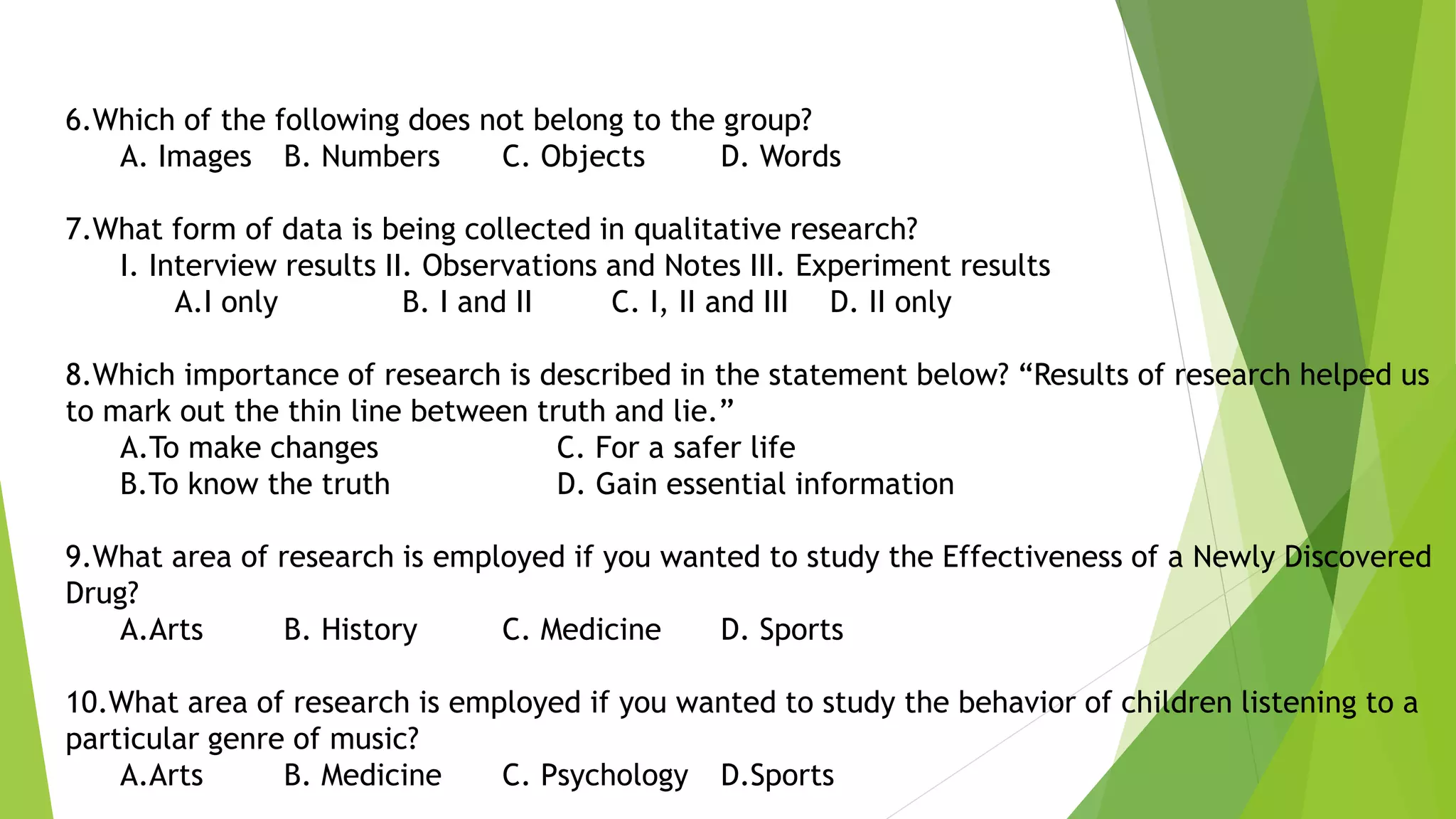
6.Which of the following does not belong to the group?
A. Images B. Numbers C. Objects D. Words
7.What form of data is being collected in qualitative research?
I. Interview results II. Observations and Notes III. Experiment results
A.I only B. I and II C. I, II and III D. II only
8.Which importance of research is described in the statement below? “Results of research helped us
to mark out the thin line between truth and lie.”
A.To make changes C. For a safer life
B.To know the truth D. Gain essential information
9.What area of research is employed if you wanted to study the Effectiveness of a Newly Discovered
Drug?
A.Arts B. History C. Medicine D. Sports
10.What area of research is employed if you wanted to study the behavior of children listening to a
particular genre of music?
A.Arts B. Medicine C. Psychology D.Sports
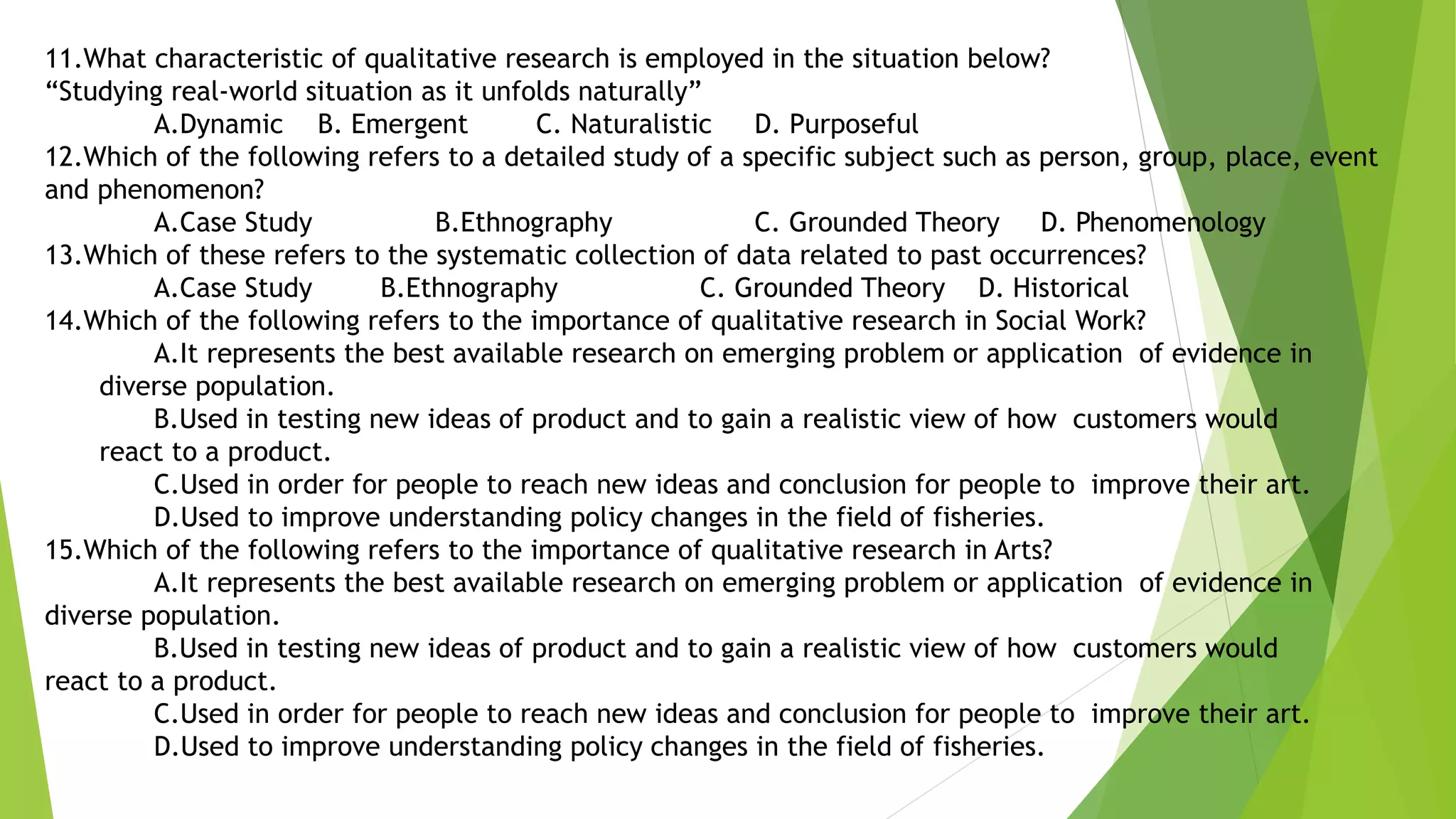
11.What characteristic of qualitative research is employed in the situation below?
“Studying real-world situation as it unfolds naturally”
A.Dynamic B. Emergent C. Naturalistic D. Purposeful
12.Which of the following refers to a detailed study of a specific subject such as person, group, place, event
and phenomenon?
A.Case Study B.Ethnography C. Grounded Theory D. Phenomenology
13.Which of these refers to the systematic collection of data related to past occurrences?
A.Case Study B.Ethnography C. Grounded Theory D. Historical
14.Which of the following refers to the importance of qualitative research in Social Work?
A.It represents the best available research on emerging problem or application of evidence in
diverse population.
B.Used in testing new ideas of product and to gain a realistic view of how customers would
react to a product.
C.Used in order for people to reach new ideas and conclusion for people to improve their art.
D.Used to improve understanding policy changes in the field of fisheries.
15.Which of the following refers to the importance of qualitative research in Arts?
A.It represents the best available research on emerging problem or application of evidence in
diverse population.
B.Used in testing new ideas of product and to gain a realistic view of how customers would
react to a product.
C.Used in order for people to reach new ideas and conclusion for people to improve their art.
D.Used to improve understanding policy changes in the field of fisheries.
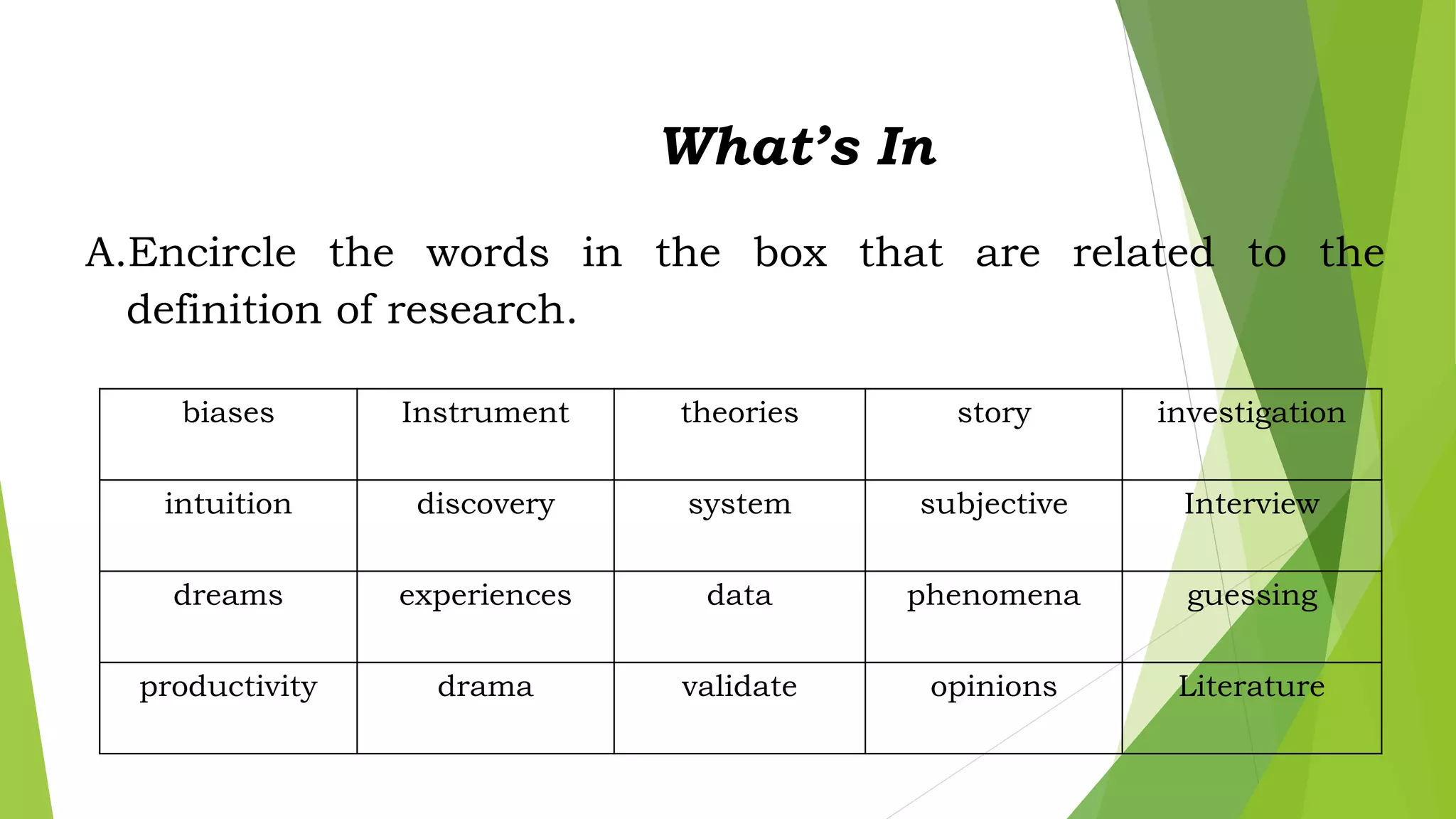
What’s In
biases Instrument theories story investigation
intuition discovery system subjective Interview
dreams experiences data phenomena guessing
productivity drama validate opinions Literature
A.Encircle the words in the box that are related to the
definition of research.
B. Using the words underlined found in Part A, formulate
your own definition of research. Use the blanks provided.
__________________________________________________________________________________
__________________________________________________________________________________
__________________________________________________________________________________
__________________________________________________________________________________
__________________________________________________________________________________
__________________________________________________________________________________
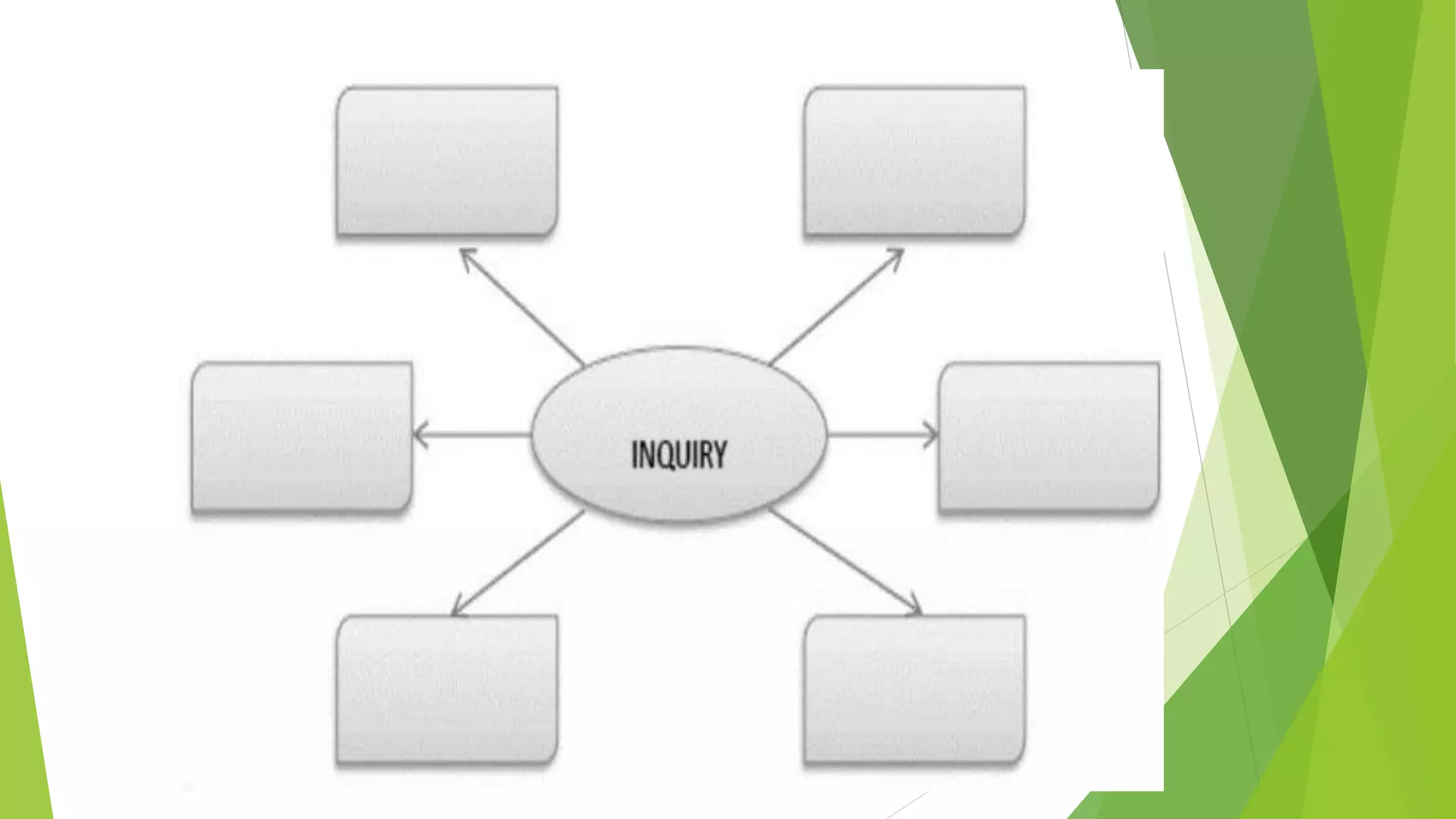
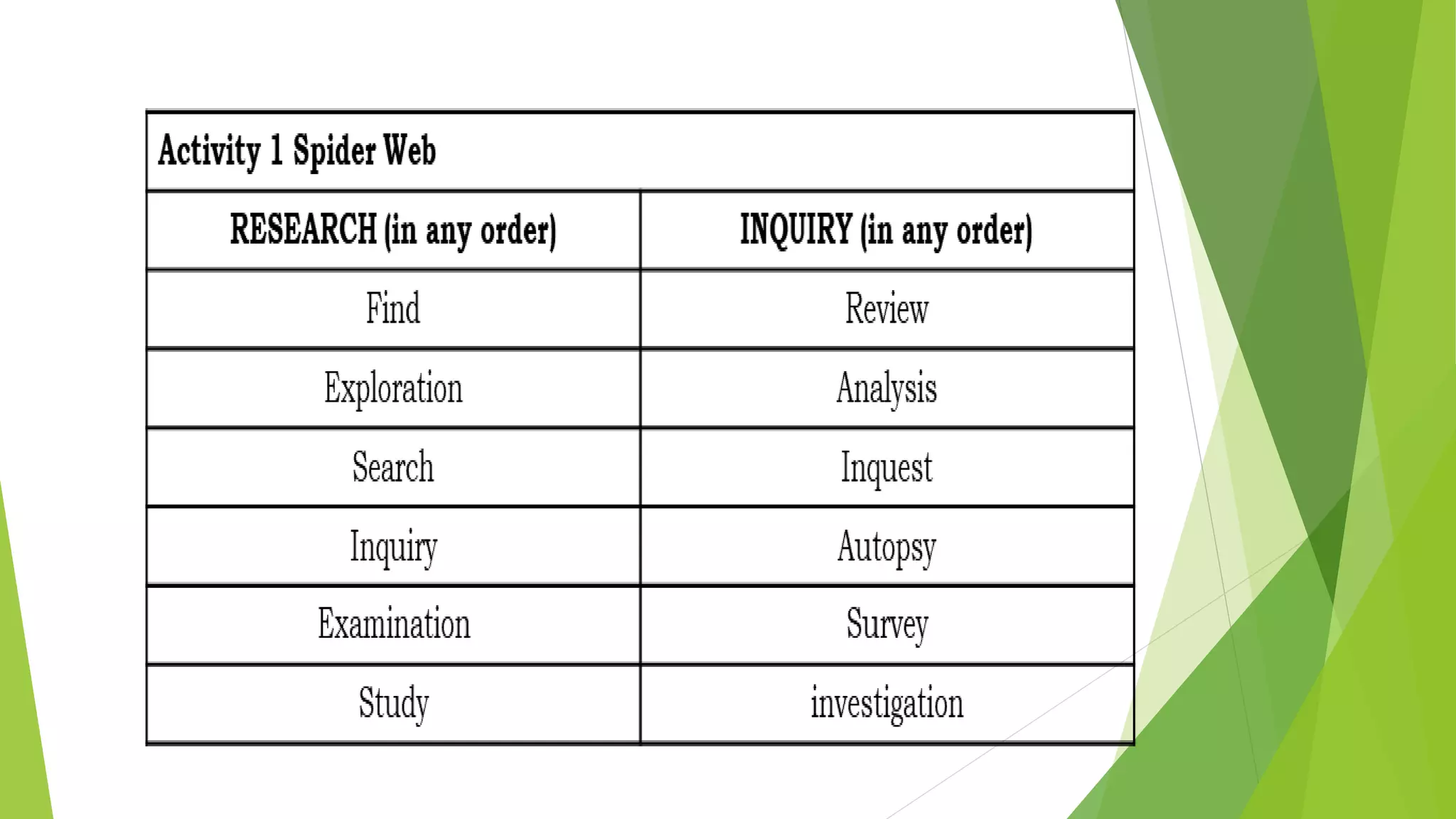
Activity 1 Spider Web
Direction: Complete the concept map by writing word/s related to the
middle word. After answering this, you may proceed to the next activity.
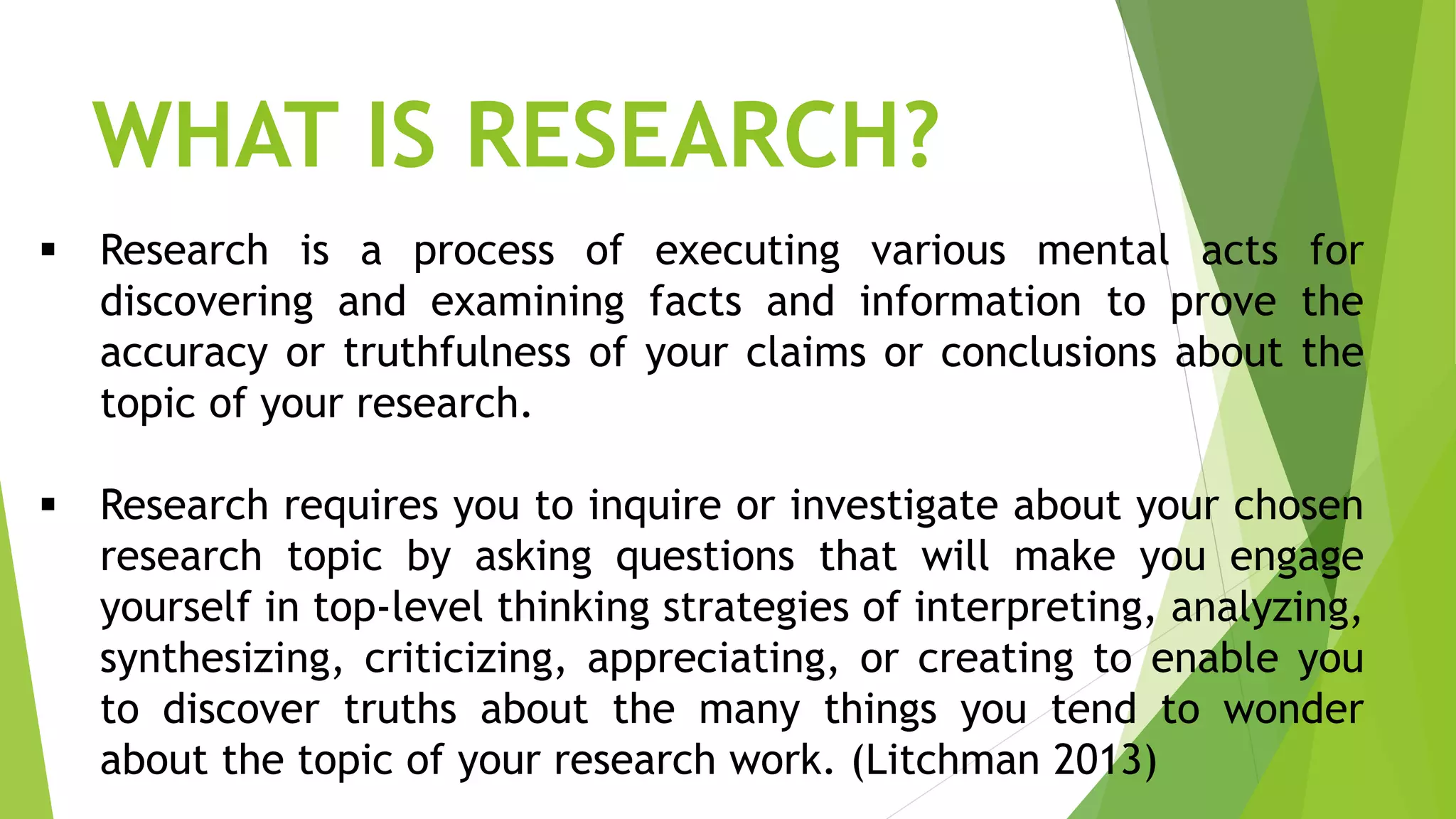
 Research is a process of executing various mental acts for
discovering and examining facts and information to prove the
accuracy or truthfulness of your claims or conclusions about the
topic of your research.
 Research requires you to inquire or investigate about your chosen
research topic by asking questions that will make you engage
yourself in top-level thinking strategies of interpreting, analyzing,
synthesizing, criticizing, appreciating, or creating to enable you
to discover truths about the many things you tend to wonder
about the topic of your research work. (Litchman 2013)
WHAT IS RESEARCH?
What is Inquiry – Based Learning?
Inquiry is defined as “a seeking for truth, information or
knowledge”. The information is sought through questioning.
Individuals carry on the process of inquiry from birth till death.
The process of inquiry begins with gathering information and
data through applying the various human senses.
The elements of inquiry – based process is multiple, varied
and open to selection. Different factors will be involved
different kinds of inquiries in different areas of knowledge and
at different levels of experience.
Research is the systematic investigation and study of
materials and sources to establish facts and reach new
conclusions. When you come across studies about events
that happen or experiences that you meet, they shape
people’s understanding of the world around them. In
various spheres of human life, research has come up with
developing appropriate solutions to improve the
individual’s quality of life. Although it may take place in
different settings and may use different methods, a
scientific research is universally a systematic and objective
search for reliable knowledge.
Researchers must not simply set results and recommend actions.
The importance of research should be measured on the extent to
which they are being actually carried out.
Research is conducted in many different settings. Conducting
research in an educational setting is important in every educator’s
professional life. Education in a research is done to improve these
practices. There are two basic importance of research, to learn
something or to gather evidence. To learn something is for our
benefit. It is almost impossible for a person to stop learning.
Research is organized learning looking for specific things to add to
our store of knowledge.
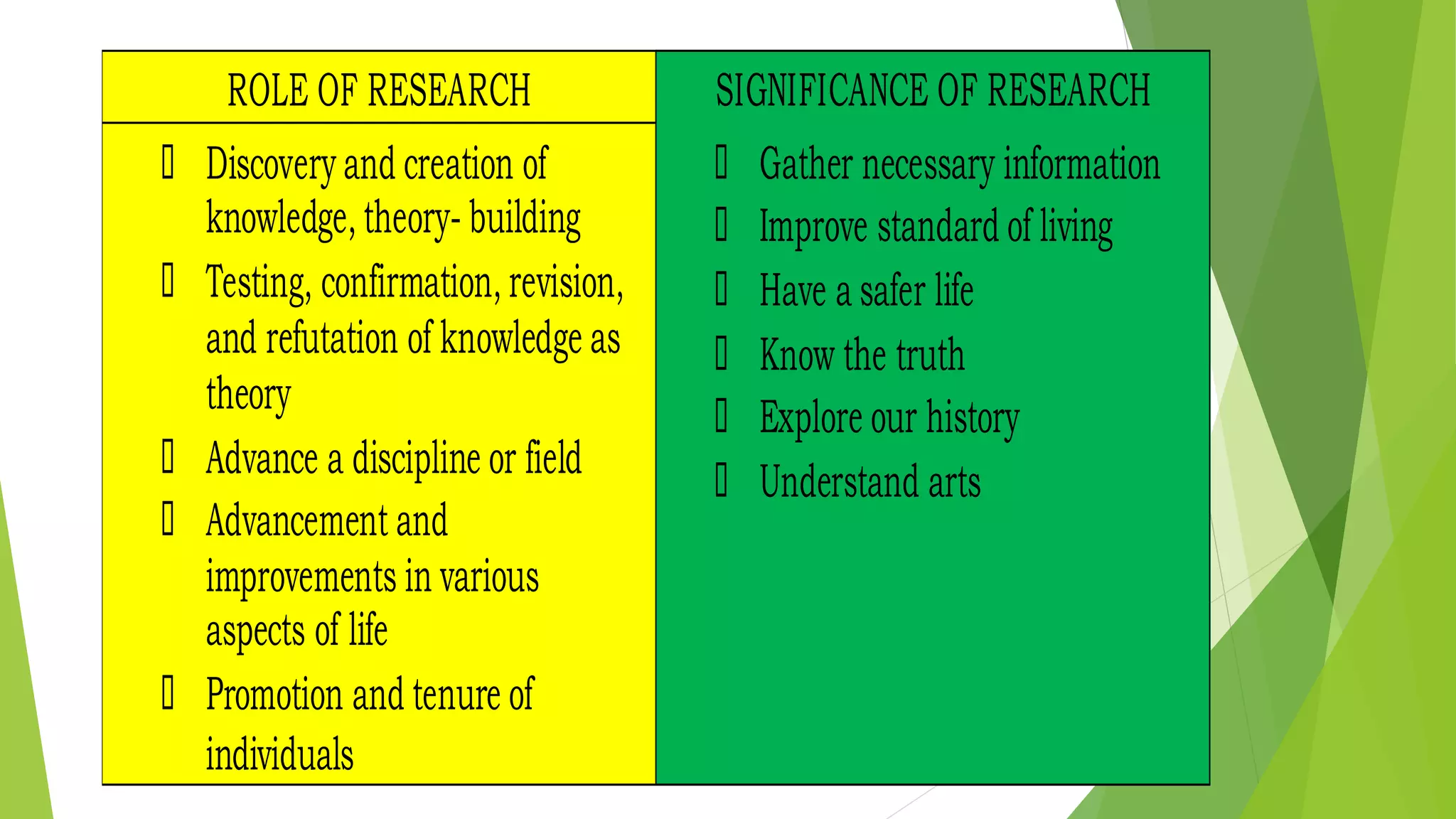
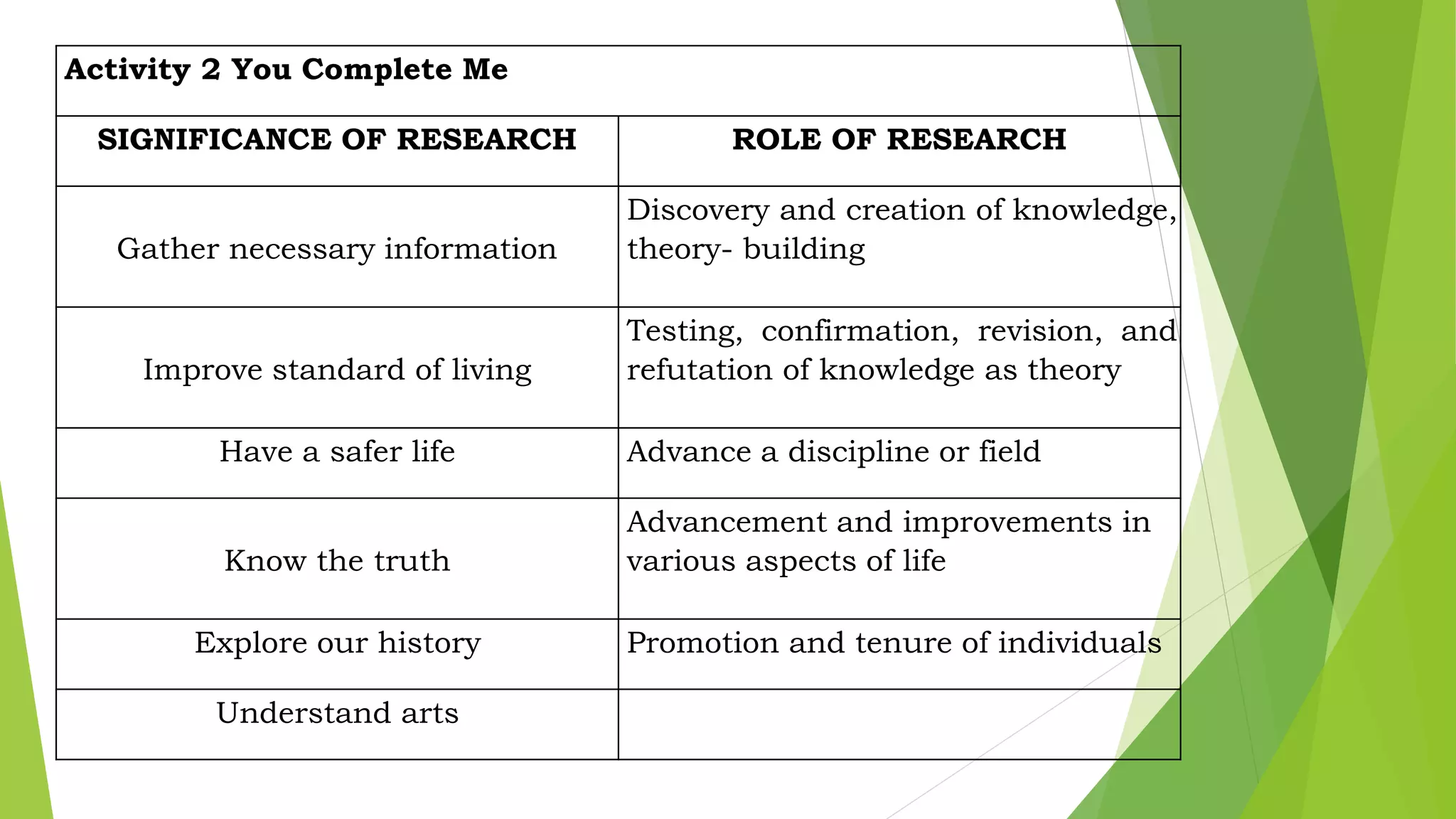
ROLE OF RESEARCH SIGNIFICANCE OF RESEARCH
✓ Discovery and creation of
knowledge, theory- building
✓ Testing, confirmation, revision,
and refutation of knowledge as
theory
✓ Advance a discipline or field
✓ Advancement and
improvements in various
aspects of life
✓ Promotion and tenure of
individuals
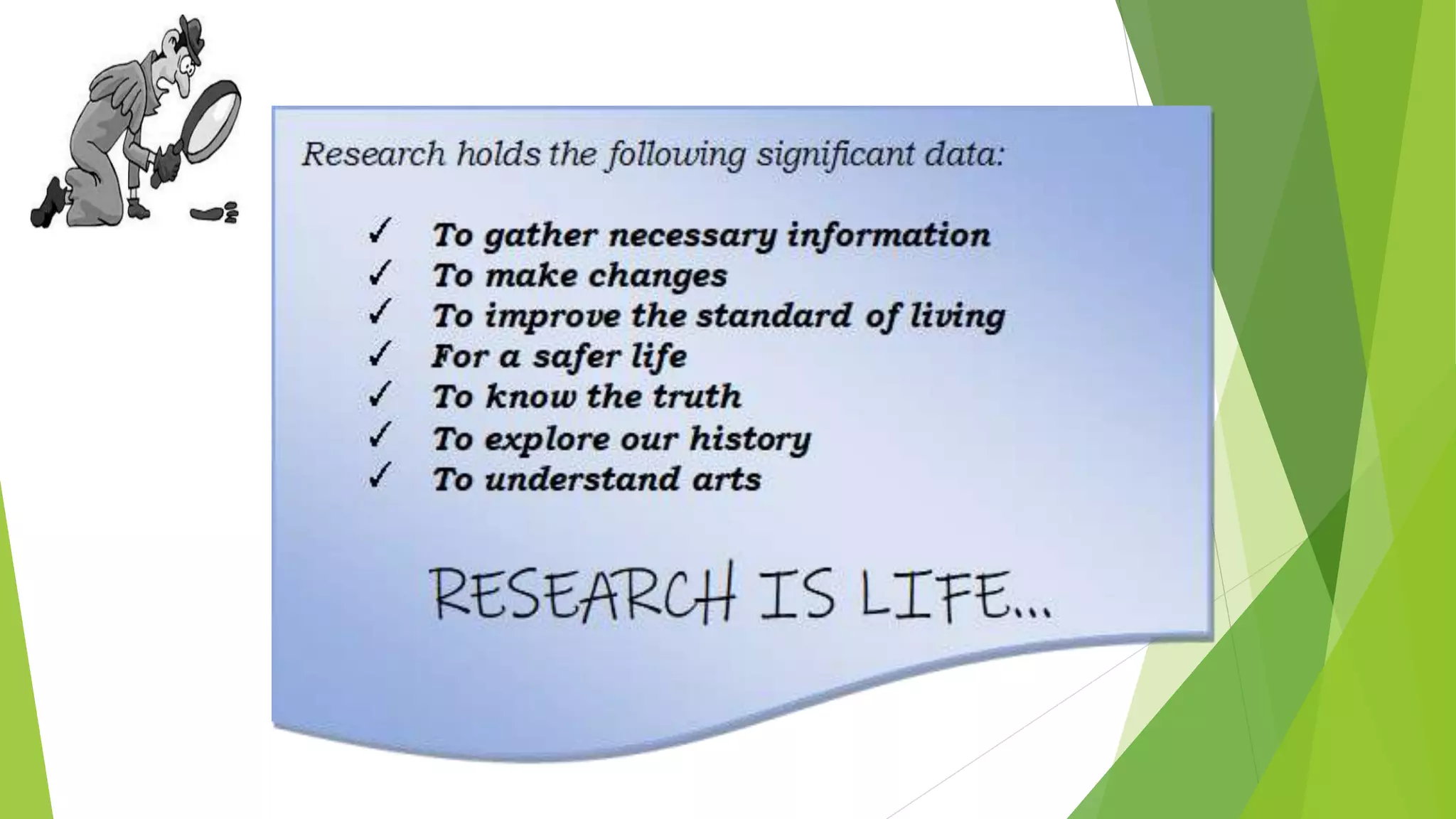
✓ Gather necessary information
✓ Improve standard of living
✓ Have a safer life
✓ Know the truth
✓ Explore our history
✓ Understand arts
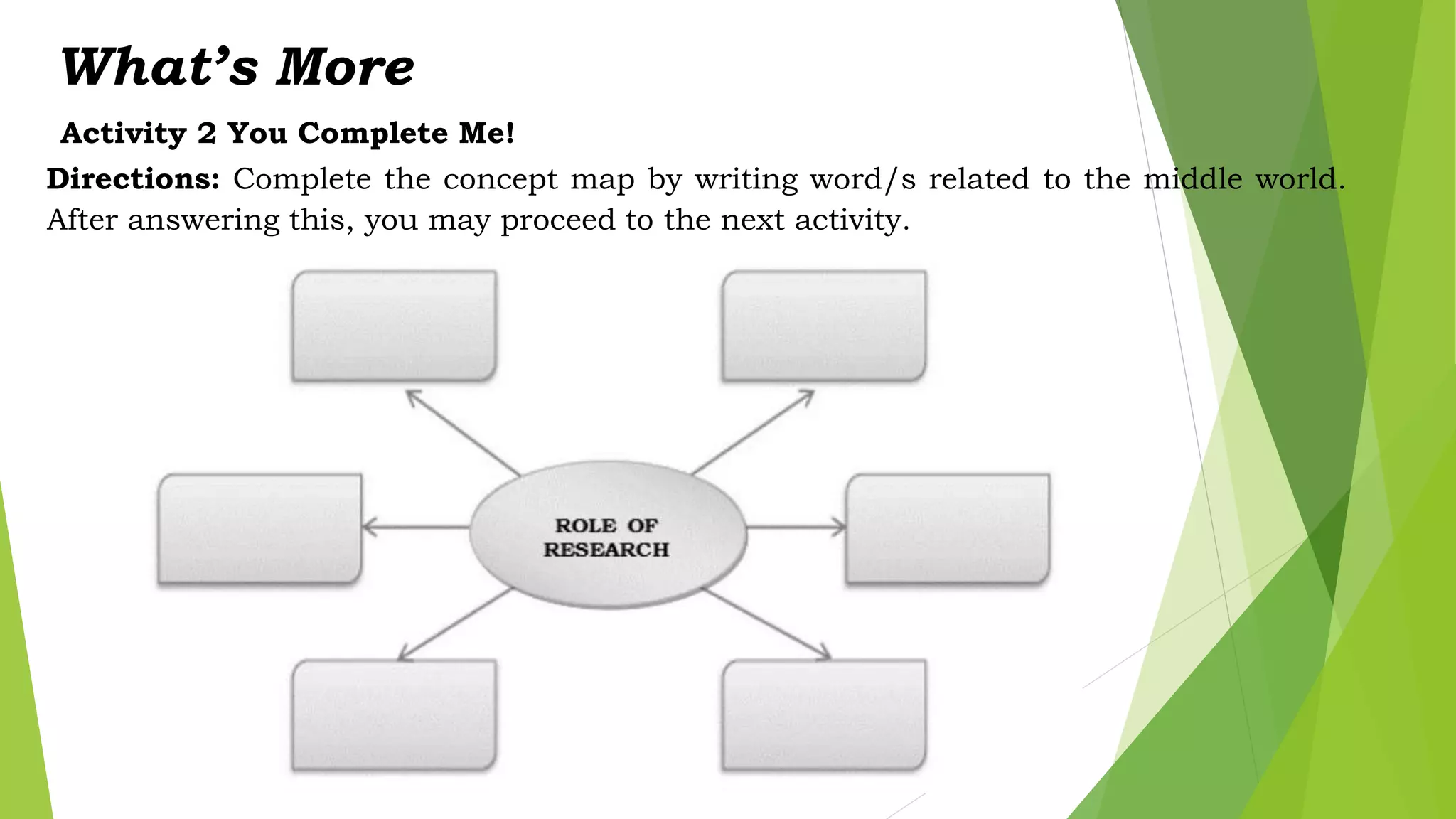
What’s More
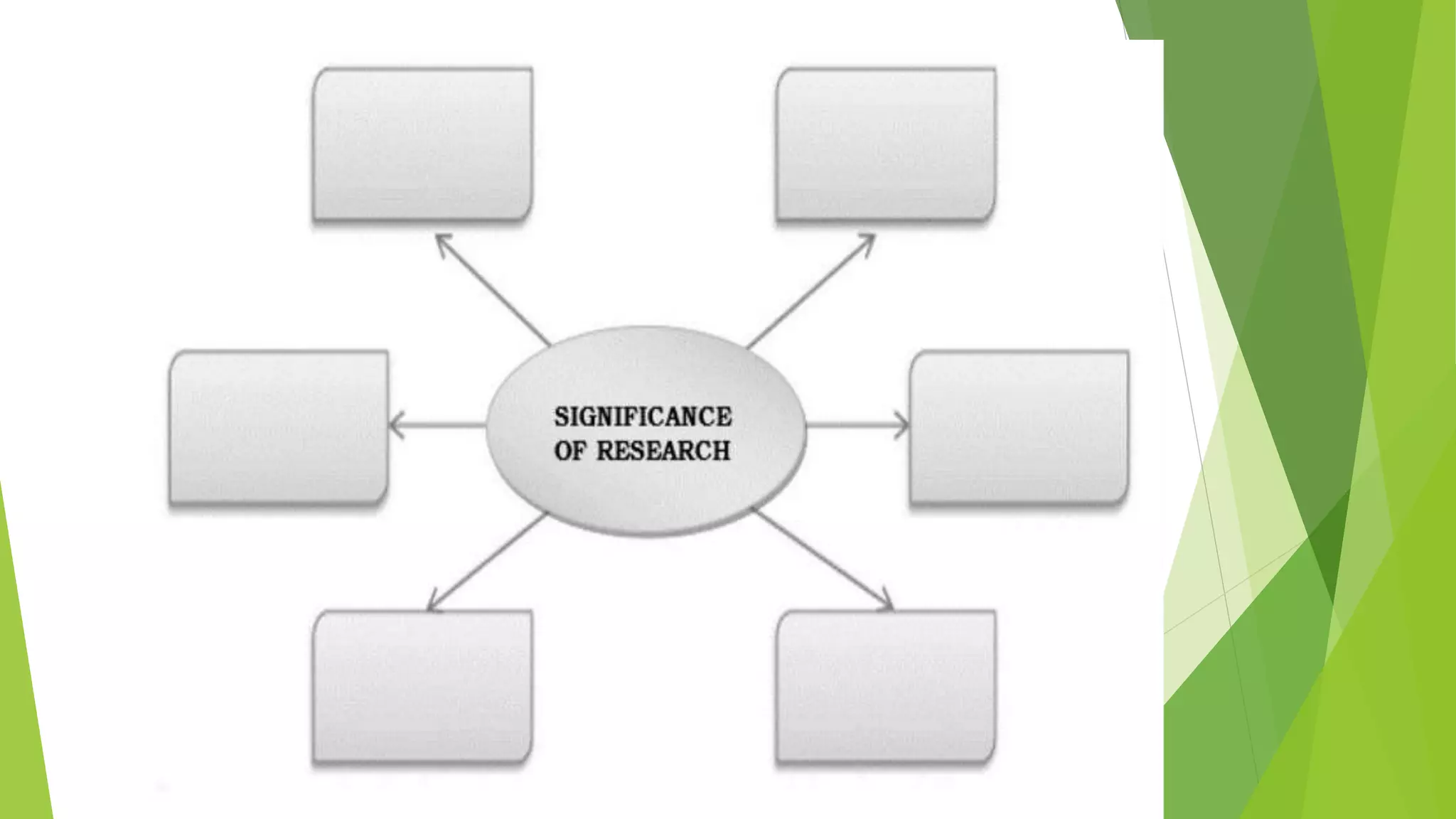
Activity 2 You Complete Me!
Directions: Complete the concept map by writing word/s related to the middle world.
After answering this, you may proceed to the next activity.
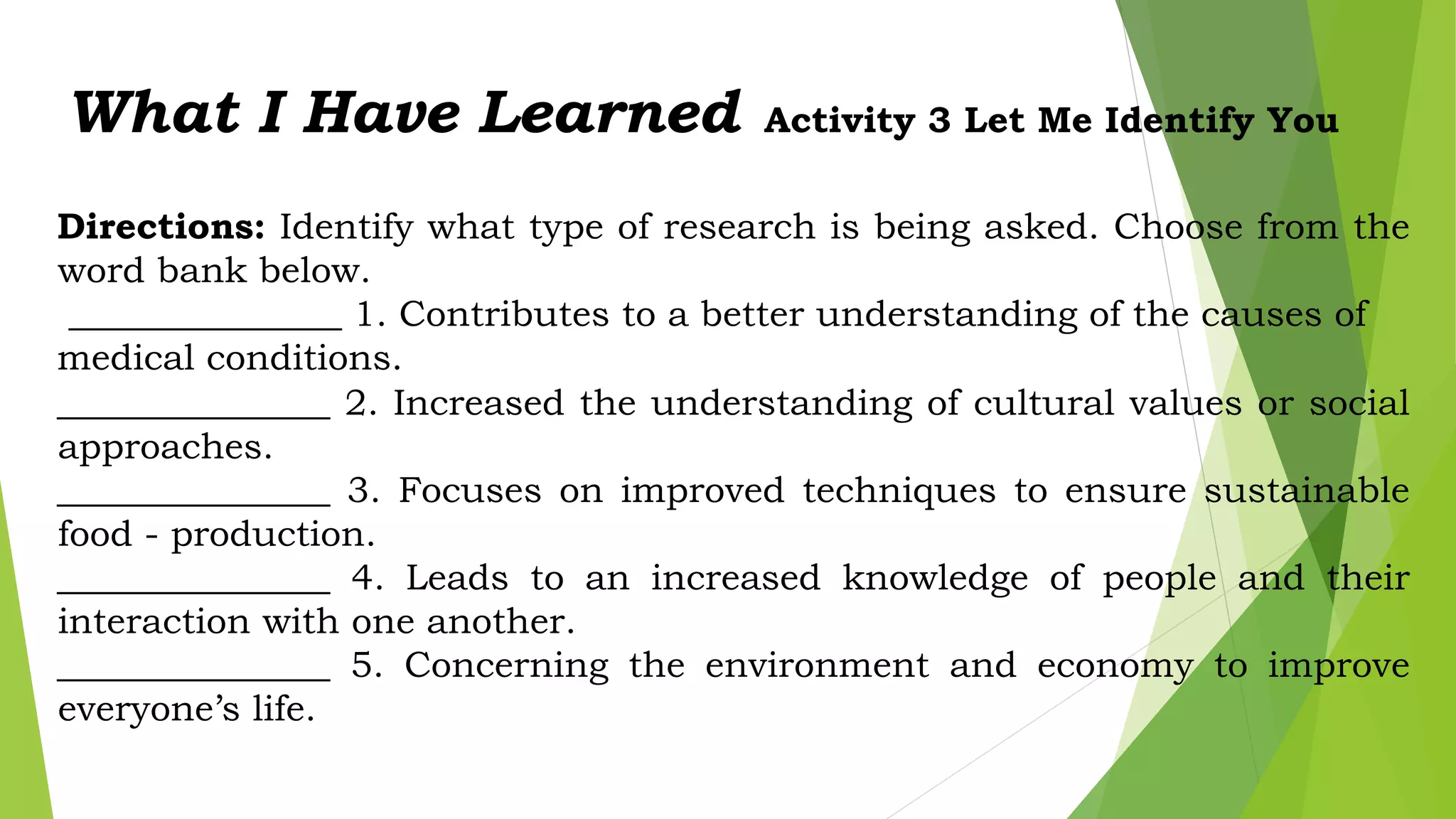
What I Have Learned Activity 3 Let Me Identify You
Directions: Identify what type of research is being asked. Choose from the
word bank below.
_______________ 1. Contributes to a better understanding of the causes of
medical conditions.
_______________ 2. Increased the understanding of cultural values or social
approaches.
_______________ 3. Focuses on improved techniques to ensure sustainable
food - production.
_______________ 4. Leads to an increased knowledge of people and their
interaction with one another.
_______________ 5. Concerning the environment and economy to improve
everyone’s life.
What I Can Do
•What is the importance of research in your education as a 21st Century learner?
__________________________________________________________________________________
__________________________________________________________________________________
__________________________________________________________________________________
__________________________________________________________________________________
•As a learner, what do you want to research on? Why?
__________________________________________________________________________________
__________________________________________________________________________________
__________________________________________________________________________________
__________________________________________________________________________________
__________________________________________________________________________________
theories story investigatio
n
biases Instrumen
t
system subjective Interview intuition discovery
assessment phenomena Guessing dreams experiences
validate opinions Literature productivit
y
drama
Lesson 1
What’s In (sample answer) A.
B.
Research is systematic procedure, validating the investigation of theories and opinions from a discovery or phenomena. Information is gathered through literature an
Activity 2 You Complete Me
SIGNIFICANCE OF RESEARCH ROLE OF RESEARCH
Gather necessary information
Discovery and creation of knowledge,
theory- building
Improve standard of living
Testing, confirmation, revision, and
refutation of knowledge as theory
Have a safer life Advance a discipline or field
Know the truth
Advancement and improvements in
various aspects of life
Explore our history Promotion and tenure of individuals
Understand arts
What’s More
What I Have Learned
Activity 3 Let Me Identify You
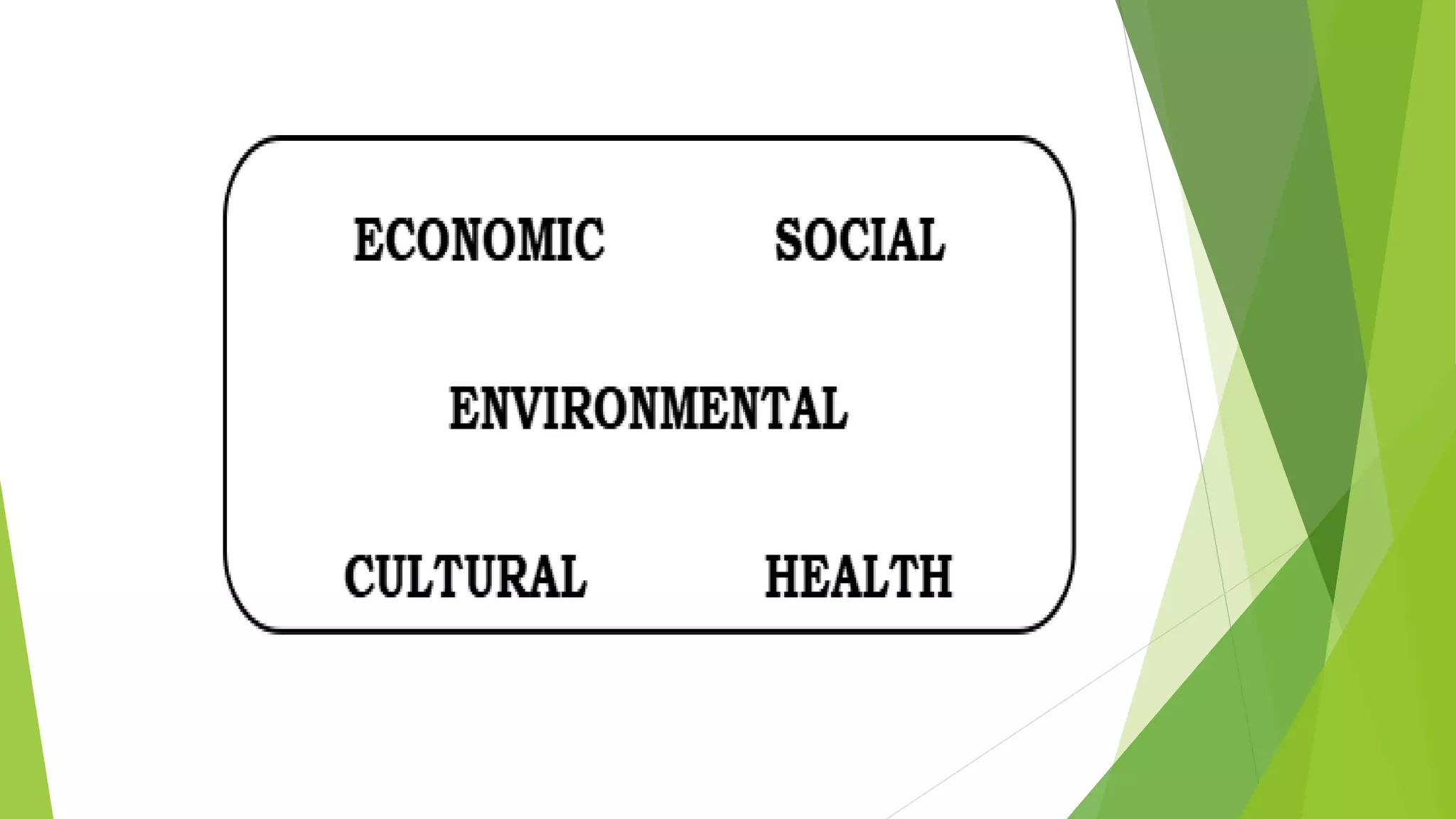
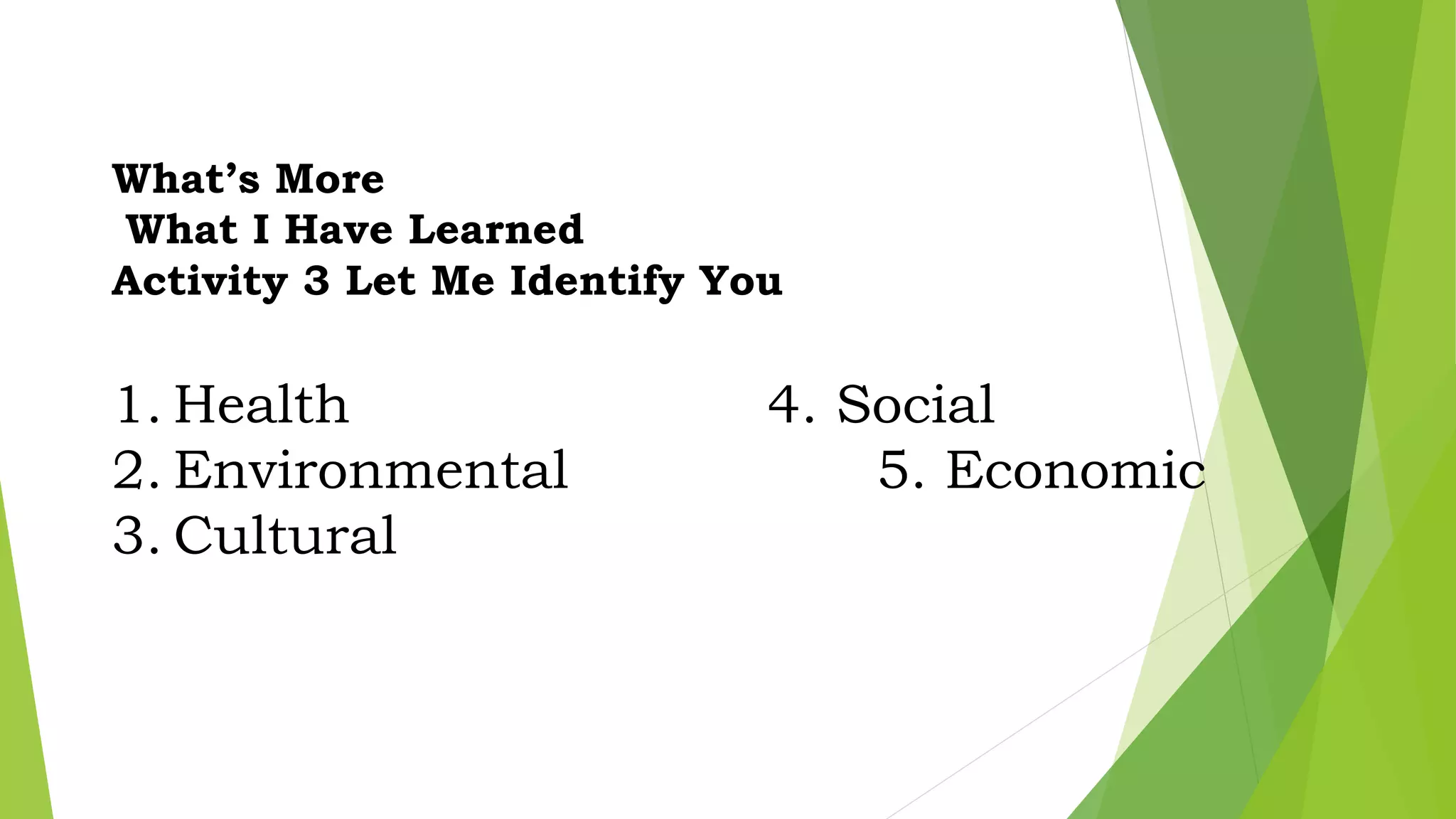
1. Health 4. Social
2. Environmental 5. Economic
3. Cultural
What’s In
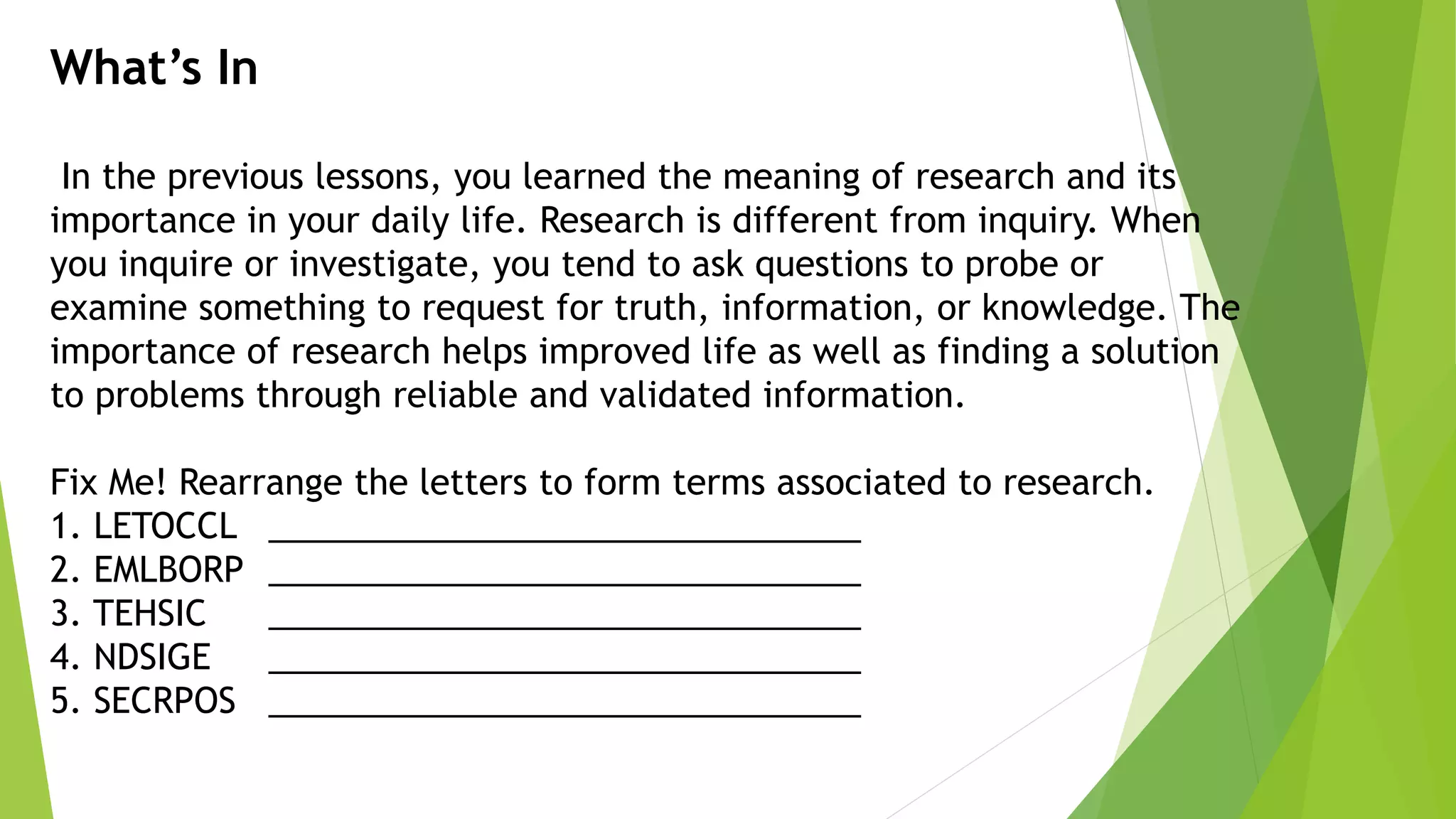
In the previous lessons, you learned the meaning of research and its
importance in your daily life. Research is different from inquiry. When
you inquire or investigate, you tend to ask questions to probe or
examine something to request for truth, information, or knowledge. The
importance of research helps improved life as well as finding a solution
to problems through reliable and validated information.
Fix Me! Rearrange the letters to form terms associated to research.
1. LETOCCL _______________________________
2. EMLBORP _______________________________
3. TEHSIC _______________________________
4. NDSIGE _______________________________
5. SECRPOS _______________________________
LESSON 2: Characteristics, Processes &
Ethics of Research
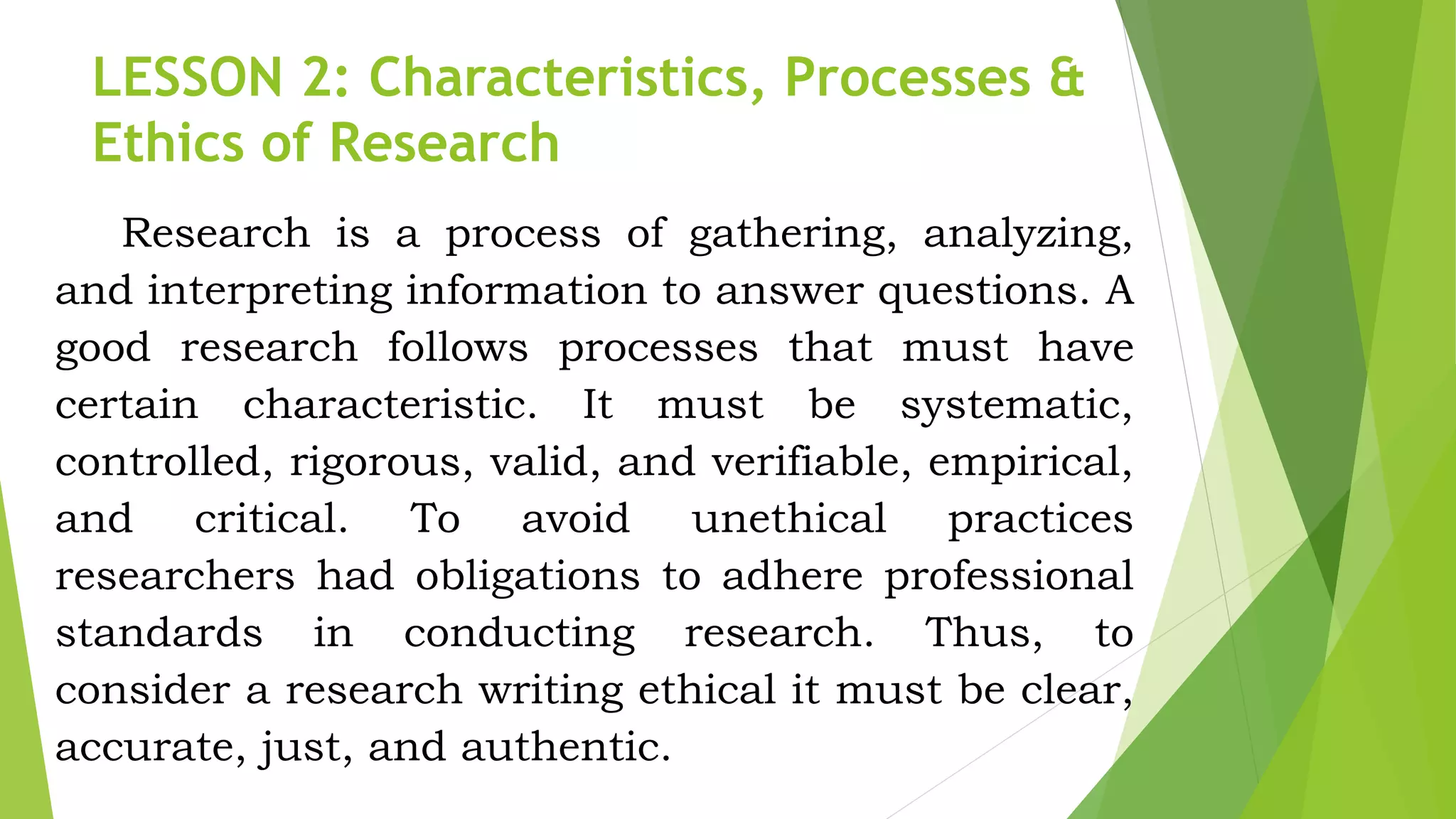
Research is a process of gathering, analyzing,
and interpreting information to answer questions. A
good research follows processes that must have
certain characteristic. It must be systematic,
controlled, rigorous, valid, and verifiable, empirical,
and critical. To avoid unethical practices
researchers had obligations to adhere professional
standards in conducting research. Thus, to
consider a research writing ethical it must be clear,
accurate, just, and authentic.
What’s New
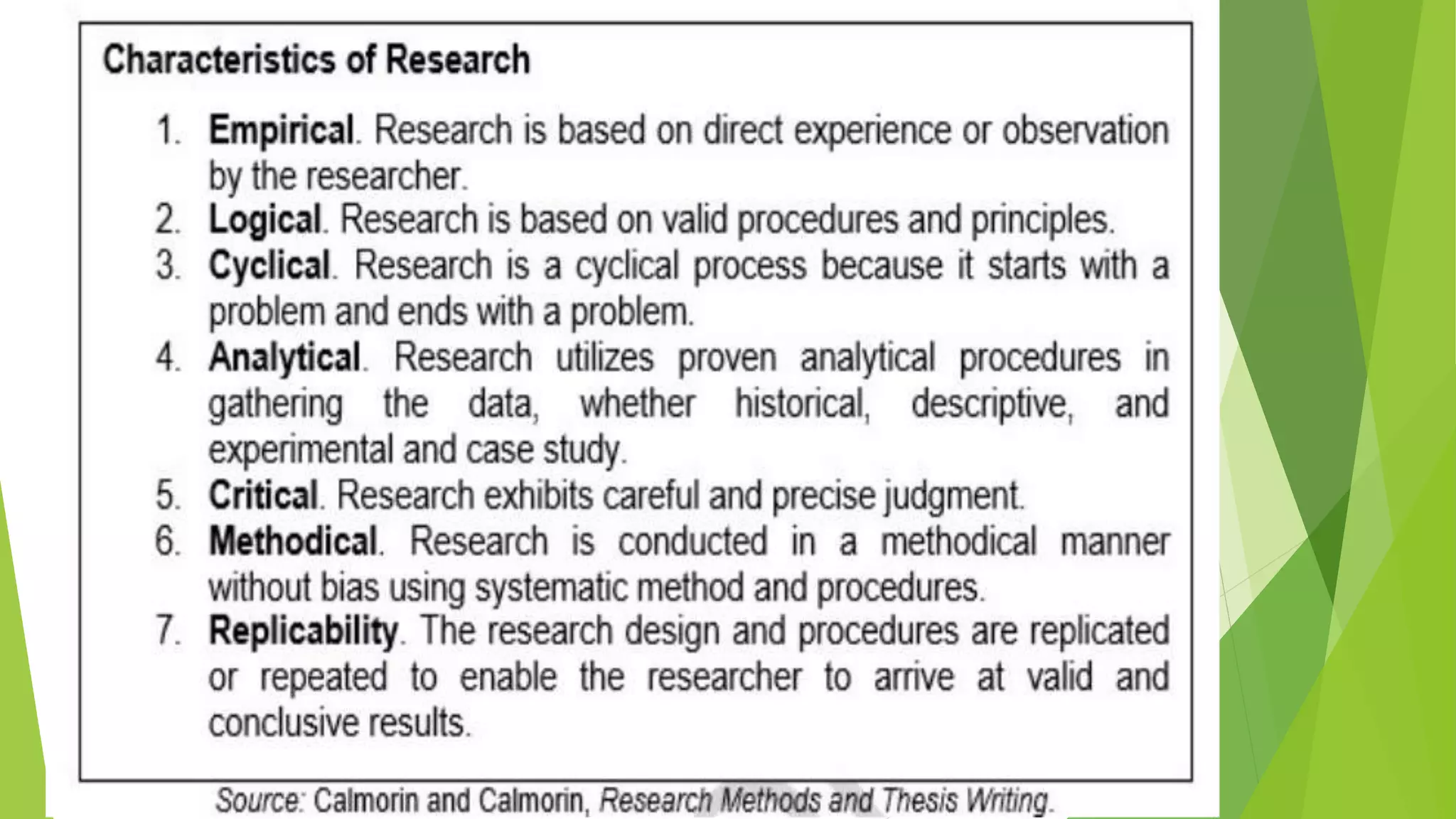
Characteristics of Research
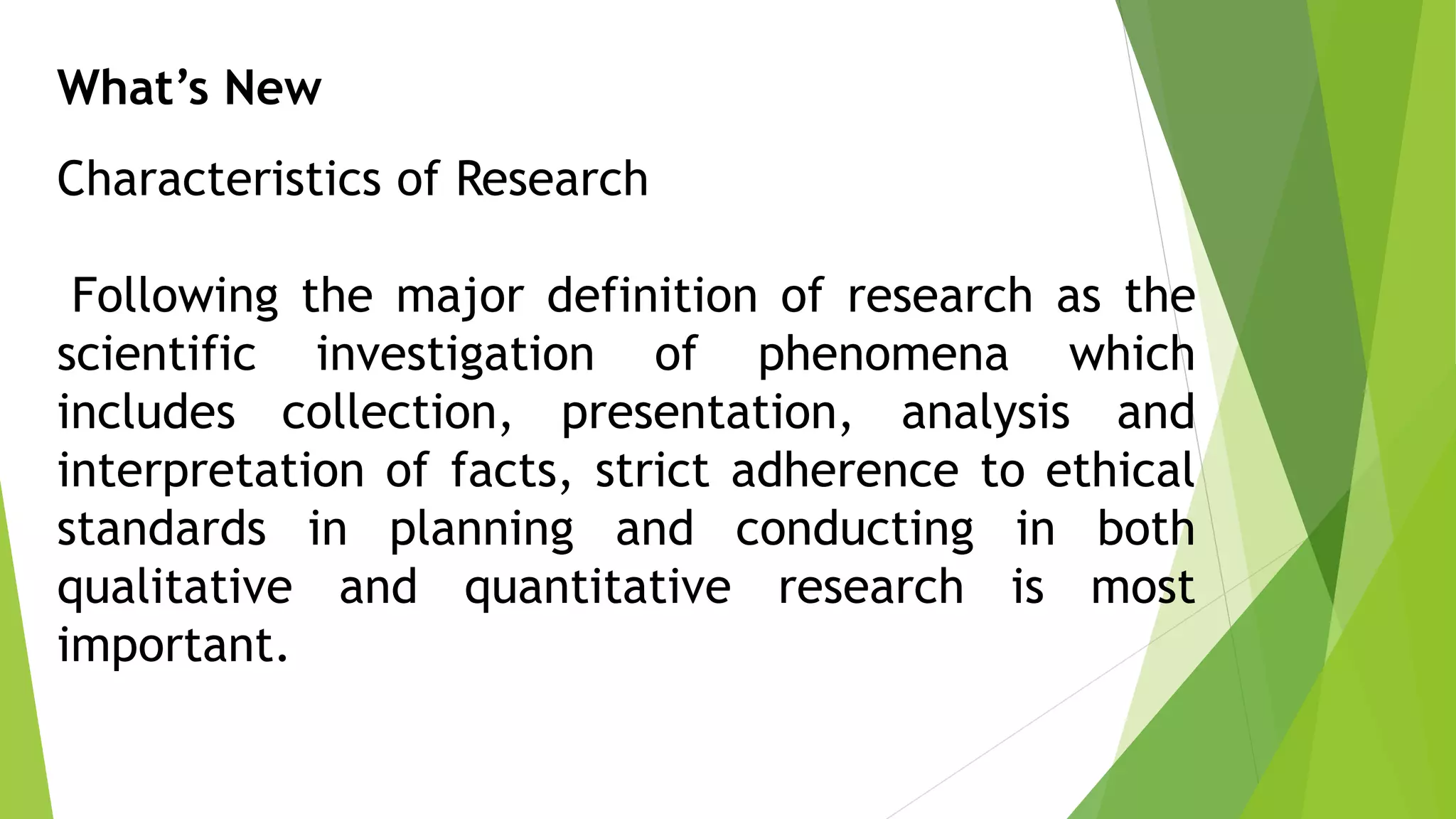
Following the major definition of research as the
scientific investigation of phenomena which
includes collection, presentation, analysis and
interpretation of facts, strict adherence to ethical
standards in planning and conducting in both
qualitative and quantitative research is most
important.
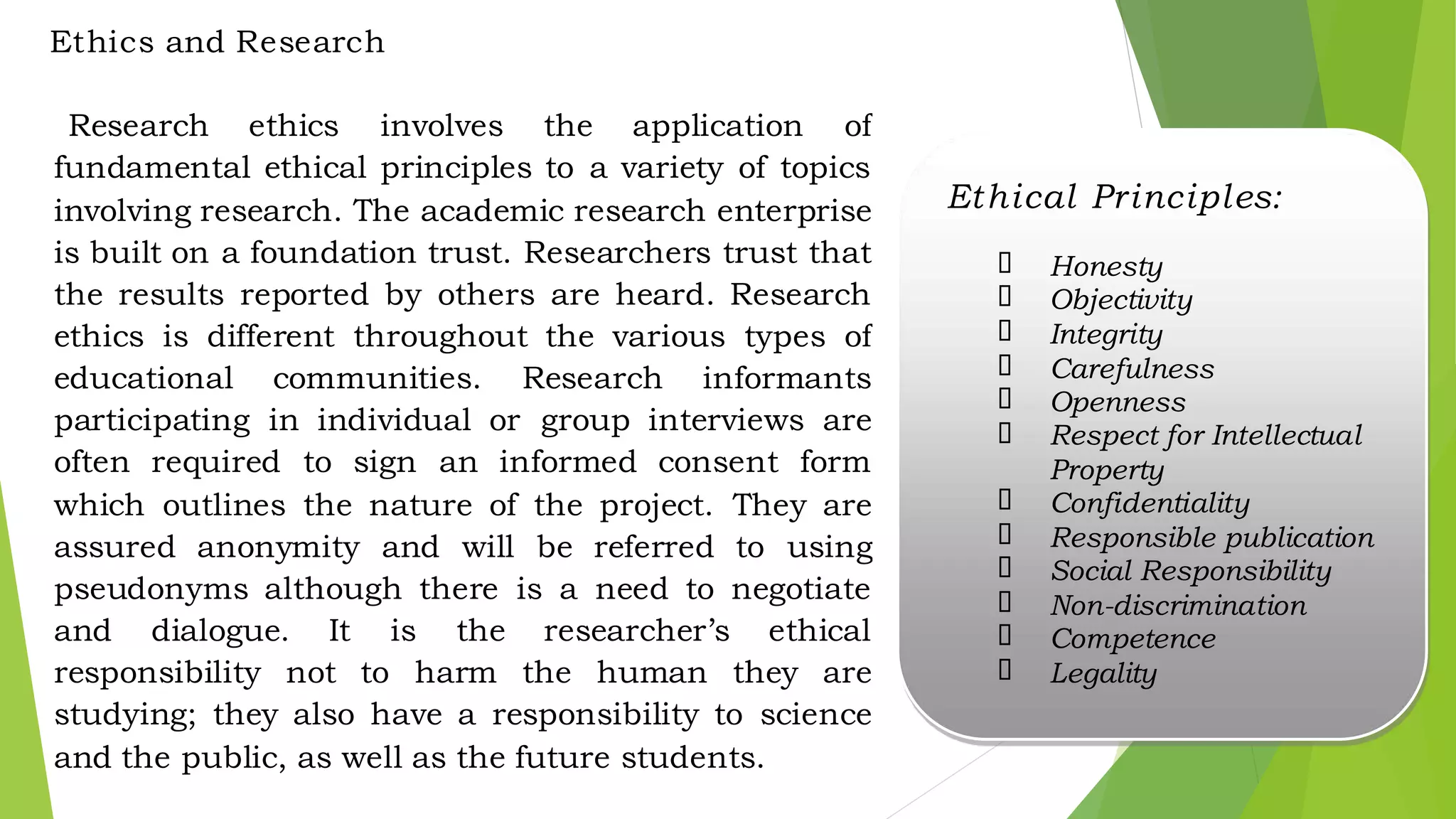
Ethics and Research
Research ethics involves the application of
fundamental ethical principles to a variety of topics
involving research. The academic research enterprise
is built on a foundation trust. Researchers trust that
the results reported by others are heard. Research
ethics is different throughout the various types of
educational communities. Research informants
participating in individual or group interviews are
often required to sign an informed consent form
which outlines the nature of the project. They are
assured anonymity and will be referred to using
pseudonyms although there is a need to negotiate
and dialogue. It is the researcher’s ethical
responsibility not to harm the human they are
studying; they also have a responsibility to science
and the public, as well as the future students.

Ethical Principles:
✓ Honesty
✓ Objectivity
✓ Integrity
✓ Carefulness
✓ Openness
✓ Respect for Intellectual
Property
✓ Confidentiality
✓ Responsible publication
✓ Social Responsibility
✓ Non-discrimination
✓ Competence
✓ Legality
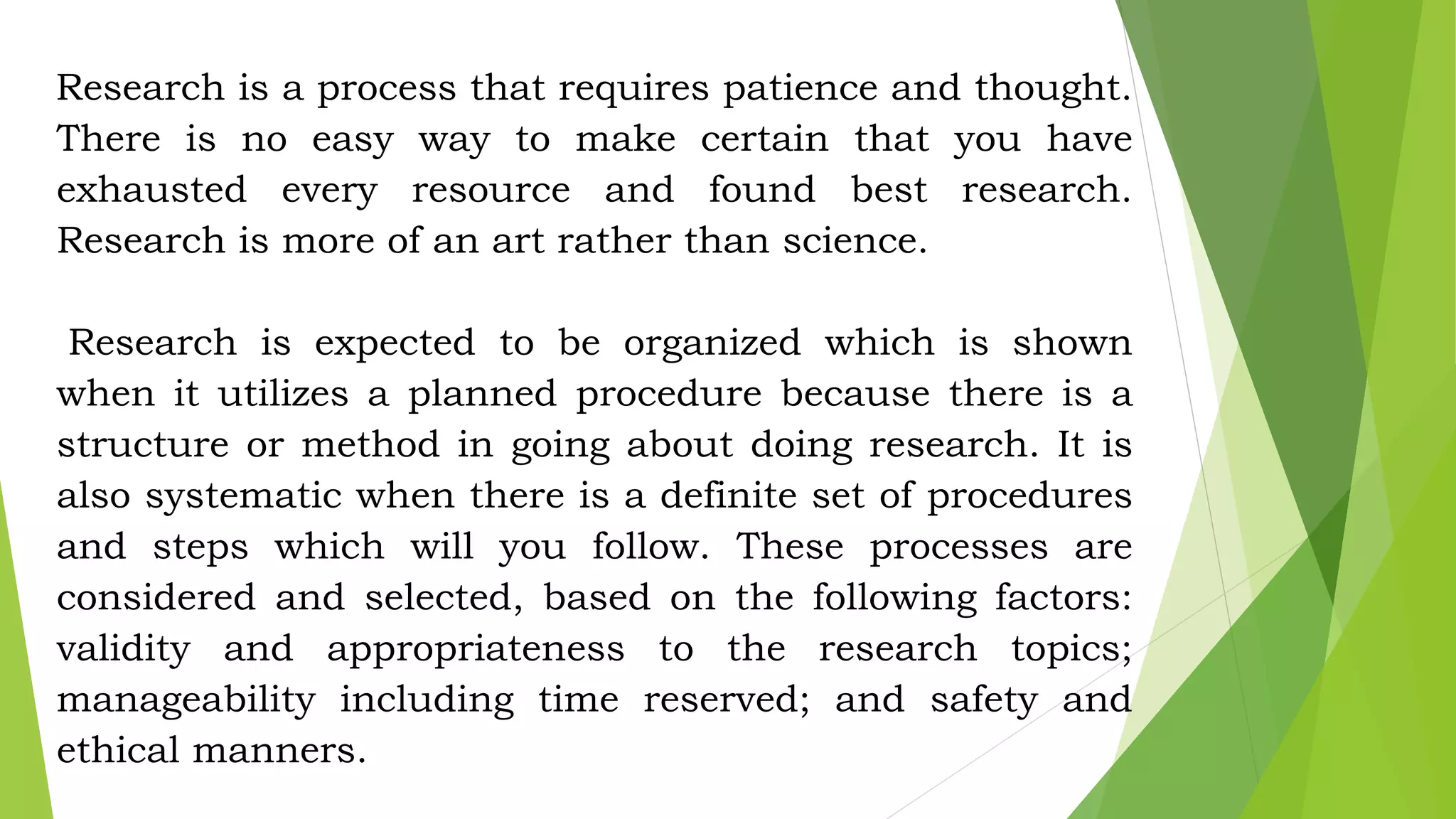
Research is a process that requires patience and thought.
There is no easy way to make certain that you have
exhausted every resource and found best research.
Research is more of an art rather than science.
Research is expected to be organized which is shown
when it utilizes a planned procedure because there is a
structure or method in going about doing research. It is
also systematic when there is a definite set of procedures
and steps which will you follow. These processes are
considered and selected, based on the following factors:
validity and appropriateness to the research topics;
manageability including time reserved; and safety and
ethical manners.
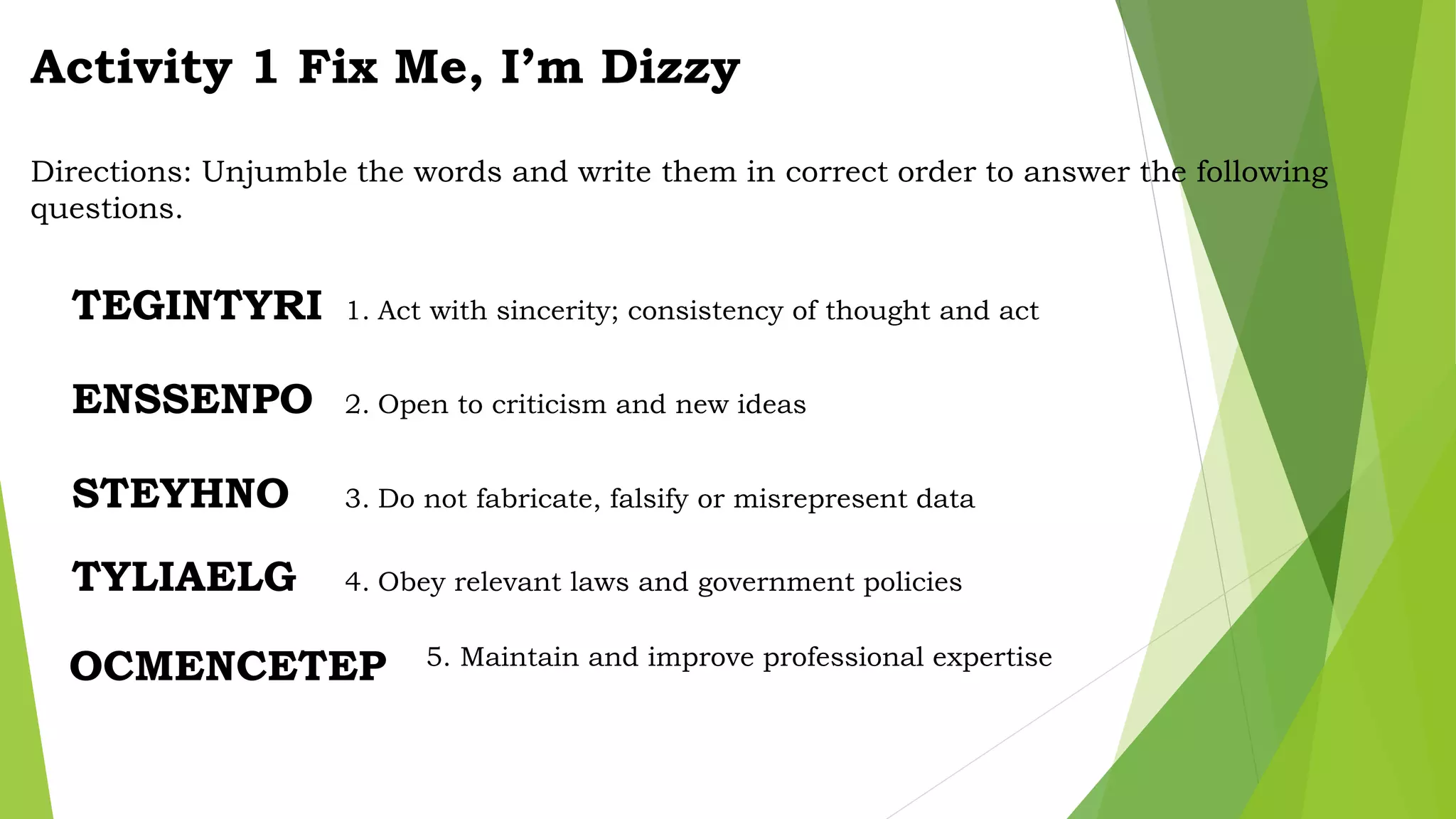
Activity 1 Fix Me, I’m Dizzy
Directions: Unjumble the words and write them in correct order to answer the following
questions.
TEGINTYRI 1. Act with sincerity; consistency of thought and act
ENSSENPO 2. Open to criticism and new ideas
STEYHNO 3. Do not fabricate, falsify or misrepresent data
TYLIAELG 4. Obey relevant laws and government policies
OCMENCETEP 5. Maintain and improve professional expertise
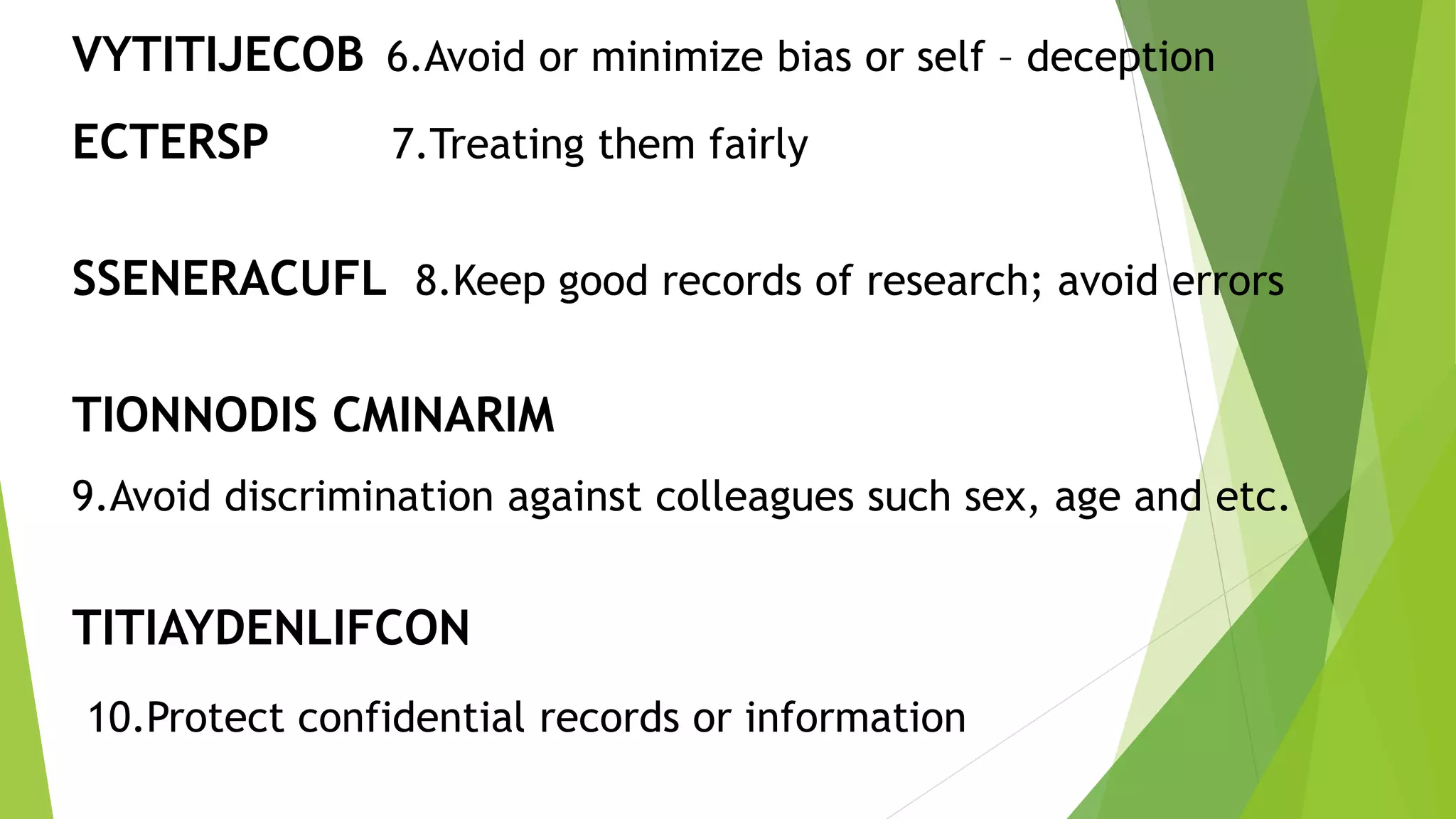
VYTITIJECOB 6.Avoid or minimize bias or self – deception
ECTERSP 7.Treating them fairly
SSENERACUFL 8.Keep good records of research; avoid errors
TIONNODIS CMINARIM
9.Avoid discrimination against colleagues such sex, age and etc.
TITIAYDENLIFCON
10.Protect confidential records or information
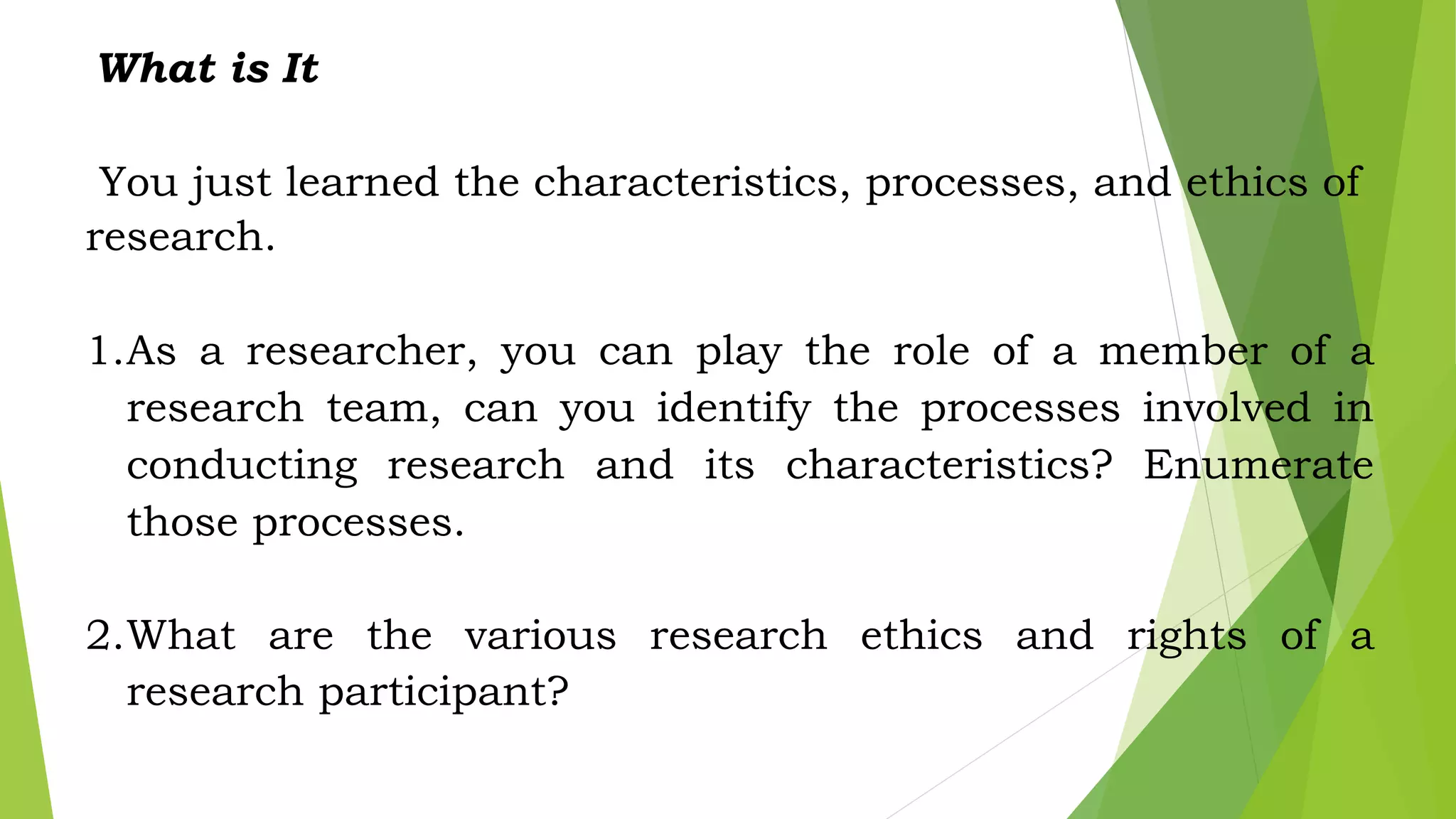
What is It
You just learned the characteristics, processes, and ethics of
research.
1.As a researcher, you can play the role of a member of a
research team, can you identify the processes involved in
conducting research and its characteristics? Enumerate
those processes.
2.What are the various research ethics and rights of a
research participant?
What’s More
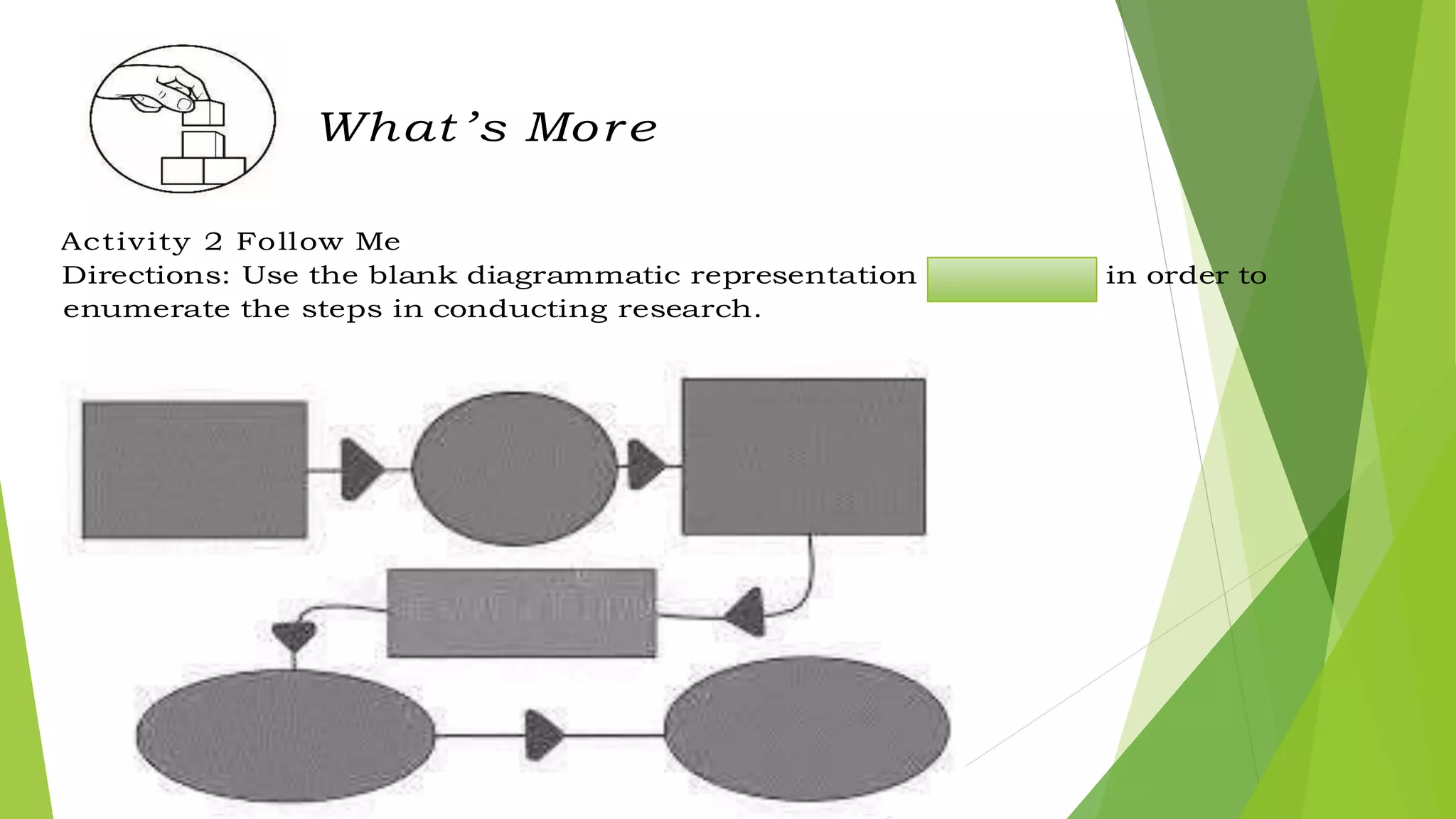
Activity 2 Follow Me
Directions: Use the blank diagrammatic representation on page 18 in order to
enumerate the steps in conducting research.
What I Have Learned
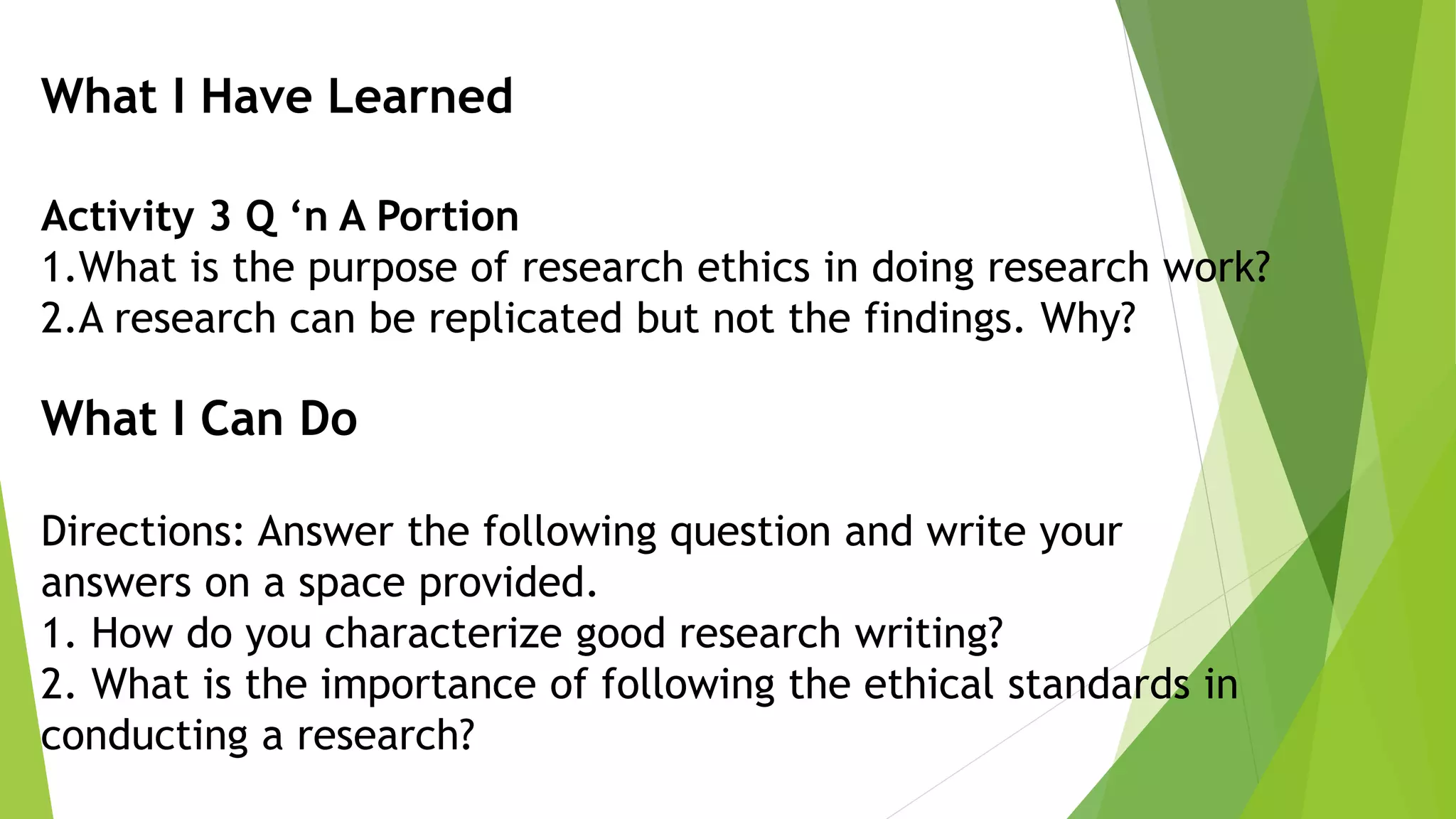
Activity 3 Q ‘n A Portion
1.What is the purpose of research ethics in doing research work?
2.A research can be replicated but not the findings. Why?
What I Can Do
Directions: Answer the following question and write your
answers on a space provided.
1. How do you characterize good research writing?
2. What is the importance of following the ethical standards in
conducting a research?
Lesson 2
What’s In What’s More
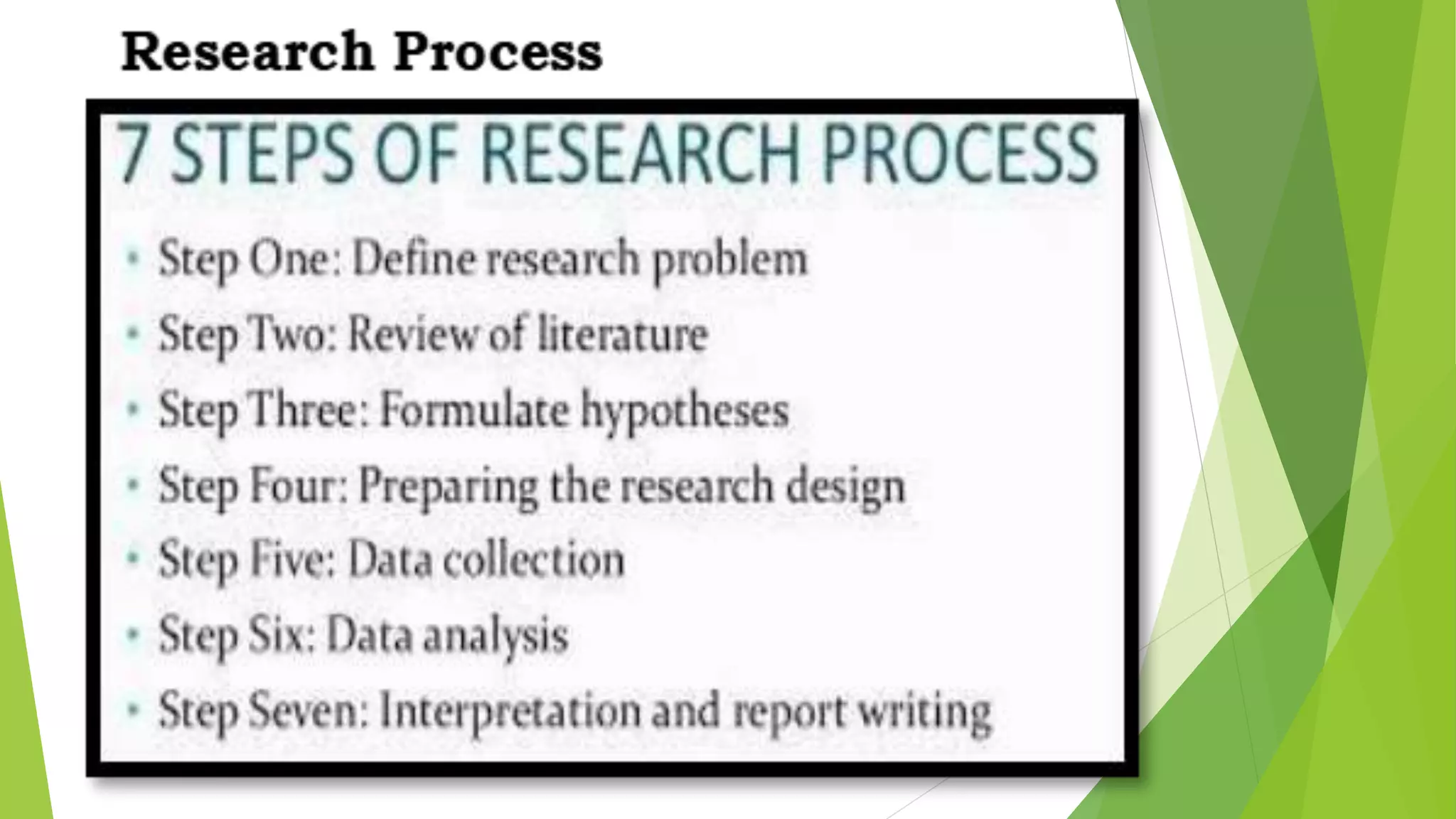
1.COLLECT 1. Define research problem
2.PROBLEM 2. Review of literature
3.ETHICS 3. Formulate hypothesis
4.DESIGN 4. Preparing the research design
5.PROCESS 5. Data collection
6.Data analysis
Interpretation and report writing
What’s New
1.INTEGRITY 6. OBJECTIVITY
2.OPENNESS 7. RESPECT
3.HONESTY 8. CAREFULNESS
4.LEGALITY 9. NON - DISCRIMINATION
5.COMPETENCE 10. CONFIDENTIALITY

PRACTICAL RESEARCH 1.pptx

  • 1.
  • 2.
    What I Know Directions:Choose the letter of the correct answer. Write your answers in a separate sheet. 1.Which of the following is a function of research? A. Describe B. Explain C. Predict D. All of these 2.Which of these is NOT an importance of research in our daily life? A. Gain unessential information B. Know the truth C. Make changes D. Safer life 3.Which of the following characteristics of research utilizes proven analytical procedures in gathering data? A. Analytical B. Controlled C. Empirical D. Systematic 4.Wilhelm reports the result of observation based on the gathered data in his research. He never tried to fabricate, falsify, and misinterpret data. What ethical principle is being shown? A. Carefulness B. Honesty C. Integrity D. Objectivity 5.Is it important to follow the research process in conducting a research work? A. No, for it will just add up to your stress in writing your research paper. B. No, because you can start right away with the last step to finish the research work in a short span of time. C. Yes, to effectively carry out the research work and to be systematic in writing your research paper. D. Yes, because it is what is required.
  • 3.
    6.Which of thefollowing does not belong to the group? A. Images B. Numbers C. Objects D. Words 7.What form of data is being collected in qualitative research? I. Interview results II. Observations and Notes III. Experiment results A.I only B. I and II C. I, II and III D. II only 8.Which importance of research is described in the statement below? “Results of research helped us to mark out the thin line between truth and lie.” A.To make changes C. For a safer life B.To know the truth D. Gain essential information 9.What area of research is employed if you wanted to study the Effectiveness of a Newly Discovered Drug? A.Arts B. History C. Medicine D. Sports 10.What area of research is employed if you wanted to study the behavior of children listening to a particular genre of music? A.Arts B. Medicine C. Psychology D.Sports
  • 4.
    11.What characteristic ofqualitative research is employed in the situation below? “Studying real-world situation as it unfolds naturally” A.Dynamic B. Emergent C. Naturalistic D. Purposeful 12.Which of the following refers to a detailed study of a specific subject such as person, group, place, event and phenomenon? A.Case Study B.Ethnography C. Grounded Theory D. Phenomenology 13.Which of these refers to the systematic collection of data related to past occurrences? A.Case Study B.Ethnography C. Grounded Theory D. Historical 14.Which of the following refers to the importance of qualitative research in Social Work? A.It represents the best available research on emerging problem or application of evidence in diverse population. B.Used in testing new ideas of product and to gain a realistic view of how customers would react to a product. C.Used in order for people to reach new ideas and conclusion for people to improve their art. D.Used to improve understanding policy changes in the field of fisheries. 15.Which of the following refers to the importance of qualitative research in Arts? A.It represents the best available research on emerging problem or application of evidence in diverse population. B.Used in testing new ideas of product and to gain a realistic view of how customers would react to a product. C.Used in order for people to reach new ideas and conclusion for people to improve their art. D.Used to improve understanding policy changes in the field of fisheries.
  • 5.
    What’s In biases Instrumenttheories story investigation intuition discovery system subjective Interview dreams experiences data phenomena guessing productivity drama validate opinions Literature A.Encircle the words in the box that are related to the definition of research.
  • 6.
    B. Using thewords underlined found in Part A, formulate your own definition of research. Use the blanks provided. __________________________________________________________________________________ __________________________________________________________________________________ __________________________________________________________________________________ __________________________________________________________________________________ __________________________________________________________________________________ __________________________________________________________________________________
  • 7.
    Activity 1 SpiderWeb Direction: Complete the concept map by writing word/s related to the middle word. After answering this, you may proceed to the next activity.
  • 9.
     Research isa process of executing various mental acts for discovering and examining facts and information to prove the accuracy or truthfulness of your claims or conclusions about the topic of your research.  Research requires you to inquire or investigate about your chosen research topic by asking questions that will make you engage yourself in top-level thinking strategies of interpreting, analyzing, synthesizing, criticizing, appreciating, or creating to enable you to discover truths about the many things you tend to wonder about the topic of your research work. (Litchman 2013) WHAT IS RESEARCH?
  • 10.
    What is Inquiry– Based Learning? Inquiry is defined as “a seeking for truth, information or knowledge”. The information is sought through questioning. Individuals carry on the process of inquiry from birth till death. The process of inquiry begins with gathering information and data through applying the various human senses. The elements of inquiry – based process is multiple, varied and open to selection. Different factors will be involved different kinds of inquiries in different areas of knowledge and at different levels of experience.
  • 11.
    Research is thesystematic investigation and study of materials and sources to establish facts and reach new conclusions. When you come across studies about events that happen or experiences that you meet, they shape people’s understanding of the world around them. In various spheres of human life, research has come up with developing appropriate solutions to improve the individual’s quality of life. Although it may take place in different settings and may use different methods, a scientific research is universally a systematic and objective search for reliable knowledge.
  • 13.
    Researchers must notsimply set results and recommend actions. The importance of research should be measured on the extent to which they are being actually carried out. Research is conducted in many different settings. Conducting research in an educational setting is important in every educator’s professional life. Education in a research is done to improve these practices. There are two basic importance of research, to learn something or to gather evidence. To learn something is for our benefit. It is almost impossible for a person to stop learning. Research is organized learning looking for specific things to add to our store of knowledge.
  • 14.
    ROLE OF RESEARCHSIGNIFICANCE OF RESEARCH ✓ Discovery and creation of knowledge, theory- building ✓ Testing, confirmation, revision, and refutation of knowledge as theory ✓ Advance a discipline or field ✓ Advancement and improvements in various aspects of life ✓ Promotion and tenure of individuals ✓ Gather necessary information ✓ Improve standard of living ✓ Have a safer life ✓ Know the truth ✓ Explore our history ✓ Understand arts
  • 15.
    What’s More Activity 2You Complete Me! Directions: Complete the concept map by writing word/s related to the middle world. After answering this, you may proceed to the next activity.
  • 17.
    What I HaveLearned Activity 3 Let Me Identify You Directions: Identify what type of research is being asked. Choose from the word bank below. _______________ 1. Contributes to a better understanding of the causes of medical conditions. _______________ 2. Increased the understanding of cultural values or social approaches. _______________ 3. Focuses on improved techniques to ensure sustainable food - production. _______________ 4. Leads to an increased knowledge of people and their interaction with one another. _______________ 5. Concerning the environment and economy to improve everyone’s life.
  • 19.
    What I CanDo •What is the importance of research in your education as a 21st Century learner? __________________________________________________________________________________ __________________________________________________________________________________ __________________________________________________________________________________ __________________________________________________________________________________ •As a learner, what do you want to research on? Why? __________________________________________________________________________________ __________________________________________________________________________________ __________________________________________________________________________________ __________________________________________________________________________________ __________________________________________________________________________________
  • 20.
    theories story investigatio n biasesInstrumen t system subjective Interview intuition discovery assessment phenomena Guessing dreams experiences validate opinions Literature productivit y drama Lesson 1 What’s In (sample answer) A. B. Research is systematic procedure, validating the investigation of theories and opinions from a discovery or phenomena. Information is gathered through literature an
  • 22.
    Activity 2 YouComplete Me SIGNIFICANCE OF RESEARCH ROLE OF RESEARCH Gather necessary information Discovery and creation of knowledge, theory- building Improve standard of living Testing, confirmation, revision, and refutation of knowledge as theory Have a safer life Advance a discipline or field Know the truth Advancement and improvements in various aspects of life Explore our history Promotion and tenure of individuals Understand arts
  • 23.
    What’s More What IHave Learned Activity 3 Let Me Identify You 1. Health 4. Social 2. Environmental 5. Economic 3. Cultural
  • 24.
    What’s In In theprevious lessons, you learned the meaning of research and its importance in your daily life. Research is different from inquiry. When you inquire or investigate, you tend to ask questions to probe or examine something to request for truth, information, or knowledge. The importance of research helps improved life as well as finding a solution to problems through reliable and validated information. Fix Me! Rearrange the letters to form terms associated to research. 1. LETOCCL _______________________________ 2. EMLBORP _______________________________ 3. TEHSIC _______________________________ 4. NDSIGE _______________________________ 5. SECRPOS _______________________________
  • 25.
    LESSON 2: Characteristics,Processes & Ethics of Research Research is a process of gathering, analyzing, and interpreting information to answer questions. A good research follows processes that must have certain characteristic. It must be systematic, controlled, rigorous, valid, and verifiable, empirical, and critical. To avoid unethical practices researchers had obligations to adhere professional standards in conducting research. Thus, to consider a research writing ethical it must be clear, accurate, just, and authentic.
  • 26.
    What’s New Characteristics ofResearch Following the major definition of research as the scientific investigation of phenomena which includes collection, presentation, analysis and interpretation of facts, strict adherence to ethical standards in planning and conducting in both qualitative and quantitative research is most important.
  • 28.
    Ethics and Research Researchethics involves the application of fundamental ethical principles to a variety of topics involving research. The academic research enterprise is built on a foundation trust. Researchers trust that the results reported by others are heard. Research ethics is different throughout the various types of educational communities. Research informants participating in individual or group interviews are often required to sign an informed consent form which outlines the nature of the project. They are assured anonymity and will be referred to using pseudonyms although there is a need to negotiate and dialogue. It is the researcher’s ethical responsibility not to harm the human they are studying; they also have a responsibility to science and the public, as well as the future students. Ethical Principles: ✓ Honesty ✓ Objectivity ✓ Integrity ✓ Carefulness ✓ Openness ✓ Respect for Intellectual Property ✓ Confidentiality ✓ Responsible publication ✓ Social Responsibility ✓ Non-discrimination ✓ Competence ✓ Legality

  • 30.
    Research is aprocess that requires patience and thought. There is no easy way to make certain that you have exhausted every resource and found best research. Research is more of an art rather than science. Research is expected to be organized which is shown when it utilizes a planned procedure because there is a structure or method in going about doing research. It is also systematic when there is a definite set of procedures and steps which will you follow. These processes are considered and selected, based on the following factors: validity and appropriateness to the research topics; manageability including time reserved; and safety and ethical manners.
  • 31.
    Activity 1 FixMe, I’m Dizzy Directions: Unjumble the words and write them in correct order to answer the following questions. TEGINTYRI 1. Act with sincerity; consistency of thought and act ENSSENPO 2. Open to criticism and new ideas STEYHNO 3. Do not fabricate, falsify or misrepresent data TYLIAELG 4. Obey relevant laws and government policies OCMENCETEP 5. Maintain and improve professional expertise
  • 32.
    VYTITIJECOB 6.Avoid orminimize bias or self – deception ECTERSP 7.Treating them fairly SSENERACUFL 8.Keep good records of research; avoid errors TIONNODIS CMINARIM 9.Avoid discrimination against colleagues such sex, age and etc. TITIAYDENLIFCON 10.Protect confidential records or information
  • 33.
    What is It Youjust learned the characteristics, processes, and ethics of research. 1.As a researcher, you can play the role of a member of a research team, can you identify the processes involved in conducting research and its characteristics? Enumerate those processes. 2.What are the various research ethics and rights of a research participant?
  • 34.
    What’s More Activity 2Follow Me Directions: Use the blank diagrammatic representation on page 18 in order to enumerate the steps in conducting research.
  • 35.
    What I HaveLearned Activity 3 Q ‘n A Portion 1.What is the purpose of research ethics in doing research work? 2.A research can be replicated but not the findings. Why? What I Can Do Directions: Answer the following question and write your answers on a space provided. 1. How do you characterize good research writing? 2. What is the importance of following the ethical standards in conducting a research?
  • 36.
    Lesson 2 What’s InWhat’s More 1.COLLECT 1. Define research problem 2.PROBLEM 2. Review of literature 3.ETHICS 3. Formulate hypothesis 4.DESIGN 4. Preparing the research design 5.PROCESS 5. Data collection 6.Data analysis Interpretation and report writing
  • 37.
    What’s New 1.INTEGRITY 6.OBJECTIVITY 2.OPENNESS 7. RESPECT 3.HONESTY 8. CAREFULNESS 4.LEGALITY 9. NON - DISCRIMINATION 5.COMPETENCE 10. CONFIDENTIALITY