Critical Approaches
in Writing a Critique
Quarter 1, Module 6
EVA FE N. CAMPANADO
Teacher
PRAYER
ATTENDANCE
GROUP 1
GROUP 2
GROUP 3
Critical Approaches
in Writing a Critique
Quarter 1, Module 6
What I Need
to Know
Learning Objectives
Let’s Review
TUOLNIE
Let’s Review
OUTLINE
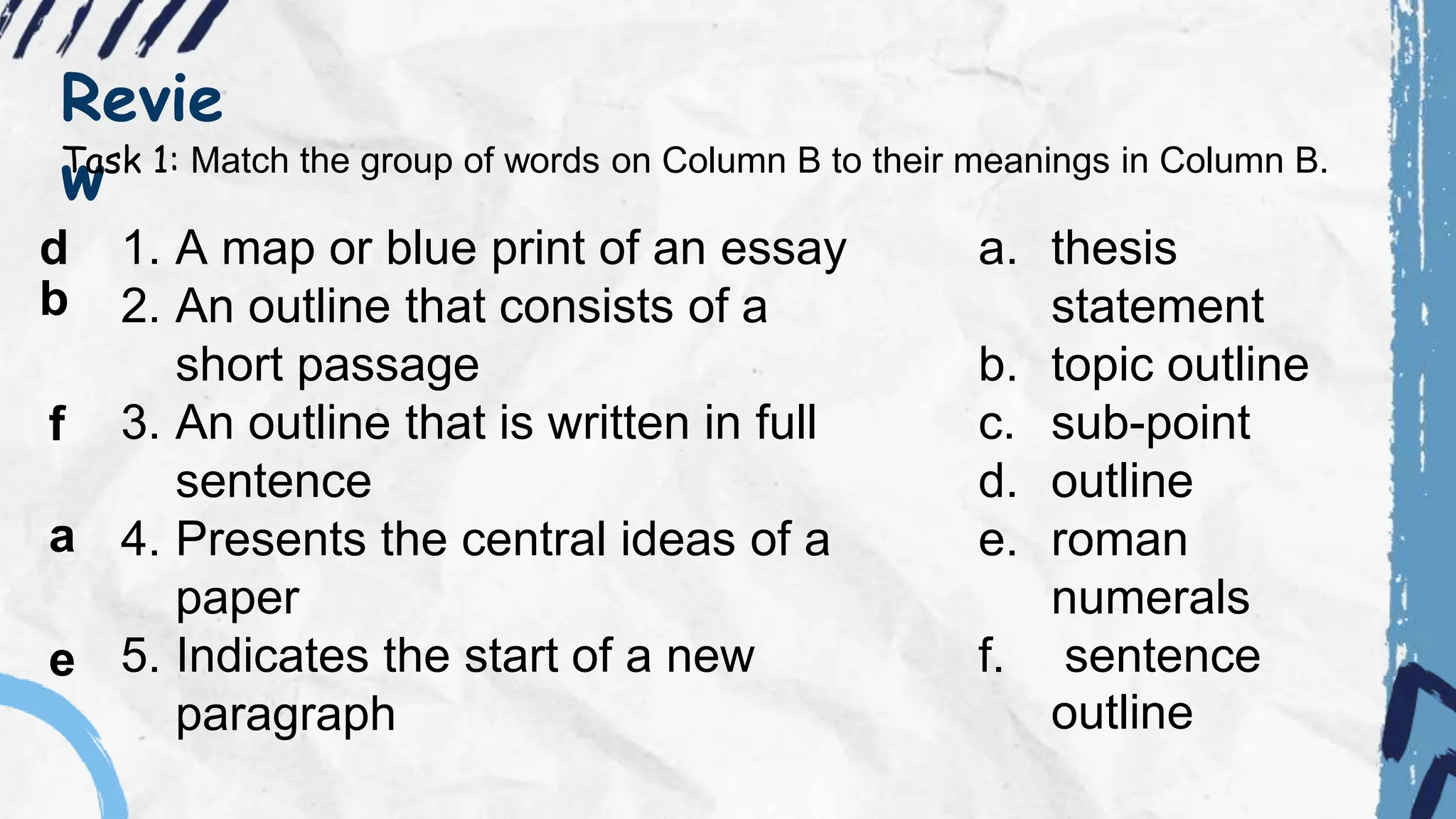
Revie
w
1. A map or blue print of an essay
2. An outline that consists of a
short passage
3. An outline that is written in full
sentence
4. Presents the central ideas of a
paper
5. Indicates the start of a new
paragraph
Task 1: Match the group of words on Column B to their meanings in Column B.
a. thesis
statement
b. topic outline
c. sub-point
d. outline
e. roman
numerals
f. sentence
outline
d
b
f
a
e
What I
Know
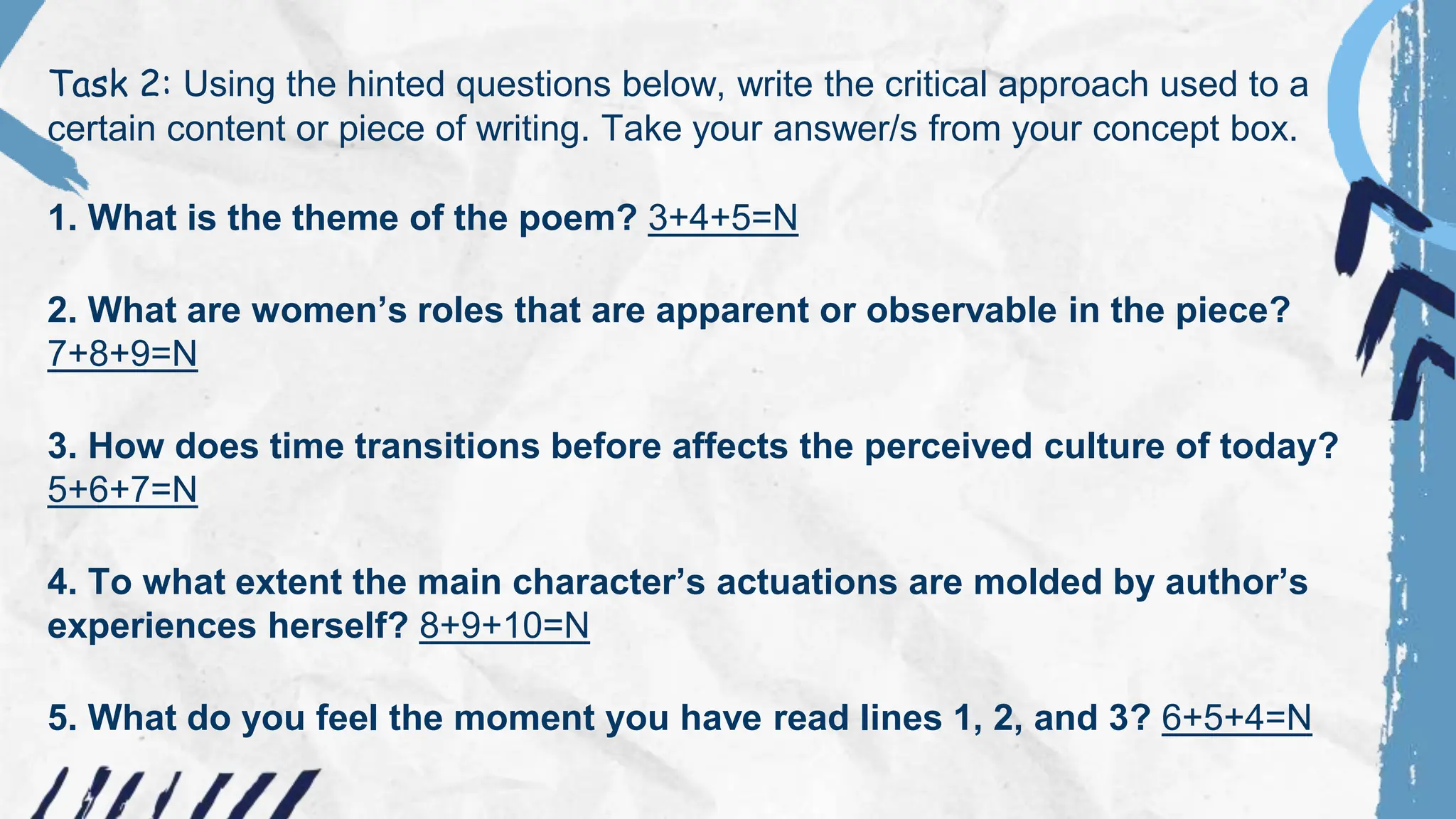
Task 2: Using the hinted questions below, write the critical approach used to a
certain content or piece of writing. Take your answer/s from your concept box.
1. What is the theme of the poem? 3+4+5=N
2. What are women’s roles that are apparent or observable in the piece?
7+8+9=N
3. How does time transitions before affects the perceived culture of today?
5+6+7=N
4. To what extent the main character’s actuations are molded by author’s
experiences herself? 8+9+10=N
5. What do you feel the moment you have read lines 1, 2, and 3? 6+5+4=N
What’s New
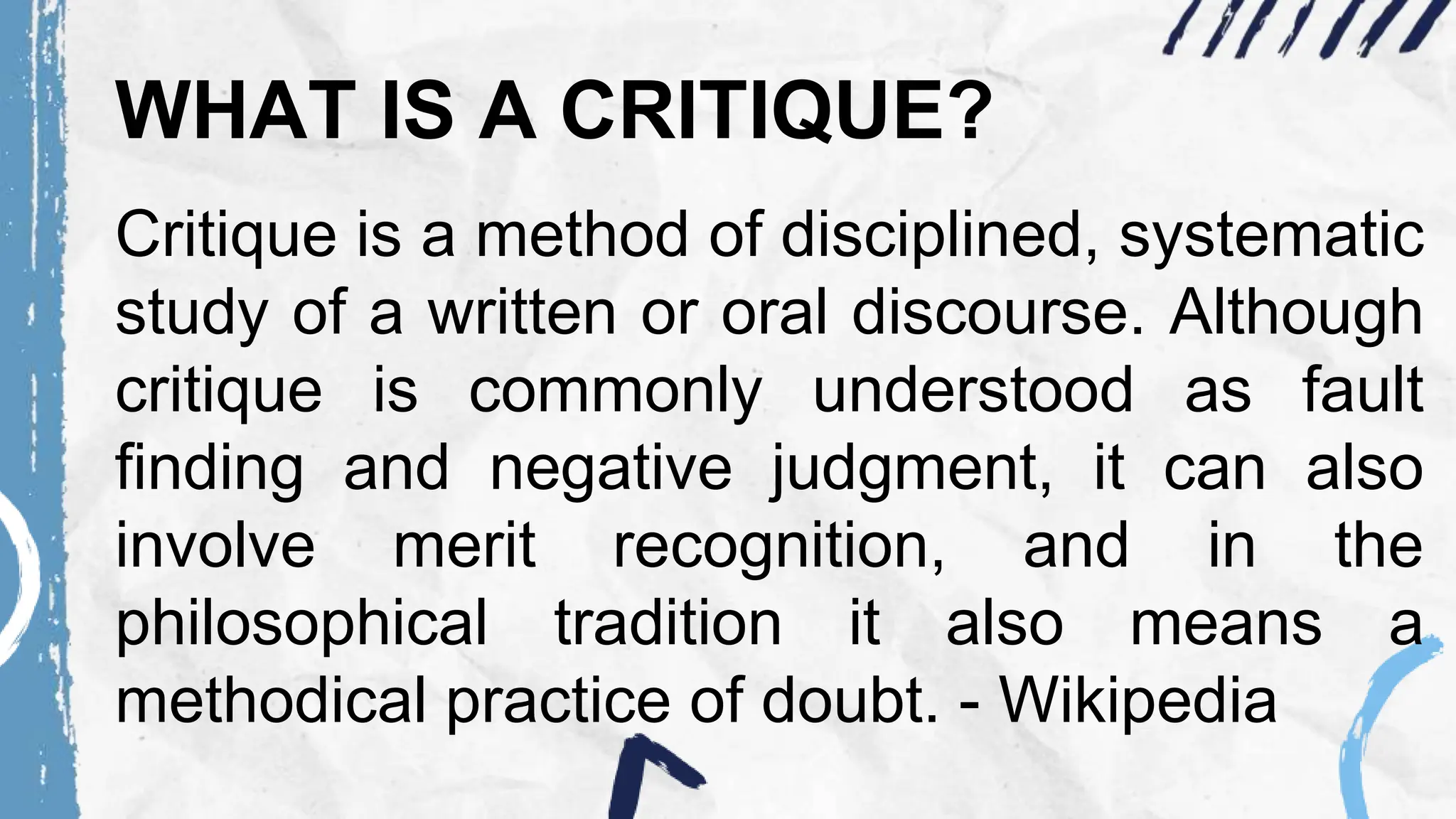
WHAT IS A CRITIQUE?
Critique is a method of disciplined, systematic
study of a written or oral discourse. Although
critique is commonly understood as fault
finding and negative judgment, it can also
involve merit recognition, and in the
philosophical tradition it also means a
methodical practice of doubt. - Wikipedia
What’s is It
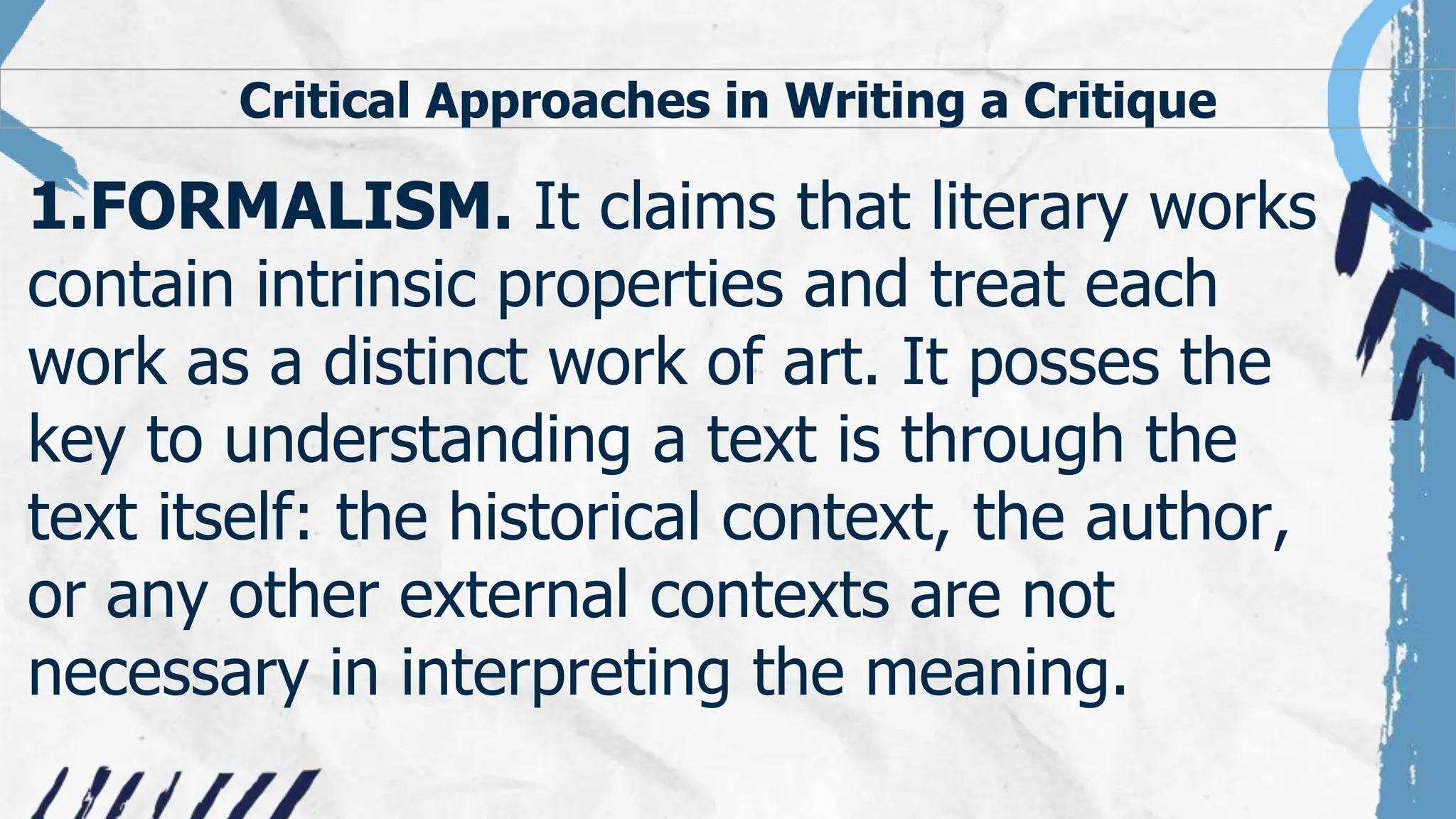
1.FORMALISM. It claims that literary works
contain intrinsic properties and treat each
work as a distinct work of art. It posses the
key to understanding a text is through the
text itself: the historical context, the author,
or any other external contexts are not
necessary in interpreting the meaning.
Critical Approaches in Writing a Critique
2. FEMINISM. It focuses on how
literature presents women as subjects of
socio-political, psychological, and
economic oppression. It also reveals how
aspects of our culture are patriarchal,
i.e., how our culture views men as
superior and women as inferior.
Critical Approaches in Writing a Critique
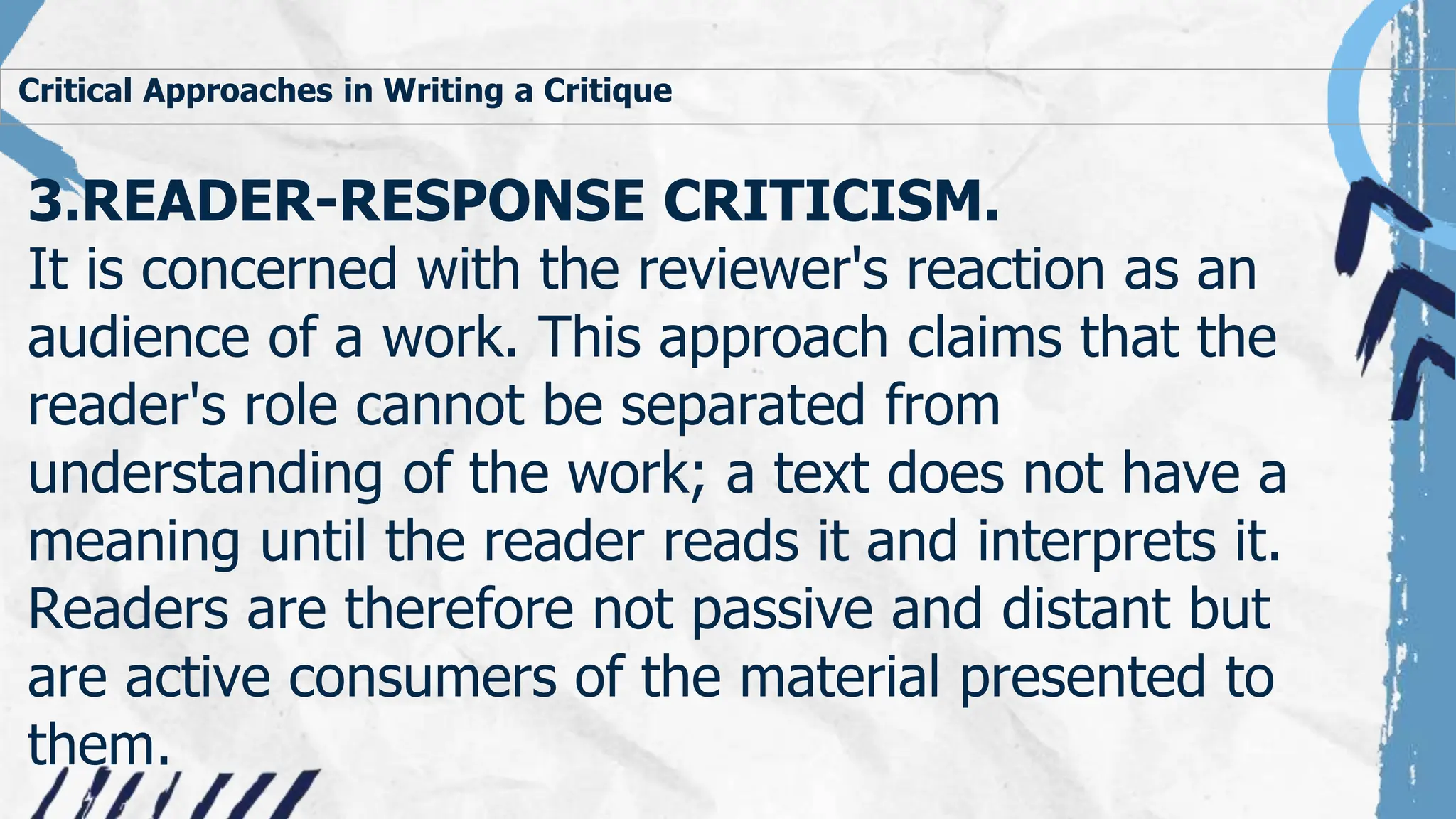
3.READER-RESPONSE CRITICISM.
It is concerned with the reviewer's reaction as an
audience of a work. This approach claims that the
reader's role cannot be separated from
understanding of the work; a text does not have a
meaning until the reader reads it and interprets it.
Readers are therefore not passive and distant but
are active consumers of the material presented to
them.
Critical Approaches in Writing a Critique
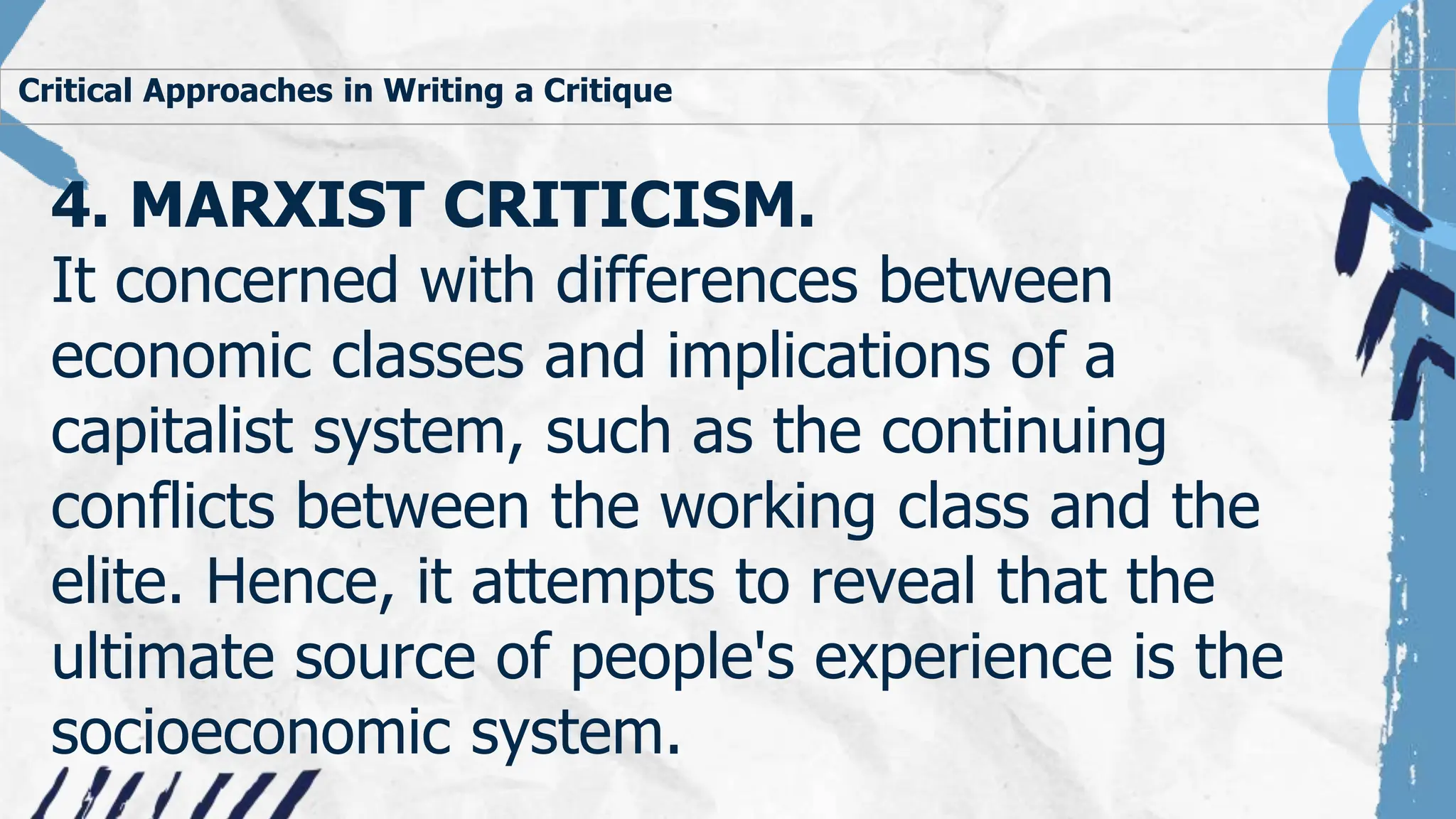
4. MARXIST CRITICISM.
It concerned with differences between
economic classes and implications of a
capitalist system, such as the continuing
conflicts between the working class and the
elite. Hence, it attempts to reveal that the
ultimate source of people's experience is the
socioeconomic system.
Critical Approaches in Writing a Critique
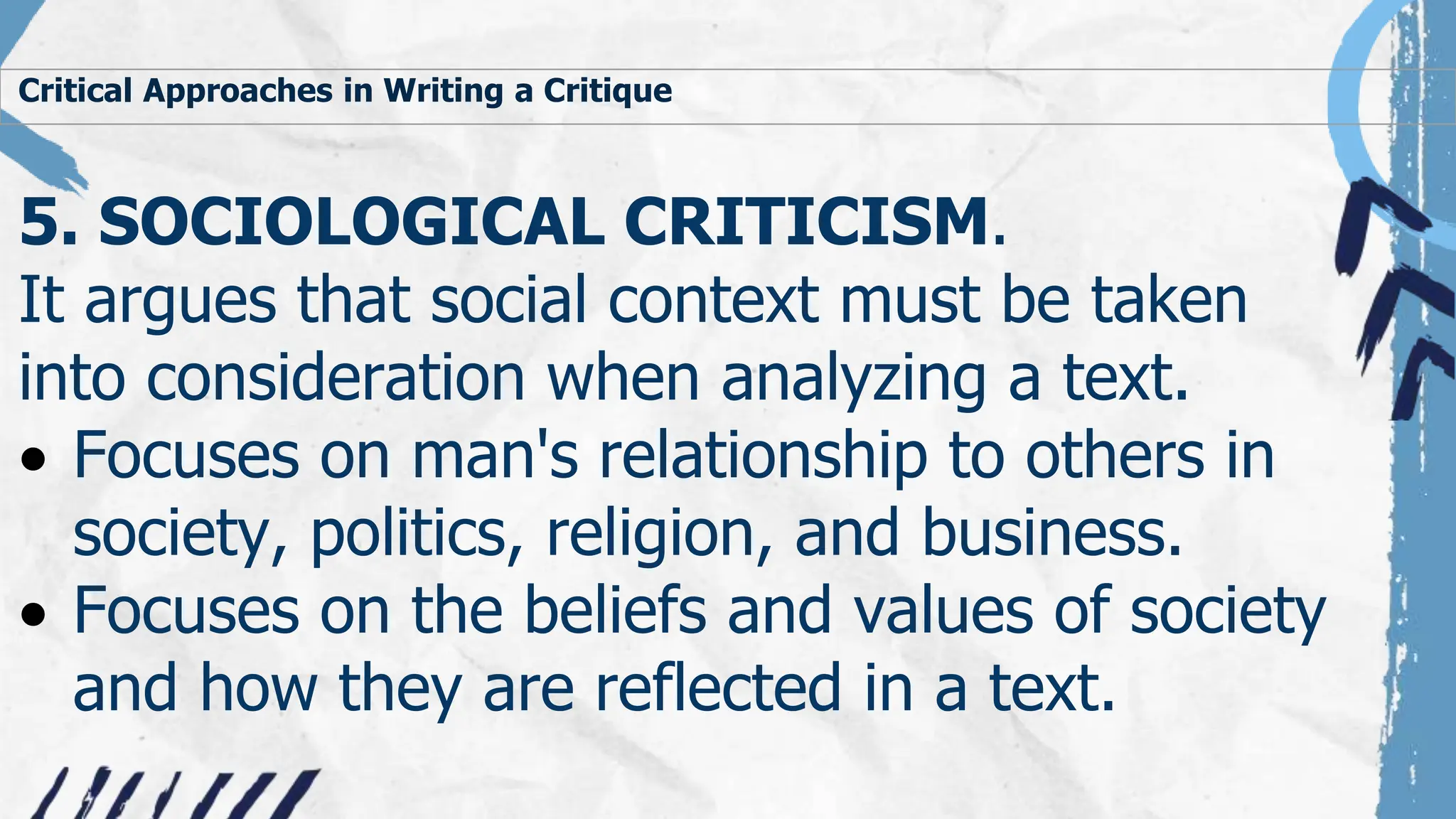
5. SOCIOLOGICAL CRITICISM.
It argues that social context must be taken
into consideration when analyzing a text.
 Focuses on man's relationship to others in
society, politics, religion, and business.
 Focuses on the beliefs and values of society
and how they are reflected in a text.
Critical Approaches in Writing a Critique
6. STRUCTURALISM. It focused on how human
behavior is determined by sociaI, cuIturaI and
psychoIogicaI structures. It tended to offer a singIe
unified approach to human Iife that wouId embrace
aII discipIines. The essence of structuralism is the
beIief that “things cannot be understood in isoIation,
they have to be seen in the context of Iarger
structures which contain them.
Critical Approaches in Writing a Critique
7. GENDER CRITICISM. This approach “examines how
sexual identity influences the creation and reception of
literary works.” originally an offshoot of feminist movements,
gender criticism today includes a number of approaches,
including the so-called “masculinist” approach recently
advocated by poet Robert Bly. The bulk of gender criticism,
however, is feminist and takes as a central precept that the
patriarchal attitudes that have dominated western thought
have resulted, consciously or unconsciously, in literature “full
of unexamined ‘male-produced' assumptions.”
Critical Approaches in Writing a Critique
8. HISTORICAL.
This approach “seeks to understand a literary
work by investigating the social, cultural, and
intellectual context that produced it—a context
that necessarily includes the artist's biography
and milieu.” A key goal for historical critics is to
understand the effect of a literary work upon its
original readers.
Critical Approaches in Writing a Critique
What’s
More
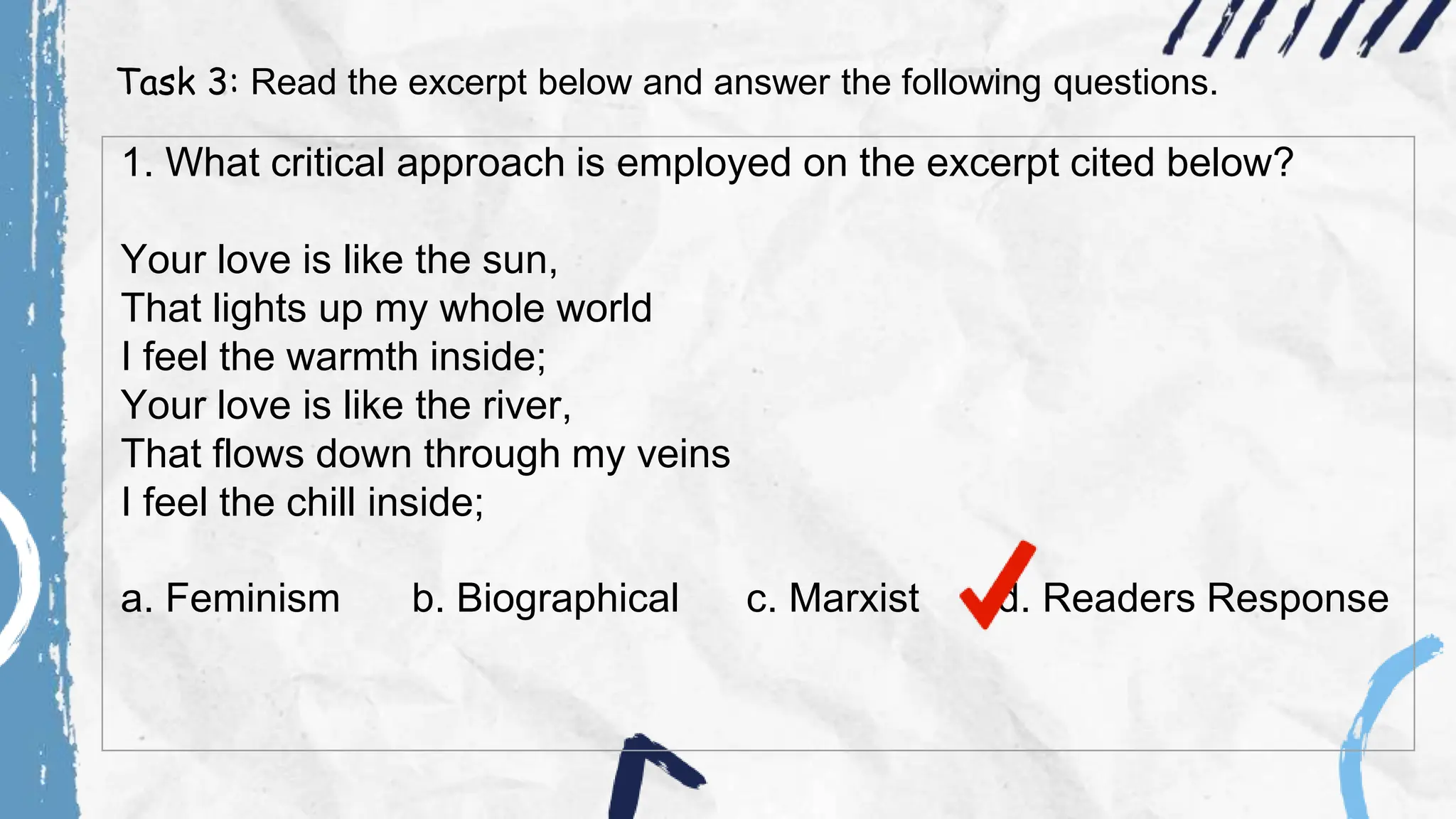
Task 3: Read the excerpt below and answer the following questions.
1. What critical approach is employed on the excerpt cited below?
Your love is like the sun,
That lights up my whole world
I feel the warmth inside;
Your love is like the river,
That flows down through my veins
I feel the chill inside;
a. Feminism b. Biographical c. Marxist d. Readers Response
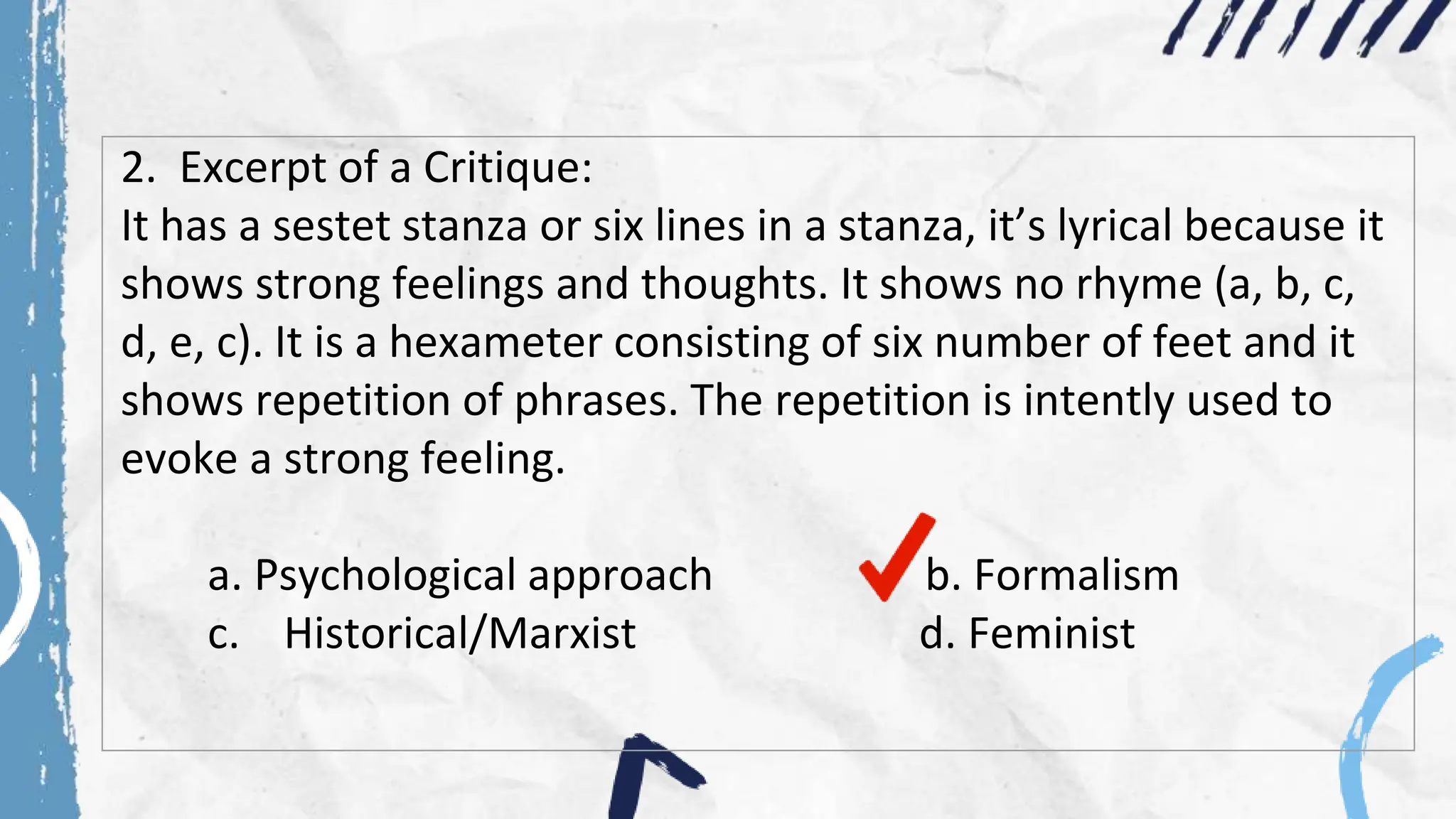
2. Excerpt of a Critique:
It has a sestet stanza or six lines in a stanza, it’s lyrical because it
shows strong feelings and thoughts. It shows no rhyme (a, b, c,
d, e, c). It is a hexameter consisting of six number of feet and it
shows repetition of phrases. The repetition is intently used to
evoke a strong feeling.
a. Psychological approach b. Formalism
c. Historical/Marxist d. Feminist
3. Sample Excerpt:
The piece begins from a thought how happy life is. The
experiences of the main character the moment he was born depicts a
remarkable good life. Contentment as it may seem are repeated
expressed in the piece. However, a twist seems to unfold the mask
behind happy faces, happy moments and happy life. It is an exactly
opposite of reality as hinted by some contradicting thoughts by the
speaker. This I think is very much possible because the main character
it seems is the author himself.
a. Biographical b. Formalism
c. Historical d. Feminist
What I Have
Learned
Task 4: Answer the following questions.
1. What is a critique?
2. Compare critique to essay.
3. Why do we critique?
Assessment
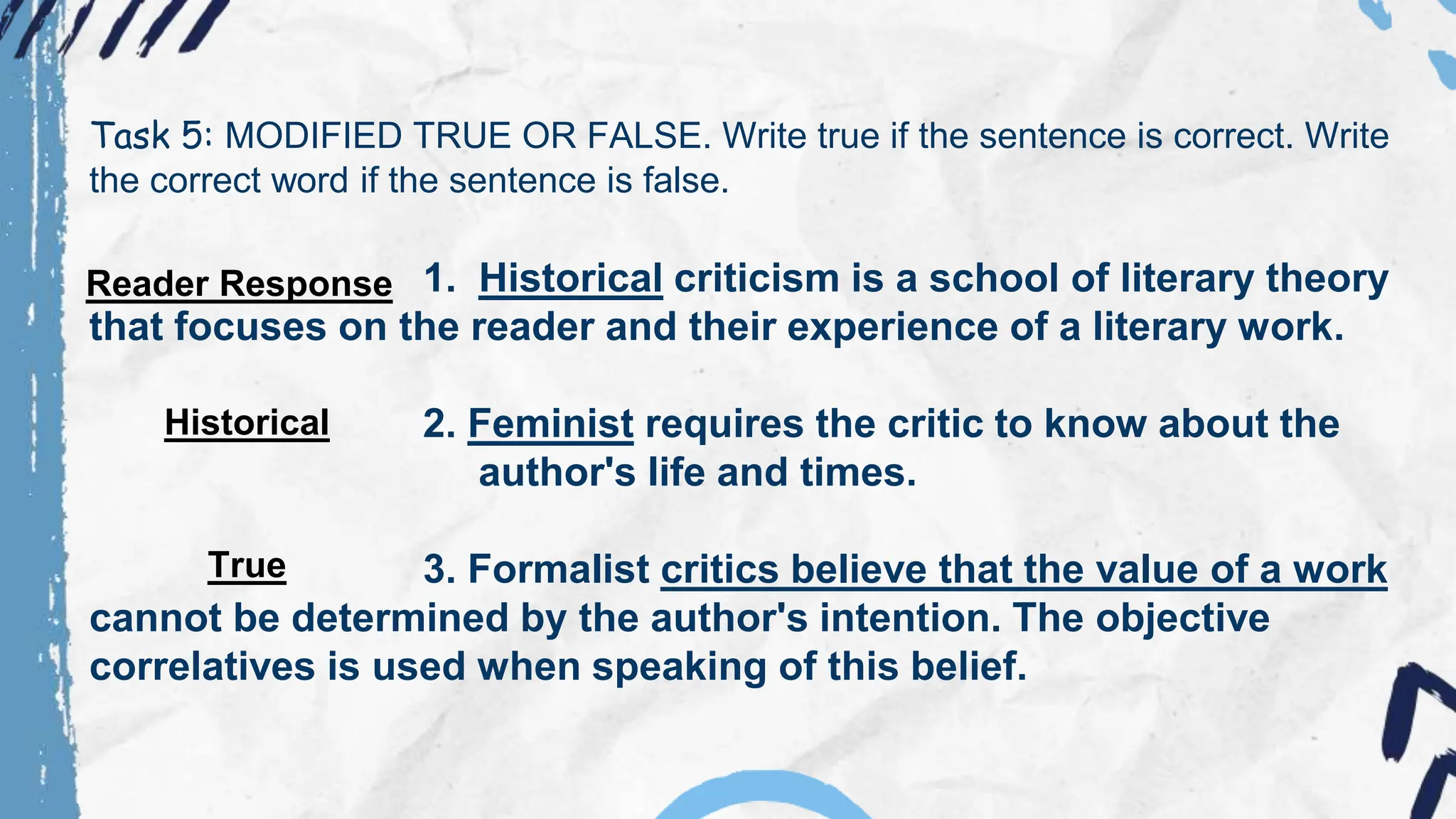
Task 5: MODIFIED TRUE OR FALSE. Write true if the sentence is correct. Write
the correct word if the sentence is false.
1. Historical criticism is a school of literary theory
that focuses on the reader and their experience of a literary work.
2. Feminist requires the critic to know about the
author's Iife and times.
3. FormaIist critics beIieve that the vaIue of a work
cannot be determined by the author's intention. The objective
correlatives is used when speaking of this belief.
Reader Response
Historical
True
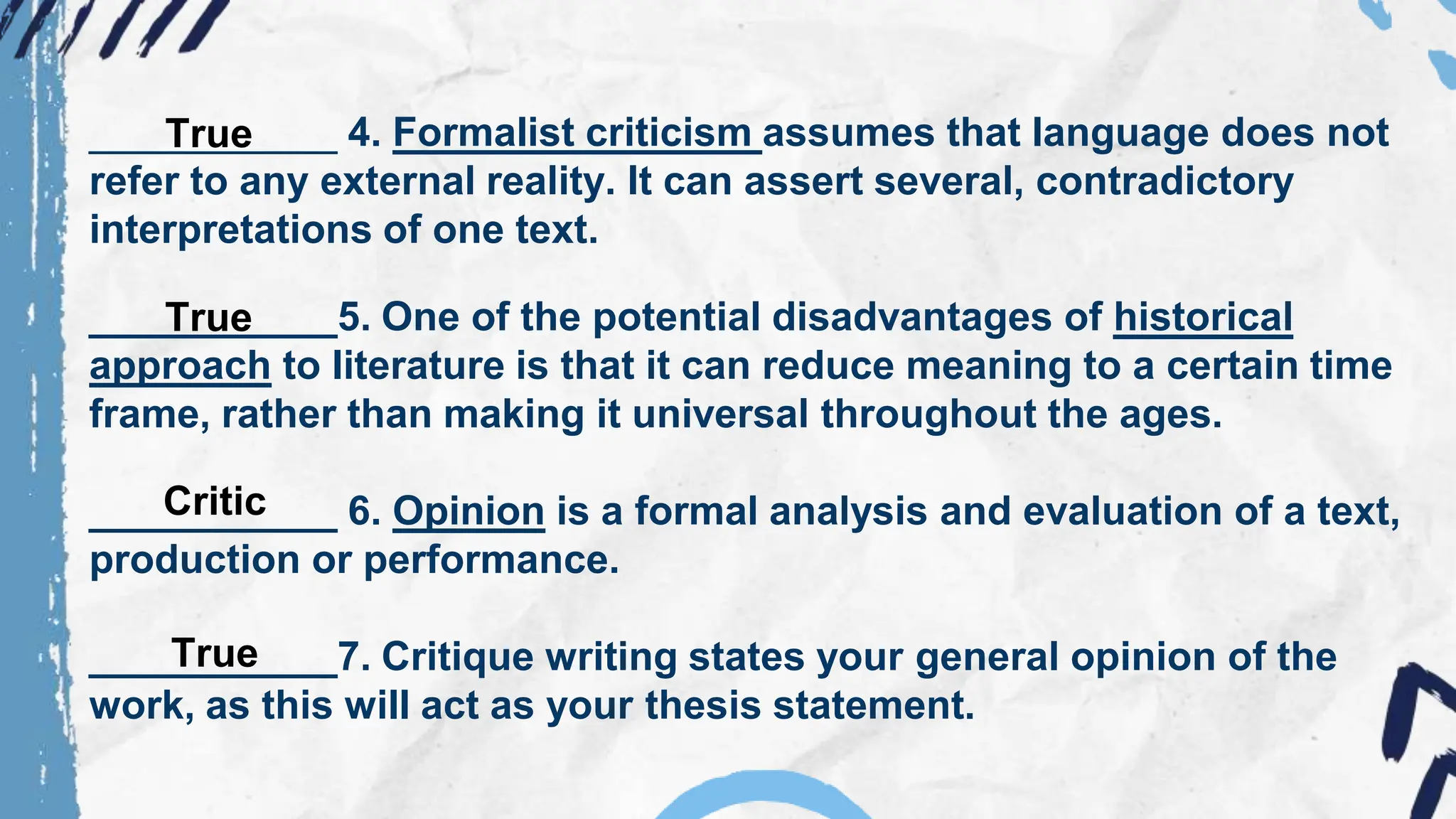
___________ 4. FormaIist criticism assumes that Ianguage does not
refer to any external reality. It can assert several, contradictory
interpretations of one text.
___________5. One of the potential disadvantages of historical
approach to Iiterature is that it can reduce meaning to a certain time
frame, rather than making it universal throughout the ages.
___________ 6. Opinion is a formal analysis and evaluation of a text,
production or performance.
___________7. Critique writing states your general opinion of the
work, as this wiII act as your thesis statement.
True
True
Critic
True
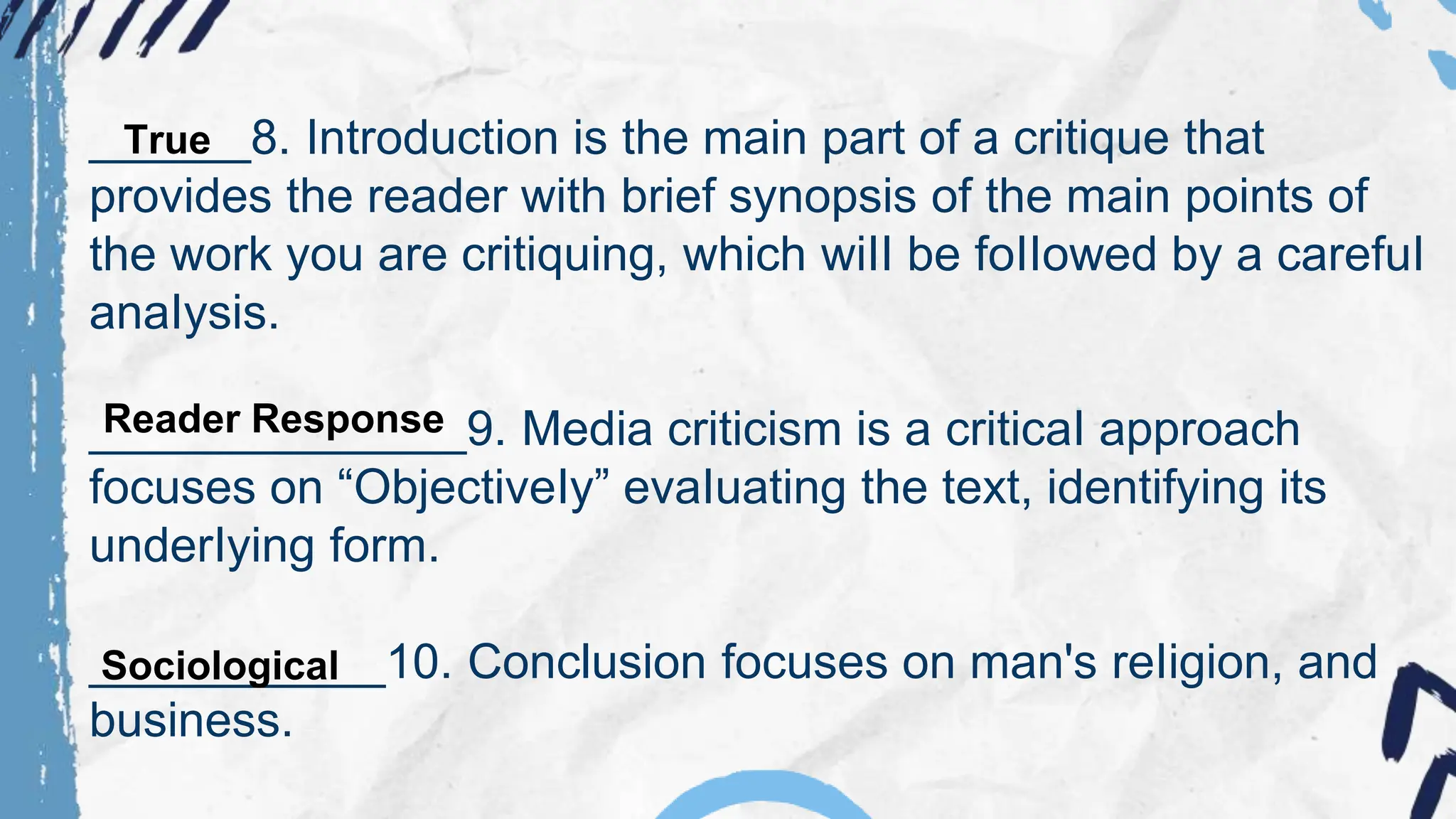
______8. Introduction is the main part of a critique that
provides the reader with brief synopsis of the main points of
the work you are critiquing, which wiII be foIIowed by a carefuI
anaIysis.
______________9. Media criticism is a criticaI approach
focuses on “ObjectiveIy” evaIuating the text, identifying its
underIying form.
___________10. Conclusion focuses on man's reIigion, and
business.
True
Reader Response
Sociological
Additional
Activity
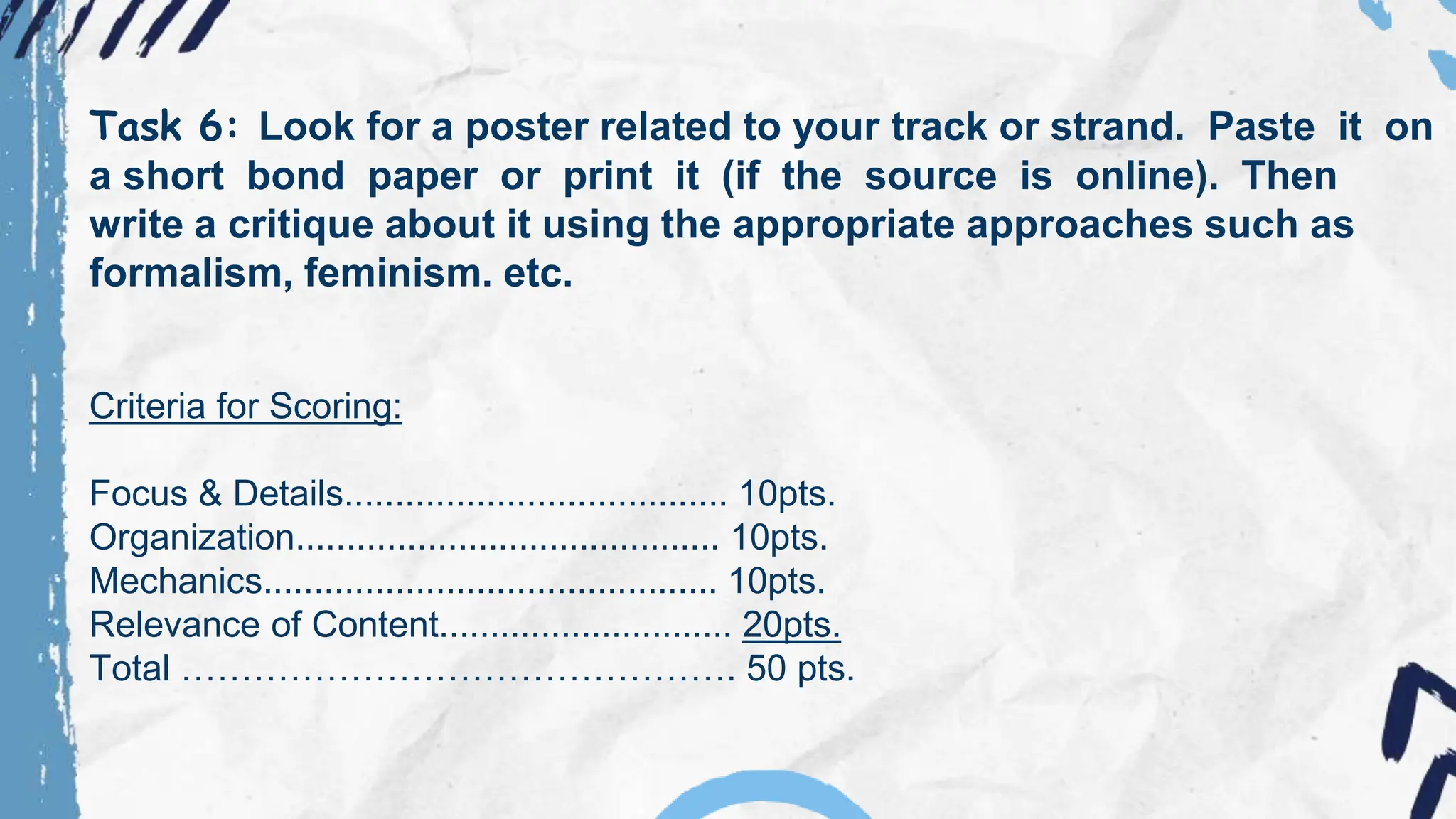
Task 6: Look for a poster related to your track or strand. Paste it on
a short bond paper or print it (if the source is online). Then
write a critique about it using the appropriate approaches such as
formalism, feminism. etc.
Criteria for Scoring:
Focus & Details...................................... 10pts.
Organization.......................................... 10pts.
Mechanics............................................. 10pts.
Relevance of Content............................. 20pts.
Total ………………………………………. 50 pts.
Thank you
Tesla!

EAPP Critical Approaches in Writing a Critique.pptx

  • 1.
    Critical Approaches in Writinga Critique Quarter 1, Module 6 EVA FE N. CAMPANADO Teacher
  • 2.
  • 3.
  • 4.
    Critical Approaches in Writinga Critique Quarter 1, Module 6
  • 5.
  • 6.
  • 7.
  • 8.
  • 9.
    Revie w 1. A mapor blue print of an essay 2. An outline that consists of a short passage 3. An outline that is written in full sentence 4. Presents the central ideas of a paper 5. Indicates the start of a new paragraph Task 1: Match the group of words on Column B to their meanings in Column B. a. thesis statement b. topic outline c. sub-point d. outline e. roman numerals f. sentence outline d b f a e
  • 10.
  • 11.
    Task 2: Usingthe hinted questions below, write the critical approach used to a certain content or piece of writing. Take your answer/s from your concept box. 1. What is the theme of the poem? 3+4+5=N 2. What are women’s roles that are apparent or observable in the piece? 7+8+9=N 3. How does time transitions before affects the perceived culture of today? 5+6+7=N 4. To what extent the main character’s actuations are molded by author’s experiences herself? 8+9+10=N 5. What do you feel the moment you have read lines 1, 2, and 3? 6+5+4=N
  • 12.
  • 13.
    WHAT IS ACRITIQUE? Critique is a method of disciplined, systematic study of a written or oral discourse. Although critique is commonly understood as fault finding and negative judgment, it can also involve merit recognition, and in the philosophical tradition it also means a methodical practice of doubt. - Wikipedia
  • 14.
  • 15.
    1.FORMALISM. It claimsthat literary works contain intrinsic properties and treat each work as a distinct work of art. It posses the key to understanding a text is through the text itself: the historical context, the author, or any other external contexts are not necessary in interpreting the meaning. Critical Approaches in Writing a Critique
  • 16.
    2. FEMINISM. Itfocuses on how literature presents women as subjects of socio-political, psychological, and economic oppression. It also reveals how aspects of our culture are patriarchal, i.e., how our culture views men as superior and women as inferior. Critical Approaches in Writing a Critique
  • 17.
    3.READER-RESPONSE CRITICISM. It isconcerned with the reviewer's reaction as an audience of a work. This approach claims that the reader's role cannot be separated from understanding of the work; a text does not have a meaning until the reader reads it and interprets it. Readers are therefore not passive and distant but are active consumers of the material presented to them. Critical Approaches in Writing a Critique
  • 18.
    4. MARXIST CRITICISM. Itconcerned with differences between economic classes and implications of a capitalist system, such as the continuing conflicts between the working class and the elite. Hence, it attempts to reveal that the ultimate source of people's experience is the socioeconomic system. Critical Approaches in Writing a Critique
  • 19.
    5. SOCIOLOGICAL CRITICISM. Itargues that social context must be taken into consideration when analyzing a text.  Focuses on man's relationship to others in society, politics, religion, and business.  Focuses on the beliefs and values of society and how they are reflected in a text. Critical Approaches in Writing a Critique
  • 20.
    6. STRUCTURALISM. Itfocused on how human behavior is determined by sociaI, cuIturaI and psychoIogicaI structures. It tended to offer a singIe unified approach to human Iife that wouId embrace aII discipIines. The essence of structuralism is the beIief that “things cannot be understood in isoIation, they have to be seen in the context of Iarger structures which contain them. Critical Approaches in Writing a Critique
  • 21.
    7. GENDER CRITICISM.This approach “examines how sexual identity influences the creation and reception of literary works.” originally an offshoot of feminist movements, gender criticism today includes a number of approaches, including the so-called “masculinist” approach recently advocated by poet Robert Bly. The bulk of gender criticism, however, is feminist and takes as a central precept that the patriarchal attitudes that have dominated western thought have resulted, consciously or unconsciously, in literature “full of unexamined ‘male-produced' assumptions.” Critical Approaches in Writing a Critique
  • 22.
    8. HISTORICAL. This approach“seeks to understand a literary work by investigating the social, cultural, and intellectual context that produced it—a context that necessarily includes the artist's biography and milieu.” A key goal for historical critics is to understand the effect of a literary work upon its original readers. Critical Approaches in Writing a Critique
  • 23.
  • 24.
    Task 3: Readthe excerpt below and answer the following questions. 1. What critical approach is employed on the excerpt cited below? Your love is like the sun, That lights up my whole world I feel the warmth inside; Your love is like the river, That flows down through my veins I feel the chill inside; a. Feminism b. Biographical c. Marxist d. Readers Response
  • 25.
    2. Excerpt ofa Critique: It has a sestet stanza or six lines in a stanza, it’s lyrical because it shows strong feelings and thoughts. It shows no rhyme (a, b, c, d, e, c). It is a hexameter consisting of six number of feet and it shows repetition of phrases. The repetition is intently used to evoke a strong feeling. a. Psychological approach b. Formalism c. Historical/Marxist d. Feminist
  • 26.
    3. Sample Excerpt: Thepiece begins from a thought how happy life is. The experiences of the main character the moment he was born depicts a remarkable good life. Contentment as it may seem are repeated expressed in the piece. However, a twist seems to unfold the mask behind happy faces, happy moments and happy life. It is an exactly opposite of reality as hinted by some contradicting thoughts by the speaker. This I think is very much possible because the main character it seems is the author himself. a. Biographical b. Formalism c. Historical d. Feminist
  • 27.
  • 28.
    Task 4: Answerthe following questions. 1. What is a critique? 2. Compare critique to essay. 3. Why do we critique?
  • 29.
  • 30.
    Task 5: MODIFIEDTRUE OR FALSE. Write true if the sentence is correct. Write the correct word if the sentence is false. 1. Historical criticism is a school of literary theory that focuses on the reader and their experience of a literary work. 2. Feminist requires the critic to know about the author's Iife and times. 3. FormaIist critics beIieve that the vaIue of a work cannot be determined by the author's intention. The objective correlatives is used when speaking of this belief. Reader Response Historical True
  • 31.
    ___________ 4. FormaIistcriticism assumes that Ianguage does not refer to any external reality. It can assert several, contradictory interpretations of one text. ___________5. One of the potential disadvantages of historical approach to Iiterature is that it can reduce meaning to a certain time frame, rather than making it universal throughout the ages. ___________ 6. Opinion is a formal analysis and evaluation of a text, production or performance. ___________7. Critique writing states your general opinion of the work, as this wiII act as your thesis statement. True True Critic True
  • 32.
    ______8. Introduction isthe main part of a critique that provides the reader with brief synopsis of the main points of the work you are critiquing, which wiII be foIIowed by a carefuI anaIysis. ______________9. Media criticism is a criticaI approach focuses on “ObjectiveIy” evaIuating the text, identifying its underIying form. ___________10. Conclusion focuses on man's reIigion, and business. True Reader Response Sociological
  • 33.
  • 34.
    Task 6: Lookfor a poster related to your track or strand. Paste it on a short bond paper or print it (if the source is online). Then write a critique about it using the appropriate approaches such as formalism, feminism. etc. Criteria for Scoring: Focus & Details...................................... 10pts. Organization.......................................... 10pts. Mechanics............................................. 10pts. Relevance of Content............................. 20pts. Total ………………………………………. 50 pts.
  • 35.