Practical Research 1
Quarter 1 - Module 1:
Nature of Inquiry and Research
Learning Objectives:
After studying this chapter, you will be able to:
a. define what is research (CS_RS11-IIIa-1);
b. give the importance of research in daily life (CS_RS11-IIIa-2);
c. enumerate the characteristics, processes, and ethics of
research (CS_RS11- IIIa-3);
d. differentiate Quantitative from Qualitative Research (CS_RS11-
IIIa-4); and
e. provide examples of research in the area of interest (CS_RS11-
IIIa-5).
Pre-test
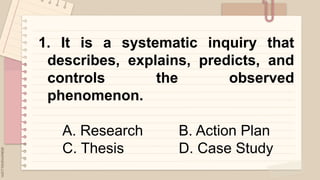
1. It is a systematic inquiry that
describes, explains, predicts, and
controls the observed
phenomenon.
A. Research B. Action Plan
C. Thesis D. Case Study
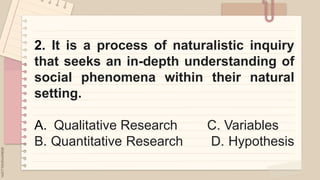
2. It is a process of naturalistic inquiry
that seeks an in-depth understanding of
social phenomena within their natural
setting.
A. Qualitative Research C. Variables
B. Quantitative Research D. Hypothesis
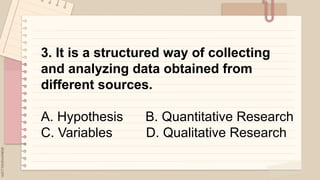
3. It is a structured way of collecting
and analyzing data obtained from
different sources.
A. Hypothesis B. Quantitative Research
C. Variables D. Qualitative Research
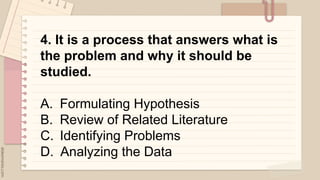
4. It is a process that answers what is
the problem and why it should be
studied.
A. Formulating Hypothesis
B. Review of Related Literature
C. Identifying Problems
D. Analyzing the Data
.
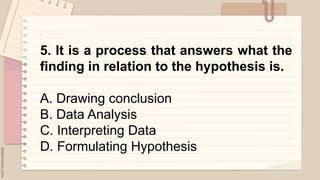
5. It is a process that answers what the
finding in relation to the hypothesis is.
A. Drawing conclusion
B. Data Analysis
C. Interpreting Data
D. Formulating Hypothesis
.
6. It is a process that answers what
information is already available.
A. Review of Related Literature
B. Sampling
C. Interpreting Data
D. Data Analysis
.
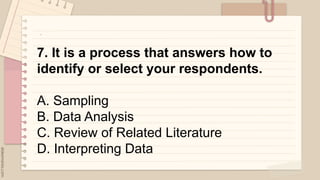
7. It is a process that answers how to
identify or select your respondents.
A. Sampling
B. Data Analysis
C. Review of Related Literature
D. Interpreting Data
.
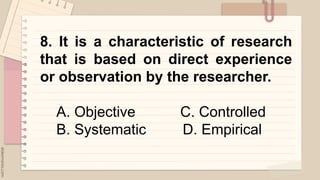
8. It is a characteristic of research
that is based on direct experience
or observation by the researcher.
A. Objective C. Controlled
B. Systematic D. Empirical
.
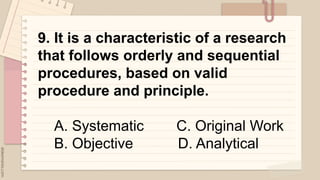
9. It is a characteristic of a research
that follows orderly and sequential
procedures, based on valid
procedure and principle.
A. Systematic C. Original Work
B. Objective D. Analytical
.
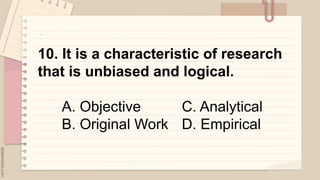
10. It is a characteristic of research
that is unbiased and logical.
A. Objective C. Analytical
B. Original Work D. Empirical
.
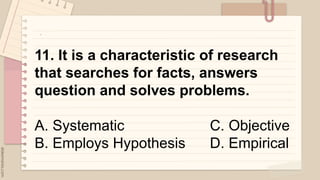
11. It is a characteristic of research
that searches for facts, answers
question and solves problems.
A. Systematic C. Objective
B. Employs Hypothesis D. Empirical
.
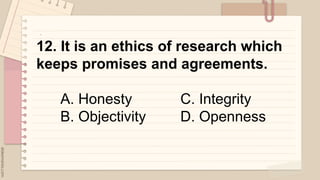
12. It is an ethics of research which
keeps promises and agreements.
A. Honesty C. Integrity
B. Objectivity D. Openness
.
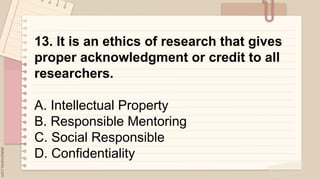
13. It is an ethics of research that gives
proper acknowledgment or credit to all
researchers.
A. Intellectual Property
B. Responsible Mentoring
C. Social Responsible
D. Confidentiality
.
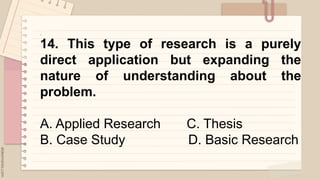
14. This type of research is a purely
direct application but expanding the
nature of understanding about the
problem.
A. Applied Research C. Thesis
B. Case Study D. Basic Research
.
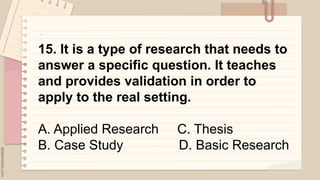
15. It is a type of research that needs to
answer a specific question. It teaches
and provides validation in order to
apply to the real setting.
A. Applied Research C. Thesis
B. Case Study D. Basic Research
Lesson 1:
IMPORTANCE OF RESEARCH
IN DAILY LIFE
Direction:
Complete the concept
map by writing words
associated with the
middle word.
.
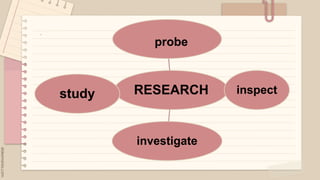
RESEARCH
?
?
?
?
.
RESEARCH inspect
investigate
study
probe
.
What is RESEARCH?
Research is an organized investigation and study of
materials and sources to create facts and reach new
inferences. Research has come up with developing
appropriate solutions to improve the individual’s
quality of life. Although it may take place in a different
setting and may use different methods, scientific
research is universally a systematic and objective
search for reliable knowledge (Walker, 2010).
.
Research is a verified approach of
thinking and employing legalized
instruments and steps to obtain a more
adequate solution to a problem that is
otherwise impossible to address under
ordinary means (Crawford, as cited by
Alcantara & Espina, 1995).
.
In most cases, research helps society to
answer the WHAT and HOW questions. It
must be a proper investigation and should
reach a valid conclusion that would
facilitate the finding of answers to the
questions. Some of these questions are:
How can research affect society? What is
the impact of the research to daily life?
.
Research can be categorized into two:
.
Basic Research
This is the type of research that is a
purely direct application but increasing
the nature of understanding about the
problem. It develops the scientific
theories to be more understandable to the
readers.
.
Applied Research
It is a type of research that needs an
answer to a specific question. It
provides solutions and validation in
order to apply to the real setting.
.
What’s More?
.
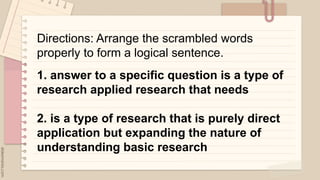
Directions: Arrange the scrambled words
properly to form a logical sentence.
1. answer to a specific question is a type of
research applied research that needs
2. is a type of research that is purely direct
application but expanding the nature of
understanding basic research
.
What I Have Learned
.
This part of the module, you will brush up on
your knowledge of the lesson by filling in the
blanks below:
Research is __________________________ .
Give at least two (2) importance of research.
1. ___________________________________
2. ___________________________________
-END of
Lesson 1-

Practical research 1 - Module 1- Lesson 1.pptx

  • 1.
    Practical Research 1 Quarter1 - Module 1: Nature of Inquiry and Research
  • 2.
    Learning Objectives: After studyingthis chapter, you will be able to: a. define what is research (CS_RS11-IIIa-1); b. give the importance of research in daily life (CS_RS11-IIIa-2); c. enumerate the characteristics, processes, and ethics of research (CS_RS11- IIIa-3); d. differentiate Quantitative from Qualitative Research (CS_RS11- IIIa-4); and e. provide examples of research in the area of interest (CS_RS11- IIIa-5).
  • 3.
  • 4.
    1. It isa systematic inquiry that describes, explains, predicts, and controls the observed phenomenon. A. Research B. Action Plan C. Thesis D. Case Study
  • 5.
    2. It isa process of naturalistic inquiry that seeks an in-depth understanding of social phenomena within their natural setting. A. Qualitative Research C. Variables B. Quantitative Research D. Hypothesis
  • 6.
    3. It isa structured way of collecting and analyzing data obtained from different sources. A. Hypothesis B. Quantitative Research C. Variables D. Qualitative Research
  • 7.
    4. It isa process that answers what is the problem and why it should be studied. A. Formulating Hypothesis B. Review of Related Literature C. Identifying Problems D. Analyzing the Data
  • 8.
    . 5. It isa process that answers what the finding in relation to the hypothesis is. A. Drawing conclusion B. Data Analysis C. Interpreting Data D. Formulating Hypothesis
  • 9.
    . 6. It isa process that answers what information is already available. A. Review of Related Literature B. Sampling C. Interpreting Data D. Data Analysis
  • 10.
    . 7. It isa process that answers how to identify or select your respondents. A. Sampling B. Data Analysis C. Review of Related Literature D. Interpreting Data
  • 11.
    . 8. It isa characteristic of research that is based on direct experience or observation by the researcher. A. Objective C. Controlled B. Systematic D. Empirical
  • 12.
    . 9. It isa characteristic of a research that follows orderly and sequential procedures, based on valid procedure and principle. A. Systematic C. Original Work B. Objective D. Analytical
  • 13.
    . 10. It isa characteristic of research that is unbiased and logical. A. Objective C. Analytical B. Original Work D. Empirical
  • 14.
    . 11. It isa characteristic of research that searches for facts, answers question and solves problems. A. Systematic C. Objective B. Employs Hypothesis D. Empirical
  • 15.
    . 12. It isan ethics of research which keeps promises and agreements. A. Honesty C. Integrity B. Objectivity D. Openness
  • 16.
    . 13. It isan ethics of research that gives proper acknowledgment or credit to all researchers. A. Intellectual Property B. Responsible Mentoring C. Social Responsible D. Confidentiality
  • 17.
    . 14. This typeof research is a purely direct application but expanding the nature of understanding about the problem. A. Applied Research C. Thesis B. Case Study D. Basic Research
  • 18.
    . 15. It isa type of research that needs to answer a specific question. It teaches and provides validation in order to apply to the real setting. A. Applied Research C. Thesis B. Case Study D. Basic Research
  • 19.
    Lesson 1: IMPORTANCE OFRESEARCH IN DAILY LIFE
  • 20.
    Direction: Complete the concept mapby writing words associated with the middle word.
  • 21.
  • 22.
  • 23.
    . What is RESEARCH? Researchis an organized investigation and study of materials and sources to create facts and reach new inferences. Research has come up with developing appropriate solutions to improve the individual’s quality of life. Although it may take place in a different setting and may use different methods, scientific research is universally a systematic and objective search for reliable knowledge (Walker, 2010).
  • 24.
    . Research is averified approach of thinking and employing legalized instruments and steps to obtain a more adequate solution to a problem that is otherwise impossible to address under ordinary means (Crawford, as cited by Alcantara & Espina, 1995).
  • 25.
    . In most cases,research helps society to answer the WHAT and HOW questions. It must be a proper investigation and should reach a valid conclusion that would facilitate the finding of answers to the questions. Some of these questions are: How can research affect society? What is the impact of the research to daily life?
  • 26.
    . Research can becategorized into two:
  • 27.
    . Basic Research This isthe type of research that is a purely direct application but increasing the nature of understanding about the problem. It develops the scientific theories to be more understandable to the readers.
  • 28.
    . Applied Research It isa type of research that needs an answer to a specific question. It provides solutions and validation in order to apply to the real setting.
  • 29.
  • 30.
    . Directions: Arrange thescrambled words properly to form a logical sentence. 1. answer to a specific question is a type of research applied research that needs 2. is a type of research that is purely direct application but expanding the nature of understanding basic research
  • 31.
  • 32.
    . This part ofthe module, you will brush up on your knowledge of the lesson by filling in the blanks below: Research is __________________________ . Give at least two (2) importance of research. 1. ___________________________________ 2. ___________________________________
  • 33.