Page 1
Page 2
Psychology
• Psychology: It is a scientific study of mind
and behavior (or behavior and mental
processes), especially as it relates to
individual human beings.
• Psyche: Totality of human
mind, conscious and unconscious.
• Psychology is the scientific or objective
study of the psyche.
Page 3
Learning
• Learning: relatively permanent change in an
individual's behavior or behavior potential (or
capability) as a result of experience or practice.
1. Change in behavior
2. Change takes place due to practice or experience
3. Change is relatively permanent
Page 4
Theories of learning
• BehaviouralBehavioural
Classical conditioningClassical conditioning
Operant conditioningOperant conditioning
• CognitiveCognitive
Social learningSocial learning
Page 5
Classical conditioning
• Also called ‘PAVLOVIAN’ orAlso called ‘PAVLOVIAN’ or
‘RESPONDENT’ learning‘RESPONDENT’ learning
• Explained by IVAN PAVLOV- a RussianExplained by IVAN PAVLOV- a Russian
Physiologist.Physiologist.
• A type of conditioning in which anA type of conditioning in which an
individual responds to some stimulus thatindividual responds to some stimulus that
would not ordinarily produce such awould not ordinarily produce such a
response.response.
Page 6
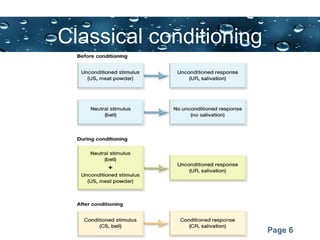
Classical conditioning
Page 7
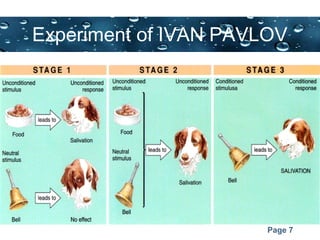
Experiment of IVAN PAVLOV
Page 8
Theories of classical conditioning
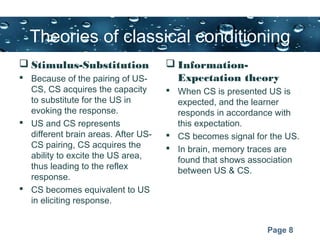
 Stimulus-Substitution
 Because of the pairing of US-
CS, CS acquires the capacity
to substitute for the US in
evoking the response.
 US and CS represents
different brain areas. After US-
CS pairing, CS acquires the
ability to excite the US area,
thus leading to the reflex
response.
 CS becomes equivalent to US
in eliciting response.
 Information-
Expectation theory
 When CS is presented US is
expected, and the learner
responds in accordance with
this expectation.
 CS becomes signal for the US.
 In brain, memory traces are
found that shows association
between US & CS.
Page 9
Extinction
• When CS is presented without US for
number of trials, the strength and
magnitude of CR gradually decreases.
• Process of EXTINCTION is not
‘FORGETTING’
• Extinction does not remove entirely the
tendency to respond to stimulus.
Page 10
Theories for Extinction
• Excitation-
Inhibition theory
• During acquisition,
excitatory tendency has
the upper hand
• During extinction,
inhibition builds up to
suppress the conditioned
responding
• Information-
Expectation theory
• During extinction, CS is
no longer paired with US,
the CS ceases to be a
signal for the US.
• So, CS becomes the
neutral stimulus.
Page 11
Spontaneous recovery
• On the next day after extinction, if the dog
is taken to the laboratory and conditioned
stimulus is presented, there is conditioned
response which is greater than extinction
day before.
• So, it shows that extinction does not
remove the tendency to respond to the
CS.
Page 12
Reconditioning
• After extinction when experiment is
repeated with lapse of few days,
conditioning occurs more rapid than
original conditioning.
Page 13
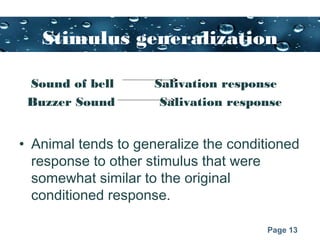
Stimulus generalization
Sound of bell Salivation response
Buzzer Sound Salivation response
• Animal tends to generalize the conditioned
response to other stimulus that were
somewhat similar to the original
conditioned response.
Page 14
Discrimination
• is the process of learning to make one
response to one stimulus and a different
response or no response to another
stimulus.
Page 15
Significance of classical conditioning
• To study emotional responses that becomes
conditioned on a certain stimuli
• Extinction and alteration of disturbing emotional
responses by classical conditioning is one form
of Behavior Therapy.
• Systematic Desensitization, Flooding, Aversive
therapy are techniques used for behavior
therapy.
Page 16
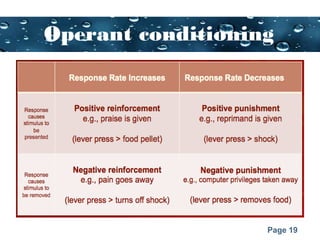
Operant conditioning
Instrumental conditioning: behavior of the animal
which leads to reward is done in instrumental manner, so
that due to reward desirable behavior is increased.
Operant conditioning: response operates on the
environment, it may have the consequences that can
affect the likelihood that the response will occure again.
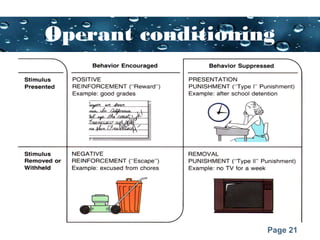
 Reinforcement:
 Positive reinforcement
 Negative reinforcement
Page 17
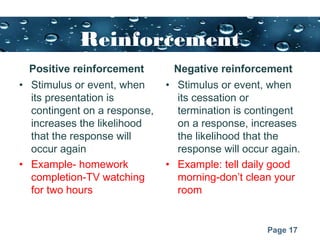
Reinforcement
Positive reinforcement
• Stimulus or event, when
its presentation is
contingent on a response,
increases the likelihood
that the response will
occur again
• Example- homework
completion-TV watching
for two hours
Negative reinforcement
• Stimulus or event, when
its cessation or
termination is contingent
on a response, increases
the likelihood that the
response will occur again.
• Example: tell daily good
morning-don’t clean your
room
Page 18
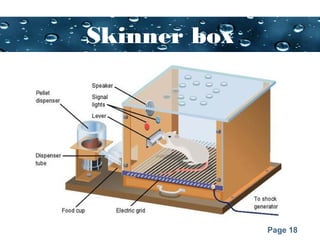
Skinner box
Page 19
Operant conditioning
Page 20
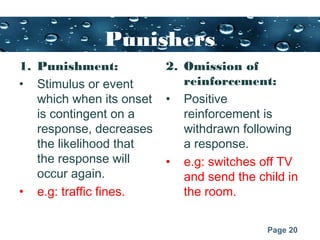
Punishers
1. Punishment:
• Stimulus or event
which when its onset
is contingent on a
response, decreases
the likelihood that
the response will
occur again.
• e.g: traffic fines.
2. Omission of
reinforcement:
• Positive
reinforcement is
withdrawn following
a response.
• e.g: switches off TV
and send the child in
the room.
Page 21
Operant conditioning
Page 22
Operant conditioning
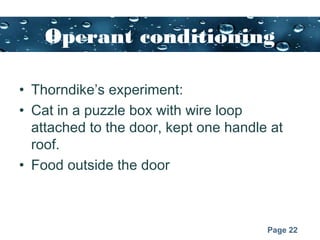
• Thorndike’s experiment:
• Cat in a puzzle box with wire loop
attached to the door, kept one handle at
roof.
• Food outside the door
Page 23
Operant conditioning
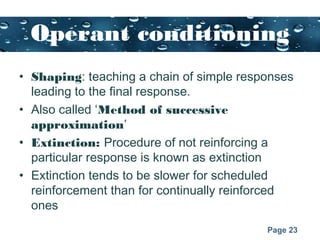
• Shaping: teaching a chain of simple responses
leading to the final response.
• Also called ‘Method of successive
approximation’
• Extinction: Procedure of not reinforcing a
particular response is known as extinction
• Extinction tends to be slower for scheduled
reinforcement than for continually reinforced
ones
Page 24
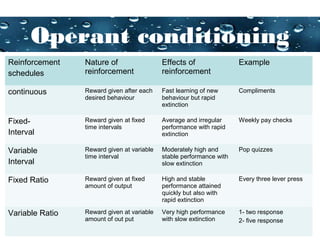
Operant conditioning
Reinforcement
schedules
Nature of
reinforcement
Effects of
reinforcement
Example
continuous Reward given after each
desired behaviour
Fast learning of new
behaviour but rapid
extinction
Compliments
Fixed-
Interval
Reward given at fixed
time intervals
Average and irregular
performance with rapid
extinction
Weekly pay checks
Variable
Interval
Reward given at variable
time interval
Moderately high and
stable performance with
slow extinction
Pop quizzes
Fixed Ratio Reward given at fixed
amount of output
High and stable
performance attained
quickly but also with
rapid extinction
Every three lever press
Variable Ratio Reward given at variable
amount of out put
Very high performance
with slow extinction
1- two response
2- five response
Page 25
Conditioned positive
reinforcers• Primary Reinforcers
• Are reinforcers that work
from the first time they
are made contingent on a
response.
• They work naturally, no
previous training is
necessary.
• Secondary or
Conditioned
Reinforcers
• Does not work naturally
• Their ability to reinforce
instrumental responses
depends upon learning.
• Stimuli become
conditioned reinforcers in
instrumental conditioning
by being paired with
primary reinforcers.
Page 26
Conditioned positive
reinforcers
• Secondary Reinforcers:
• Click occurs each time a food pellet (primary
reinforcers) is delivered
• Thus click becomes the conditioned reinforcer
• Initially click stimulus has no reinforcing
properties, but by it presence every time the
primary reinforcer is delivered, it becomes
reinforcer in its own right.
Page 27
Stimulus
generalization
• In instrumental conditioning tendency to
respond depends upon degree of similarity
between the original training situation and
changed one.
• Situation of operant chamber is changed
(light)
Page 28
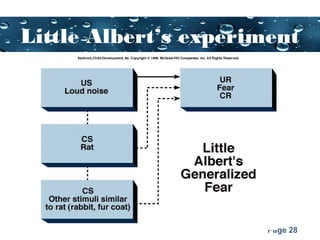
Little Albert’s experiment
Page 29
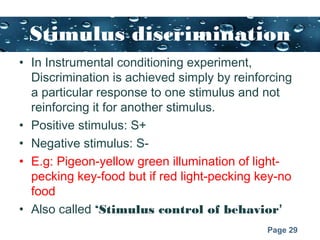
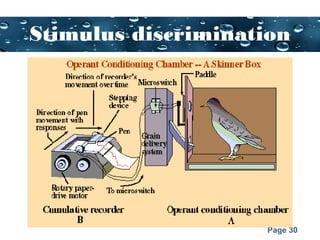
Stimulus discrimination
• In Instrumental conditioning experiment,
Discrimination is achieved simply by reinforcing
a particular response to one stimulus and not
reinforcing it for another stimulus.
• Positive stimulus: S+
• Negative stimulus: S-
• E.g: Pigeon-yellow green illumination of light-
pecking key-food but if red light-pecking key-no
food
• Also called ‘Stimulus control of behavior’
Page 30
Stimulus discrimination
Page 31
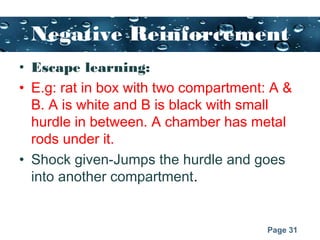
Negative Reinforcement
• Escape learning:
• E.g: rat in box with two compartment: A &
B. A is white and B is black with small
hurdle in between. A chamber has metal
rods under it.
• Shock given-Jumps the hurdle and goes
into another compartment.
Page 32
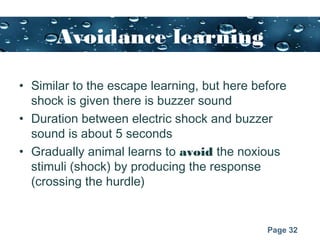
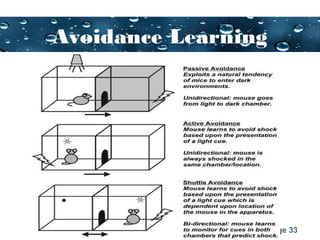
Avoidance learning
• Similar to the escape learning, but here before
shock is given there is buzzer sound
• Duration between electric shock and buzzer
sound is about 5 seconds
• Gradually animal learns to avoid the noxious
stimuli (shock) by producing the response
(crossing the hurdle)
Page 33
Avoidance Learning
Page 34
Significance
• Socialization of children
• Programmed learning: School education
• Personalized system of instruction: educational
application-course is divided in to easy units- each unit
must be mastered at highest level of proficiency
• Business operations
• Behavior therapy and behavior modification: extinction,
shaping, differential reinforcement, punishment, token
economies, covert sensitization
Page 35
Cognitive learning
• Cognition: processing of the information
about the environment that is received
through senses.
• Cognitive learning: a change in the way
information is processed as a result of
experience a person or animal has had.
Page 36
Cognitive learning
• Latent Learning: learning that occurs but is not
evident in behavior until later, when conditions for its
appearance are favorable.
• Insight Learning: In a typical insight situation, a
problem is posed, a period follows during which no
apparent progress is made, and then the solution comes
suddenly.
• Simply what has been learned can be applied easily to
other, similar situations.
• Imitation Learning: a person or animal watches or
hears another do or say something, then responds in the
same way.
Page 37
Cognitive process in classical and
operant conditioning
• Classical conditioning: pairing of the
stimulus CS-US, when CS is presented
US is expected.
• Operant conditioning: Expectation of
reward
• Avoidance learning: warning stimulus is
considered signal for impeding shock.
Page 38
Thank you for your warm listening
• Everyone wanted a change in me, so I learned myself
and tried to identify problems within me, now I have
changed myself, ultimately what I got is these words ‘you
have changed completely’, now they have nothing to do
with me.
• I wondered a lot for these behaviors and I found out that
no one wants any change in you, what they actually want
is expression of emotions in a different way, but one
should not change for anyone apart from his own self,
ultimately what we need is pleasure from within not from
outside……………Ravi

Learning theories

  • 1.
  • 2.
    Page 2 Psychology • Psychology:It is a scientific study of mind and behavior (or behavior and mental processes), especially as it relates to individual human beings. • Psyche: Totality of human mind, conscious and unconscious. • Psychology is the scientific or objective study of the psyche.
  • 3.
    Page 3 Learning • Learning:relatively permanent change in an individual's behavior or behavior potential (or capability) as a result of experience or practice. 1. Change in behavior 2. Change takes place due to practice or experience 3. Change is relatively permanent
  • 4.
    Page 4 Theories oflearning • BehaviouralBehavioural Classical conditioningClassical conditioning Operant conditioningOperant conditioning • CognitiveCognitive Social learningSocial learning
  • 5.
    Page 5 Classical conditioning •Also called ‘PAVLOVIAN’ orAlso called ‘PAVLOVIAN’ or ‘RESPONDENT’ learning‘RESPONDENT’ learning • Explained by IVAN PAVLOV- a RussianExplained by IVAN PAVLOV- a Russian Physiologist.Physiologist. • A type of conditioning in which anA type of conditioning in which an individual responds to some stimulus thatindividual responds to some stimulus that would not ordinarily produce such awould not ordinarily produce such a response.response.
  • 6.
  • 7.
  • 8.
    Page 8 Theories ofclassical conditioning  Stimulus-Substitution  Because of the pairing of US- CS, CS acquires the capacity to substitute for the US in evoking the response.  US and CS represents different brain areas. After US- CS pairing, CS acquires the ability to excite the US area, thus leading to the reflex response.  CS becomes equivalent to US in eliciting response.  Information- Expectation theory  When CS is presented US is expected, and the learner responds in accordance with this expectation.  CS becomes signal for the US.  In brain, memory traces are found that shows association between US & CS.
  • 9.
    Page 9 Extinction • WhenCS is presented without US for number of trials, the strength and magnitude of CR gradually decreases. • Process of EXTINCTION is not ‘FORGETTING’ • Extinction does not remove entirely the tendency to respond to stimulus.
  • 10.
    Page 10 Theories forExtinction • Excitation- Inhibition theory • During acquisition, excitatory tendency has the upper hand • During extinction, inhibition builds up to suppress the conditioned responding • Information- Expectation theory • During extinction, CS is no longer paired with US, the CS ceases to be a signal for the US. • So, CS becomes the neutral stimulus.
  • 11.
    Page 11 Spontaneous recovery •On the next day after extinction, if the dog is taken to the laboratory and conditioned stimulus is presented, there is conditioned response which is greater than extinction day before. • So, it shows that extinction does not remove the tendency to respond to the CS.
  • 12.
    Page 12 Reconditioning • Afterextinction when experiment is repeated with lapse of few days, conditioning occurs more rapid than original conditioning.
  • 13.
    Page 13 Stimulus generalization Soundof bell Salivation response Buzzer Sound Salivation response • Animal tends to generalize the conditioned response to other stimulus that were somewhat similar to the original conditioned response.
  • 14.
    Page 14 Discrimination • isthe process of learning to make one response to one stimulus and a different response or no response to another stimulus.
  • 15.
    Page 15 Significance ofclassical conditioning • To study emotional responses that becomes conditioned on a certain stimuli • Extinction and alteration of disturbing emotional responses by classical conditioning is one form of Behavior Therapy. • Systematic Desensitization, Flooding, Aversive therapy are techniques used for behavior therapy.
  • 16.
    Page 16 Operant conditioning Instrumentalconditioning: behavior of the animal which leads to reward is done in instrumental manner, so that due to reward desirable behavior is increased. Operant conditioning: response operates on the environment, it may have the consequences that can affect the likelihood that the response will occure again.  Reinforcement:  Positive reinforcement  Negative reinforcement
  • 17.
    Page 17 Reinforcement Positive reinforcement •Stimulus or event, when its presentation is contingent on a response, increases the likelihood that the response will occur again • Example- homework completion-TV watching for two hours Negative reinforcement • Stimulus or event, when its cessation or termination is contingent on a response, increases the likelihood that the response will occur again. • Example: tell daily good morning-don’t clean your room
  • 18.
  • 19.
  • 20.
    Page 20 Punishers 1. Punishment: •Stimulus or event which when its onset is contingent on a response, decreases the likelihood that the response will occur again. • e.g: traffic fines. 2. Omission of reinforcement: • Positive reinforcement is withdrawn following a response. • e.g: switches off TV and send the child in the room.
  • 21.
  • 22.
    Page 22 Operant conditioning •Thorndike’s experiment: • Cat in a puzzle box with wire loop attached to the door, kept one handle at roof. • Food outside the door
  • 23.
    Page 23 Operant conditioning •Shaping: teaching a chain of simple responses leading to the final response. • Also called ‘Method of successive approximation’ • Extinction: Procedure of not reinforcing a particular response is known as extinction • Extinction tends to be slower for scheduled reinforcement than for continually reinforced ones
  • 24.
    Page 24 Operant conditioning Reinforcement schedules Natureof reinforcement Effects of reinforcement Example continuous Reward given after each desired behaviour Fast learning of new behaviour but rapid extinction Compliments Fixed- Interval Reward given at fixed time intervals Average and irregular performance with rapid extinction Weekly pay checks Variable Interval Reward given at variable time interval Moderately high and stable performance with slow extinction Pop quizzes Fixed Ratio Reward given at fixed amount of output High and stable performance attained quickly but also with rapid extinction Every three lever press Variable Ratio Reward given at variable amount of out put Very high performance with slow extinction 1- two response 2- five response
  • 25.
    Page 25 Conditioned positive reinforcers•Primary Reinforcers • Are reinforcers that work from the first time they are made contingent on a response. • They work naturally, no previous training is necessary. • Secondary or Conditioned Reinforcers • Does not work naturally • Their ability to reinforce instrumental responses depends upon learning. • Stimuli become conditioned reinforcers in instrumental conditioning by being paired with primary reinforcers.
  • 26.
    Page 26 Conditioned positive reinforcers •Secondary Reinforcers: • Click occurs each time a food pellet (primary reinforcers) is delivered • Thus click becomes the conditioned reinforcer • Initially click stimulus has no reinforcing properties, but by it presence every time the primary reinforcer is delivered, it becomes reinforcer in its own right.
  • 27.
    Page 27 Stimulus generalization • Ininstrumental conditioning tendency to respond depends upon degree of similarity between the original training situation and changed one. • Situation of operant chamber is changed (light)
  • 28.
  • 29.
    Page 29 Stimulus discrimination •In Instrumental conditioning experiment, Discrimination is achieved simply by reinforcing a particular response to one stimulus and not reinforcing it for another stimulus. • Positive stimulus: S+ • Negative stimulus: S- • E.g: Pigeon-yellow green illumination of light- pecking key-food but if red light-pecking key-no food • Also called ‘Stimulus control of behavior’
  • 30.
  • 31.
    Page 31 Negative Reinforcement •Escape learning: • E.g: rat in box with two compartment: A & B. A is white and B is black with small hurdle in between. A chamber has metal rods under it. • Shock given-Jumps the hurdle and goes into another compartment.
  • 32.
    Page 32 Avoidance learning •Similar to the escape learning, but here before shock is given there is buzzer sound • Duration between electric shock and buzzer sound is about 5 seconds • Gradually animal learns to avoid the noxious stimuli (shock) by producing the response (crossing the hurdle)
  • 33.
  • 34.
    Page 34 Significance • Socializationof children • Programmed learning: School education • Personalized system of instruction: educational application-course is divided in to easy units- each unit must be mastered at highest level of proficiency • Business operations • Behavior therapy and behavior modification: extinction, shaping, differential reinforcement, punishment, token economies, covert sensitization
  • 35.
    Page 35 Cognitive learning •Cognition: processing of the information about the environment that is received through senses. • Cognitive learning: a change in the way information is processed as a result of experience a person or animal has had.
  • 36.
    Page 36 Cognitive learning •Latent Learning: learning that occurs but is not evident in behavior until later, when conditions for its appearance are favorable. • Insight Learning: In a typical insight situation, a problem is posed, a period follows during which no apparent progress is made, and then the solution comes suddenly. • Simply what has been learned can be applied easily to other, similar situations. • Imitation Learning: a person or animal watches or hears another do or say something, then responds in the same way.
  • 37.
    Page 37 Cognitive processin classical and operant conditioning • Classical conditioning: pairing of the stimulus CS-US, when CS is presented US is expected. • Operant conditioning: Expectation of reward • Avoidance learning: warning stimulus is considered signal for impeding shock.
  • 38.
    Page 38 Thank youfor your warm listening • Everyone wanted a change in me, so I learned myself and tried to identify problems within me, now I have changed myself, ultimately what I got is these words ‘you have changed completely’, now they have nothing to do with me. • I wondered a lot for these behaviors and I found out that no one wants any change in you, what they actually want is expression of emotions in a different way, but one should not change for anyone apart from his own self, ultimately what we need is pleasure from within not from outside……………Ravi