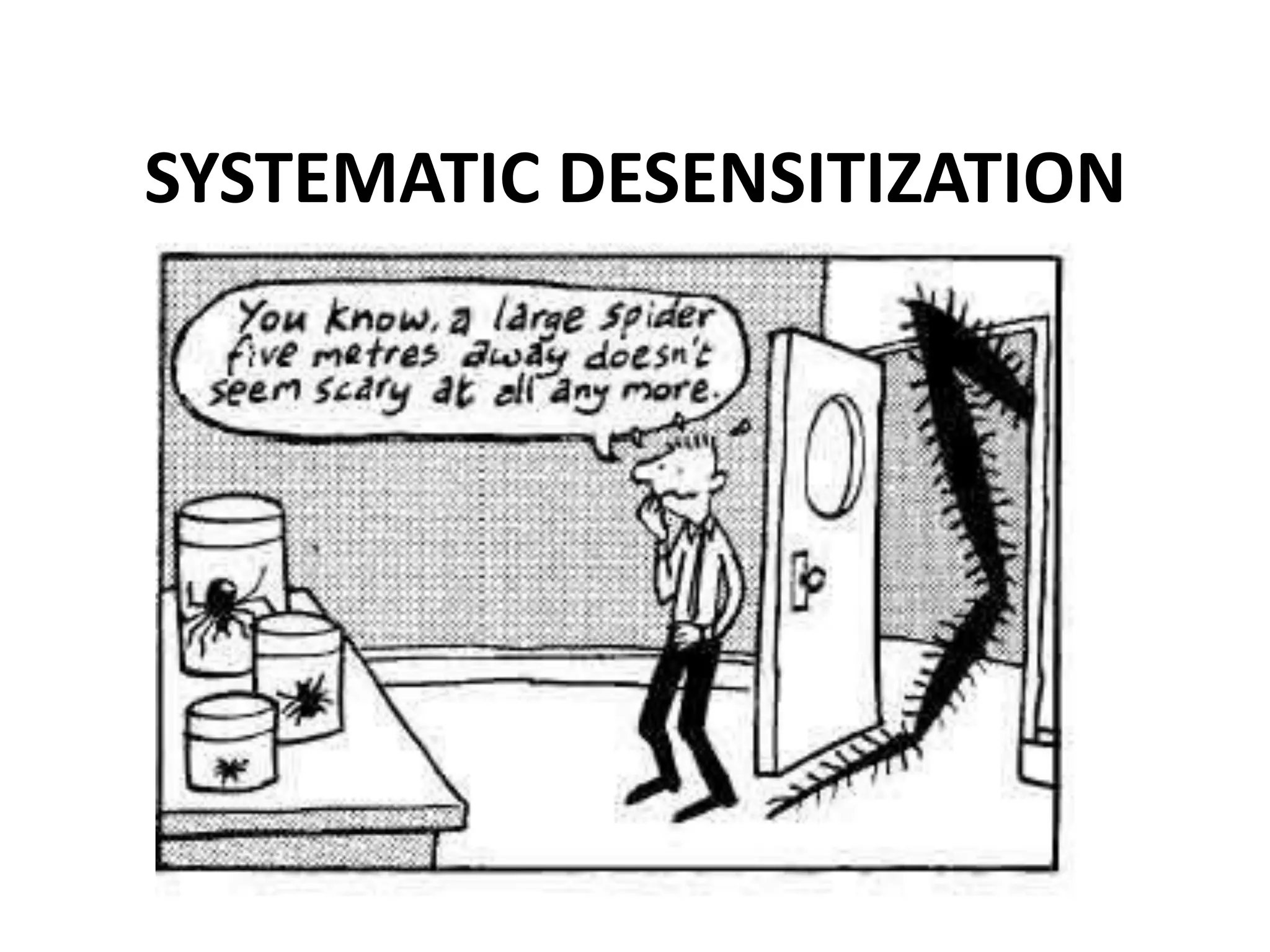
SYSTEMATIC DESENSITIZATION
• Systematic desensitization, also known
as graduated exposure therapy is a type
of behavior therapy used in the field
of psychology to help effectively
overcome phobias and other anxiety disorders.
• More specifically, it is a form of counter
conditioning, a type of Pavlovian therapy
developed by South African psychiatrist, Joseph
Wolpe.
• In the 1950s, Wolpe discovered that the cats of
Wits University could overcome their fears
through gradual and systematic exposure.
Three steps of desensitization
• The process of systematic desensitization occurs in
three steps.
• The first step of systematic desensitization is the
identification of an anxiety inducing stimulus hierarchy.
• The second step is the learning of relaxation or coping
techniques.
• Once the individual has been taught these skills, he or
she must use them in the third step to react towards
and overcome situations in the established hierarchy of
fears.
• The goal of this process is for the individual to learn
how to cope with, and overcome the fear in each step
of the hierarchy.
Establish anxiety stimulus hierarchy.
• The individual must first identify the items that
are causing anxiety.
• Each item that causes anxiety is given a subjective
ranking on the severity of induced anxiety.
• If the individual is experiencing great anxiety to
many different triggers, each item is dealt with
separately.
• For each trigger or stimuli, a list is created to rank
the events from least anxiety provoking to the
greatest anxiety provoking.
Learn coping mechanism or
incompatible response.
• Relaxation training, such as meditation, is one
type of coping strategy.
• Wolpe taught his patients relaxation
responses because it is not possible to be both
relaxed and anxious at the same time.
• In this method, patients practice tensing and
relaxing different parts of the body until the
patient reaches a state of serenity.
Connect the stimulus
• Connect the stimulus to the incompatible response or
coping method through counter conditioning.
• In this step the client completely relaxes and is then is
presented with the lowest item that was placed on their
hierarchy of severity of anxiety.
• When the client has reached a state of serenity again
after being presented with the first stimuli, the second
stimuli that should present a higher level of anxiety is
presented.
• Again, the individual practices the coping strategies
learned.
• This activity is completed until all items of the hierarchy
of severity of anxiety is completed without inducing
anxiety in the client.
Systematic desensitization and specific phobias
• Specific phobias are one class of mental disorder often
treated via systematic desensitization.
• When persons experience such phobias (for example
fears of heights, dogs, snakes, closed spaces, etc.), they
tend to avoid the feared stimuli; this avoidance, in turn,
can temporarily reduce anxiety but is not necessarily
an adaptive way of coping with it.
• In this regard, patients' avoidance behaviors can
become reinforced – a concept defined by the tenets
of operant conditioning.
• Wolpe found that systematic desensitization was
successful 90% of the time when treating phobias
Current use of systematic desensitization
• Desensitization is widely known as one of the most effective
therapy techniques.
• In recent decades, systematic desensitization has been used
less and less as a treatment of choice for anxiety disorders.
• Since 1970 academic research on systematic desensitization
has declined, and the current focus has been on other
therapies.
• In addition, the number of clinicians using systematic
desensitization has also declined since 1980.
• Those clinicians that continue to regularly use systematic
desensitization were trained before 1986.
• It is believed that the decrease of systematic desensitization
by practicing psychologist is due to the increase in other
techniques such as flooding, implosive therapy,
and participant modeling.
Example
• A client may approach a therapist due to their great phobia of
snakes. This is how the therapist would help the client using
the three steps of systematic sensitization:
• Establish anxiety stimulus hierarchy. A therapist may begin by
asking the patient to identify a fear hierarchy. This fear
hierarchy would list the relative unpleasantness of various
levels of exposure to a snake. For example, seeing a picture of
a snake might elicit a low fear rating, compared to live snakes
crawling on the individual—the latter scenario becoming
highest on the fear hierarchy.
• Learn coping mechanisms or incompatible responses. The
therapist would work with the client to learn appropriate
coping and relaxation techniques such as meditation and
deep muscle relaxation responses.
• Connect the stimulus to the incompatible response or coping
method. The client would be presented with increasingly
unpleasant levels of the feared stimuli, from lowest to
highest—while utilizing the deep relaxation techniques (i.e.
progressive muscle relaxation) previously learned. The
imagined stimuli to help with a phobia of snakes may include:
a picture of a snake; a small snake in a nearby room; a snake
in full view; touching of the snake, etc. At each step in the
imagined progression, the patient is desensitized to the
phobia through exposure to the stimulus while in a state of
relaxation. As the fear hierarchy is unlearned, anxiety
gradually becomes extinguished.
References
• Wolpe.J.(1958). Psychotherapy by reciprocal
inhibition. Stanford, CA; Stanford University
Press.

Systematic desensitization

  • 1.
  • 2.
    • Systematic desensitization,also known as graduated exposure therapy is a type of behavior therapy used in the field of psychology to help effectively overcome phobias and other anxiety disorders. • More specifically, it is a form of counter conditioning, a type of Pavlovian therapy developed by South African psychiatrist, Joseph Wolpe. • In the 1950s, Wolpe discovered that the cats of Wits University could overcome their fears through gradual and systematic exposure.
  • 3.
    Three steps ofdesensitization • The process of systematic desensitization occurs in three steps. • The first step of systematic desensitization is the identification of an anxiety inducing stimulus hierarchy. • The second step is the learning of relaxation or coping techniques. • Once the individual has been taught these skills, he or she must use them in the third step to react towards and overcome situations in the established hierarchy of fears. • The goal of this process is for the individual to learn how to cope with, and overcome the fear in each step of the hierarchy.
  • 4.
    Establish anxiety stimulushierarchy. • The individual must first identify the items that are causing anxiety. • Each item that causes anxiety is given a subjective ranking on the severity of induced anxiety. • If the individual is experiencing great anxiety to many different triggers, each item is dealt with separately. • For each trigger or stimuli, a list is created to rank the events from least anxiety provoking to the greatest anxiety provoking.
  • 5.
    Learn coping mechanismor incompatible response. • Relaxation training, such as meditation, is one type of coping strategy. • Wolpe taught his patients relaxation responses because it is not possible to be both relaxed and anxious at the same time. • In this method, patients practice tensing and relaxing different parts of the body until the patient reaches a state of serenity.
  • 6.
    Connect the stimulus •Connect the stimulus to the incompatible response or coping method through counter conditioning. • In this step the client completely relaxes and is then is presented with the lowest item that was placed on their hierarchy of severity of anxiety. • When the client has reached a state of serenity again after being presented with the first stimuli, the second stimuli that should present a higher level of anxiety is presented. • Again, the individual practices the coping strategies learned. • This activity is completed until all items of the hierarchy of severity of anxiety is completed without inducing anxiety in the client.
  • 7.
    Systematic desensitization andspecific phobias • Specific phobias are one class of mental disorder often treated via systematic desensitization. • When persons experience such phobias (for example fears of heights, dogs, snakes, closed spaces, etc.), they tend to avoid the feared stimuli; this avoidance, in turn, can temporarily reduce anxiety but is not necessarily an adaptive way of coping with it. • In this regard, patients' avoidance behaviors can become reinforced – a concept defined by the tenets of operant conditioning. • Wolpe found that systematic desensitization was successful 90% of the time when treating phobias
  • 8.
    Current use ofsystematic desensitization • Desensitization is widely known as one of the most effective therapy techniques. • In recent decades, systematic desensitization has been used less and less as a treatment of choice for anxiety disorders. • Since 1970 academic research on systematic desensitization has declined, and the current focus has been on other therapies. • In addition, the number of clinicians using systematic desensitization has also declined since 1980. • Those clinicians that continue to regularly use systematic desensitization were trained before 1986. • It is believed that the decrease of systematic desensitization by practicing psychologist is due to the increase in other techniques such as flooding, implosive therapy, and participant modeling.
  • 9.
    Example • A clientmay approach a therapist due to their great phobia of snakes. This is how the therapist would help the client using the three steps of systematic sensitization: • Establish anxiety stimulus hierarchy. A therapist may begin by asking the patient to identify a fear hierarchy. This fear hierarchy would list the relative unpleasantness of various levels of exposure to a snake. For example, seeing a picture of a snake might elicit a low fear rating, compared to live snakes crawling on the individual—the latter scenario becoming highest on the fear hierarchy.
  • 10.
    • Learn copingmechanisms or incompatible responses. The therapist would work with the client to learn appropriate coping and relaxation techniques such as meditation and deep muscle relaxation responses. • Connect the stimulus to the incompatible response or coping method. The client would be presented with increasingly unpleasant levels of the feared stimuli, from lowest to highest—while utilizing the deep relaxation techniques (i.e. progressive muscle relaxation) previously learned. The imagined stimuli to help with a phobia of snakes may include: a picture of a snake; a small snake in a nearby room; a snake in full view; touching of the snake, etc. At each step in the imagined progression, the patient is desensitized to the phobia through exposure to the stimulus while in a state of relaxation. As the fear hierarchy is unlearned, anxiety gradually becomes extinguished.
  • 11.
    References • Wolpe.J.(1958). Psychotherapyby reciprocal inhibition. Stanford, CA; Stanford University Press.