An Introduction To NAGS and
SNAGS
By Dr Ayesha Anwer Ali
Introduction about Brian
Mulligan
Brian R. Mulligan qualified as a physiotherapist in
1954 and gained his diploma in Manipulative
Therapy in 1974. He has been the author of
numerous articled published in New Zealand Journal
of Physiotherapy. He is also the author of two books:
"Manual Therapy "NAGS","SNAGS", "MWMS",etc'
(2003) for Physiotherapists.
'Self Treatment for the Back, Neck and Limbs' for
Public.
Mulligan manual therapy
•Articular techniques with additional
neuromuscular effects
•Positional fault causing physiological
restriction in joint
•Glide mobilization used along joint plane
•Reduction / elimination of symptoms guide
treatment technique
•Many techniques are weight bearing
Techniques Names
NAGS- Natural Apophyseal Glides.
SNAGS - Sustained Natural Apophyseal Glides.
MWMS- Mobilization with Movements.
The concept of (MWM) of the extremities and
SNAGS of the spine were first coined by Brian R.
Mulligan.
NAGS
•Accessory movement force applied along
facet joint plane
•C2-T3 levels
•Oscillation 2-3 / second
•Mid to end range
•Mild discomfort, never pain
•Antero-cranial direction (towards eyes)
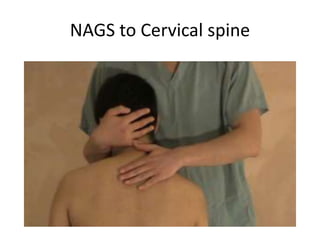
NAGS to Cervical spine
•Stand side on to pt, stabilizing them with your
trunk
•Reach around their head with your right hand,
their head rests on your chest
•Hook little finger under spinous process below
level to be treated
•Press your thenar eminence against your little
finger
•Oscillate towards pt eyes
NAGS to Cervical spine
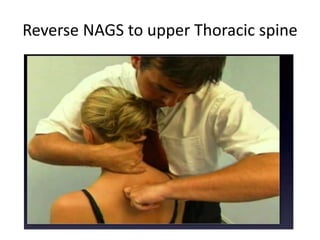
Reverse NAGS to upper Thoracic
spine
•Stand side on to pt, stabilizing them with your trunk
•Reach around their head with your right hand, their
head rests on your chest
•Hook little finger of right hand across vertebra above
•Use thumb pad & distal PIP as a ‘V’ shape to contact
transverse process of articular pillar of vertebra below
•Oscillate towards pt eyes
Reverse NAGS to upper Thoracic spine
SNAGS
Active patient, moving through symptomatic
ROM
Glide is held / sustained
Used for C, T, L spine Sustained facet glide with
movement
Applied at end range, aim to increase pain free
ROM
Result should be instant and long lasting
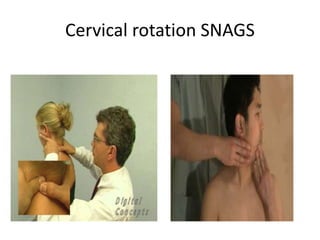
Cervical rotation SNAGS
Stand side on to pt, reaching across to contralateral
neck
Place side of thumb on spinous process supported by
your other fingers
Rest of hand alongside patients mandible to add
slight traction
Patients rotates head applying self overpressure for 2
secs
Follow with pressure over spinous process towards
eye
Cervical rotation SNAGS
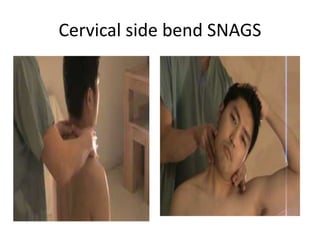
Cervical side bend SNAGS
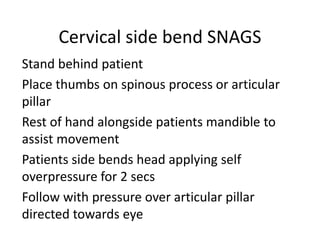
Stand behind patient
Place thumbs on spinous process or articular
pillar
Rest of hand alongside patients mandible to
assist movement
Patients side bends head applying self
overpressure for 2 secs
Follow with pressure over articular pillar
directed towards eye
Cervical side bend SNAGS
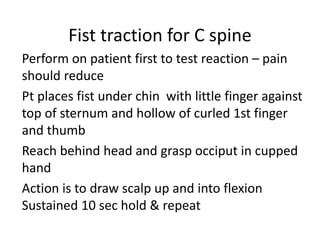
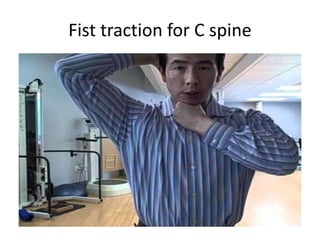
Fist traction for C spine
Perform on patient first to test reaction – pain
should reduce
Pt places fist under chin with little finger against
top of sternum and hollow of curled 1st finger
and thumb
Reach behind head and grasp occiput in cupped
hand
Action is to draw scalp up and into flexion
Sustained 10 sec hold & repeat
Fist traction for C spine
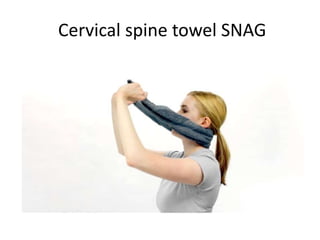
Cervical spine towel SNAG
Test using SNAG of C2 on C1
Place edge of towel over C2 spinous process
Draw towel forwards and upwards towards
eye
Active retraction against restraint of towel
edge
Especially good for cervicogenic headaches
Cervical spine towel SNAG

Nags and Snags.pptx

  • 1.
    An Introduction ToNAGS and SNAGS By Dr Ayesha Anwer Ali
  • 2.
    Introduction about Brian Mulligan BrianR. Mulligan qualified as a physiotherapist in 1954 and gained his diploma in Manipulative Therapy in 1974. He has been the author of numerous articled published in New Zealand Journal of Physiotherapy. He is also the author of two books: "Manual Therapy "NAGS","SNAGS", "MWMS",etc' (2003) for Physiotherapists. 'Self Treatment for the Back, Neck and Limbs' for Public.
  • 3.
    Mulligan manual therapy •Articulartechniques with additional neuromuscular effects •Positional fault causing physiological restriction in joint •Glide mobilization used along joint plane •Reduction / elimination of symptoms guide treatment technique •Many techniques are weight bearing
  • 4.
    Techniques Names NAGS- NaturalApophyseal Glides. SNAGS - Sustained Natural Apophyseal Glides. MWMS- Mobilization with Movements. The concept of (MWM) of the extremities and SNAGS of the spine were first coined by Brian R. Mulligan.
  • 5.
    NAGS •Accessory movement forceapplied along facet joint plane •C2-T3 levels •Oscillation 2-3 / second •Mid to end range •Mild discomfort, never pain •Antero-cranial direction (towards eyes)
  • 6.
    NAGS to Cervicalspine •Stand side on to pt, stabilizing them with your trunk •Reach around their head with your right hand, their head rests on your chest •Hook little finger under spinous process below level to be treated •Press your thenar eminence against your little finger •Oscillate towards pt eyes
  • 7.
  • 8.
    Reverse NAGS toupper Thoracic spine •Stand side on to pt, stabilizing them with your trunk •Reach around their head with your right hand, their head rests on your chest •Hook little finger of right hand across vertebra above •Use thumb pad & distal PIP as a ‘V’ shape to contact transverse process of articular pillar of vertebra below •Oscillate towards pt eyes
  • 9.
    Reverse NAGS toupper Thoracic spine
  • 10.
    SNAGS Active patient, movingthrough symptomatic ROM Glide is held / sustained Used for C, T, L spine Sustained facet glide with movement Applied at end range, aim to increase pain free ROM Result should be instant and long lasting
  • 11.
    Cervical rotation SNAGS Standside on to pt, reaching across to contralateral neck Place side of thumb on spinous process supported by your other fingers Rest of hand alongside patients mandible to add slight traction Patients rotates head applying self overpressure for 2 secs Follow with pressure over spinous process towards eye
  • 12.
  • 13.
    Cervical side bendSNAGS Stand behind patient Place thumbs on spinous process or articular pillar Rest of hand alongside patients mandible to assist movement Patients side bends head applying self overpressure for 2 secs Follow with pressure over articular pillar directed towards eye
  • 14.
  • 15.
    Fist traction forC spine Perform on patient first to test reaction – pain should reduce Pt places fist under chin with little finger against top of sternum and hollow of curled 1st finger and thumb Reach behind head and grasp occiput in cupped hand Action is to draw scalp up and into flexion Sustained 10 sec hold & repeat
  • 16.
  • 17.
    Cervical spine towelSNAG Test using SNAG of C2 on C1 Place edge of towel over C2 spinous process Draw towel forwards and upwards towards eye Active retraction against restraint of towel edge Especially good for cervicogenic headaches
  • 18.