STRAIN-COUNTERSTRAIN
      John Christiansen,
       MS PT, OCS, ATC
 Advanced Rehabilitation Clinics
Strain-Counterstrain

• Developed by Lawrence Jones, D.O.


• Based on work of Irvin Korr, Ph.D.
 “Proprioceptors and Somatic Dysfunction”
Korr said:

• “To a physiologist it seems much more
 reasonable that the limitation and
 resistance to motion of a joint that
 characterizes an osteopathic lesion do not
 arise within the joint, but are imposed by
 one or more of the muscles that traverse
 and move the joint.”
Korr, cont

• Increased gamma outflow in response to
 momentarily silent proprioceptor input
 from hypershortened muscle
Korr, cont’d

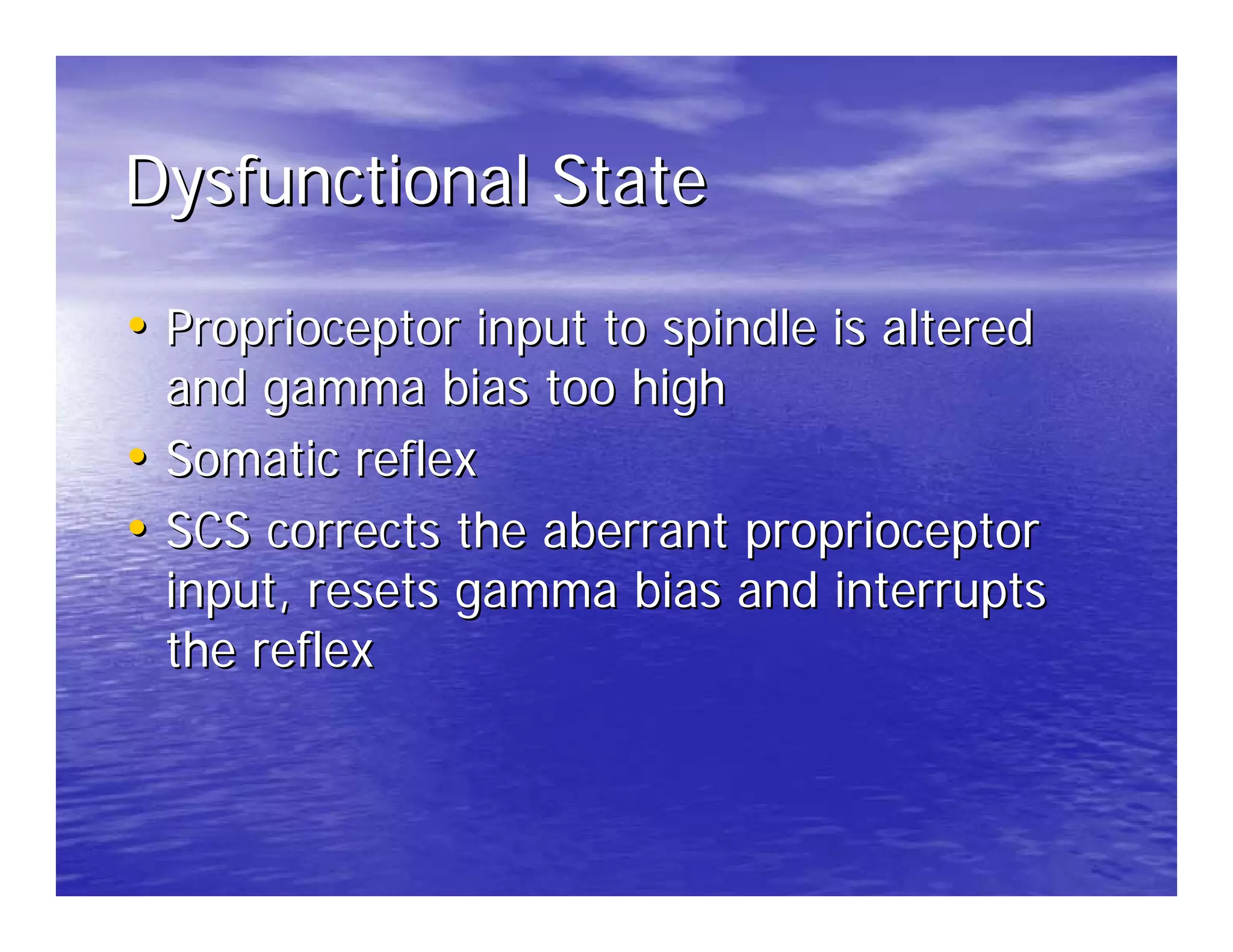
• Inappropriate “gain” in the primary
  proprioceptor reflexes in the muscle
  spindle
• When muscle is returned to resting length,
  “restretched”, this increased gain causes
  an overreaction and spindle reports strain
  before any real strain
Dysfunctional State

• Proprioceptor input to spindle is altered
  and gamma bias too high
• Somatic reflex
• SCS corrects the aberrant proprioceptor
  input, resets gamma bias and interrupts
  the reflex
Definition 1

• A passive positional procedure that places
 the body in a position of greatest comfort,
 thereby relieving pain by reduction and
 arrest of inappropriate proprioceptor
 activity that maintains somatic
 dysfunction.
Definition 2

• A mild overstretching applied in a direction
 opposite to the false and continuing
 message of strain which the body is
 suffering
TENDER POINTS

• Over 200 distinct tender points

• Manifestations of somatic dysfunction
What is a tender point?

• Small zone of tense, tender edematous
 muscle and fascial tissue

• 1 cm in diameter
What is a tender point?

• Sensory manifestation of a neuromuscular
 or musculoskeletal dysfunction

• At least 4x as tender to palpation than
 normal tissue
What is a tender point?

• They are NOT trigger points

• Travell latent trigger point- does not
 respond to spray and stretch or injection
TECHNIQUE

• Locate tender point

• Find position of comfort, or mobile point,
 at least 70% decrease in tenderness

• Monitor tender point as hold position of
 comfort 90 seconds
TECHNIQUE


• Return to neutral slowly

• Recheck tender point- at least 70%
 decrease in tenderness
Mobile Point

• Point of maximum tissue relaxation
  beneath your monitoring finger

• If you move in any direction, it will
  increase tissue tension
Treatment Pulse


• If you have found the mobile point, as you
 hold the 90 seconds, you’ll feel a pulsing

• Probably blood flow returning to area
GENERAL RULES

• Hold treatment position for 90 seconds

• Return to neutral slowly

• Anterior tender points are usually treated
 in flexion
GENERAL RULES


• Posterior tender points are usually treated
 in extension

• Tender points on or near midline are
 treated with more flexion and extension
GENERAL RULES


• Tender points lateral to midline are usually
 treated with more rotation and
 sidebending

• With multiple points, treat the most severe
 first
GENERAL RULES


• It tender points are in a row, treat the one
 in the middle first

• Tender points in the extremities are
 usually on the opposite side of pain
GENERAL RULES


• Warn patient they may be sore after the
 treatment

• Only contraindication is (+) vertebral
 artery test for some cervical treatments
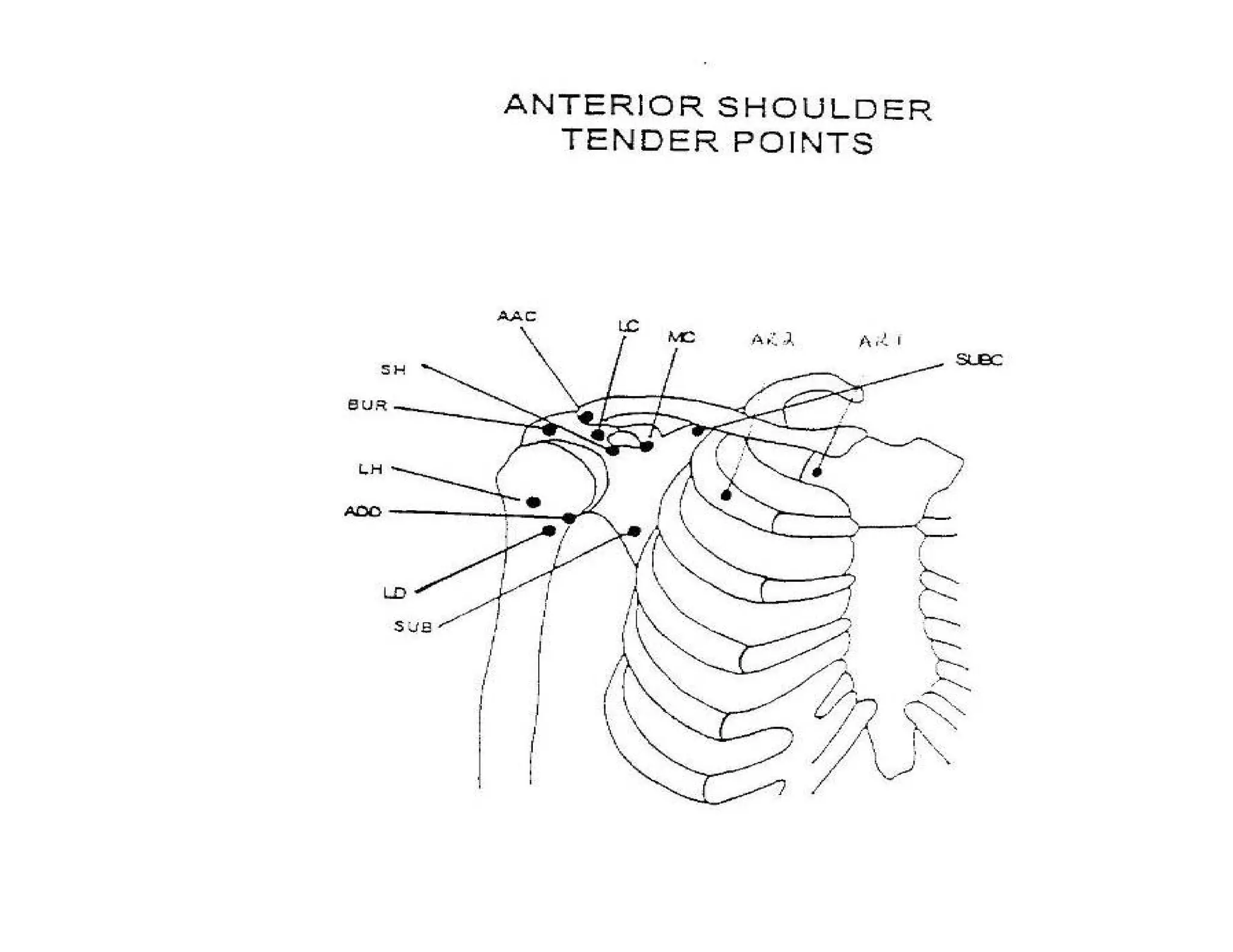
Anterior rib 1 (AR1)

• Tender Point: 1st costal cartilage

• Treatment: Patient supine
     • Mild cervical flexion
     • Marked rotation toward tender point
     • Mild cervical sidebend toward
Anterior Rib 2 (AR2)

• Tender Point: 2nd rib mid clavicular line

• Treatment: same as AR1
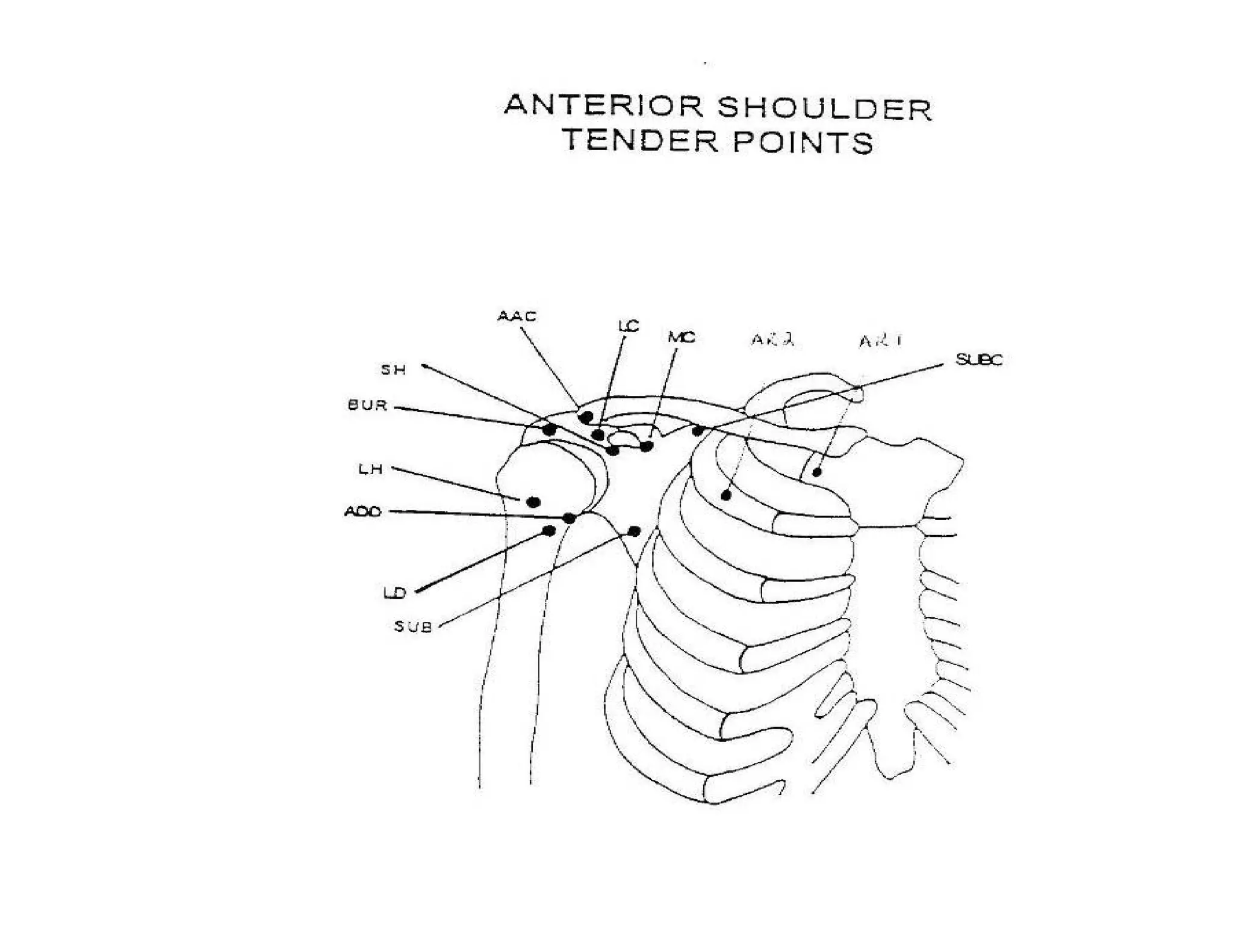
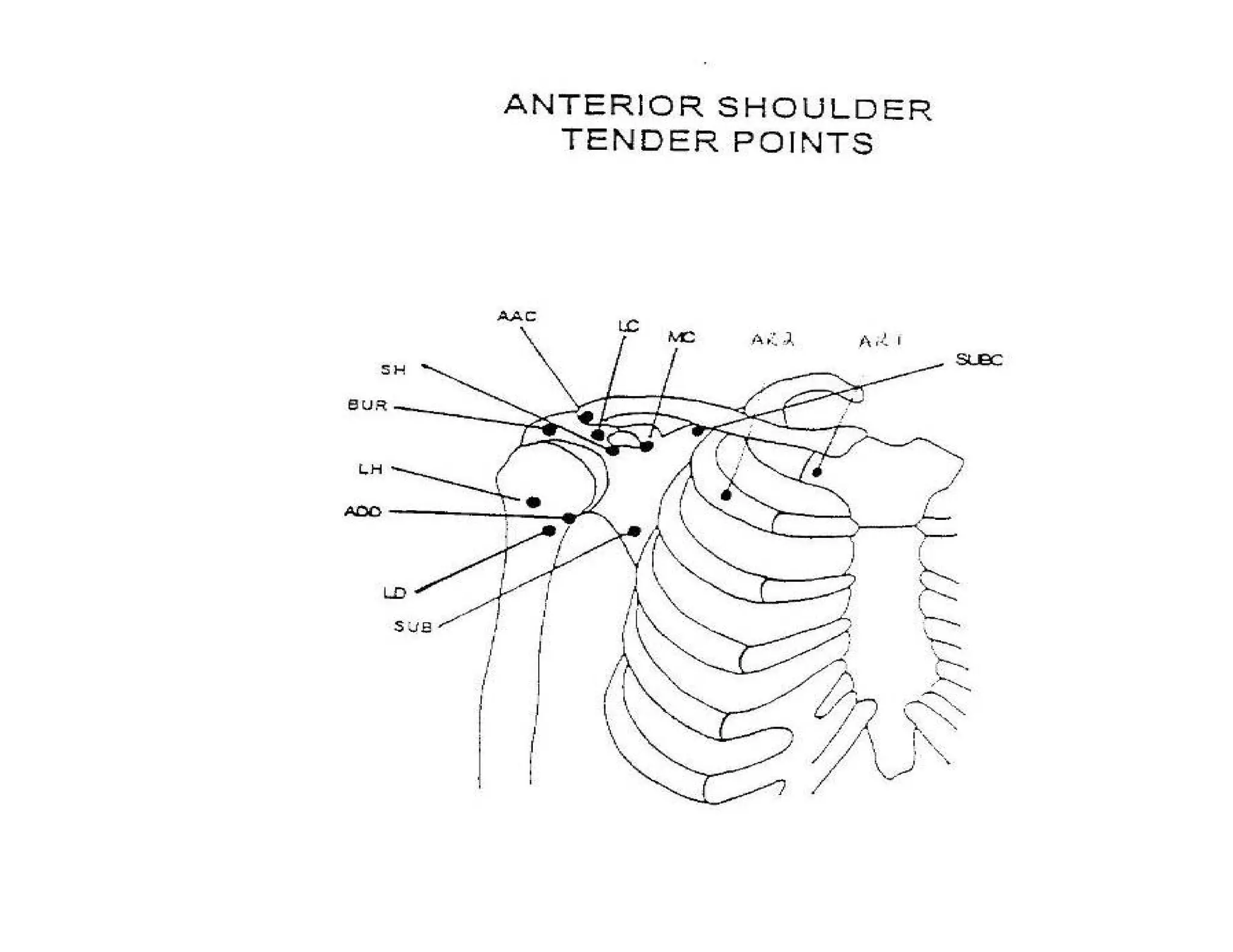
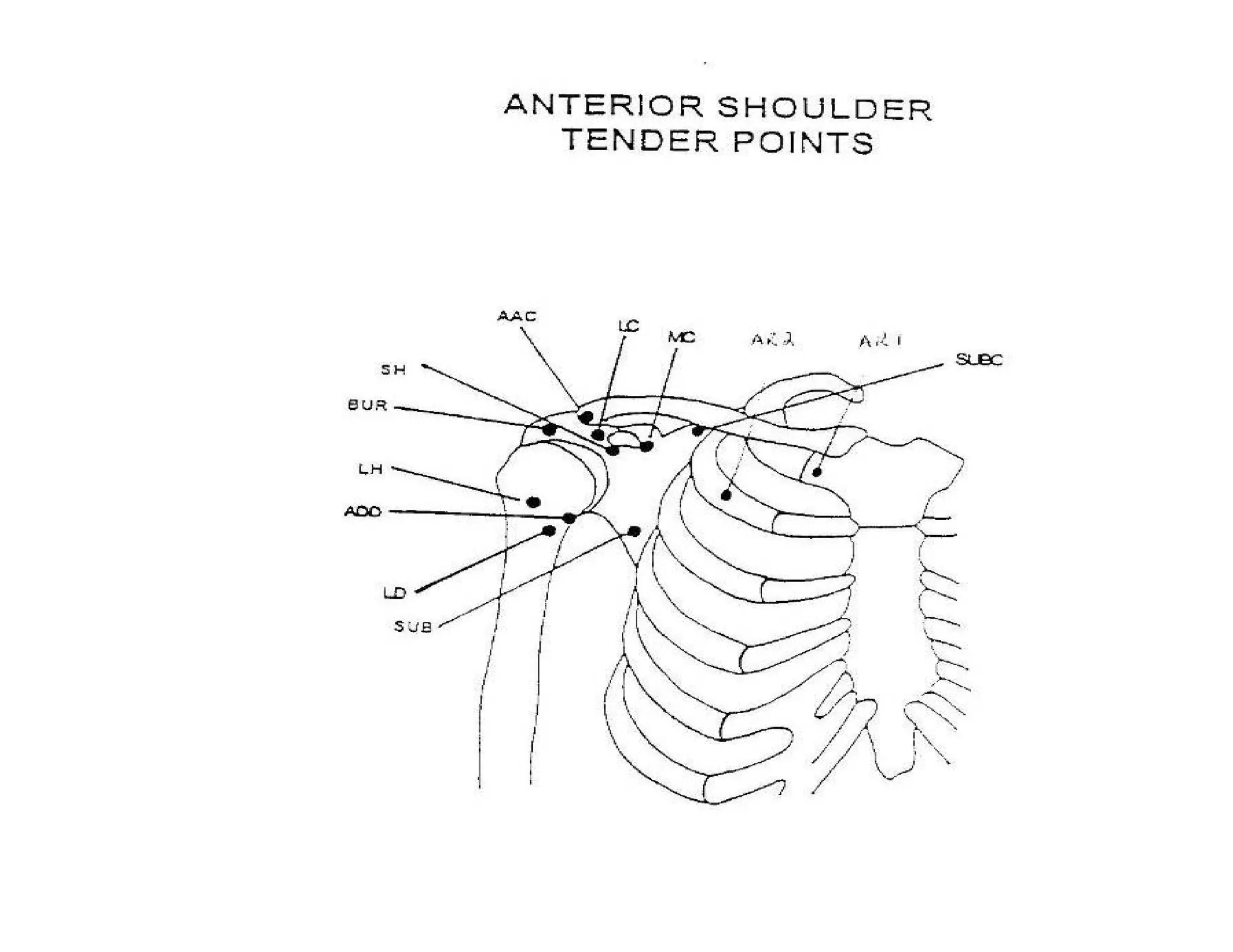
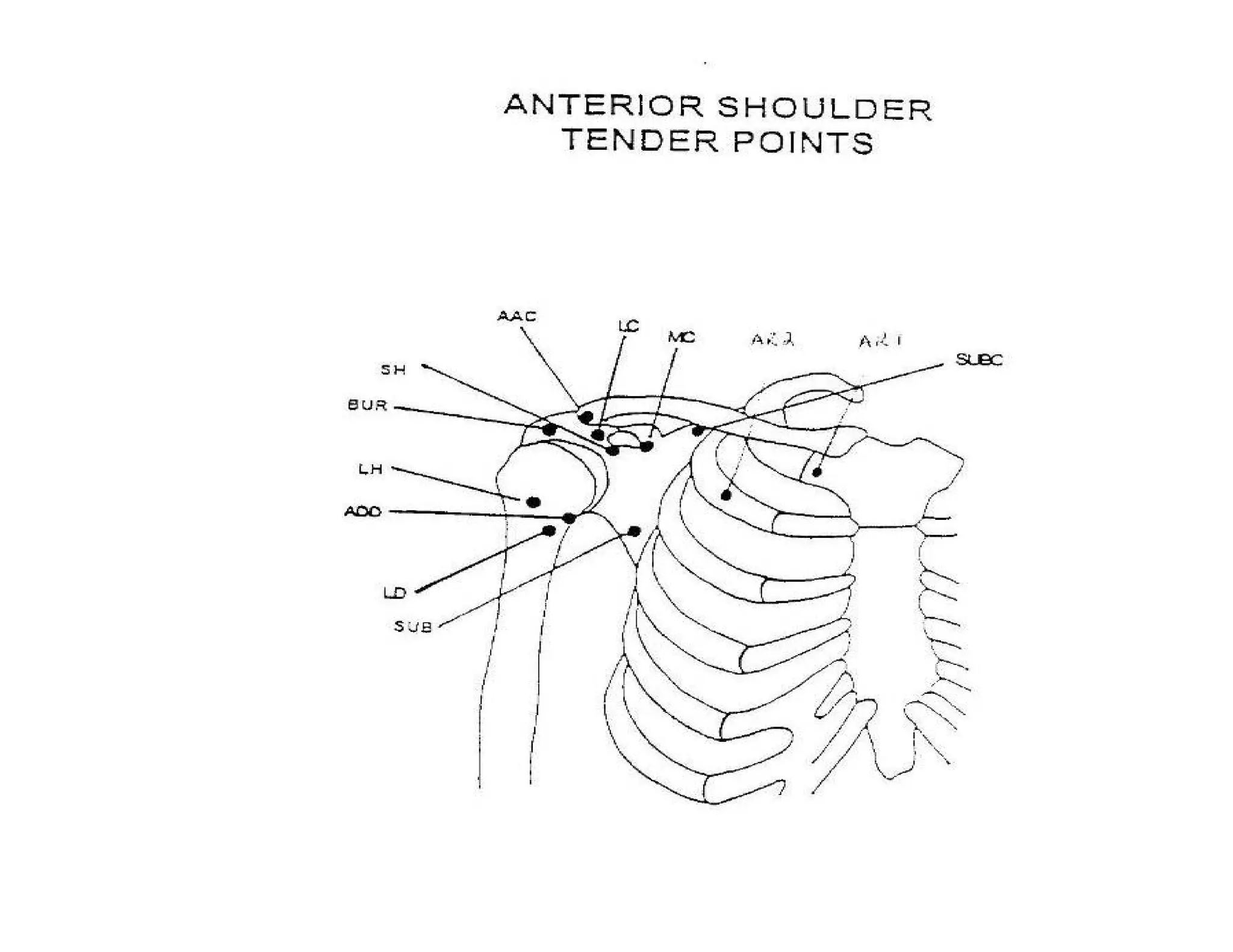
Anterior Acromio-clavicular (AAC)

• Tender Point: Anterior aspect distal
  clavicle
• Treatment: Patient supine
  – Clinician stands on opposite
  – Adduct obliquely across body, 0-30°
  – Slight traction of arm
Bursa (BUR)

• Tender point: Under acromion with arm in
 90° abduction

• Treatment: Patient supine
  – Flexion of arm 120°
  – Slight ER of arm with elbow flexed
Long Head of Biceps (LH)

• Tender point: Over long head in bicipital
 groove

• Treatment: Patient supine
  – Flexion of arm, dorsum of hand on forehead
  – Fine tune with IR or ER of arm
Short Head of Biceps (SH)

• Tender Point: Inferior lateral aspect of
 coracoid

• Treatment: Patient supine
  – Flexion of arm 90°, elbow flexed, forearm
    supinated
  – Moderate horizontal adduction
Medial Coracoid (MC)

• Tender Point: Medial aspect of coracoid process

• Treatment: Patient sitting
  –   Extend arm 30°
  –   Slight adduction
  –   IR
  –   Slight shoulder protraction and push elbow forward
Lateral Coracoid (LC)

• Tender Point: Superior aspect of coracoid

• Treatment: Patient supine, head off table
  – Marked cervical extension
  – SB away
  – Rotate toward
Subscapularis (SUB)

• Tender Point: Lateral margin of scapula,
 anywhere in subscapularis

• Treatment: Patient supine, edge of table
  – Extend arm 30°
  – Marked IR
  – Slight adduction
Latissimus Dorsi (LD)

• Tender Point: Anterior humerus, elow
 bicipital groove

• Treatment: Patient supine, edge of table
  – Extend arm 30°
  – Marked IR
  – Traction of arm
Adduction Shoulder (ADD)

• Tender Point: High in axilla on medial
 humerus

• Treatment: Patient supine
  – Adduction of arm tight to body
  – Compression through shaft of humerus
Subclavius (SUBC)

• Tender Point: Under surface of mid-
 clavicle

• Treatment: Patient supine
  – Clinician on opposite side
  – Adduction of arm horizontally
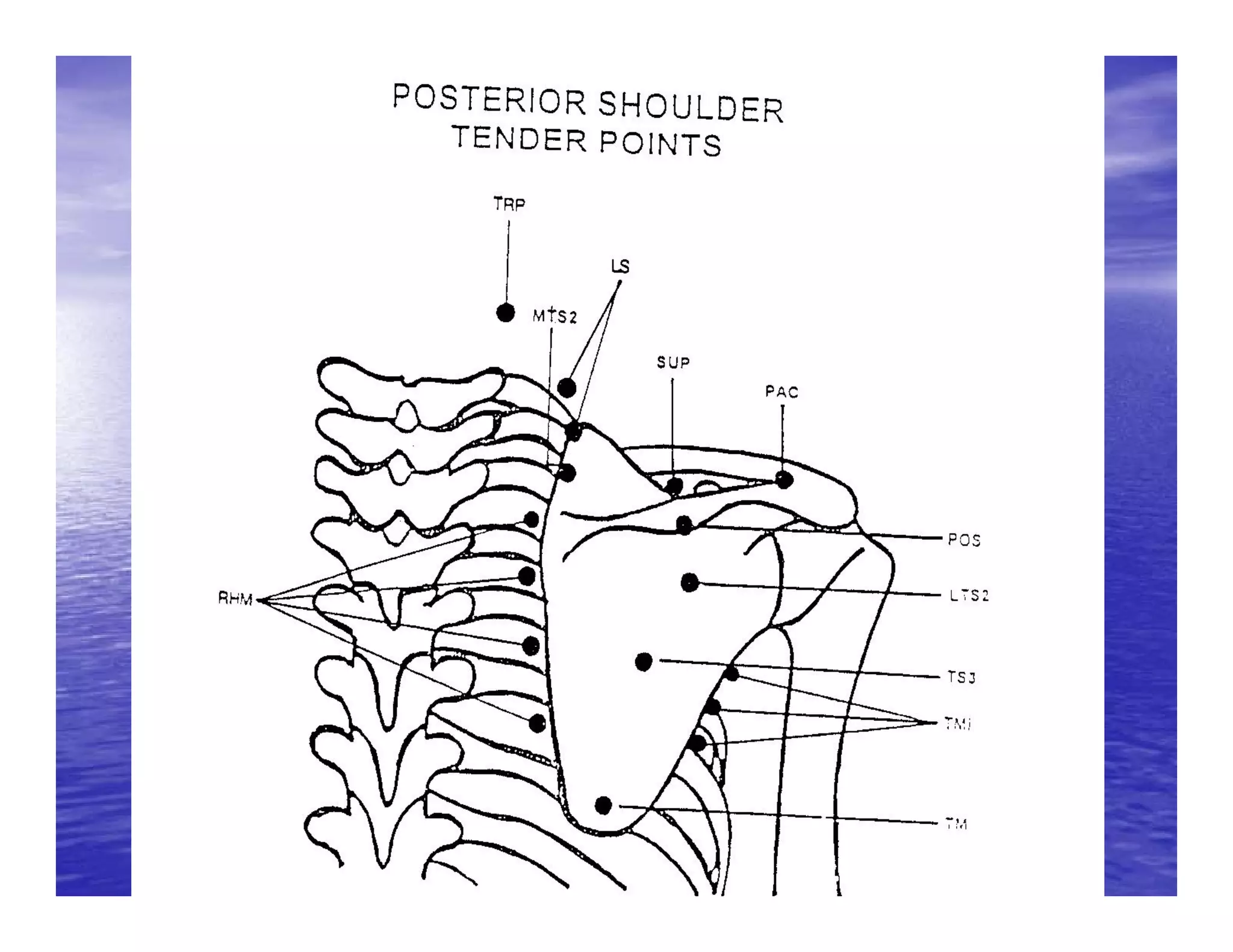
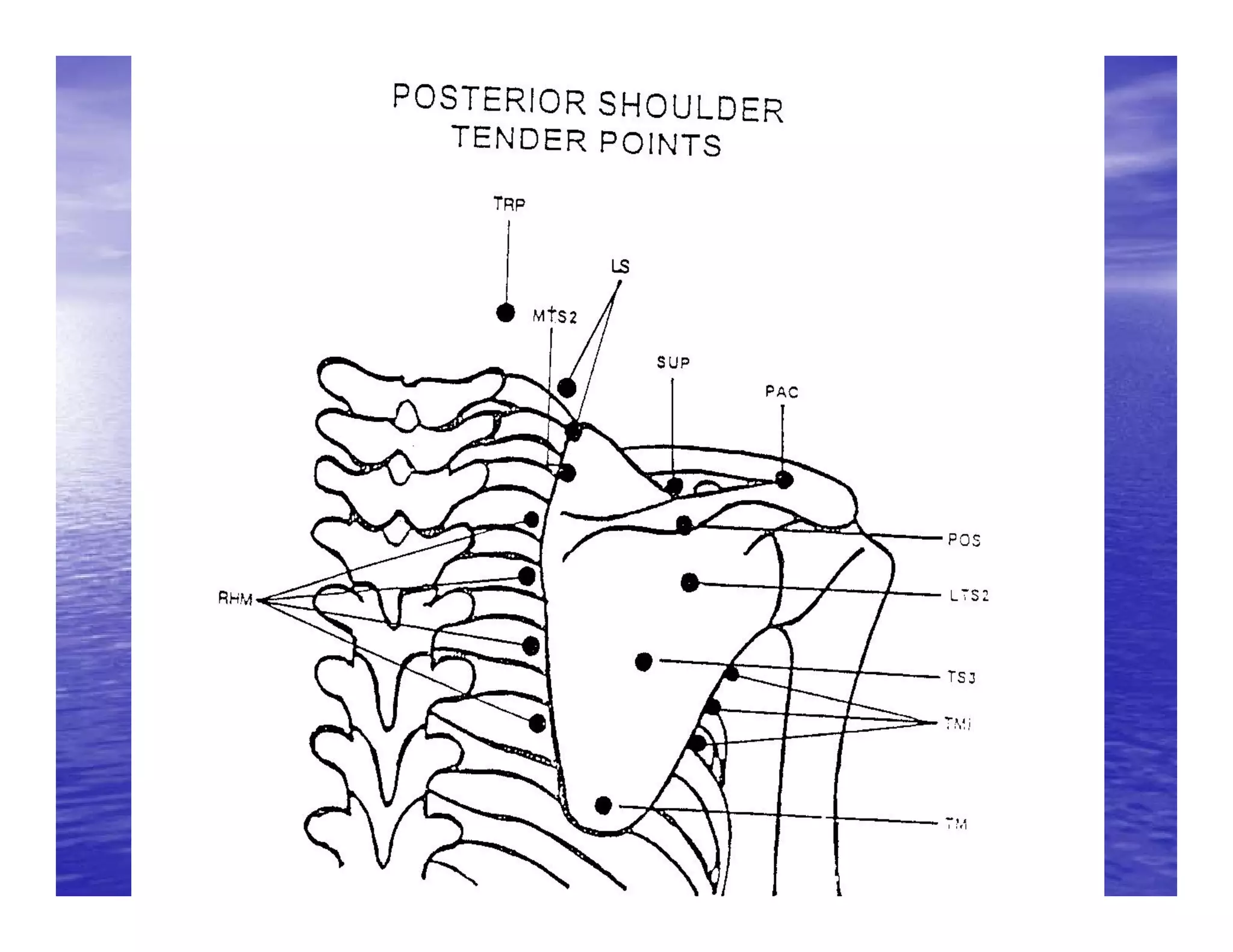
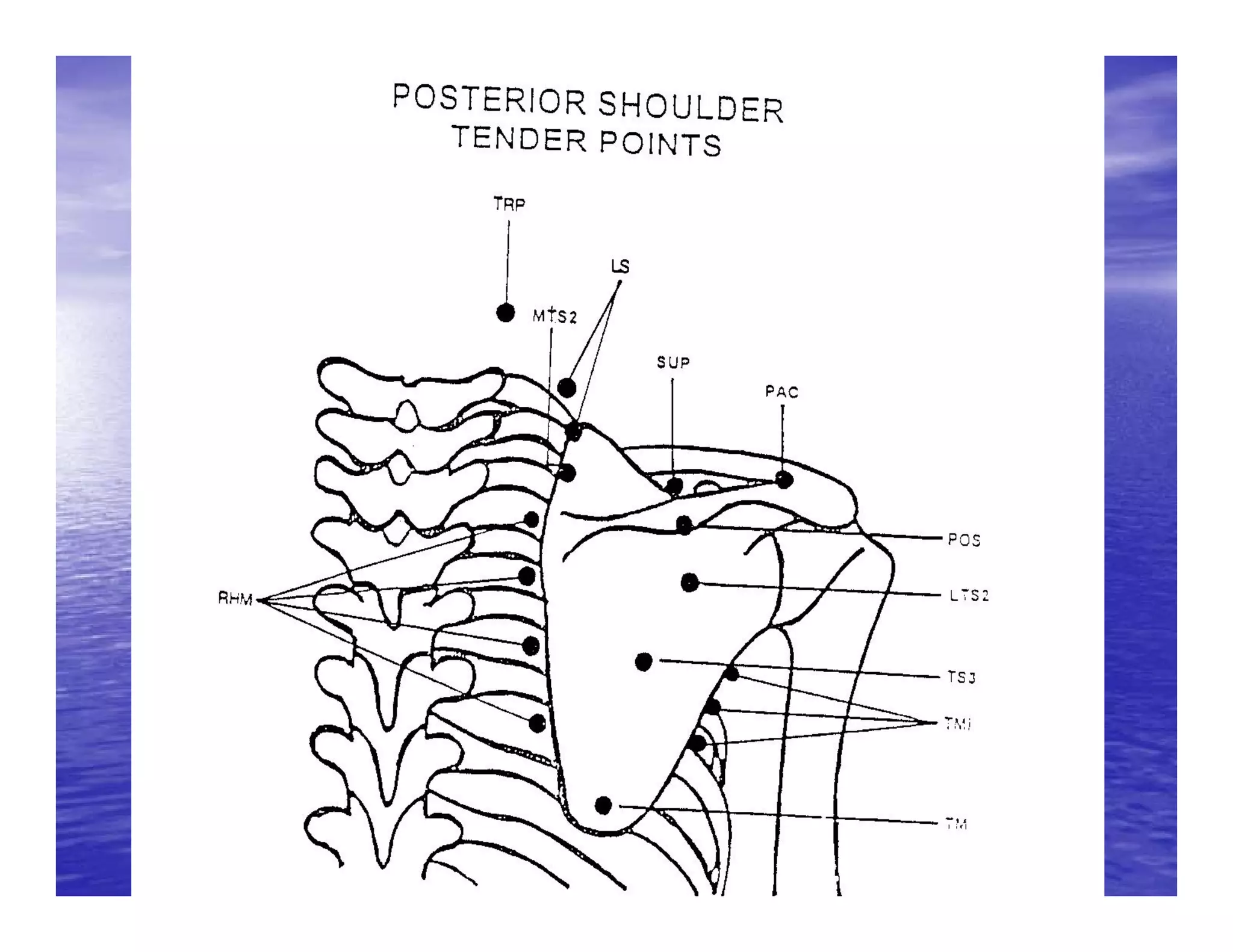
Posterior Acromio-clavicular (PAC)

• Tender Point: Posterior clavicle

• Treatment: Patient prone
  – Adduct arm obliquely across body 0-30°
  – Traction of arm
Supraspinatus (SUP)

• Tender Point: Belly of muscle

• Treatment: Patient supine
  – Flexion of arm 45°
  – Abduction of arm 45°
  – Marked ER
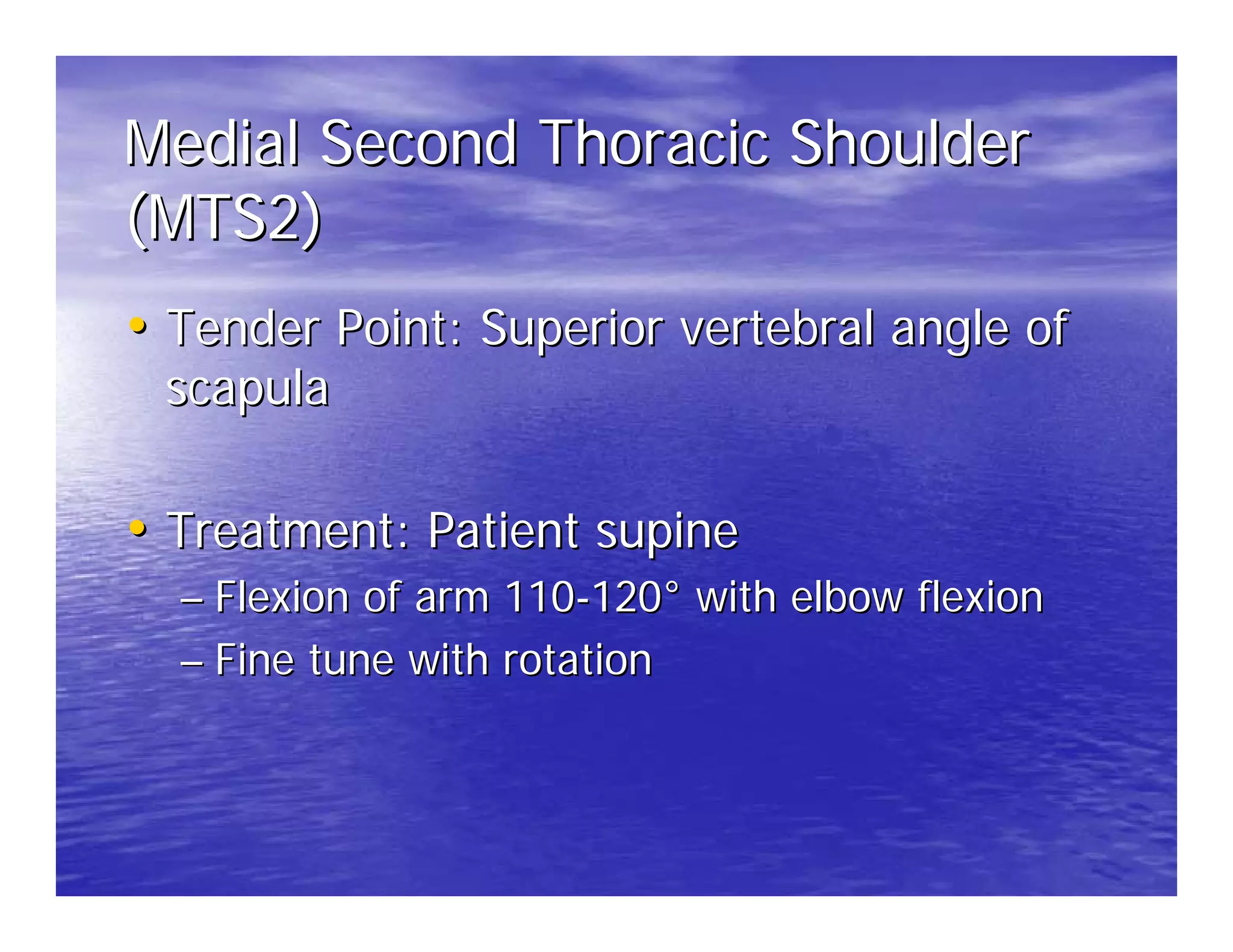
Medial Second Thoracic Shoulder
(MTS2)
• Tender Point: Superior vertebral angle of
 scapula

• Treatment: Patient supine
  – Flexion of arm 110-120° with elbow flexion
  – Fine tune with rotation
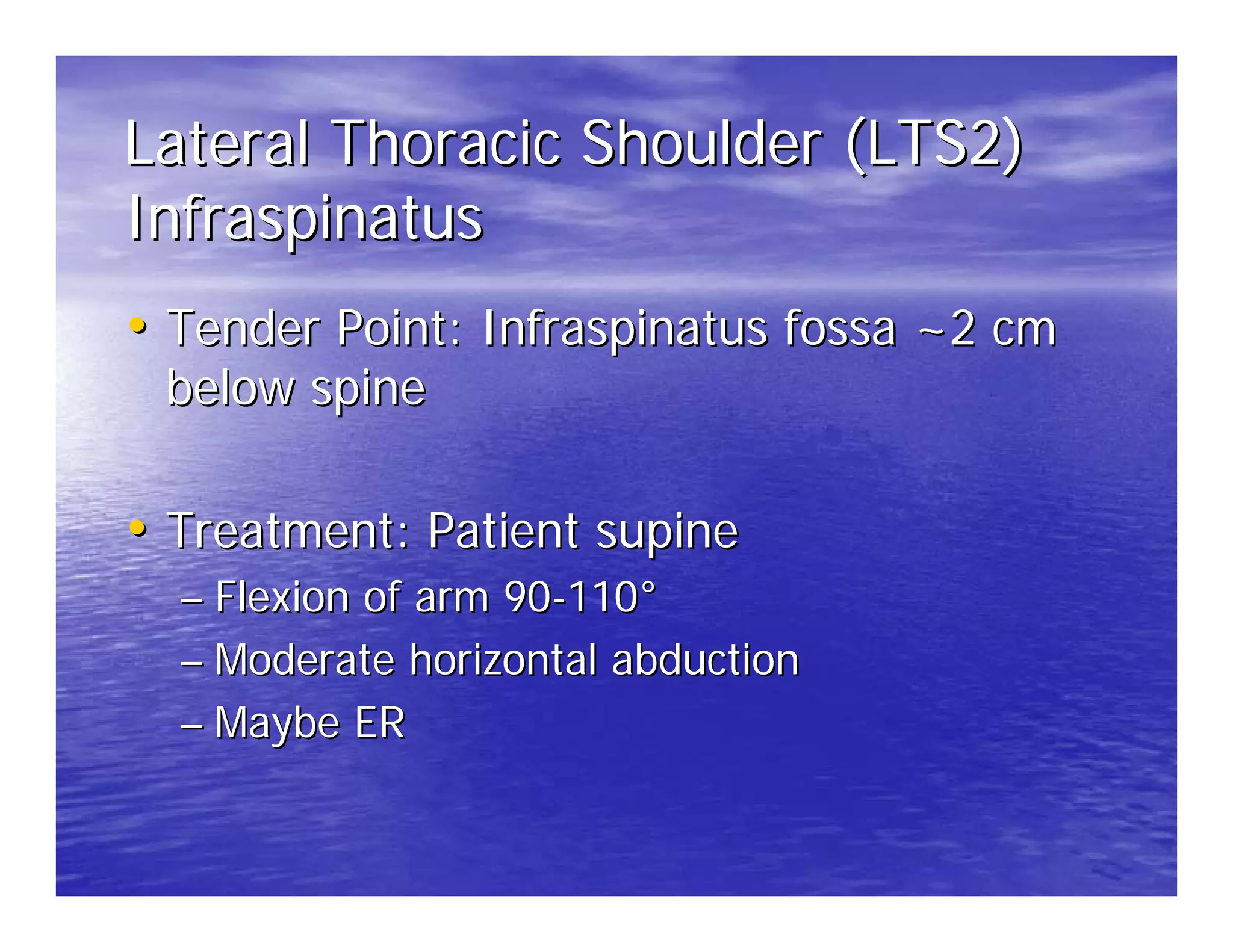
Lateral Thoracic Shoulder (LTS2)
Infraspinatus
• Tender Point: Infraspinatus fossa ~2 cm
 below spine

• Treatment: Patient supine
  – Flexion of arm 90-110°
  – Moderate horizontal abduction
  – Maybe ER
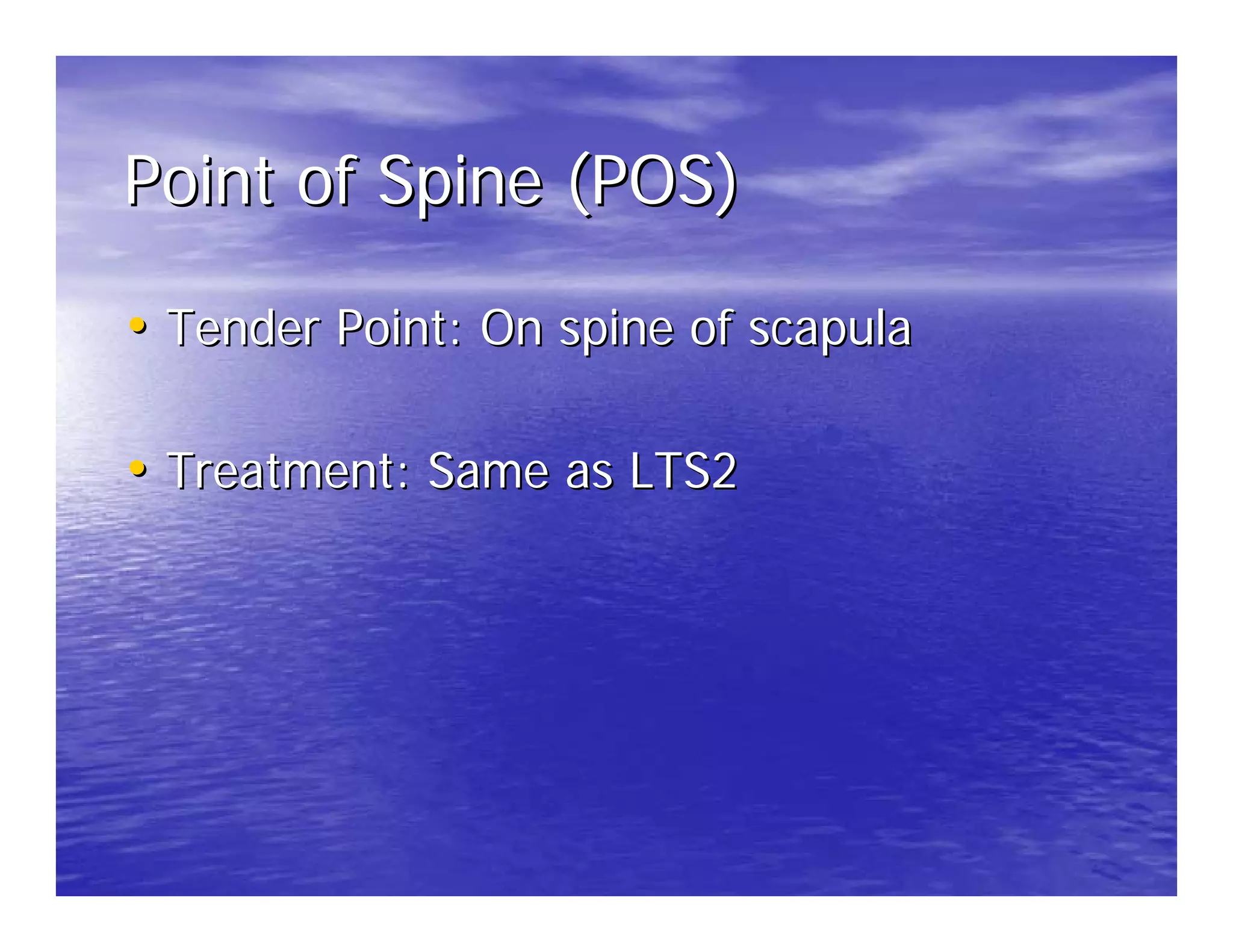
Point of Spine (POS)

• Tender Point: On spine of scapula

• Treatment: Same as LTS2
Third Thoracic Shoulder (TS3)

• Tender Point: Belly of infraspinatus

• Treatment: Patient Supine
  – Flexion of arm 135°
  – Fine tune with ad/abduction and rotation
Trapezius (TRP)

• Tender Point: Upper trapezius

• Treatment: Patient supine
  – Sidebend head towards
  – Flexion of arm overhead
  – Traction of scapula superiorly pulling on arm
Levator Scapula (LS)

• Tender Point: In muscle

• Treatment: Patient supine
  – Arm by side, elbow flexed
  – Sidebend head towards
  – Elevate scapula by pushing cephalad through
    humerus
Teres Major (TM)

• Tender Point:

• 1. Dorsal surface inferior angle of scapula
• 2. Posterior axilla, lateral to subscapularis
  point
Teres Major (TM)

• Treatment: Patient sitting
  – Extension of arm 30°
  – Slight adduction
  – Marked IR
Teres Minor (TMi)

• Tender point: Lateral border of scapula in
 belly of muscle

• Treatment: Patient sitting or supine
  – Extension of arm 30°
  – Slight adduction
  – Marked ER
Rhomboids (RHM)

• Tender Point: Medial border of scapula

• Treatment: Patient prone, arm by side
  – Clinician stands opposite
  – Adduction of scapula
  – Elevation of scapula

Strain counterstrain powerpoint

  • 1.
    STRAIN-COUNTERSTRAIN John Christiansen, MS PT, OCS, ATC Advanced Rehabilitation Clinics
  • 2.
    Strain-Counterstrain • Developed byLawrence Jones, D.O. • Based on work of Irvin Korr, Ph.D. “Proprioceptors and Somatic Dysfunction”
  • 3.
    Korr said: • “Toa physiologist it seems much more reasonable that the limitation and resistance to motion of a joint that characterizes an osteopathic lesion do not arise within the joint, but are imposed by one or more of the muscles that traverse and move the joint.”
  • 4.
    Korr, cont • Increasedgamma outflow in response to momentarily silent proprioceptor input from hypershortened muscle
  • 5.
    Korr, cont’d • Inappropriate“gain” in the primary proprioceptor reflexes in the muscle spindle • When muscle is returned to resting length, “restretched”, this increased gain causes an overreaction and spindle reports strain before any real strain
  • 7.
    Dysfunctional State • Proprioceptorinput to spindle is altered and gamma bias too high • Somatic reflex • SCS corrects the aberrant proprioceptor input, resets gamma bias and interrupts the reflex
  • 8.
    Definition 1 • Apassive positional procedure that places the body in a position of greatest comfort, thereby relieving pain by reduction and arrest of inappropriate proprioceptor activity that maintains somatic dysfunction.
  • 9.
    Definition 2 • Amild overstretching applied in a direction opposite to the false and continuing message of strain which the body is suffering
  • 10.
    TENDER POINTS • Over200 distinct tender points • Manifestations of somatic dysfunction
  • 11.
    What is atender point? • Small zone of tense, tender edematous muscle and fascial tissue • 1 cm in diameter
  • 12.
    What is atender point? • Sensory manifestation of a neuromuscular or musculoskeletal dysfunction • At least 4x as tender to palpation than normal tissue
  • 13.
    What is atender point? • They are NOT trigger points • Travell latent trigger point- does not respond to spray and stretch or injection
  • 14.
    TECHNIQUE • Locate tenderpoint • Find position of comfort, or mobile point, at least 70% decrease in tenderness • Monitor tender point as hold position of comfort 90 seconds
  • 15.
    TECHNIQUE • Return toneutral slowly • Recheck tender point- at least 70% decrease in tenderness
  • 16.
    Mobile Point • Pointof maximum tissue relaxation beneath your monitoring finger • If you move in any direction, it will increase tissue tension
  • 17.
    Treatment Pulse • Ifyou have found the mobile point, as you hold the 90 seconds, you’ll feel a pulsing • Probably blood flow returning to area
  • 18.
    GENERAL RULES • Holdtreatment position for 90 seconds • Return to neutral slowly • Anterior tender points are usually treated in flexion
  • 19.
    GENERAL RULES • Posteriortender points are usually treated in extension • Tender points on or near midline are treated with more flexion and extension
  • 20.
    GENERAL RULES • Tenderpoints lateral to midline are usually treated with more rotation and sidebending • With multiple points, treat the most severe first
  • 21.
    GENERAL RULES • Ittender points are in a row, treat the one in the middle first • Tender points in the extremities are usually on the opposite side of pain
  • 22.
    GENERAL RULES • Warnpatient they may be sore after the treatment • Only contraindication is (+) vertebral artery test for some cervical treatments
  • 24.
    Anterior rib 1(AR1) • Tender Point: 1st costal cartilage • Treatment: Patient supine • Mild cervical flexion • Marked rotation toward tender point • Mild cervical sidebend toward
  • 25.
    Anterior Rib 2(AR2) • Tender Point: 2nd rib mid clavicular line • Treatment: same as AR1
  • 27.
    Anterior Acromio-clavicular (AAC) •Tender Point: Anterior aspect distal clavicle • Treatment: Patient supine – Clinician stands on opposite – Adduct obliquely across body, 0-30° – Slight traction of arm
  • 28.
    Bursa (BUR) • Tenderpoint: Under acromion with arm in 90° abduction • Treatment: Patient supine – Flexion of arm 120° – Slight ER of arm with elbow flexed
  • 30.
    Long Head ofBiceps (LH) • Tender point: Over long head in bicipital groove • Treatment: Patient supine – Flexion of arm, dorsum of hand on forehead – Fine tune with IR or ER of arm
  • 31.
    Short Head ofBiceps (SH) • Tender Point: Inferior lateral aspect of coracoid • Treatment: Patient supine – Flexion of arm 90°, elbow flexed, forearm supinated – Moderate horizontal adduction
  • 32.
    Medial Coracoid (MC) •Tender Point: Medial aspect of coracoid process • Treatment: Patient sitting – Extend arm 30° – Slight adduction – IR – Slight shoulder protraction and push elbow forward
  • 33.
    Lateral Coracoid (LC) •Tender Point: Superior aspect of coracoid • Treatment: Patient supine, head off table – Marked cervical extension – SB away – Rotate toward
  • 35.
    Subscapularis (SUB) • TenderPoint: Lateral margin of scapula, anywhere in subscapularis • Treatment: Patient supine, edge of table – Extend arm 30° – Marked IR – Slight adduction
  • 36.
    Latissimus Dorsi (LD) •Tender Point: Anterior humerus, elow bicipital groove • Treatment: Patient supine, edge of table – Extend arm 30° – Marked IR – Traction of arm
  • 38.
    Adduction Shoulder (ADD) •Tender Point: High in axilla on medial humerus • Treatment: Patient supine – Adduction of arm tight to body – Compression through shaft of humerus
  • 39.
    Subclavius (SUBC) • TenderPoint: Under surface of mid- clavicle • Treatment: Patient supine – Clinician on opposite side – Adduction of arm horizontally
  • 41.
    Posterior Acromio-clavicular (PAC) •Tender Point: Posterior clavicle • Treatment: Patient prone – Adduct arm obliquely across body 0-30° – Traction of arm
  • 42.
    Supraspinatus (SUP) • TenderPoint: Belly of muscle • Treatment: Patient supine – Flexion of arm 45° – Abduction of arm 45° – Marked ER
  • 44.
    Medial Second ThoracicShoulder (MTS2) • Tender Point: Superior vertebral angle of scapula • Treatment: Patient supine – Flexion of arm 110-120° with elbow flexion – Fine tune with rotation
  • 45.
    Lateral Thoracic Shoulder(LTS2) Infraspinatus • Tender Point: Infraspinatus fossa ~2 cm below spine • Treatment: Patient supine – Flexion of arm 90-110° – Moderate horizontal abduction – Maybe ER
  • 46.
    Point of Spine(POS) • Tender Point: On spine of scapula • Treatment: Same as LTS2
  • 47.
    Third Thoracic Shoulder(TS3) • Tender Point: Belly of infraspinatus • Treatment: Patient Supine – Flexion of arm 135° – Fine tune with ad/abduction and rotation
  • 49.
    Trapezius (TRP) • TenderPoint: Upper trapezius • Treatment: Patient supine – Sidebend head towards – Flexion of arm overhead – Traction of scapula superiorly pulling on arm
  • 50.
    Levator Scapula (LS) •Tender Point: In muscle • Treatment: Patient supine – Arm by side, elbow flexed – Sidebend head towards – Elevate scapula by pushing cephalad through humerus
  • 52.
    Teres Major (TM) •Tender Point: • 1. Dorsal surface inferior angle of scapula • 2. Posterior axilla, lateral to subscapularis point
  • 53.
    Teres Major (TM) •Treatment: Patient sitting – Extension of arm 30° – Slight adduction – Marked IR
  • 54.
    Teres Minor (TMi) •Tender point: Lateral border of scapula in belly of muscle • Treatment: Patient sitting or supine – Extension of arm 30° – Slight adduction – Marked ER
  • 55.
    Rhomboids (RHM) • TenderPoint: Medial border of scapula • Treatment: Patient prone, arm by side – Clinician stands opposite – Adduction of scapula – Elevation of scapula