SCANS
Dr. Padmesh. V
Diuretic Renal scans:
• These are primarily done to rule out obstruction at
Pelvi-ureteric or Vesico-ureteric junction in a child
with hydronephrosis.
• Additionally, information about the function of each
kidney can be gathered.
• There are 3 agents which can be used for a diuretic
renal scan- DTPA or MAG3 or LLEC.
• All three are good but LLEC is supposed to be the
best as the image quality is the best.
DTPA / MAG 3 Scan
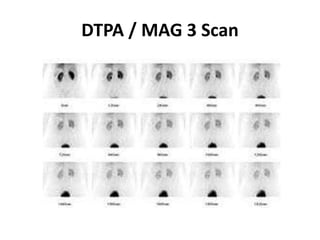
• Involves an injection of either DTPA (99mTc-
diethylene triamine pentaacetic acid) or
MAG3 followed by immediate images of the
kidneys as the injection enters the body.
• In doing this, we can get information on
– renal blood flow,
– GFR,
– tubular function and
– urinary excretion.
DTPA / MAG 3 Scan
• Clinical Indications:
• Assessment of GFR
• Differential renal function
• Acute renal failure
• Chronic renal failure
• Acute & chronic rejection
• Screening of patients with suspected renal hypertension
• Obstruction
• Hydronephrosis
DTPA / MAG 3 Scan
DTPA / MAG 3 Scan
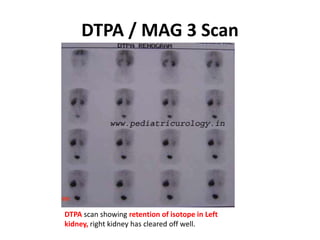
DTPA scan showing retention of isotope in Left
kidney, right kidney has cleared off well.
DMSA Scan
DMSA Scan
• Technetium99m DMSA (Di mercapto succinic acid)
is the radiotracer that is injected intravenously into
the patient in order to visualise the renal cortex of
the kidneys.
• This injection will take 3 hours to be bound to the
kidneys before any imaging can commence.
DMSA Scan
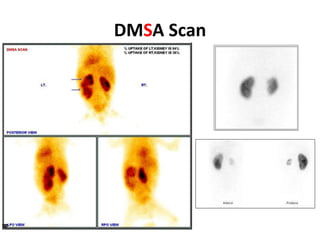
• Clinical Indications:
• Assessment of Renal Scarring
• Urinary Tract Infection
• Pyelonephritis
• Renal infarct
• Horseshoe kidney
• Ectopic kidney
DMSA Scan
DMSA Scan
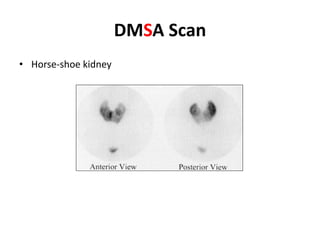
• Horse-shoe kidney
DMSA Scan
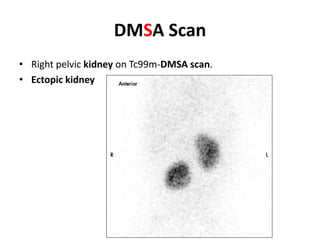
• Right pelvic kidney on Tc99m-DMSA scan.
• Ectopic kidney
Bone Scan
Bone Scan
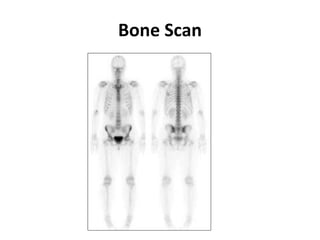
• A Bone scan is a two part test involving an
intravenous radioactive injection (Technetium99m
HDP) followed by images of the blood flow and blood
pool to the area of interest.
• The HDP takes 2-3 hours to be absorbed by the
bones, so a delay is required in order to visualise the
bone structures.
Bone Scan
• Clinical Indications:
• Metastatic Disease
• Primary Malignant Bone Tumours
• Benign Primary Tumours
• Osteomyelitis
• Septic Arthritis
• Fractures - Traumatic, Stress, Insufficiency
• Paget’s Disease
• Avascular Necrosis
• Legg-Calve Perthes Disease
• Arthritides - Degenerative Joint Disease, Rheumatoid Arthritis,
Pseudoarthritis.
Bone Scan
Bone Scan
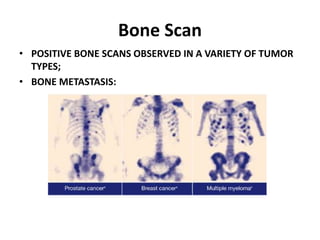
• POSITIVE BONE SCANS OBSERVED IN A VARIETY OF TUMOR
TYPES;
• BONE METASTASIS:
HIDA SCAN
HIDA SCAN
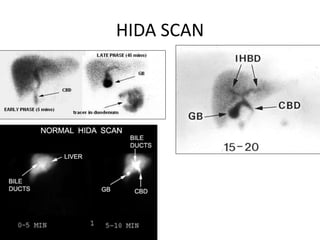
• Patients will be injected with Technetium99m Hepatolite (HIDA) .
• Hydroxy imino diacetic acid (HIDA).
• Images will be taken of the liver and gallbladder for about 60 minutes.
• After this time, we will determine if the patient requires a CCK
infusion or a morphine injection.
• The CCK infusion simulates the patient eating a fatty meal, so if the
gallbladder is visualised, we should expect it to empty after the CCK
infusion.
• However, if the gallbladder is not seen after 60 minutes and infusion
of morphine may be given to contract the sphincter of Oddi, which
increases biliary pressure, in order to help visualise the gallbladder.
HIDA SCAN
• Clinical Indications:
• Biliary atresia
• Neonatal hepatitis (Parenchymal liver dis)
• Abnormal biliary leakage
• Acute Cholecystitis
• Chronic Cholecystitis
HIDA SCAN
• Interpretation
• A normal result means that the gallbladder is visualized within 1 hour
of the injection and the tracer is in the small intestine.
• GB not visualized: If the gallbladder is not visualized within 4 hours
after the injection it indicates that there is either cholecystitis or cystic
duct obstruction.
• Tracer not visualized in intestines means common bile duct
obstruction. If the radioactive tracer moves through bile ducts very
slowly, this may indicate a blockage or obstruction. Or it may indicate a
problem in liver. .
• If the radioactive tracer is found outside of biliary system it indicates
a leak.
• Uptake is poor in parenchymal liver disease, such as neonatal
hepatitis, but excretion into the bile and intestine eventually ensues.
HIDA SCAN
• Imaging results are best when scanning is preceded by a 5-7 day
period of treatment with phenobarbital to stimulate bile flow.
• After intravenous injection, the isotope is normally detected in the
bowel within 1-2 hr.
• In the presence of extrahepatic obstruction, excretion of the isotope
is delayed; accordingly, serial scans should be made for up to 24 hr
after injection.
• Early in the course of biliary atresia, hepatocyte function is usually
good; uptake (clearance) occurs rapidly, but excretion into the
intestine is absent. Visualization of bowel excludes biliary atresia.
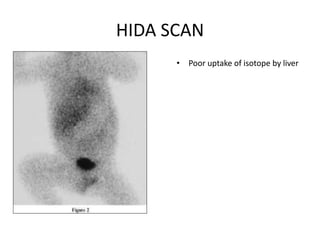
• In contrast, uptake is poor in parenchymal liver disease, such as
neonatal hepatitis, but excretion into the bile and intestine
eventually ensues. Visualization of bowel by 4-24 hrs more typical
of neonatal hepatitis.
HIDA SCAN
HIDA SCAN
HIDA SCAN
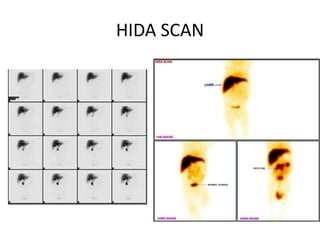
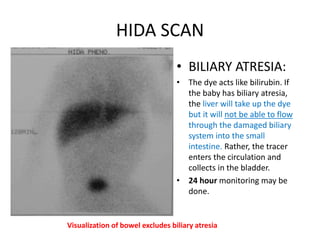
• BILIARY ATRESIA:
• The dye acts like bilirubin. If
the baby has biliary atresia,
the liver will take up the dye
but it will not be able to flow
through the damaged biliary
system into the small
intestine. Rather, the tracer
enters the circulation and
collects in the bladder.
• 24 hour monitoring may be
done.
Visualization of bowel excludes biliary atresia
HIDA SCAN
• Poor uptake of isotope by liver
Lung Scan (V/Q)
Lung Scan (V/Q)
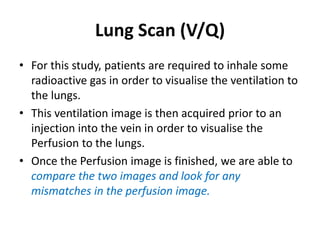
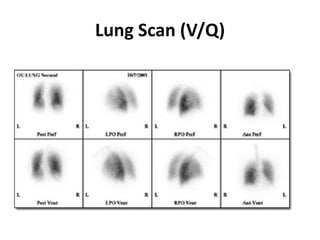
• For this study, patients are required to inhale some
radioactive gas in order to visualise the ventilation to
the lungs.
• This ventilation image is then acquired prior to an
injection into the vein in order to visualise the
Perfusion to the lungs.
• Once the Perfusion image is finished, we are able to
compare the two images and look for any
mismatches in the perfusion image.
Lung Scan (V/Q)
• Clinical Indications:
• Pulmonary Embolism
• Assessment prior to lung reduction surgery
Lung Scan (V/Q)
Lung Scan (V/Q)
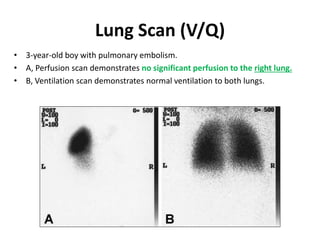
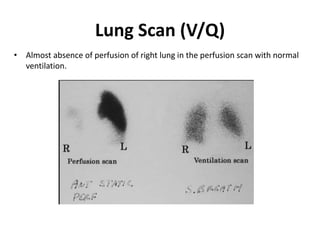
• 3-year-old boy with pulmonary embolism.
• A, Perfusion scan demonstrates no significant perfusion to the right lung.
• B, Ventilation scan demonstrates normal ventilation to both lungs.
Lung Scan (V/Q)
• Almost absence of perfusion of right lung in the perfusion scan with normal
ventilation.
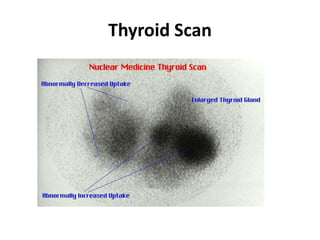
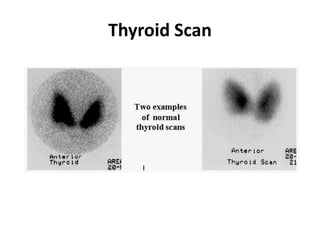
Thyroid Scan
Thyroid Scan
• A thyroid scan involves an intravenous
injection of Technetium Pertechnetate.
• Enables us to determine the function of the
thyroid gland with or without the presence of
nodules.
• It also determines the presence and site of the
thyroid tissue such as in thyroid bed of a
completely excised gland or in other locations
(ie sublingual). (ectopic)
Thyroid Scan
• Clinical Indications:
• Hyperthyroidism - determine cause
• Nodules - Assess activity
• Find ectopic thyroid site
• This scan has no role in the evaluation of hypothyroidism
without the presence of nodules
Thyroid Scan
Thyroid Scan
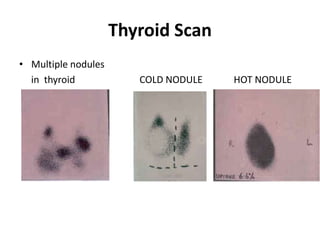
• Multiple nodules
in thyroid COLD NODULE HOT NODULE
Thyroid Scan
Thank you!
http://oscepediatrics.blogspot.in/
http://www.slideshare.net/Dr_Padmesh

Scans.. Dr.Padmesh

  • 1.
  • 2.
  • 3.
    Diuretic Renal scans: •These are primarily done to rule out obstruction at Pelvi-ureteric or Vesico-ureteric junction in a child with hydronephrosis. • Additionally, information about the function of each kidney can be gathered. • There are 3 agents which can be used for a diuretic renal scan- DTPA or MAG3 or LLEC. • All three are good but LLEC is supposed to be the best as the image quality is the best.
  • 4.
    DTPA / MAG3 Scan • Involves an injection of either DTPA (99mTc- diethylene triamine pentaacetic acid) or MAG3 followed by immediate images of the kidneys as the injection enters the body. • In doing this, we can get information on – renal blood flow, – GFR, – tubular function and – urinary excretion.
  • 5.
    DTPA / MAG3 Scan • Clinical Indications: • Assessment of GFR • Differential renal function • Acute renal failure • Chronic renal failure • Acute & chronic rejection • Screening of patients with suspected renal hypertension • Obstruction • Hydronephrosis
  • 6.
    DTPA / MAG3 Scan
  • 7.
    DTPA / MAG3 Scan DTPA scan showing retention of isotope in Left kidney, right kidney has cleared off well.
  • 8.
  • 9.
    DMSA Scan • Technetium99mDMSA (Di mercapto succinic acid) is the radiotracer that is injected intravenously into the patient in order to visualise the renal cortex of the kidneys. • This injection will take 3 hours to be bound to the kidneys before any imaging can commence.
  • 10.
    DMSA Scan • ClinicalIndications: • Assessment of Renal Scarring • Urinary Tract Infection • Pyelonephritis • Renal infarct • Horseshoe kidney • Ectopic kidney
  • 11.
  • 12.
  • 13.
    DMSA Scan • Rightpelvic kidney on Tc99m-DMSA scan. • Ectopic kidney
  • 14.
  • 15.
    Bone Scan • ABone scan is a two part test involving an intravenous radioactive injection (Technetium99m HDP) followed by images of the blood flow and blood pool to the area of interest. • The HDP takes 2-3 hours to be absorbed by the bones, so a delay is required in order to visualise the bone structures.
  • 16.
    Bone Scan • ClinicalIndications: • Metastatic Disease • Primary Malignant Bone Tumours • Benign Primary Tumours • Osteomyelitis • Septic Arthritis • Fractures - Traumatic, Stress, Insufficiency • Paget’s Disease • Avascular Necrosis • Legg-Calve Perthes Disease • Arthritides - Degenerative Joint Disease, Rheumatoid Arthritis, Pseudoarthritis.
  • 17.
  • 18.
    Bone Scan • POSITIVEBONE SCANS OBSERVED IN A VARIETY OF TUMOR TYPES; • BONE METASTASIS:
  • 19.
  • 20.
    HIDA SCAN • Patientswill be injected with Technetium99m Hepatolite (HIDA) . • Hydroxy imino diacetic acid (HIDA). • Images will be taken of the liver and gallbladder for about 60 minutes. • After this time, we will determine if the patient requires a CCK infusion or a morphine injection. • The CCK infusion simulates the patient eating a fatty meal, so if the gallbladder is visualised, we should expect it to empty after the CCK infusion. • However, if the gallbladder is not seen after 60 minutes and infusion of morphine may be given to contract the sphincter of Oddi, which increases biliary pressure, in order to help visualise the gallbladder.
  • 21.
    HIDA SCAN • ClinicalIndications: • Biliary atresia • Neonatal hepatitis (Parenchymal liver dis) • Abnormal biliary leakage • Acute Cholecystitis • Chronic Cholecystitis
  • 22.
    HIDA SCAN • Interpretation •A normal result means that the gallbladder is visualized within 1 hour of the injection and the tracer is in the small intestine. • GB not visualized: If the gallbladder is not visualized within 4 hours after the injection it indicates that there is either cholecystitis or cystic duct obstruction. • Tracer not visualized in intestines means common bile duct obstruction. If the radioactive tracer moves through bile ducts very slowly, this may indicate a blockage or obstruction. Or it may indicate a problem in liver. . • If the radioactive tracer is found outside of biliary system it indicates a leak. • Uptake is poor in parenchymal liver disease, such as neonatal hepatitis, but excretion into the bile and intestine eventually ensues.
  • 23.
    HIDA SCAN • Imagingresults are best when scanning is preceded by a 5-7 day period of treatment with phenobarbital to stimulate bile flow. • After intravenous injection, the isotope is normally detected in the bowel within 1-2 hr. • In the presence of extrahepatic obstruction, excretion of the isotope is delayed; accordingly, serial scans should be made for up to 24 hr after injection. • Early in the course of biliary atresia, hepatocyte function is usually good; uptake (clearance) occurs rapidly, but excretion into the intestine is absent. Visualization of bowel excludes biliary atresia. • In contrast, uptake is poor in parenchymal liver disease, such as neonatal hepatitis, but excretion into the bile and intestine eventually ensues. Visualization of bowel by 4-24 hrs more typical of neonatal hepatitis.
  • 24.
  • 25.
  • 26.
    HIDA SCAN • BILIARYATRESIA: • The dye acts like bilirubin. If the baby has biliary atresia, the liver will take up the dye but it will not be able to flow through the damaged biliary system into the small intestine. Rather, the tracer enters the circulation and collects in the bladder. • 24 hour monitoring may be done. Visualization of bowel excludes biliary atresia
  • 27.
    HIDA SCAN • Pooruptake of isotope by liver
  • 28.
  • 29.
    Lung Scan (V/Q) •For this study, patients are required to inhale some radioactive gas in order to visualise the ventilation to the lungs. • This ventilation image is then acquired prior to an injection into the vein in order to visualise the Perfusion to the lungs. • Once the Perfusion image is finished, we are able to compare the two images and look for any mismatches in the perfusion image.
  • 30.
    Lung Scan (V/Q) •Clinical Indications: • Pulmonary Embolism • Assessment prior to lung reduction surgery
  • 31.
  • 32.
    Lung Scan (V/Q) •3-year-old boy with pulmonary embolism. • A, Perfusion scan demonstrates no significant perfusion to the right lung. • B, Ventilation scan demonstrates normal ventilation to both lungs.
  • 33.
    Lung Scan (V/Q) •Almost absence of perfusion of right lung in the perfusion scan with normal ventilation.
  • 34.
  • 35.
    Thyroid Scan • Athyroid scan involves an intravenous injection of Technetium Pertechnetate. • Enables us to determine the function of the thyroid gland with or without the presence of nodules. • It also determines the presence and site of the thyroid tissue such as in thyroid bed of a completely excised gland or in other locations (ie sublingual). (ectopic)
  • 36.
    Thyroid Scan • ClinicalIndications: • Hyperthyroidism - determine cause • Nodules - Assess activity • Find ectopic thyroid site • This scan has no role in the evaluation of hypothyroidism without the presence of nodules
  • 37.
  • 38.
    Thyroid Scan • Multiplenodules in thyroid COLD NODULE HOT NODULE
  • 39.
  • 40.