






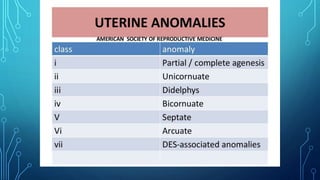
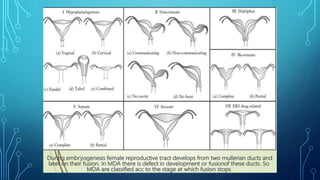

HYSTEROSALPINGOGRAPHY
PRESENTER-DR.NABA KUMAR BARMAN, JR 1
MODERATOR-DR. SUNIL KUMAR MD
The radiographic evaluation of the uterine cavity and
fallopian tubes after the administration of a radio-
opaque medium under fluoroscopic control
Most common indication – infertility- primary/ secondary
Other indications include
• Recurrent abortions.
• Pelvic pain.
• Prior to or after tubal surgery, tubal recanalization or other
intervention.
• Prior to treatment with assisted reproductive techniques.
• Congenital abnormalities or anatomic variants.
Uterine and tubal lesion like tuberculosis ,submucous fibroid
polyp synechiae
• Suspected pregnancy
• Acute pelvic infection
• Active vaginal bleeding, during menstruation
• Recent dilation and curettage
• Tubal or uterine surgery within last 6 weeks
• Contrast sensitivity
Means the procedure should not be performed beyond 10 days
from the start of the last menses.
Other considerations-
If the patient has cycles longer than 28 days, the 10-day rule
can be stretched to 12-13 days.
• Patient to avoid unprotected sexual intercourse from the date
of her period until investigation is over to avoid possible risk of
pregnancy
If the patient has irregular cycles or absent menses, a
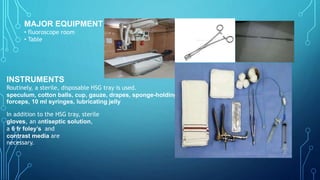
MAJOR EQUIPMENT
• fluoroscope room
• Table
INSTRUMENTS
Routinely, a sterile, disposable HSG tray is used.
speculum, cotton balls, cup, gauze, drapes, sponge-holding
forceps, 10 ml syringes, lubricating jelly
In addition to the HSG tray, sterile
gloves, an antiseptic solution,
a 6 fr foley’s and
contrast media are
necessary.
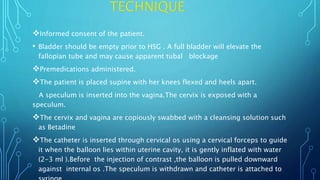
Informed consent of the patient.
• Bladder should be empty prior to HSG . A full bladder will elevate the
fallopian tube and may cause apparent tubal blockage
Premedications administered.
The patient is placed supine with her knees flexed and heels apart.
A speculum is inserted into the vagina.The cervix is exposed with a
speculum.
The cervix and vagina are copiously swabbed with a cleansing solution such
as Betadine
The catheter is inserted through cervical os using a cervical forceps to guide
it when the balloon lies within uterine cavity, it is gently inflated with water
(2-3 ml ).Before the injection of contrast ,the balloon is pulled downward
against internal os .The speculum is withdrawn and catheter is attached to
Water-soluble iodinated contrast media is preferred.
Amount of contrast medium to be introduced is variable.
On average, approx. 5 ml is necessary to fill uterine cavity, and
additional 5 ml needed to demonstrate tubal patency.
The contrast is diluted in the ratio of 2: 1 .
Using fluoroscopic guidance, contrast agent is slowly injected,
usually 5–10 ml over 1 min and radiographs are obtained.
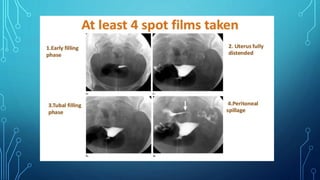
Early filling phase of the uterus -to evaluate for any filling
defect or contour abnormality.
Fully distended uterus – best for evaluating the shape.
Filled fallopian tube to demonstrate and evaluate the fallopian
tube.
Free intraperitoneal spillage to document tubal patency.
• Additional oblique views may be taken for optimal visualisation
of pelvic pathology and tortuous fallopian tubes( to see
retroverted or anteverted)
• After end of the procedure , antibiotic course is given and
patient is informed about vaginal spotting for 1-2 days
Mild discomfort or pain.
Mild vaginal bleeding.
Vasovagal reactions and hyperventilation.
Pelvic infection - a serious complication of HSG.
Venous or lymphatic intravasation of contrast media.
An allergic or idiosyncratic reaction.
Radiation exposure - a cause of concern.
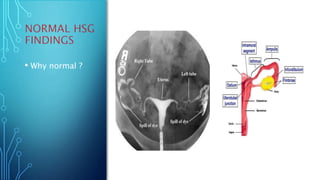
• Why normal ?
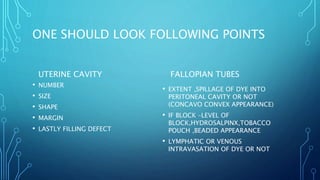
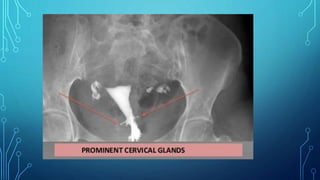
ONE SHOULD LOOK FOLLOWING POINTS
UTERINE CAVITY
• NUMBER
• SIZE
• SHAPE
• MARGIN
• LASTLY FILLING DEFECT
FALLOPIAN TUBES
• EXTENT ,SPILLAGE OF DYE INTO
PERITONEAL CAVITY OR NOT
(CONCAVO CONVEX APPEARANCE)
• IF BLOCK –LEVEL OF
BLOCK,HYDROSALPINX,TOBACCO
POUCH ,BEADED APPEARANCE
• LYMPHATIC OR VENOUS
INTRAVASATION OF DYE OR NOT
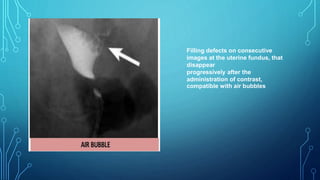
Filling defects on consecutive
images at the uterine fundus, that
disappear
progressively after the
administration of contrast,
compatible with air bubbles
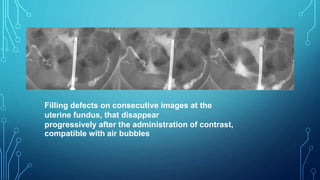
Filling defects on consecutive images at the
uterine fundus, that disappear
progressively after the administration of contrast,
compatible with air bubbles
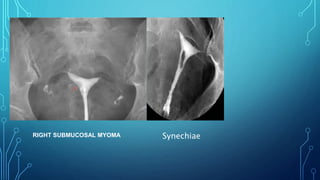
DIFFERENTIALS
Fibroid.
Endometrial polyp.
Synechiae
Air bubbles.
(often mobile or transient and are expelled into the tubes)
RIGHT SUBMUCOSAL MYOMA Synechiae
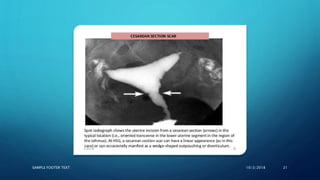
SAMPLE FOOTER TEXT 10/3/2018 21
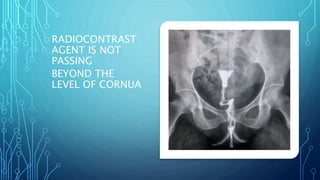
RADIOCONTRAST
AGENT IS NOT
PASSING
BEYOND THE
LEVEL OF CORNUA
Most common finding- may be d/t
 Tubal block
 Tubal spasm
Attempt to differentiate-
• Administration of spasmolytic.
• Progressive administration of contrast medium.
• Selective cannulation of the fallopian tubes may be performed.
These cannot be reliably differentiated on radiography – a limitation.
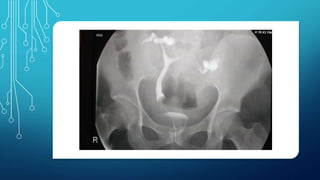
Almost always a result of a past pelvic infection.
Most common are - gonorrhea, chlamydia,
staphylococcus, streptococcus,
pelvic tuberculosis.
Other causes-
Endometriosis.
Adhesion formation from surgery.
Carcinoma of the tube, ovary or other surrounding organs.
MANAGEMENT
Treatment options available- Tubal repair surgeries
IVF
The prognosis of repair may be assessed by degree of
dilatation-
• <1.5 cm favourable prognosis
• >3 cm unfavourable prognosis
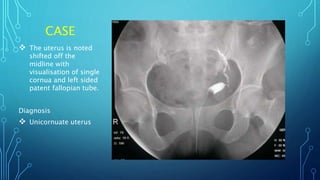
CASE
 The uterus is noted
shifted off the
midline with
visualisation of single
cornua and left sided
patent fallopian tube.
Diagnosis
 Unicornuate uterus
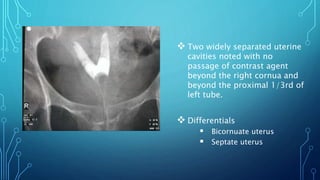
 Two widely separated uterine
cavities noted with no
passage of contrast agent
beyond the right cornua and
beyond the proximal 1/3rd of
left tube.
 Differentials
 Bicornuate uterus
 Septate uterus
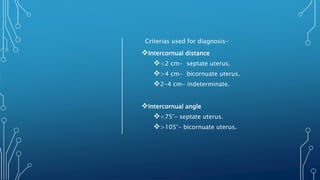
Criterias used for diagnosis-
Intercornual distance
<2 cm- septate uterus.
>4 cm- bicornuate uterus.
2-4 cm- indeterminate.
Intercornual angle
<75°- septate uterus.
>105°- bicornuate uterus.
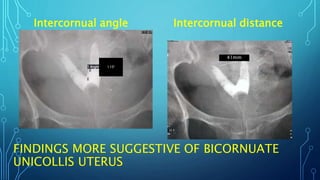
FINDINGS MORE SUGGESTIVE OF BICORNUATE
UNICOLLIS UTERUS
Intercornual angle Intercornual distance
41mm
110°
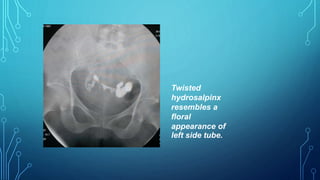
Twisted
hydrosalpinx
resembles a
floral
appearance of
left side tube.
HSG FINDINDS IN GENITAL
TUBERCULOSIS
FALLOPIAN TUBES
 SPECIFIC
Beaded tube
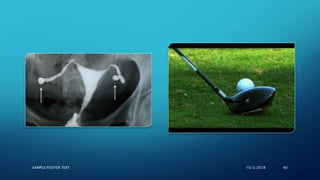
Golf club tube
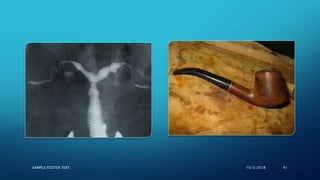
Pipe stem tube
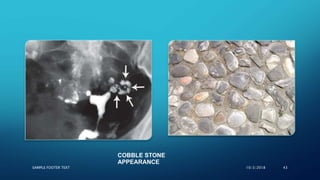
Cobblestone tube
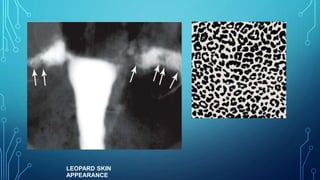
Leopard skin tube
 NON SPECIFIC
Hydrosalpinx
Mucosal thickening
Peri tubal adhesion
SPECIFIC
T shaped uterus
Pseudounicornuate
uterus
Trifoliate uterus
NONSPECIFIC
endometritis
Synechiae
distortion of uterine Contour
Venous, lymphatic intravasation
UTERUS
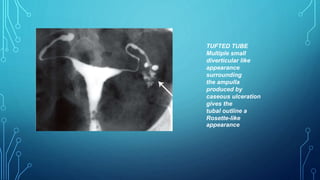
TUFTED TUBE
Multiple small
diverticular like
appearance
surrounding
the ampulla
produced by
caseous ulceration
gives the
tubal outline a
Rosette-like
appearance
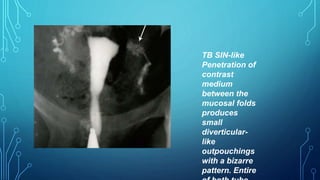
TB SIN-like
Penetration of
contrast
medium
between the
mucosal folds
produces
small
diverticular-
like
outpouchings
with a bizarre
pattern. Entire
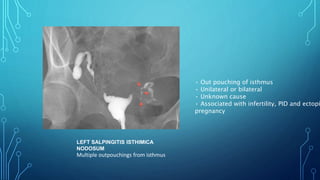
• Out pouching of isthmus
• Unilateral or bilateral
• Unknown cause
• Associated with infertility, PID and ectopi
pregnancy
LEFT SALPINGITIS ISTHIMICA
NODOSUM
Multiple outpouchings from isthmus
cotton-wool plug appearance
Distribution of contrast medium in a
reticular pattern
producing a " cotton-wool plug"
appearance [arrow]
BEADED TUBE
Multiple constrictions along the
fallopian tube giving rise to
a " beaded" appearance [arrows]
SAMPLE FOOTER TEXT 10/3/2018 40
SAMPLE FOOTER TEXT 10/3/2018 41
LEOPARD SKIN
APPEARANCE
SAMPLE FOOTER TEXT 10/3/2018 43
COBBLE STONE
APPEARANCE
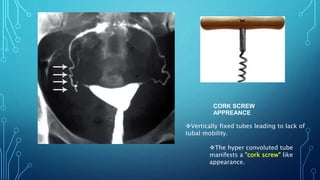
CORK SCREW
APPREANCE
Vertically fixed tubes leading to lack of
tubal mobility.
The hyper convoluted tube
manifests a "cork screw" like
appearance.
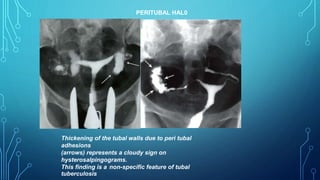
PERITUBAL HAL0
Thickening of the tubal walls due to peri tubal
adhesions
(arrows) represents a cloudy sign on
hysterosalpingograms.
This finding is a non-specific feature of tubal
tuberculosis
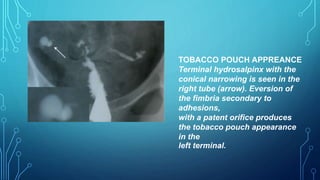
TOBACCO POUCH APPREANCE
Terminal hydrosalpinx with the
conical narrowing is seen in the
right tube (arrow). Eversion of
the fimbria secondary to
adhesions,
with a patent orifice produces
the tobacco pouch appearance
in the
left terminal.
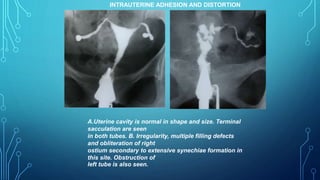
INTRAUTERINE ADHESION AND DISTORTION
A.Uterine cavity is normal in shape and size. Terminal
sacculation are seen
in both tubes. B. Irregularity, multiple filling defects
and obliteration of right
ostium secondary to extensive synechiae formation in
this site. Obstruction of
left tube is also seen.
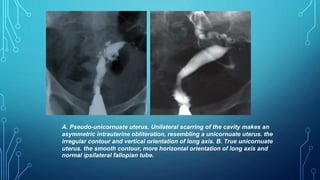
A. Pseudo-unicornuate uterus. Unilateral scarring of the cavity makes an
asymmetric intrauterine obliteration, resembling a unicornuate uterus. the
irregular contour and vertical orientation of long axis. B. True unicornuate
uterus. the smooth contour, more horizontal orientation of long axis and
normal ipsilateral fallopian tube.
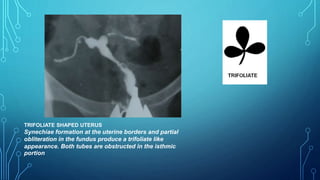
TRIFOLIATE SHAPED UTERUS
Synechiae formation at the uterine borders and partial
obliteration in the fundus produce a trifoliate like
appearance. Both tubes are obstructed in the isthmic
portion
THANK YOU

Hsg ppt

  • 1.
  • 2.
    The radiographic evaluationof the uterine cavity and fallopian tubes after the administration of a radio- opaque medium under fluoroscopic control
  • 3.
    Most common indication– infertility- primary/ secondary Other indications include • Recurrent abortions. • Pelvic pain. • Prior to or after tubal surgery, tubal recanalization or other intervention. • Prior to treatment with assisted reproductive techniques. • Congenital abnormalities or anatomic variants. Uterine and tubal lesion like tuberculosis ,submucous fibroid polyp synechiae
  • 4.
    • Suspected pregnancy •Acute pelvic infection • Active vaginal bleeding, during menstruation • Recent dilation and curettage • Tubal or uterine surgery within last 6 weeks • Contrast sensitivity
  • 5.
    Means the procedureshould not be performed beyond 10 days from the start of the last menses. Other considerations- If the patient has cycles longer than 28 days, the 10-day rule can be stretched to 12-13 days. • Patient to avoid unprotected sexual intercourse from the date of her period until investigation is over to avoid possible risk of pregnancy If the patient has irregular cycles or absent menses, a
  • 6.
    MAJOR EQUIPMENT • fluoroscoperoom • Table INSTRUMENTS Routinely, a sterile, disposable HSG tray is used. speculum, cotton balls, cup, gauze, drapes, sponge-holding forceps, 10 ml syringes, lubricating jelly In addition to the HSG tray, sterile gloves, an antiseptic solution, a 6 fr foley’s and contrast media are necessary.
  • 7.
    Informed consent ofthe patient. • Bladder should be empty prior to HSG . A full bladder will elevate the fallopian tube and may cause apparent tubal blockage Premedications administered. The patient is placed supine with her knees flexed and heels apart. A speculum is inserted into the vagina.The cervix is exposed with a speculum. The cervix and vagina are copiously swabbed with a cleansing solution such as Betadine The catheter is inserted through cervical os using a cervical forceps to guide it when the balloon lies within uterine cavity, it is gently inflated with water (2-3 ml ).Before the injection of contrast ,the balloon is pulled downward against internal os .The speculum is withdrawn and catheter is attached to
  • 8.
    Water-soluble iodinated contrastmedia is preferred. Amount of contrast medium to be introduced is variable. On average, approx. 5 ml is necessary to fill uterine cavity, and additional 5 ml needed to demonstrate tubal patency. The contrast is diluted in the ratio of 2: 1 . Using fluoroscopic guidance, contrast agent is slowly injected, usually 5–10 ml over 1 min and radiographs are obtained.
  • 9.
    Early filling phaseof the uterus -to evaluate for any filling defect or contour abnormality. Fully distended uterus – best for evaluating the shape. Filled fallopian tube to demonstrate and evaluate the fallopian tube. Free intraperitoneal spillage to document tubal patency. • Additional oblique views may be taken for optimal visualisation of pelvic pathology and tortuous fallopian tubes( to see retroverted or anteverted) • After end of the procedure , antibiotic course is given and patient is informed about vaginal spotting for 1-2 days
  • 11.
    Mild discomfort orpain. Mild vaginal bleeding. Vasovagal reactions and hyperventilation. Pelvic infection - a serious complication of HSG. Venous or lymphatic intravasation of contrast media. An allergic or idiosyncratic reaction. Radiation exposure - a cause of concern.
  • 12.
  • 13.
    ONE SHOULD LOOKFOLLOWING POINTS UTERINE CAVITY • NUMBER • SIZE • SHAPE • MARGIN • LASTLY FILLING DEFECT FALLOPIAN TUBES • EXTENT ,SPILLAGE OF DYE INTO PERITONEAL CAVITY OR NOT (CONCAVO CONVEX APPEARANCE) • IF BLOCK –LEVEL OF BLOCK,HYDROSALPINX,TOBACCO POUCH ,BEADED APPEARANCE • LYMPHATIC OR VENOUS INTRAVASATION OF DYE OR NOT
  • 16.
    Filling defects onconsecutive images at the uterine fundus, that disappear progressively after the administration of contrast, compatible with air bubbles
  • 17.
    Filling defects onconsecutive images at the uterine fundus, that disappear progressively after the administration of contrast, compatible with air bubbles
  • 18.
  • 19.
  • 21.
    SAMPLE FOOTER TEXT10/3/2018 21
  • 22.
  • 23.
    Most common finding-may be d/t  Tubal block  Tubal spasm Attempt to differentiate- • Administration of spasmolytic. • Progressive administration of contrast medium. • Selective cannulation of the fallopian tubes may be performed. These cannot be reliably differentiated on radiography – a limitation.
  • 25.
    Almost always aresult of a past pelvic infection. Most common are - gonorrhea, chlamydia, staphylococcus, streptococcus, pelvic tuberculosis. Other causes- Endometriosis. Adhesion formation from surgery. Carcinoma of the tube, ovary or other surrounding organs.
  • 26.
    MANAGEMENT Treatment options available-Tubal repair surgeries IVF The prognosis of repair may be assessed by degree of dilatation- • <1.5 cm favourable prognosis • >3 cm unfavourable prognosis
  • 27.
    CASE  The uterusis noted shifted off the midline with visualisation of single cornua and left sided patent fallopian tube. Diagnosis  Unicornuate uterus
  • 30.
     Two widelyseparated uterine cavities noted with no passage of contrast agent beyond the right cornua and beyond the proximal 1/3rd of left tube.  Differentials  Bicornuate uterus  Septate uterus
  • 31.
    Criterias used fordiagnosis- Intercornual distance <2 cm- septate uterus. >4 cm- bicornuate uterus. 2-4 cm- indeterminate. Intercornual angle <75°- septate uterus. >105°- bicornuate uterus.
  • 32.
    FINDINGS MORE SUGGESTIVEOF BICORNUATE UNICOLLIS UTERUS Intercornual angle Intercornual distance 41mm 110°
  • 33.
  • 34.
    HSG FINDINDS INGENITAL TUBERCULOSIS FALLOPIAN TUBES  SPECIFIC Beaded tube Golf club tube Pipe stem tube Cobblestone tube Leopard skin tube  NON SPECIFIC Hydrosalpinx Mucosal thickening Peri tubal adhesion SPECIFIC T shaped uterus Pseudounicornuate uterus Trifoliate uterus NONSPECIFIC endometritis Synechiae distortion of uterine Contour Venous, lymphatic intravasation UTERUS
  • 35.
    TUFTED TUBE Multiple small diverticularlike appearance surrounding the ampulla produced by caseous ulceration gives the tubal outline a Rosette-like appearance
  • 36.
    TB SIN-like Penetration of contrast medium betweenthe mucosal folds produces small diverticular- like outpouchings with a bizarre pattern. Entire
  • 37.
    • Out pouchingof isthmus • Unilateral or bilateral • Unknown cause • Associated with infertility, PID and ectopi pregnancy LEFT SALPINGITIS ISTHIMICA NODOSUM Multiple outpouchings from isthmus
  • 38.
    cotton-wool plug appearance Distributionof contrast medium in a reticular pattern producing a " cotton-wool plug" appearance [arrow]
  • 39.
    BEADED TUBE Multiple constrictionsalong the fallopian tube giving rise to a " beaded" appearance [arrows]
  • 40.
    SAMPLE FOOTER TEXT10/3/2018 40
  • 41.
    SAMPLE FOOTER TEXT10/3/2018 41
  • 42.
  • 43.
    SAMPLE FOOTER TEXT10/3/2018 43 COBBLE STONE APPEARANCE
  • 44.
    CORK SCREW APPREANCE Vertically fixedtubes leading to lack of tubal mobility. The hyper convoluted tube manifests a "cork screw" like appearance.
  • 45.
    PERITUBAL HAL0 Thickening ofthe tubal walls due to peri tubal adhesions (arrows) represents a cloudy sign on hysterosalpingograms. This finding is a non-specific feature of tubal tuberculosis
  • 46.
    TOBACCO POUCH APPREANCE Terminalhydrosalpinx with the conical narrowing is seen in the right tube (arrow). Eversion of the fimbria secondary to adhesions, with a patent orifice produces the tobacco pouch appearance in the left terminal.
  • 47.
    INTRAUTERINE ADHESION ANDDISTORTION A.Uterine cavity is normal in shape and size. Terminal sacculation are seen in both tubes. B. Irregularity, multiple filling defects and obliteration of right ostium secondary to extensive synechiae formation in this site. Obstruction of left tube is also seen.
  • 48.
    A. Pseudo-unicornuate uterus.Unilateral scarring of the cavity makes an asymmetric intrauterine obliteration, resembling a unicornuate uterus. the irregular contour and vertical orientation of long axis. B. True unicornuate uterus. the smooth contour, more horizontal orientation of long axis and normal ipsilateral fallopian tube.
  • 49.
    TRIFOLIATE SHAPED UTERUS Synechiaeformation at the uterine borders and partial obliteration in the fundus produce a trifoliate like appearance. Both tubes are obstructed in the isthmic portion
  • 50.

Editor's Notes

  • #5 .(needs to be ruled out performing the examination before the ovulation phase)
  • #6 (menses start usually 14 days after ovulation)
  • #9 absorbed easily, does not leave a residue within reproductive tract, provides adequate visualization, however, cause pain &persist for hours after procedure. Particularly if an oil-based contrast agent is used, injection should be halted immediately if myometrial or venous intravasation is observed. (2 parts contrast & 1 part NS)
  • #10 Small filling defects are best seen at this stage.
  • #11 Spot radiograph obtained during the early filling stage of the uterus. Small filling defects are best seen at this stage On a radiograph obtained with the uterus fully distended with contrast material, portions of both fallopian tubes are opacified. Like images obtained during the early filling stage of the uterus, images obtained at full uterine distention allow evaluation for filling defects and contour abnormalities. However, small filling defects may be obscured when the uterus is well opacified Spot radiograph clearly depicts the interstitial, isthmic, and ampullary portions of both fallopian tubes. Spot radiograph shows intraperitoneal contrast material spillage from the fallopian tubes. In this case, the spillage outlines the convexity of the uterine fundus
  • #12 because the women being examined are of reproductive age.
  • #17 Spot radiograph shows air bubbles (arrow) in the left side of the uterus
  • #25 HSG findings- B/l distal tubal block leading to hydrosalpinx
  • #32 is the distance between the distal ends of the horns (ends that are continuous with fallopian tubes). is the angle formed by the most medial aspects of the 2 uterine hemicavities
  • #41 GOLF CLUB TUBE Sacculation of both tubes in distal portion with an associated hydrosalpinx giving a Golf club-like appearance (arrows)
  • #42 Absence of normal tortuosity and a curved or straight pipe like appearance show fibrotic stage of tuberculous salpingitis. Irregular contour of the uterine cavity with diminished capacity in the fundual portion resembling a septate uterus
  • #43 Multiple rounded filling defects following intraluminal granuloma formations within the hydrosalpinx, resembling a " leopard skin" appearance [arrows]
  • #44 Intraluminal scarring of the tube gives rises a cobblestone like appearance which is an effective radiographic sign of intraluminal adhesions
  • #45 Vertically fixed tubes secondary to dense peritubal adhesions. Dense connective tissue causes the lack of tubal mobility. The hyperconvulated right tube and manifests a " cork screw" like appearance [arrows]