ADVERSE
DRUG REACTIONS

By:Dr.Vijay Bhushanam T
Objectives
• Definition of terms associated with Adverse Drug
Reactions (ADRs)
• Classification of ADRs
• Discussion on each type of ADR with examples
Definitions
• Adverse Event (AE): Any untoward medical occurrence
that may present during treatment with a pharmaceutical
product but which does not necessarily have a causal
relationship with this treatment.
• Adverse Drug Reaction (ADR): Any noxious change
which is suspected to be due to a drug, occurs at doses
normally used in man, requires treatment or decrease in
dose or indicates caution in future use of the same drug.
• Therefore, an adverse drug reaction is an adverse event
with a causal link to a drug.
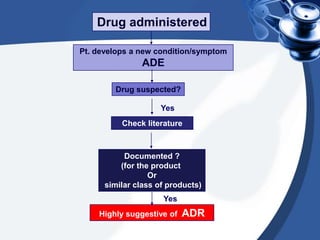
Drug administered
Pt. develops a new condition/symptom

ADE
Drug suspected?
Yes
Check literature

Documented ?
(for the product
Or
similar class of products)
Yes

Highly suggestive of

ADR
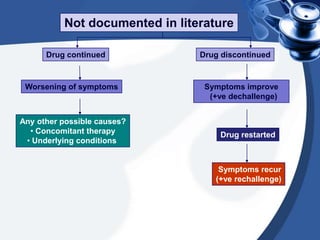
Not documented in literature
Drug continued

Worsening of symptoms

Any other possible causes?
• Concomitant therapy
• Underlying conditions

Drug discontinued

Symptoms improve
(+ve dechallenge)

Drug restarted

Symptoms recur
(+ve rechallenge)
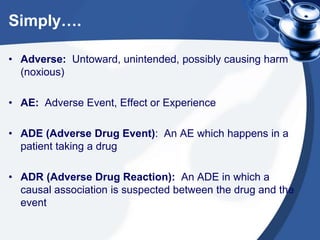
Simply….
• Adverse: Untoward, unintended, possibly causing harm
(noxious)
• AE: Adverse Event, Effect or Experience
• ADE (Adverse Drug Event): An AE which happens in a
patient taking a drug
• ADR (Adverse Drug Reaction): An ADE in which a
causal association is suspected between the drug and the
event
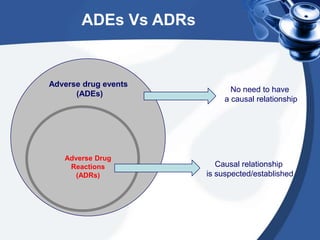
ADEs Vs ADRs

Adverse drug events
(ADEs)

Adverse Drug
Reactions
(ADRs)

No need to have
a causal relationship

Causal relationship
is suspected/established
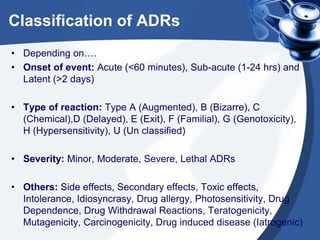
Classification of ADRs
• Depending on….
• Onset of event: Acute (<60 minutes), Sub-acute (1-24 hrs) and
Latent (>2 days)
• Type of reaction: Type A (Augmented), B (Bizarre), C
(Chemical),D (Delayed), E (Exit), F (Familial), G (Genotoxicity),
H (Hypersensitivity), U (Un classified)
• Severity: Minor, Moderate, Severe, Lethal ADRs
• Others: Side effects, Secondary effects, Toxic effects,
Intolerance, Idiosyncrasy, Drug allergy, Photosensitivity, Drug
Dependence, Drug Withdrawal Reactions, Teratogenicity,
Mutagenicity, Carcinogenicity, Drug induced disease (Iatrogenic)
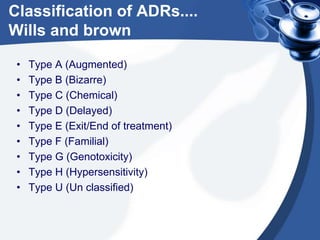
Classification of ADRs....
Wills and brown
•
•
•
•
•
•
•
•
•

Type A (Augmented)
Type B (Bizarre)
Type C (Chemical)
Type D (Delayed)
Type E (Exit/End of treatment)
Type F (Familial)
Type G (Genotoxicity)
Type H (Hypersensitivity)
Type U (Un classified)
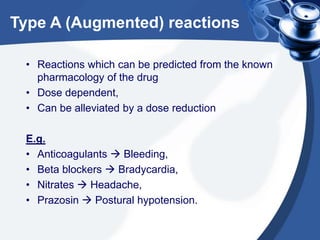
Type A (Augmented) reactions
• Reactions which can be predicted from the known
pharmacology of the drug
• Dose dependent,
• Can be alleviated by a dose reduction

E.g.
• Anticoagulants  Bleeding,
• Beta blockers  Bradycardia,
• Nitrates  Headache,
• Prazosin  Postural hypotension.
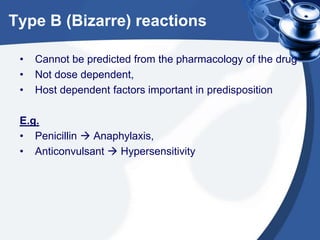
Type B (Bizarre) reactions
•
•
•

Cannot be predicted from the pharmacology of the drug
Not dose dependent,
Host dependent factors important in predisposition

E.g.
• Penicillin  Anaphylaxis,
• Anticonvulsant  Hypersensitivity
Type C (Chemical) reactions
• Biological characteristics can be predicted from the
chemical structure of the drug/metabolite

E.g.
• Paracetamol  Hepatotoxicity
Type D (Delayed) reactions
• Occur after many years of treatment.
• Can be due to accumulation.
E.g.
• Chemotherapy  Secondary tumours
• Phenytoin during pregnancy  Teratogenic effects
• Antipsychotics  Tardive dyskinesia
• Analgesics  Nephropathy
Type E (End of treatment) reactions
•

Occur on withdrawal especially when drug is stopped
abruptly

E.g.
• Phenytoin withdrawal  Seizures,
• Steroid withdrawal  Adrenocortical insufficiency.
Classification of ADRs….
Depending on Severity
• Minor ADRs: No therapy, antidote or prolongation of
hospitalization is required.
• Moderate ADRs: Requires change in drug therapy, specific
treatment or prolongs hospital stay by atleast 1 day.

• Severe ADRs: Potentially life threatening, causes
permanent damage or requires intensive medical treatment.
• Lethal: Directly or indirectly contributes to death of the
patient.
Side effects
• Unwanted but often unavoidable, pharmacodynamic effects
that occur at therapeutic doses
• Predicted from the pharmacological profile of a drug
• Known to occur in a given percentage of drug recipients
• E.g.
• Side effect based on therapeutic effect:
Atropine (preanaesthetic) dryness of mouth
Acetazolamide (diuretic-bicarbonate excretion) Acidosis
• Side effect based on a different action:
Promethazine (anti-allergic) sedation
Estrogen (Anti ovulatory)  Nausea
• Depending on the context:
Codeine (anti-tussive)  constipation Used in Traveller’s
diarrhea
Side effects….
• Drug discovery
• Occasionally, “adverse” effects may be exploited to develop an
entirely new indication for a drug.
• E.g:
• Unwanted hair growth during Minoxidil treatment of severely
hypertensive patients  development of the drug for hair
growth.
• Sildenafil was initially developed as an antianginal, but its
effects to alleviate erectile dysfunction  a new drug indication
in erectile tissue.
• Sulfonamides used as antibacterials were found to produce
hypoglycemia and acidosis as side effects  development of
Hypoglycemic Sulfonylureas and Carbonic anhydrase inhibitor
Acetazolamide.
Secondary effects
• Indirect consequences of a primary action of the drug
• E.g.
• Tetracyclines Suppression of bacterial flora
Superinfections
• Corticosteroids Weaken host defence Activation of
latent tuberculosis
Toxic effects
• Result of excessive pharmacological action of the drug
due to over dosage or prolonged use.
• Over dosage may be
1.
2.

Absolute (Accidental, homicidal, suicidal)
Relative (Gentamycin in Renal failure)

• Result from
1. Extension of therapeutic effect:
E.g. Barbiturates  Coma,
Digoxin  Complete A-V block,
Heparin  Bleeding
2. Functional alteration:
E.g. Atropine  Delirium
3. Drug induced tissue damage:
E.g. Paracetamol  Hepatic necrosis
Intolerance
• Appearance of characteristic toxic effects of a drug in an
individual at therapeutic doses
• Converse of tolerance,
• Indicates a low threshold of the individual
• E.g.
• Triflupromazine (single dose)  Muscular dystonias in
some individuals
• Carbamazepine (few doses) Ataxia in some individuals
• Chloroquine (single tablet)  Vomiting and abdominal
pain in some individuals
Idiosyncrasy
• Genetically determined abnormal reactivity to a chemical
• Certain Bizarre drug effects due to peculiarities of an
individual for which no definite genotype has been
described, are also included.
• Drug interacts with some unique feature of the individual,
not found in majority subjects, and produces the
uncharacteristic reaction.
• E.g.
• Barbiturates Excitement and mental confusion in some individuals
• Quinine  Cramps, diarrhea, asthma, vascular collapse in some
individuals
• Chloramphenicol  Aplastic anemia in rare individuals
Drug allergy
• Immunologically mediated reaction producing stereotype
symptoms, unrelated to the pharmacodynamic profile of the drug
• Generally occur even with much smaller doses
• Also called Drug hypersensitivity
• Types:
• Type I: Immediate, anaphylactic (IgE)
• E.g: Penicillins  Anaphylaxis
• Type II: Cytotoxic antibody (IgG, IgM)
Humoral
• E.g: Methyldopa  hemolytic anemia
immunity
• Type III: Serum sickness (IgG, IgM)
• Antigen-antibody complex
• E.g: Procainamide-induced lupus
• Type IV: Delayed hypersensitivity (T cell)
Cell mediated
immunity
• E.g: Contact dermatitis
Photosensitivity
• Cutaneous reaction resulting from drug induced sensitization of the
skin to UV radiation. The reactions are of two types
• Phototoxic: Drug or its metabolite accumulates in the skin, absorbs
light and undergoes a photochemical reaction resulting in local tissue
damage (sunburn-like, i.e., erythema, edema, blistering, hyper
pigmentation)
E.g. Tetracyclines (esp. Demeclocycline), and Tar products,
Nalidixic acid, Fluoroquinolones, Sulfones etc
• Photo allergic: Drug or its metabolite induces a cell mediated
immune response which on exposure to light (longer wave length)
produces a papular or eczematous contact dermatitis like picture.
E.g. Sulfonamides, Sulfonylureas, Griseofulvin, Chloroquine,
Chlorpromazine
Drug dependence
• Drugs capable of altering mood and feelings are liable to repetitive use
to derive euphoria, withdrawal from reality, social adjustment, etc.
• Psychological dependence: Individual believes that optimal state of
well being is achieved only through the actions of the drug.
• E.g. Opioids, Cocaine.
• Physical dependence: Altered physiological state produced by
repeated administration of a drug which necessitates the continued
presence of the drug to maintain physiological equilibrium.
Discontinuation of the drug results in a characteristic withdrawal
(abstinence) syndrome.
• E.g. Opioids, Barbiturates, Alcohol, Benzodiazepines
Drug dependence….
• Drug abuse: Use of a drug by self medication in a manner and
amount, that deviates from the approved medical and social
patterns in a given culture at a given time.
Drug abuse refers to any use of an illicit drug.
• Drug addiction: Compulsive drug use characterized by
overwhelming involvement with the use of a drug.
• Drug habituation: Less intensive involvement with the drug,
withdrawal produces only mild discomfort.

• Habituation and addiction imply different degrees of
psychological dependence.
Drug withdrawal reactions
• Sudden interruption of therapy with certain drugs result in
adverse consequences, mostly in the form of worsening
of the clinical condition for which the drug was being
used.
•
•
•
•

E.g:
Corticosteroid Adrenal insufficiency
β-blockers  worsening of angina, precipitation of MI
Clonidine  severe HTN, restlessness, sympathetic over
activity
Teratogenicity
• Capacity of a drug to cause foetal abnormalities when
administered to the pregnant mother.
• Drugs can affect the foetus at 3 stages:
1. Fertilization and implantation (Conception to 17 days):
failure of pregnancy which often goes unnoticed.
2. Organogenesis(18 days to 55 days): most vulnerable period,
deformities are produced.
3. Growth and development (> 56 days): developmental and
functional abnormalities can occur.
•
•
•
•

E.g:
Thalidomide Phocomelia, multiple defects
Anticancer drugs  Cleft palate, hydrocephalus, multiple defects
ACE inhibitors  Hypoplasia of organs (lungs, kidney)
Mutagenecity and
Carcinogenicity
• Capacity of a drug to cause genetic defects and
cancer respectively.
• Chemical carcinogenesis generally takes several
(10-40) years to develop.
•
•
•
•
•

E.g.
Anticancer drugs,
Radio-isotypes,
Estrogens,
Tobacco.
Drug induced disease
• Also called Iatrogenic(Physician induced) diseases.
• Functional disturbances caused by drugs which persist
even after the offending drug has been withdrawn and
largely eliminated
•
•
•
•
•

E.g.
Salicylates, Corticosteroids  Peptic ulcer
Phenothiazines, other antipsychotics  Parkinsonism
Isoniazid  Hepatitis
Hydralazine  DLE
Summary
• Adverse Drug Reactions (ADRs) are adverse events with a
causal link to a drug.
• Types of Classification of ADRs:
• Onset of event: Acute (<60 minutes), Sub-acute (1-24 hrs) and
Latent (>2 days)
• Type of reaction: Type A (Augmented), B (Bizarre), C
(Chemical),D (Delayed), E (Exit), F (Familial), G (Genotoxicity),
H (Hypersensitivity), U (Un classified)
• Severity: Minor, Moderate, Severe, Lethal ADRs
• Others: Side effects, Secondary effects, Toxic effects,
Intolerance, Idiosyncrasy, Drug allergy, Photosensitivity, Drug
Dependence, Drug Withdrawal Reactions, Teratogenicity,
Mutagenicity, Carcinogenicity, Drug induced disease
(Iatrogenic)

Adverse drug reactions

  • 1.
  • 2.
    Objectives • Definition ofterms associated with Adverse Drug Reactions (ADRs) • Classification of ADRs • Discussion on each type of ADR with examples
  • 3.
    Definitions • Adverse Event(AE): Any untoward medical occurrence that may present during treatment with a pharmaceutical product but which does not necessarily have a causal relationship with this treatment. • Adverse Drug Reaction (ADR): Any noxious change which is suspected to be due to a drug, occurs at doses normally used in man, requires treatment or decrease in dose or indicates caution in future use of the same drug. • Therefore, an adverse drug reaction is an adverse event with a causal link to a drug.
  • 4.
    Drug administered Pt. developsa new condition/symptom ADE Drug suspected? Yes Check literature Documented ? (for the product Or similar class of products) Yes Highly suggestive of ADR
  • 5.
    Not documented inliterature Drug continued Worsening of symptoms Any other possible causes? • Concomitant therapy • Underlying conditions Drug discontinued Symptoms improve (+ve dechallenge) Drug restarted Symptoms recur (+ve rechallenge)
  • 6.
    Simply…. • Adverse: Untoward,unintended, possibly causing harm (noxious) • AE: Adverse Event, Effect or Experience • ADE (Adverse Drug Event): An AE which happens in a patient taking a drug • ADR (Adverse Drug Reaction): An ADE in which a causal association is suspected between the drug and the event
  • 7.
    ADEs Vs ADRs Adversedrug events (ADEs) Adverse Drug Reactions (ADRs) No need to have a causal relationship Causal relationship is suspected/established
  • 8.
    Classification of ADRs •Depending on…. • Onset of event: Acute (<60 minutes), Sub-acute (1-24 hrs) and Latent (>2 days) • Type of reaction: Type A (Augmented), B (Bizarre), C (Chemical),D (Delayed), E (Exit), F (Familial), G (Genotoxicity), H (Hypersensitivity), U (Un classified) • Severity: Minor, Moderate, Severe, Lethal ADRs • Others: Side effects, Secondary effects, Toxic effects, Intolerance, Idiosyncrasy, Drug allergy, Photosensitivity, Drug Dependence, Drug Withdrawal Reactions, Teratogenicity, Mutagenicity, Carcinogenicity, Drug induced disease (Iatrogenic)
  • 9.
    Classification of ADRs.... Willsand brown • • • • • • • • • Type A (Augmented) Type B (Bizarre) Type C (Chemical) Type D (Delayed) Type E (Exit/End of treatment) Type F (Familial) Type G (Genotoxicity) Type H (Hypersensitivity) Type U (Un classified)
  • 10.
    Type A (Augmented)reactions • Reactions which can be predicted from the known pharmacology of the drug • Dose dependent, • Can be alleviated by a dose reduction E.g. • Anticoagulants  Bleeding, • Beta blockers  Bradycardia, • Nitrates  Headache, • Prazosin  Postural hypotension.
  • 11.
    Type B (Bizarre)reactions • • • Cannot be predicted from the pharmacology of the drug Not dose dependent, Host dependent factors important in predisposition E.g. • Penicillin  Anaphylaxis, • Anticonvulsant  Hypersensitivity
  • 12.
    Type C (Chemical)reactions • Biological characteristics can be predicted from the chemical structure of the drug/metabolite E.g. • Paracetamol  Hepatotoxicity
  • 13.
    Type D (Delayed)reactions • Occur after many years of treatment. • Can be due to accumulation. E.g. • Chemotherapy  Secondary tumours • Phenytoin during pregnancy  Teratogenic effects • Antipsychotics  Tardive dyskinesia • Analgesics  Nephropathy
  • 14.
    Type E (Endof treatment) reactions • Occur on withdrawal especially when drug is stopped abruptly E.g. • Phenytoin withdrawal  Seizures, • Steroid withdrawal  Adrenocortical insufficiency.
  • 15.
    Classification of ADRs…. Dependingon Severity • Minor ADRs: No therapy, antidote or prolongation of hospitalization is required. • Moderate ADRs: Requires change in drug therapy, specific treatment or prolongs hospital stay by atleast 1 day. • Severe ADRs: Potentially life threatening, causes permanent damage or requires intensive medical treatment. • Lethal: Directly or indirectly contributes to death of the patient.
  • 16.
    Side effects • Unwantedbut often unavoidable, pharmacodynamic effects that occur at therapeutic doses • Predicted from the pharmacological profile of a drug • Known to occur in a given percentage of drug recipients • E.g. • Side effect based on therapeutic effect: Atropine (preanaesthetic) dryness of mouth Acetazolamide (diuretic-bicarbonate excretion) Acidosis • Side effect based on a different action: Promethazine (anti-allergic) sedation Estrogen (Anti ovulatory)  Nausea • Depending on the context: Codeine (anti-tussive)  constipation Used in Traveller’s diarrhea
  • 17.
    Side effects…. • Drugdiscovery • Occasionally, “adverse” effects may be exploited to develop an entirely new indication for a drug. • E.g: • Unwanted hair growth during Minoxidil treatment of severely hypertensive patients  development of the drug for hair growth. • Sildenafil was initially developed as an antianginal, but its effects to alleviate erectile dysfunction  a new drug indication in erectile tissue. • Sulfonamides used as antibacterials were found to produce hypoglycemia and acidosis as side effects  development of Hypoglycemic Sulfonylureas and Carbonic anhydrase inhibitor Acetazolamide.
  • 18.
    Secondary effects • Indirectconsequences of a primary action of the drug • E.g. • Tetracyclines Suppression of bacterial flora Superinfections • Corticosteroids Weaken host defence Activation of latent tuberculosis
  • 19.
    Toxic effects • Resultof excessive pharmacological action of the drug due to over dosage or prolonged use. • Over dosage may be 1. 2. Absolute (Accidental, homicidal, suicidal) Relative (Gentamycin in Renal failure) • Result from 1. Extension of therapeutic effect: E.g. Barbiturates  Coma, Digoxin  Complete A-V block, Heparin  Bleeding 2. Functional alteration: E.g. Atropine  Delirium 3. Drug induced tissue damage: E.g. Paracetamol  Hepatic necrosis
  • 20.
    Intolerance • Appearance ofcharacteristic toxic effects of a drug in an individual at therapeutic doses • Converse of tolerance, • Indicates a low threshold of the individual • E.g. • Triflupromazine (single dose)  Muscular dystonias in some individuals • Carbamazepine (few doses) Ataxia in some individuals • Chloroquine (single tablet)  Vomiting and abdominal pain in some individuals
  • 21.
    Idiosyncrasy • Genetically determinedabnormal reactivity to a chemical • Certain Bizarre drug effects due to peculiarities of an individual for which no definite genotype has been described, are also included. • Drug interacts with some unique feature of the individual, not found in majority subjects, and produces the uncharacteristic reaction. • E.g. • Barbiturates Excitement and mental confusion in some individuals • Quinine  Cramps, diarrhea, asthma, vascular collapse in some individuals • Chloramphenicol  Aplastic anemia in rare individuals
  • 22.
    Drug allergy • Immunologicallymediated reaction producing stereotype symptoms, unrelated to the pharmacodynamic profile of the drug • Generally occur even with much smaller doses • Also called Drug hypersensitivity • Types: • Type I: Immediate, anaphylactic (IgE) • E.g: Penicillins  Anaphylaxis • Type II: Cytotoxic antibody (IgG, IgM) Humoral • E.g: Methyldopa  hemolytic anemia immunity • Type III: Serum sickness (IgG, IgM) • Antigen-antibody complex • E.g: Procainamide-induced lupus • Type IV: Delayed hypersensitivity (T cell) Cell mediated immunity • E.g: Contact dermatitis
  • 23.
    Photosensitivity • Cutaneous reactionresulting from drug induced sensitization of the skin to UV radiation. The reactions are of two types • Phototoxic: Drug or its metabolite accumulates in the skin, absorbs light and undergoes a photochemical reaction resulting in local tissue damage (sunburn-like, i.e., erythema, edema, blistering, hyper pigmentation) E.g. Tetracyclines (esp. Demeclocycline), and Tar products, Nalidixic acid, Fluoroquinolones, Sulfones etc • Photo allergic: Drug or its metabolite induces a cell mediated immune response which on exposure to light (longer wave length) produces a papular or eczematous contact dermatitis like picture. E.g. Sulfonamides, Sulfonylureas, Griseofulvin, Chloroquine, Chlorpromazine
  • 24.
    Drug dependence • Drugscapable of altering mood and feelings are liable to repetitive use to derive euphoria, withdrawal from reality, social adjustment, etc. • Psychological dependence: Individual believes that optimal state of well being is achieved only through the actions of the drug. • E.g. Opioids, Cocaine. • Physical dependence: Altered physiological state produced by repeated administration of a drug which necessitates the continued presence of the drug to maintain physiological equilibrium. Discontinuation of the drug results in a characteristic withdrawal (abstinence) syndrome. • E.g. Opioids, Barbiturates, Alcohol, Benzodiazepines
  • 25.
    Drug dependence…. • Drugabuse: Use of a drug by self medication in a manner and amount, that deviates from the approved medical and social patterns in a given culture at a given time. Drug abuse refers to any use of an illicit drug. • Drug addiction: Compulsive drug use characterized by overwhelming involvement with the use of a drug. • Drug habituation: Less intensive involvement with the drug, withdrawal produces only mild discomfort. • Habituation and addiction imply different degrees of psychological dependence.
  • 26.
    Drug withdrawal reactions •Sudden interruption of therapy with certain drugs result in adverse consequences, mostly in the form of worsening of the clinical condition for which the drug was being used. • • • • E.g: Corticosteroid Adrenal insufficiency β-blockers  worsening of angina, precipitation of MI Clonidine  severe HTN, restlessness, sympathetic over activity
  • 27.
    Teratogenicity • Capacity ofa drug to cause foetal abnormalities when administered to the pregnant mother. • Drugs can affect the foetus at 3 stages: 1. Fertilization and implantation (Conception to 17 days): failure of pregnancy which often goes unnoticed. 2. Organogenesis(18 days to 55 days): most vulnerable period, deformities are produced. 3. Growth and development (> 56 days): developmental and functional abnormalities can occur. • • • • E.g: Thalidomide Phocomelia, multiple defects Anticancer drugs  Cleft palate, hydrocephalus, multiple defects ACE inhibitors  Hypoplasia of organs (lungs, kidney)
  • 28.
    Mutagenecity and Carcinogenicity • Capacityof a drug to cause genetic defects and cancer respectively. • Chemical carcinogenesis generally takes several (10-40) years to develop. • • • • • E.g. Anticancer drugs, Radio-isotypes, Estrogens, Tobacco.
  • 29.
    Drug induced disease •Also called Iatrogenic(Physician induced) diseases. • Functional disturbances caused by drugs which persist even after the offending drug has been withdrawn and largely eliminated • • • • • E.g. Salicylates, Corticosteroids  Peptic ulcer Phenothiazines, other antipsychotics  Parkinsonism Isoniazid  Hepatitis Hydralazine  DLE
  • 30.
    Summary • Adverse DrugReactions (ADRs) are adverse events with a causal link to a drug. • Types of Classification of ADRs: • Onset of event: Acute (<60 minutes), Sub-acute (1-24 hrs) and Latent (>2 days) • Type of reaction: Type A (Augmented), B (Bizarre), C (Chemical),D (Delayed), E (Exit), F (Familial), G (Genotoxicity), H (Hypersensitivity), U (Un classified) • Severity: Minor, Moderate, Severe, Lethal ADRs • Others: Side effects, Secondary effects, Toxic effects, Intolerance, Idiosyncrasy, Drug allergy, Photosensitivity, Drug Dependence, Drug Withdrawal Reactions, Teratogenicity, Mutagenicity, Carcinogenicity, Drug induced disease (Iatrogenic)