ADVERSE DRUG
REACTIONS
CONTENTS
▪ Reporting of adverse drug reactions.
▪ Management of adverse drug reactions.
ADVERSE DRUG REACTIONS
▪ According to WHO, an adverse drug reaction is defined as,
“A response which is noxious and unintended, and which occurs at doses
normally used in humans for the prophylaxis, diagnosis, or therapy of
disease, or for the modification of physiological function.”
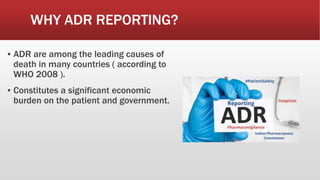
WHY ADR REPORTING?
▪ ADR are among the leading causes of
death in many countries ( according to
WHO 2008 ).
▪ Constitutes a significant economic
burden on the patient and government.
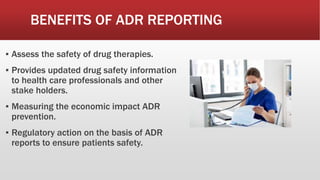
BENEFITS OF ADR REPORTING
▪ Assess the safety of drug therapies.
▪ Provides updated drug safety information
to health care professionals and other
stake holders.
▪ Measuring the economic impact ADR
prevention.
▪ Regulatory action on the basis of ADR
reports to ensure patients safety.
WHO CAN REPORT?
▪ All health care professionals like
clinicians, dentist, pharmacists,
nurses etc.
▪ All non – healthcare professionals
including patients can also report.
WHAT TO REPORT ?
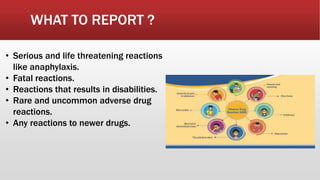
• Serious and life threatening reactions
like anaphylaxis.
• Fatal reactions.
• Reactions that results in disabilities.
• Rare and uncommon adverse drug
reactions.
• Any reactions to newer drugs.
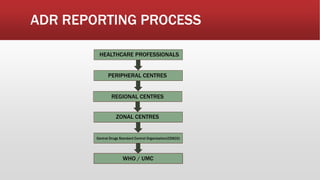
ADR REPORTING PROCESS
HEALTHCARE PROFESSIONALS
PERIPHERAL CENTRES
REGIONAL CENTRES
ZONAL CENTRES
Central Drugs Standard Control Organisation(CDSCO)
WHO / UMC
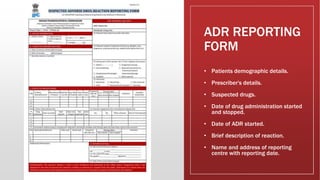
ADR REPORTING
FORM
• Patients demographic details.
• Prescriber's details.
• Suspected drugs.
• Date of drug administration started
and stopped.
• Date of ADR started.
• Brief description of reaction.
• Name and address of reporting
centre with reporting date.
HOW TO REPORT?
▪ Report should be on a standard ADR reporting form.
▪ Duly filled the ADR’s in the reporting form when an ADR is encountered.
▪ Use a separate form for each patient and filled with complete information.
▪ The completed ADR form is then returned to the nearest Adverse drug reaction Monitoring office
( AMC ) or the National Coordinating Centre.
▪ Any follow up information for an ADR case that has already been reported can be sent on
another ADR form, or communicated by telephone, fax or email.
▪ Follow up reports should be identifiable and the following should be indicated on the report.
Follow up information.
Date of original report.
Patient identity should be recorded.
DIFFERENT APPROACHES FOR ADR
REPORTING
Various approaches for ADR reporting are :-
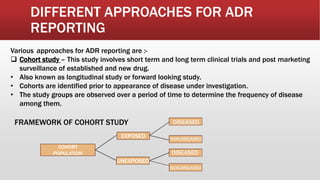
 Cohort study – This study involves short term and long term clinical trials and post marketing
surveillance of established and new drug.
• Also known as longitudinal study or forward looking study.
• Cohorts are identified prior to appearance of disease under investigation.
• The study groups are observed over a period of time to determine the frequency of disease
among them.
FRAMEWORK OF COHORT STUDY
COHORT
POPULATION
EXPOSED
UNEXPOSED
DISEASED
NON-DISEASED
DISEASED
NON-DISEASED
SPONTANEOUS REPORTS of suspected adverse drug reaction occurs when prescribers
report suspected reaction to investigator agency.
• Passive surveillance system.
• The process includes :-
Data acquisition – which depends largely on the input information derived from reports
submitted by the health professionals who have encountered what they suspect is an ADR.
Data assessment – which involves assessment of the individual case reports and
assessment of pooled data obtained from various sources such as the international
database of the WHO.
Data interpretation – based on the available data and the assessments made, a signal
related to the adverse reaction may be generated.
 REVIEW OF VITAL STATISTICS –regular review of national and regional vital statistics.
 CASE CONTROL STUDIES – patients with suspected drug induced diseases are compared
with a reference population.
• It is a retrospective study.
• A case – controlled study is an observational study in which subjects are sampled based
upon presence or absence of disease and then their prior exposure status is determined.
• BASIC STEPS –
 Selection of cases and control.
 Matching.
 Measurement of exposure and
 Analysis and interpretation.
• ADVANTAGES –
 Efficient for the study of rare diseases.
 Efficient for the study of chronic diseases.
• DISADVANTAGES –
 Risk of diseases cannot be estimated directly.
MANAGEMENT OF ADR
HOW TO MANAGE ADR?
• The main and primary in management is withdrawal of suspected drugs.
• However, in case the reaction is expected to be dose related, then dose of the drug must be reduced, and treatment
of suspected reaction must be considered.
• When an ADR reaction is managed, clear therapeutic objective must be maintained.
• The drug treatment must not be unnecessarily continued for longer time period and the patient must be reviewed
regularly and simplify management should be followed.
• Following steps must be followed during the management of any type of suspected, or unexpected ADR :-
 Monitoring patient who are at greater risk of developing ADR.
 Monitoring patients who are prescribed with drugs highly to cause ADR.
 Assessing and documenting the patients previous allergic status.
 Changing the dose of drugs.
 Replacement with alternate medicine.
 Obtaining feedback about the reported reaction.
 Educating patients.
 Conducting workshops/seminars on ADR for healthcare professionals.
THANK YOU
SUBJECT – PHARMACY PRACTICE
NAME – SONIYA M. SUNIL
SEMESTER – 7
MAR DIOSCORUS COLLEGE OF PHARMACY