VIRTUAL FACULTY DEVELOPMENT PROGRAMME
ANTENNAS AND MICROWAVE ENGINEERING
(22.6.2020-26.6.2020)
INTRODUCTION TO MICROWAVE SYSTEMS AND ANTENNAS
PRESENTED BY
Dr. S. ASHA,
PROF/ECE/SEC
ANTENNAS AND MICROWAVE ENGINEERING
• UNIT-1 : INTRODUCTION TO MICROWAVE SYSTEMS AND ANTENNAS .
(Dr.S.ASHA /PROF/SEC)
• UNIT-II : RADIATION MECHANISMS AND DESIGN ASPECTS .
(Mr.C.MAHENDRAN /ASST.PROF/ACGCET)
• UNIT-III : ANTENNA ARRAYS AND APPLICATIONS .
(Dr.A.AMSAVENI /PROF/KCT)
• UNIT –IV : PASSIVE AND ACTIVE MICROWAVE DEVICES .
(Dr.G.KAVYA/PROF/SAEC)
• UNIT-V : MICROWAVE DESIGN PRINCIPLES.
(Dr.M.SELVI/PROF/SCE)
AGENDA
• ENGINEERING
• MICROWAVE
• FREQUENCY BANDS
• APPLICATION
• WHY ANTENNA
• WHAT IS ANTENNA
• ANTENNA REGIONS
• ANTENNA PARAMETERS
• FRISS TXN EQUATION
ENGINEERING
• PHYSICS(PARTICLE,WAVE)
• ELECTRON (SMALLEST/INVISIBLE/INTERATOMIC NEGATIVELY CHARGED PARTICLE
,ONE MILLIONTH OF THICKNESS OF FIBRE)
• ELECTRON IS A WAVE(SINGLE/RAY/BUNCH)
• ELECTRON OSCILLATION(RADIATION)
• MATHEMATICS(DISTANCE,TIME)
• (TIME-STATIC,DYNAMIC)
• (DISTANCE-INFORMATION)
MICROWAVE
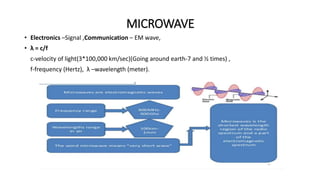
• Electronics –Signal ,Communication – EM wave,
• λ = c/f
c-velocity of light(3*100,000 km/sec)(Going around earth-7 and ½ times) ,
f-frequency (Hertz), λ –wavelength (meter).
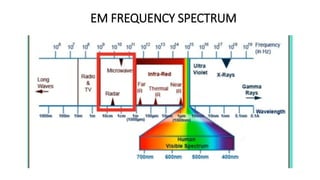
EM FREQUENCY SPECTRUM
MICROWAVE FREQUENCY BAND
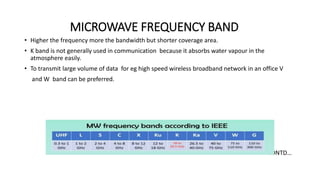
• Higher the frequency more the bandwidth but shorter coverage area.
• K band is not generally used in communication because it absorbs water vapour in the
atmosphere easily.
• To transmit large volume of data for eg high speed wireless broadband network in an office V
and W band can be preferred.
CONTD…
MICROWAVE FREQUENCY BAND
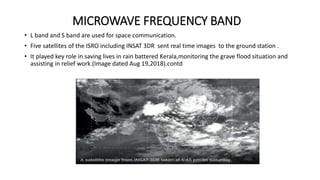
• L band and S band are used for space communication.
• Five satellites of the ISRO including INSAT 3DR sent real time images to the ground station .
• It played key role in saving lives in rain battered Kerala,monitoring the grave flood situation and
assisting in relief work.(Image dated Aug 19,2018).contd
MICROWAVE APPLICATIONS
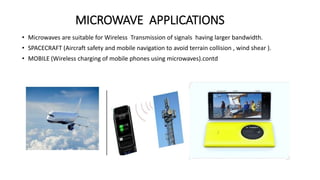
• Microwaves are suitable for Wireless Transmission of signals having larger bandwidth.
• SPACECRAFT (Aircraft safety and mobile navigation to avoid terrain collision , wind shear ).
• MOBILE (Wireless charging of mobile phones using microwaves).contd
MICROWAVE APPLICATIONS
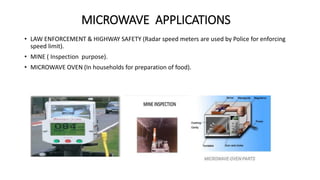
• LAW ENFORCEMENT & HIGHWAY SAFETY (Radar speed meters are used by Police for enforcing
speed limit).
• MINE ( Inspection purpose).
• MICROWAVE OVEN (In households for preparation of food).
UNIT-1(INTRODUCTION TO MICROWAVE SYSTEMS AND
ANTENNAS)
• ENGINEERING ,MICROWAVE , ANTENNA
• MICROWAVE FREQUENCY BANDS
• ANTENNA REGIONS
ANTENNA PARAMETERS:
• CIRCUIT QUANTITIES
• FIELD QUANTITIES
FRISS TRANSMISSION EQUATION
• LINK BUDGET AND LINK MARGIN
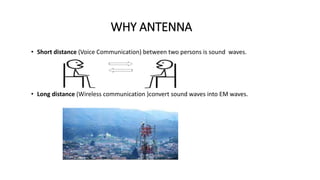
WHY ANTENNA
• Short distance (Voice Communication) between two persons is sound waves.
• Long distance (Wireless communication )convert sound waves into EM waves.
ANTENNA
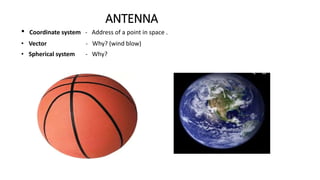
• Coordinate system - Address of a point in space .
• Vector - Why? (wind blow)
• Spherical system - Why?
ANTENNA
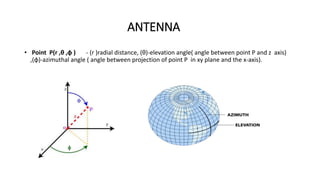
• Point P(r ,θ ,φ ) - (r )radial distance, (θ)-elevation angle( angle between point P and z axis)
,(φ)-azimuthal angle ( angle between projection of point P in xy plane and the x-axis).
ANTENNA
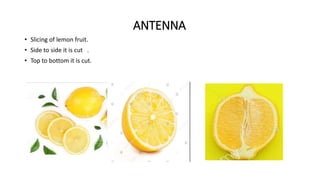
• Slicing of lemon fruit.
• Side to side it is cut .
• Top to bottom it is cut.
ANTENNA
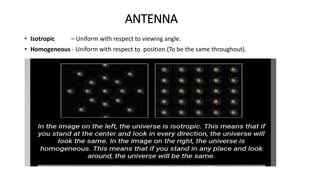
• Isotropic – Uniform with respect to viewing angle.
• Homogeneous - Uniform with respect to position.(To be the same throughout).
ANTENNA – INTERFACE
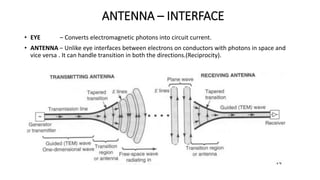
• EYE – Converts electromagnetic photons into circuit current.
• ANTENNA – Unlike eye interfaces between electrons on conductors with photons in space and
vice versa . It can handle transition in both the directions.(Reciprocity).
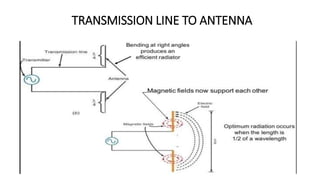
TRANSMISSION LINE TO ANTENNA
WHAT IS ANTENNA
• ANTENNAE or AERIAL
• Transducer(electrical energy into electromagnetic energy and vice versa).
• Transition device between guided wave(plane wave) and free space wave(spherical wave) and vive
versa.
• Conductor which radiates(electrons accelerated and retarded repeatedly),(flow of energy) .
• WEBSTERS dictionary., IEEE Std(metallic tubing device i.e rod or wire for radiating or receiving radio
waves).
• Spatial Filter.( It has the property of being more sensitive to one direction than other which provides
ability to spatially filter signals from its environment).
• Polarization Filter.(It has the property of being more sensitive to one polarization than other which
provides ability to filter signals based on polarization).
• Impedance Transformer.(Intrinsic impedance of free space is (η) E/H =377 Ω).,
(Characteristic impedance of transmission line (ZO) V/I = 50 Ω ) .
• Propagation mode Adapter.(It must serve as a probing device in addition to directional and impedance
transformation device).
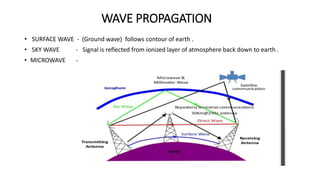
WAVE PROPAGATION
• SURFACE WAVE - (Ground wave) follows contour of earth .
• SKY WAVE - Signal is reflected from ionized layer of atmosphere back down to earth .
• MICROWAVE -
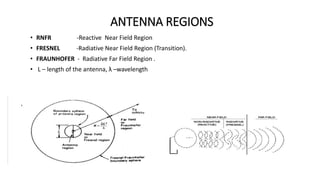
ANTENNA REGIONS
• RNFR -Reactive Near Field Region
• FRESNEL -Radiative Near Field Region (Transition).
• FRAUNHOFER - Radiative Far Field Region .
• L – length of the antenna, λ –wavelength
ANTENNA PARAMETERS
• Circuit low frequency- V(V),I (A)
• Field high frequency –E(V/m),H(A/m)
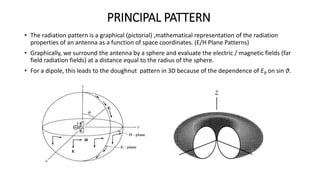
PRINCIPAL PATTERN
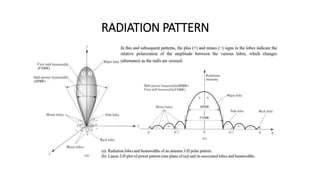
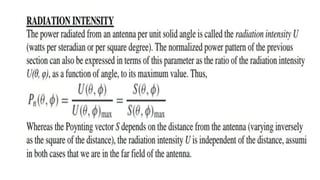
• The radiation pattern is a graphical (pictorial) ,mathematical representation of the radiation
properties of an antenna as a function of space coordinates. (E/H Plane Patterns)
• Graphically, we surround the antenna by a sphere and evaluate the electric / magnetic fields (far
field radiation fields) at a distance equal to the radius of the sphere.
• For a dipole, this leads to the doughnut pattern in 3D because of the dependence of Eθ on sin θ.
RADIATION PATTERN
RADIATION PATTERN
• MAJOR LOBE : Radiation lobe containing direction of maximum radiation (main beam).
• MINOR LOBE : Is any lobe except major lobe.
• SIDELOBE : Radiation lobe in any direction other than the intended lobe .
• BACK LOBE : Radiation lobe which makes an angle of approximately 180 degrees with respect
to beam of an antenna
RADIATION PATTERN
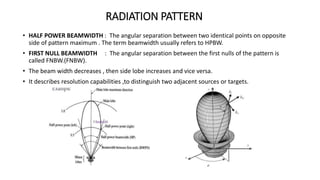
• HALF POWER BEAMWIDTH : The angular separation between two identical points on opposite
side of pattern maximum . The term beamwidth usually refers to HPBW.
• FIRST NULL BEAMWIDTH : The angular separation between the first nulls of the pattern is
called FNBW.(FNBW).
• The beam width decreases , then side lobe increases and vice versa.
• It describes resolution capabilities ,to distinguish two adjacent sources or targets.
ISOTROPIC PATTERN
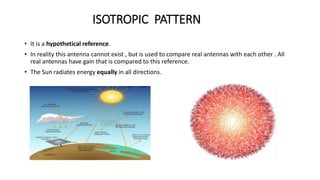
• It is a hypothetical reference.
• In reality this antenna cannot exist , but is used to compare real antennas with each other . All
real antennas have gain that is compared to this reference.
• The Sun radiates energy equally in all directions.
DIRECTIONAL PATTERN
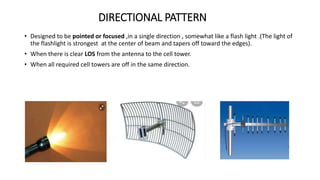
• Designed to be pointed or focused ,in a single direction , somewhat like a flash light .(The light of
the flashlight is strongest at the center of beam and tapers off toward the edges).
• When there is clear LOS from the antenna to the cell tower.
• When all required cell towers are off in the same direction.
OMNI DIRECTIONAL
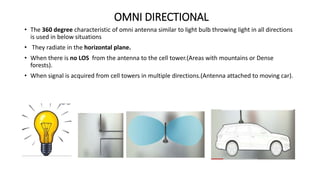
• The 360 degree characteristic of omni antenna similar to light bulb throwing light in all directions
is used in below situations
• They radiate in the horizontal plane.
• When there is no LOS from the antenna to the cell tower.(Areas with mountains or Dense
forests).
• When signal is acquired from cell towers in multiple directions.(Antenna attached to moving car).
ISOTROPIC/OMNI DIRECTIONAL/DIRECTIONAL
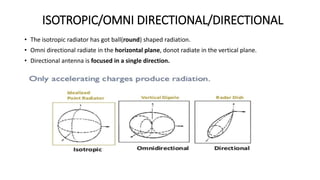
• The isotropic radiator has got ball(round) shaped radiation.
• Omni directional radiate in the horizontal plane, donot radiate in the vertical plane.
• Directional antenna is focused in a single direction.
BEAM SOLID ANGLE
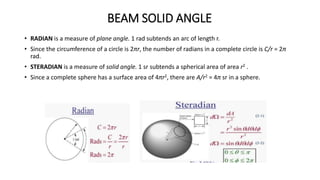
• RADIAN is a measure of plane angle. 1 rad subtends an arc of length r.
• Since the circumference of a circle is 2πr, the number of radians in a complete circle is C/r = 2π
rad.
• STERADIAN is a measure of solid angle. 1 sr subtends a spherical area of area r2 .
• Since a complete sphere has a surface area of 4πr2, there are A/r2 = 4π sr in a sphere.
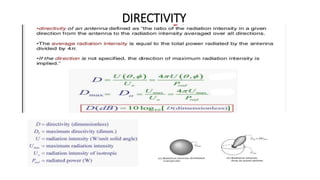
DIRECTIVITY
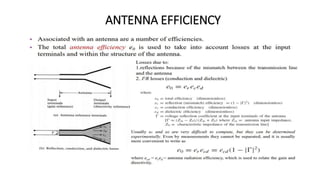
ANTENNA EFFICIENCY
ANTENNA GAIN
• The gain of an antenna takes into account the efficiency and directional abilities. But directivity
describes only directional properties controlled by the pattern.
• Defn: measurement of antennas ability to direct or concentrate the radiated signal emitting from
it.(dBi -decibels relative to isotropic radiator)
• Why?-in specification sheet, gain is quoted than directivity because it takes in to account the
actual losses that occur.(Reflection losses,Polarisation losses).
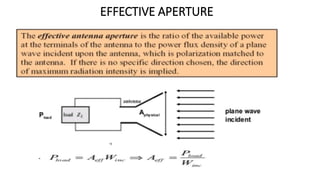
EFFECTIVE APERTURE
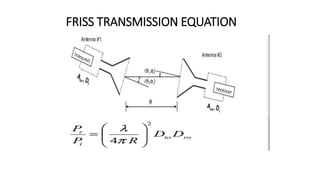
FRISS TRANSMISSION EQUATION

Antenna ppt unit1

  • 1.
    VIRTUAL FACULTY DEVELOPMENTPROGRAMME ANTENNAS AND MICROWAVE ENGINEERING (22.6.2020-26.6.2020) INTRODUCTION TO MICROWAVE SYSTEMS AND ANTENNAS PRESENTED BY Dr. S. ASHA, PROF/ECE/SEC
  • 2.
    ANTENNAS AND MICROWAVEENGINEERING • UNIT-1 : INTRODUCTION TO MICROWAVE SYSTEMS AND ANTENNAS . (Dr.S.ASHA /PROF/SEC) • UNIT-II : RADIATION MECHANISMS AND DESIGN ASPECTS . (Mr.C.MAHENDRAN /ASST.PROF/ACGCET) • UNIT-III : ANTENNA ARRAYS AND APPLICATIONS . (Dr.A.AMSAVENI /PROF/KCT) • UNIT –IV : PASSIVE AND ACTIVE MICROWAVE DEVICES . (Dr.G.KAVYA/PROF/SAEC) • UNIT-V : MICROWAVE DESIGN PRINCIPLES. (Dr.M.SELVI/PROF/SCE)
  • 3.
    AGENDA • ENGINEERING • MICROWAVE •FREQUENCY BANDS • APPLICATION • WHY ANTENNA • WHAT IS ANTENNA • ANTENNA REGIONS • ANTENNA PARAMETERS • FRISS TXN EQUATION
  • 4.
    ENGINEERING • PHYSICS(PARTICLE,WAVE) • ELECTRON(SMALLEST/INVISIBLE/INTERATOMIC NEGATIVELY CHARGED PARTICLE ,ONE MILLIONTH OF THICKNESS OF FIBRE) • ELECTRON IS A WAVE(SINGLE/RAY/BUNCH) • ELECTRON OSCILLATION(RADIATION) • MATHEMATICS(DISTANCE,TIME) • (TIME-STATIC,DYNAMIC) • (DISTANCE-INFORMATION)
  • 5.
    MICROWAVE • Electronics –Signal,Communication – EM wave, • λ = c/f c-velocity of light(3*100,000 km/sec)(Going around earth-7 and ½ times) , f-frequency (Hertz), λ –wavelength (meter).
  • 6.
  • 7.
    MICROWAVE FREQUENCY BAND •Higher the frequency more the bandwidth but shorter coverage area. • K band is not generally used in communication because it absorbs water vapour in the atmosphere easily. • To transmit large volume of data for eg high speed wireless broadband network in an office V and W band can be preferred. CONTD…
  • 8.
    MICROWAVE FREQUENCY BAND •L band and S band are used for space communication. • Five satellites of the ISRO including INSAT 3DR sent real time images to the ground station . • It played key role in saving lives in rain battered Kerala,monitoring the grave flood situation and assisting in relief work.(Image dated Aug 19,2018).contd
  • 9.
    MICROWAVE APPLICATIONS • Microwavesare suitable for Wireless Transmission of signals having larger bandwidth. • SPACECRAFT (Aircraft safety and mobile navigation to avoid terrain collision , wind shear ). • MOBILE (Wireless charging of mobile phones using microwaves).contd
  • 10.
    MICROWAVE APPLICATIONS • LAWENFORCEMENT & HIGHWAY SAFETY (Radar speed meters are used by Police for enforcing speed limit). • MINE ( Inspection purpose). • MICROWAVE OVEN (In households for preparation of food).
  • 11.
    UNIT-1(INTRODUCTION TO MICROWAVESYSTEMS AND ANTENNAS) • ENGINEERING ,MICROWAVE , ANTENNA • MICROWAVE FREQUENCY BANDS • ANTENNA REGIONS ANTENNA PARAMETERS: • CIRCUIT QUANTITIES • FIELD QUANTITIES FRISS TRANSMISSION EQUATION • LINK BUDGET AND LINK MARGIN
  • 12.
    WHY ANTENNA • Shortdistance (Voice Communication) between two persons is sound waves. • Long distance (Wireless communication )convert sound waves into EM waves.
  • 13.
    ANTENNA • Coordinate system- Address of a point in space . • Vector - Why? (wind blow) • Spherical system - Why?
  • 14.
    ANTENNA • Point P(r,θ ,φ ) - (r )radial distance, (θ)-elevation angle( angle between point P and z axis) ,(φ)-azimuthal angle ( angle between projection of point P in xy plane and the x-axis).
  • 15.
    ANTENNA • Slicing oflemon fruit. • Side to side it is cut . • Top to bottom it is cut.
  • 16.
    ANTENNA • Isotropic –Uniform with respect to viewing angle. • Homogeneous - Uniform with respect to position.(To be the same throughout).
  • 17.
    ANTENNA – INTERFACE •EYE – Converts electromagnetic photons into circuit current. • ANTENNA – Unlike eye interfaces between electrons on conductors with photons in space and vice versa . It can handle transition in both the directions.(Reciprocity).
  • 18.
  • 19.
    WHAT IS ANTENNA •ANTENNAE or AERIAL • Transducer(electrical energy into electromagnetic energy and vice versa). • Transition device between guided wave(plane wave) and free space wave(spherical wave) and vive versa. • Conductor which radiates(electrons accelerated and retarded repeatedly),(flow of energy) . • WEBSTERS dictionary., IEEE Std(metallic tubing device i.e rod or wire for radiating or receiving radio waves). • Spatial Filter.( It has the property of being more sensitive to one direction than other which provides ability to spatially filter signals from its environment). • Polarization Filter.(It has the property of being more sensitive to one polarization than other which provides ability to filter signals based on polarization). • Impedance Transformer.(Intrinsic impedance of free space is (η) E/H =377 Ω)., (Characteristic impedance of transmission line (ZO) V/I = 50 Ω ) . • Propagation mode Adapter.(It must serve as a probing device in addition to directional and impedance transformation device).
  • 20.
    WAVE PROPAGATION • SURFACEWAVE - (Ground wave) follows contour of earth . • SKY WAVE - Signal is reflected from ionized layer of atmosphere back down to earth . • MICROWAVE -
  • 21.
    ANTENNA REGIONS • RNFR-Reactive Near Field Region • FRESNEL -Radiative Near Field Region (Transition). • FRAUNHOFER - Radiative Far Field Region . • L – length of the antenna, λ –wavelength
  • 22.
    ANTENNA PARAMETERS • Circuitlow frequency- V(V),I (A) • Field high frequency –E(V/m),H(A/m)
  • 23.
    PRINCIPAL PATTERN • Theradiation pattern is a graphical (pictorial) ,mathematical representation of the radiation properties of an antenna as a function of space coordinates. (E/H Plane Patterns) • Graphically, we surround the antenna by a sphere and evaluate the electric / magnetic fields (far field radiation fields) at a distance equal to the radius of the sphere. • For a dipole, this leads to the doughnut pattern in 3D because of the dependence of Eθ on sin θ.
  • 24.
  • 25.
    RADIATION PATTERN • MAJORLOBE : Radiation lobe containing direction of maximum radiation (main beam). • MINOR LOBE : Is any lobe except major lobe. • SIDELOBE : Radiation lobe in any direction other than the intended lobe . • BACK LOBE : Radiation lobe which makes an angle of approximately 180 degrees with respect to beam of an antenna
  • 26.
    RADIATION PATTERN • HALFPOWER BEAMWIDTH : The angular separation between two identical points on opposite side of pattern maximum . The term beamwidth usually refers to HPBW. • FIRST NULL BEAMWIDTH : The angular separation between the first nulls of the pattern is called FNBW.(FNBW). • The beam width decreases , then side lobe increases and vice versa. • It describes resolution capabilities ,to distinguish two adjacent sources or targets.
  • 27.
    ISOTROPIC PATTERN • Itis a hypothetical reference. • In reality this antenna cannot exist , but is used to compare real antennas with each other . All real antennas have gain that is compared to this reference. • The Sun radiates energy equally in all directions.
  • 28.
    DIRECTIONAL PATTERN • Designedto be pointed or focused ,in a single direction , somewhat like a flash light .(The light of the flashlight is strongest at the center of beam and tapers off toward the edges). • When there is clear LOS from the antenna to the cell tower. • When all required cell towers are off in the same direction.
  • 29.
    OMNI DIRECTIONAL • The360 degree characteristic of omni antenna similar to light bulb throwing light in all directions is used in below situations • They radiate in the horizontal plane. • When there is no LOS from the antenna to the cell tower.(Areas with mountains or Dense forests). • When signal is acquired from cell towers in multiple directions.(Antenna attached to moving car).
  • 30.
    ISOTROPIC/OMNI DIRECTIONAL/DIRECTIONAL • Theisotropic radiator has got ball(round) shaped radiation. • Omni directional radiate in the horizontal plane, donot radiate in the vertical plane. • Directional antenna is focused in a single direction.
  • 31.
    BEAM SOLID ANGLE •RADIAN is a measure of plane angle. 1 rad subtends an arc of length r. • Since the circumference of a circle is 2πr, the number of radians in a complete circle is C/r = 2π rad. • STERADIAN is a measure of solid angle. 1 sr subtends a spherical area of area r2 . • Since a complete sphere has a surface area of 4πr2, there are A/r2 = 4π sr in a sphere.
  • 34.
  • 35.
  • 36.
    ANTENNA GAIN • Thegain of an antenna takes into account the efficiency and directional abilities. But directivity describes only directional properties controlled by the pattern. • Defn: measurement of antennas ability to direct or concentrate the radiated signal emitting from it.(dBi -decibels relative to isotropic radiator) • Why?-in specification sheet, gain is quoted than directivity because it takes in to account the actual losses that occur.(Reflection losses,Polarisation losses).
  • 37.
  • 38.