

Ways To Relief PAIN During Childbirth
www.layyous.com
www.layyous.com
www.layyous.com
There Are THREE Stages Of labour
www.layyous.com
Time:
Primigravida : 8-12 hours in primigravida
Multipara: 4-6 hours in multipara
Dilatation Of Cervix : cervix 10 cm to allow
the passage of the head.
www.layyous.com
Time:
Primigravida : Mmore than 42 minutes in primigravida
Multipara: Between 10-30 minutes in multipara
It is the stage of passage of the head.
www.layyous.com
Time:
10-20 minutes
It is the stage of passage of the placenta.
You may feel irregular, and separate labour pain in the last weeks
of pregnancy, and once they become regular intervals, about 5
minutes, it is the time for delivery.
www.layyous.com
 Cervical dilatation
 Contraction and retraction in the lower uterine part
 Contractions and retractions affect blood vessels &
accumulates metabolites which leads to pain.
 Contractions cause tension on the ligaments that
hold the uterus
Where you may feel pain?
Down in the abdomen.
Sides of the pelvic bone.
 Umbilicus down to the genital area.
 Lower back.
www.layyous.com
Signs of labour:
 Labour pain : regular uterine contraction very often,
 Pain can’t be relieved by analgesia.
 Bloody show.
 For primigravida : feel irregular uterine contractions ½-1 hour apart,
 Can be relieved with analgesia
When should you go to the hospital?
1- If labour pain started.
2- Heavy sudden bleeding.
3- Passage of watery vaginal Discharge
4- Passage of greenish watery vaginal discharge
www.layyous.com
www.layyous.com
1st Stage Of labour:
1- Don’t push downward.
2-Take slow deep breath.
3-Lie on the left or right side.
www.layyous.com
2nd stage of labour:
 Follow your doctor’s instructions,
 by taking deep breaths,
 then push downward (as if you want to defecate),
 then rest and relax in between contractions.
 Please do not scream in this stage, or pull your hair, or
jump from the bed.
Your doctor may need to cut an incision in your perineum especially in
primigravida to help your baby through the process. This is done under
local anesthesia.
www.layyous.com
 Empty your bladder.
 When blood gushes out of your vagina your doctor will pull the umbilical
cord, so try to help by pushing down, then he will do uterine massage to
help the uterus to contract.
 Once labour is finished, your doctor will start suturing your perineum
under local anesthesia.
 In cases of difficult labour, your doctor may need to use vacuum or
forceps, in order to get the baby out, so you need to know what type of
delivery may be necessary.
www.layyous.com
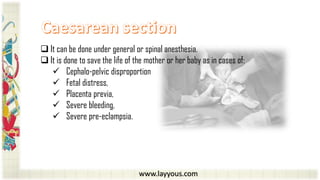
 It can be done under general or spinal anesthesia.
 It is done to save the life of the mother or her baby as in cases of:
 Cephalo-pelvic disproportion
 Fetal distress,
 Placenta previa,
 Severe bleeding,
 Severe pre-eclampsia.
www.layyous.com
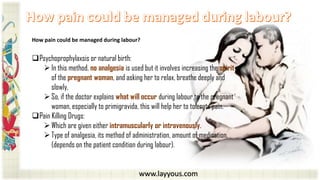
How pain could be managed during labour?
Psychoprophylaxsis or natural birth:
In this method, no analgesia is used but it involves increasing the spirit
of the pregnant woman, and asking her to relax, breathe deeply and
slowly,
So, if the doctor explains what will occur during labour to the pregnant
woman, especially to primigravida, this will help her to tolerate pain.
Pain Killing Drugs:
Which are given either intramuscularly or intravenously.
Type of analgesia, its method of administration, amount of medication,
(depends on the patient condition during labour).
In this method, the drug is inserted in the epidural space
after local anesthesia.
The anesthesiologist will test the efficiency of the drug by
pricking the patient gently, starting from the thigh to the
abdomen
It usually has no direct effect. It may lengthen, shorten or
not affect the duration of delivery.
www.layyous.com
www.layyous.com
 Analgesia during labour is a choice left for the pregnant woman, and her
doctor, to determine if this is possible or not.
 If you notice any of these things, call your doctor immediately:
Bleeding.
Passage of watery vaginal discharge.
uterine contraction lasting 15-20 seconds in the beginning then
increase to 40-50 seconds, occuring at 2-3 minutes intervals. At this
time, concentrate on taking deep and slow breaths.
www.layyous.com
 When you arrive to the hospital, the nurse and the resident doctor will assess
your condition, if it is early labour, then you may be discharged home.
 If you are in true labour you will be admitted to the hospital.
 You also may be admitted to the hospital if you are hypertensive, or complain
of pre-eclampsia, diabetic, or if there is fetal distress.
-
www.layyous.com
 After delivery, your baby’s mouth and nostrils
will be cleaned from mucus, and covered.
 The umbilical cord will be cut in order that your
baby will breathe from his nose and mouth.
 Then another sequence of contractions will occur
in order to deliver the placenta.
 You will carry your baby between your hands and
his weight and length will be measured.
www.layyous.com
www.layyous.com

Childbirth - Ways to relief pain during childbirth

  • 1.
    Ways To ReliefPAIN During Childbirth www.layyous.com
  • 2.
  • 3.
  • 4.
    www.layyous.com Time: Primigravida : 8-12hours in primigravida Multipara: 4-6 hours in multipara Dilatation Of Cervix : cervix 10 cm to allow the passage of the head.
  • 5.
    www.layyous.com Time: Primigravida : Mmorethan 42 minutes in primigravida Multipara: Between 10-30 minutes in multipara It is the stage of passage of the head.
  • 6.
    www.layyous.com Time: 10-20 minutes It isthe stage of passage of the placenta. You may feel irregular, and separate labour pain in the last weeks of pregnancy, and once they become regular intervals, about 5 minutes, it is the time for delivery.
  • 7.
    www.layyous.com  Cervical dilatation Contraction and retraction in the lower uterine part  Contractions and retractions affect blood vessels & accumulates metabolites which leads to pain.  Contractions cause tension on the ligaments that hold the uterus Where you may feel pain? Down in the abdomen. Sides of the pelvic bone.  Umbilicus down to the genital area.  Lower back.
  • 8.
    www.layyous.com Signs of labour: Labour pain : regular uterine contraction very often,  Pain can’t be relieved by analgesia.  Bloody show.  For primigravida : feel irregular uterine contractions ½-1 hour apart,  Can be relieved with analgesia When should you go to the hospital? 1- If labour pain started. 2- Heavy sudden bleeding. 3- Passage of watery vaginal Discharge 4- Passage of greenish watery vaginal discharge
  • 9.
  • 10.
    www.layyous.com 1st Stage Oflabour: 1- Don’t push downward. 2-Take slow deep breath. 3-Lie on the left or right side.
  • 11.
    www.layyous.com 2nd stage oflabour:  Follow your doctor’s instructions,  by taking deep breaths,  then push downward (as if you want to defecate),  then rest and relax in between contractions.  Please do not scream in this stage, or pull your hair, or jump from the bed. Your doctor may need to cut an incision in your perineum especially in primigravida to help your baby through the process. This is done under local anesthesia.
  • 12.
    www.layyous.com  Empty yourbladder.  When blood gushes out of your vagina your doctor will pull the umbilical cord, so try to help by pushing down, then he will do uterine massage to help the uterus to contract.  Once labour is finished, your doctor will start suturing your perineum under local anesthesia.  In cases of difficult labour, your doctor may need to use vacuum or forceps, in order to get the baby out, so you need to know what type of delivery may be necessary.
  • 13.
    www.layyous.com  It canbe done under general or spinal anesthesia.  It is done to save the life of the mother or her baby as in cases of:  Cephalo-pelvic disproportion  Fetal distress,  Placenta previa,  Severe bleeding,  Severe pre-eclampsia.
  • 14.
    www.layyous.com How pain couldbe managed during labour? Psychoprophylaxsis or natural birth: In this method, no analgesia is used but it involves increasing the spirit of the pregnant woman, and asking her to relax, breathe deeply and slowly, So, if the doctor explains what will occur during labour to the pregnant woman, especially to primigravida, this will help her to tolerate pain. Pain Killing Drugs: Which are given either intramuscularly or intravenously. Type of analgesia, its method of administration, amount of medication, (depends on the patient condition during labour).
  • 15.
    In this method,the drug is inserted in the epidural space after local anesthesia. The anesthesiologist will test the efficiency of the drug by pricking the patient gently, starting from the thigh to the abdomen It usually has no direct effect. It may lengthen, shorten or not affect the duration of delivery. www.layyous.com
  • 16.
    www.layyous.com  Analgesia duringlabour is a choice left for the pregnant woman, and her doctor, to determine if this is possible or not.  If you notice any of these things, call your doctor immediately: Bleeding. Passage of watery vaginal discharge. uterine contraction lasting 15-20 seconds in the beginning then increase to 40-50 seconds, occuring at 2-3 minutes intervals. At this time, concentrate on taking deep and slow breaths.
  • 17.
    www.layyous.com  When youarrive to the hospital, the nurse and the resident doctor will assess your condition, if it is early labour, then you may be discharged home.  If you are in true labour you will be admitted to the hospital.  You also may be admitted to the hospital if you are hypertensive, or complain of pre-eclampsia, diabetic, or if there is fetal distress. -
  • 18.
    www.layyous.com  After delivery,your baby’s mouth and nostrils will be cleaned from mucus, and covered.  The umbilical cord will be cut in order that your baby will breathe from his nose and mouth.  Then another sequence of contractions will occur in order to deliver the placenta.  You will carry your baby between your hands and his weight and length will be measured.
  • 19.