MPUMALANGA DEPARTMENT OF LABOUR 
CHARLES COTTER 
9-10 SEPTEMBER 2014
TRAINING PROGRAMME OVERVIEW 
• Defining the fundamental concepts 
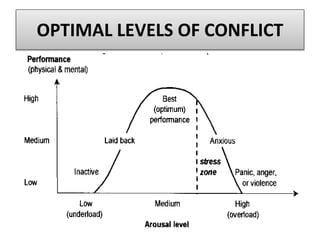
• Optimal levels of conflict 
• The manager’s roles and responsibilities as a conflict manager 
• The five (5) distinctive conflict resolution styles 
 Characteristics 
 Suitability and appropriateness 
• Applying the 4-step conflict resolution process 
• Proactively managing conflict 
• Dealing effectively with anger
THE FUNDAMENTALS OF CONFLICT 
MANAGEMENT 
• Defining conflict 
• Differentiating between functional and 
dysfunctional conflict 
• Identifying the causes/sources of conflict 
• Indicators/warning signals of conflict
FUNCTIONAL AND DYSFUNCTIONAL 
CONFLICT 
• Functional conflict leads to open discussion, a better 
understanding of differences, innovative solutions and 
greater commitment. 
• Functional conflict contributes to the achievement of 
organizational goals and enhances relationship-building. 
• Dysfunctional conflict tends be more focused on emotions 
than on the goal/task at hand known as affect 
conflict/interpersonal conflict, it is destructive when a 
solution is not reached, energy is diverted away from the 
core problem and morale is negatively affected. 
• Dysfunctional conflict is detrimental to relationships within 
the team and team performance.
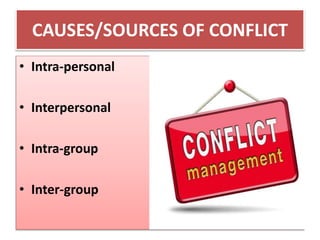
CAUSES/SOURCES OF CONFLICT 
• Intra-personal 
• Interpersonal 
• Intra-group 
• Inter-group
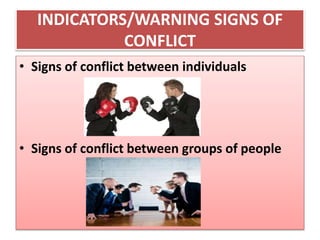
INDICATORS/WARNING SIGNS OF 
CONFLICT 
• Signs of conflict between individuals 
• Signs of conflict between groups of people
OPTIMAL LEVELS OF CONFLICT
ADVANTAGES OF OPTIMAL LEVELS OF 
CONFLICT 
• Co-operation from team members 
• Improved performance and productivity 
• Reduced stress and preserved integrity 
• Solve problems as quickly as possible 
• Improved relationships and teamwork 
• Enhanced creativity 
• Increased staff morale
MANAGER RESPONSIBILITIES 
• Conflict Manager 
• Coach 
• Liaison 
• Trouble-shooter
CONFLICT MANAGER 
• Key responsibilities include: 
Helping to identify the sources of conflict 
Identifying the resolution options available 
Evaluating the advantages and disadvantages of 
each resolution option
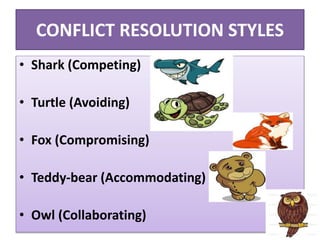
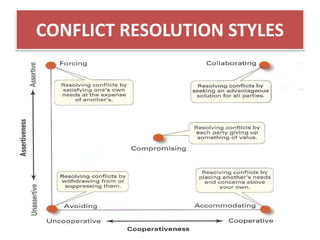
CONFLICT RESOLUTION STYLES 
• Shark (Competing) 
• Turtle (Avoiding) 
• Fox (Compromising) 
• Teddy-bear (Accommodating) 
• Owl (Collaborating)
CONFLICT RESOLUTION STYLES
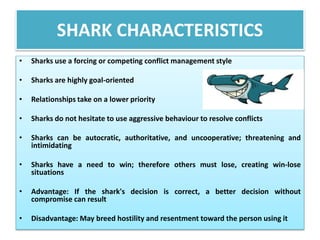
SHARK CHARACTERISTICS 
• Sharks use a forcing or competing conflict management style 
• Sharks are highly goal-oriented 
• Relationships take on a lower priority 
• Sharks do not hesitate to use aggressive behaviour to resolve conflicts 
• Sharks can be autocratic, authoritative, and uncooperative; threatening and 
intimidating 
• Sharks have a need to win; therefore others must lose, creating win-lose 
situations 
• Advantage: If the shark's decision is correct, a better decision without 
compromise can result 
• Disadvantage: May breed hostility and resentment toward the person using it
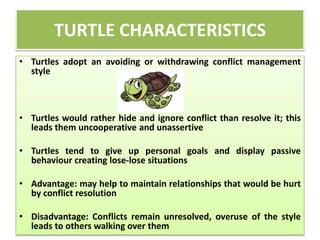
TURTLE CHARACTERISTICS 
• Turtles adopt an avoiding or withdrawing conflict management 
style 
• Turtles would rather hide and ignore conflict than resolve it; this 
leads them uncooperative and unassertive 
• Turtles tend to give up personal goals and display passive 
behaviour creating lose-lose situations 
• Advantage: may help to maintain relationships that would be hurt 
by conflict resolution 
• Disadvantage: Conflicts remain unresolved, overuse of the style 
leads to others walking over them
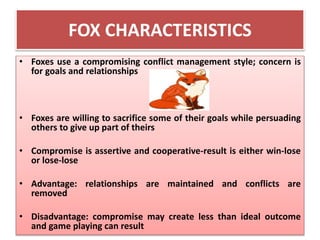
FOX CHARACTERISTICS 
• Foxes use a compromising conflict management style; concern is 
for goals and relationships 
• Foxes are willing to sacrifice some of their goals while persuading 
others to give up part of theirs 
• Compromise is assertive and cooperative-result is either win-lose 
or lose-lose 
• Advantage: relationships are maintained and conflicts are 
removed 
• Disadvantage: compromise may create less than ideal outcome 
and game playing can result
TEDDY-BEAR CHARACTERISTICS 
• Teddy bears use a smoothing or accommodating conflict 
management style with emphasis on human relationships 
• Teddy bears ignore their own goals and resolve conflict by giving 
into others; unassertive and cooperative creating a win-lose (bear 
is loser) situation 
• Advantage: Accommodating maintains relationships 
• Disadvantage: Giving in may not be productive, bear may be taken 
advantage of
OWL CHARACTERISTICS 
• Owls use a collaborating or problem confronting conflict 
management style valuing their goals and relationships 
• Owls view conflicts as problems to be solved finding solutions 
agreeable to all sides (win-win) 
• Advantage: both sides get what they want and negative feelings 
eliminated 
• Disadvantage: takes a great deal of time and effort
THE 4-STEP CONFLICT RESOLUTION 
PROCESS – THERAPEUTIC MODEL 
• Step 1: Identify sources of potential and actual conflict 
(DIAGNOSIS) 
• Step 2: Develop conflict resolution strategies/techniques 
(EXAMINATION) 
• Step 3: Apply conflict resolution strategies/techniques (REMEDY) 
• Step 4: Control and review the effectiveness of the conflict 
resolution strategy/technique (FOLLOW-UP)
STEP 1: DIAGNOSIS 
• Identify the sources/causes of conflict: 
Intra-personal 
Interpersonal 
Intra-group or Inter-group 
• The best approach to manage conflict 
effectively is to be proactive.
STEP 2: EXAMINATION 
• Develop conflict resolution strategies/techniques: 
 Shark (Competing) 
 Turtle (Avoiding) 
 Fox (Compromising) 
 Teddy-bear (Accommodating) 
 Owl (Collaborating) 
• There is no one best way to deal with conflict. It is dependent on the 
current situation as well as the team members involved in the conflict. 
• The golden rule is that managers should take prompt action in resolving 
conflict. 
• By failing to act, it may result in the conflict escalating beyond control and 
“spreading like a cancer” negatively affecting team performance and 
relationships.
STEP 3: REMEDY 
• Apply conflict resolution strategies/techniques 
• The key is to match strategies to situations. 
• Influential considerations: 
Time pressure 
Issue importance 
Relationship importance 
Relative power
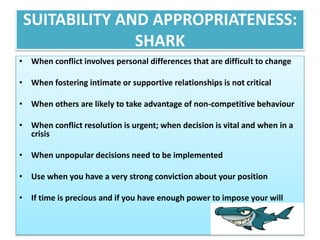
SUITABILITY AND APPROPRIATENESS: 
SHARK 
• When conflict involves personal differences that are difficult to change 
• When fostering intimate or supportive relationships is not critical 
• When others are likely to take advantage of non-competitive behaviour 
• When conflict resolution is urgent; when decision is vital and when in a 
crisis 
• When unpopular decisions need to be implemented 
• Use when you have a very strong conviction about your position 
• If time is precious and if you have enough power to impose your will
SUITABILITY AND APPROPRIATENESS: 
TURTLE 
• When the stakes are not high or issue is trivial 
• When confrontation will hurt a working relationship 
• When there is little chance of satisfying your wants 
• When disruption outweighs benefit of conflict resolution 
• When gathering information is more important than an immediate 
decision 
• When others can more effectively resolve the conflict 
• When time constraints demand a delay 
• Use it when it simply is not worth the effort to argue
SUITABILITY AND APPROPRIATENESS: 
FOX 
• When important/complex issues leave no clear or 
simple solutions 
• When all conflicting people are equal in power 
and have strong interests in different solutions 
• When there are no time restraints 
• Use when the goal is to get past the issue and 
move on
SUITABILITY AND APPROPRIATENESS: 
TEDDY-BEAR 
• When maintaining the relationship outweighs other 
considerations 
• When suggestions/changes are not important to the 
accommodator 
• When minimizing losses in situations where outmatched or losing 
• When time is limited or when harmony and stability are valued 
• Use this approach very sparingly and infrequently, for example, in 
situations when you know that you will have another more useful 
approach in the very near future
SUITABILITY AND APPROPRIATENESS: 
OWL 
• When maintaining relationships is important 
• When time is not a concern 
• When peer conflict is involved 
• When trying to gain commitment through consensus building 
• When learning and trying to merge differing perspectives 
• Use when the goal is to meet as many current needs as possible 
by using mutual resources. This approach sometimes raises new 
mutual needs. 
• Use when the goal is to cultivate ownership and commitment
STEP 4: FOLLOW-UP 
• Managers will need to confirm whether this technique 
has adequately resolved the conflict. 
• In the event that this dysfunctional conflict persists, 
managers may have to resort to alternative (third 
party) strategies: 
Mediation 
Counseling 
Organizational development (OD) interventions
PRO-ACTIVELY MINIMIZING CONFLICT 
• Referring (to expert staff) 
• Informing 
Performance expectations 
Changes to organizational policy and operations 
• Consulting with team members 
• Employee Engagement
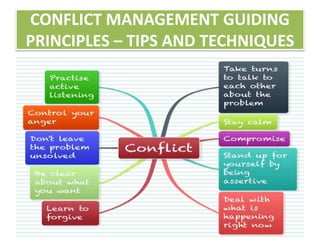
CONFLICT MANAGEMENT GUIDING 
PRINCIPLES – TIPS AND TECHNIQUES
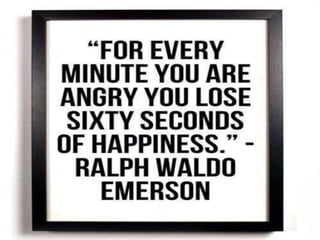
DEALING WITH ANGER 
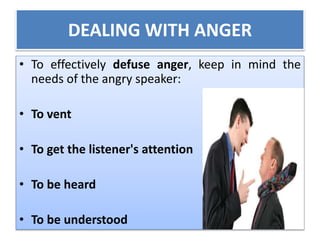
• To effectively defuse anger, keep in mind the 
needs of the angry speaker: 
• To vent 
• To get the listener's attention 
• To be heard 
• To be understood
DEALING WITH ANGER 
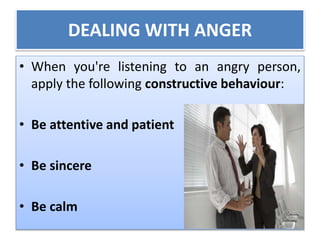
• When you're listening to an angry person, 
apply the following constructive behaviour: 
• Be attentive and patient 
• Be sincere 
• Be calm
CONCLUSION 
• Key points 
• Summary 
• Questions
CONTACT DETAILS 
• Charles Cotter 
• (+27) 84 562 9446 
• charlescot@polka.co.za 
• LinkedIn 
• Twitter: Charles_Cotter

Conflict management and resolution

  • 1.
    MPUMALANGA DEPARTMENT OFLABOUR CHARLES COTTER 9-10 SEPTEMBER 2014
  • 2.
    TRAINING PROGRAMME OVERVIEW • Defining the fundamental concepts • Optimal levels of conflict • The manager’s roles and responsibilities as a conflict manager • The five (5) distinctive conflict resolution styles  Characteristics  Suitability and appropriateness • Applying the 4-step conflict resolution process • Proactively managing conflict • Dealing effectively with anger
  • 3.
    THE FUNDAMENTALS OFCONFLICT MANAGEMENT • Defining conflict • Differentiating between functional and dysfunctional conflict • Identifying the causes/sources of conflict • Indicators/warning signals of conflict
  • 4.
    FUNCTIONAL AND DYSFUNCTIONAL CONFLICT • Functional conflict leads to open discussion, a better understanding of differences, innovative solutions and greater commitment. • Functional conflict contributes to the achievement of organizational goals and enhances relationship-building. • Dysfunctional conflict tends be more focused on emotions than on the goal/task at hand known as affect conflict/interpersonal conflict, it is destructive when a solution is not reached, energy is diverted away from the core problem and morale is negatively affected. • Dysfunctional conflict is detrimental to relationships within the team and team performance.
  • 6.
    CAUSES/SOURCES OF CONFLICT • Intra-personal • Interpersonal • Intra-group • Inter-group
  • 7.
    INDICATORS/WARNING SIGNS OF CONFLICT • Signs of conflict between individuals • Signs of conflict between groups of people
  • 8.
  • 9.
    ADVANTAGES OF OPTIMALLEVELS OF CONFLICT • Co-operation from team members • Improved performance and productivity • Reduced stress and preserved integrity • Solve problems as quickly as possible • Improved relationships and teamwork • Enhanced creativity • Increased staff morale
  • 10.
    MANAGER RESPONSIBILITIES •Conflict Manager • Coach • Liaison • Trouble-shooter
  • 11.
    CONFLICT MANAGER •Key responsibilities include: Helping to identify the sources of conflict Identifying the resolution options available Evaluating the advantages and disadvantages of each resolution option
  • 12.
    CONFLICT RESOLUTION STYLES • Shark (Competing) • Turtle (Avoiding) • Fox (Compromising) • Teddy-bear (Accommodating) • Owl (Collaborating)
  • 13.
  • 14.
    SHARK CHARACTERISTICS •Sharks use a forcing or competing conflict management style • Sharks are highly goal-oriented • Relationships take on a lower priority • Sharks do not hesitate to use aggressive behaviour to resolve conflicts • Sharks can be autocratic, authoritative, and uncooperative; threatening and intimidating • Sharks have a need to win; therefore others must lose, creating win-lose situations • Advantage: If the shark's decision is correct, a better decision without compromise can result • Disadvantage: May breed hostility and resentment toward the person using it
  • 15.
    TURTLE CHARACTERISTICS •Turtles adopt an avoiding or withdrawing conflict management style • Turtles would rather hide and ignore conflict than resolve it; this leads them uncooperative and unassertive • Turtles tend to give up personal goals and display passive behaviour creating lose-lose situations • Advantage: may help to maintain relationships that would be hurt by conflict resolution • Disadvantage: Conflicts remain unresolved, overuse of the style leads to others walking over them
  • 16.
    FOX CHARACTERISTICS •Foxes use a compromising conflict management style; concern is for goals and relationships • Foxes are willing to sacrifice some of their goals while persuading others to give up part of theirs • Compromise is assertive and cooperative-result is either win-lose or lose-lose • Advantage: relationships are maintained and conflicts are removed • Disadvantage: compromise may create less than ideal outcome and game playing can result
  • 17.
    TEDDY-BEAR CHARACTERISTICS •Teddy bears use a smoothing or accommodating conflict management style with emphasis on human relationships • Teddy bears ignore their own goals and resolve conflict by giving into others; unassertive and cooperative creating a win-lose (bear is loser) situation • Advantage: Accommodating maintains relationships • Disadvantage: Giving in may not be productive, bear may be taken advantage of
  • 18.
    OWL CHARACTERISTICS •Owls use a collaborating or problem confronting conflict management style valuing their goals and relationships • Owls view conflicts as problems to be solved finding solutions agreeable to all sides (win-win) • Advantage: both sides get what they want and negative feelings eliminated • Disadvantage: takes a great deal of time and effort
  • 20.
    THE 4-STEP CONFLICTRESOLUTION PROCESS – THERAPEUTIC MODEL • Step 1: Identify sources of potential and actual conflict (DIAGNOSIS) • Step 2: Develop conflict resolution strategies/techniques (EXAMINATION) • Step 3: Apply conflict resolution strategies/techniques (REMEDY) • Step 4: Control and review the effectiveness of the conflict resolution strategy/technique (FOLLOW-UP)
  • 21.
    STEP 1: DIAGNOSIS • Identify the sources/causes of conflict: Intra-personal Interpersonal Intra-group or Inter-group • The best approach to manage conflict effectively is to be proactive.
  • 22.
    STEP 2: EXAMINATION • Develop conflict resolution strategies/techniques:  Shark (Competing)  Turtle (Avoiding)  Fox (Compromising)  Teddy-bear (Accommodating)  Owl (Collaborating) • There is no one best way to deal with conflict. It is dependent on the current situation as well as the team members involved in the conflict. • The golden rule is that managers should take prompt action in resolving conflict. • By failing to act, it may result in the conflict escalating beyond control and “spreading like a cancer” negatively affecting team performance and relationships.
  • 23.
    STEP 3: REMEDY • Apply conflict resolution strategies/techniques • The key is to match strategies to situations. • Influential considerations: Time pressure Issue importance Relationship importance Relative power
  • 24.
    SUITABILITY AND APPROPRIATENESS: SHARK • When conflict involves personal differences that are difficult to change • When fostering intimate or supportive relationships is not critical • When others are likely to take advantage of non-competitive behaviour • When conflict resolution is urgent; when decision is vital and when in a crisis • When unpopular decisions need to be implemented • Use when you have a very strong conviction about your position • If time is precious and if you have enough power to impose your will
  • 25.
    SUITABILITY AND APPROPRIATENESS: TURTLE • When the stakes are not high or issue is trivial • When confrontation will hurt a working relationship • When there is little chance of satisfying your wants • When disruption outweighs benefit of conflict resolution • When gathering information is more important than an immediate decision • When others can more effectively resolve the conflict • When time constraints demand a delay • Use it when it simply is not worth the effort to argue
  • 26.
    SUITABILITY AND APPROPRIATENESS: FOX • When important/complex issues leave no clear or simple solutions • When all conflicting people are equal in power and have strong interests in different solutions • When there are no time restraints • Use when the goal is to get past the issue and move on
  • 27.
    SUITABILITY AND APPROPRIATENESS: TEDDY-BEAR • When maintaining the relationship outweighs other considerations • When suggestions/changes are not important to the accommodator • When minimizing losses in situations where outmatched or losing • When time is limited or when harmony and stability are valued • Use this approach very sparingly and infrequently, for example, in situations when you know that you will have another more useful approach in the very near future
  • 28.
    SUITABILITY AND APPROPRIATENESS: OWL • When maintaining relationships is important • When time is not a concern • When peer conflict is involved • When trying to gain commitment through consensus building • When learning and trying to merge differing perspectives • Use when the goal is to meet as many current needs as possible by using mutual resources. This approach sometimes raises new mutual needs. • Use when the goal is to cultivate ownership and commitment
  • 29.
    STEP 4: FOLLOW-UP • Managers will need to confirm whether this technique has adequately resolved the conflict. • In the event that this dysfunctional conflict persists, managers may have to resort to alternative (third party) strategies: Mediation Counseling Organizational development (OD) interventions
  • 30.
    PRO-ACTIVELY MINIMIZING CONFLICT • Referring (to expert staff) • Informing Performance expectations Changes to organizational policy and operations • Consulting with team members • Employee Engagement
  • 31.
    CONFLICT MANAGEMENT GUIDING PRINCIPLES – TIPS AND TECHNIQUES
  • 33.
    DEALING WITH ANGER • To effectively defuse anger, keep in mind the needs of the angry speaker: • To vent • To get the listener's attention • To be heard • To be understood
  • 34.
    DEALING WITH ANGER • When you're listening to an angry person, apply the following constructive behaviour: • Be attentive and patient • Be sincere • Be calm
  • 35.
    CONCLUSION • Keypoints • Summary • Questions
  • 36.
    CONTACT DETAILS •Charles Cotter • (+27) 84 562 9446 • charlescot@polka.co.za • LinkedIn • Twitter: Charles_Cotter