Prepared by : Chandresh
Suthar
TOPIC
•
• FREE BODY DIAGRAM
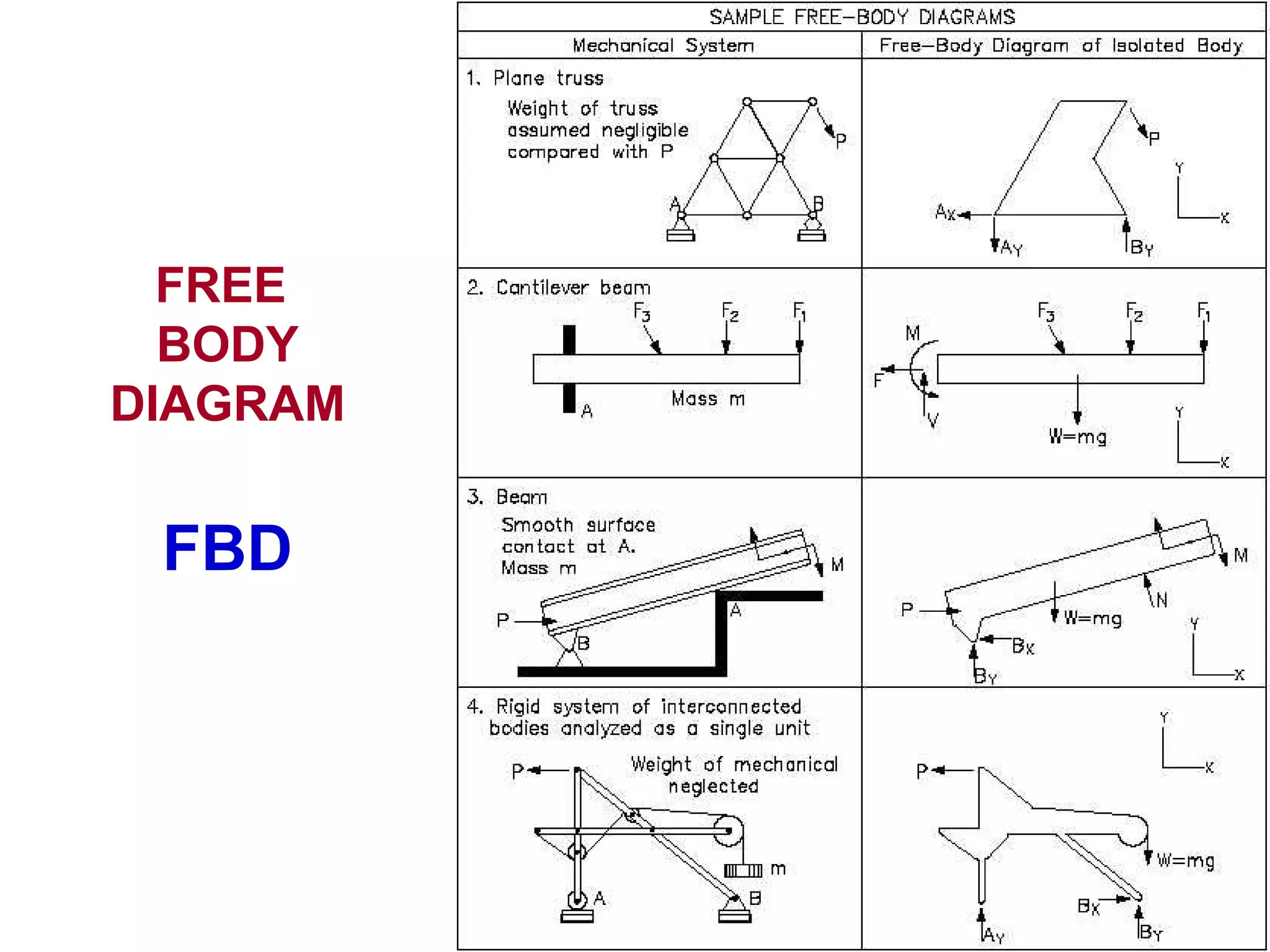
Free-body diagrams
Free-body diagrams are used to show the
relative magnitude and direction of all
forces acting on an object.
FREE
BODY
DIAGRAM
FBD
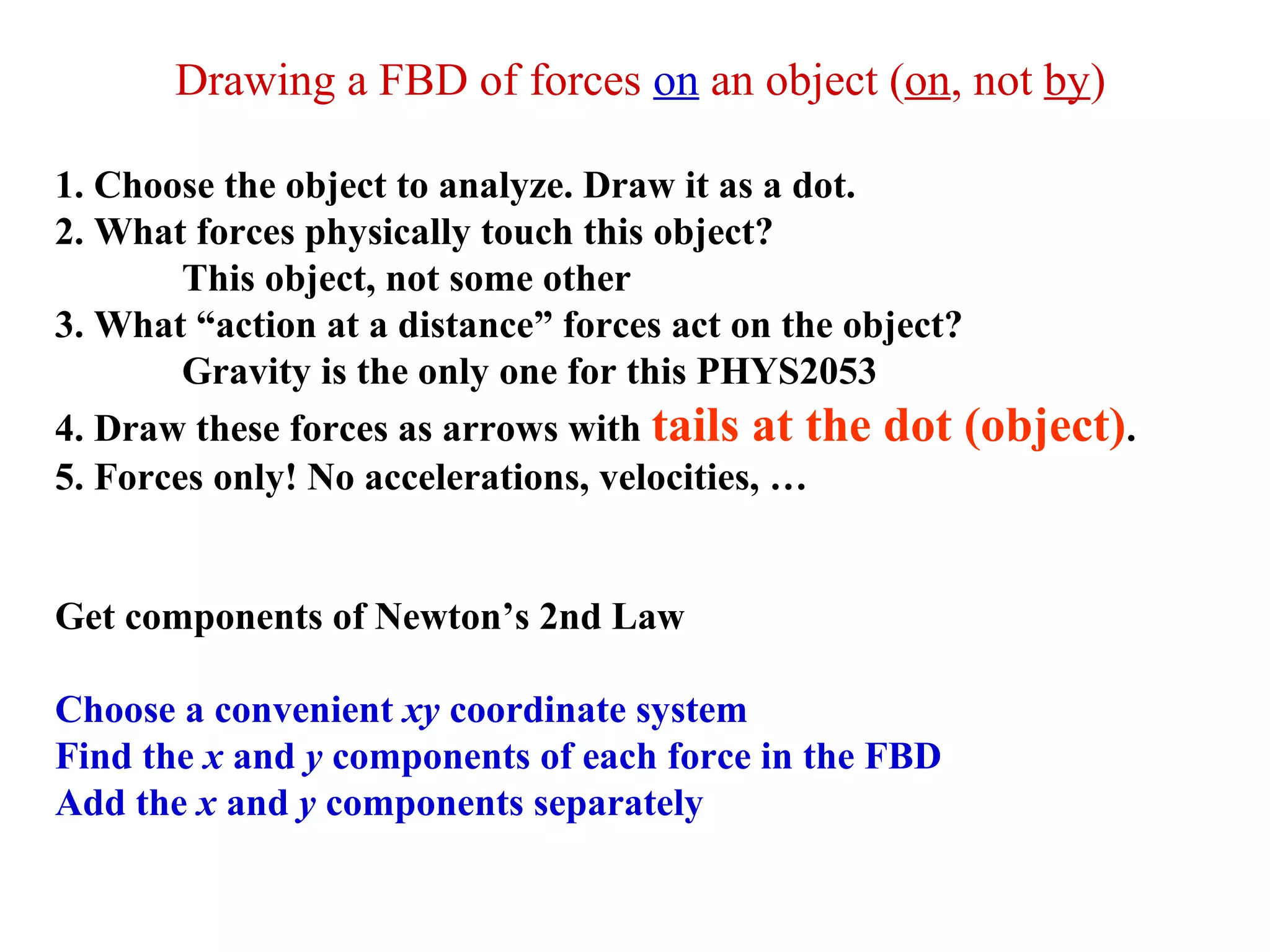
Drawing a FBD of forces on an object (on, not by)
1. Choose the object to analyze. Draw it as a dot.
2. What forces physically touch this object?
This object, not some other
3. What “action at a distance” forces act on the object?
Gravity is the only one for this PHYS2053
4. Draw these forces as arrows with tails at the dot (object).
5. Forces only! No accelerations, velocities, …
Get components of Newton’s 2nd Law
Choose a convenient xy coordinate system
Find the x and y components of each force in the FBD
Add the x and y components separately
From Simple to Complex
• 1) Horizontal plane
• 2) Inclined plane
Horizontal plane
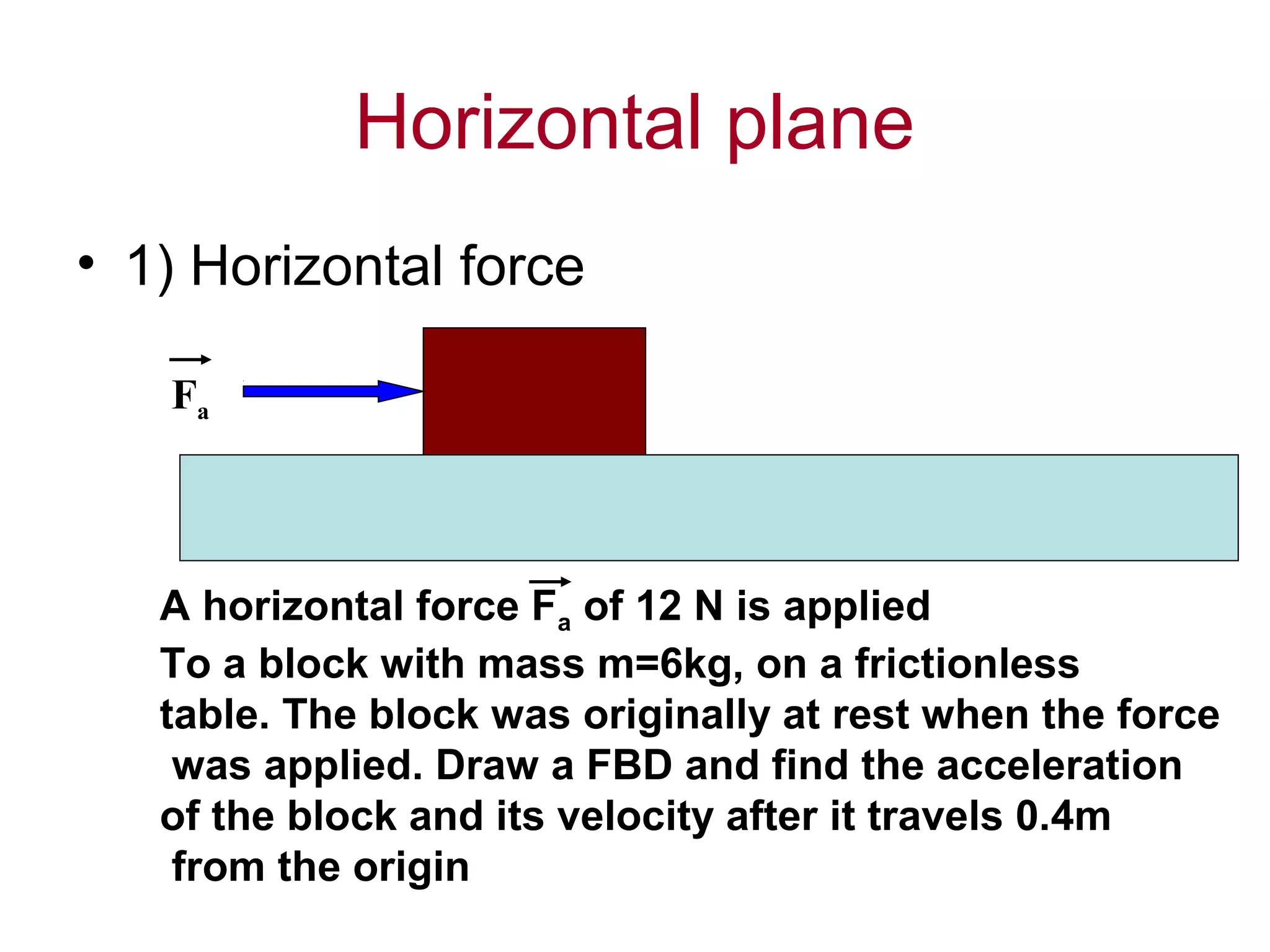
• 1) Horizontal force
A horizontal force Fa of 12 N is applied
To a block with mass m=6kg, on a frictionless
table. The block was originally at rest when the force
was applied. Draw a FBD and find the acceleration
of the block and its velocity after it travels 0.4m
from the origin
Fa
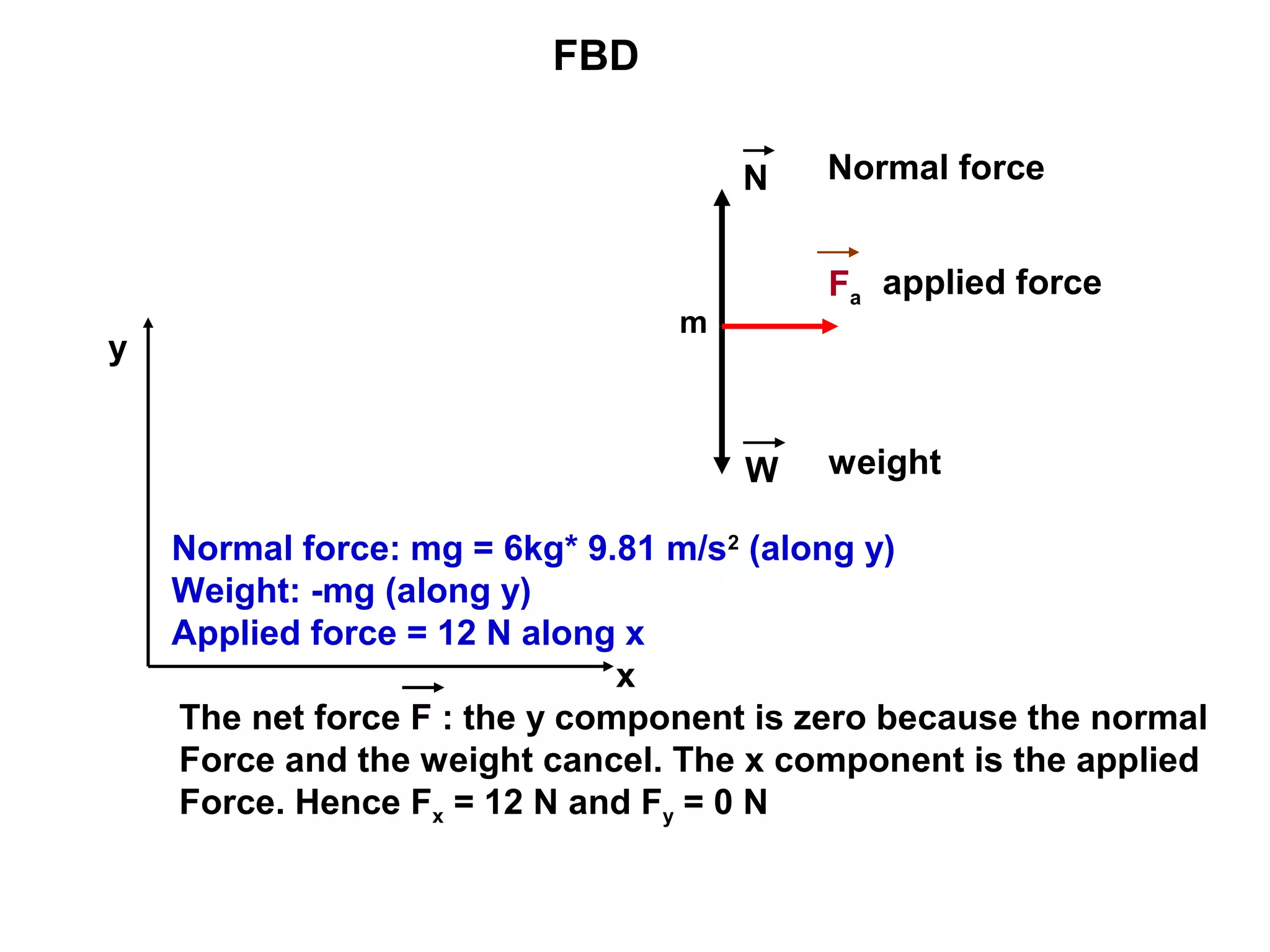
FBD
m
Fa
N
W
Normal force
weight
applied force
x
y
Normal force: mg = 6kg* 9.81 m/s2
(along y)
Weight: -mg (along y)
Applied force = 12 N along x
The net force F : the y component is zero because the normal
Force and the weight cancel. The x component is the applied
Force. Hence Fx = 12 N and Fy = 0 N
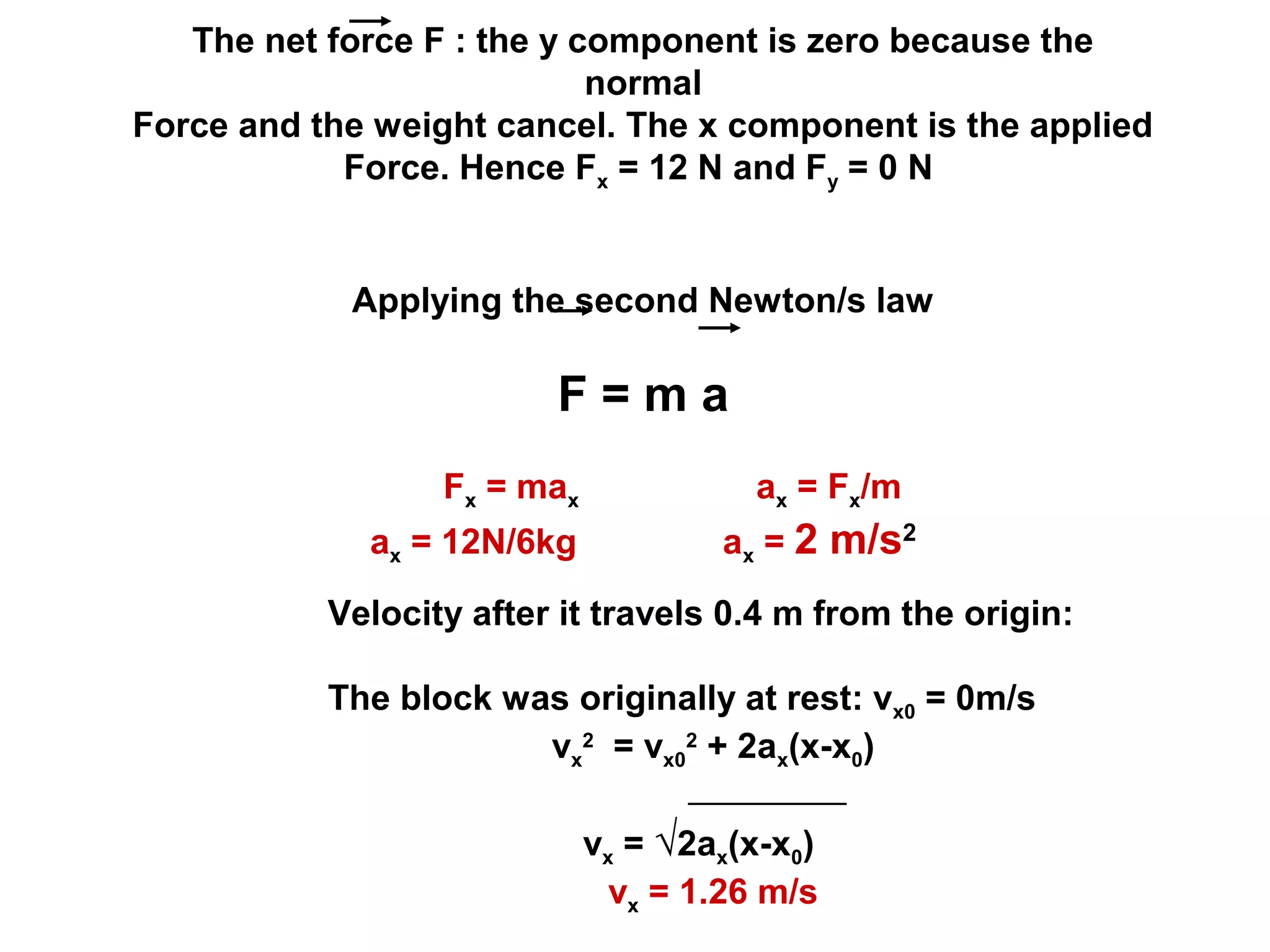
The net force F : the y component is zero because the
normal
Force and the weight cancel. The x component is the applied
Force. Hence Fx = 12 N and Fy = 0 N
Applying the second Newton/s law
F = m a
Fx = max ax = Fx/m
ax = 12N/6kg ax = 2 m/s2
Velocity after it travels 0.4 m from the origin:
The block was originally at rest: vx0 = 0m/s
vx
2
= vx0
2
+ 2ax(x-x0)
vx = √2ax(x-x0)
vx = 1.26 m/s
Horizontal plane
• 2) Force at an angle
A force Fa of 15 N making an angle of 35o
from the horizontal
is applied to a block with mass m=6kg, on a frictionless table.
The block was originally at rest when the force was applied.
Draw a FBD and find the acceleration of the block and its
velocity after it travels for 5 seconds from the origin
θ
FBD
m
Fa
N
W
Normal force
weight
applied force
x
y
θ
Fa,y
Fa,x
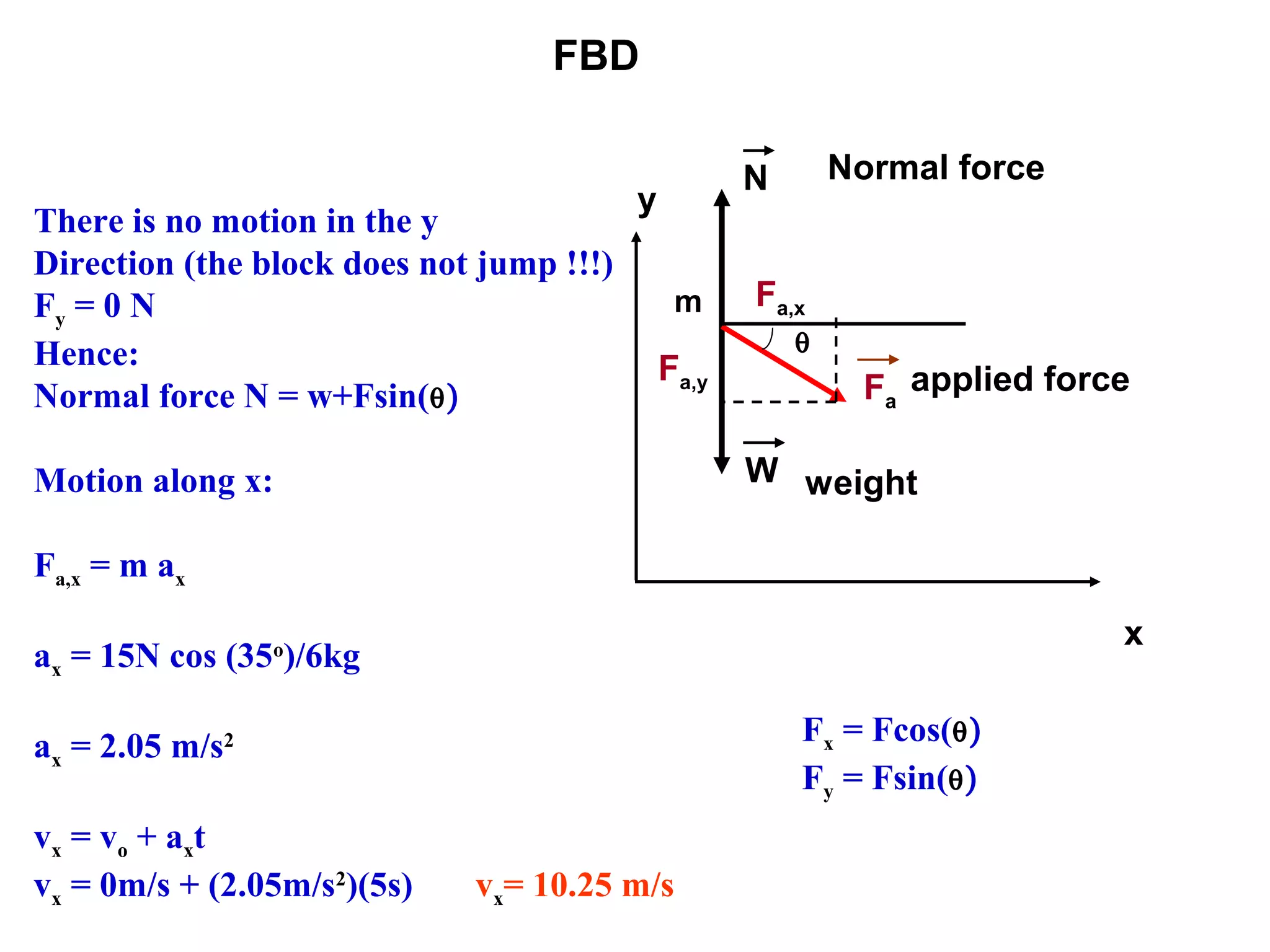
There is no motion in the y
Direction (the block does not jump !!!)
Fy = 0 N
Hence:
Normal force N = w+Fsin(θ)
Motion along x:
Fa,x = m ax
ax = 15N cos (35o
)/6kg
ax = 2.05 m/s2
vx = vo + axt
vx = 0m/s + (2.05m/s2
)(5s) vx= 10.25 m/s
Fx = Fcos(θ)
Fy = Fsin(θ)
Horizontal plane
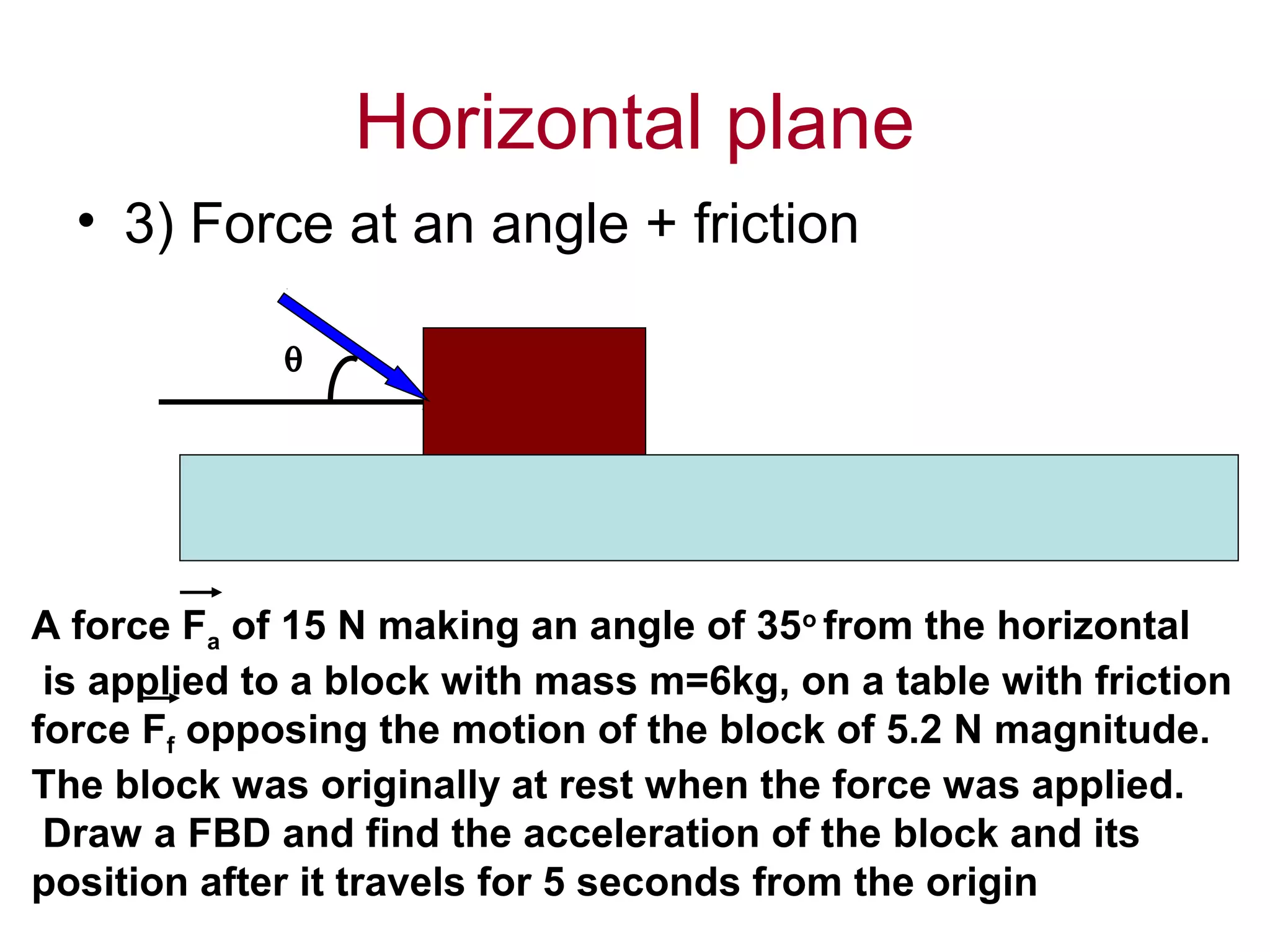
• 3) Force at an angle + friction
A force Fa of 15 N making an angle of 35o
from the horizontal
is applied to a block with mass m=6kg, on a table with friction
force Ff opposing the motion of the block of 5.2 N magnitude.
The block was originally at rest when the force was applied.
Draw a FBD and find the acceleration of the block and its
position after it travels for 5 seconds from the origin
θ
FBD
m
Fa
N
W
Normal force
weight
applied force
x
y
θ
Fa,y
Fa,x
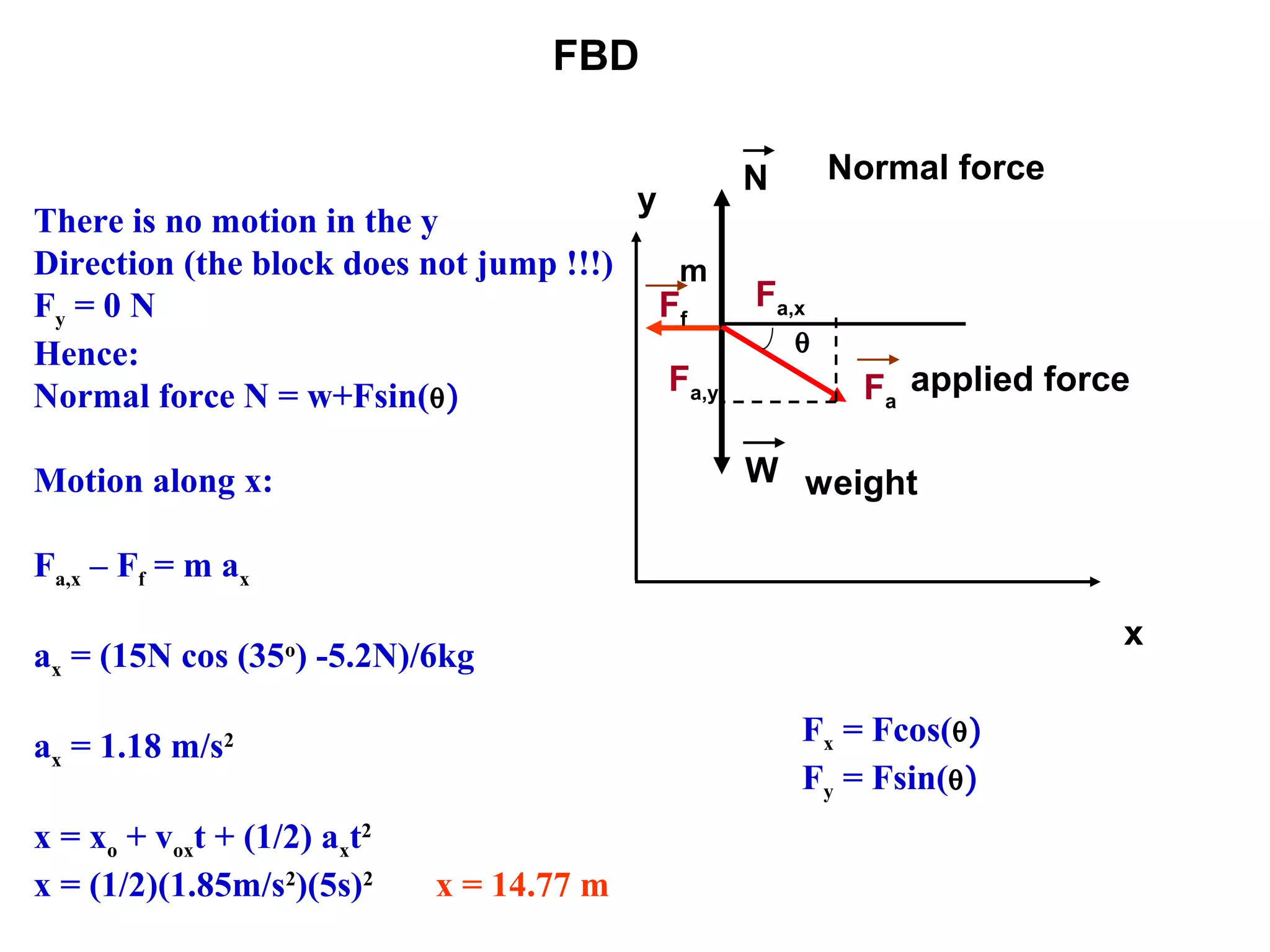
There is no motion in the y
Direction (the block does not jump !!!)
Fy = 0 N
Hence:
Normal force N = w+Fsin(θ)
Motion along x:
Fa,x – Ff = m ax
ax = (15N cos (35o
) -5.2N)/6kg
ax = 1.18 m/s2
x = xo + voxt + (1/2) axt2
x = (1/2)(1.85m/s2
)(5s)2
x = 14.77 m
Fx = Fcos(θ)
Fy = Fsin(θ)
Ff
x
y
θ
θ
θ
α
β ???
β = 90o
- α
β = 90o
- (90o
- θ)
β = θ
α = 90o
- θ
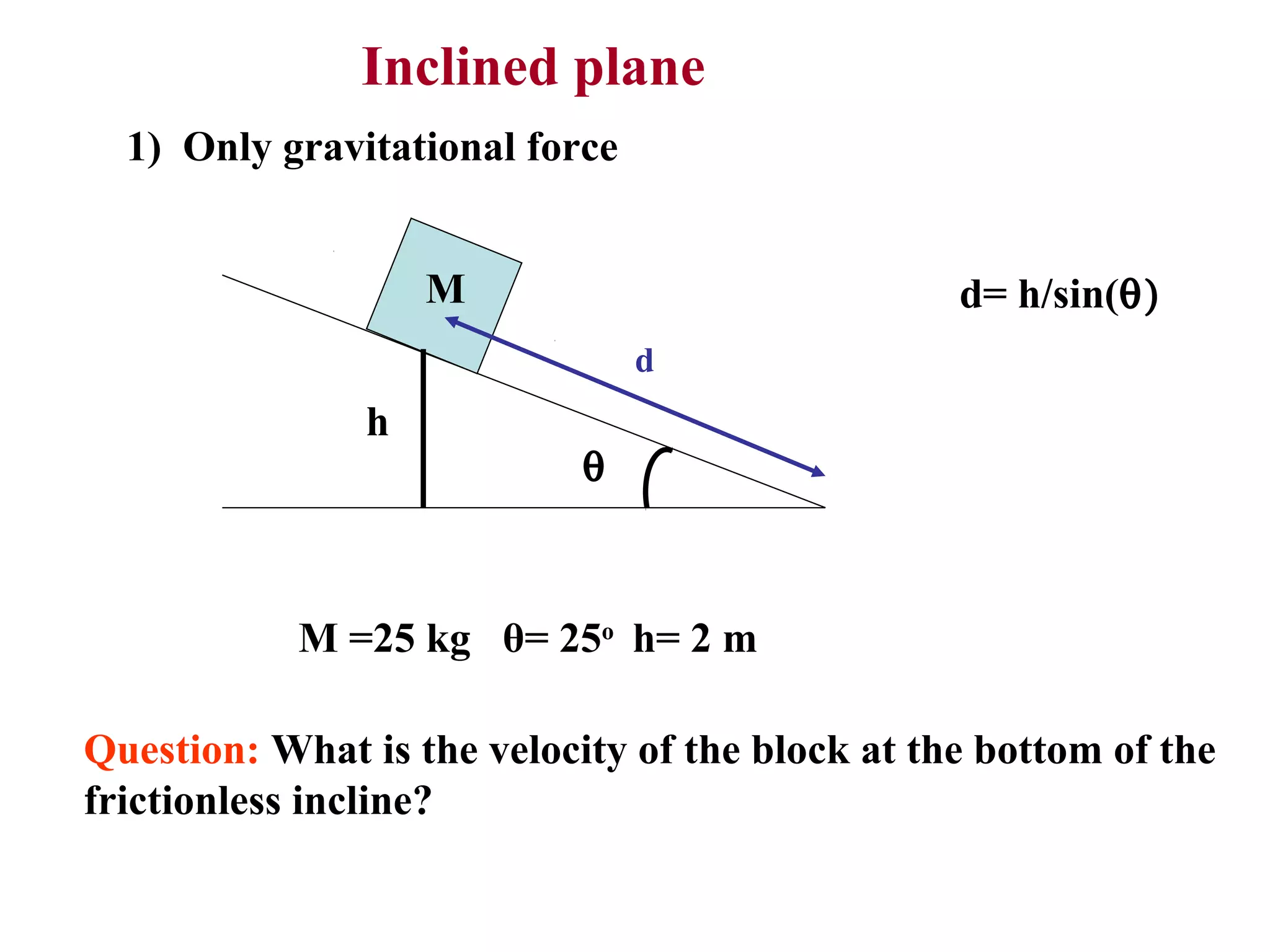
Inclined plane
1) Only gravitational force
M =25 kg θ= 25o
h= 2 m
θ
M
h
Question: What is the velocity of the block at the bottom of the
frictionless incline?
d
d= h/sin(θ)
FBD
Wx = W sin θ Wy = W cos θ
N =-Wy
y
θW
N
x
Wx
Wy
θ
y-component of the net force is zero!
22ο
M
h
Fa
37ο
Ff
A box with mass 45 kg is at rest when a force Fa (20N)making an angle
of 370
with the inclined plane. The inclined plane makes an angle of 220
with the horizontal plane. When the box is moving on the inclined
Plane, there is a friction force Ff of 5 N opposing the motion. The box was
Originally at a height h from the ground (h=4 m).
Draw the free body diagram for the box. Determine the components x, y
for all the forces acting on the box. Find the net force and acceleration
Of the box.
 Gravity pulls down on the squirrel while
air resistance keeps the squirrel in the air
for a while.
The conditions for a particle to
be in equilibrium
• Necessary conditions for an object to
settle into equilibrium
ΣF = 0
ΣFx = 0 and ΣFy = 0
•Both x and y forces must be considered separately.
Free body diagram

Free body diagram

  • 1.
    Prepared by :Chandresh Suthar
  • 2.
  • 3.
    Free-body diagrams Free-body diagramsare used to show the relative magnitude and direction of all forces acting on an object.
  • 4.
  • 5.
    Drawing a FBDof forces on an object (on, not by) 1. Choose the object to analyze. Draw it as a dot. 2. What forces physically touch this object? This object, not some other 3. What “action at a distance” forces act on the object? Gravity is the only one for this PHYS2053 4. Draw these forces as arrows with tails at the dot (object). 5. Forces only! No accelerations, velocities, … Get components of Newton’s 2nd Law Choose a convenient xy coordinate system Find the x and y components of each force in the FBD Add the x and y components separately
  • 6.
    From Simple toComplex • 1) Horizontal plane • 2) Inclined plane
  • 7.
    Horizontal plane • 1)Horizontal force A horizontal force Fa of 12 N is applied To a block with mass m=6kg, on a frictionless table. The block was originally at rest when the force was applied. Draw a FBD and find the acceleration of the block and its velocity after it travels 0.4m from the origin Fa
  • 8.
    FBD m Fa N W Normal force weight applied force x y Normalforce: mg = 6kg* 9.81 m/s2 (along y) Weight: -mg (along y) Applied force = 12 N along x The net force F : the y component is zero because the normal Force and the weight cancel. The x component is the applied Force. Hence Fx = 12 N and Fy = 0 N
  • 9.
    The net forceF : the y component is zero because the normal Force and the weight cancel. The x component is the applied Force. Hence Fx = 12 N and Fy = 0 N Applying the second Newton/s law F = m a Fx = max ax = Fx/m ax = 12N/6kg ax = 2 m/s2 Velocity after it travels 0.4 m from the origin: The block was originally at rest: vx0 = 0m/s vx 2 = vx0 2 + 2ax(x-x0) vx = √2ax(x-x0) vx = 1.26 m/s
  • 10.
    Horizontal plane • 2)Force at an angle A force Fa of 15 N making an angle of 35o from the horizontal is applied to a block with mass m=6kg, on a frictionless table. The block was originally at rest when the force was applied. Draw a FBD and find the acceleration of the block and its velocity after it travels for 5 seconds from the origin θ
  • 11.
    FBD m Fa N W Normal force weight applied force x y θ Fa,y Fa,x Thereis no motion in the y Direction (the block does not jump !!!) Fy = 0 N Hence: Normal force N = w+Fsin(θ) Motion along x: Fa,x = m ax ax = 15N cos (35o )/6kg ax = 2.05 m/s2 vx = vo + axt vx = 0m/s + (2.05m/s2 )(5s) vx= 10.25 m/s Fx = Fcos(θ) Fy = Fsin(θ)
  • 12.
    Horizontal plane • 3)Force at an angle + friction A force Fa of 15 N making an angle of 35o from the horizontal is applied to a block with mass m=6kg, on a table with friction force Ff opposing the motion of the block of 5.2 N magnitude. The block was originally at rest when the force was applied. Draw a FBD and find the acceleration of the block and its position after it travels for 5 seconds from the origin θ
  • 13.
    FBD m Fa N W Normal force weight applied force x y θ Fa,y Fa,x Thereis no motion in the y Direction (the block does not jump !!!) Fy = 0 N Hence: Normal force N = w+Fsin(θ) Motion along x: Fa,x – Ff = m ax ax = (15N cos (35o ) -5.2N)/6kg ax = 1.18 m/s2 x = xo + voxt + (1/2) axt2 x = (1/2)(1.85m/s2 )(5s)2 x = 14.77 m Fx = Fcos(θ) Fy = Fsin(θ) Ff
  • 14.
  • 15.
    θ α β ??? β =90o - α β = 90o - (90o - θ) β = θ α = 90o - θ
  • 16.
    Inclined plane 1) Onlygravitational force M =25 kg θ= 25o h= 2 m θ M h Question: What is the velocity of the block at the bottom of the frictionless incline? d d= h/sin(θ)
  • 17.
    FBD Wx = Wsin θ Wy = W cos θ N =-Wy y θW N x Wx Wy θ
  • 18.
    y-component of thenet force is zero!
  • 19.
    22ο M h Fa 37ο Ff A box withmass 45 kg is at rest when a force Fa (20N)making an angle of 370 with the inclined plane. The inclined plane makes an angle of 220 with the horizontal plane. When the box is moving on the inclined Plane, there is a friction force Ff of 5 N opposing the motion. The box was Originally at a height h from the ground (h=4 m). Draw the free body diagram for the box. Determine the components x, y for all the forces acting on the box. Find the net force and acceleration Of the box.
  • 20.
     Gravity pullsdown on the squirrel while air resistance keeps the squirrel in the air for a while.
  • 21.
    The conditions fora particle to be in equilibrium • Necessary conditions for an object to settle into equilibrium ΣF = 0 ΣFx = 0 and ΣFy = 0
  • 22.
    •Both x andy forces must be considered separately.