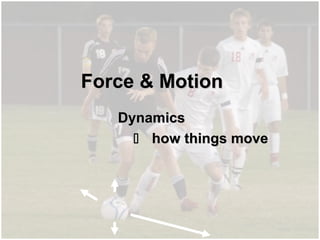
Force & Motion
   Dynamics
      how things move
Aristotle (4-300 BC)
 Believed everything moved to return to its
    own. ie. rock to earth, smoke to air
    Objects want to be in a state of rest.


 Galileo (15-1600 AD)
   Dropped objects from the Leaning Tower of
   Pisa. Too quick, Too Fast  after 3s, v =
   29 m/s (64 mi/hr), y = 44 m (1/2 football
   field) per second
Slowed things down by rolling balls down various
inclines.


                                       ?

  It always came to about the same height.
  What would happen on a smooth horizontal
  surface?
 Inertia  tendency of an object to maintain a
    state of rest or motion
Newton (16-1700 AD)
  Mass is a measure of inertia
  The more mass you have, the less it wants
  to change its state of motion.

1st Law (Law of Inertia)
     An object in motion tends to stay in
   motion with a constant velocity and an
   object at rest tends to stay at rest, unless
   acted on by an unbalanced force.
Force
   a push or pull on an object
    (measured in Newtons)
Net Force (Fnet)
      is the sum of all the forces acting on
     an object
   Balanced                     Unbalanced
F1 = 2 N       F2 = -2 N F1 = 2 N        F2 = -5 N

  Fnet = 2 + -2 = 0 N       Fnet = 2 + -5 = -3 N
Force Diagrams (Free Body Diagram)
   a vector diagram of all the forces acting on

1. Draw the object as a single dot.
     an object
2. Draw the force vectors as coming out of the
   dot. Label each of the vectors.
   F1  Force of object 1 on object 2
3. Check to make sure that all forces are
   accounted for.
2 Types of forces
Contact – Look at the objects actually touching
Noncontact – look at gravity, electricity, and magnetism
Normal Force
  force perpendicular to the ground pushing up

  Samples
 Draw a force diagram of
 you sitting in your desk.
Accelerating out of the parking lot, you put your foot on
the gas and the engine applies 2500 N of force forward
on your 10,000 N car. If the ground puts 1000 N of
friction back on the car:
a. draw a free body diagram
b. what is the net force?
Newton’s 2nd Law
If all objects resting want to stay resting,
     how do they move?
If all objects moving want to stay moving,
     how do they stop?
Force!!!
F↑a↑                     m↓a↑
Fαa                      1/m α a
Force is directly        mass is inversely
proportional to accel.   proportional to accel.
2nd Law (Law of Acceleration)
 Force makes an object want to accelerate.
 Mass makes an object not want to accelerate.


                a α Fnet/m
                a = k Fnet / m Const = 1
                a = F/m
                F = ma
 1 Newton = amount of force necessary to
    accelerate a 1 kg mass at 1 m/s2
 1 N = 1 kg m/s2
    This would be like holding 100 g in your hand.
    1 N = (.1 kg) (9.8m/s2)
 1lb is about 4 N
Net force in the
No Angle                   y direction                            Angle
 Fnety = 0                 usually cancels                       Fnety = 0
FN – Fg = 0                out to zero:                        FN + Fy = Fg
   FN = F g

              FN                                          FN               Fyou
                                                                FyouY
  FF               Fyou                              FF
                                                                        FyouX

              Fg                                                Fg

                          Net force in x direction
                          causes acceleration:        Constant Velocity
Accelerating                                              Fnetx = 0
 Fnetx = ma
                                                         Fx – Ff = 0
Fx – Ff = ma
                                                           F =F
To find the mass,
 F1 = 2 N 196 N F2 = -5 N       take the weight,
                                 divide by 9.8.


     Fnet = 2 + -5 = -3 N
Weight  force of
 gravity
 F = ma
 Fg = m g
                            F = ma
196 N= m (9.8 m/s2)
m = 20 kg                   -3 = 20 a
                            a = -0.15 m/s2
Use vf, x, or t to find a, then a to find Fnet, or use Fnet to find a then a to find vf, x,
or t


 vf
 x
 t               x = vit + ½ at2            a               Fnet = ma
                                                                                  Fnet
                 vf = vi + at


 vi
                 vf2 = vi2 + 2ax
You pull a 50 N block with a force of 15 N at 26 °.
a. draw a force diagram
b. find the mass of the block.
c. find the components of your force.
d. find the normal force
e. find the acceleration of the block if friction is 4 N?
f. find the block’s final velocity after 3 s?
                    Givens
You pull a 50 N block with a force of 15 N at       Y direction
26°.                                                Fnet = m a
a. draw a force diagram
b. find the mass of the block.                      Fnet = 0
c. find the components of your force.               FN + Fy – Fg = 0
d. find the normal force                            FN + 6.58 – 50 = 0
e. find the acceleration of the block if friction   FN = 43.4 N
is 4 N?
f. find the block’s final velocity after 3 s?
          FN
                                Givens              X direction
              Fx = 15 cos 26 = 13.5 N
                  15 N          vi = 0              Fnet = m a
              Fy = 15 sin 26 =a = 1.86 m/s2
                                 6.58 N
                                                    Fx = 5.10 a
                                t=3s
                                                    13.5 -4 = 5.10 a
                                vf = ?
                                                    a = 1.86 m/s2
             Fg = m g
               g     a         vf = vi + at
             50 = m(9.8)       vf = 0 + (1.86)(3)
             m = 5.10 kg       vf = 5.59 m/s
Newton’s Third Law
Newton’s 3 Law rd


Every Action has an equal and opposite reaction.
∴Every interaction happens in 2’s.
    Action Force and Reaction Force

How do we know what action & reaction are?
 Action: Object A exerts a force on object B
 Reaction: Object B exerts a force on object A
  Notice that these forces are acting on two
               different objects.
example: Earth exerts a force on Boulder
         Boulder exerts a force on Earth
                    If the boulder exerts a
                  force on the earth that is
       Force of    equal, why doesn’t the
       Earth on    earth accelerate to the
       Boulder              boulder?

      Force of
      Boulder
      on Earth
Mass! 2nd Law!!!
                    F=F


                m   AM  =       a
So the earth moves, but it is soooo small that we
 can’t tell!

Another example… horse and cart.
Are the equal and opposite forces acting on the
  same object?

1 newton's laws notes

  • 1.
    Force & Motion Dynamics  how things move
  • 2.
    Aristotle (4-300 BC) Believed everything moved to return to its own. ie. rock to earth, smoke to air Objects want to be in a state of rest. Galileo (15-1600 AD) Dropped objects from the Leaning Tower of Pisa. Too quick, Too Fast  after 3s, v = 29 m/s (64 mi/hr), y = 44 m (1/2 football field) per second
  • 3.
    Slowed things downby rolling balls down various inclines. ? It always came to about the same height. What would happen on a smooth horizontal surface?  Inertia  tendency of an object to maintain a state of rest or motion
  • 4.
    Newton (16-1700 AD) Mass is a measure of inertia The more mass you have, the less it wants to change its state of motion. 1st Law (Law of Inertia)  An object in motion tends to stay in motion with a constant velocity and an object at rest tends to stay at rest, unless acted on by an unbalanced force.
  • 5.
    Force a push or pull on an object (measured in Newtons) Net Force (Fnet)  is the sum of all the forces acting on an object Balanced Unbalanced F1 = 2 N F2 = -2 N F1 = 2 N F2 = -5 N Fnet = 2 + -2 = 0 N Fnet = 2 + -5 = -3 N
  • 6.
    Force Diagrams (FreeBody Diagram)  a vector diagram of all the forces acting on 1. Draw the object as a single dot. an object 2. Draw the force vectors as coming out of the dot. Label each of the vectors. F1  Force of object 1 on object 2 3. Check to make sure that all forces are accounted for. 2 Types of forces Contact – Look at the objects actually touching Noncontact – look at gravity, electricity, and magnetism
  • 7.
    Normal Force force perpendicular to the ground pushing up Samples Draw a force diagram of you sitting in your desk. Accelerating out of the parking lot, you put your foot on the gas and the engine applies 2500 N of force forward on your 10,000 N car. If the ground puts 1000 N of friction back on the car: a. draw a free body diagram b. what is the net force?
  • 8.
    Newton’s 2nd Law Ifall objects resting want to stay resting, how do they move? If all objects moving want to stay moving, how do they stop? Force!!! F↑a↑ m↓a↑ Fαa 1/m α a Force is directly mass is inversely proportional to accel. proportional to accel.
  • 9.
    2nd Law (Lawof Acceleration) Force makes an object want to accelerate. Mass makes an object not want to accelerate. a α Fnet/m a = k Fnet / m Const = 1 a = F/m F = ma 1 Newton = amount of force necessary to accelerate a 1 kg mass at 1 m/s2 1 N = 1 kg m/s2 This would be like holding 100 g in your hand. 1 N = (.1 kg) (9.8m/s2) 1lb is about 4 N
  • 10.
    Net force inthe No Angle y direction Angle Fnety = 0 usually cancels Fnety = 0 FN – Fg = 0 out to zero: FN + Fy = Fg FN = F g FN FN Fyou FyouY FF Fyou FF FyouX Fg Fg Net force in x direction causes acceleration: Constant Velocity Accelerating Fnetx = 0 Fnetx = ma Fx – Ff = 0 Fx – Ff = ma F =F
  • 11.
    To find themass, F1 = 2 N 196 N F2 = -5 N take the weight, divide by 9.8. Fnet = 2 + -5 = -3 N Weight  force of gravity F = ma Fg = m g F = ma 196 N= m (9.8 m/s2) m = 20 kg -3 = 20 a a = -0.15 m/s2
  • 12.
    Use vf, x,or t to find a, then a to find Fnet, or use Fnet to find a then a to find vf, x, or t vf x t x = vit + ½ at2 a Fnet = ma Fnet vf = vi + at vi vf2 = vi2 + 2ax
  • 13.
    You pull a50 N block with a force of 15 N at 26 °. a. draw a force diagram b. find the mass of the block. c. find the components of your force. d. find the normal force e. find the acceleration of the block if friction is 4 N? f. find the block’s final velocity after 3 s? Givens
  • 15.
    You pull a50 N block with a force of 15 N at Y direction 26°. Fnet = m a a. draw a force diagram b. find the mass of the block. Fnet = 0 c. find the components of your force. FN + Fy – Fg = 0 d. find the normal force FN + 6.58 – 50 = 0 e. find the acceleration of the block if friction FN = 43.4 N is 4 N? f. find the block’s final velocity after 3 s? FN Givens X direction Fx = 15 cos 26 = 13.5 N 15 N vi = 0 Fnet = m a Fy = 15 sin 26 =a = 1.86 m/s2 6.58 N Fx = 5.10 a t=3s 13.5 -4 = 5.10 a vf = ? a = 1.86 m/s2 Fg = m g g a vf = vi + at 50 = m(9.8) vf = 0 + (1.86)(3) m = 5.10 kg vf = 5.59 m/s
  • 17.
  • 18.
    Newton’s 3 Lawrd Every Action has an equal and opposite reaction. ∴Every interaction happens in 2’s. Action Force and Reaction Force How do we know what action & reaction are? Action: Object A exerts a force on object B Reaction: Object B exerts a force on object A Notice that these forces are acting on two different objects.
  • 19.
    example: Earth exertsa force on Boulder Boulder exerts a force on Earth If the boulder exerts a force on the earth that is Force of equal, why doesn’t the Earth on earth accelerate to the Boulder boulder? Force of Boulder on Earth
  • 20.
    Mass! 2nd Law!!! F=F m AM = a So the earth moves, but it is soooo small that we can’t tell! Another example… horse and cart. Are the equal and opposite forces acting on the same object?

Editor's Notes

  • #8 Show the free body diagram of the block.
  • #19 Draw picture of a boulder & earth on the board. jump off lab table. have students watch the floor.