Linear Algebra
Eigenvalues and
Eigenvectors
Shambhu Sharan
Eigenvalues and
Eigenvectors
Motivation
Geometrical interpretation
Determination of eigenvalues
and eigenvectors
Algebraic and geometric
multiplicity, Defect
Symmetric, Skew-Symmetric,
and Orthogonal Matrices
Diagonalization of
Matrices
Similar matrices
Eigenvalues and eigenvectors
of similar matrices
Diagonalization of real
symmetric Matrices
Quadratic form
Application to quadratic form
principal axes form or
canonical form
Linear Algebra
Eigenvalues and Eigenvectors
Shambhu Sharan
Department of Mathematics
College of Commerce, Arts & Science, Patna
Linear Algebra
Eigenvalues and
Eigenvectors
Shambhu Sharan
Eigenvalues and
Eigenvectors
Motivation
Geometrical interpretation
Determination of eigenvalues
and eigenvectors
Algebraic and geometric
multiplicity, Defect
Symmetric, Skew-Symmetric,
and Orthogonal Matrices
Diagonalization of
Matrices
Similar matrices
Eigenvalues and eigenvectors
of similar matrices
Diagonalization of real
symmetric Matrices
Quadratic form
Application to quadratic form
principal axes form or
canonical form
Outline
Eigenvalues and Eigenvectors
Motivation
Geometrical interpretation
Determination of eigenvalues and eigenvectors
Algebraic and geometric multiplicity, Defect
Symmetric, Skew-Symmetric, and Orthogonal Matrices
Diagonalization of Matrices
Similar matrices
Eigenvalues and eigenvectors of similar matrices
Diagonalization of real symmetric Matrices
Quadratic form
Application to quadratic form
principal axes form or canonical form
Linear Algebra
Eigenvalues and
Eigenvectors
Shambhu Sharan
Eigenvalues and
Eigenvectors
Motivation
Geometrical interpretation
Determination of eigenvalues
and eigenvectors
Algebraic and geometric
multiplicity, Defect
Symmetric, Skew-Symmetric,
and Orthogonal Matrices
Diagonalization of
Matrices
Similar matrices
Eigenvalues and eigenvectors
of similar matrices
Diagonalization of real
symmetric Matrices
Quadratic form
Application to quadratic form
principal axes form or
canonical form
Eigen values and Eigen vectors
Let A = [aij] be a given n × n matrix. Consider the vector
equation
Ax = λx. (1)
Here x is an unknown vector and λ an unknown scalar. Our
task is to determine x’s and λ’s that equation (1).
Geometrically, solving eq. (1) in this way means that we are
looking for vectors x for which the multiplication of x by the
matrix A has the same effect as the multiplication of x by a
scalar A, giving a vector Ax with components proportional to
those of x, and A as the factor of proportionality.
Linear Algebra
Eigenvalues and
Eigenvectors
Shambhu Sharan
Eigenvalues and
Eigenvectors
Motivation
Geometrical interpretation
Determination of eigenvalues
and eigenvectors
Algebraic and geometric
multiplicity, Defect
Symmetric, Skew-Symmetric,
and Orthogonal Matrices
Diagonalization of
Matrices
Similar matrices
Eigenvalues and eigenvectors
of similar matrices
Diagonalization of real
symmetric Matrices
Quadratic form
Application to quadratic form
principal axes form or
canonical form
Eigen values and Eigen vectors
Let A = [aij] be a given n × n matrix. Consider the vector
equation
Ax = λx. (1)
Here x is an unknown vector and λ an unknown scalar. Our
task is to determine x’s and λ’s that equation (1).
Geometrically, solving eq. (1) in this way means that we are
looking for vectors x for which the multiplication of x by the
matrix A has the same effect as the multiplication of x by a
scalar A, giving a vector Ax with components proportional to
those of x, and A as the factor of proportionality.
Clearly, the zero vector x = 0 is a solution of (1) for any value
of λ, because A0 = 0 (this is of no interest).
Linear Algebra
Eigenvalues and
Eigenvectors
Shambhu Sharan
Eigenvalues and
Eigenvectors
Motivation
Geometrical interpretation
Determination of eigenvalues
and eigenvectors
Algebraic and geometric
multiplicity, Defect
Symmetric, Skew-Symmetric,
and Orthogonal Matrices
Diagonalization of
Matrices
Similar matrices
Eigenvalues and eigenvectors
of similar matrices
Diagonalization of real
symmetric Matrices
Quadratic form
Application to quadratic form
principal axes form or
canonical form
Eigenvalues and Eigenvectors
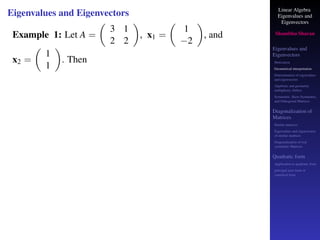
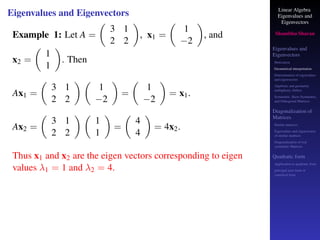
Example 1: Let A =

3 1
2 2

, x1 =

1
−2

, and
x2 =

1
1

. Then
Linear Algebra
Eigenvalues and
Eigenvectors
Shambhu Sharan
Eigenvalues and
Eigenvectors
Motivation
Geometrical interpretation
Determination of eigenvalues
and eigenvectors
Algebraic and geometric
multiplicity, Defect
Symmetric, Skew-Symmetric,
and Orthogonal Matrices
Diagonalization of
Matrices
Similar matrices
Eigenvalues and eigenvectors
of similar matrices
Diagonalization of real
symmetric Matrices
Quadratic form
Application to quadratic form
principal axes form or
canonical form
Eigenvalues and Eigenvectors
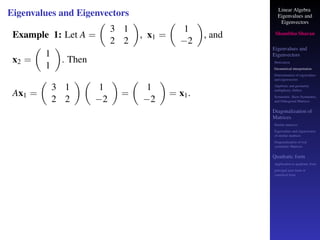
Example 1: Let A =

3 1
2 2

, x1 =

1
−2

, and
x2 =

1
1

. Then
Ax1 =

3 1
2 2
 
1
−2

=

1
−2

= x1.
Linear Algebra
Eigenvalues and
Eigenvectors
Shambhu Sharan
Eigenvalues and
Eigenvectors
Motivation
Geometrical interpretation
Determination of eigenvalues
and eigenvectors
Algebraic and geometric
multiplicity, Defect
Symmetric, Skew-Symmetric,
and Orthogonal Matrices
Diagonalization of
Matrices
Similar matrices
Eigenvalues and eigenvectors
of similar matrices
Diagonalization of real
symmetric Matrices
Quadratic form
Application to quadratic form
principal axes form or
canonical form
Eigenvalues and Eigenvectors
Example 1: Let A =

3 1
2 2

, x1 =

1
−2

, and
x2 =

1
1

. Then
Ax1 =

3 1
2 2
 
1
−2

=

1
−2

= x1.
Ax2 =

3 1
2 2
 
1
1

=

4
4

= 4x2.
Thus x1 and x2 are the eigen vectors corresponding to eigen
values λ1 = 1 and λ2 = 4.
Linear Algebra
Eigenvalues and
Eigenvectors
Shambhu Sharan
Eigenvalues and
Eigenvectors
Motivation
Geometrical interpretation
Determination of eigenvalues
and eigenvectors
Algebraic and geometric
multiplicity, Defect
Symmetric, Skew-Symmetric,
and Orthogonal Matrices
Diagonalization of
Matrices
Similar matrices
Eigenvalues and eigenvectors
of similar matrices
Diagonalization of real
symmetric Matrices
Quadratic form
Application to quadratic form
principal axes form or
canonical form
Eigen values and Eigen vectors
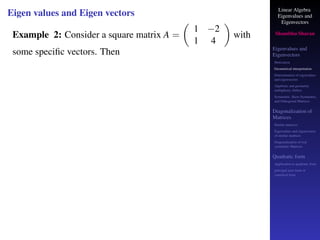
Example 2: Consider a square matrix A =

1 −2
1 4

with
some specific vectors. Then
Linear Algebra
Eigenvalues and
Eigenvectors
Shambhu Sharan
Eigenvalues and
Eigenvectors
Motivation
Geometrical interpretation
Determination of eigenvalues
and eigenvectors
Algebraic and geometric
multiplicity, Defect
Symmetric, Skew-Symmetric,
and Orthogonal Matrices
Diagonalization of
Matrices
Similar matrices
Eigenvalues and eigenvectors
of similar matrices
Diagonalization of real
symmetric Matrices
Quadratic form
Application to quadratic form
principal axes form or
canonical form
Eigen values and Eigen vectors
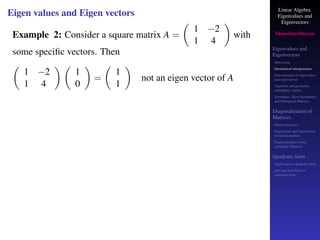
Example 2: Consider a square matrix A =

1 −2
1 4

with
some specific vectors. Then

1 −2
1 4
 
1
0

=

1
1

not an eigen vector of A
Linear Algebra
Eigenvalues and
Eigenvectors
Shambhu Sharan
Eigenvalues and
Eigenvectors
Motivation
Geometrical interpretation
Determination of eigenvalues
and eigenvectors
Algebraic and geometric
multiplicity, Defect
Symmetric, Skew-Symmetric,
and Orthogonal Matrices
Diagonalization of
Matrices
Similar matrices
Eigenvalues and eigenvectors
of similar matrices
Diagonalization of real
symmetric Matrices
Quadratic form
Application to quadratic form
principal axes form or
canonical form
Eigen values and Eigen vectors
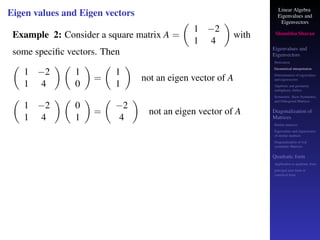
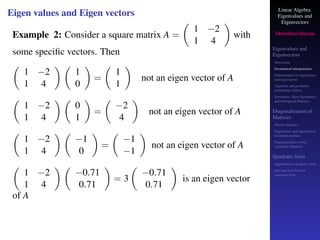
Example 2: Consider a square matrix A =

1 −2
1 4

with
some specific vectors. Then

1 −2
1 4
 
1
0

=

1
1

not an eigen vector of A

1 −2
1 4
 
0
1

=

−2
4

not an eigen vector of A
Linear Algebra
Eigenvalues and
Eigenvectors
Shambhu Sharan
Eigenvalues and
Eigenvectors
Motivation
Geometrical interpretation
Determination of eigenvalues
and eigenvectors
Algebraic and geometric
multiplicity, Defect
Symmetric, Skew-Symmetric,
and Orthogonal Matrices
Diagonalization of
Matrices
Similar matrices
Eigenvalues and eigenvectors
of similar matrices
Diagonalization of real
symmetric Matrices
Quadratic form
Application to quadratic form
principal axes form or
canonical form
Eigen values and Eigen vectors
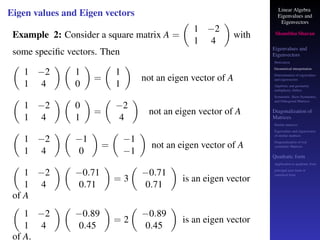
Example 2: Consider a square matrix A =

1 −2
1 4

with
some specific vectors. Then

1 −2
1 4
 
1
0

=

1
1

not an eigen vector of A

1 −2
1 4
 
0
1

=

−2
4

not an eigen vector of A

1 −2
1 4
 
−1
0

=

−1
−1

not an eigen vector of A

1 −2
1 4
 
−0.71
0.71

= 3

−0.71
0.71

is an eigen vector
of A
Linear Algebra
Eigenvalues and
Eigenvectors
Shambhu Sharan
Eigenvalues and
Eigenvectors
Motivation
Geometrical interpretation
Determination of eigenvalues
and eigenvectors
Algebraic and geometric
multiplicity, Defect
Symmetric, Skew-Symmetric,
and Orthogonal Matrices
Diagonalization of
Matrices
Similar matrices
Eigenvalues and eigenvectors
of similar matrices
Diagonalization of real
symmetric Matrices
Quadratic form
Application to quadratic form
principal axes form or
canonical form
Eigen values and Eigen vectors
Example 2: Consider a square matrix A =

1 −2
1 4

with
some specific vectors. Then

1 −2
1 4
 
1
0

=

1
1

not an eigen vector of A

1 −2
1 4
 
0
1

=

−2
4

not an eigen vector of A

1 −2
1 4
 
−1
0

=

−1
−1

not an eigen vector of A

1 −2
1 4
 
−0.71
0.71

= 3

−0.71
0.71

is an eigen vector
of A

1 −2
1 4
 
−0.89
0.45

= 2

−0.89
0.45

is an eigen vector
of A.
Linear Algebra
Eigenvalues and
Eigenvectors
Shambhu Sharan
Eigenvalues and
Eigenvectors
Motivation
Geometrical interpretation
Determination of eigenvalues
and eigenvectors
Algebraic and geometric
multiplicity, Defect
Symmetric, Skew-Symmetric,
and Orthogonal Matrices
Diagonalization of
Matrices
Similar matrices
Eigenvalues and eigenvectors
of similar matrices
Diagonalization of real
symmetric Matrices
Quadratic form
Application to quadratic form
principal axes form or
canonical form
Eigenvalues and Eigenvectors
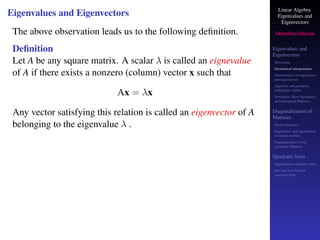
The above observation leads us to the following definition.
Definition
Let A be any square matrix. A scalar λ is called an eignevalue
of A if there exists a nonzero (column) vector x such that
Ax = λx
Any vector satisfying this relation is called an eigenvector of A
belonging to the eigenvalue λ .
Linear Algebra
Eigenvalues and
Eigenvectors
Shambhu Sharan
Eigenvalues and
Eigenvectors
Motivation
Geometrical interpretation
Determination of eigenvalues
and eigenvectors
Algebraic and geometric
multiplicity, Defect
Symmetric, Skew-Symmetric,
and Orthogonal Matrices
Diagonalization of
Matrices
Similar matrices
Eigenvalues and eigenvectors
of similar matrices
Diagonalization of real
symmetric Matrices
Quadratic form
Application to quadratic form
principal axes form or
canonical form
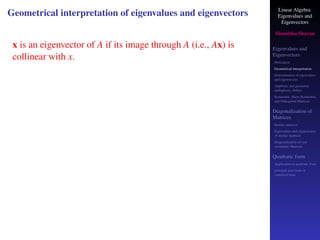
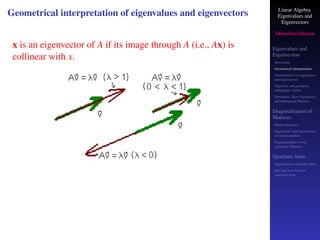
Geometrical interpretation of eigenvalues and eigenvectors
x is an eigenvector of A if its image through A (i.e., Ax) is
collinear with x.
Linear Algebra
Eigenvalues and
Eigenvectors
Shambhu Sharan
Eigenvalues and
Eigenvectors
Motivation
Geometrical interpretation
Determination of eigenvalues
and eigenvectors
Algebraic and geometric
multiplicity, Defect
Symmetric, Skew-Symmetric,
and Orthogonal Matrices
Diagonalization of
Matrices
Similar matrices
Eigenvalues and eigenvectors
of similar matrices
Diagonalization of real
symmetric Matrices
Quadratic form
Application to quadratic form
principal axes form or
canonical form
Geometrical interpretation of eigenvalues and eigenvectors
x is an eigenvector of A if its image through A (i.e., Ax) is
collinear with x.
Linear Algebra
Eigenvalues and
Eigenvectors
Shambhu Sharan
Eigenvalues and
Eigenvectors
Motivation
Geometrical interpretation
Determination of eigenvalues
and eigenvectors
Algebraic and geometric
multiplicity, Defect
Symmetric, Skew-Symmetric,
and Orthogonal Matrices
Diagonalization of
Matrices
Similar matrices
Eigenvalues and eigenvectors
of similar matrices
Diagonalization of real
symmetric Matrices
Quadratic form
Application to quadratic form
principal axes form or
canonical form
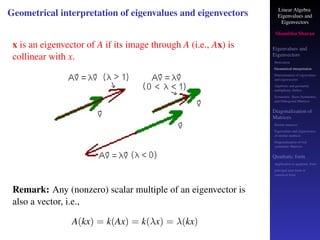
Geometrical interpretation of eigenvalues and eigenvectors
x is an eigenvector of A if its image through A (i.e., Ax) is
collinear with x.
Remark: Any (nonzero) scalar multiple of an eigenvector is
also a vector, i.e.,
A(kx) = k(Ax) = k(λx) = λ(kx)
Linear Algebra
Eigenvalues and
Eigenvectors
Shambhu Sharan
Eigenvalues and
Eigenvectors
Motivation
Geometrical interpretation
Determination of eigenvalues
and eigenvectors
Algebraic and geometric
multiplicity, Defect
Symmetric, Skew-Symmetric,
and Orthogonal Matrices
Diagonalization of
Matrices
Similar matrices
Eigenvalues and eigenvectors
of similar matrices
Diagonalization of real
symmetric Matrices
Quadratic form
Application to quadratic form
principal axes form or
canonical form
Q. How to find eigen values and
eigen vectors?
Linear Algebra
Eigenvalues and
Eigenvectors
Shambhu Sharan
Eigenvalues and
Eigenvectors
Motivation
Geometrical interpretation
Determination of eigenvalues
and eigenvectors
Algebraic and geometric
multiplicity, Defect
Symmetric, Skew-Symmetric,
and Orthogonal Matrices
Diagonalization of
Matrices
Similar matrices
Eigenvalues and eigenvectors
of similar matrices
Diagonalization of real
symmetric Matrices
Quadratic form
Application to quadratic form
principal axes form or
canonical form
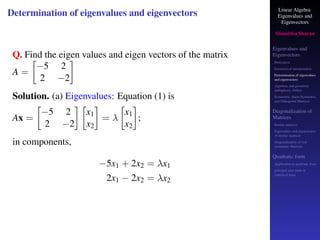
Determination of eigenvalues and eigenvectors
Q. Find the eigen values and eigen vectors of the matrix
A =

−5 2
2 −2

Solution. (a) Eigenvalues: Equation (1) is
Ax =

−5 2
2 −2
 
x1
x2

= λ

x1
x2

;
in components,
−5x1 + 2x2 = λx1
2x1 − 2x2 = λx2
Linear Algebra
Eigenvalues and
Eigenvectors
Shambhu Sharan
Eigenvalues and
Eigenvectors
Motivation
Geometrical interpretation
Determination of eigenvalues
and eigenvectors
Algebraic and geometric
multiplicity, Defect
Symmetric, Skew-Symmetric,
and Orthogonal Matrices
Diagonalization of
Matrices
Similar matrices
Eigenvalues and eigenvectors
of similar matrices
Diagonalization of real
symmetric Matrices
Quadratic form
Application to quadratic form
principal axes form or
canonical form
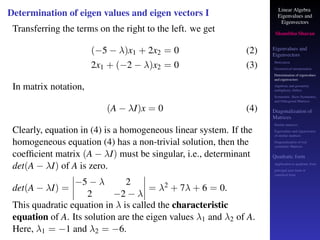
Determination of eigen values and eigen vectors I
Transferring the terms on the right to the left. we get
(−5 − λ)x1 + 2x2 = 0 (2)
2x1 + (−2 − λ)x2 = 0 (3)
In matrix notation,
(A − λI)x = 0 (4)
Clearly, equation in (4) is a homogeneous linear system. If the
homogeneous equation (4) has a non-trivial solution, then the
coefficient matrix (A − λI) must be singular, i.e., determinant
det(A − λI) of A is zero.
det(A − λI) =
−5 − λ 2
2 −2 − λ
= λ2 + 7λ + 6 = 0.
This quadratic equation in λ is called the characteristic
equation of A. Its solution are the eigen values λ1 and λ2 of A.
Here, λ1 = −1 and λ2 = −6.
Linear Algebra
Eigenvalues and
Eigenvectors
Shambhu Sharan
Eigenvalues and
Eigenvectors
Motivation
Geometrical interpretation
Determination of eigenvalues
and eigenvectors
Algebraic and geometric
multiplicity, Defect
Symmetric, Skew-Symmetric,
and Orthogonal Matrices
Diagonalization of
Matrices
Similar matrices
Eigenvalues and eigenvectors
of similar matrices
Diagonalization of real
symmetric Matrices
Quadratic form
Application to quadratic form
principal axes form or
canonical form
Determination of eigen values and eigen vectors II
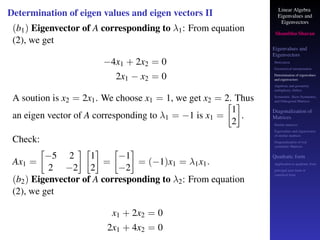
(b1) Eigenvector of A corresponding to λ1: From equation
(2), we get
−4x1 + 2x2 = 0
2x1 − x2 = 0
A soution is x2 = 2x1. We choose x1 = 1, we get x2 = 2. Thus
an eigen vector of A corresponding to λ1 = −1 is x1 =

1
2

.
Check:
Ax1 =

−5 2
2 −2
 
1
2

=

−1
−2

= (−1)x1 = λ1x1.
(b2) Eigenvector of A corresponding to λ2: From equation
(2), we get
x1 + 2x2 = 0
2x1 + 4x2 = 0
Linear Algebra
Eigenvalues and
Eigenvectors
Shambhu Sharan
Eigenvalues and
Eigenvectors
Motivation
Geometrical interpretation
Determination of eigenvalues
and eigenvectors
Algebraic and geometric
multiplicity, Defect
Symmetric, Skew-Symmetric,
and Orthogonal Matrices
Diagonalization of
Matrices
Similar matrices
Eigenvalues and eigenvectors
of similar matrices
Diagonalization of real
symmetric Matrices
Quadratic form
Application to quadratic form
principal axes form or
canonical form
Determination of eigen values and eigen vectors III
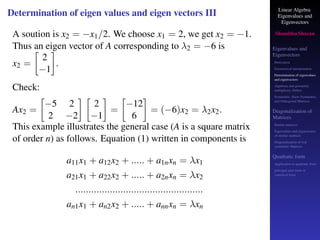
A soution is x2 = −x1/2. We choose x1 = 2, we get x2 = −1.
Thus an eigen vector of A corresponding to λ2 = −6 is
x2 =

2
−1

.
Check:
Ax2 =

−5 2
2 −2
 
2
−1

=

−12
6

= (−6)x2 = λ2x2.
This example illustrates the general case (A is a square matrix
of order n) as follows. Equation (1) written in components is
a11x1 + a12x2 + ..... + a1nxn = λx1
a21x1 + a22x2 + ..... + a2nxn = λx2
................................................
an1x1 + an2x2 + ..... + annxn = λxn
Linear Algebra
Eigenvalues and
Eigenvectors
Shambhu Sharan
Eigenvalues and
Eigenvectors
Motivation
Geometrical interpretation
Determination of eigenvalues
and eigenvectors
Algebraic and geometric
multiplicity, Defect
Symmetric, Skew-Symmetric,
and Orthogonal Matrices
Diagonalization of
Matrices
Similar matrices
Eigenvalues and eigenvectors
of similar matrices
Diagonalization of real
symmetric Matrices
Quadratic form
Application to quadratic form
principal axes form or
canonical form
Determination of eigen values and eigen vectors IV
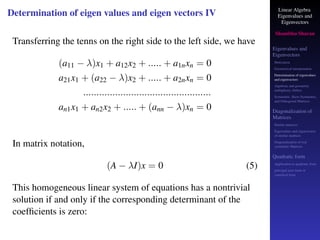
Transferring the tenns on the right side to the left side, we have
(a11 − λ)x1 + a12x2 + ..... + a1nxn = 0
a21x1 + (a22 − λ)x2 + ..... + a2nxn = 0
................................................
an1x1 + an2x2 + ..... + (ann − λ)xn = 0
In matrix notation,
(A − λI)x = 0 (5)
This homogeneous linear system of equations has a nontrivial
solution if and only if the corresponding determinant of the
coefficients is zero:
Linear Algebra
Eigenvalues and
Eigenvectors
Shambhu Sharan
Eigenvalues and
Eigenvectors
Motivation
Geometrical interpretation
Determination of eigenvalues
and eigenvectors
Algebraic and geometric
multiplicity, Defect
Symmetric, Skew-Symmetric,
and Orthogonal Matrices
Diagonalization of
Matrices
Similar matrices
Eigenvalues and eigenvectors
of similar matrices
Diagonalization of real
symmetric Matrices
Quadratic form
Application to quadratic form
principal axes form or
canonical form
Determination of eigen values and eigen vectors V
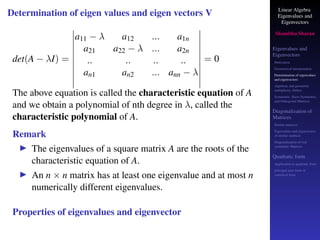
det(A − λI) =
a11 − λ a12 ... a1n
a21 a22 − λ ... a2n
.. .. .. ..
an1 an2 ... ann − λ
= 0
The above equation is called the characteristic equation of A
and we obtain a polynomial of nth degree in λ, called the
characteristic polynomial of A.
Remark
▶ The eigenvalues of a square matrix A are the roots of the
characteristic equation of A.
▶ An n × n matrix has at least one eigenvalue and at most n
numerically different eigenvalues.
Properties of eigenvalues and eigenvector
Linear Algebra
Eigenvalues and
Eigenvectors
Shambhu Sharan
Eigenvalues and
Eigenvectors
Motivation
Geometrical interpretation
Determination of eigenvalues
and eigenvectors
Algebraic and geometric
multiplicity, Defect
Symmetric, Skew-Symmetric,
and Orthogonal Matrices
Diagonalization of
Matrices
Similar matrices
Eigenvalues and eigenvectors
of similar matrices
Diagonalization of real
symmetric Matrices
Quadratic form
Application to quadratic form
principal axes form or
canonical form
Determination of eigen values and eigen vectors VI
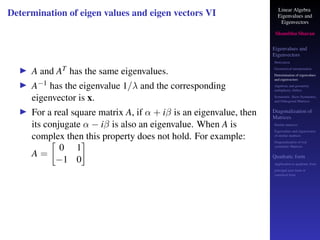
▶ A and AT has the same eigenvalues.
▶ A−1 has the eigenvalue 1/λ and the corresponding
eigenvector is x.
▶ For a real square matrix A, if α + iβ is an eigenvalue, then
its conjugate α − iβ is also an eigenvalue. When A is
complex then this property does not hold. For example:
A =

0 1
−1 0
Linear Algebra
Eigenvalues and
Eigenvectors
Shambhu Sharan
Eigenvalues and
Eigenvectors
Motivation
Geometrical interpretation
Determination of eigenvalues
and eigenvectors
Algebraic and geometric
multiplicity, Defect
Symmetric, Skew-Symmetric,
and Orthogonal Matrices
Diagonalization of
Matrices
Similar matrices
Eigenvalues and eigenvectors
of similar matrices
Diagonalization of real
symmetric Matrices
Quadratic form
Application to quadratic form
principal axes form or
canonical form
Examples I
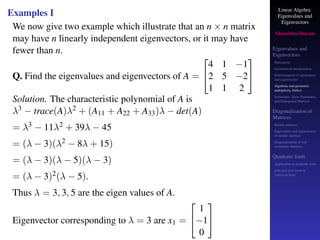
We now give two example which illustrate that an n × n matrix
may have n linearly independent eigenvectors, or it may have
fewer than n.
Q. Find the eigenvalues and eigenvectors of A =


4 1 −1
2 5 −2
1 1 2


Solution. The characteristic polynomial of A is
λ3 − trace(A)λ2 + (A11 + A22 + A33)λ − det(A)
= λ3 − 11λ2 + 39λ − 45
= (λ − 3)(λ2 − 8λ + 15)
= (λ − 3)(λ − 5)(λ − 3)
= (λ − 3)2(λ − 5).
Thus λ = 3, 3, 5 are the eigen values of A.
Eigenvector corresponding to λ = 3 are x1 =


1
−1
0


Linear Algebra
Eigenvalues and
Eigenvectors
Shambhu Sharan
Eigenvalues and
Eigenvectors
Motivation
Geometrical interpretation
Determination of eigenvalues
and eigenvectors
Algebraic and geometric
multiplicity, Defect
Symmetric, Skew-Symmetric,
and Orthogonal Matrices
Diagonalization of
Matrices
Similar matrices
Eigenvalues and eigenvectors
of similar matrices
Diagonalization of real
symmetric Matrices
Quadratic form
Application to quadratic form
principal axes form or
canonical form
Examples II
x2 =


1
0
1


Eigenvector corresponding to λ = 5 is x3 =


1
2
1


Thus X = {x1, x2, x3} = {[1 − 1 0]T, [1 0 1]T, [1 2 1]T} is a
maximal set of linearly independent eigenvectors of A.
Q. Find the eigen values and eigenvectors of A =


3 −1 1
7 −5 1
6 −6 2


Solution. The characteristic polynomial of A is
λ3 − trace(A)λ2 + (A11 + A22 + A33)λ − det(A)
= λ3 − 12λ − 16
= (λ − 2)2(λ + 4).
Linear Algebra
Eigenvalues and
Eigenvectors
Shambhu Sharan
Eigenvalues and
Eigenvectors
Motivation
Geometrical interpretation
Determination of eigenvalues
and eigenvectors
Algebraic and geometric
multiplicity, Defect
Symmetric, Skew-Symmetric,
and Orthogonal Matrices
Diagonalization of
Matrices
Similar matrices
Eigenvalues and eigenvectors
of similar matrices
Diagonalization of real
symmetric Matrices
Quadratic form
Application to quadratic form
principal axes form or
canonical form
Examples III
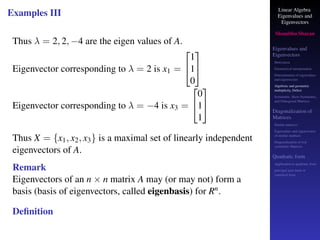
Thus λ = 2, 2, −4 are the eigen values of A.
Eigenvector corresponding to λ = 2 is x1 =


1
1
0


Eigenvector corresponding to λ = −4 is x3 =


0
1
1


Thus X = {x1, x2, x3} is a maximal set of linearly independent
eigenvectors of A.
Remark
Eigenvectors of an n × n matrix A may (or may not) form a
basis (basis of eigenvectors, called eigenbasis) for Rn.
Definition
Linear Algebra
Eigenvalues and
Eigenvectors
Shambhu Sharan
Eigenvalues and
Eigenvectors
Motivation
Geometrical interpretation
Determination of eigenvalues
and eigenvectors
Algebraic and geometric
multiplicity, Defect
Symmetric, Skew-Symmetric,
and Orthogonal Matrices
Diagonalization of
Matrices
Similar matrices
Eigenvalues and eigenvectors
of similar matrices
Diagonalization of real
symmetric Matrices
Quadratic form
Application to quadratic form
principal axes form or
canonical form
Examples IV
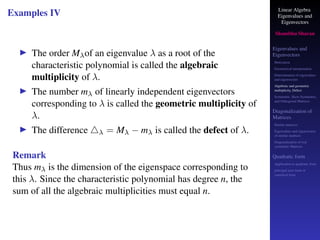
▶ The order Mλof an eigenvalue λ as a root of the
characteristic polynomial is called the algebraic
multiplicity of λ.
▶ The number mλ of linearly independent eigenvectors
corresponding to λ is called the geometric multiplicity of
λ.
▶ The difference △λ = Mλ − mλ is called the defect of λ.
Remark
Thus mλ is the dimension of the eigenspace corresponding to
this λ. Since the characteristic polynomial has degree n, the
sum of all the algebraic multiplicities must equal n.
Linear Algebra
Eigenvalues and
Eigenvectors
Shambhu Sharan
Eigenvalues and
Eigenvectors
Motivation
Geometrical interpretation
Determination of eigenvalues
and eigenvectors
Algebraic and geometric
multiplicity, Defect
Symmetric, Skew-Symmetric,
and Orthogonal Matrices
Diagonalization of
Matrices
Similar matrices
Eigenvalues and eigenvectors
of similar matrices
Diagonalization of real
symmetric Matrices
Quadratic form
Application to quadratic form
principal axes form or
canonical form
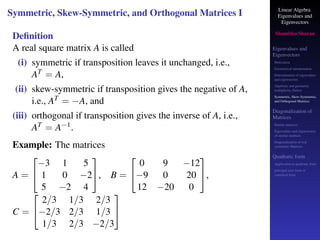
Symmetric, Skew-Symmetric, and Orthogonal Matrices I
Definition
A real square matrix A is called
(i) symmetric if transposition leaves it unchanged, i.e.,
AT = A,
(ii) skew-symmetric if transposition gives the negative of A,
i.e., AT = −A, and
(iii) orthogonal if transposition gives the inverse of A, i.e.,
AT = A−1.
Example: The matrices
A =


−3 1 5
1 0 −2
5 −2 4

, B =


0 9 −12
−9 0 20
12 −20 0

,
C =


2/3 1/3 2/3
−2/3 2/3 1/3
1/3 2/3 −2/3


Linear Algebra
Eigenvalues and
Eigenvectors
Shambhu Sharan
Eigenvalues and
Eigenvectors
Motivation
Geometrical interpretation
Determination of eigenvalues
and eigenvectors
Algebraic and geometric
multiplicity, Defect
Symmetric, Skew-Symmetric,
and Orthogonal Matrices
Diagonalization of
Matrices
Similar matrices
Eigenvalues and eigenvectors
of similar matrices
Diagonalization of real
symmetric Matrices
Quadratic form
Application to quadratic form
principal axes form or
canonical form
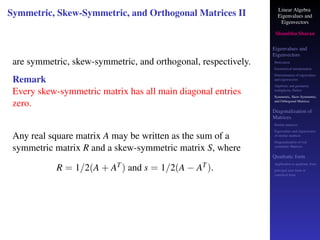
Symmetric, Skew-Symmetric, and Orthogonal Matrices II
are symmetric, skew-symmetric, and orthogonal, respectively.
Remark
Every skew-symmetric matrix has all main diagonal entries
zero.
Any real square matrix A may be written as the sum of a
symmetric matrix R and a skew-symmetric matrix S, where
R = 1/2(A + AT) and s = 1/2(A − AT).
Linear Algebra
Eigenvalues and
Eigenvectors
Shambhu Sharan
Eigenvalues and
Eigenvectors
Motivation
Geometrical interpretation
Determination of eigenvalues
and eigenvectors
Algebraic and geometric
multiplicity, Defect
Symmetric, Skew-Symmetric,
and Orthogonal Matrices
Diagonalization of
Matrices
Similar matrices
Eigenvalues and eigenvectors
of similar matrices
Diagonalization of real
symmetric Matrices
Quadratic form
Application to quadratic form
principal axes form or
canonical form
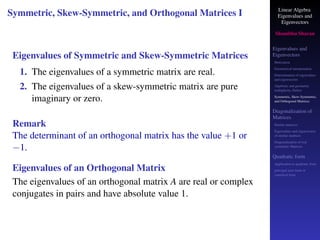
Symmetric, Skew-Symmetric, and Orthogonal Matrices I
Eigenvalues of Symmetric and Skew-Symmetric Matrices
1. The eigenvalues of a symmetric matrix are real.
2. The eigenvalues of a skew-symmetric matrix are pure
imaginary or zero.
Remark
The determinant of an orthogonal matrix has the value +1 or
−1.
Eigenvalues of an Orthogonal Matrix
The eigenvalues of an orthogonal matrix A are real or complex
conjugates in pairs and have absolute value 1.
Linear Algebra
Eigenvalues and
Eigenvectors
Shambhu Sharan
Eigenvalues and
Eigenvectors
Motivation
Geometrical interpretation
Determination of eigenvalues
and eigenvectors
Algebraic and geometric
multiplicity, Defect
Symmetric, Skew-Symmetric,
and Orthogonal Matrices
Diagonalization of
Matrices
Similar matrices
Eigenvalues and eigenvectors
of similar matrices
Diagonalization of real
symmetric Matrices
Quadratic form
Application to quadratic form
principal axes form or
canonical form
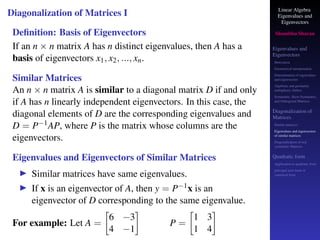
Diagonalization of Matrices I
Definition: Basis of Eigenvectors
If an n × n matrix A has n distinct eigenvalues, then A has a
basis of eigenvectors x1, x2, ..., xn.
Similar Matrices
An n × n matrix A is similar to a diagonal matrix D if and only
if A has n linearly independent eigenvectors. In this case, the
diagonal elements of D are the corresponding eigenvalues and
D = P−1AP, where P is the matrix whose columns are the
eigenvectors.
Eigenvalues and Eigenvectors of Similar Matrices
▶ Similar matrices have same eigenvalues.
▶ If x is an eigenvector of A, then y = P−1x is an
eigenvector of D corresponding to the same eigenvalue.
For example: Let A =

6 −3
4 −1

P =

1 3
1 4
Linear Algebra
Eigenvalues and
Eigenvectors
Shambhu Sharan
Eigenvalues and
Eigenvectors
Motivation
Geometrical interpretation
Determination of eigenvalues
and eigenvectors
Algebraic and geometric
multiplicity, Defect
Symmetric, Skew-Symmetric,
and Orthogonal Matrices
Diagonalization of
Matrices
Similar matrices
Eigenvalues and eigenvectors
of similar matrices
Diagonalization of real
symmetric Matrices
Quadratic form
Application to quadratic form
principal axes form or
canonical form
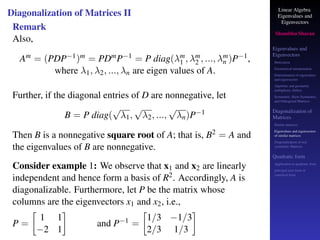
Diagonalization of Matrices II
Remark
Also,
Am = (PDP−1)m = PDmP−1 = P diag(λm
1 , λm
2 , ..., λm
n )P−1,
where λ1, λ2, ..., λn are eigen values of A.
Further, if the diagonal entries of D are nonnegative, let
B = P diag(
√
λ1,
√
λ2, ...,
√
λn)P−1
Then B is a nonnegative square root of A; that is, B2 = A and
the eigenvalues of B are nonnegative.
Consider example 1: We observe that x1 and x2 are linearly
independent and hence form a basis of R2. Accordingly, A is
diagonalizable. Furthermore, let P be the matrix whose
columns are the eigenvectors x1 and x2, i.e.,
P =

1 1
−2 1

and P−1 =

1/3 −1/3
2/3 1/3
Linear Algebra
Eigenvalues and
Eigenvectors
Shambhu Sharan
Eigenvalues and
Eigenvectors
Motivation
Geometrical interpretation
Determination of eigenvalues
and eigenvectors
Algebraic and geometric
multiplicity, Defect
Symmetric, Skew-Symmetric,
and Orthogonal Matrices
Diagonalization of
Matrices
Similar matrices
Eigenvalues and eigenvectors
of similar matrices
Diagonalization of real
symmetric Matrices
Quadratic form
Application to quadratic form
principal axes form or
canonical form
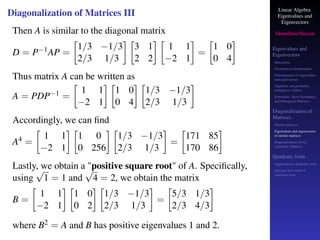
Diagonalization of Matrices III
Then A is similar to the diagonal matrix
D = P−1AP =

1/3 −1/3
2/3 1/3
 
3 1
2 2
 
1 1
−2 1

=

1 0
0 4

Thus matrix A can be written as
A = PDP−1 =

1 1
−2 1
 
1 0
0 4
 
1/3 −1/3
2/3 1/3

Accordingly, we can find
A4 =

1 1
−2 1
 
1 0
0 256
 
1/3 −1/3
2/3 1/3

=

171 85
170 86

Lastly, we obtain a positive square root of A. Specifically,
using
√
1 = 1 and
√
4 = 2, we obtain the matrix
B =

1 1
−2 1
 
1 0
0 2
 
1/3 −1/3
2/3 1/3

=

5/3 1/3
2/3 4/3

where B2 = A and B has positive eigenvalues 1 and 2.
Linear Algebra
Eigenvalues and
Eigenvectors
Shambhu Sharan
Eigenvalues and
Eigenvectors
Motivation
Geometrical interpretation
Determination of eigenvalues
and eigenvectors
Algebraic and geometric
multiplicity, Defect
Symmetric, Skew-Symmetric,
and Orthogonal Matrices
Diagonalization of
Matrices
Similar matrices
Eigenvalues and eigenvectors
of similar matrices
Diagonalization of real
symmetric Matrices
Quadratic form
Application to quadratic form
principal axes form or
canonical form
Diagonalization of Matrices IV
Now, consider the matrix A =

5 −1
1 3

We observe that λ = 4 is the only eigenvalue of A. The
corresponding eigenvector is x = [1 1]T. Accordingly, A is not
diagonalizable, since there does not exist a basis consisting of
eigenvectors of A.
Linear Algebra
Eigenvalues and
Eigenvectors
Shambhu Sharan
Eigenvalues and
Eigenvectors
Motivation
Geometrical interpretation
Determination of eigenvalues
and eigenvectors
Algebraic and geometric
multiplicity, Defect
Symmetric, Skew-Symmetric,
and Orthogonal Matrices
Diagonalization of
Matrices
Similar matrices
Eigenvalues and eigenvectors
of similar matrices
Diagonalization of real
symmetric Matrices
Quadratic form
Application to quadratic form
principal axes form or
canonical form
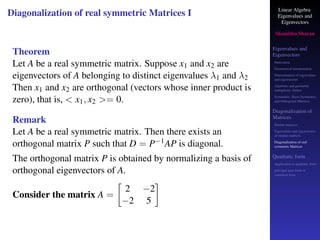
Diagonalization of real symmetric Matrices I
Theorem
Let A be a real symmetric matrix. Suppose x1 and x2 are
eigenvectors of A belonging to distinct eigenvalues λ1 and λ2
Then x1 and x2 are orthogonal (vectors whose inner product is
zero), that is,  x1, x2 = 0.
Remark
Let A be a real symmetric matrix. Then there exists an
orthogonal matrix P such that D = P−1AP is diagonal.
The orthogonal matrix P is obtained by normalizing a basis of
orthogonal eigenvectors of A.
Consider the matrix A =

2 −2
−2 5
Linear Algebra
Eigenvalues and
Eigenvectors
Shambhu Sharan
Eigenvalues and
Eigenvectors
Motivation
Geometrical interpretation
Determination of eigenvalues
and eigenvectors
Algebraic and geometric
multiplicity, Defect
Symmetric, Skew-Symmetric,
and Orthogonal Matrices
Diagonalization of
Matrices
Similar matrices
Eigenvalues and eigenvectors
of similar matrices
Diagonalization of real
symmetric Matrices
Quadratic form
Application to quadratic form
principal axes form or
canonical form
Quadratic form and Transformation to Principal Axes I
A quadratic form Q in the components x1, x2, ..., xn of a vector
x is a sum of n2 terms, i.e.,
Q = xTAX =
Pn
i=1
Pn
j=1 aijxixj =
a11x2
1 + a12x1x2 + ..... + a1nx1xn
a21x2x1 + a22x2
2 + ..... + a2nx2xn
................................................
an1xnx1 + an2xnx2 + ..... + annx2
n
A = [aij] is the coefficient matrix form. We may assume that A
is symmetric, because we can take off-diagonal terms together
in pairs and write the result as a sum of two equal terms.
Remark
Linear Algebra
Eigenvalues and
Eigenvectors
Shambhu Sharan
Eigenvalues and
Eigenvectors
Motivation
Geometrical interpretation
Determination of eigenvalues
and eigenvectors
Algebraic and geometric
multiplicity, Defect
Symmetric, Skew-Symmetric,
and Orthogonal Matrices
Diagonalization of
Matrices
Similar matrices
Eigenvalues and eigenvectors
of similar matrices
Diagonalization of real
symmetric Matrices
Quadratic form
Application to quadratic form
principal axes form or
canonical form
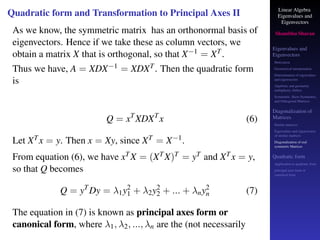
Quadratic form and Transformation to Principal Axes II
As we know, the symmetric matrix has an orthonormal basis of
eigenvectors. Hence if we take these as column vectors, we
obtain a matrix X that is orthogonal, so that X−1 = XT.
Thus we have, A = XDX−1 = XDXT. Then the quadratic form
is
Q = xT
XDXT
x (6)
Let XTx = y. Then x = Xy, since XT = X−1.
From equation (6), we have xTX = (XTX)T = yT and XTx = y,
so that Q becomes
Q = yT
Dy = λ1y2
1 + λ2y2
2 + ... + λny2
n (7)
The equation in (7) is known as principal axes form or
canonical form, where λ1, λ2, ..., λn are the (not necessarily
Linear Algebra
Eigenvalues and
Eigenvectors
Shambhu Sharan
Eigenvalues and
Eigenvectors
Motivation
Geometrical interpretation
Determination of eigenvalues
and eigenvectors
Algebraic and geometric
multiplicity, Defect
Symmetric, Skew-Symmetric,
and Orthogonal Matrices
Diagonalization of
Matrices
Similar matrices
Eigenvalues and eigenvectors
of similar matrices
Diagonalization of real
symmetric Matrices
Quadratic form
Application to quadratic form
principal axes form or
canonical form
Quadratic form and Transformation to Principal Axes III
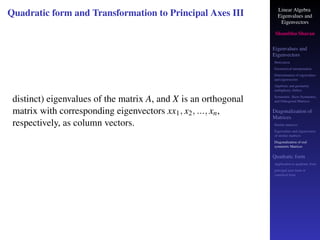
distinct) eigenvalues of the matrix A, and X is an orthogonal
matrix with corresponding eigenvectors xx1, x2, ..., xn,
respectively, as column vectors.
Linear Algebra
Eigenvalues and
Eigenvectors
Shambhu Sharan
Eigenvalues and
Eigenvectors
Motivation
Geometrical interpretation
Determination of eigenvalues
and eigenvectors
Algebraic and geometric
multiplicity, Defect
Symmetric, Skew-Symmetric,
and Orthogonal Matrices
Diagonalization of
Matrices
Similar matrices
Eigenvalues and eigenvectors
of similar matrices
Diagonalization of real
symmetric Matrices
Quadratic form
Application to quadratic form
principal axes form or
canonical form
Application to quadratic form I
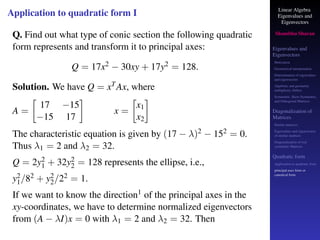
Q. Find out what type of conic section the following quadratic
form represents and transform it to principal axes:
Q = 17x2 − 30xy + 17y2 = 128.
Solution. We have Q = xTAx, where
A =

17 −15
−15 17

x =

x1
x2

The characteristic equation is given by (17 − λ)2 − 152 = 0.
Thus λ1 = 2 and λ2 = 32.
Q = 2y2
1 + 32y2
2 = 128 represents the ellipse, i.e.,
y2
1/82 + y2
2/22 = 1.
If we want to know the direction1 of the principal axes in the
xy-coordinates, we have to determine normalized eigenvectors
from (A − λI)x = 0 with λ1 = 2 and λ2 = 32. Then
Linear Algebra
Eigenvalues and
Eigenvectors
Shambhu Sharan
Eigenvalues and
Eigenvectors
Motivation
Geometrical interpretation
Determination of eigenvalues
and eigenvectors
Algebraic and geometric
multiplicity, Defect
Symmetric, Skew-Symmetric,
and Orthogonal Matrices
Diagonalization of
Matrices
Similar matrices
Eigenvalues and eigenvectors
of similar matrices
Diagonalization of real
symmetric Matrices
Quadratic form
Application to quadratic form
principal axes form or
canonical form
Application to quadratic form II
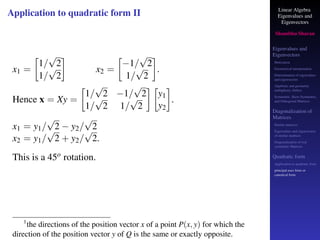
x1 =

1/
√
2
1/
√
2

x2 =

−1/
√
2
1/
√
2

.
Hence x = Xy =

1/
√
2 −1/
√
2
1/
√
2 1/
√
2
 
y1
y2

.
x1 = y1/
√
2 − y2/
√
2
x2 = y1/
√
2 + y2/
√
2.
This is a 45o rotation.
1
the directions of the position vector x of a point P(x, y) for which the
direction of the position vector y of Q is the same or exactly opposite.
Linear Algebra
Eigenvalues and
Eigenvectors
Shambhu Sharan
Eigenvalues and
Eigenvectors
Motivation
Geometrical interpretation
Determination of eigenvalues
and eigenvectors
Algebraic and geometric
multiplicity, Defect
Symmetric, Skew-Symmetric,
and Orthogonal Matrices
Diagonalization of
Matrices
Similar matrices
Eigenvalues and eigenvectors
of similar matrices
Diagonalization of real
symmetric Matrices
Quadratic form
Application to quadratic form
principal axes form or
canonical form
VIT
THANK YOU

PPT on Eigen values and Eigen vectors.pdf

  • 1.
    Linear Algebra Eigenvalues and Eigenvectors ShambhuSharan Eigenvalues and Eigenvectors Motivation Geometrical interpretation Determination of eigenvalues and eigenvectors Algebraic and geometric multiplicity, Defect Symmetric, Skew-Symmetric, and Orthogonal Matrices Diagonalization of Matrices Similar matrices Eigenvalues and eigenvectors of similar matrices Diagonalization of real symmetric Matrices Quadratic form Application to quadratic form principal axes form or canonical form Linear Algebra Eigenvalues and Eigenvectors Shambhu Sharan Department of Mathematics College of Commerce, Arts & Science, Patna
  • 2.
    Linear Algebra Eigenvalues and Eigenvectors ShambhuSharan Eigenvalues and Eigenvectors Motivation Geometrical interpretation Determination of eigenvalues and eigenvectors Algebraic and geometric multiplicity, Defect Symmetric, Skew-Symmetric, and Orthogonal Matrices Diagonalization of Matrices Similar matrices Eigenvalues and eigenvectors of similar matrices Diagonalization of real symmetric Matrices Quadratic form Application to quadratic form principal axes form or canonical form Outline Eigenvalues and Eigenvectors Motivation Geometrical interpretation Determination of eigenvalues and eigenvectors Algebraic and geometric multiplicity, Defect Symmetric, Skew-Symmetric, and Orthogonal Matrices Diagonalization of Matrices Similar matrices Eigenvalues and eigenvectors of similar matrices Diagonalization of real symmetric Matrices Quadratic form Application to quadratic form principal axes form or canonical form
  • 3.
    Linear Algebra Eigenvalues and Eigenvectors ShambhuSharan Eigenvalues and Eigenvectors Motivation Geometrical interpretation Determination of eigenvalues and eigenvectors Algebraic and geometric multiplicity, Defect Symmetric, Skew-Symmetric, and Orthogonal Matrices Diagonalization of Matrices Similar matrices Eigenvalues and eigenvectors of similar matrices Diagonalization of real symmetric Matrices Quadratic form Application to quadratic form principal axes form or canonical form Eigen values and Eigen vectors Let A = [aij] be a given n × n matrix. Consider the vector equation Ax = λx. (1) Here x is an unknown vector and λ an unknown scalar. Our task is to determine x’s and λ’s that equation (1). Geometrically, solving eq. (1) in this way means that we are looking for vectors x for which the multiplication of x by the matrix A has the same effect as the multiplication of x by a scalar A, giving a vector Ax with components proportional to those of x, and A as the factor of proportionality.
  • 4.
    Linear Algebra Eigenvalues and Eigenvectors ShambhuSharan Eigenvalues and Eigenvectors Motivation Geometrical interpretation Determination of eigenvalues and eigenvectors Algebraic and geometric multiplicity, Defect Symmetric, Skew-Symmetric, and Orthogonal Matrices Diagonalization of Matrices Similar matrices Eigenvalues and eigenvectors of similar matrices Diagonalization of real symmetric Matrices Quadratic form Application to quadratic form principal axes form or canonical form Eigen values and Eigen vectors Let A = [aij] be a given n × n matrix. Consider the vector equation Ax = λx. (1) Here x is an unknown vector and λ an unknown scalar. Our task is to determine x’s and λ’s that equation (1). Geometrically, solving eq. (1) in this way means that we are looking for vectors x for which the multiplication of x by the matrix A has the same effect as the multiplication of x by a scalar A, giving a vector Ax with components proportional to those of x, and A as the factor of proportionality. Clearly, the zero vector x = 0 is a solution of (1) for any value of λ, because A0 = 0 (this is of no interest).
  • 5.
    Linear Algebra Eigenvalues and Eigenvectors ShambhuSharan Eigenvalues and Eigenvectors Motivation Geometrical interpretation Determination of eigenvalues and eigenvectors Algebraic and geometric multiplicity, Defect Symmetric, Skew-Symmetric, and Orthogonal Matrices Diagonalization of Matrices Similar matrices Eigenvalues and eigenvectors of similar matrices Diagonalization of real symmetric Matrices Quadratic form Application to quadratic form principal axes form or canonical form Eigenvalues and Eigenvectors Example 1: Let A = 3 1 2 2 , x1 = 1 −2 , and x2 = 1 1 . Then
  • 6.
    Linear Algebra Eigenvalues and Eigenvectors ShambhuSharan Eigenvalues and Eigenvectors Motivation Geometrical interpretation Determination of eigenvalues and eigenvectors Algebraic and geometric multiplicity, Defect Symmetric, Skew-Symmetric, and Orthogonal Matrices Diagonalization of Matrices Similar matrices Eigenvalues and eigenvectors of similar matrices Diagonalization of real symmetric Matrices Quadratic form Application to quadratic form principal axes form or canonical form Eigenvalues and Eigenvectors Example 1: Let A = 3 1 2 2 , x1 = 1 −2 , and x2 = 1 1 . Then Ax1 = 3 1 2 2 1 −2 = 1 −2 = x1.
  • 7.
    Linear Algebra Eigenvalues and Eigenvectors ShambhuSharan Eigenvalues and Eigenvectors Motivation Geometrical interpretation Determination of eigenvalues and eigenvectors Algebraic and geometric multiplicity, Defect Symmetric, Skew-Symmetric, and Orthogonal Matrices Diagonalization of Matrices Similar matrices Eigenvalues and eigenvectors of similar matrices Diagonalization of real symmetric Matrices Quadratic form Application to quadratic form principal axes form or canonical form Eigenvalues and Eigenvectors Example 1: Let A = 3 1 2 2 , x1 = 1 −2 , and x2 = 1 1 . Then Ax1 = 3 1 2 2 1 −2 = 1 −2 = x1. Ax2 = 3 1 2 2 1 1 = 4 4 = 4x2. Thus x1 and x2 are the eigen vectors corresponding to eigen values λ1 = 1 and λ2 = 4.
  • 8.
    Linear Algebra Eigenvalues and Eigenvectors ShambhuSharan Eigenvalues and Eigenvectors Motivation Geometrical interpretation Determination of eigenvalues and eigenvectors Algebraic and geometric multiplicity, Defect Symmetric, Skew-Symmetric, and Orthogonal Matrices Diagonalization of Matrices Similar matrices Eigenvalues and eigenvectors of similar matrices Diagonalization of real symmetric Matrices Quadratic form Application to quadratic form principal axes form or canonical form Eigen values and Eigen vectors Example 2: Consider a square matrix A = 1 −2 1 4 with some specific vectors. Then
  • 9.
    Linear Algebra Eigenvalues and Eigenvectors ShambhuSharan Eigenvalues and Eigenvectors Motivation Geometrical interpretation Determination of eigenvalues and eigenvectors Algebraic and geometric multiplicity, Defect Symmetric, Skew-Symmetric, and Orthogonal Matrices Diagonalization of Matrices Similar matrices Eigenvalues and eigenvectors of similar matrices Diagonalization of real symmetric Matrices Quadratic form Application to quadratic form principal axes form or canonical form Eigen values and Eigen vectors Example 2: Consider a square matrix A = 1 −2 1 4 with some specific vectors. Then 1 −2 1 4 1 0 = 1 1 not an eigen vector of A
  • 10.
    Linear Algebra Eigenvalues and Eigenvectors ShambhuSharan Eigenvalues and Eigenvectors Motivation Geometrical interpretation Determination of eigenvalues and eigenvectors Algebraic and geometric multiplicity, Defect Symmetric, Skew-Symmetric, and Orthogonal Matrices Diagonalization of Matrices Similar matrices Eigenvalues and eigenvectors of similar matrices Diagonalization of real symmetric Matrices Quadratic form Application to quadratic form principal axes form or canonical form Eigen values and Eigen vectors Example 2: Consider a square matrix A = 1 −2 1 4 with some specific vectors. Then 1 −2 1 4 1 0 = 1 1 not an eigen vector of A 1 −2 1 4 0 1 = −2 4 not an eigen vector of A
  • 11.
    Linear Algebra Eigenvalues and Eigenvectors ShambhuSharan Eigenvalues and Eigenvectors Motivation Geometrical interpretation Determination of eigenvalues and eigenvectors Algebraic and geometric multiplicity, Defect Symmetric, Skew-Symmetric, and Orthogonal Matrices Diagonalization of Matrices Similar matrices Eigenvalues and eigenvectors of similar matrices Diagonalization of real symmetric Matrices Quadratic form Application to quadratic form principal axes form or canonical form Eigen values and Eigen vectors Example 2: Consider a square matrix A = 1 −2 1 4 with some specific vectors. Then 1 −2 1 4 1 0 = 1 1 not an eigen vector of A 1 −2 1 4 0 1 = −2 4 not an eigen vector of A 1 −2 1 4 −1 0 = −1 −1 not an eigen vector of A 1 −2 1 4 −0.71 0.71 = 3 −0.71 0.71 is an eigen vector of A
  • 12.
    Linear Algebra Eigenvalues and Eigenvectors ShambhuSharan Eigenvalues and Eigenvectors Motivation Geometrical interpretation Determination of eigenvalues and eigenvectors Algebraic and geometric multiplicity, Defect Symmetric, Skew-Symmetric, and Orthogonal Matrices Diagonalization of Matrices Similar matrices Eigenvalues and eigenvectors of similar matrices Diagonalization of real symmetric Matrices Quadratic form Application to quadratic form principal axes form or canonical form Eigen values and Eigen vectors Example 2: Consider a square matrix A = 1 −2 1 4 with some specific vectors. Then 1 −2 1 4 1 0 = 1 1 not an eigen vector of A 1 −2 1 4 0 1 = −2 4 not an eigen vector of A 1 −2 1 4 −1 0 = −1 −1 not an eigen vector of A 1 −2 1 4 −0.71 0.71 = 3 −0.71 0.71 is an eigen vector of A 1 −2 1 4 −0.89 0.45 = 2 −0.89 0.45 is an eigen vector of A.
  • 13.
    Linear Algebra Eigenvalues and Eigenvectors ShambhuSharan Eigenvalues and Eigenvectors Motivation Geometrical interpretation Determination of eigenvalues and eigenvectors Algebraic and geometric multiplicity, Defect Symmetric, Skew-Symmetric, and Orthogonal Matrices Diagonalization of Matrices Similar matrices Eigenvalues and eigenvectors of similar matrices Diagonalization of real symmetric Matrices Quadratic form Application to quadratic form principal axes form or canonical form Eigenvalues and Eigenvectors The above observation leads us to the following definition. Definition Let A be any square matrix. A scalar λ is called an eignevalue of A if there exists a nonzero (column) vector x such that Ax = λx Any vector satisfying this relation is called an eigenvector of A belonging to the eigenvalue λ .
  • 14.
    Linear Algebra Eigenvalues and Eigenvectors ShambhuSharan Eigenvalues and Eigenvectors Motivation Geometrical interpretation Determination of eigenvalues and eigenvectors Algebraic and geometric multiplicity, Defect Symmetric, Skew-Symmetric, and Orthogonal Matrices Diagonalization of Matrices Similar matrices Eigenvalues and eigenvectors of similar matrices Diagonalization of real symmetric Matrices Quadratic form Application to quadratic form principal axes form or canonical form Geometrical interpretation of eigenvalues and eigenvectors x is an eigenvector of A if its image through A (i.e., Ax) is collinear with x.
  • 15.
    Linear Algebra Eigenvalues and Eigenvectors ShambhuSharan Eigenvalues and Eigenvectors Motivation Geometrical interpretation Determination of eigenvalues and eigenvectors Algebraic and geometric multiplicity, Defect Symmetric, Skew-Symmetric, and Orthogonal Matrices Diagonalization of Matrices Similar matrices Eigenvalues and eigenvectors of similar matrices Diagonalization of real symmetric Matrices Quadratic form Application to quadratic form principal axes form or canonical form Geometrical interpretation of eigenvalues and eigenvectors x is an eigenvector of A if its image through A (i.e., Ax) is collinear with x.
  • 16.
    Linear Algebra Eigenvalues and Eigenvectors ShambhuSharan Eigenvalues and Eigenvectors Motivation Geometrical interpretation Determination of eigenvalues and eigenvectors Algebraic and geometric multiplicity, Defect Symmetric, Skew-Symmetric, and Orthogonal Matrices Diagonalization of Matrices Similar matrices Eigenvalues and eigenvectors of similar matrices Diagonalization of real symmetric Matrices Quadratic form Application to quadratic form principal axes form or canonical form Geometrical interpretation of eigenvalues and eigenvectors x is an eigenvector of A if its image through A (i.e., Ax) is collinear with x. Remark: Any (nonzero) scalar multiple of an eigenvector is also a vector, i.e., A(kx) = k(Ax) = k(λx) = λ(kx)
  • 17.
    Linear Algebra Eigenvalues and Eigenvectors ShambhuSharan Eigenvalues and Eigenvectors Motivation Geometrical interpretation Determination of eigenvalues and eigenvectors Algebraic and geometric multiplicity, Defect Symmetric, Skew-Symmetric, and Orthogonal Matrices Diagonalization of Matrices Similar matrices Eigenvalues and eigenvectors of similar matrices Diagonalization of real symmetric Matrices Quadratic form Application to quadratic form principal axes form or canonical form Q. How to find eigen values and eigen vectors?
  • 18.
    Linear Algebra Eigenvalues and Eigenvectors ShambhuSharan Eigenvalues and Eigenvectors Motivation Geometrical interpretation Determination of eigenvalues and eigenvectors Algebraic and geometric multiplicity, Defect Symmetric, Skew-Symmetric, and Orthogonal Matrices Diagonalization of Matrices Similar matrices Eigenvalues and eigenvectors of similar matrices Diagonalization of real symmetric Matrices Quadratic form Application to quadratic form principal axes form or canonical form Determination of eigenvalues and eigenvectors Q. Find the eigen values and eigen vectors of the matrix A = −5 2 2 −2 Solution. (a) Eigenvalues: Equation (1) is Ax = −5 2 2 −2 x1 x2 = λ x1 x2 ; in components, −5x1 + 2x2 = λx1 2x1 − 2x2 = λx2
  • 19.
    Linear Algebra Eigenvalues and Eigenvectors ShambhuSharan Eigenvalues and Eigenvectors Motivation Geometrical interpretation Determination of eigenvalues and eigenvectors Algebraic and geometric multiplicity, Defect Symmetric, Skew-Symmetric, and Orthogonal Matrices Diagonalization of Matrices Similar matrices Eigenvalues and eigenvectors of similar matrices Diagonalization of real symmetric Matrices Quadratic form Application to quadratic form principal axes form or canonical form Determination of eigen values and eigen vectors I Transferring the terms on the right to the left. we get (−5 − λ)x1 + 2x2 = 0 (2) 2x1 + (−2 − λ)x2 = 0 (3) In matrix notation, (A − λI)x = 0 (4) Clearly, equation in (4) is a homogeneous linear system. If the homogeneous equation (4) has a non-trivial solution, then the coefficient matrix (A − λI) must be singular, i.e., determinant det(A − λI) of A is zero. det(A − λI) = −5 − λ 2 2 −2 − λ = λ2 + 7λ + 6 = 0. This quadratic equation in λ is called the characteristic equation of A. Its solution are the eigen values λ1 and λ2 of A. Here, λ1 = −1 and λ2 = −6.
  • 20.
    Linear Algebra Eigenvalues and Eigenvectors ShambhuSharan Eigenvalues and Eigenvectors Motivation Geometrical interpretation Determination of eigenvalues and eigenvectors Algebraic and geometric multiplicity, Defect Symmetric, Skew-Symmetric, and Orthogonal Matrices Diagonalization of Matrices Similar matrices Eigenvalues and eigenvectors of similar matrices Diagonalization of real symmetric Matrices Quadratic form Application to quadratic form principal axes form or canonical form Determination of eigen values and eigen vectors II (b1) Eigenvector of A corresponding to λ1: From equation (2), we get −4x1 + 2x2 = 0 2x1 − x2 = 0 A soution is x2 = 2x1. We choose x1 = 1, we get x2 = 2. Thus an eigen vector of A corresponding to λ1 = −1 is x1 = 1 2 . Check: Ax1 = −5 2 2 −2 1 2 = −1 −2 = (−1)x1 = λ1x1. (b2) Eigenvector of A corresponding to λ2: From equation (2), we get x1 + 2x2 = 0 2x1 + 4x2 = 0
  • 21.
    Linear Algebra Eigenvalues and Eigenvectors ShambhuSharan Eigenvalues and Eigenvectors Motivation Geometrical interpretation Determination of eigenvalues and eigenvectors Algebraic and geometric multiplicity, Defect Symmetric, Skew-Symmetric, and Orthogonal Matrices Diagonalization of Matrices Similar matrices Eigenvalues and eigenvectors of similar matrices Diagonalization of real symmetric Matrices Quadratic form Application to quadratic form principal axes form or canonical form Determination of eigen values and eigen vectors III A soution is x2 = −x1/2. We choose x1 = 2, we get x2 = −1. Thus an eigen vector of A corresponding to λ2 = −6 is x2 = 2 −1 . Check: Ax2 = −5 2 2 −2 2 −1 = −12 6 = (−6)x2 = λ2x2. This example illustrates the general case (A is a square matrix of order n) as follows. Equation (1) written in components is a11x1 + a12x2 + ..... + a1nxn = λx1 a21x1 + a22x2 + ..... + a2nxn = λx2 ................................................ an1x1 + an2x2 + ..... + annxn = λxn
  • 22.
    Linear Algebra Eigenvalues and Eigenvectors ShambhuSharan Eigenvalues and Eigenvectors Motivation Geometrical interpretation Determination of eigenvalues and eigenvectors Algebraic and geometric multiplicity, Defect Symmetric, Skew-Symmetric, and Orthogonal Matrices Diagonalization of Matrices Similar matrices Eigenvalues and eigenvectors of similar matrices Diagonalization of real symmetric Matrices Quadratic form Application to quadratic form principal axes form or canonical form Determination of eigen values and eigen vectors IV Transferring the tenns on the right side to the left side, we have (a11 − λ)x1 + a12x2 + ..... + a1nxn = 0 a21x1 + (a22 − λ)x2 + ..... + a2nxn = 0 ................................................ an1x1 + an2x2 + ..... + (ann − λ)xn = 0 In matrix notation, (A − λI)x = 0 (5) This homogeneous linear system of equations has a nontrivial solution if and only if the corresponding determinant of the coefficients is zero:
  • 23.
    Linear Algebra Eigenvalues and Eigenvectors ShambhuSharan Eigenvalues and Eigenvectors Motivation Geometrical interpretation Determination of eigenvalues and eigenvectors Algebraic and geometric multiplicity, Defect Symmetric, Skew-Symmetric, and Orthogonal Matrices Diagonalization of Matrices Similar matrices Eigenvalues and eigenvectors of similar matrices Diagonalization of real symmetric Matrices Quadratic form Application to quadratic form principal axes form or canonical form Determination of eigen values and eigen vectors V det(A − λI) = a11 − λ a12 ... a1n a21 a22 − λ ... a2n .. .. .. .. an1 an2 ... ann − λ = 0 The above equation is called the characteristic equation of A and we obtain a polynomial of nth degree in λ, called the characteristic polynomial of A. Remark ▶ The eigenvalues of a square matrix A are the roots of the characteristic equation of A. ▶ An n × n matrix has at least one eigenvalue and at most n numerically different eigenvalues. Properties of eigenvalues and eigenvector
  • 24.
    Linear Algebra Eigenvalues and Eigenvectors ShambhuSharan Eigenvalues and Eigenvectors Motivation Geometrical interpretation Determination of eigenvalues and eigenvectors Algebraic and geometric multiplicity, Defect Symmetric, Skew-Symmetric, and Orthogonal Matrices Diagonalization of Matrices Similar matrices Eigenvalues and eigenvectors of similar matrices Diagonalization of real symmetric Matrices Quadratic form Application to quadratic form principal axes form or canonical form Determination of eigen values and eigen vectors VI ▶ A and AT has the same eigenvalues. ▶ A−1 has the eigenvalue 1/λ and the corresponding eigenvector is x. ▶ For a real square matrix A, if α + iβ is an eigenvalue, then its conjugate α − iβ is also an eigenvalue. When A is complex then this property does not hold. For example: A = 0 1 −1 0
  • 25.
    Linear Algebra Eigenvalues and Eigenvectors ShambhuSharan Eigenvalues and Eigenvectors Motivation Geometrical interpretation Determination of eigenvalues and eigenvectors Algebraic and geometric multiplicity, Defect Symmetric, Skew-Symmetric, and Orthogonal Matrices Diagonalization of Matrices Similar matrices Eigenvalues and eigenvectors of similar matrices Diagonalization of real symmetric Matrices Quadratic form Application to quadratic form principal axes form or canonical form Examples I We now give two example which illustrate that an n × n matrix may have n linearly independent eigenvectors, or it may have fewer than n. Q. Find the eigenvalues and eigenvectors of A =   4 1 −1 2 5 −2 1 1 2   Solution. The characteristic polynomial of A is λ3 − trace(A)λ2 + (A11 + A22 + A33)λ − det(A) = λ3 − 11λ2 + 39λ − 45 = (λ − 3)(λ2 − 8λ + 15) = (λ − 3)(λ − 5)(λ − 3) = (λ − 3)2(λ − 5). Thus λ = 3, 3, 5 are the eigen values of A. Eigenvector corresponding to λ = 3 are x1 =   1 −1 0  
  • 26.
    Linear Algebra Eigenvalues and Eigenvectors ShambhuSharan Eigenvalues and Eigenvectors Motivation Geometrical interpretation Determination of eigenvalues and eigenvectors Algebraic and geometric multiplicity, Defect Symmetric, Skew-Symmetric, and Orthogonal Matrices Diagonalization of Matrices Similar matrices Eigenvalues and eigenvectors of similar matrices Diagonalization of real symmetric Matrices Quadratic form Application to quadratic form principal axes form or canonical form Examples II x2 =   1 0 1   Eigenvector corresponding to λ = 5 is x3 =   1 2 1   Thus X = {x1, x2, x3} = {[1 − 1 0]T, [1 0 1]T, [1 2 1]T} is a maximal set of linearly independent eigenvectors of A. Q. Find the eigen values and eigenvectors of A =   3 −1 1 7 −5 1 6 −6 2   Solution. The characteristic polynomial of A is λ3 − trace(A)λ2 + (A11 + A22 + A33)λ − det(A) = λ3 − 12λ − 16 = (λ − 2)2(λ + 4).
  • 27.
    Linear Algebra Eigenvalues and Eigenvectors ShambhuSharan Eigenvalues and Eigenvectors Motivation Geometrical interpretation Determination of eigenvalues and eigenvectors Algebraic and geometric multiplicity, Defect Symmetric, Skew-Symmetric, and Orthogonal Matrices Diagonalization of Matrices Similar matrices Eigenvalues and eigenvectors of similar matrices Diagonalization of real symmetric Matrices Quadratic form Application to quadratic form principal axes form or canonical form Examples III Thus λ = 2, 2, −4 are the eigen values of A. Eigenvector corresponding to λ = 2 is x1 =   1 1 0   Eigenvector corresponding to λ = −4 is x3 =   0 1 1   Thus X = {x1, x2, x3} is a maximal set of linearly independent eigenvectors of A. Remark Eigenvectors of an n × n matrix A may (or may not) form a basis (basis of eigenvectors, called eigenbasis) for Rn. Definition
  • 28.
    Linear Algebra Eigenvalues and Eigenvectors ShambhuSharan Eigenvalues and Eigenvectors Motivation Geometrical interpretation Determination of eigenvalues and eigenvectors Algebraic and geometric multiplicity, Defect Symmetric, Skew-Symmetric, and Orthogonal Matrices Diagonalization of Matrices Similar matrices Eigenvalues and eigenvectors of similar matrices Diagonalization of real symmetric Matrices Quadratic form Application to quadratic form principal axes form or canonical form Examples IV ▶ The order Mλof an eigenvalue λ as a root of the characteristic polynomial is called the algebraic multiplicity of λ. ▶ The number mλ of linearly independent eigenvectors corresponding to λ is called the geometric multiplicity of λ. ▶ The difference △λ = Mλ − mλ is called the defect of λ. Remark Thus mλ is the dimension of the eigenspace corresponding to this λ. Since the characteristic polynomial has degree n, the sum of all the algebraic multiplicities must equal n.
  • 29.
    Linear Algebra Eigenvalues and Eigenvectors ShambhuSharan Eigenvalues and Eigenvectors Motivation Geometrical interpretation Determination of eigenvalues and eigenvectors Algebraic and geometric multiplicity, Defect Symmetric, Skew-Symmetric, and Orthogonal Matrices Diagonalization of Matrices Similar matrices Eigenvalues and eigenvectors of similar matrices Diagonalization of real symmetric Matrices Quadratic form Application to quadratic form principal axes form or canonical form Symmetric, Skew-Symmetric, and Orthogonal Matrices I Definition A real square matrix A is called (i) symmetric if transposition leaves it unchanged, i.e., AT = A, (ii) skew-symmetric if transposition gives the negative of A, i.e., AT = −A, and (iii) orthogonal if transposition gives the inverse of A, i.e., AT = A−1. Example: The matrices A =   −3 1 5 1 0 −2 5 −2 4  , B =   0 9 −12 −9 0 20 12 −20 0  , C =   2/3 1/3 2/3 −2/3 2/3 1/3 1/3 2/3 −2/3  
  • 30.
    Linear Algebra Eigenvalues and Eigenvectors ShambhuSharan Eigenvalues and Eigenvectors Motivation Geometrical interpretation Determination of eigenvalues and eigenvectors Algebraic and geometric multiplicity, Defect Symmetric, Skew-Symmetric, and Orthogonal Matrices Diagonalization of Matrices Similar matrices Eigenvalues and eigenvectors of similar matrices Diagonalization of real symmetric Matrices Quadratic form Application to quadratic form principal axes form or canonical form Symmetric, Skew-Symmetric, and Orthogonal Matrices II are symmetric, skew-symmetric, and orthogonal, respectively. Remark Every skew-symmetric matrix has all main diagonal entries zero. Any real square matrix A may be written as the sum of a symmetric matrix R and a skew-symmetric matrix S, where R = 1/2(A + AT) and s = 1/2(A − AT).
  • 31.
    Linear Algebra Eigenvalues and Eigenvectors ShambhuSharan Eigenvalues and Eigenvectors Motivation Geometrical interpretation Determination of eigenvalues and eigenvectors Algebraic and geometric multiplicity, Defect Symmetric, Skew-Symmetric, and Orthogonal Matrices Diagonalization of Matrices Similar matrices Eigenvalues and eigenvectors of similar matrices Diagonalization of real symmetric Matrices Quadratic form Application to quadratic form principal axes form or canonical form Symmetric, Skew-Symmetric, and Orthogonal Matrices I Eigenvalues of Symmetric and Skew-Symmetric Matrices 1. The eigenvalues of a symmetric matrix are real. 2. The eigenvalues of a skew-symmetric matrix are pure imaginary or zero. Remark The determinant of an orthogonal matrix has the value +1 or −1. Eigenvalues of an Orthogonal Matrix The eigenvalues of an orthogonal matrix A are real or complex conjugates in pairs and have absolute value 1.
  • 32.
    Linear Algebra Eigenvalues and Eigenvectors ShambhuSharan Eigenvalues and Eigenvectors Motivation Geometrical interpretation Determination of eigenvalues and eigenvectors Algebraic and geometric multiplicity, Defect Symmetric, Skew-Symmetric, and Orthogonal Matrices Diagonalization of Matrices Similar matrices Eigenvalues and eigenvectors of similar matrices Diagonalization of real symmetric Matrices Quadratic form Application to quadratic form principal axes form or canonical form Diagonalization of Matrices I Definition: Basis of Eigenvectors If an n × n matrix A has n distinct eigenvalues, then A has a basis of eigenvectors x1, x2, ..., xn. Similar Matrices An n × n matrix A is similar to a diagonal matrix D if and only if A has n linearly independent eigenvectors. In this case, the diagonal elements of D are the corresponding eigenvalues and D = P−1AP, where P is the matrix whose columns are the eigenvectors. Eigenvalues and Eigenvectors of Similar Matrices ▶ Similar matrices have same eigenvalues. ▶ If x is an eigenvector of A, then y = P−1x is an eigenvector of D corresponding to the same eigenvalue. For example: Let A = 6 −3 4 −1 P = 1 3 1 4
  • 33.
    Linear Algebra Eigenvalues and Eigenvectors ShambhuSharan Eigenvalues and Eigenvectors Motivation Geometrical interpretation Determination of eigenvalues and eigenvectors Algebraic and geometric multiplicity, Defect Symmetric, Skew-Symmetric, and Orthogonal Matrices Diagonalization of Matrices Similar matrices Eigenvalues and eigenvectors of similar matrices Diagonalization of real symmetric Matrices Quadratic form Application to quadratic form principal axes form or canonical form Diagonalization of Matrices II Remark Also, Am = (PDP−1)m = PDmP−1 = P diag(λm 1 , λm 2 , ..., λm n )P−1, where λ1, λ2, ..., λn are eigen values of A. Further, if the diagonal entries of D are nonnegative, let B = P diag( √ λ1, √ λ2, ..., √ λn)P−1 Then B is a nonnegative square root of A; that is, B2 = A and the eigenvalues of B are nonnegative. Consider example 1: We observe that x1 and x2 are linearly independent and hence form a basis of R2. Accordingly, A is diagonalizable. Furthermore, let P be the matrix whose columns are the eigenvectors x1 and x2, i.e., P = 1 1 −2 1 and P−1 = 1/3 −1/3 2/3 1/3
  • 34.
    Linear Algebra Eigenvalues and Eigenvectors ShambhuSharan Eigenvalues and Eigenvectors Motivation Geometrical interpretation Determination of eigenvalues and eigenvectors Algebraic and geometric multiplicity, Defect Symmetric, Skew-Symmetric, and Orthogonal Matrices Diagonalization of Matrices Similar matrices Eigenvalues and eigenvectors of similar matrices Diagonalization of real symmetric Matrices Quadratic form Application to quadratic form principal axes form or canonical form Diagonalization of Matrices III Then A is similar to the diagonal matrix D = P−1AP = 1/3 −1/3 2/3 1/3 3 1 2 2 1 1 −2 1 = 1 0 0 4 Thus matrix A can be written as A = PDP−1 = 1 1 −2 1 1 0 0 4 1/3 −1/3 2/3 1/3 Accordingly, we can find A4 = 1 1 −2 1 1 0 0 256 1/3 −1/3 2/3 1/3 = 171 85 170 86 Lastly, we obtain a positive square root of A. Specifically, using √ 1 = 1 and √ 4 = 2, we obtain the matrix B = 1 1 −2 1 1 0 0 2 1/3 −1/3 2/3 1/3 = 5/3 1/3 2/3 4/3 where B2 = A and B has positive eigenvalues 1 and 2.
  • 35.
    Linear Algebra Eigenvalues and Eigenvectors ShambhuSharan Eigenvalues and Eigenvectors Motivation Geometrical interpretation Determination of eigenvalues and eigenvectors Algebraic and geometric multiplicity, Defect Symmetric, Skew-Symmetric, and Orthogonal Matrices Diagonalization of Matrices Similar matrices Eigenvalues and eigenvectors of similar matrices Diagonalization of real symmetric Matrices Quadratic form Application to quadratic form principal axes form or canonical form Diagonalization of Matrices IV Now, consider the matrix A = 5 −1 1 3 We observe that λ = 4 is the only eigenvalue of A. The corresponding eigenvector is x = [1 1]T. Accordingly, A is not diagonalizable, since there does not exist a basis consisting of eigenvectors of A.
  • 36.
    Linear Algebra Eigenvalues and Eigenvectors ShambhuSharan Eigenvalues and Eigenvectors Motivation Geometrical interpretation Determination of eigenvalues and eigenvectors Algebraic and geometric multiplicity, Defect Symmetric, Skew-Symmetric, and Orthogonal Matrices Diagonalization of Matrices Similar matrices Eigenvalues and eigenvectors of similar matrices Diagonalization of real symmetric Matrices Quadratic form Application to quadratic form principal axes form or canonical form Diagonalization of real symmetric Matrices I Theorem Let A be a real symmetric matrix. Suppose x1 and x2 are eigenvectors of A belonging to distinct eigenvalues λ1 and λ2 Then x1 and x2 are orthogonal (vectors whose inner product is zero), that is, x1, x2 = 0. Remark Let A be a real symmetric matrix. Then there exists an orthogonal matrix P such that D = P−1AP is diagonal. The orthogonal matrix P is obtained by normalizing a basis of orthogonal eigenvectors of A. Consider the matrix A = 2 −2 −2 5
  • 37.
    Linear Algebra Eigenvalues and Eigenvectors ShambhuSharan Eigenvalues and Eigenvectors Motivation Geometrical interpretation Determination of eigenvalues and eigenvectors Algebraic and geometric multiplicity, Defect Symmetric, Skew-Symmetric, and Orthogonal Matrices Diagonalization of Matrices Similar matrices Eigenvalues and eigenvectors of similar matrices Diagonalization of real symmetric Matrices Quadratic form Application to quadratic form principal axes form or canonical form Quadratic form and Transformation to Principal Axes I A quadratic form Q in the components x1, x2, ..., xn of a vector x is a sum of n2 terms, i.e., Q = xTAX = Pn i=1 Pn j=1 aijxixj = a11x2 1 + a12x1x2 + ..... + a1nx1xn a21x2x1 + a22x2 2 + ..... + a2nx2xn ................................................ an1xnx1 + an2xnx2 + ..... + annx2 n A = [aij] is the coefficient matrix form. We may assume that A is symmetric, because we can take off-diagonal terms together in pairs and write the result as a sum of two equal terms. Remark
  • 38.
    Linear Algebra Eigenvalues and Eigenvectors ShambhuSharan Eigenvalues and Eigenvectors Motivation Geometrical interpretation Determination of eigenvalues and eigenvectors Algebraic and geometric multiplicity, Defect Symmetric, Skew-Symmetric, and Orthogonal Matrices Diagonalization of Matrices Similar matrices Eigenvalues and eigenvectors of similar matrices Diagonalization of real symmetric Matrices Quadratic form Application to quadratic form principal axes form or canonical form Quadratic form and Transformation to Principal Axes II As we know, the symmetric matrix has an orthonormal basis of eigenvectors. Hence if we take these as column vectors, we obtain a matrix X that is orthogonal, so that X−1 = XT. Thus we have, A = XDX−1 = XDXT. Then the quadratic form is Q = xT XDXT x (6) Let XTx = y. Then x = Xy, since XT = X−1. From equation (6), we have xTX = (XTX)T = yT and XTx = y, so that Q becomes Q = yT Dy = λ1y2 1 + λ2y2 2 + ... + λny2 n (7) The equation in (7) is known as principal axes form or canonical form, where λ1, λ2, ..., λn are the (not necessarily
  • 39.
    Linear Algebra Eigenvalues and Eigenvectors ShambhuSharan Eigenvalues and Eigenvectors Motivation Geometrical interpretation Determination of eigenvalues and eigenvectors Algebraic and geometric multiplicity, Defect Symmetric, Skew-Symmetric, and Orthogonal Matrices Diagonalization of Matrices Similar matrices Eigenvalues and eigenvectors of similar matrices Diagonalization of real symmetric Matrices Quadratic form Application to quadratic form principal axes form or canonical form Quadratic form and Transformation to Principal Axes III distinct) eigenvalues of the matrix A, and X is an orthogonal matrix with corresponding eigenvectors xx1, x2, ..., xn, respectively, as column vectors.
  • 40.
    Linear Algebra Eigenvalues and Eigenvectors ShambhuSharan Eigenvalues and Eigenvectors Motivation Geometrical interpretation Determination of eigenvalues and eigenvectors Algebraic and geometric multiplicity, Defect Symmetric, Skew-Symmetric, and Orthogonal Matrices Diagonalization of Matrices Similar matrices Eigenvalues and eigenvectors of similar matrices Diagonalization of real symmetric Matrices Quadratic form Application to quadratic form principal axes form or canonical form Application to quadratic form I Q. Find out what type of conic section the following quadratic form represents and transform it to principal axes: Q = 17x2 − 30xy + 17y2 = 128. Solution. We have Q = xTAx, where A = 17 −15 −15 17 x = x1 x2 The characteristic equation is given by (17 − λ)2 − 152 = 0. Thus λ1 = 2 and λ2 = 32. Q = 2y2 1 + 32y2 2 = 128 represents the ellipse, i.e., y2 1/82 + y2 2/22 = 1. If we want to know the direction1 of the principal axes in the xy-coordinates, we have to determine normalized eigenvectors from (A − λI)x = 0 with λ1 = 2 and λ2 = 32. Then
  • 41.
    Linear Algebra Eigenvalues and Eigenvectors ShambhuSharan Eigenvalues and Eigenvectors Motivation Geometrical interpretation Determination of eigenvalues and eigenvectors Algebraic and geometric multiplicity, Defect Symmetric, Skew-Symmetric, and Orthogonal Matrices Diagonalization of Matrices Similar matrices Eigenvalues and eigenvectors of similar matrices Diagonalization of real symmetric Matrices Quadratic form Application to quadratic form principal axes form or canonical form Application to quadratic form II x1 = 1/ √ 2 1/ √ 2 x2 = −1/ √ 2 1/ √ 2 . Hence x = Xy = 1/ √ 2 −1/ √ 2 1/ √ 2 1/ √ 2 y1 y2 . x1 = y1/ √ 2 − y2/ √ 2 x2 = y1/ √ 2 + y2/ √ 2. This is a 45o rotation. 1 the directions of the position vector x of a point P(x, y) for which the direction of the position vector y of Q is the same or exactly opposite.
  • 42.
    Linear Algebra Eigenvalues and Eigenvectors ShambhuSharan Eigenvalues and Eigenvectors Motivation Geometrical interpretation Determination of eigenvalues and eigenvectors Algebraic and geometric multiplicity, Defect Symmetric, Skew-Symmetric, and Orthogonal Matrices Diagonalization of Matrices Similar matrices Eigenvalues and eigenvectors of similar matrices Diagonalization of real symmetric Matrices Quadratic form Application to quadratic form principal axes form or canonical form VIT THANK YOU