Title: Understanding
Eigenvalues and Eigenvectors
Subtitle: Exploring their Significance and Properties in Mathematics
Name of the student: Sayan Das University Roll No: Class Roll No: 39
Stream: Computer Science and Engineering College Name: Govt. College of Engineering and Textile Technology, Serampore
DATE:
Introduction to Eigenvalues and Eigenvectors
Definition: Eigenvalues and eigenvectors are fundamental concepts in linear algebra.
Eigenvalues represent the scaling factor of eigenvectors in a linear
transformation.
Eigenvalues and Eigenvectors in Matrix Operations
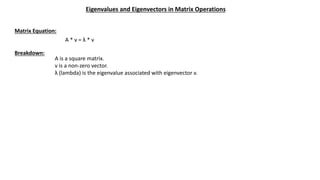
Matrix Equation:
A * v = λ * v
Breakdown:
A is a square matrix.
v is a non-zero vector.
λ (lambda) is the eigenvalue associated with eigenvector v.
Calculating Eigenvalues and Eigenvectors
Eigenvalue Equation:
det(A - λI) = 0
Steps:
1. Find the determinant of (A – λI).
2. Solve for λ values that satisfy the equation.
3. Substitute each λ into (A – λI)v = 0 to find
corresponding eigenvectors.
Geometric Interpretation
Visualization:
Eigenvectors represent directions that remain unchanged under a linear transformation.
Eigenvalues indicate the scaling factor by which the eigenvectors are stretched or
compressed.
Properties of Eigenvalues
Real vs. Complex Eigenvalues:
• Real eigenvalues are associated with real symmetric
matrices.
• Complex eigenvalues often occur in non-symmetric
matrices.
Properties of Eigenvectors
Orthogonality:
• Eigenvectors corresponding to distinct eigenvalues are orthogonal.
• Orthogonal eigenvectors provide a useful basis for diagonalizing a
matrix.
Applications of Eigenvalues and Eigenvectors
Engineering and Physics:
• Structural engineering for analyzing vibrations and deformations.
• Quantum mechanics for understanding state transitions.
Conclusion
Summary:
• Eigenvalues and eigenvectors are essential concepts in linear algebra.
• They have diverse applications in various fields and play a crucial role in
understanding linear transformations and matrix properties.
References

Understanding Eigenvalues and Eigenvectors PPT presentation

  • 1.
    Title: Understanding Eigenvalues andEigenvectors Subtitle: Exploring their Significance and Properties in Mathematics Name of the student: Sayan Das University Roll No: Class Roll No: 39 Stream: Computer Science and Engineering College Name: Govt. College of Engineering and Textile Technology, Serampore DATE:
  • 2.
    Introduction to Eigenvaluesand Eigenvectors Definition: Eigenvalues and eigenvectors are fundamental concepts in linear algebra. Eigenvalues represent the scaling factor of eigenvectors in a linear transformation.
  • 3.
    Eigenvalues and Eigenvectorsin Matrix Operations Matrix Equation: A * v = λ * v Breakdown: A is a square matrix. v is a non-zero vector. λ (lambda) is the eigenvalue associated with eigenvector v.
  • 4.
    Calculating Eigenvalues andEigenvectors Eigenvalue Equation: det(A - λI) = 0 Steps: 1. Find the determinant of (A – λI). 2. Solve for λ values that satisfy the equation. 3. Substitute each λ into (A – λI)v = 0 to find corresponding eigenvectors.
  • 5.
    Geometric Interpretation Visualization: Eigenvectors representdirections that remain unchanged under a linear transformation. Eigenvalues indicate the scaling factor by which the eigenvectors are stretched or compressed.
  • 6.
    Properties of Eigenvalues Realvs. Complex Eigenvalues: • Real eigenvalues are associated with real symmetric matrices. • Complex eigenvalues often occur in non-symmetric matrices.
  • 7.
    Properties of Eigenvectors Orthogonality: •Eigenvectors corresponding to distinct eigenvalues are orthogonal. • Orthogonal eigenvectors provide a useful basis for diagonalizing a matrix.
  • 8.
    Applications of Eigenvaluesand Eigenvectors Engineering and Physics: • Structural engineering for analyzing vibrations and deformations. • Quantum mechanics for understanding state transitions.
  • 9.
    Conclusion Summary: • Eigenvalues andeigenvectors are essential concepts in linear algebra. • They have diverse applications in various fields and play a crucial role in understanding linear transformations and matrix properties.
  • 10.