ROME ARCHITECTURE.
MADE BY PABLO CALDEVILLA.
TEMPLES.
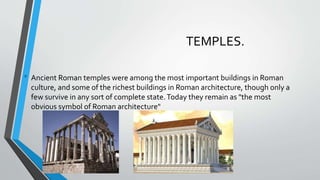
• Ancient Roman temples were among the most important buildings in Roman
culture, and some of the richest buildings in Roman architecture, though only a
few survive in any sort of complete state.Today they remain as "the most
obvious symbol of Roman architecture"
SHRINES
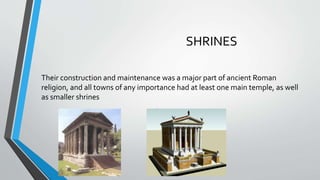
Their construction and maintenance was a major part of ancient Roman
religion, and all towns of any importance had at least one main temple, as well
as smaller shrines
ARCHITECTURE
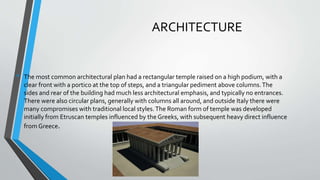
• The most common architectural plan had a rectangular temple raised on a high podium, with a
clear front with a portico at the top of steps, and a triangular pediment above columns.The
sides and rear of the building had much less architectural emphasis, and typically no entrances.
There were also circular plans, generally with columns all around, and outside Italy there were
many compromises with traditional local styles.The Roman form of temple was developed
initially from Etruscan temples influenced by the Greeks, with subsequent heavy direct influence
from Greece.
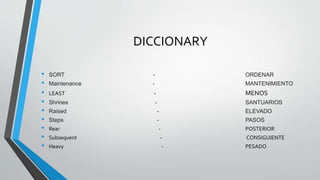
DICCIONARY
• SORT - ORDENAR
• Maintenance - MANTENIMIENTO
• LEAST - MENOS
• Shrines - SANTUARIOS
• Raised - ELEVADO
• Steps - PASOS
• Rear - POSTERIOR
• Subsequent - CONSIGUIENTE
• Heavy - PESADO
THE END
• THIS ISTHE END OFTHE POWER POINT.
I HOPEYOU LIKED IT.

4

  • 1.
    ROME ARCHITECTURE. MADE BYPABLO CALDEVILLA.
  • 2.
    TEMPLES. • Ancient Romantemples were among the most important buildings in Roman culture, and some of the richest buildings in Roman architecture, though only a few survive in any sort of complete state.Today they remain as "the most obvious symbol of Roman architecture"
  • 3.
    SHRINES Their construction andmaintenance was a major part of ancient Roman religion, and all towns of any importance had at least one main temple, as well as smaller shrines
  • 4.
    ARCHITECTURE • The mostcommon architectural plan had a rectangular temple raised on a high podium, with a clear front with a portico at the top of steps, and a triangular pediment above columns.The sides and rear of the building had much less architectural emphasis, and typically no entrances. There were also circular plans, generally with columns all around, and outside Italy there were many compromises with traditional local styles.The Roman form of temple was developed initially from Etruscan temples influenced by the Greeks, with subsequent heavy direct influence from Greece.
  • 5.
    DICCIONARY • SORT -ORDENAR • Maintenance - MANTENIMIENTO • LEAST - MENOS • Shrines - SANTUARIOS • Raised - ELEVADO • Steps - PASOS • Rear - POSTERIOR • Subsequent - CONSIGUIENTE • Heavy - PESADO
  • 6.
    THE END • THISISTHE END OFTHE POWER POINT. I HOPEYOU LIKED IT.