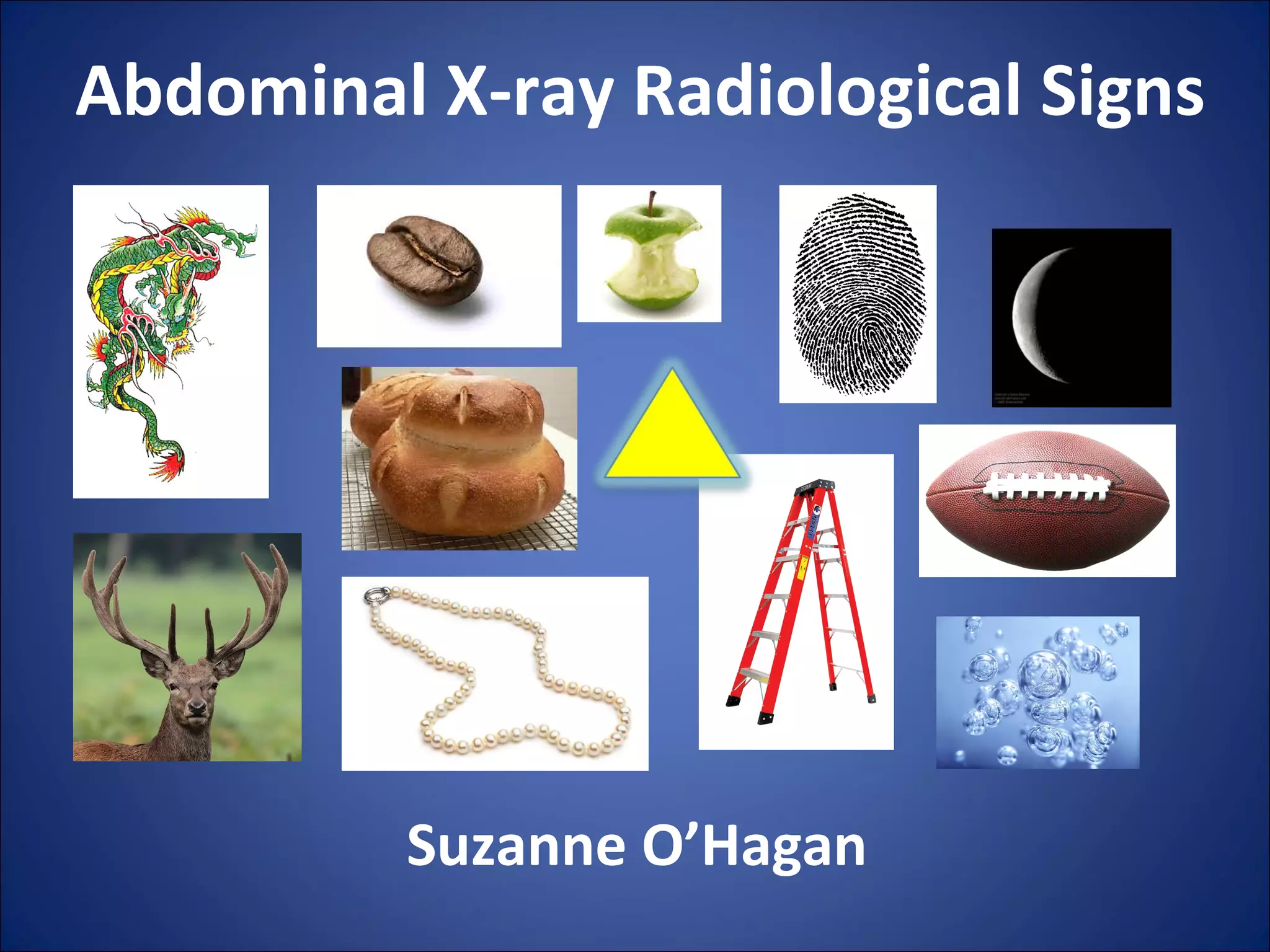
Abdominal X-ray Radiological Signs
Suzanne O’Hagan
Lightbulb moment
a moment of sudden inspiration, revelation, or recognition
Approach to AXR
• Bowel gas pattern
• Extraluminal air
• Soft tissue masses
• Calcifications
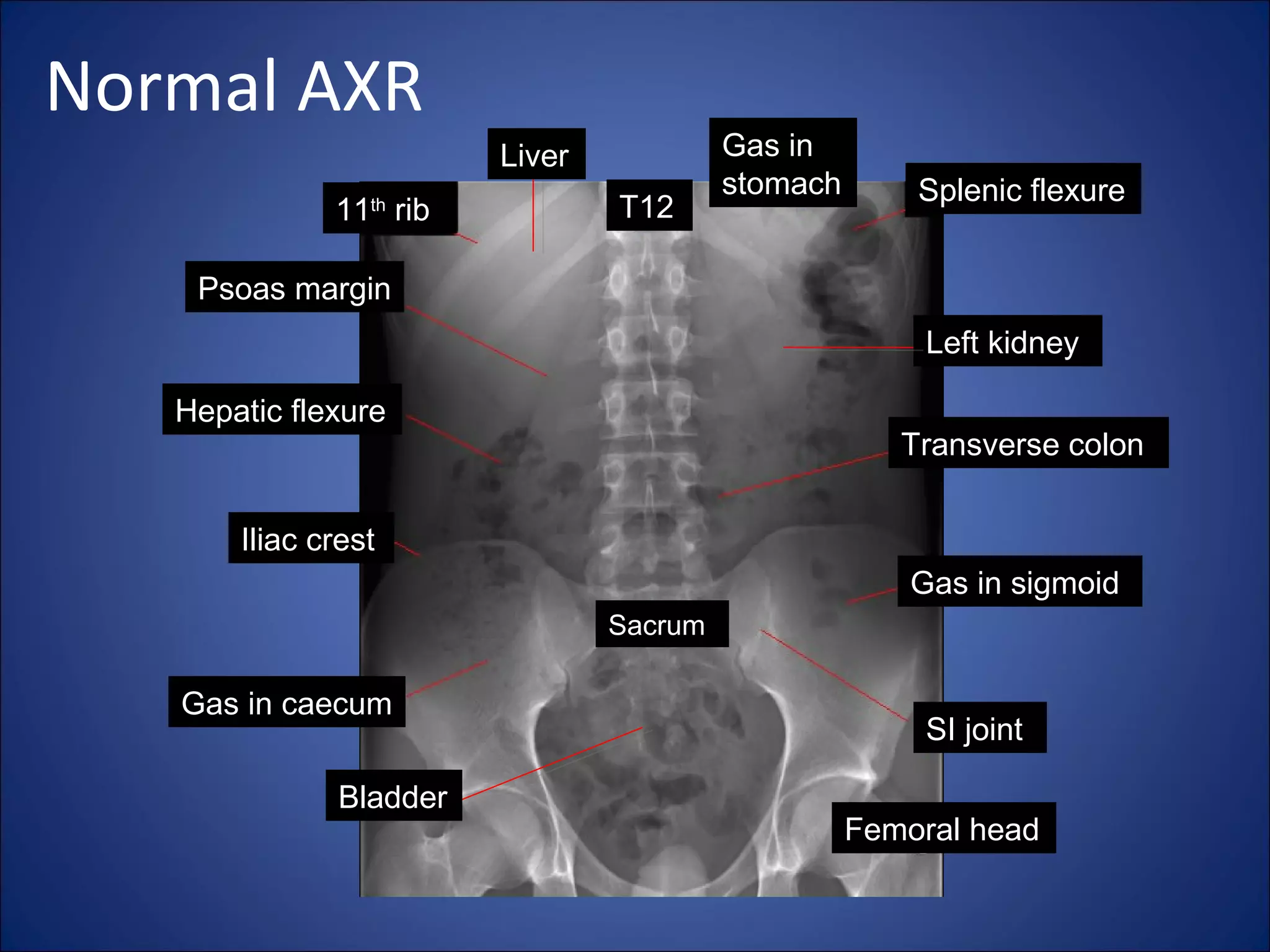
Normal AXR
11th
rib
Hepatic flexure
Gas in
stomach
T12
Gas in caecum
Iliac crest
Femoral head
SI joint
Gas in sigmoid
Transverse colon
Splenic flexure
Psoas margin
Sacrum
Left kidney
Liver
Bladder
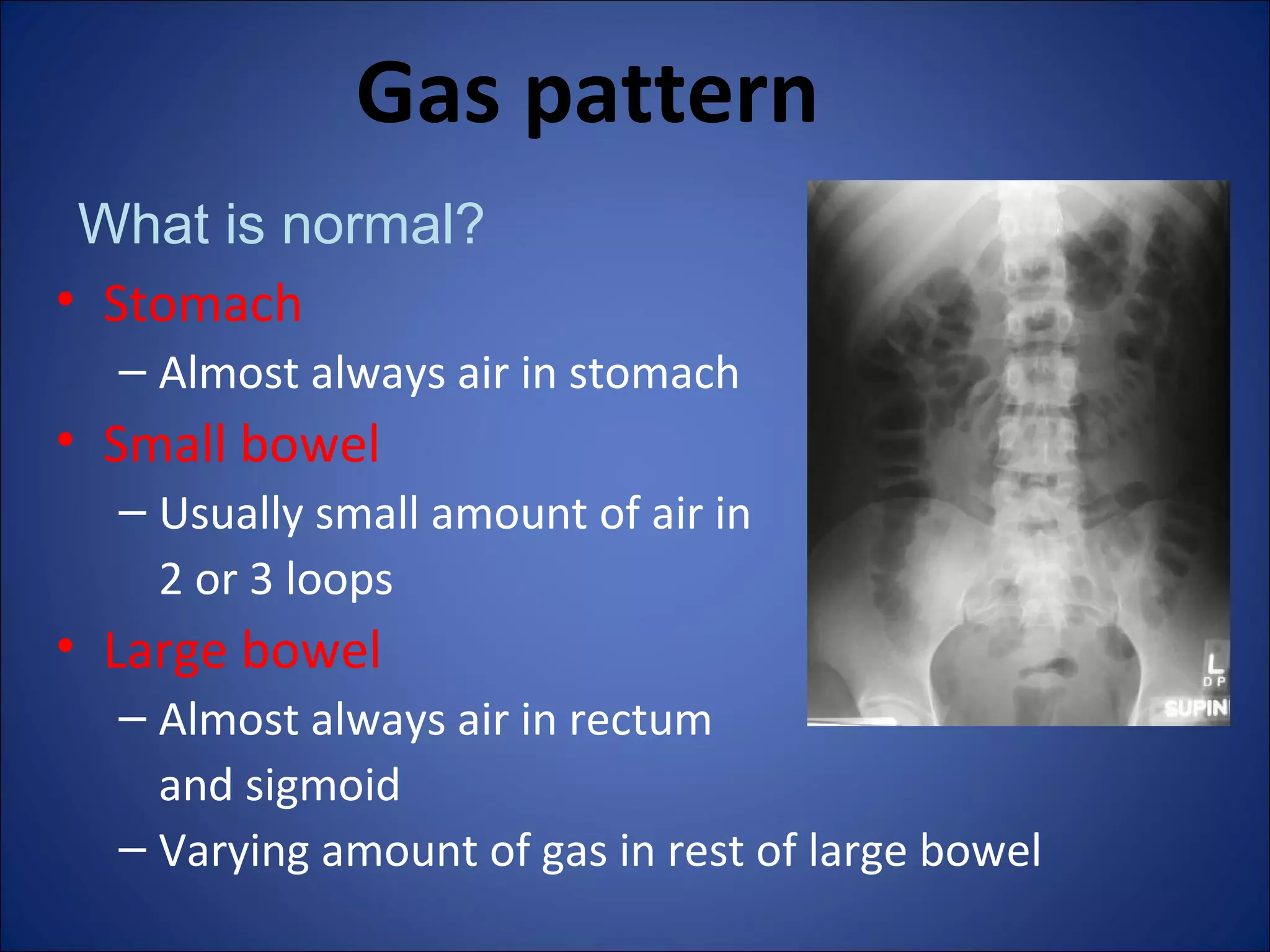
Gas pattern
• Stomach
– Almost always air in stomach
• Small bowel
– Usually small amount of air in
2 or 3 loops
• Large bowel
– Almost always air in rectum
and sigmoid
– Varying amount of gas in rest of large bowel
What is normal?
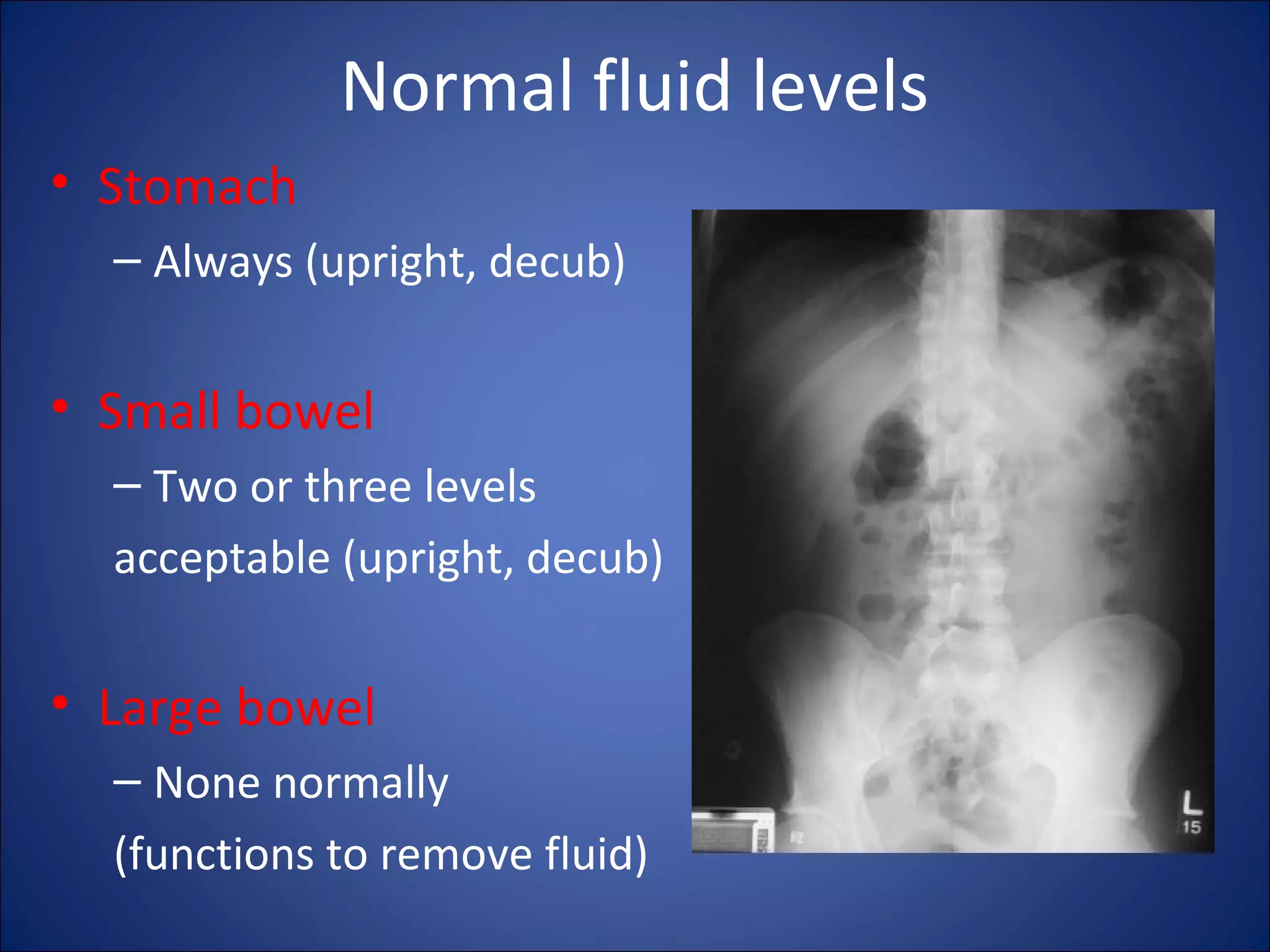
Normal fluid levels
• Stomach
– Always (upright, decub)
• Small bowel
– Two or three levels
acceptable (upright, decub)
• Large bowel
– None normally
(functions to remove fluid)
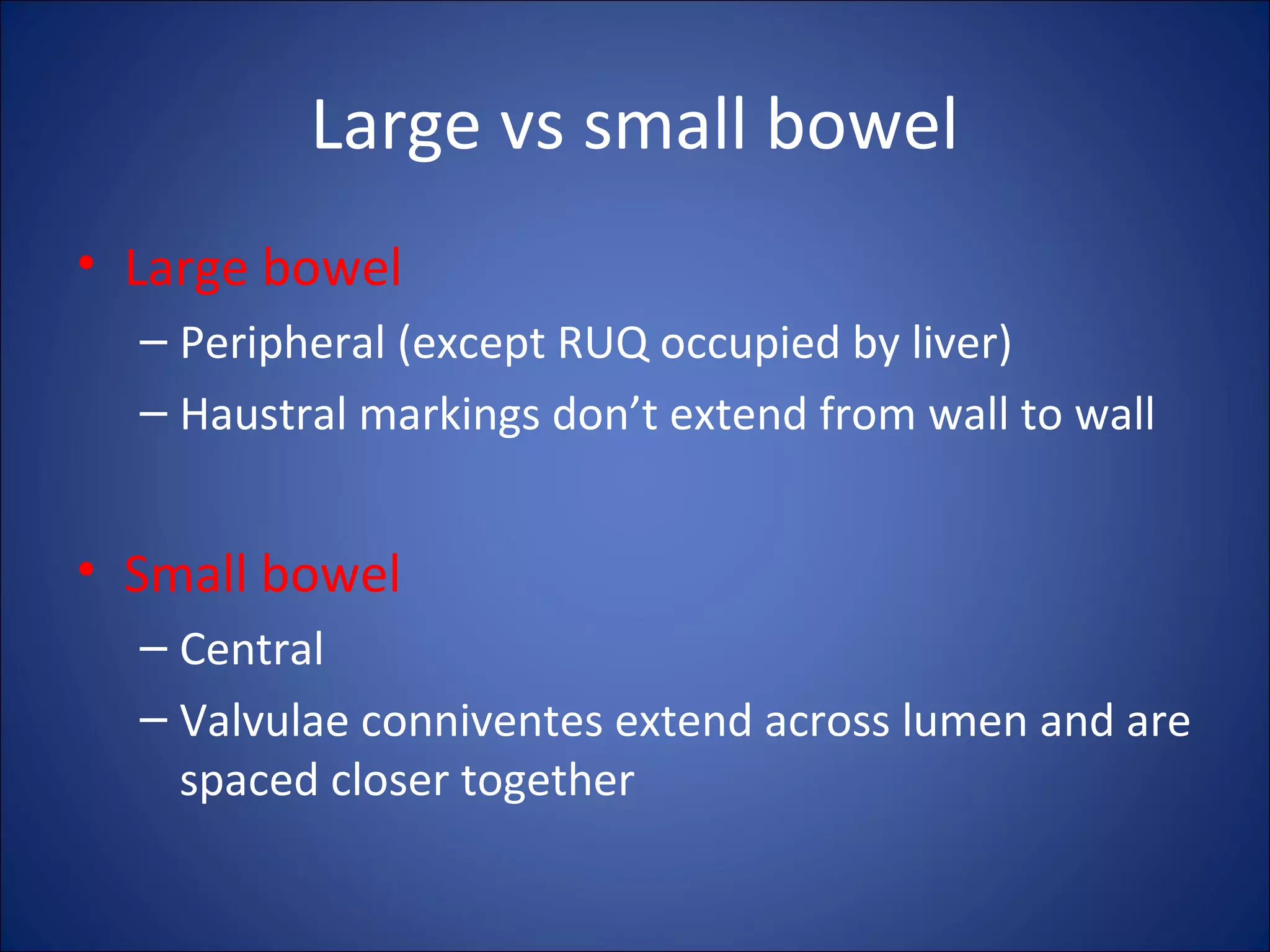
Large vs small bowel
• Large bowel
– Peripheral (except RUQ occupied by liver)
– Haustral markings don’t extend from wall to wall
• Small bowel
– Central
– Valvulae conniventes extend across lumen and are
spaced closer together
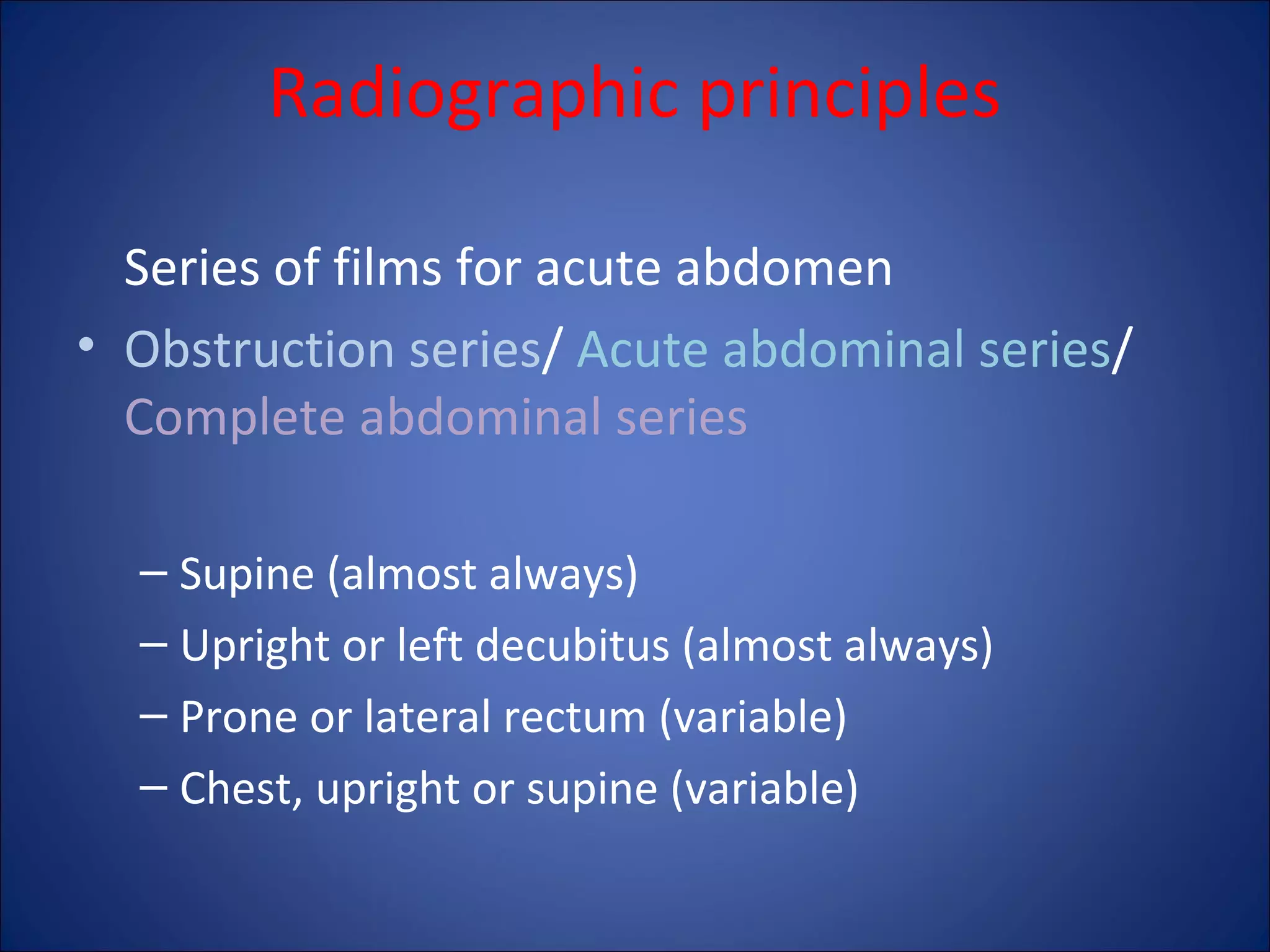
Radiographic principles
Series of films for acute abdomen
• Obstruction series/ Acute abdominal series/
Complete abdominal series
– Supine (almost always)
– Upright or left decubitus (almost always)
– Prone or lateral rectum (variable)
– Chest, upright or supine (variable)
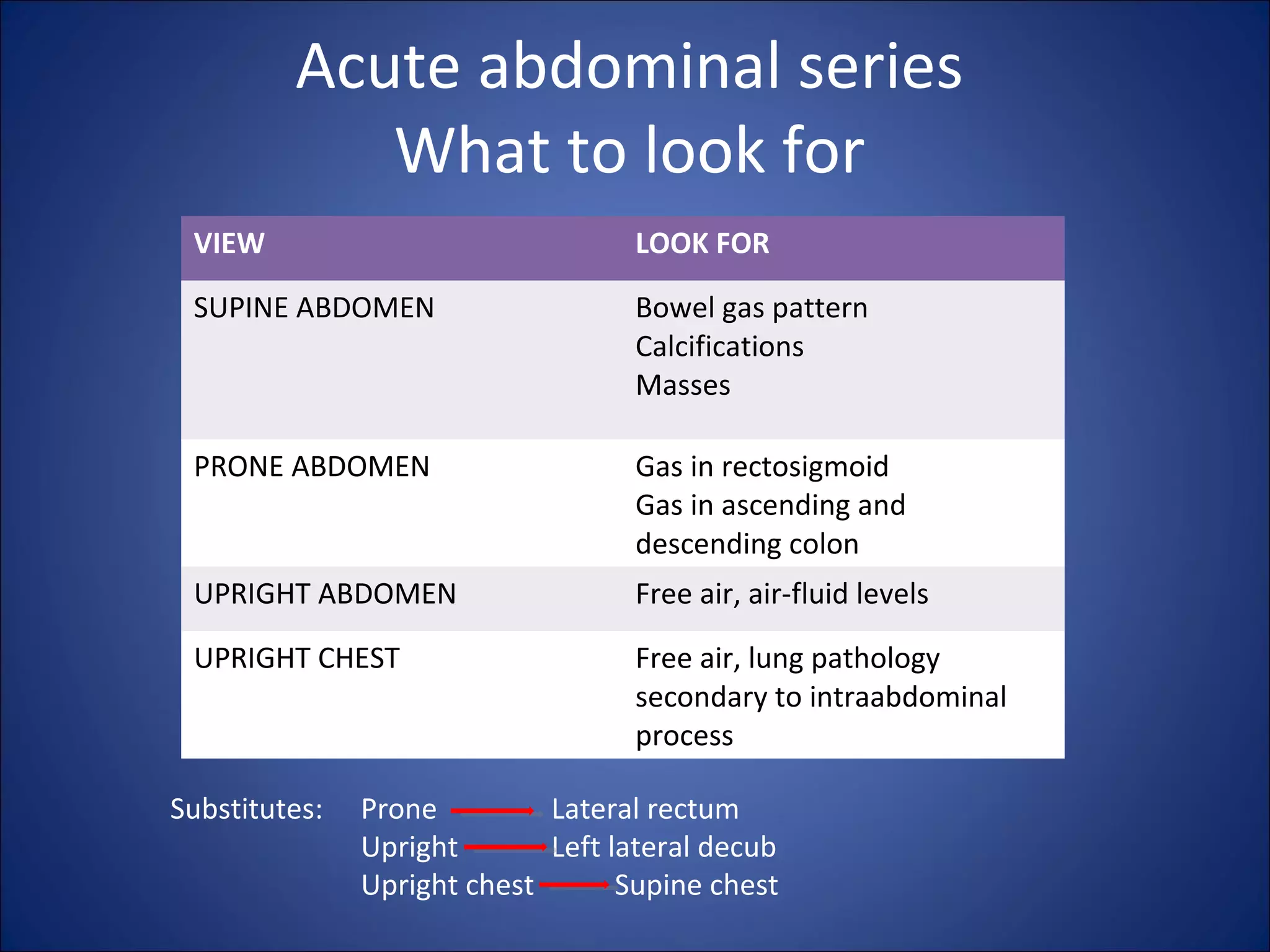
VIEW LOOK FOR
SUPINE ABDOMEN Bowel gas pattern
Calcifications
Masses
PRONE ABDOMEN Gas in rectosigmoid
Gas in ascending and
descending colon
UPRIGHT ABDOMEN Free air, air-fluid levels
UPRIGHT CHEST Free air, lung pathology
secondary to intraabdominal
process
Acute abdominal series
What to look for
Substitutes: Prone Lateral rectum
Upright Left lateral decub
Upright chest Supine chest
Obtaining views
• Supine
– Patient on back, x ray beam directed
vertically downward, casette
posterior, x-ray tube anterior (AP)
• Prone
– Patient on abdomen, x-ray beam
directed vertically downward, cassette
anterior, x-ray tube posterior (PA)
• Upright
– Patient stands or sits, x-ray beam
directed horizontally, cassette
posterior, x-ray tube anterior (AP)
• Upright chest
– Patient stands or sits, horizontal x-ray
beam, cassette anterior, x-ray tube
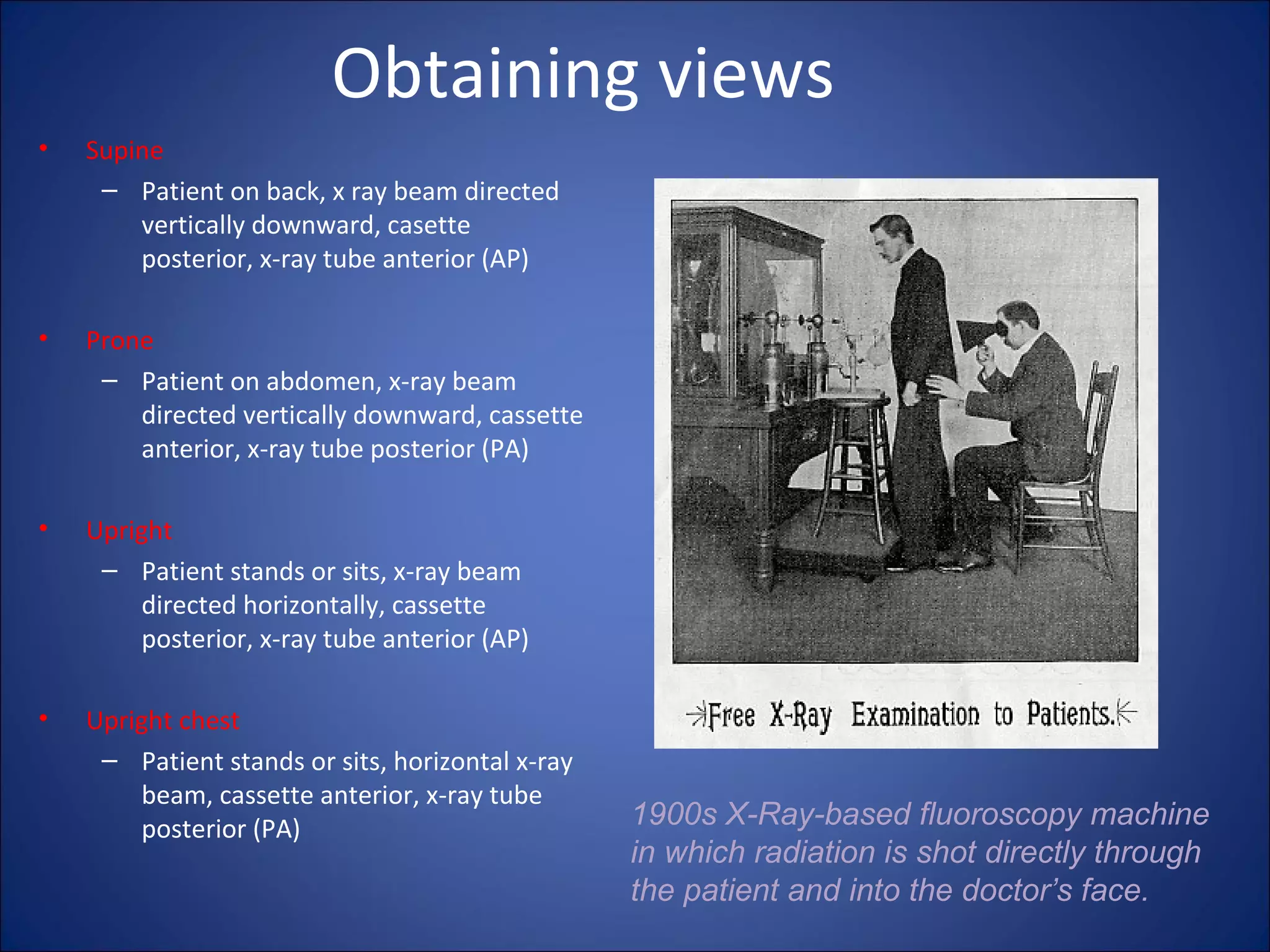
posterior (PA) 1900s X-Ray-based fluoroscopy machine
in which radiation is shot directly through
the patient and into the doctor’s face.
Abnormal Gas Patterns
• Functional ileus
– One or more bowel loops become aperistaltic usually
due to local irritation or inflammation
• Localised “sentinel loops” (one or two loops)
• Generalised (all loops of large and small bowel)
• Mechanical obstruction
– Intraluminal or extraluminal
• Small bowel obstruction
• Large bowel obstruction
3, 6, 9 RULE
Maximum Normal Diameter of bowel
Small bowel 3cm
Large bowel 6cm
Caecum 9cm
Localised ileus
Key features
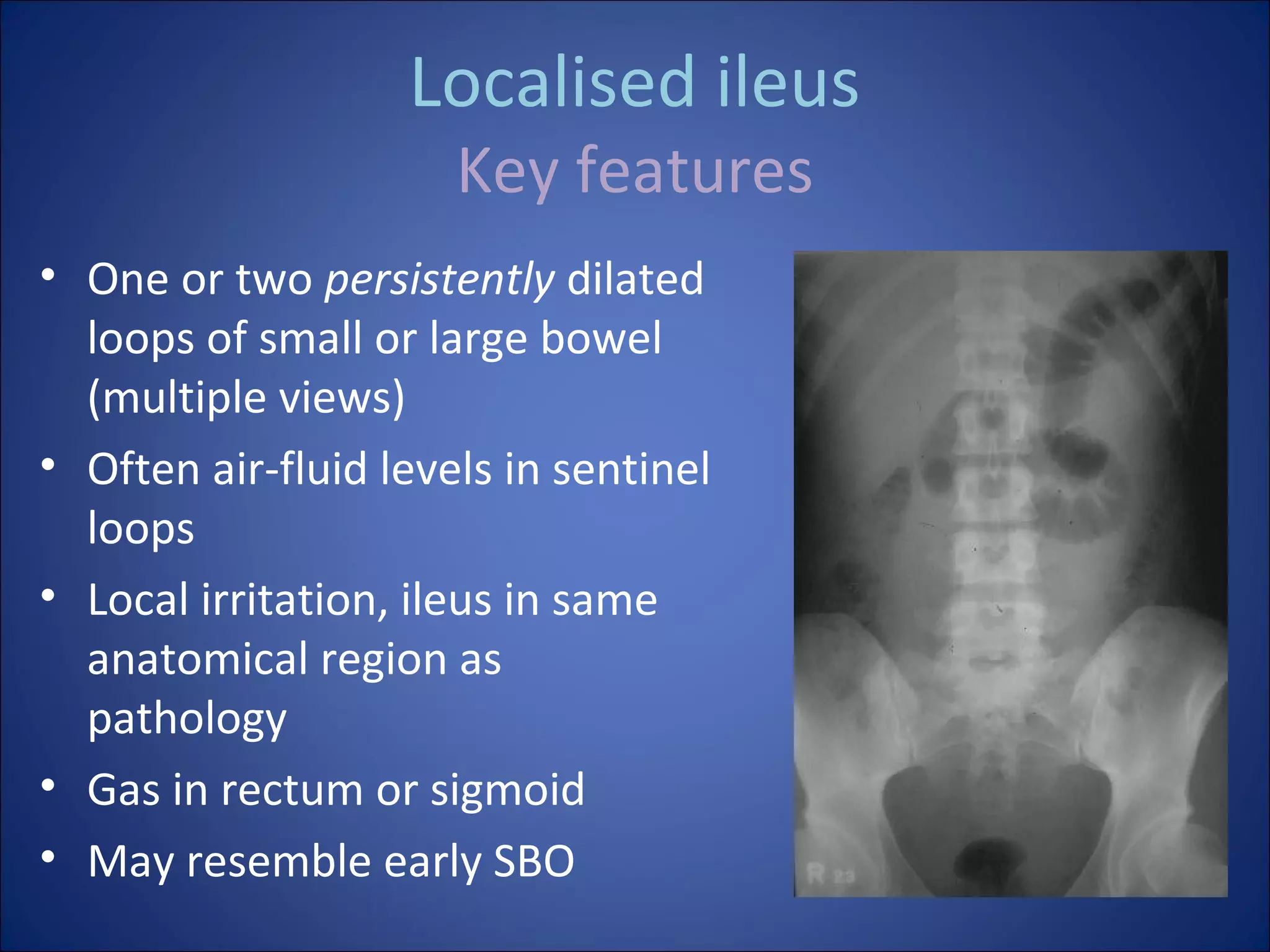
• One or two persistently dilated
loops of small or large bowel
(multiple views)
• Often air-fluid levels in sentinel
loops
• Local irritation, ileus in same
anatomical region as
pathology
• Gas in rectum or sigmoid
• May resemble early SBO
Causes of Localised Ileus
by location
SITE OF DILATED LOOPS CAUSE
Right upper quadrant Cholecystitis
Left upper quadrant Pancreatitis
Right lower quadrant Appendicitis
Left lower quadrant Diverticulitis
Mid-abdomen Ulcer or kidney/ureteric calculi
Colon cut off sign
Explanation:
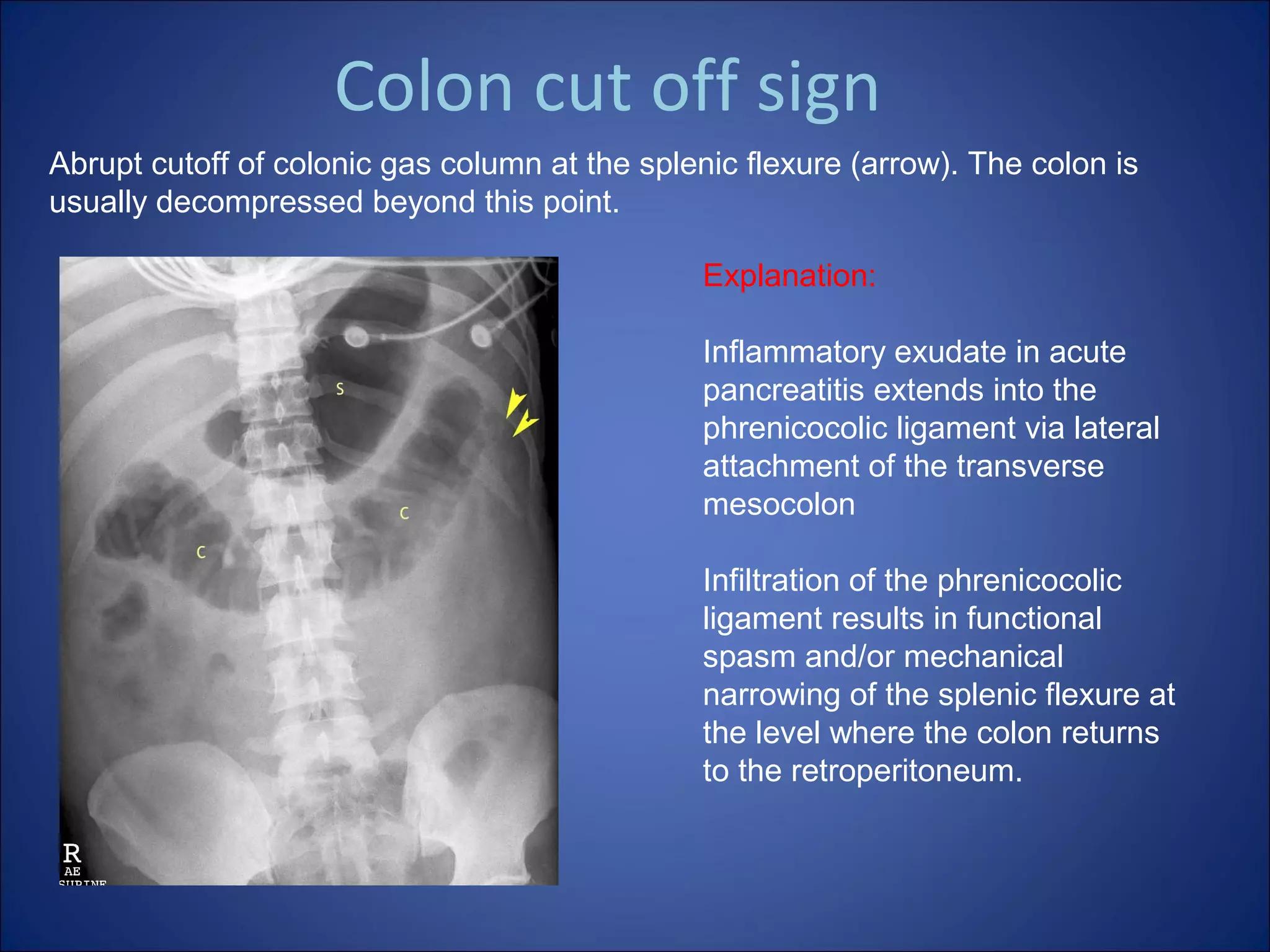
Inflammatory exudate in acute
pancreatitis extends into the
phrenicocolic ligament via lateral
attachment of the transverse
mesocolon
Infiltration of the phrenicocolic
ligament results in functional
spasm and/or mechanical
narrowing of the splenic flexure at
the level where the colon returns
to the retroperitoneum.
Abrupt cutoff of colonic gas column at the splenic flexure (arrow). The colon is
usually decompressed beyond this point.
Generalised ileus
Key features
• Entire bowel aperistaltic/hypoperistaltic
• Dilated small bowel and large bowel to rectum
(with LBO no gas in rectum/sigmoid)
• Long air-fluid levels
CAUSE REMARK
*Postoperative Usually abdominal surgery
Electrolyte imbalance Diabetic ketoacidosis
* almost always
Generalised adynamic ileus
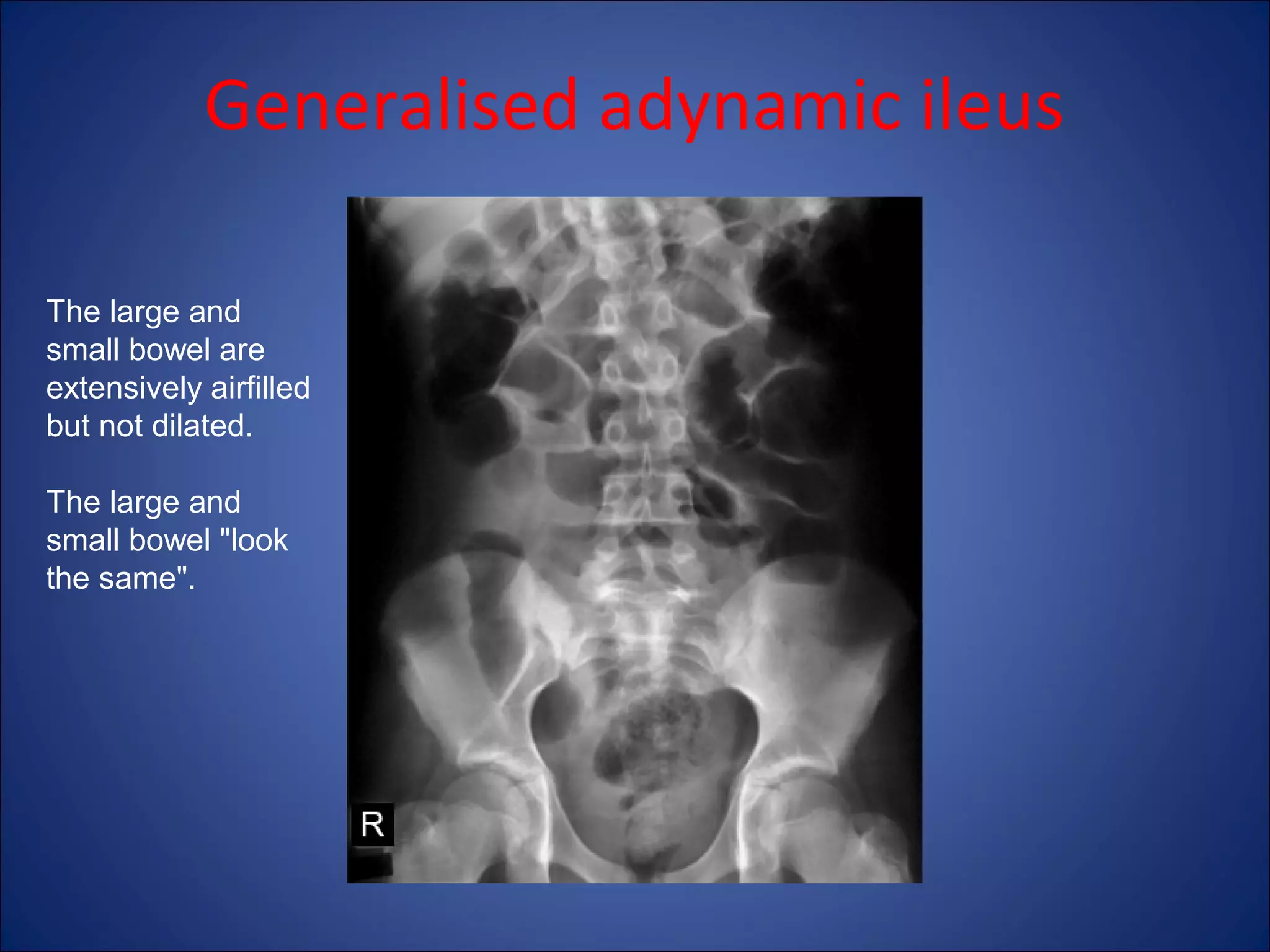
The large and
small bowel are
extensively airfilled
but not dilated.
The large and
small bowel "look
the same".
Mechanical SBO
• Dilated small bowel
• Fighting loops (visible loops, lying
transversely, with air-fluid levels at different
levels)
• Little gas in colon, especially rectum
SBO Erect SBO Supine
Air fluid levels
Causes of Mechanical SBO
* May be visible on AXR
Adhesions
Hernia*
Malignancy
Gallstone ileus*
Intussesception
Inflammatory bowel disease
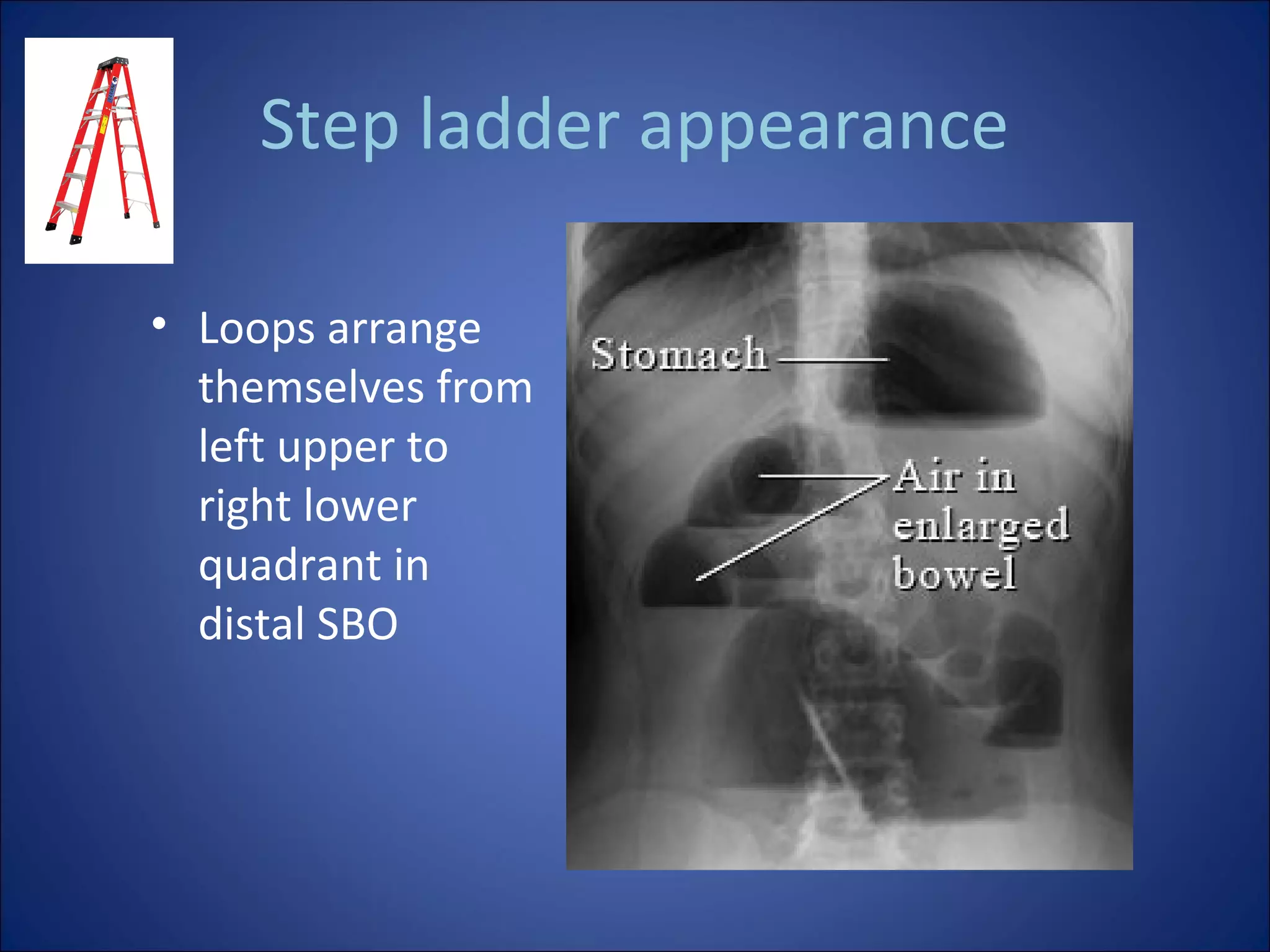
Step ladder appearance
• Loops arrange
themselves from
left upper to
right lower
quadrant in
distal SBO
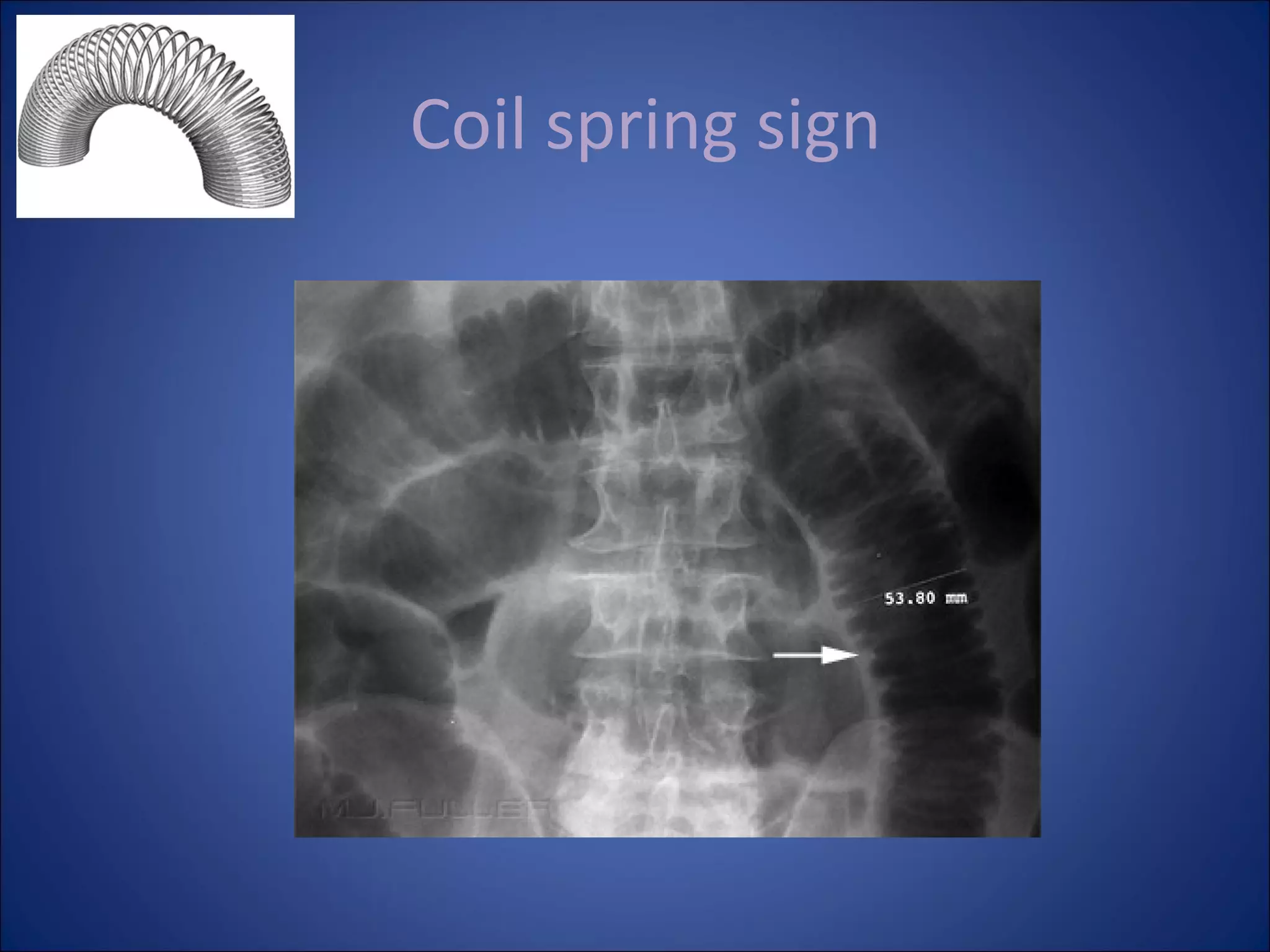
Coil spring sign
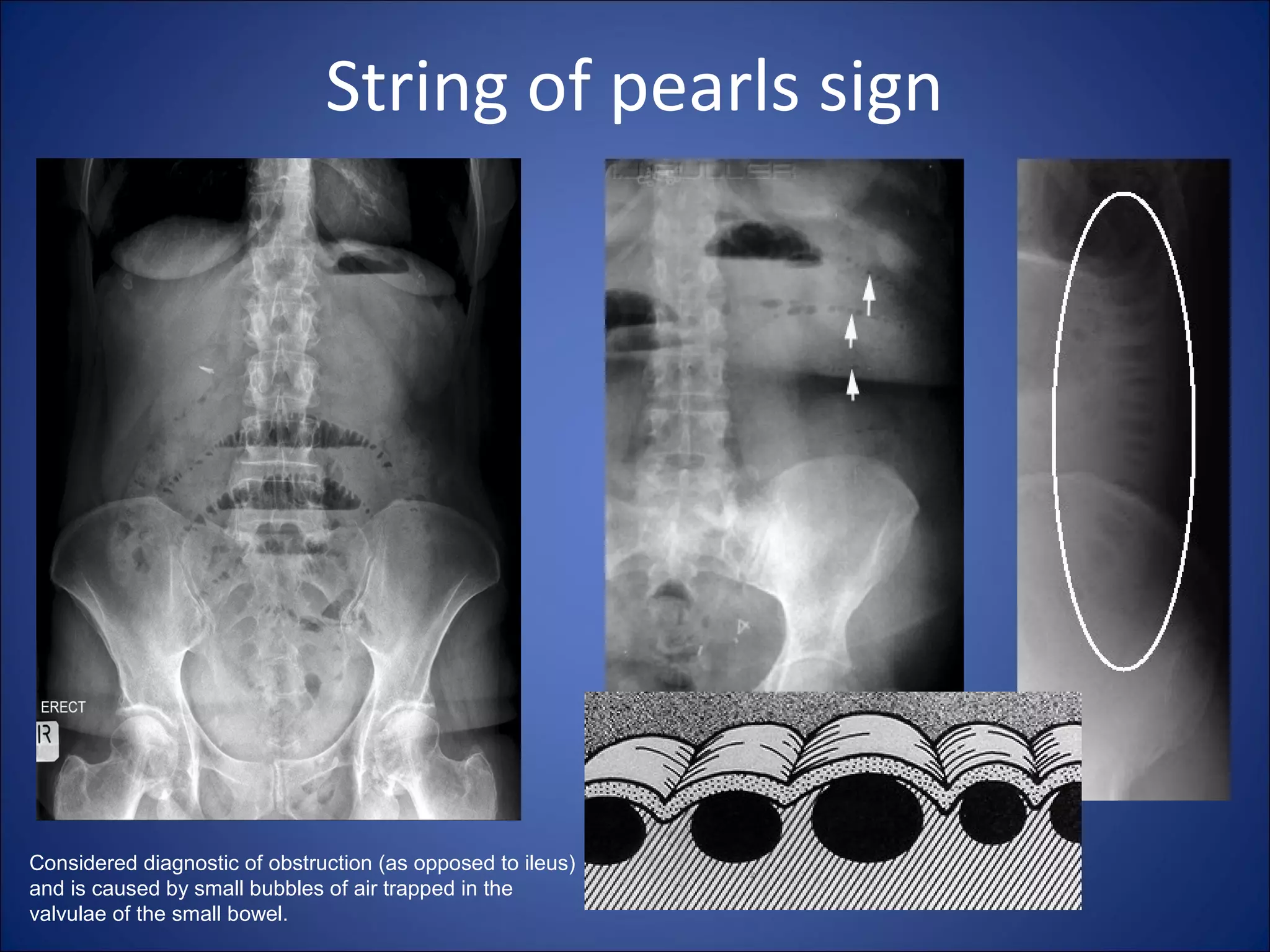
String of pearls sign
Considered diagnostic of obstruction (as opposed to ileus)
and is caused by small bubbles of air trapped in the
valvulae of the small bowel.
Stretch/slit sign
Slit of air caught in a
valvulae, characteristic
of SBO
Closed loop obstruction
• Two points of same loop of bowel obstructed
at a single location
• Forms a C or a U shape
– Term applies to small bowel, usually caused by
adhesions
– Large bowel, called a volvulus
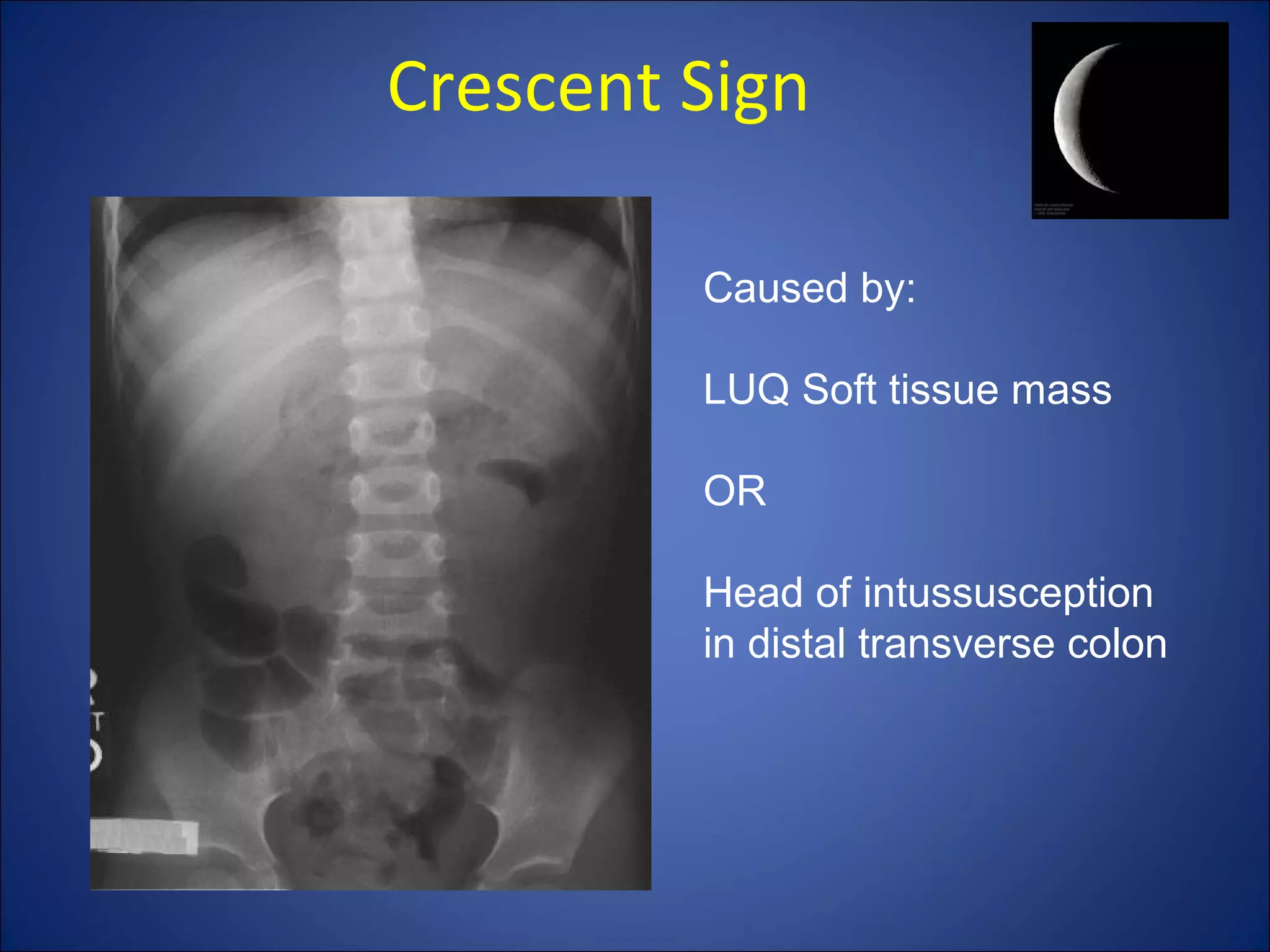
Crescent Sign
Caused by:
LUQ Soft tissue mass
OR
Head of intussusception
in distal transverse colon
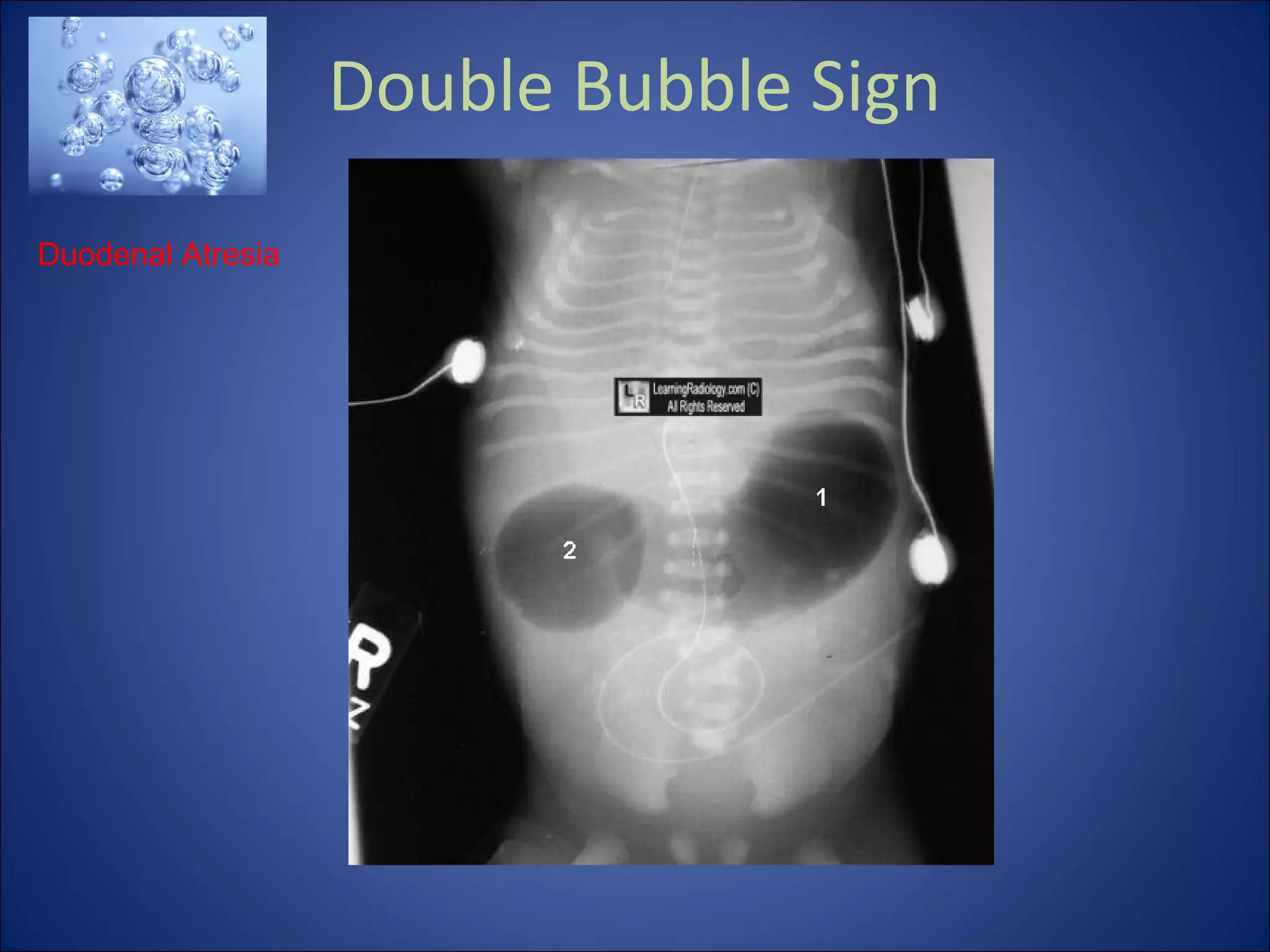
Double Bubble Sign
Duodenal Atresia
Mechanical LBO
• Colon dilates from point
of obstruction
backwards
• Little/no air fluid levels
(colon reabsorbs water)
• Little or no air in
rectum/sigmoid
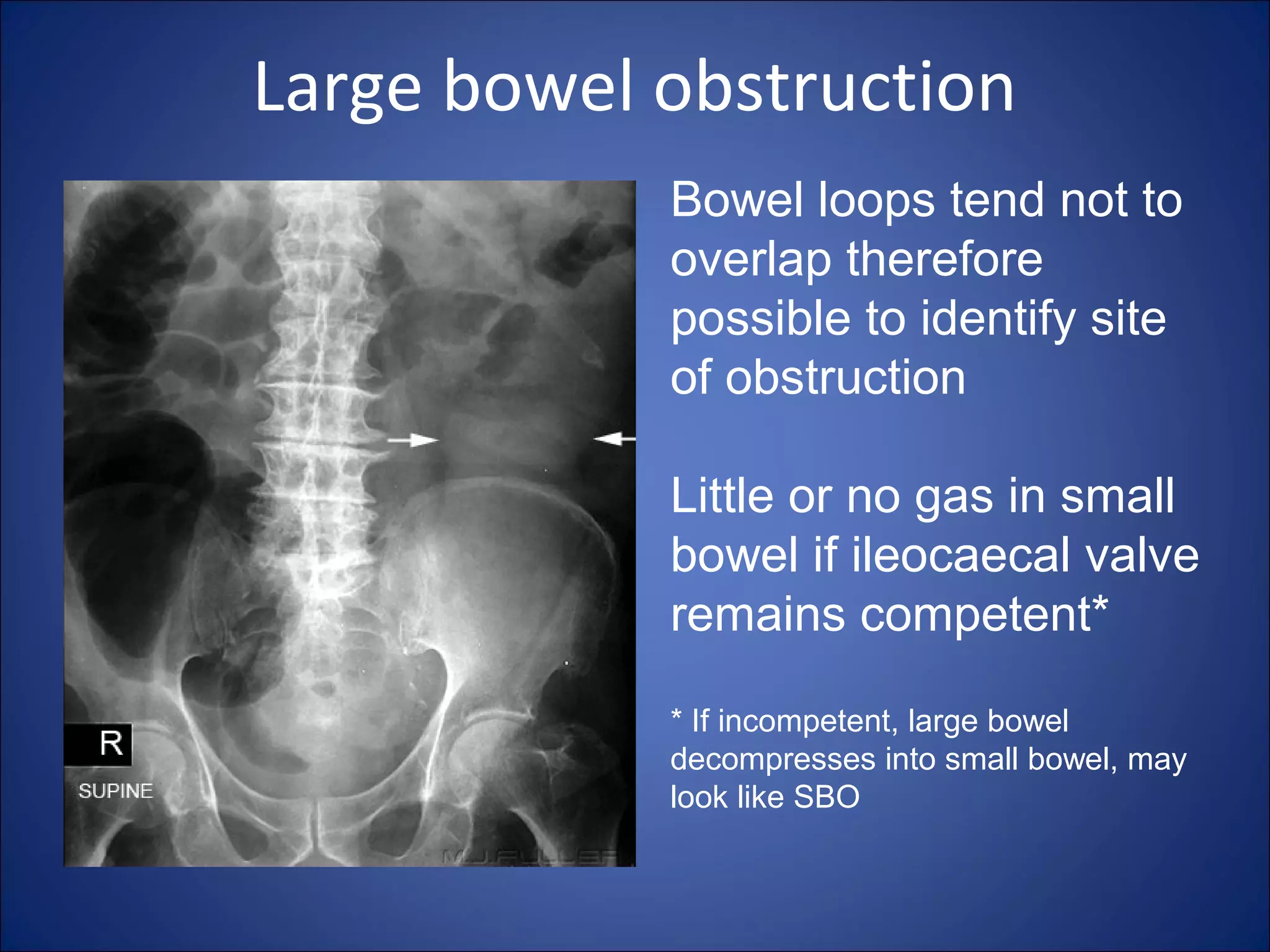
Large bowel obstruction
Bowel loops tend not to
overlap therefore
possible to identify site
of obstruction
Little or no gas in small
bowel if ileocaecal valve
remains competent*
* If incompetent, large bowel
decompresses into small bowel, may
look like SBO
Causes of Mechanical LBO
TUMOUR
VOLVULUS
HERNIA
DIVERTICULITIS
INTUSSUSCEPTION
Note on volvulus
• Sigmoid colon has its own mesentry therefore
prone to twisting
• Caecum usually retroperitoneal and not prone
to twisting; 20% people have defect in
peritoneum that covers the caecum resulting
in a mobile caecum
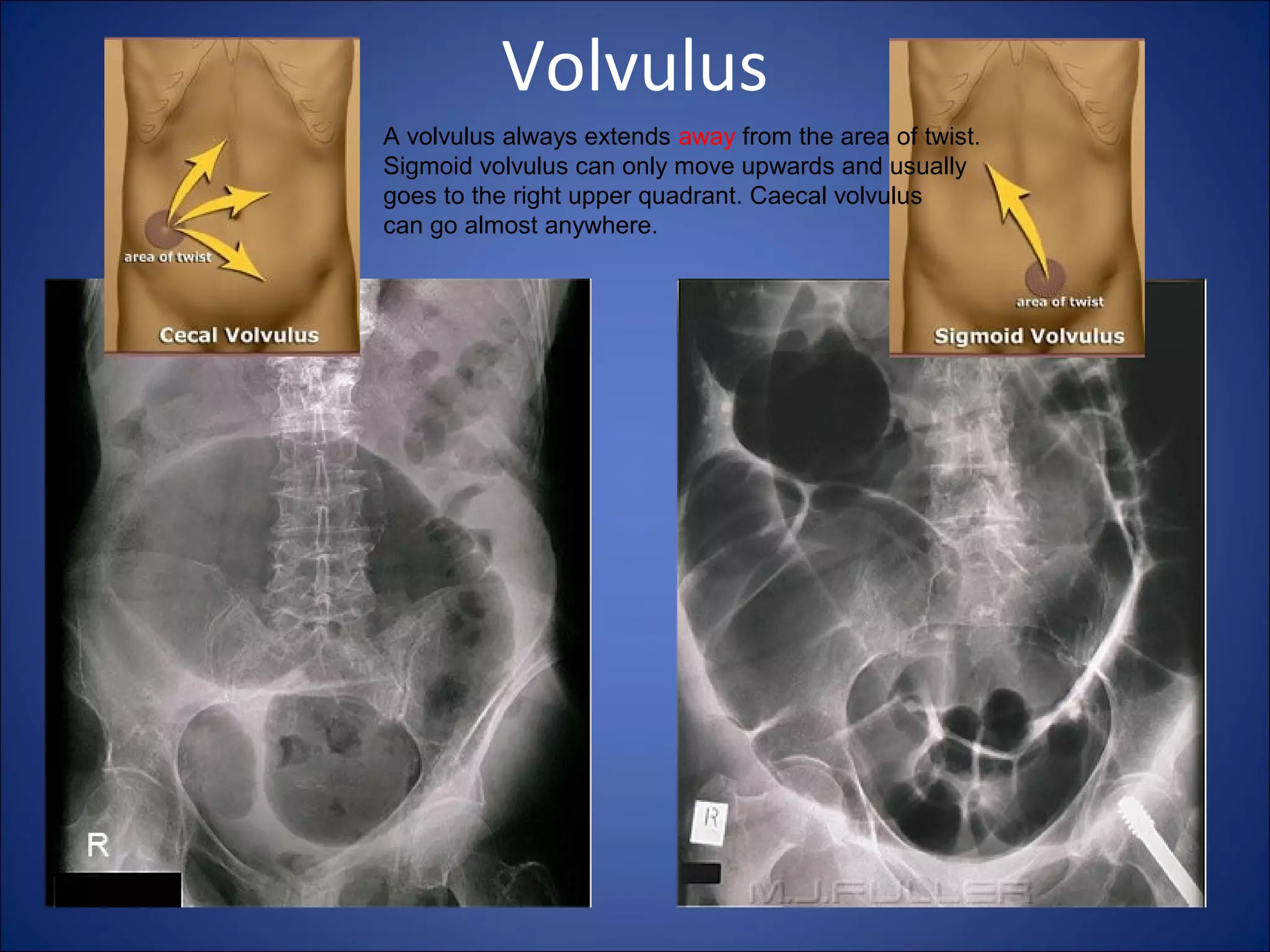
Volvulus
A volvulus always extends away from the area of twist.
Sigmoid volvulus can only move upwards and usually
goes to the right upper quadrant. Caecal volvulus
can go almost anywhere.
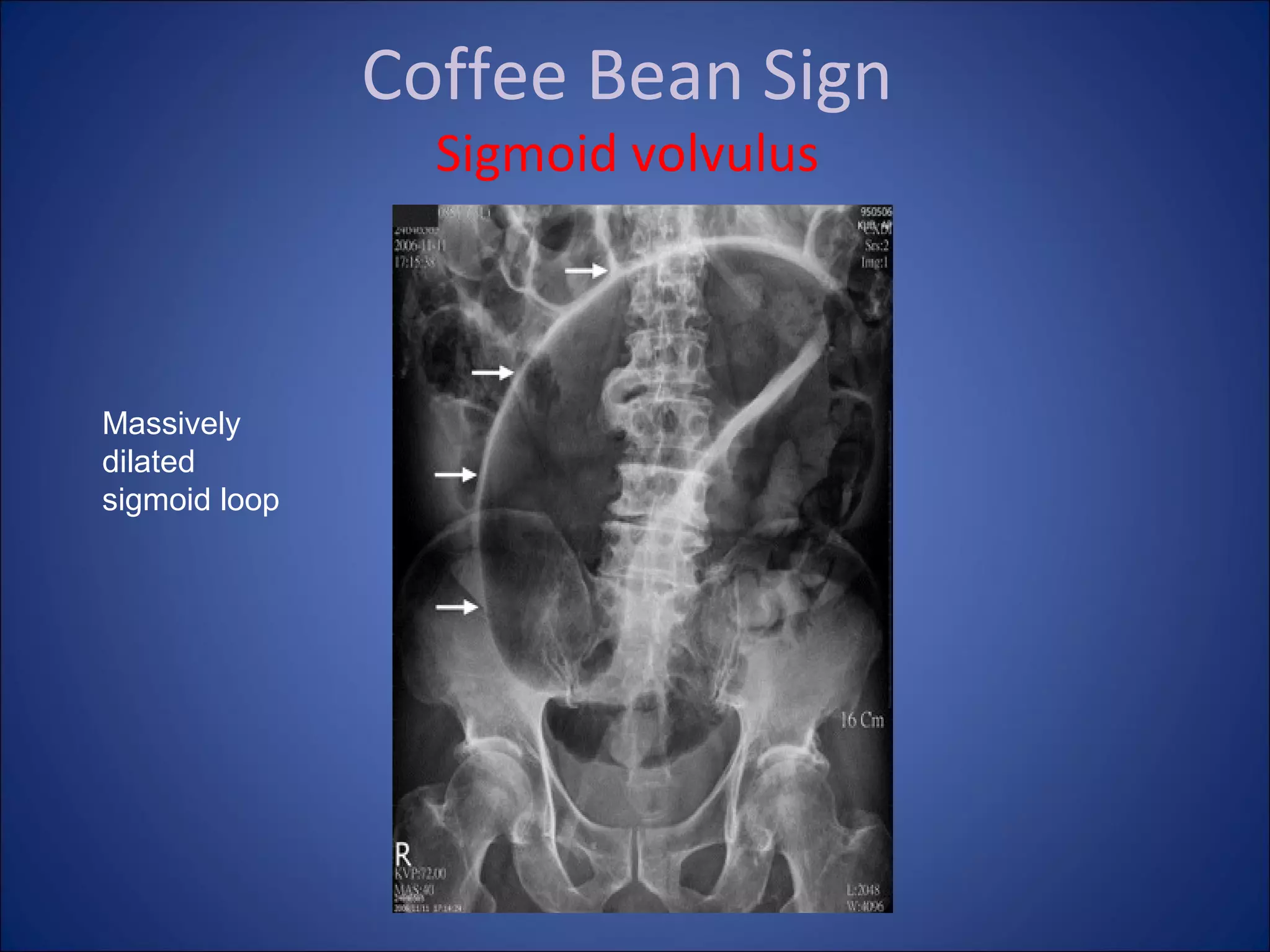
Coffee Bean Sign
Sigmoid volvulus
Massively
dilated
sigmoid loop
Hernia
Lateral decubitus of value
The advantage is that there may be a greater chance of air entering the
herniated bowel because it is the least dependent part of the bowel in the
supine position.
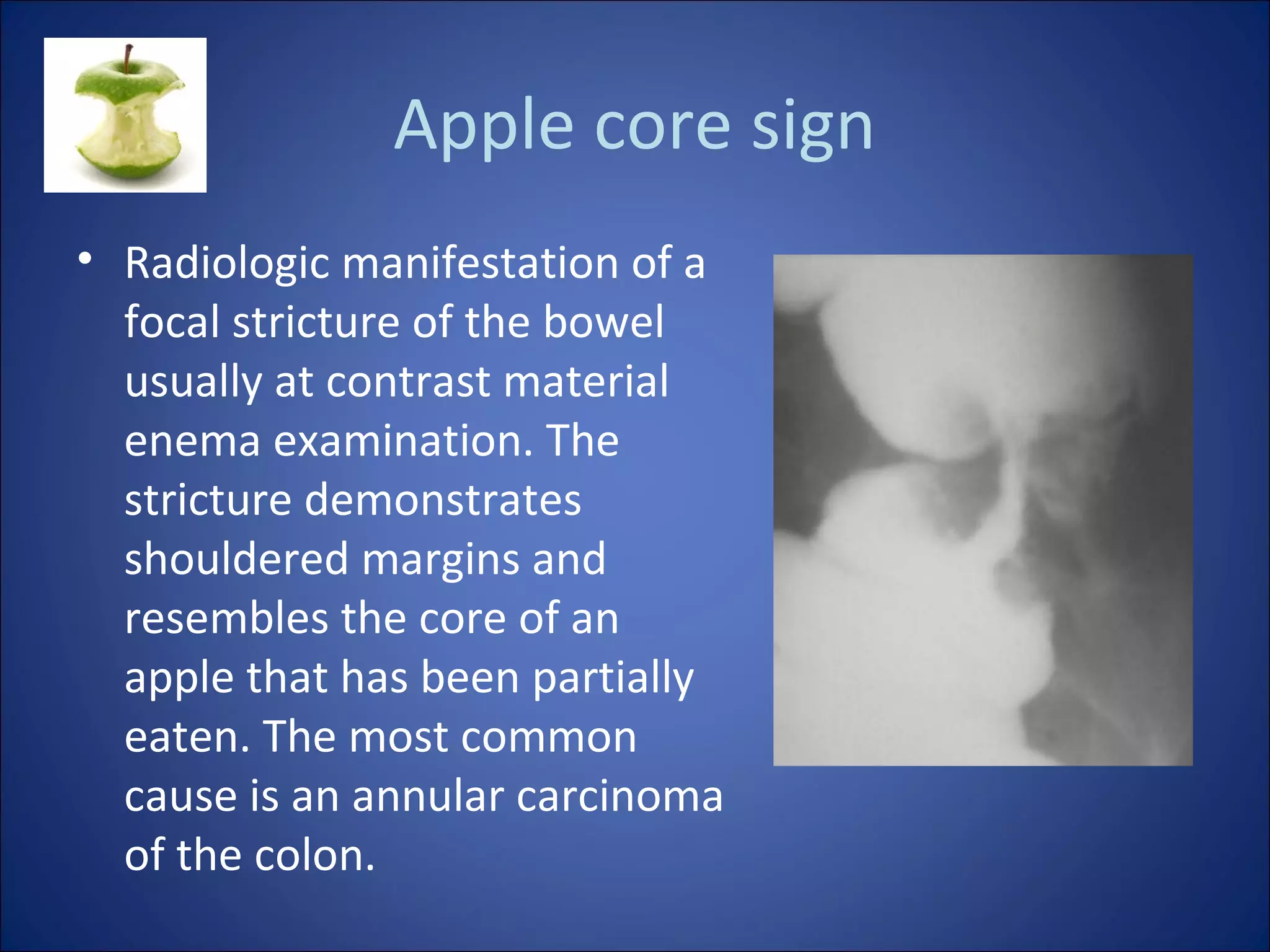
Apple core sign
• Radiologic manifestation of a
focal stricture of the bowel
usually at contrast material
enema examination. The
stricture demonstrates
shouldered margins and
resembles the core of an
apple that has been partially
eaten. The most common
cause is an annular carcinoma
of the colon.
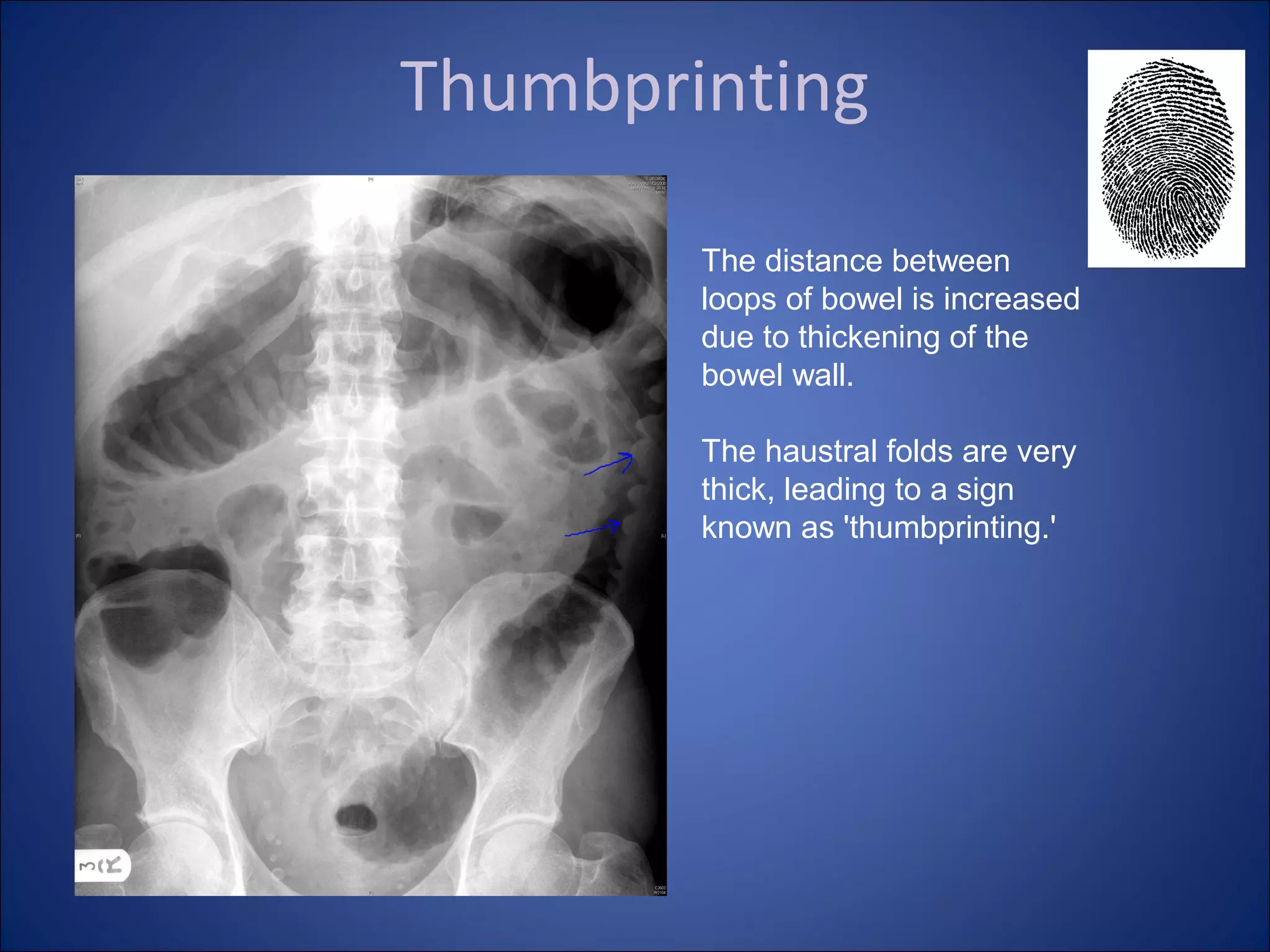
Thumbprinting
The distance between
loops of bowel is increased
due to thickening of the
bowel wall.
The haustral folds are very
thick, leading to a sign
known as 'thumbprinting.'
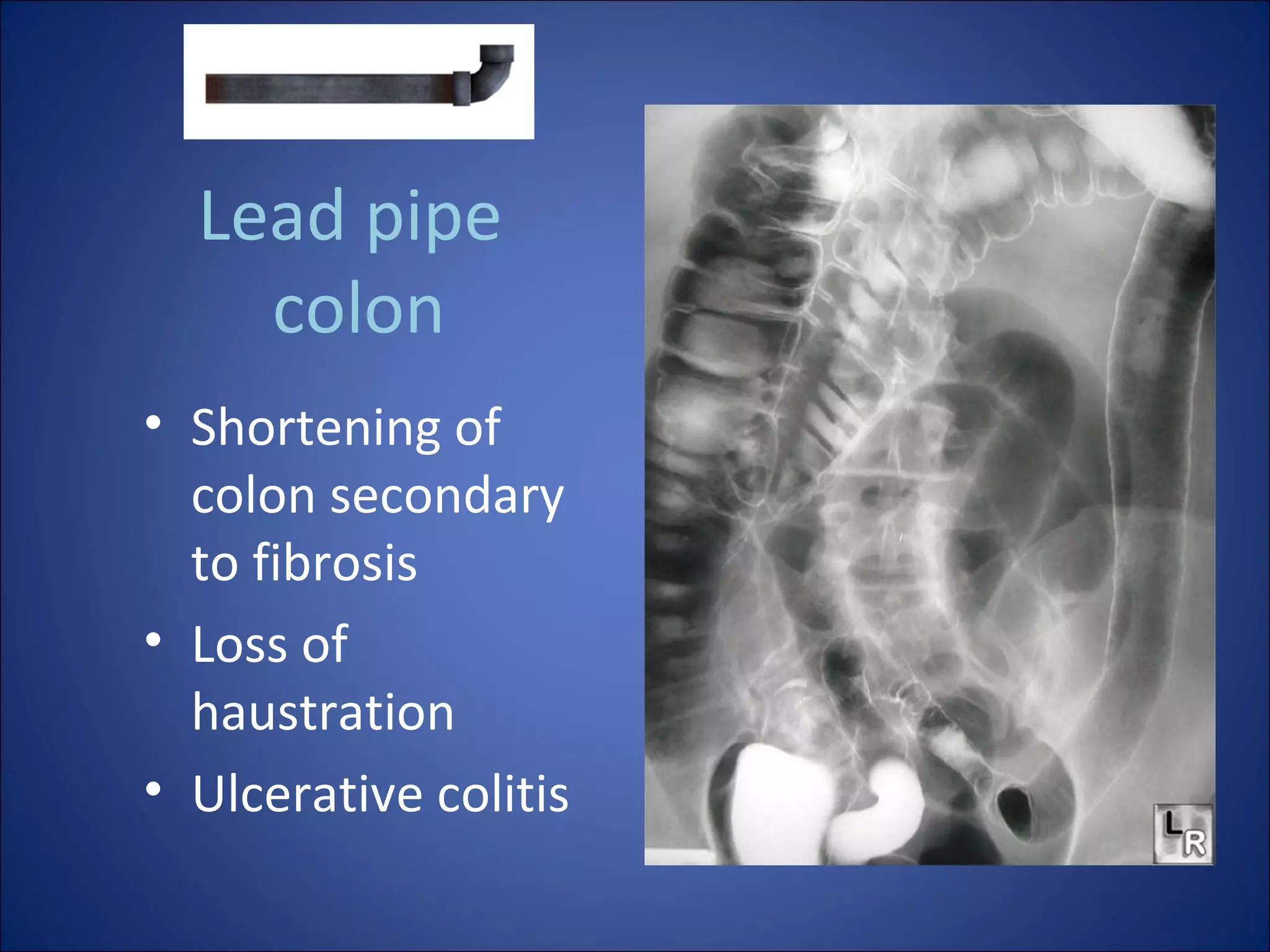
Lead pipe
colon
• Shortening of
colon secondary
to fibrosis
• Loss of
haustration
• Ulcerative colitis
Extraluminal air
• TYPES
– Pneumoperitoneum/free air/intraperitoneal air
– Retroperintoneal air
– Air in the bowel wall (pneumatosis intestinalis)
– Air in the biliary system (pneumobilia)
Upright film best
• The patient should be positioned sitting
upright for 10-20 minutes prior to acquiring
the erect chest X-ray image.
• This allows any free intra-abdominal gas to
rise up, forming a crescent beneath the
diaphragm. It is said that as little as 1ml of gas
can be detected in this way.
Free Air
Causes
• Rupture of a hollow viscus
– Perforated peptic ulcer
– Trauma
– Perforated diverticulitis (usually seals off)
– Perforated carcinoma
• Post-op 5-7 days normal, should get less with successive
studies *NOT ruptured appendix (seals off)
Signs of free air
• Crescent sign
• Chilaiditis sign
• Riglers (and False Rigler’s)
• Football sign
• Falciform ligament sign
• Triangle sign
• Cupola sign
• Lesser sac sign
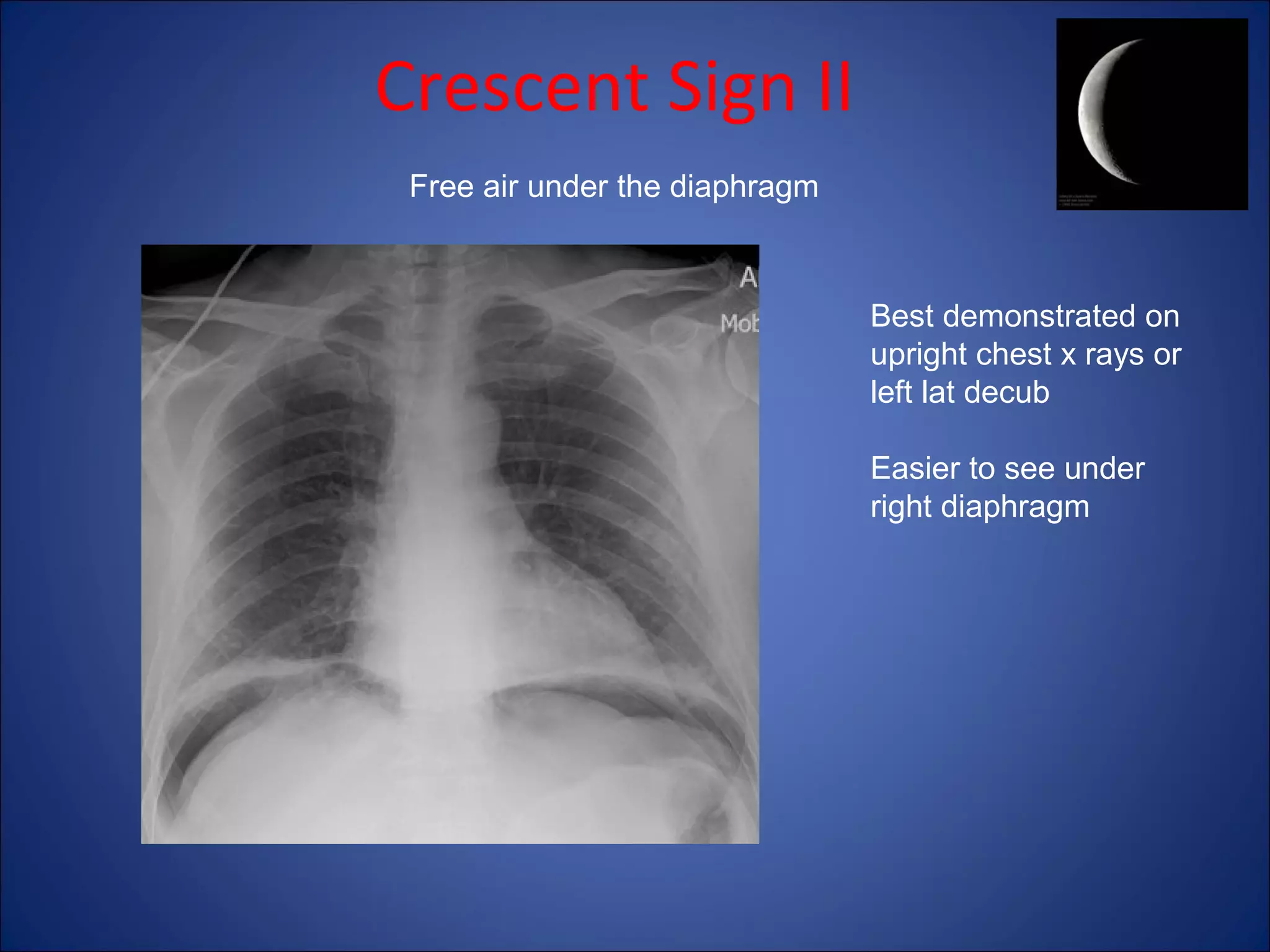
Crescent Sign II
Free air under the diaphragm
Best demonstrated on
upright chest x rays or
left lat decub
Easier to see under
right diaphragm
Chilaiditis sign
• May mimic air under
the diaphragm
• Look for haustral folds
• Get left lat decub to
confirm
In patients who have cirrhosis
or flattened diaphragms due to
lung hyperinflation, a void is
created within the upper
abdomen above the liver. This
space may be filled by bowel. If
this bowel is air filled then it
may mimic free gas.
Rigler’s Sign
Bowel wall visualised on both sides due to intra and extraluminal air
Usually large amounts of free air
May be confused with overlapping loops of bowel, confirm with upright view
False Rigler’s Sign
• The Rigler sign can sometimes be simulated by
contiguous loops of bowel, whereby
intraluminal air in one loop of bowel may
appear to outline the wall of an adjacent loop,
which results in a misdiagnosis of free air.
• Measure distance of interface if unsure
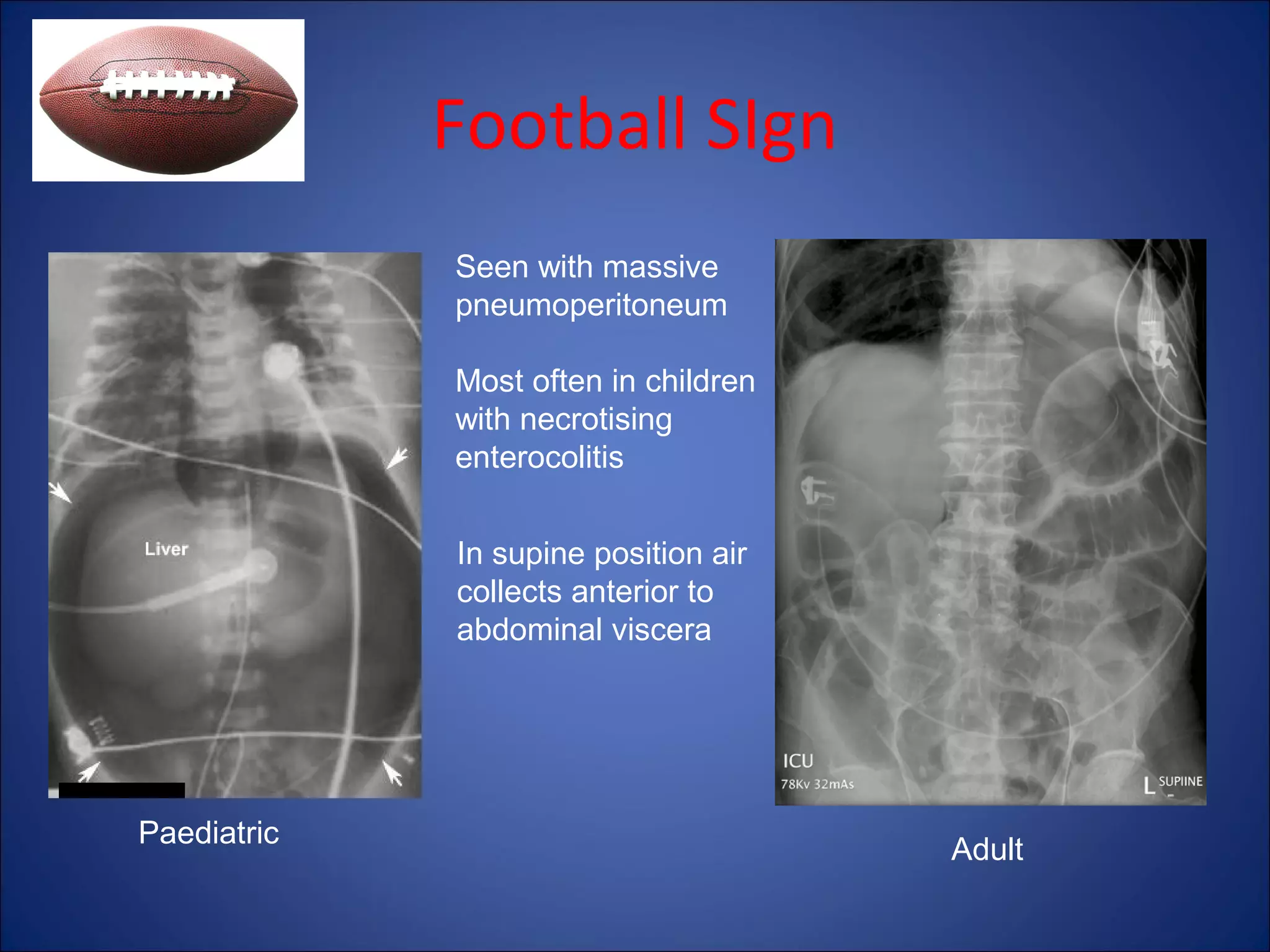
Football SIgn
Seen with massive
pneumoperitoneum
Most often in children
with necrotising
enterocolitis
Paediatric
Adult
In supine position air
collects anterior to
abdominal viscera
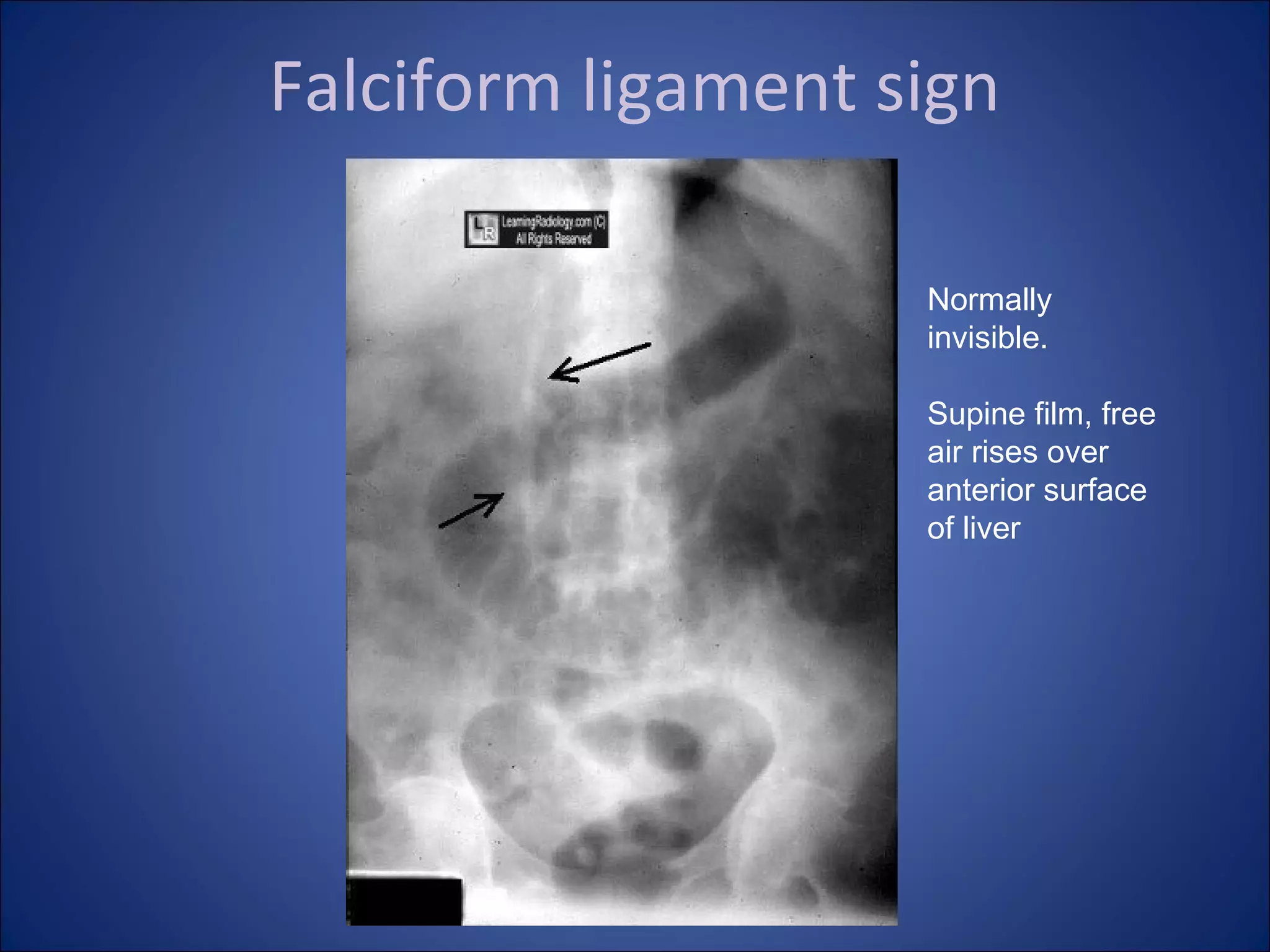
Falciform ligament sign
Normally
invisible.
Supine film, free
air rises over
anterior surface
of liver
Other patterns of air around liver
Doge’s Cap Sign
Inverted V sign
• On the supine radiograph, an inverted "V"
may be seen over the pelvis in a patient with
pneumoperitoneum.
• While in infants this is produced by the
umbilical arteries, in adults it appears to be
created by the inferior epigastric vessels
Continuous diaphragm sign
Sufficient
free air, left
and right
hemi-
diaphragms
appear
continous
Lesser sac Sign Cupola Sign
Lesser sac
sign
– (black
arrows)
The lesser sac is
positioned
posterior to the
stomach and is
usually a potential
space. There is
free connection
between the lesser
sac and the
greater sac
through the
foramen of
Winslow
Cupola
sign
– (white
arrows)
Air superior to
left lobe of
liver
Double Bubble Sign
Cupola Sign
The term cupola comes from a dome such as
this famous dome of the Duomo in Florence.
Air beneath the central tendon of the diaphragm
Triangle Sign
• The triangle sign
refers to small
triangles of free gas
that can typically be
positioned between
the large bowel and
the flank
Retroperitoneal Air
• Recognised by:
– Streaky, linear appearance outlining
retroperitoneal structures
– Mottled, blotchy appearance
– Relatively fixed position
• May outline:
– Psoas muscles
– Kidneys, ureters, bladder
– Aorta or IVC
– Subphrenic spaces
Causes of retroperitoneal air
• Bowel perforation (appendix, ileum, colon)
• Trauma (blunt or penetrating)
• Iatrogenic
• Foreign body
• Gas producing infection
Pneumoretroperitoneum
• This patient has free air in
the retroperitoneal space.
The air is seen surrounding
the lateral border of the right
kidney (white arrow). There
is other evidence of free gas
including Rigler's sign.
• If you are not confident that
the appearance is
pneumoretroperitoneum,
you can try an erect and
decubitus view to see if the
gas moves. If the gas is seen
to move, it's not in the
retroperitoneum.
Air in the bowel wall
• Signs
– Best seen in profile producing a linear lucency that
parallels the bowel
– Air en face has a mottled appearance resembling
gas mixed with faeculent material
Causes of air in bowel wall
• Primary Pneumatosis cystoides intestinalis (rare)
– usually affects left colon
– Produces cyst-like collections of air in the submucosa or serosa
• Secondary
– Diseases with bowel wall necrosis
– Obstructing lesions of the bowel that raise intraluminal pressure
• Complications
– Rupture into peritoneal cavity
– Dissection of air into portal venous system
Pneumatosis intestinalis
• Intramural air,
best
appreciated in
profile
Air in the biliary tree
• One or two tube-like branching lucencies in
the RUQ, conform to location of major bile
ducts
Causes
• “Normal” if Sphincter of Oddi incompetence
• Previous surgery including sphincterotomy or
transplantation of CBD
• Pathology (uncommon)
– Gallstone ileus: gallstone erodes through wall of
GB into the duodenum producing a fistula
between the bowel and the biliary system.
– Stone impacts in small bowel = mechanical SBO.
“ileus” misnomer
Biliary vs Portal Venous Air
• Portal venous air
usually associated
with bowel necrosis
• Air is peripheral
rather than central
• Numerous
branching
structures
Soft tissue masses
• Organomegaly
– Know normal landmarks
2 ways to identify soft tissue masses/organs:
– Direct visualisation of edges of structure
– Indirect by displacement of bowel
CT, US and MRI have essentially replaced conventional
radiography in the assessment of organomegaly and soft
tissue masses
Location Pattern
Abdominal Calcifications
First exclude artefact
Kim Kardashian’s butt – real or artefact?
Location
• Vascular
• Liver
• Gallbladder
• Spleen
• Pancreas
• Lymph nodes
• Adrenals
• Kidneys
• Ureters
• Bladder
• Prostate
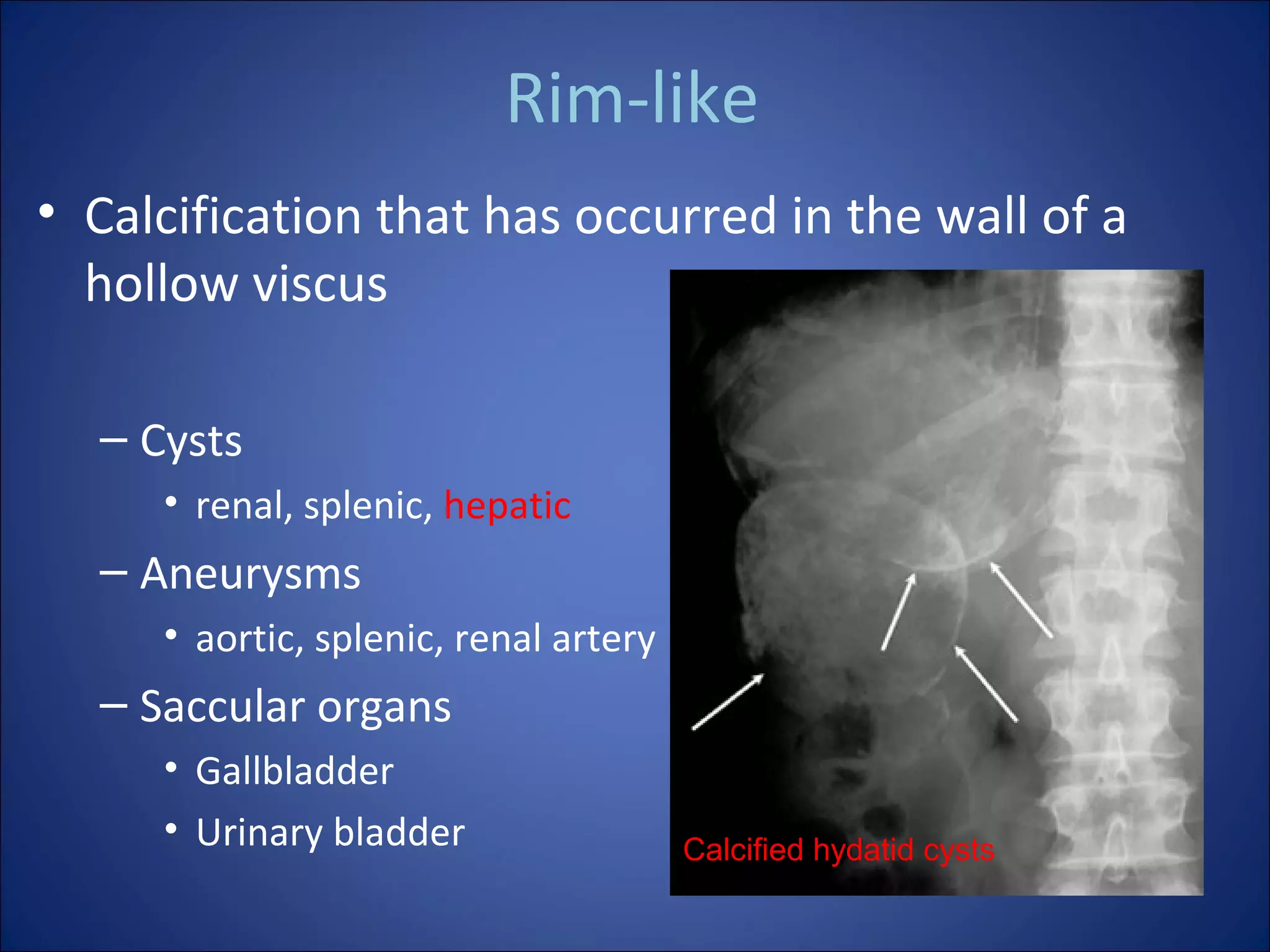
Rim-like
• Calcification that has occurred in the wall of a
hollow viscus
– Cysts
• renal, splenic, hepatic
– Aneurysms
• aortic, splenic, renal artery
– Saccular organs
• Gallbladder
• Urinary bladder Calcified hydatid cysts
Linear/Track
• Calcification in walls of tubular structures
– Arteries
– Fallopian tubes
– Vas deferens
– Ureter
Aortoiliac calcification
Chinese Dragon Sign
Calcified splenic artery
Calcified vas deferens
Floccular, Amorphous, Popcorn
• Formed in solid organ or tumour
– Pancreas (chronic pancreatitis)
– Leiomyomas of uterus
– Ovarian cystadenomas
– Lymph nodes
– Adenocarcinomas of stomach, ovary, colon
– Metastases
– Soft tissue (previous trauma, crystal deposition)
Calcified enteric
lymph nodes
Calcified fibroids
Calcified pancreas
Floccular
Lamellar or laminar
• Formed around a nidus inside hollow lumen
• Concentric layers due to prolonged movement
of stone inside hollow viscus
– Renal stones
– Gallstones
– Bladder stones
Bladder calculi
Lamellar
Renal calculi
Pelvicalyceal calcifications
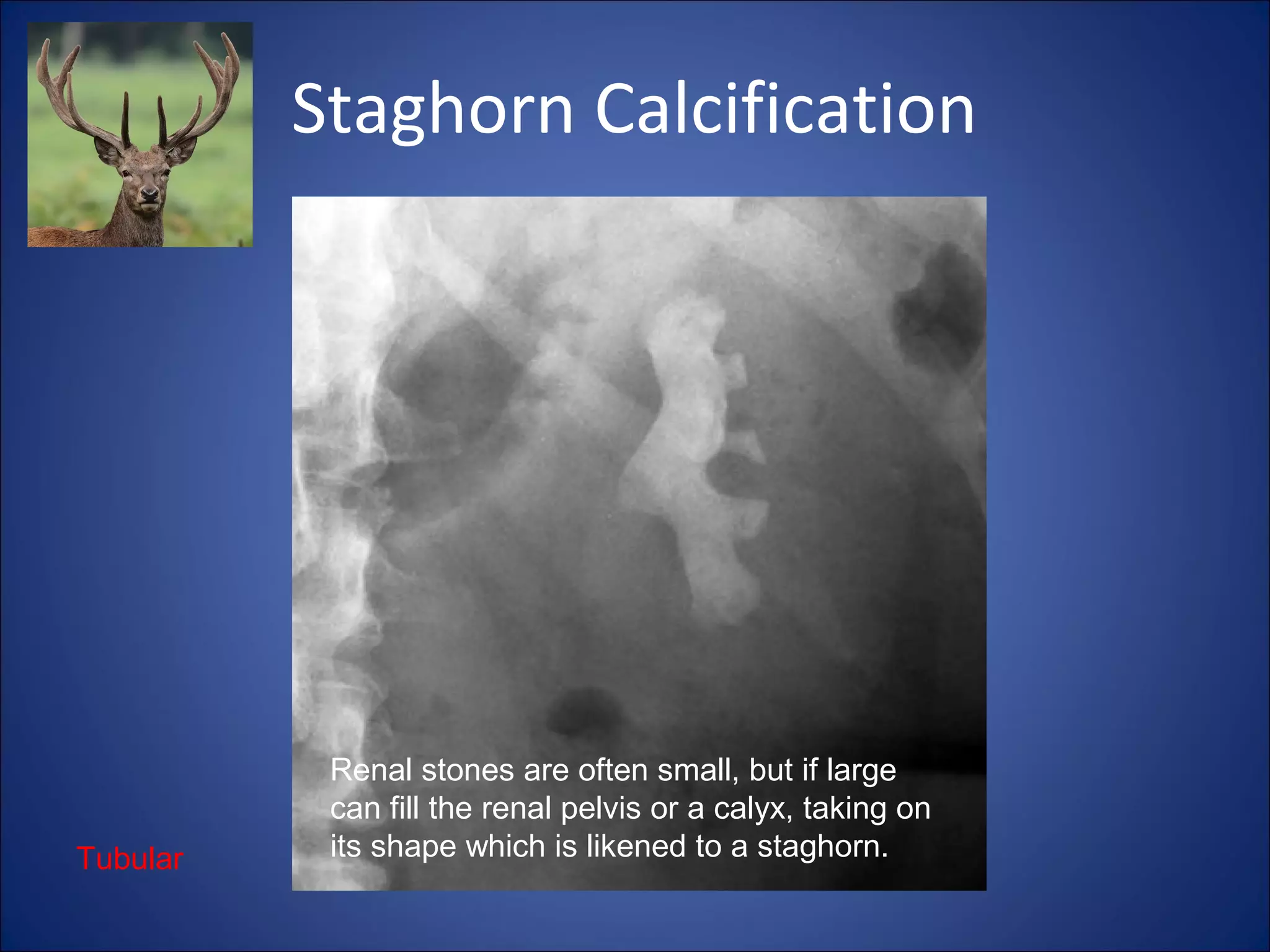
Staghorn Calcification
Renal stones are often small, but if large
can fill the renal pelvis or a calyx, taking on
its shape which is likened to a staghorn.Tubular
Nephrocalcinosis
Uncommonly the renal
parenchyma can become
calcified.
This is known as
nephrocalcinosis, a condition
found in disease entities such
as medullary sponge kidney
or hyperparathyroidism.
Renal calculi
Parenchymal calcification
Flocculent
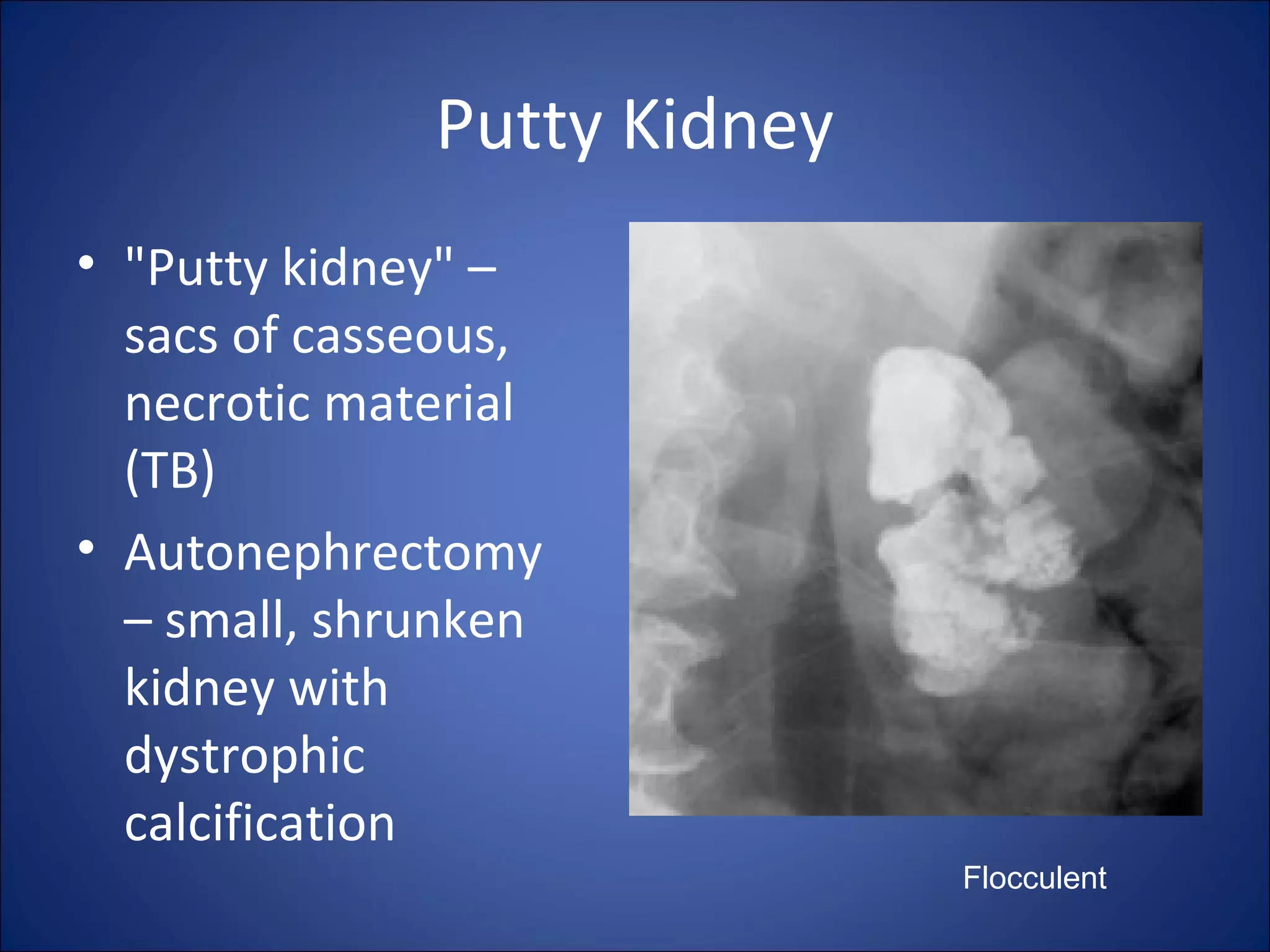
Putty Kidney
• "Putty kidney" –
sacs of casseous,
necrotic material
(TB)
• Autonephrectomy
– small, shrunken
kidney with
dystrophic
calcification
Flocculent
Calcified gallstones
Lamellar
Conclusion
• Approach to AXR should include gas pattern,
extraluminal air, soft tissue and calcifications
• Named radiological signs are a useful way of
remembering, identifying and reporting on
films
References
• Herring, W. Learning Radiology 2nd
Ed, 2012
• Begg, J. Abdominal X-rays Made Easy, 1999
• http://www.wikiradiography.com
• http://www.radiopaedia.org
• http://www.imagingconsult.com
• Roche, C et al. Radiographics: Selections from the buffet of food signs in Radiology. Nov 2002, RG,
22, 1369-1384
• Young, L. Radiology Cases in Paediatric Emergency Medicine. Vol 1 Ca 2. The Target, Crescent and
Absent Liver Edge Signs.
• Raymond, B et al. Radiographics: Classic signs in uroradiology. RSN 2004
• http://www.swansea-radiology.co.uk Radiology Teaching Site. Introduction to abdominal
radiography
• Mussin, R. Postgrad Med J 2011: 87:274-287. Gas patterns on plain abdominal radiographs
• http://www.radiologymasterclass.co.uk/tutorials/abdo/abdo_x-ray_abnormalities
• Mettler: Essentials of Radiology, 2nd
Ed, 2005
• http://www.learningradiology.com/radsigns
• Muharram Food signs in radiology. International Journal of Health Sciences Vol 1 No 1. Jan 2007.
THANK YOU

Abdomen xray signs

  • 1.
    Abdominal X-ray RadiologicalSigns Suzanne O’Hagan
  • 2.
    Lightbulb moment a momentof sudden inspiration, revelation, or recognition
  • 3.
    Approach to AXR •Bowel gas pattern • Extraluminal air • Soft tissue masses • Calcifications
  • 4.
    Normal AXR 11th rib Hepatic flexure Gasin stomach T12 Gas in caecum Iliac crest Femoral head SI joint Gas in sigmoid Transverse colon Splenic flexure Psoas margin Sacrum Left kidney Liver Bladder
  • 5.
    Gas pattern • Stomach –Almost always air in stomach • Small bowel – Usually small amount of air in 2 or 3 loops • Large bowel – Almost always air in rectum and sigmoid – Varying amount of gas in rest of large bowel What is normal?
  • 6.
    Normal fluid levels •Stomach – Always (upright, decub) • Small bowel – Two or three levels acceptable (upright, decub) • Large bowel – None normally (functions to remove fluid)
  • 7.
    Large vs smallbowel • Large bowel – Peripheral (except RUQ occupied by liver) – Haustral markings don’t extend from wall to wall • Small bowel – Central – Valvulae conniventes extend across lumen and are spaced closer together
  • 8.
    Radiographic principles Series offilms for acute abdomen • Obstruction series/ Acute abdominal series/ Complete abdominal series – Supine (almost always) – Upright or left decubitus (almost always) – Prone or lateral rectum (variable) – Chest, upright or supine (variable)
  • 9.
    VIEW LOOK FOR SUPINEABDOMEN Bowel gas pattern Calcifications Masses PRONE ABDOMEN Gas in rectosigmoid Gas in ascending and descending colon UPRIGHT ABDOMEN Free air, air-fluid levels UPRIGHT CHEST Free air, lung pathology secondary to intraabdominal process Acute abdominal series What to look for Substitutes: Prone Lateral rectum Upright Left lateral decub Upright chest Supine chest
  • 10.
    Obtaining views • Supine –Patient on back, x ray beam directed vertically downward, casette posterior, x-ray tube anterior (AP) • Prone – Patient on abdomen, x-ray beam directed vertically downward, cassette anterior, x-ray tube posterior (PA) • Upright – Patient stands or sits, x-ray beam directed horizontally, cassette posterior, x-ray tube anterior (AP) • Upright chest – Patient stands or sits, horizontal x-ray beam, cassette anterior, x-ray tube posterior (PA) 1900s X-Ray-based fluoroscopy machine in which radiation is shot directly through the patient and into the doctor’s face.
  • 11.
    Abnormal Gas Patterns •Functional ileus – One or more bowel loops become aperistaltic usually due to local irritation or inflammation • Localised “sentinel loops” (one or two loops) • Generalised (all loops of large and small bowel) • Mechanical obstruction – Intraluminal or extraluminal • Small bowel obstruction • Large bowel obstruction
  • 12.
    3, 6, 9RULE Maximum Normal Diameter of bowel Small bowel 3cm Large bowel 6cm Caecum 9cm
  • 13.
    Localised ileus Key features •One or two persistently dilated loops of small or large bowel (multiple views) • Often air-fluid levels in sentinel loops • Local irritation, ileus in same anatomical region as pathology • Gas in rectum or sigmoid • May resemble early SBO
  • 14.
    Causes of LocalisedIleus by location SITE OF DILATED LOOPS CAUSE Right upper quadrant Cholecystitis Left upper quadrant Pancreatitis Right lower quadrant Appendicitis Left lower quadrant Diverticulitis Mid-abdomen Ulcer or kidney/ureteric calculi
  • 15.
    Colon cut offsign Explanation: Inflammatory exudate in acute pancreatitis extends into the phrenicocolic ligament via lateral attachment of the transverse mesocolon Infiltration of the phrenicocolic ligament results in functional spasm and/or mechanical narrowing of the splenic flexure at the level where the colon returns to the retroperitoneum. Abrupt cutoff of colonic gas column at the splenic flexure (arrow). The colon is usually decompressed beyond this point.
  • 16.
    Generalised ileus Key features •Entire bowel aperistaltic/hypoperistaltic • Dilated small bowel and large bowel to rectum (with LBO no gas in rectum/sigmoid) • Long air-fluid levels CAUSE REMARK *Postoperative Usually abdominal surgery Electrolyte imbalance Diabetic ketoacidosis * almost always
  • 17.
    Generalised adynamic ileus Thelarge and small bowel are extensively airfilled but not dilated. The large and small bowel "look the same".
  • 18.
    Mechanical SBO • Dilatedsmall bowel • Fighting loops (visible loops, lying transversely, with air-fluid levels at different levels) • Little gas in colon, especially rectum
  • 19.
    SBO Erect SBOSupine Air fluid levels
  • 20.
    Causes of MechanicalSBO * May be visible on AXR Adhesions Hernia* Malignancy Gallstone ileus* Intussesception Inflammatory bowel disease
  • 21.
    Step ladder appearance •Loops arrange themselves from left upper to right lower quadrant in distal SBO
  • 22.
  • 23.
    String of pearlssign Considered diagnostic of obstruction (as opposed to ileus) and is caused by small bubbles of air trapped in the valvulae of the small bowel.
  • 24.
    Stretch/slit sign Slit ofair caught in a valvulae, characteristic of SBO
  • 25.
    Closed loop obstruction •Two points of same loop of bowel obstructed at a single location • Forms a C or a U shape – Term applies to small bowel, usually caused by adhesions – Large bowel, called a volvulus
  • 26.
    Crescent Sign Caused by: LUQSoft tissue mass OR Head of intussusception in distal transverse colon
  • 27.
  • 28.
    Mechanical LBO • Colondilates from point of obstruction backwards • Little/no air fluid levels (colon reabsorbs water) • Little or no air in rectum/sigmoid
  • 29.
    Large bowel obstruction Bowelloops tend not to overlap therefore possible to identify site of obstruction Little or no gas in small bowel if ileocaecal valve remains competent* * If incompetent, large bowel decompresses into small bowel, may look like SBO
  • 30.
    Causes of MechanicalLBO TUMOUR VOLVULUS HERNIA DIVERTICULITIS INTUSSUSCEPTION
  • 31.
    Note on volvulus •Sigmoid colon has its own mesentry therefore prone to twisting • Caecum usually retroperitoneal and not prone to twisting; 20% people have defect in peritoneum that covers the caecum resulting in a mobile caecum
  • 32.
    Volvulus A volvulus alwaysextends away from the area of twist. Sigmoid volvulus can only move upwards and usually goes to the right upper quadrant. Caecal volvulus can go almost anywhere.
  • 33.
    Coffee Bean Sign Sigmoidvolvulus Massively dilated sigmoid loop
  • 34.
    Hernia Lateral decubitus ofvalue The advantage is that there may be a greater chance of air entering the herniated bowel because it is the least dependent part of the bowel in the supine position.
  • 35.
    Apple core sign •Radiologic manifestation of a focal stricture of the bowel usually at contrast material enema examination. The stricture demonstrates shouldered margins and resembles the core of an apple that has been partially eaten. The most common cause is an annular carcinoma of the colon.
  • 36.
    Thumbprinting The distance between loopsof bowel is increased due to thickening of the bowel wall. The haustral folds are very thick, leading to a sign known as 'thumbprinting.'
  • 37.
    Lead pipe colon • Shorteningof colon secondary to fibrosis • Loss of haustration • Ulcerative colitis
  • 38.
    Extraluminal air • TYPES –Pneumoperitoneum/free air/intraperitoneal air – Retroperintoneal air – Air in the bowel wall (pneumatosis intestinalis) – Air in the biliary system (pneumobilia)
  • 39.
    Upright film best •The patient should be positioned sitting upright for 10-20 minutes prior to acquiring the erect chest X-ray image. • This allows any free intra-abdominal gas to rise up, forming a crescent beneath the diaphragm. It is said that as little as 1ml of gas can be detected in this way.
  • 40.
    Free Air Causes • Ruptureof a hollow viscus – Perforated peptic ulcer – Trauma – Perforated diverticulitis (usually seals off) – Perforated carcinoma • Post-op 5-7 days normal, should get less with successive studies *NOT ruptured appendix (seals off)
  • 41.
    Signs of freeair • Crescent sign • Chilaiditis sign • Riglers (and False Rigler’s) • Football sign • Falciform ligament sign • Triangle sign • Cupola sign • Lesser sac sign
  • 42.
    Crescent Sign II Freeair under the diaphragm Best demonstrated on upright chest x rays or left lat decub Easier to see under right diaphragm
  • 43.
    Chilaiditis sign • Maymimic air under the diaphragm • Look for haustral folds • Get left lat decub to confirm In patients who have cirrhosis or flattened diaphragms due to lung hyperinflation, a void is created within the upper abdomen above the liver. This space may be filled by bowel. If this bowel is air filled then it may mimic free gas.
  • 44.
    Rigler’s Sign Bowel wallvisualised on both sides due to intra and extraluminal air Usually large amounts of free air May be confused with overlapping loops of bowel, confirm with upright view
  • 45.
    False Rigler’s Sign •The Rigler sign can sometimes be simulated by contiguous loops of bowel, whereby intraluminal air in one loop of bowel may appear to outline the wall of an adjacent loop, which results in a misdiagnosis of free air. • Measure distance of interface if unsure
  • 46.
    Football SIgn Seen withmassive pneumoperitoneum Most often in children with necrotising enterocolitis Paediatric Adult In supine position air collects anterior to abdominal viscera
  • 47.
    Falciform ligament sign Normally invisible. Supinefilm, free air rises over anterior surface of liver
  • 48.
    Other patterns ofair around liver Doge’s Cap Sign
  • 49.
    Inverted V sign •On the supine radiograph, an inverted "V" may be seen over the pelvis in a patient with pneumoperitoneum. • While in infants this is produced by the umbilical arteries, in adults it appears to be created by the inferior epigastric vessels
  • 50.
    Continuous diaphragm sign Sufficient freeair, left and right hemi- diaphragms appear continous
  • 51.
    Lesser sac SignCupola Sign Lesser sac sign – (black arrows) The lesser sac is positioned posterior to the stomach and is usually a potential space. There is free connection between the lesser sac and the greater sac through the foramen of Winslow Cupola sign – (white arrows) Air superior to left lobe of liver Double Bubble Sign
  • 52.
    Cupola Sign The termcupola comes from a dome such as this famous dome of the Duomo in Florence. Air beneath the central tendon of the diaphragm
  • 53.
    Triangle Sign • Thetriangle sign refers to small triangles of free gas that can typically be positioned between the large bowel and the flank
  • 54.
    Retroperitoneal Air • Recognisedby: – Streaky, linear appearance outlining retroperitoneal structures – Mottled, blotchy appearance – Relatively fixed position • May outline: – Psoas muscles – Kidneys, ureters, bladder – Aorta or IVC – Subphrenic spaces
  • 55.
    Causes of retroperitonealair • Bowel perforation (appendix, ileum, colon) • Trauma (blunt or penetrating) • Iatrogenic • Foreign body • Gas producing infection
  • 56.
    Pneumoretroperitoneum • This patienthas free air in the retroperitoneal space. The air is seen surrounding the lateral border of the right kidney (white arrow). There is other evidence of free gas including Rigler's sign. • If you are not confident that the appearance is pneumoretroperitoneum, you can try an erect and decubitus view to see if the gas moves. If the gas is seen to move, it's not in the retroperitoneum.
  • 57.
    Air in thebowel wall • Signs – Best seen in profile producing a linear lucency that parallels the bowel – Air en face has a mottled appearance resembling gas mixed with faeculent material
  • 58.
    Causes of airin bowel wall • Primary Pneumatosis cystoides intestinalis (rare) – usually affects left colon – Produces cyst-like collections of air in the submucosa or serosa • Secondary – Diseases with bowel wall necrosis – Obstructing lesions of the bowel that raise intraluminal pressure • Complications – Rupture into peritoneal cavity – Dissection of air into portal venous system
  • 59.
    Pneumatosis intestinalis • Intramuralair, best appreciated in profile
  • 60.
    Air in thebiliary tree • One or two tube-like branching lucencies in the RUQ, conform to location of major bile ducts
  • 61.
    Causes • “Normal” ifSphincter of Oddi incompetence • Previous surgery including sphincterotomy or transplantation of CBD • Pathology (uncommon) – Gallstone ileus: gallstone erodes through wall of GB into the duodenum producing a fistula between the bowel and the biliary system. – Stone impacts in small bowel = mechanical SBO. “ileus” misnomer
  • 62.
    Biliary vs PortalVenous Air • Portal venous air usually associated with bowel necrosis • Air is peripheral rather than central • Numerous branching structures
  • 63.
    Soft tissue masses •Organomegaly – Know normal landmarks 2 ways to identify soft tissue masses/organs: – Direct visualisation of edges of structure – Indirect by displacement of bowel CT, US and MRI have essentially replaced conventional radiography in the assessment of organomegaly and soft tissue masses
  • 64.
  • 65.
    First exclude artefact KimKardashian’s butt – real or artefact?
  • 66.
    Location • Vascular • Liver •Gallbladder • Spleen • Pancreas • Lymph nodes • Adrenals • Kidneys • Ureters • Bladder • Prostate
  • 67.
    Rim-like • Calcification thathas occurred in the wall of a hollow viscus – Cysts • renal, splenic, hepatic – Aneurysms • aortic, splenic, renal artery – Saccular organs • Gallbladder • Urinary bladder Calcified hydatid cysts
  • 68.
    Linear/Track • Calcification inwalls of tubular structures – Arteries – Fallopian tubes – Vas deferens – Ureter Aortoiliac calcification
  • 69.
  • 70.
  • 71.
    Floccular, Amorphous, Popcorn •Formed in solid organ or tumour – Pancreas (chronic pancreatitis) – Leiomyomas of uterus – Ovarian cystadenomas – Lymph nodes – Adenocarcinomas of stomach, ovary, colon – Metastases – Soft tissue (previous trauma, crystal deposition)
  • 72.
    Calcified enteric lymph nodes Calcifiedfibroids Calcified pancreas Floccular
  • 73.
    Lamellar or laminar •Formed around a nidus inside hollow lumen • Concentric layers due to prolonged movement of stone inside hollow viscus – Renal stones – Gallstones – Bladder stones
  • 74.
  • 75.
  • 76.
    Staghorn Calcification Renal stonesare often small, but if large can fill the renal pelvis or a calyx, taking on its shape which is likened to a staghorn.Tubular
  • 77.
    Nephrocalcinosis Uncommonly the renal parenchymacan become calcified. This is known as nephrocalcinosis, a condition found in disease entities such as medullary sponge kidney or hyperparathyroidism. Renal calculi Parenchymal calcification Flocculent
  • 78.
    Putty Kidney • "Puttykidney" – sacs of casseous, necrotic material (TB) • Autonephrectomy – small, shrunken kidney with dystrophic calcification Flocculent
  • 79.
  • 80.
    Conclusion • Approach toAXR should include gas pattern, extraluminal air, soft tissue and calcifications • Named radiological signs are a useful way of remembering, identifying and reporting on films
  • 81.
    References • Herring, W.Learning Radiology 2nd Ed, 2012 • Begg, J. Abdominal X-rays Made Easy, 1999 • http://www.wikiradiography.com • http://www.radiopaedia.org • http://www.imagingconsult.com • Roche, C et al. Radiographics: Selections from the buffet of food signs in Radiology. Nov 2002, RG, 22, 1369-1384 • Young, L. Radiology Cases in Paediatric Emergency Medicine. Vol 1 Ca 2. The Target, Crescent and Absent Liver Edge Signs. • Raymond, B et al. Radiographics: Classic signs in uroradiology. RSN 2004 • http://www.swansea-radiology.co.uk Radiology Teaching Site. Introduction to abdominal radiography • Mussin, R. Postgrad Med J 2011: 87:274-287. Gas patterns on plain abdominal radiographs • http://www.radiologymasterclass.co.uk/tutorials/abdo/abdo_x-ray_abnormalities • Mettler: Essentials of Radiology, 2nd Ed, 2005 • http://www.learningradiology.com/radsigns • Muharram Food signs in radiology. International Journal of Health Sciences Vol 1 No 1. Jan 2007.
  • 82.

Editor's Notes

  • #10 Lung pathology – pacreatitis assoc with left pleural effusion, ovarian tumour assoc with right or bilateral effusion, subphrenic abscess assoc with right pleural effusion