



Full Annealing
ASWANTH SELVA PRAGATHEESWARAN
Firstly, What’s Annealing?
 The term annealing refers to a heat treatment in which a material is
exposed to an elevated temperature for an extended time period and then
slowly cooled.
Why?
Annealing is carried out to
 Relieve stresses
 Increase softness, ductility,and toughness
 Produce a specific microstructure.
How’s it done?
1. Heating to the desired temperature,
2. Holding or ‘‘soaking’’ at that temperature
3. Cooling, usually to room temperature
Any annealing process consists of three stages:
Time and temperature are important parameters in these procedures.
Types of annealing
 There are many types of annealing and full annealing is one of it.
When do we use Full Annealing?
 Full Annealing process is often utilized in low and medium carbon steels
that will be machined or will experience extensive plastic deformation
during a forming operation.
The Full-Annealing procedure
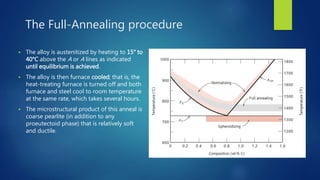
 The alloy is austenitized by heating to 15° to
40°C above the A or A lines as indicated
until equilibrium is achieved.
 The alloy is then furnace cooled; that is, the
heat-treating furnace is turned off and both
furnace and steel cool to room temperature
at the same rate, which takes several hours.
 The microstructural product of this anneal is
coarse pearlite (in addition to any
proeutectoid phase) that is relatively soft
and ductile.
Full – annealing cooling procedure
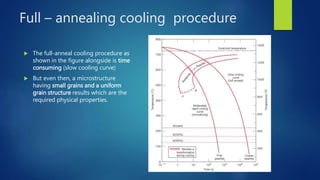
 The full-anneal cooling procedure as
shown in the figure alongside is time
consuming (slow cooling curve)
 But even then, a microstructure
having small grains and a uniform
grain structure results which are the
required physical properties.
Thank You

Full annealing

  • 1.
  • 2.
    Firstly, What’s Annealing? The term annealing refers to a heat treatment in which a material is exposed to an elevated temperature for an extended time period and then slowly cooled.
  • 3.
    Why? Annealing is carriedout to  Relieve stresses  Increase softness, ductility,and toughness  Produce a specific microstructure.
  • 4.
    How’s it done? 1.Heating to the desired temperature, 2. Holding or ‘‘soaking’’ at that temperature 3. Cooling, usually to room temperature Any annealing process consists of three stages: Time and temperature are important parameters in these procedures.
  • 5.
    Types of annealing There are many types of annealing and full annealing is one of it.
  • 6.
    When do weuse Full Annealing?  Full Annealing process is often utilized in low and medium carbon steels that will be machined or will experience extensive plastic deformation during a forming operation.
  • 7.
    The Full-Annealing procedure The alloy is austenitized by heating to 15° to 40°C above the A or A lines as indicated until equilibrium is achieved.  The alloy is then furnace cooled; that is, the heat-treating furnace is turned off and both furnace and steel cool to room temperature at the same rate, which takes several hours.  The microstructural product of this anneal is coarse pearlite (in addition to any proeutectoid phase) that is relatively soft and ductile.
  • 8.
    Full – annealingcooling procedure  The full-anneal cooling procedure as shown in the figure alongside is time consuming (slow cooling curve)  But even then, a microstructure having small grains and a uniform grain structure results which are the required physical properties.
  • 9.

Editor's Notes

  • #7 Full Anneal A heat treatment known as full annealing is often utilized in low- and mediumcarbon steels that will be machined or will experience extensive plastic deformation during a forming operation. The alloy is austenitized by heating to 15 to 40C (30 to 70F) above the A 3 or A lines as indicated in Figure 14.4 until equilibrium is achieved. The alloy is then furnace cooled; that is, the heat-treating furnace is turned off and both furnace and steel cool to room temperature at the same rate, which takes several hours. The microstructural product of this anneal is coarse pearlite (in addition to any proeutectoid phase) that is relatively soft and ductile. The full-anneal cooling procedure (also shown in Figure 11.18) is time consuming; however, a microstructure having small grains and a uniform grain structure results. 1