Presented by :
5G CLASS OF ENGLISH EDUCATION DEPARTMENT
IAIN SURAKARTA
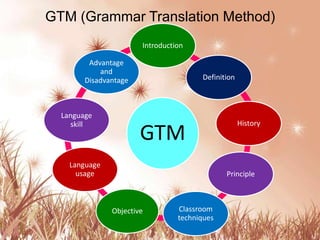
GTM (Grammar Translation Method)
GTM
Introduction
Definition
History
Principle
Classroom
techniques
Objective
Language
usage
Language
skill
Advantage
and
Disadvantage
Random House Unabridged Dictionary
Richard and Rogers, 2002 (as cited in Barb, 2010),
GTM means a traditional technique of foreign-language teaching
based on explicit instruction in the grammatical analysis of the target
language and translation of sentences from the native language into
the target language and vice versa.
GTM is a way of studying a language that approaches the language
first thought detailed analysis of its grammar rules, followed by the
application of this knowledge through the task of translating
sentences and text into and out of the target language.
The Grammar-Translation Method is a
method of foreign or second language
teaching which uses translation and
grammar study as the main teaching and
learning activities.
GTM is the oldest method of teaching. The
grammar translation method is a foreign
language teaching method derived from the
classical (sometimes called traditional)
method of teaching Greek and Latin. This
method has been used from the classical
times to translate classical languages, Latin
and Greek, it has been called Classical
method.
1. The goal of foreign language study is to learn a language
in order to read its literature.
2. Vocabulary and grammar are emphasized.
3. Vocabulary selection is based solely on the reading text
used, and words are taught throw bilingual word lists,
dictionary study, and memorization.
4. The sentence is the basic unit of teaching and language
practice.
5. Accuracy is emphasized.
6. Grammar is taught deductively; that is, students are given
grammar rules and example and are told to memorize
them, and then asked to apply the rules to other
examples.
7. The student’s native language is the medium of
instruction.
1. The roles of the teacher and the student.
2. Translation of literary passage as the main
classroom activity.
3. Reading comprehension activity.
4. Vocabulary activity.
5. Grammar activity.
1. To be able to read literature written
in the target language
2. To be able to translate from one
language to another
3. To develop reading and writing skill
L1 USAGE: Classes are conducted in the
native language. Classroom instructions
are given in L1.
L2 USAGE: The foreign language use is
limited. Classroom will use foreign
language for L2.
1. The first language is maintained as the reference system in the
learning of the second language.
2. Comparison between two languages helps students to have a
better understanding of the sentence meaning.
3. Systematic study of grammatical rules plays an important role in
fostering students’ ability of reading and grammar.
4. The focus on understanding literary texts
5. Makes few demands on teachers although it often creates
frustration for students.
6. Translation is the easiest way of explaining meanings or words
and phrases from one language into another.
7. Teacher and students are easy to communicate/It does not need
native language
1. Overemphasis on translation can never emancipate the
learners from dependence on the first language.
2. The Grammar-Translation puts too much emphasis on
reading and writing and neglects listening and speaking.
3. In the Grammar-Translation Method, the texts are mostly
taken form literary works. The language learned often
doesn’t meet the practical needs of the learners.
4. Memorizing grammar rules and bilingual word lists does not
motivate students to actively communicate in the target
language.
5. No scope for effective communication and very tedious for
Learner.
6. Direct translation is widely regarded as an inefficient way of
becoming fluent in any language
Grammar translation method

Grammar translation method

  • 1.
    Presented by : 5GCLASS OF ENGLISH EDUCATION DEPARTMENT IAIN SURAKARTA
  • 2.
    GTM (Grammar TranslationMethod) GTM Introduction Definition History Principle Classroom techniques Objective Language usage Language skill Advantage and Disadvantage
  • 3.
    Random House UnabridgedDictionary Richard and Rogers, 2002 (as cited in Barb, 2010), GTM means a traditional technique of foreign-language teaching based on explicit instruction in the grammatical analysis of the target language and translation of sentences from the native language into the target language and vice versa. GTM is a way of studying a language that approaches the language first thought detailed analysis of its grammar rules, followed by the application of this knowledge through the task of translating sentences and text into and out of the target language.
  • 4.
    The Grammar-Translation Methodis a method of foreign or second language teaching which uses translation and grammar study as the main teaching and learning activities.
  • 5.
    GTM is theoldest method of teaching. The grammar translation method is a foreign language teaching method derived from the classical (sometimes called traditional) method of teaching Greek and Latin. This method has been used from the classical times to translate classical languages, Latin and Greek, it has been called Classical method.
  • 6.
    1. The goalof foreign language study is to learn a language in order to read its literature. 2. Vocabulary and grammar are emphasized. 3. Vocabulary selection is based solely on the reading text used, and words are taught throw bilingual word lists, dictionary study, and memorization. 4. The sentence is the basic unit of teaching and language practice. 5. Accuracy is emphasized. 6. Grammar is taught deductively; that is, students are given grammar rules and example and are told to memorize them, and then asked to apply the rules to other examples. 7. The student’s native language is the medium of instruction.
  • 7.
    1. The rolesof the teacher and the student. 2. Translation of literary passage as the main classroom activity. 3. Reading comprehension activity. 4. Vocabulary activity. 5. Grammar activity.
  • 8.
    1. To beable to read literature written in the target language 2. To be able to translate from one language to another 3. To develop reading and writing skill
  • 9.
    L1 USAGE: Classesare conducted in the native language. Classroom instructions are given in L1. L2 USAGE: The foreign language use is limited. Classroom will use foreign language for L2.
  • 11.
    1. The firstlanguage is maintained as the reference system in the learning of the second language. 2. Comparison between two languages helps students to have a better understanding of the sentence meaning. 3. Systematic study of grammatical rules plays an important role in fostering students’ ability of reading and grammar. 4. The focus on understanding literary texts 5. Makes few demands on teachers although it often creates frustration for students. 6. Translation is the easiest way of explaining meanings or words and phrases from one language into another. 7. Teacher and students are easy to communicate/It does not need native language
  • 12.
    1. Overemphasis ontranslation can never emancipate the learners from dependence on the first language. 2. The Grammar-Translation puts too much emphasis on reading and writing and neglects listening and speaking. 3. In the Grammar-Translation Method, the texts are mostly taken form literary works. The language learned often doesn’t meet the practical needs of the learners. 4. Memorizing grammar rules and bilingual word lists does not motivate students to actively communicate in the target language. 5. No scope for effective communication and very tedious for Learner. 6. Direct translation is widely regarded as an inefficient way of becoming fluent in any language