Ashok Pandey
Research Associate
11/4/2017 1
Developing the Research Team,
Team Management and Task
Distribution, Work Plan and
Budgeting
NHRC 2017
11/4/2017 2NHRC 2017
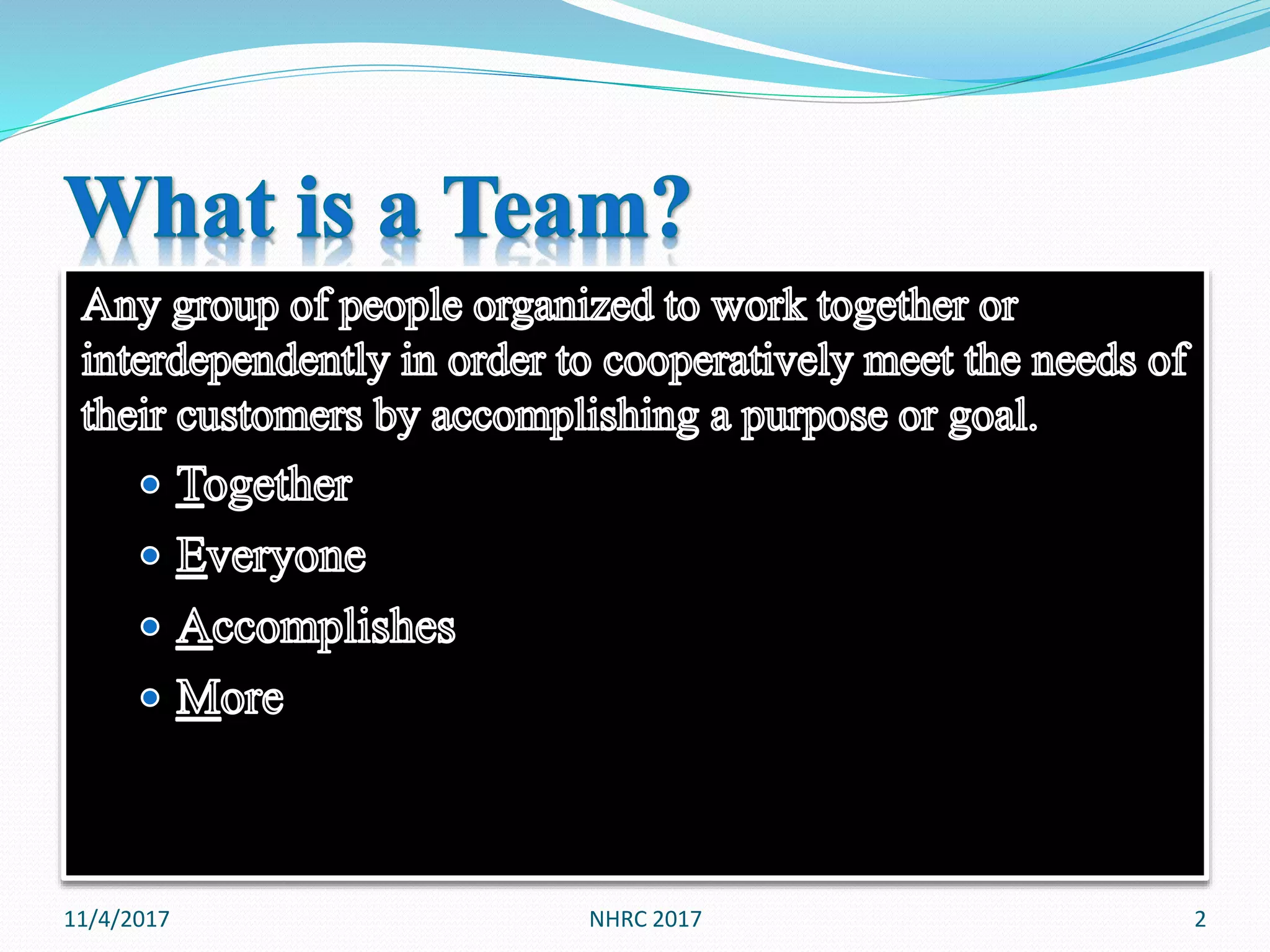
Research team
One department or institution might be described elsewhere
as a
Research group
Research centre
Research unit or
Research institute
Regardless of the terminology used, the key characteristic of
a research team is that it comprises a group of people
working together in a committed way towards a common
research goal.
11/4/2017 NHRC 2017 3
Human Resource
Nothing moves unless a piece of paper moves and
no paper can move, unless a person moves
11/4/2017 NHRC 2017 4
Research human resource
Technical team
1) Principle Investigator
2) Research officer
3) Research Associate
4) Research Scientist
5) Data analyst
6) Survey field coordinator
7) Field Research Supervisor
8) Field Research Assistant
9) Counselor
10) Clinician
11) Lab technician, etc
Admin/finance staff
1. Administrative officer
2. Accountant
3. Admin/ Typist
4. Driver
5. Office Assistant
11/4/2017 NHRC 2017 5
Hierarchy
Chain of command
Full-time: Regular staff employees whose standard work
schedule is 37.5 hours or more per week
Part-time status: Regular staff employees whose standard
work schedule is at least 20 standard hours per week but
less than 37.5 standard hours per week
Part-time to full-time status may result in changes in
benefits eligibility, coverage, and premium costs.
Employees who work an average of 30 hours or more per
week, as determined in accordance with the Employer
Shared Responsibility provisions of the Affordable
Care Act, are eligible for full-time health premiums.
11/4/2017 NHRC 2017 6
The Results of Good Team Work
11/4/2017 7NHRC 2017
The Results of Bad Team Work
11/4/2017 8NHRC 2017
11/4/2017 NHRC 2017 9
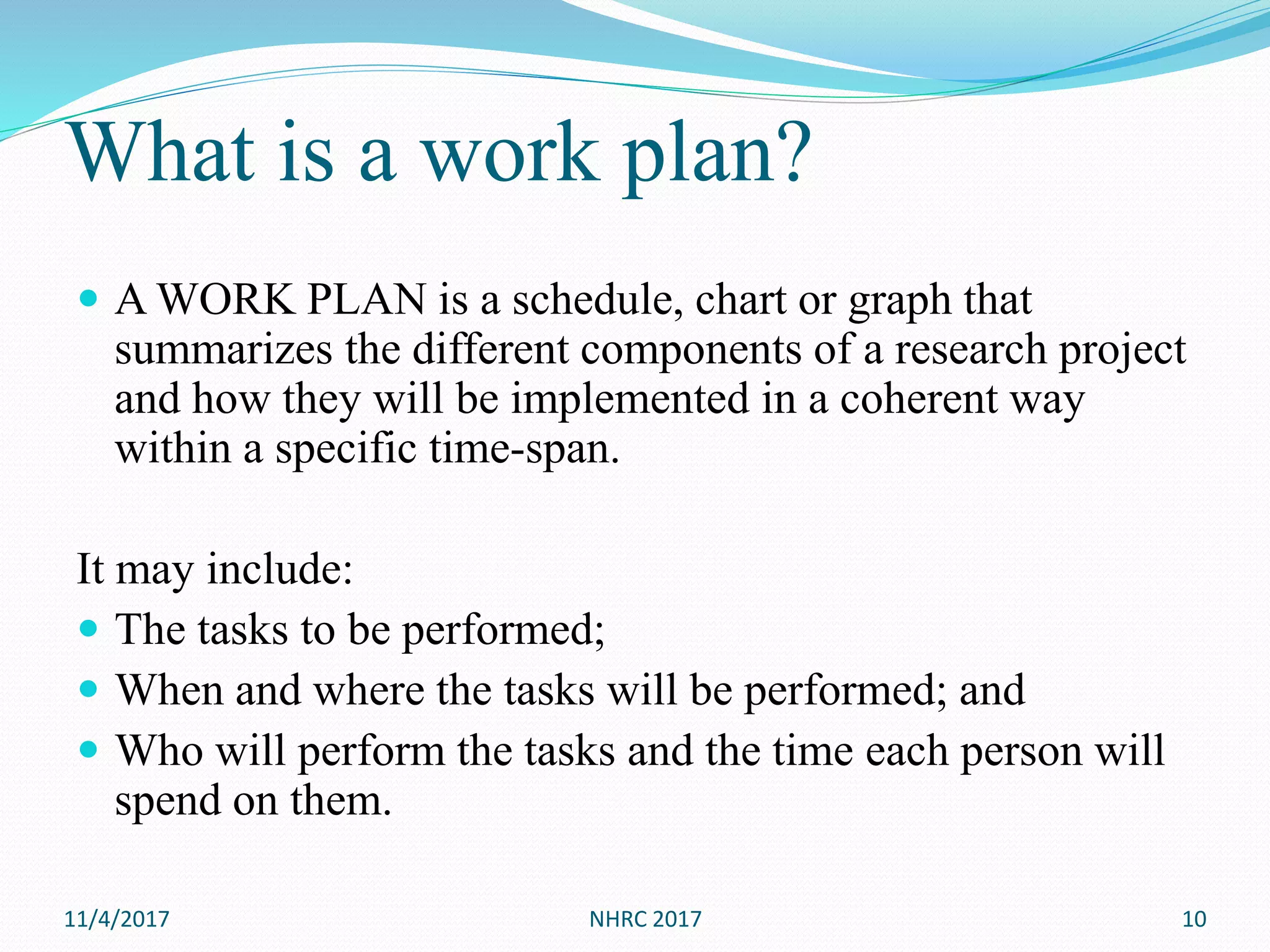
What is a work plan?
 A WORK PLAN is a schedule, chart or graph that
summarizes the different components of a research project
and how they will be implemented in a coherent way
within a specific time-span.
It may include:
 The tasks to be performed;
 When and where the tasks will be performed; and
 Who will perform the tasks and the time each person will
spend on them.
11/4/2017 NHRC 2017 10
Various work scheduling and planning
techniques
1. The work schedule
2. The GANTT Chart
11/4/2017 NHRC 2017 11
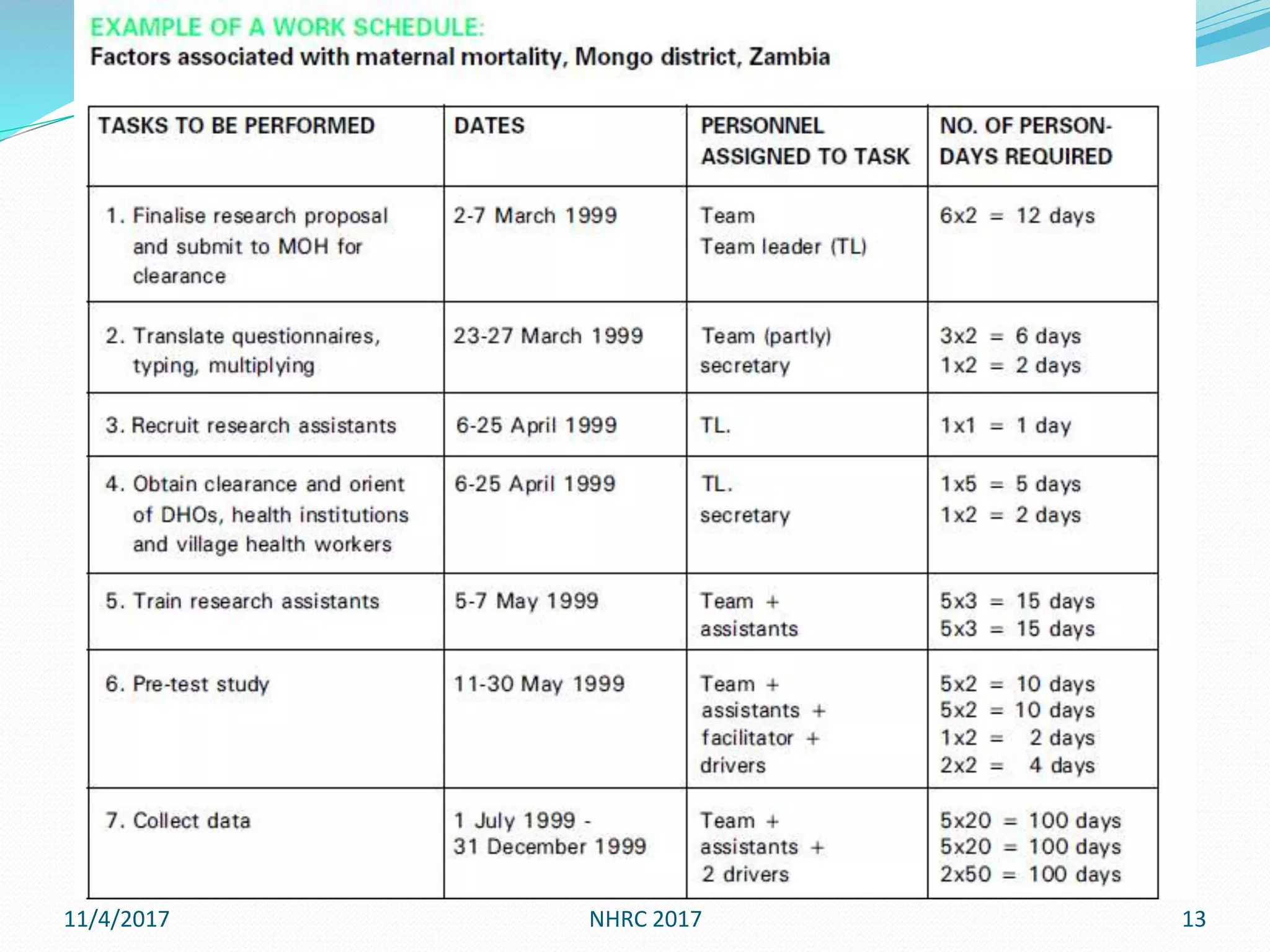
The work schedule
A work schedule is a table that summarizes the task to be
performed in a research project, the duration of each
activity and who is responsible for the different tasks.
1. The task to be performed
2. The date each task should be begin and be completed
3. Task assigned
4. Person days
11/4/2017 NHRC 2017 12
11/4/2017 NHRC 2017 13
11/4/2017 14NHRC 2017
Work Breakdown Structure
Hierarchical decomposition of a project into manageable
chunks. It is graphical and shows all the project parts in
an organized chart.
A good WBS looks like an Organization chart or Tree
diagram, with all parts connected
11/4/2017 NHRC 2017 15
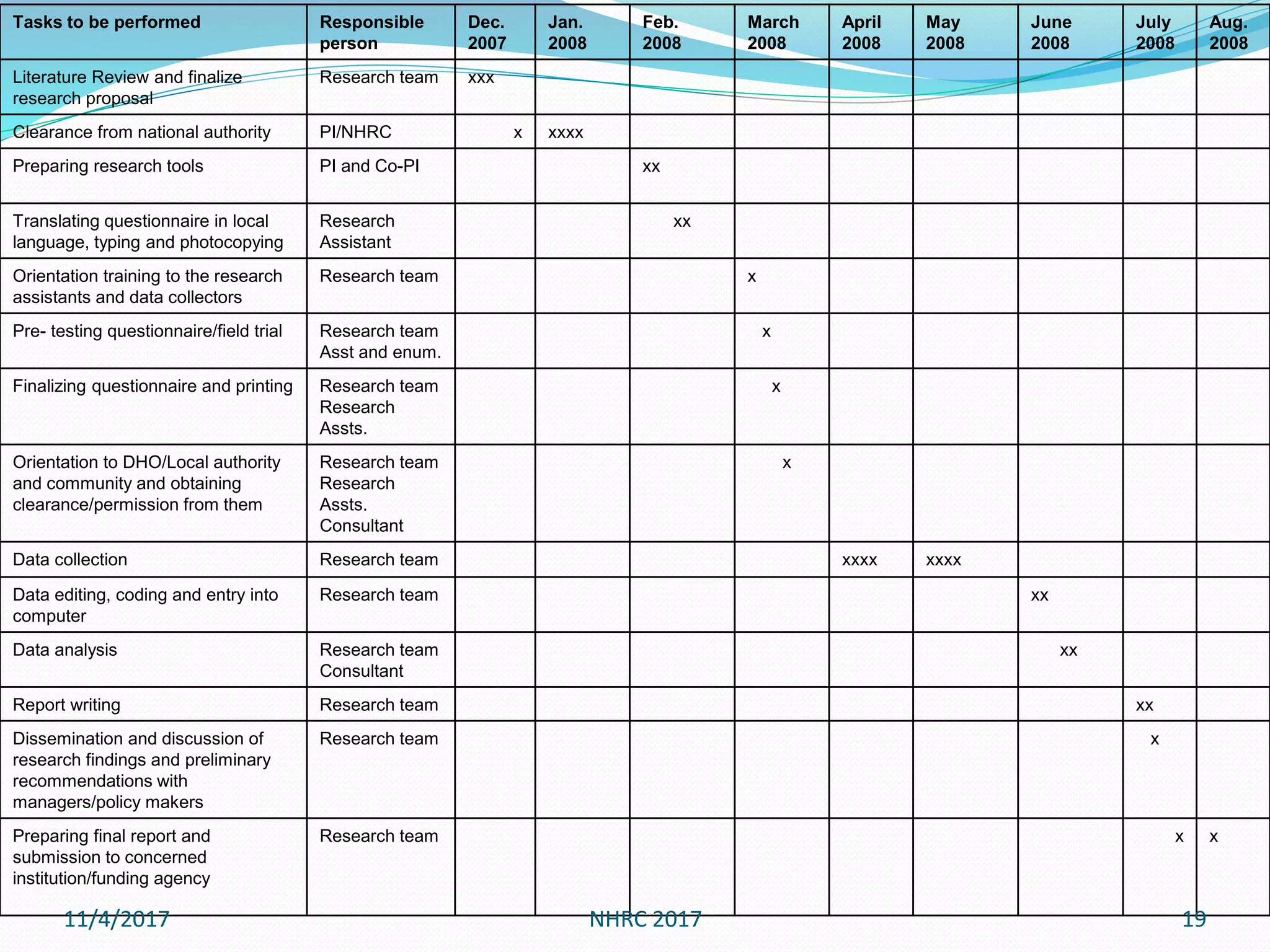
The GANTT Chart by Henry Gantt in the 1910s
A GANTT chart is a planning tool that depicts graphically the
order in which various tasks must be completed and the duration
of each activity.
The GANTT chart shown
 the tasks to be performed;
 who is responsible for each task; and
 the time each task is expected to take.
The length of each task is shown by a bar that extends over the
number of days, weeks or months the task is expected to take.
11/4/2017 NHRC 2017 16
Why Gantt Chart
For better Communicate
 Wide selection of shapes so your timeline will be unique and
impactful.
 Fit more tasks: Adjust the task size and the spacing between
tasks so you can fit the extra detail your timeline needs.
 Hours and Minutes: Creates timelines, Gantt charts and daily
schedules scaled down to hours or minutes.
 Percentage complete & duration: Show critical details clients
and executives are expecting, such as percent complete and
task duration.
 Customize fonts & colors: Plus Edition lets you format text
with font, size, color and other styles so you can create the
perfect timeline.
11/4/2017 NHRC 2017 17
11/4/2017 NHRC 2017 18
Tasks to be performed Responsible
person
Dec.
2007
Jan.
2008
Feb.
2008
March
2008
April
2008
May
2008
June
2008
July
2008
Aug.
2008
Literature Review and finalize
research proposal
Research team xxx
Clearance from national authority PI/NHRC x xxxx
Preparing research tools PI and Co-PI xx
Translating questionnaire in local
language, typing and photocopying
Research
Assistant
xx
Orientation training to the research
assistants and data collectors
Research team x
Pre- testing questionnaire/field trial Research team
Asst and enum.
x
Finalizing questionnaire and printing Research team
Research
Assts.
x
Orientation to DHO/Local authority
and community and obtaining
clearance/permission from them
Research team
Research
Assts.
Consultant
x
Data collection Research team xxxx xxxx
Data editing, coding and entry into
computer
Research team xx
Data analysis Research team
Consultant
xx
Report writing Research team xx
Dissemination and discussion of
research findings and preliminary
recommendations with
managers/policy makers
Research team x
Preparing final report and
submission to concerned
institution/funding agency
Research team x x
11/4/2017 19NHRC 2017
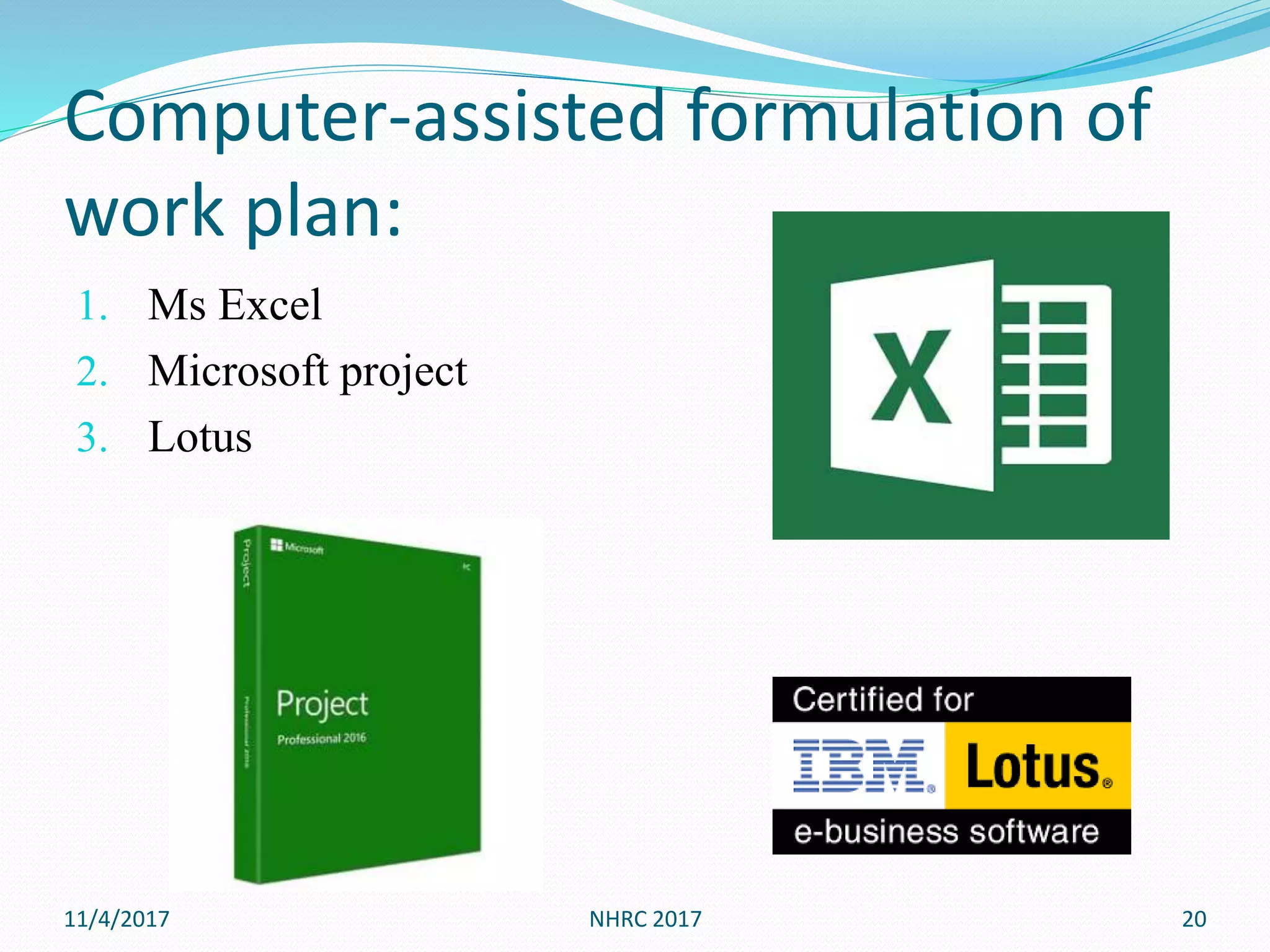
Computer-assisted formulation of
work plan:
1. Ms Excel
2. Microsoft project
3. Lotus
11/4/2017 NHRC 2017 20
11/4/2017 NHRC 2017 21
Budget
 Budget is a concrete, precise, picture of the total
operation of an enterprise/ organization/ institutions in a
monetary term.
 Budgeting is major part of planning process
 It’s an invaluable tool to help you prioritize your
spending and manage your money no matter how much
or how little you have.
11/4/2017 22NHRC 2017
When should budget preparation
begin?
A complete budget is not prepared until the final stage of
project planning.
However, cost is usually a major limiting factor and
therefore must always be kept in mind during planning so
that your proposals will not have an unrealistically high
budget.
11/4/2017 NHRC 2017 23
Advice on budget preparation
Keep in mind the tendency to underestimate the time needed to
complete project tasks in the “real world” Include a 5% contingency
fund and health insurance
Do not box yourself in too tightly with very detailed categories and
amounts, especially if regulations do not allow adjustments afterwards.
Ask the supervising agency to agree that, if necessary there may be
some transfer between line items in the budget.
11/4/2017 NHRC 2017 24
Advice on budget preparation Contd….
If your government or department has agreed to contribute a certain amount
for the project, try to arrange that the contribution be administered
separately, so that the administrators remain aware of the commitment. This
may also ensure easier access to the funds.
If the budget is for a period longer than a year, build in allowances for
inflation before the project begins and in subsequent years by increasing costs
by a set percentage.
Aware about the exchange rate of currency; 1 US Dollar equals 103 Nepalese
Rupee, 1 Euro equals 115.42 Nepalese Rupee (11/06/2017)
11/4/2017 NHRC 2017 25
Major Section of budget
 Project personnel and consultancy costs (include Researchers,
Field Supervisors, Clinicians, Research Assistant, Data Managers,
etc.)
 Non consumable supplies (if relevant, include major and minor
equipment etc.)
 Consumable and Expendable supplies include stationery,
photocopying, photographic films, cassette tapes and batteries etc.)
 Clinical Expenses (if relevant) include drugs, special investigations
like clinical tests, patients cost i.e. transportation/ reimbursement of
travel expenses)
11/4/2017 26NHRC 2017
Contd…
 Field/ Community related costs (if relevant) include
refreshment cost for focus group discussion and other
related costs etc.
 Travel within the country and subsistence costs (if
relevant) include air fare, bus fare, vehicle hiring, fuel etc.
 Administrative costs (if relevant) include house rent,
support staff, communication expenses and other
relevant)
11/4/2017 27NHRC 2017
Contd…
 Report writing include printing and binding.
 Dissemination include invitation cost, hall rent, refreshment,
report copying etc.)
 Publication costs
 Other costs includes miscellaneous and other costs.
1. Insurance cost
2. Travel insurance cost
3. Contingency cost
4. Overhead cost
11/4/2017 28NHRC 2017
Personnel Costs (Rs)
 Personnel Person(s)x Rate x Days (Rs)
Total
 Principal Investigator 1x0.0 x0 Days X
 Co Investigator
 Supervisor
 Enumerators
 Data Entry Manager
______________________________________________
Sub total 1:
11/4/2017 29NHRC 2017
Administrative Support:
 Accountant x days x Rs =……….. Rs
 Admin/ Typist x Days x Rs =…………Rs
 Driver x Days x Rs =………...Rs
 Office Assistant x Days x Rs =…………Rs
_________________________________
Sub total 2 =…………Rs
11/4/2017 30NHRC 2017
Consumable and Expendable Supplies:
 Stationery (list of items/quantity/rates on a separate
sheet) =…………Rs
 Photocopy =…………Rs
 Printing (Lump sum) =…………Rs
______________________________
Sub total 3 =………….. Rs
11/4/2017 31NHRC 2017
Ethical Approval cost (IRC/ERB)
For student
For self funded
For sponsored proposal
_________________________________
Sub total 4 =…………Rs
11/4/2017 NHRC 2017 32
Field /Community related costs
(If relevant)
 Per diem for participants:
Number X Rate X Days= Total Rs
 Per diem for facilitator/ Recorder:
Number X Rate X Days= Total Rs
 Stationery for FDG:
Number X Rate =Total Rs
 Refreshment:
Number X Rate X days = Total Rs
_________________________________
Sub total 5 =…………Rs
11/4/2017 33NHRC 2017
Budget summary
 Sub total 1 =…………………….Rs
 Sub total 2 =…………………….Rs
 Sub total 3 =…………………….Rs
 Sub total 4 =…………………….Rs
 Sub total 5 =…………………….Rs
________________________________
Total =…………………….Rs.
Contingency 5%......................Rs
________________________________
Grand Total =………………. Rs
May convert into Dollars/ Euro/Pound
11/4/2017 34NHRC 2017
11/4/2017 NHRC 2017 35
1. Personnel Costs (Rs)
2. Administrative Support(Rs)
Personnel Person(s)x Rate x mths Total
Accountant 1*10000*12 months 120,000
Admin/ Typist 1*8000*12 months 96,000
Driver 1*8000*12 months 96,000
Office Assistant 1*6000*12 months 72,000
Sub total 384,000
Personnel Person(s)x Rate x mths Total
Supervisor 1*25,000*12 months 300,000
Field Interviewer 2*15000*9 months 270,000
Clinical Practitioners 1*10,000* 9 months 90,000
Data Analyst 2*15000*6 months 180,000
Statistician 1*40,000*6 months 240,000
Sub total: 1,080,000
11/4/2017 NHRC 2017 36
3. Consumable and Expendable Supplies
Rs (Lump sum)
Lab Analysis (Kits, Vials, Syringes, etc.) 300,000
Supplementation and placebo 100,000
Stationary (Printing, Photocopy, etc) 200,000
Sub total 600,000
Budget summary
Sub totals Rs
Sub total 1 1,080,000
Sub total 2 384,000
Sub total 3 600,000
Total 2,064,000
Contingency 5% 103,200
Tax et. al 206,400
Insurance According to rules of government/insurance company
Approval cost (3%) 71,208
Grand Total 2,373,600
11/4/2017 NHRC 2017 37
Bank Details
i. Bank Account Name:
ii. Account Number:
iii. Bank Name:
iv. Bank Address:
v. SWIFT Code:
11/4/2017 38NHRC 2017
How can budgets be reduced?
 Explore whether other health-related institutions are
willing to temporarily assign or second personnel to the
project.
 When possible, use local rather than outside personnel.
If consultants are needed at the beginning, train local
personnel as soon as possible to take over their work.
 Explore the use of students or community volunteers,
where appropriate.
 Plan for strict control of project expenditures, such as
those for vehicle use, supplies, air fare etc.
11/4/2017 NHRC 2017 39
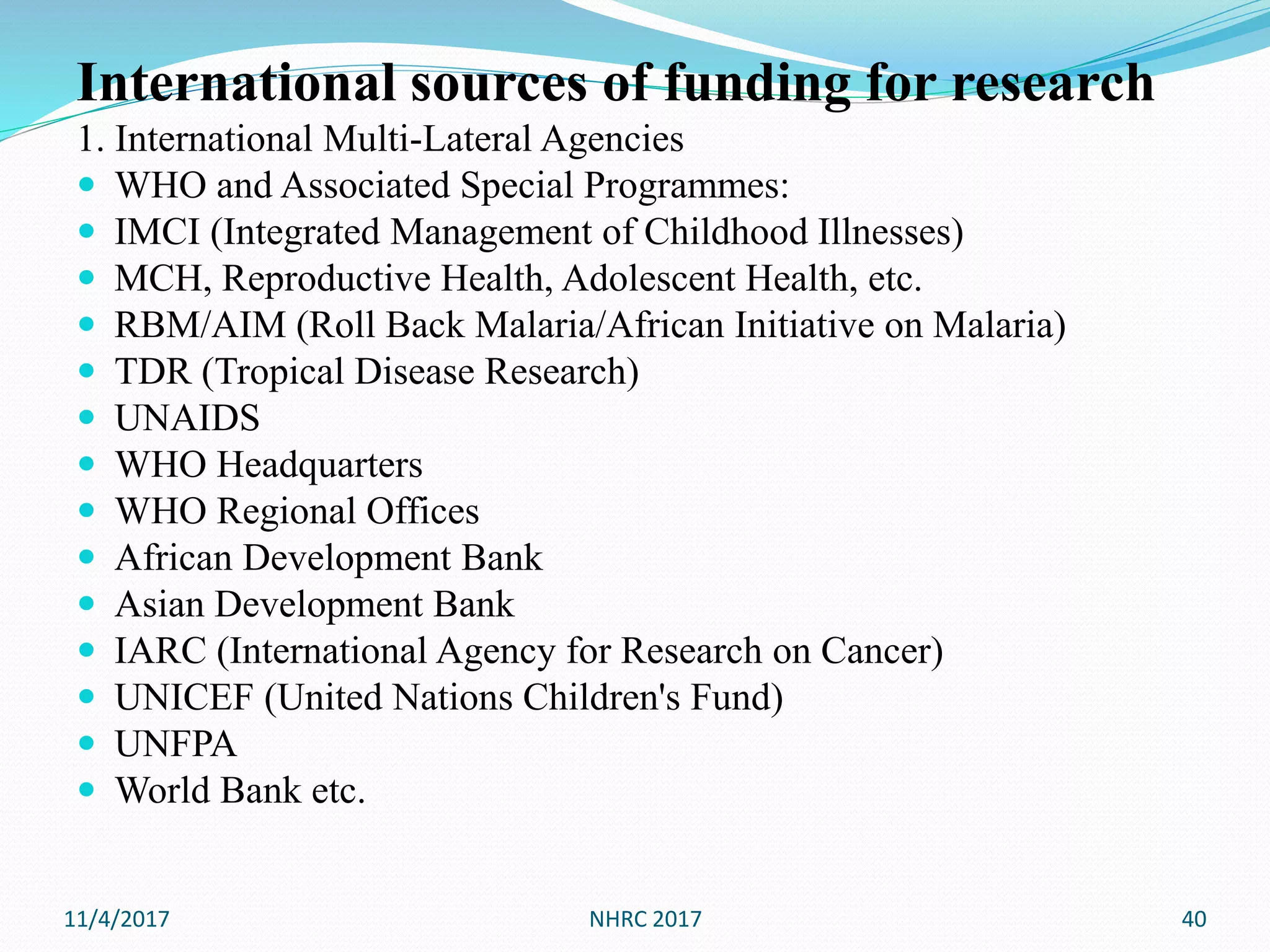
International sources of funding for research
1. International Multi-Lateral Agencies
 WHO and Associated Special Programmes:
 IMCI (Integrated Management of Childhood Illnesses)
 MCH, Reproductive Health, Adolescent Health, etc.
 RBM/AIM (Roll Back Malaria/African Initiative on Malaria)
 TDR (Tropical Disease Research)
 UNAIDS
 WHO Headquarters
 WHO Regional Offices
 African Development Bank
 Asian Development Bank
 IARC (International Agency for Research on Cancer)
 UNICEF (United Nations Children's Fund)
 UNFPA
 World Bank etc.
11/4/2017 NHRC 2017 40
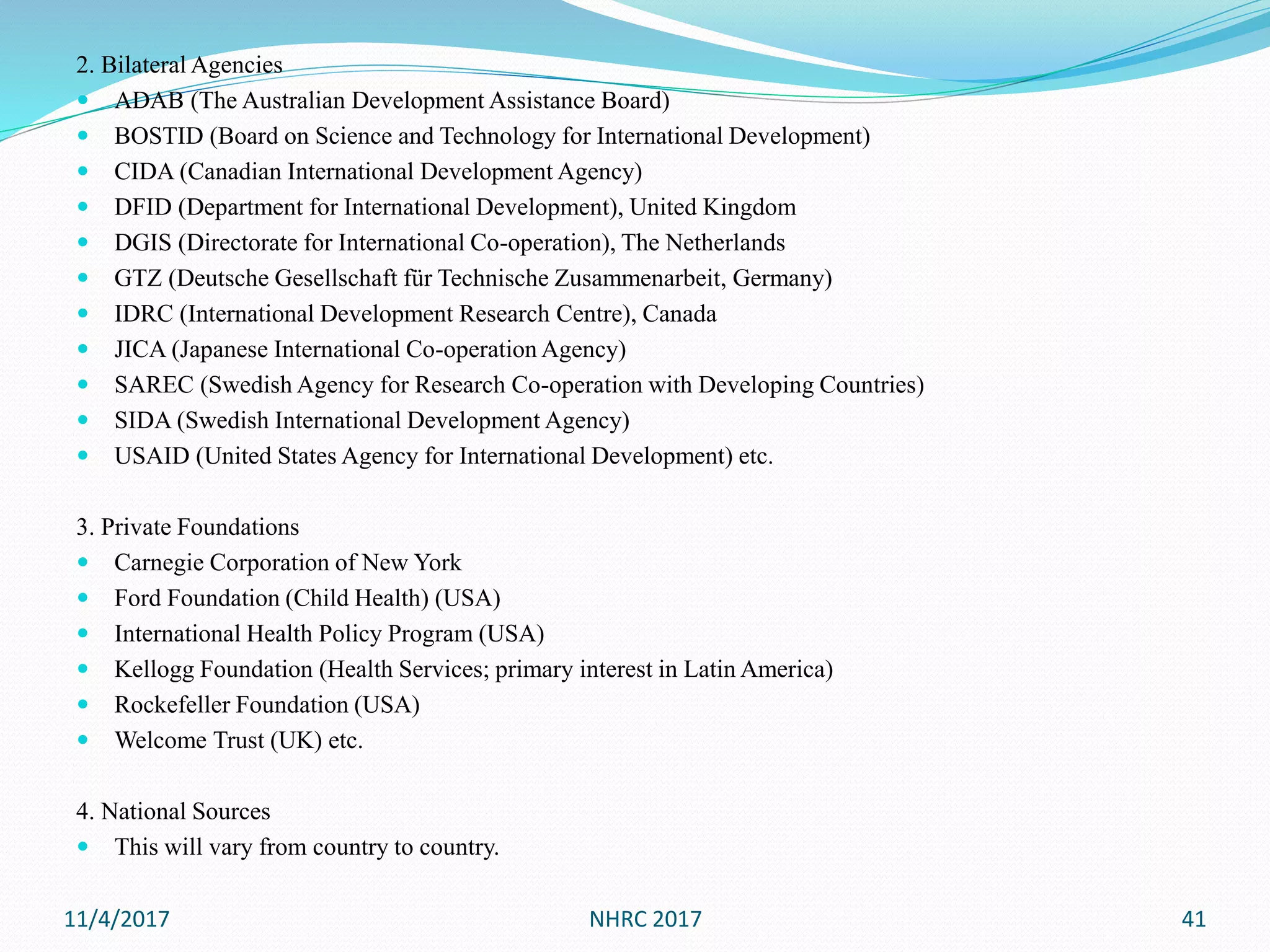
2. Bilateral Agencies
 ADAB (The Australian Development Assistance Board)
 BOSTID (Board on Science and Technology for International Development)
 CIDA (Canadian International Development Agency)
 DFID (Department for International Development), United Kingdom
 DGIS (Directorate for International Co-operation), The Netherlands
 GTZ (Deutsche Gesellschaft für Technische Zusammenarbeit, Germany)
 IDRC (International Development Research Centre), Canada
 JICA (Japanese International Co-operation Agency)
 SAREC (Swedish Agency for Research Co-operation with Developing Countries)
 SIDA (Swedish International Development Agency)
 USAID (United States Agency for International Development) etc.
3. Private Foundations
 Carnegie Corporation of New York
 Ford Foundation (Child Health) (USA)
 International Health Policy Program (USA)
 Kellogg Foundation (Health Services; primary interest in Latin America)
 Rockefeller Foundation (USA)
 Welcome Trust (UK) etc.
4. National Sources
 This will vary from country to country.
11/4/2017 NHRC 2017 41
Thank you
11/4/2017 42NHRC 2017

Work plan and Budget writing in Research

  • 1.
    Ashok Pandey Research Associate 11/4/20171 Developing the Research Team, Team Management and Task Distribution, Work Plan and Budgeting NHRC 2017
  • 2.
  • 3.
    Research team One departmentor institution might be described elsewhere as a Research group Research centre Research unit or Research institute Regardless of the terminology used, the key characteristic of a research team is that it comprises a group of people working together in a committed way towards a common research goal. 11/4/2017 NHRC 2017 3
  • 4.
    Human Resource Nothing movesunless a piece of paper moves and no paper can move, unless a person moves 11/4/2017 NHRC 2017 4
  • 5.
    Research human resource Technicalteam 1) Principle Investigator 2) Research officer 3) Research Associate 4) Research Scientist 5) Data analyst 6) Survey field coordinator 7) Field Research Supervisor 8) Field Research Assistant 9) Counselor 10) Clinician 11) Lab technician, etc Admin/finance staff 1. Administrative officer 2. Accountant 3. Admin/ Typist 4. Driver 5. Office Assistant 11/4/2017 NHRC 2017 5 Hierarchy Chain of command
  • 6.
    Full-time: Regular staffemployees whose standard work schedule is 37.5 hours or more per week Part-time status: Regular staff employees whose standard work schedule is at least 20 standard hours per week but less than 37.5 standard hours per week Part-time to full-time status may result in changes in benefits eligibility, coverage, and premium costs. Employees who work an average of 30 hours or more per week, as determined in accordance with the Employer Shared Responsibility provisions of the Affordable Care Act, are eligible for full-time health premiums. 11/4/2017 NHRC 2017 6
  • 7.
    The Results ofGood Team Work 11/4/2017 7NHRC 2017
  • 8.
    The Results ofBad Team Work 11/4/2017 8NHRC 2017
  • 9.
  • 10.
    What is awork plan?  A WORK PLAN is a schedule, chart or graph that summarizes the different components of a research project and how they will be implemented in a coherent way within a specific time-span. It may include:  The tasks to be performed;  When and where the tasks will be performed; and  Who will perform the tasks and the time each person will spend on them. 11/4/2017 NHRC 2017 10
  • 11.
    Various work schedulingand planning techniques 1. The work schedule 2. The GANTT Chart 11/4/2017 NHRC 2017 11
  • 12.
    The work schedule Awork schedule is a table that summarizes the task to be performed in a research project, the duration of each activity and who is responsible for the different tasks. 1. The task to be performed 2. The date each task should be begin and be completed 3. Task assigned 4. Person days 11/4/2017 NHRC 2017 12
  • 13.
  • 14.
  • 15.
    Work Breakdown Structure Hierarchicaldecomposition of a project into manageable chunks. It is graphical and shows all the project parts in an organized chart. A good WBS looks like an Organization chart or Tree diagram, with all parts connected 11/4/2017 NHRC 2017 15
  • 16.
    The GANTT Chartby Henry Gantt in the 1910s A GANTT chart is a planning tool that depicts graphically the order in which various tasks must be completed and the duration of each activity. The GANTT chart shown  the tasks to be performed;  who is responsible for each task; and  the time each task is expected to take. The length of each task is shown by a bar that extends over the number of days, weeks or months the task is expected to take. 11/4/2017 NHRC 2017 16
  • 17.
    Why Gantt Chart Forbetter Communicate  Wide selection of shapes so your timeline will be unique and impactful.  Fit more tasks: Adjust the task size and the spacing between tasks so you can fit the extra detail your timeline needs.  Hours and Minutes: Creates timelines, Gantt charts and daily schedules scaled down to hours or minutes.  Percentage complete & duration: Show critical details clients and executives are expecting, such as percent complete and task duration.  Customize fonts & colors: Plus Edition lets you format text with font, size, color and other styles so you can create the perfect timeline. 11/4/2017 NHRC 2017 17
  • 18.
  • 19.
    Tasks to beperformed Responsible person Dec. 2007 Jan. 2008 Feb. 2008 March 2008 April 2008 May 2008 June 2008 July 2008 Aug. 2008 Literature Review and finalize research proposal Research team xxx Clearance from national authority PI/NHRC x xxxx Preparing research tools PI and Co-PI xx Translating questionnaire in local language, typing and photocopying Research Assistant xx Orientation training to the research assistants and data collectors Research team x Pre- testing questionnaire/field trial Research team Asst and enum. x Finalizing questionnaire and printing Research team Research Assts. x Orientation to DHO/Local authority and community and obtaining clearance/permission from them Research team Research Assts. Consultant x Data collection Research team xxxx xxxx Data editing, coding and entry into computer Research team xx Data analysis Research team Consultant xx Report writing Research team xx Dissemination and discussion of research findings and preliminary recommendations with managers/policy makers Research team x Preparing final report and submission to concerned institution/funding agency Research team x x 11/4/2017 19NHRC 2017
  • 20.
    Computer-assisted formulation of workplan: 1. Ms Excel 2. Microsoft project 3. Lotus 11/4/2017 NHRC 2017 20
  • 21.
  • 22.
    Budget  Budget isa concrete, precise, picture of the total operation of an enterprise/ organization/ institutions in a monetary term.  Budgeting is major part of planning process  It’s an invaluable tool to help you prioritize your spending and manage your money no matter how much or how little you have. 11/4/2017 22NHRC 2017
  • 23.
    When should budgetpreparation begin? A complete budget is not prepared until the final stage of project planning. However, cost is usually a major limiting factor and therefore must always be kept in mind during planning so that your proposals will not have an unrealistically high budget. 11/4/2017 NHRC 2017 23
  • 24.
    Advice on budgetpreparation Keep in mind the tendency to underestimate the time needed to complete project tasks in the “real world” Include a 5% contingency fund and health insurance Do not box yourself in too tightly with very detailed categories and amounts, especially if regulations do not allow adjustments afterwards. Ask the supervising agency to agree that, if necessary there may be some transfer between line items in the budget. 11/4/2017 NHRC 2017 24
  • 25.
    Advice on budgetpreparation Contd…. If your government or department has agreed to contribute a certain amount for the project, try to arrange that the contribution be administered separately, so that the administrators remain aware of the commitment. This may also ensure easier access to the funds. If the budget is for a period longer than a year, build in allowances for inflation before the project begins and in subsequent years by increasing costs by a set percentage. Aware about the exchange rate of currency; 1 US Dollar equals 103 Nepalese Rupee, 1 Euro equals 115.42 Nepalese Rupee (11/06/2017) 11/4/2017 NHRC 2017 25
  • 26.
    Major Section ofbudget  Project personnel and consultancy costs (include Researchers, Field Supervisors, Clinicians, Research Assistant, Data Managers, etc.)  Non consumable supplies (if relevant, include major and minor equipment etc.)  Consumable and Expendable supplies include stationery, photocopying, photographic films, cassette tapes and batteries etc.)  Clinical Expenses (if relevant) include drugs, special investigations like clinical tests, patients cost i.e. transportation/ reimbursement of travel expenses) 11/4/2017 26NHRC 2017
  • 27.
    Contd…  Field/ Communityrelated costs (if relevant) include refreshment cost for focus group discussion and other related costs etc.  Travel within the country and subsistence costs (if relevant) include air fare, bus fare, vehicle hiring, fuel etc.  Administrative costs (if relevant) include house rent, support staff, communication expenses and other relevant) 11/4/2017 27NHRC 2017
  • 28.
    Contd…  Report writinginclude printing and binding.  Dissemination include invitation cost, hall rent, refreshment, report copying etc.)  Publication costs  Other costs includes miscellaneous and other costs. 1. Insurance cost 2. Travel insurance cost 3. Contingency cost 4. Overhead cost 11/4/2017 28NHRC 2017
  • 29.
    Personnel Costs (Rs) Personnel Person(s)x Rate x Days (Rs) Total  Principal Investigator 1x0.0 x0 Days X  Co Investigator  Supervisor  Enumerators  Data Entry Manager ______________________________________________ Sub total 1: 11/4/2017 29NHRC 2017
  • 30.
    Administrative Support:  Accountantx days x Rs =……….. Rs  Admin/ Typist x Days x Rs =…………Rs  Driver x Days x Rs =………...Rs  Office Assistant x Days x Rs =…………Rs _________________________________ Sub total 2 =…………Rs 11/4/2017 30NHRC 2017
  • 31.
    Consumable and ExpendableSupplies:  Stationery (list of items/quantity/rates on a separate sheet) =…………Rs  Photocopy =…………Rs  Printing (Lump sum) =…………Rs ______________________________ Sub total 3 =………….. Rs 11/4/2017 31NHRC 2017
  • 32.
    Ethical Approval cost(IRC/ERB) For student For self funded For sponsored proposal _________________________________ Sub total 4 =…………Rs 11/4/2017 NHRC 2017 32
  • 33.
    Field /Community relatedcosts (If relevant)  Per diem for participants: Number X Rate X Days= Total Rs  Per diem for facilitator/ Recorder: Number X Rate X Days= Total Rs  Stationery for FDG: Number X Rate =Total Rs  Refreshment: Number X Rate X days = Total Rs _________________________________ Sub total 5 =…………Rs 11/4/2017 33NHRC 2017
  • 34.
    Budget summary  Subtotal 1 =…………………….Rs  Sub total 2 =…………………….Rs  Sub total 3 =…………………….Rs  Sub total 4 =…………………….Rs  Sub total 5 =…………………….Rs ________________________________ Total =…………………….Rs. Contingency 5%......................Rs ________________________________ Grand Total =………………. Rs May convert into Dollars/ Euro/Pound 11/4/2017 34NHRC 2017
  • 35.
  • 36.
    1. Personnel Costs(Rs) 2. Administrative Support(Rs) Personnel Person(s)x Rate x mths Total Accountant 1*10000*12 months 120,000 Admin/ Typist 1*8000*12 months 96,000 Driver 1*8000*12 months 96,000 Office Assistant 1*6000*12 months 72,000 Sub total 384,000 Personnel Person(s)x Rate x mths Total Supervisor 1*25,000*12 months 300,000 Field Interviewer 2*15000*9 months 270,000 Clinical Practitioners 1*10,000* 9 months 90,000 Data Analyst 2*15000*6 months 180,000 Statistician 1*40,000*6 months 240,000 Sub total: 1,080,000 11/4/2017 NHRC 2017 36
  • 37.
    3. Consumable andExpendable Supplies Rs (Lump sum) Lab Analysis (Kits, Vials, Syringes, etc.) 300,000 Supplementation and placebo 100,000 Stationary (Printing, Photocopy, etc) 200,000 Sub total 600,000 Budget summary Sub totals Rs Sub total 1 1,080,000 Sub total 2 384,000 Sub total 3 600,000 Total 2,064,000 Contingency 5% 103,200 Tax et. al 206,400 Insurance According to rules of government/insurance company Approval cost (3%) 71,208 Grand Total 2,373,600 11/4/2017 NHRC 2017 37
  • 38.
    Bank Details i. BankAccount Name: ii. Account Number: iii. Bank Name: iv. Bank Address: v. SWIFT Code: 11/4/2017 38NHRC 2017
  • 39.
    How can budgetsbe reduced?  Explore whether other health-related institutions are willing to temporarily assign or second personnel to the project.  When possible, use local rather than outside personnel. If consultants are needed at the beginning, train local personnel as soon as possible to take over their work.  Explore the use of students or community volunteers, where appropriate.  Plan for strict control of project expenditures, such as those for vehicle use, supplies, air fare etc. 11/4/2017 NHRC 2017 39
  • 40.
    International sources offunding for research 1. International Multi-Lateral Agencies  WHO and Associated Special Programmes:  IMCI (Integrated Management of Childhood Illnesses)  MCH, Reproductive Health, Adolescent Health, etc.  RBM/AIM (Roll Back Malaria/African Initiative on Malaria)  TDR (Tropical Disease Research)  UNAIDS  WHO Headquarters  WHO Regional Offices  African Development Bank  Asian Development Bank  IARC (International Agency for Research on Cancer)  UNICEF (United Nations Children's Fund)  UNFPA  World Bank etc. 11/4/2017 NHRC 2017 40
  • 41.
    2. Bilateral Agencies ADAB (The Australian Development Assistance Board)  BOSTID (Board on Science and Technology for International Development)  CIDA (Canadian International Development Agency)  DFID (Department for International Development), United Kingdom  DGIS (Directorate for International Co-operation), The Netherlands  GTZ (Deutsche Gesellschaft für Technische Zusammenarbeit, Germany)  IDRC (International Development Research Centre), Canada  JICA (Japanese International Co-operation Agency)  SAREC (Swedish Agency for Research Co-operation with Developing Countries)  SIDA (Swedish International Development Agency)  USAID (United States Agency for International Development) etc. 3. Private Foundations  Carnegie Corporation of New York  Ford Foundation (Child Health) (USA)  International Health Policy Program (USA)  Kellogg Foundation (Health Services; primary interest in Latin America)  Rockefeller Foundation (USA)  Welcome Trust (UK) etc. 4. National Sources  This will vary from country to country. 11/4/2017 NHRC 2017 41
  • 42.