Cost analysis
For PB.Pharm-D
Meles T.
4/25/2024 1
2
Cost Estimation: Principles
• Costs in the economic sense (as opposed to the
accounting sense) are not necessarily expenditures
• An economic cost is incurred whenever a resource is consumed
• The value of that resource consumption is its opportunity
cost, that is,
• the value of the benefits foregone because that resource is not
available for its best alternative use
• For “no cost” resources, e.g., volunteer time, space,
need to impute an opportunity cost.
4/25/2024
Steps in Cost Estimation
1. Identify Resources (inputs or consequences) Relevant to
Study Perspective and Boundaries
4/25/2024 3
4
Study Boundaries/Scope
 This is about making the study do-able
 Boundaries or limits specified for:
• Time horizon
• Groups of affected persons to be considered, e.g.,
patients + family
• Types of health and nonhealth outcomes to be included
4/25/2024
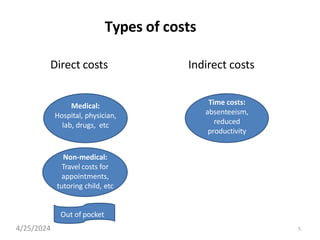
Types of costs
Direct costs Indirect costs
Time costs:
absenteeism,
reduced
productivity
Medical:
Hospital, physician,
lab, drugs, etc
Non-medical:
Travel costs for
appointments,
tutoring child, etc
Out of pocket
5
4/25/2024
Perspective
• Society
• Health system
• Insurer
• Individual
6
4/25/2024
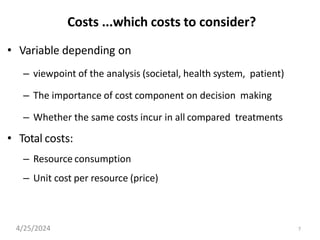
Costs ...which costs to consider?
• Variable depending on
– viewpoint of the analysis (societal, health system, patient)
– The importance of cost component on decision making
– Whether the same costs incur in all compared treatments
• Total costs:
– Resource consumption
– Unit cost per resource (price)
4/25/2024 7
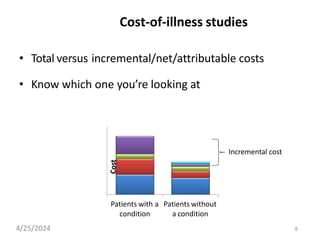
Cost-of-illness studies
• Total versus incremental/net/attributable costs
• Know which one you’re looking at
Patients with a Patients without
condition a condition
Cost
Incremental cost
8
4/25/2024
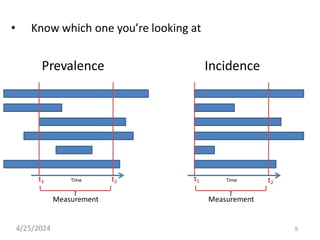
• Know which one you’re looking at
Prevalence Incidence
Time Time
Measurement Measurement
9
t1 t1 t2
t2
4/25/2024
10
Resource Measurement: Justifiable Omissions
• Common costs – costs common to all alternatives,
• e.g. 1 physician visit to prescribe the drugs being compared So
long as they occur at the same rate in both groups
• Protocol-driven costs – not “real world”
• e.g. weekly blood tests in a clinical trial
• Trivial costs
• e.g. patient cost to purchase OTC products – but be careful
about whether this really IS trivial
All must be justified by the analyst
4/25/2024
11
2. Measure Resource Consumption
1. Determine Appropriate Level ofAccuracy
• Micro-Costing - detailed inventory, measurement, and
valuation of resources consumed (inputs) in the
production of a serviceor product, e.g., dispensing
– Human resource – technician time, pharmacist time
– Supplies – container + label, drug info printouts
– Equipment – computer + software, tablet counting
machine
– Overhead – shared costs
4/25/2024
12
2. Measure Resource Consumption…
• Gross-Costing - count the number of units of service
consumed (outputs) and apply a gross estimate of
the service cost, often what is typically charged,
e.g., - # Rx dispensed x dispensing fee
– MD visits x visitfee
Choice of approach depends on the alternatives being
studied
4/25/2024
13
Collect Resource Utilization Data
• Direct measurement, e.g., trial data collectors
• Archival data – health record, claims data
• Self-report – diary (prospective); survey or interview
(retrospective)
• Expert estimate of services/treatments/tests provided to the
average patient
• Unit costs
– Reference/list prices
– Market prices
• Ideally unit prices should reflect the true (opportunity cost)
of the service ….but market price will often do
4/25/2024
14
Methods for Imputing Values for Nonmarket
Resources (usually time)
• Use market wage rate approach, e.g., for volunteer time –
• what it would cost to hire a worker to perform that job
• Use social opportunity cost approach
– e.g., what the volunteer or informal caregiver could have earned
if he/she had chosen to work in their field of training
– If leisure (vs. work) time has been sacrificed, could be valued
at $0 up to “overtime” wage rate (what an employer would pay
a worker for the 6th and 7th days of work per week)
4/25/2024
15
3. Place a Value on Resources Consumed
1. Select a unit cost for each type of resource consumed
– A market price appropriate to the perspective of
the analysis
– For studies with a time horizon greater than 1 year, use
unit costs from the base year, a concept called constant
dollars (controls for price inflation)
– For nonmarket goods and services (free services,
goods, or space) impute an opportunity cost
4/25/2024
16
Unit Cost versus Unit Charge
• Because of imperfections in health care markets, charges
for health care services may not reflect their true costs,
• e.g. hospital costs, physician fees, prescription dispensing fees
• For a third-party payer perspective, the charges faced by
the payer are the appropriate unit costs to use
• In a societal or institutional perspective this is not the
case.

4/25/2024
17
Unit Cost versus Unit Charge…
• Therefore, if the difference between the charge and the cost are
known to be large, it may be appropriate to adjust the charge per
unit of service to a unit cost that better reflects the opportunity
cost,
• e.g., by applying a cost-to-charge ratio to the charge.
4/25/2024
Duration of cost follow-up
• The follow-up for cost analysis should match that
of the true effect of an intervention on costs
• Costs immediately after implementation maybe
not a great idea.
– Except if user of analysis wants to understand start-up costs only
4/25/2024 1
8
Should costs in later life be included?
• Imagine patient reduced risk of stroke due to
antihypertensive
– Longer life = higher risk of cancer=higher costs
• Should that be taken into account?
– Yes and no
• Yes: we don’t distinguish between QALYs
• No: It is unfair towards life prolonging interventions.
• Before you include think:
– Is there life prolonging?
– Is there a true solution with data?
– Is there discounting?
4/25/2024 1
9
20
Special Case of Capital Costs
• Investments at a single point in time to purchase assets
(land, buildings, equipment) which are used over time
• Compare to operating costs, which are recurring costs
• What is important is that buildings and equipment wear
out over time and thus depreciate in value
4/25/2024
21
Special Case of Capital Costs…
• Use accounting methods to deal with depreciation (lost
value) over the useful life of the equipment or buildings
• Simplest approach is straight line depreciation, i.e., dividing the
total lost value into equal amounts in each year of the useful life.
• Must also account for the opportunity cost of having funds
tied up in these resources
– Approximated by estimating the return on the un-depreciated
balance in each year of the useful life (discount rate used to
estimate this return)
4/25/2024
22
Special Case of Overhead (shared resources)
• Resources such as utilities (electricity, water, heating),
housecleaning, insurance, equipment, etc.
• shared by different departments or programs or services
• To allocate shared costs to each service must select:
– A unit of output for the program/service onto which the shared
costs will be allocated,
– e.g., patient day in hospital, prescription dispensed by
community pharmacy
4/25/2024
23
Special Case of Overhead (shared resources)
– A basis for the allocation (e.g., floor space for housekeeping costs)
that determines the proportion of the total resource cost to
allocate to a given program or service
– A method to allocate these shared costs across programs
/services. The more important the cost the more precise the
method that should be used.
4/25/2024
How accurate is accurate
• Often not possible to get optimal data.
– Do the best you can and describe the limits of your work
• Quality of resource use dependent on quality of unit
costs (and vice versa)
4/25/2024 2
4
25
Inclusion of Indirect Costs
• Relevant in societal and employer perspectives
• Inclusion is controversial (see section 4.4 textbook) because:
– Human capital approach assumes that, when the patient dies or
becomes unemployed due to illness,
– the job is not filled by a new worker, i.e., productivity is lost
forever
– biased against patients who were never employable, e.g., in
programs for the mentally disabled
• If taking patient perspective then highly relevant
4/25/2024
26
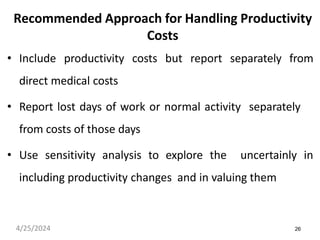
Recommended Approach for Handling Productivity
Costs
• Include productivity costs but report separately from
direct medical costs
• Report lost days of work or normal activity separately
from costs of those days
• Use sensitivity analysis to explore the uncertainly in
including productivity changes and in valuing them
4/25/2024
27
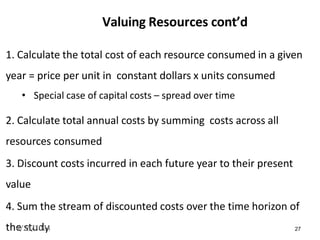
Valuing Resources cont’d
1. Calculate the total cost of each resource consumed in a given
year = price per unit in constant dollars x units consumed
• Special case of capital costs – spread over time
2. Calculate total annual costs by summing costs across all
resources consumed
3. Discount costs incurred in each future year to their present
value
4. Sum the stream of discounted costs over the time horizon of
the study
4/25/2024
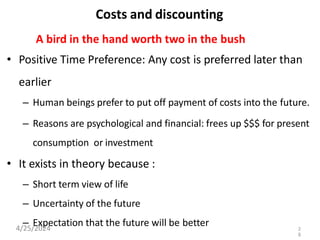
Costs and discounting
A bird in the hand worth two in the bush
• Positive Time Preference: Any cost is preferred later than
earlier
– Human beings prefer to put off payment of costs into the future.
– Reasons are psychological and financial: frees up $$$ for present
consumption or investment
• It exists in theory because :
– Short term view of life
– Uncertainty of the future
– Expectation that the future will be better
4/25/2024 2
8
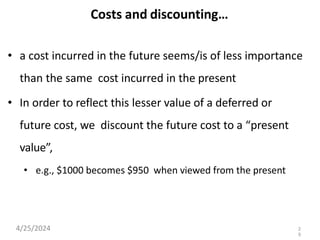
Costs and discounting…
• a cost incurred in the future seems/is of less importance
than the same cost incurred in the present
• In order to reflect this lesser value of a deferred or
future cost, we discount the future cost to a “present
value”,
• e.g., $1000 becomes $950 when viewed from the present
4/25/2024 2
9
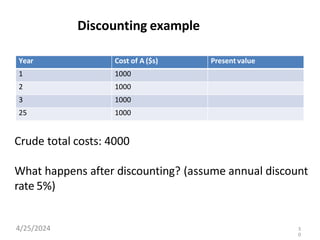
Discounting example
Year Cost of A ($s) Present value
1 1000
2 1000
3 1000
25 1000
Crude total costs: 4000
What happens after discounting? (assume annual discount
rate 5%)
4/25/2024 3
0
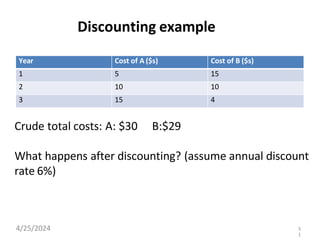
Discounting example
Year Cost of A ($s) Cost of B ($s)
1 5 15
2 10 10
3 15 4
Crude total costs: A: $30 B:$29
What happens after discounting? (assume annual discount
rate 6%)
4/25/2024 3
1
32
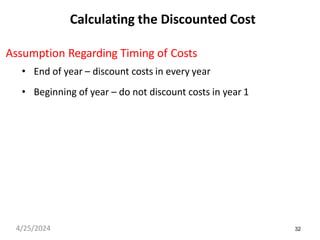
Calculating the Discounted Cost
Assumption Regarding Timing of Costs
• End of year – discount costs in every year
• Beginning of year – do not discount costs in year 1
4/25/2024
33
Discounting Health Benefits
• Tobe consistent must discount health benefits incurring in
the future as well
• Should be at the same rate as for costs:
– otherwise may become desirable to delay implementation
indefinitely so that more income is earned, which would buy
more lives saved
4/25/2024
What is the right discount rate?
• Most common method: Time preference rate
– Society’s willingness to forego consumption today in order to
have greater consumption tomorrow
– Extracted through questionnaires or assumptions on risk less
investments
– Difficulties (individual vs society, form of asking the question)
• In practice use what is in the guidelines. If no guidelines
then sensitivity analysis
4/25/2024 3
4
Discounting and inflation
• If inflation the same across cost components then:
– Inflate future costs with predicted inflation rate and use larger
discount rate OR
– Do not inflate future costs and use a smaller discount rate
• If inflation varies
– Inflate costs components separately and a larger discount at the
end
4/25/2024 3
5
33
Study Question on Costing
How would you estimate the cost of a medication review
service provided by a community pharmacist using:
a) microcosting?
b) gross costing?
4/25/2024 3
6
Thank you!
4/25/2024 37

pharmacoeconomics Cost analysis PBPD.pptx

  • 1.
  • 2.
    2 Cost Estimation: Principles •Costs in the economic sense (as opposed to the accounting sense) are not necessarily expenditures • An economic cost is incurred whenever a resource is consumed • The value of that resource consumption is its opportunity cost, that is, • the value of the benefits foregone because that resource is not available for its best alternative use • For “no cost” resources, e.g., volunteer time, space, need to impute an opportunity cost. 4/25/2024
  • 3.
    Steps in CostEstimation 1. Identify Resources (inputs or consequences) Relevant to Study Perspective and Boundaries 4/25/2024 3
  • 4.
    4 Study Boundaries/Scope  Thisis about making the study do-able  Boundaries or limits specified for: • Time horizon • Groups of affected persons to be considered, e.g., patients + family • Types of health and nonhealth outcomes to be included 4/25/2024
  • 5.
    Types of costs Directcosts Indirect costs Time costs: absenteeism, reduced productivity Medical: Hospital, physician, lab, drugs, etc Non-medical: Travel costs for appointments, tutoring child, etc Out of pocket 5 4/25/2024
  • 6.
    Perspective • Society • Healthsystem • Insurer • Individual 6 4/25/2024
  • 7.
    Costs ...which coststo consider? • Variable depending on – viewpoint of the analysis (societal, health system, patient) – The importance of cost component on decision making – Whether the same costs incur in all compared treatments • Total costs: – Resource consumption – Unit cost per resource (price) 4/25/2024 7
  • 8.
    Cost-of-illness studies • Totalversus incremental/net/attributable costs • Know which one you’re looking at Patients with a Patients without condition a condition Cost Incremental cost 8 4/25/2024
  • 9.
    • Know whichone you’re looking at Prevalence Incidence Time Time Measurement Measurement 9 t1 t1 t2 t2 4/25/2024
  • 10.
    10 Resource Measurement: JustifiableOmissions • Common costs – costs common to all alternatives, • e.g. 1 physician visit to prescribe the drugs being compared So long as they occur at the same rate in both groups • Protocol-driven costs – not “real world” • e.g. weekly blood tests in a clinical trial • Trivial costs • e.g. patient cost to purchase OTC products – but be careful about whether this really IS trivial All must be justified by the analyst 4/25/2024
  • 11.
    11 2. Measure ResourceConsumption 1. Determine Appropriate Level ofAccuracy • Micro-Costing - detailed inventory, measurement, and valuation of resources consumed (inputs) in the production of a serviceor product, e.g., dispensing – Human resource – technician time, pharmacist time – Supplies – container + label, drug info printouts – Equipment – computer + software, tablet counting machine – Overhead – shared costs 4/25/2024
  • 12.
    12 2. Measure ResourceConsumption… • Gross-Costing - count the number of units of service consumed (outputs) and apply a gross estimate of the service cost, often what is typically charged, e.g., - # Rx dispensed x dispensing fee – MD visits x visitfee Choice of approach depends on the alternatives being studied 4/25/2024
  • 13.
    13 Collect Resource UtilizationData • Direct measurement, e.g., trial data collectors • Archival data – health record, claims data • Self-report – diary (prospective); survey or interview (retrospective) • Expert estimate of services/treatments/tests provided to the average patient • Unit costs – Reference/list prices – Market prices • Ideally unit prices should reflect the true (opportunity cost) of the service ….but market price will often do 4/25/2024
  • 14.
    14 Methods for ImputingValues for Nonmarket Resources (usually time) • Use market wage rate approach, e.g., for volunteer time – • what it would cost to hire a worker to perform that job • Use social opportunity cost approach – e.g., what the volunteer or informal caregiver could have earned if he/she had chosen to work in their field of training – If leisure (vs. work) time has been sacrificed, could be valued at $0 up to “overtime” wage rate (what an employer would pay a worker for the 6th and 7th days of work per week) 4/25/2024
  • 15.
    15 3. Place aValue on Resources Consumed 1. Select a unit cost for each type of resource consumed – A market price appropriate to the perspective of the analysis – For studies with a time horizon greater than 1 year, use unit costs from the base year, a concept called constant dollars (controls for price inflation) – For nonmarket goods and services (free services, goods, or space) impute an opportunity cost 4/25/2024
  • 16.
    16 Unit Cost versusUnit Charge • Because of imperfections in health care markets, charges for health care services may not reflect their true costs, • e.g. hospital costs, physician fees, prescription dispensing fees • For a third-party payer perspective, the charges faced by the payer are the appropriate unit costs to use • In a societal or institutional perspective this is not the case. 4/25/2024
  • 17.
    17 Unit Cost versusUnit Charge… • Therefore, if the difference between the charge and the cost are known to be large, it may be appropriate to adjust the charge per unit of service to a unit cost that better reflects the opportunity cost, • e.g., by applying a cost-to-charge ratio to the charge. 4/25/2024
  • 18.
    Duration of costfollow-up • The follow-up for cost analysis should match that of the true effect of an intervention on costs • Costs immediately after implementation maybe not a great idea. – Except if user of analysis wants to understand start-up costs only 4/25/2024 1 8
  • 19.
    Should costs inlater life be included? • Imagine patient reduced risk of stroke due to antihypertensive – Longer life = higher risk of cancer=higher costs • Should that be taken into account? – Yes and no • Yes: we don’t distinguish between QALYs • No: It is unfair towards life prolonging interventions. • Before you include think: – Is there life prolonging? – Is there a true solution with data? – Is there discounting? 4/25/2024 1 9
  • 20.
    20 Special Case ofCapital Costs • Investments at a single point in time to purchase assets (land, buildings, equipment) which are used over time • Compare to operating costs, which are recurring costs • What is important is that buildings and equipment wear out over time and thus depreciate in value 4/25/2024
  • 21.
    21 Special Case ofCapital Costs… • Use accounting methods to deal with depreciation (lost value) over the useful life of the equipment or buildings • Simplest approach is straight line depreciation, i.e., dividing the total lost value into equal amounts in each year of the useful life. • Must also account for the opportunity cost of having funds tied up in these resources – Approximated by estimating the return on the un-depreciated balance in each year of the useful life (discount rate used to estimate this return) 4/25/2024
  • 22.
    22 Special Case ofOverhead (shared resources) • Resources such as utilities (electricity, water, heating), housecleaning, insurance, equipment, etc. • shared by different departments or programs or services • To allocate shared costs to each service must select: – A unit of output for the program/service onto which the shared costs will be allocated, – e.g., patient day in hospital, prescription dispensed by community pharmacy 4/25/2024
  • 23.
    23 Special Case ofOverhead (shared resources) – A basis for the allocation (e.g., floor space for housekeeping costs) that determines the proportion of the total resource cost to allocate to a given program or service – A method to allocate these shared costs across programs /services. The more important the cost the more precise the method that should be used. 4/25/2024
  • 24.
    How accurate isaccurate • Often not possible to get optimal data. – Do the best you can and describe the limits of your work • Quality of resource use dependent on quality of unit costs (and vice versa) 4/25/2024 2 4
  • 25.
    25 Inclusion of IndirectCosts • Relevant in societal and employer perspectives • Inclusion is controversial (see section 4.4 textbook) because: – Human capital approach assumes that, when the patient dies or becomes unemployed due to illness, – the job is not filled by a new worker, i.e., productivity is lost forever – biased against patients who were never employable, e.g., in programs for the mentally disabled • If taking patient perspective then highly relevant 4/25/2024
  • 26.
    26 Recommended Approach forHandling Productivity Costs • Include productivity costs but report separately from direct medical costs • Report lost days of work or normal activity separately from costs of those days • Use sensitivity analysis to explore the uncertainly in including productivity changes and in valuing them 4/25/2024
  • 27.
    27 Valuing Resources cont’d 1.Calculate the total cost of each resource consumed in a given year = price per unit in constant dollars x units consumed • Special case of capital costs – spread over time 2. Calculate total annual costs by summing costs across all resources consumed 3. Discount costs incurred in each future year to their present value 4. Sum the stream of discounted costs over the time horizon of the study 4/25/2024
  • 28.
    Costs and discounting Abird in the hand worth two in the bush • Positive Time Preference: Any cost is preferred later than earlier – Human beings prefer to put off payment of costs into the future. – Reasons are psychological and financial: frees up $$$ for present consumption or investment • It exists in theory because : – Short term view of life – Uncertainty of the future – Expectation that the future will be better 4/25/2024 2 8
  • 29.
    Costs and discounting… •a cost incurred in the future seems/is of less importance than the same cost incurred in the present • In order to reflect this lesser value of a deferred or future cost, we discount the future cost to a “present value”, • e.g., $1000 becomes $950 when viewed from the present 4/25/2024 2 9
  • 30.
    Discounting example Year Costof A ($s) Present value 1 1000 2 1000 3 1000 25 1000 Crude total costs: 4000 What happens after discounting? (assume annual discount rate 5%) 4/25/2024 3 0
  • 31.
    Discounting example Year Costof A ($s) Cost of B ($s) 1 5 15 2 10 10 3 15 4 Crude total costs: A: $30 B:$29 What happens after discounting? (assume annual discount rate 6%) 4/25/2024 3 1
  • 32.
    32 Calculating the DiscountedCost Assumption Regarding Timing of Costs • End of year – discount costs in every year • Beginning of year – do not discount costs in year 1 4/25/2024
  • 33.
    33 Discounting Health Benefits •Tobe consistent must discount health benefits incurring in the future as well • Should be at the same rate as for costs: – otherwise may become desirable to delay implementation indefinitely so that more income is earned, which would buy more lives saved 4/25/2024
  • 34.
    What is theright discount rate? • Most common method: Time preference rate – Society’s willingness to forego consumption today in order to have greater consumption tomorrow – Extracted through questionnaires or assumptions on risk less investments – Difficulties (individual vs society, form of asking the question) • In practice use what is in the guidelines. If no guidelines then sensitivity analysis 4/25/2024 3 4
  • 35.
    Discounting and inflation •If inflation the same across cost components then: – Inflate future costs with predicted inflation rate and use larger discount rate OR – Do not inflate future costs and use a smaller discount rate • If inflation varies – Inflate costs components separately and a larger discount at the end 4/25/2024 3 5
  • 36.
    33 Study Question onCosting How would you estimate the cost of a medication review service provided by a community pharmacist using: a) microcosting? b) gross costing? 4/25/2024 3 6
  • 37.