IRON MANUFACTURING
TECHNOLOGY
COREXPROCESS
Metallurgy & Material Engineering
▪ Group Members
– Usama Hassan(332)
– Asfand Shahid(333)
– JunaidIllahi (334)
– Asad Jamil (335)
– Ahmer Ejaz(336)
COREX PROCESS
▪ Smelting Reduction Process
▪ Combination of Melter Gasifier & Reduction
Shaft
▪ Lump iron ore or pellets, non-coking coal,
and oxygen as main inputs
▪ Counter Current Principle
▪ Alternative to Blast Furnace
Why do we seek alternative to Blast Furnace?
▪ CHALLENGES
– The conventional blast furnace route is too costly and
energy-intensive to keep pace with dynamic market changes,
where even short- and medium-term fluctuations show their
dramatic impact on iron production.
– The need to use coke and sinter makes it much more
difficult to fulfil ever stricter environmental regulations and
to achieve economical competitiveness .
– Rising energy demand, continuous price increases for
natural gas and raw materials, and steadily decreasing
quality of iron ore.
Why do we seek alternative to Blast Furnace?
▪ SOLUTION
– Corex is besides FINEX the only reliable alternative to the
conventional blast furnace route.
– Corex will make you less dependent on price trends for raw
materials.
– Corex provides you with the key technology for producing
hot metal in an economically and ecologically sustainable
manner.
– It frees from the need to invest in the operation and
maintenance of coking and sinter plants because these
additional facilities are not needed at all.
Differences between COREX& Blast Furnace
The maindifferences betweenCorexand a conventional blast
furnace routeare
▪ Non-coking coal can be used directlyas a reducing agent
and energy source
▪ Up to 80% of the ironoxide fraction can be lumpore; no
sintering is required
▪ Pure oxygeninsteadof nitrogen-richhot blast
Salient Features
▪ Developed by Siemens VAI.
▪ Commercially most successful among SR technologies.
▪ Work is carriedout in 2 reactors.
▪ Reductionshaft & Melter-gasifier.
▪ Commercial units in operation
– Korea: POSCO
– India: JSWSteel & Essar Steel ltd
– SouthAfrica: Mittal-SALDANHA
– China: Baosteel
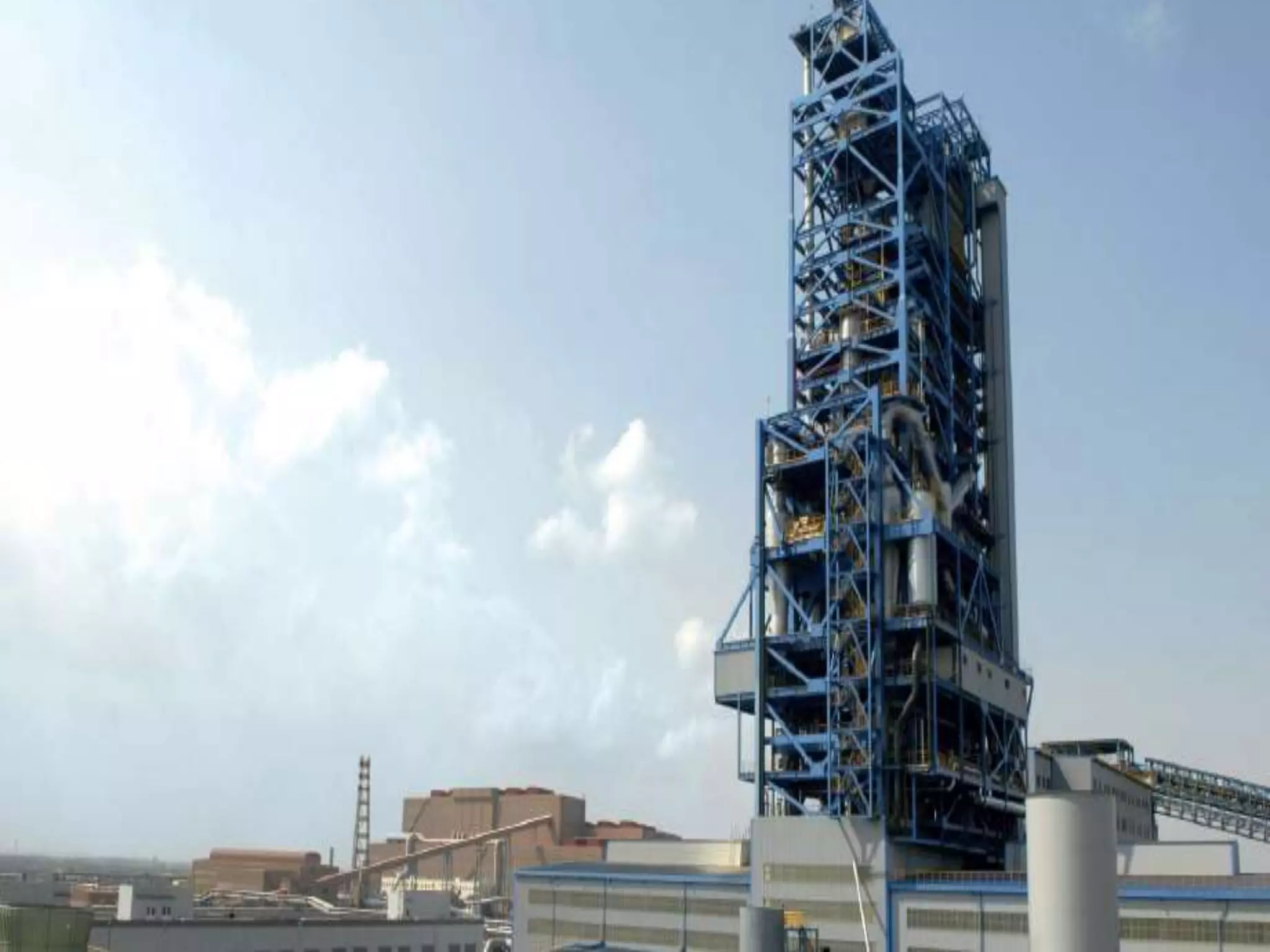
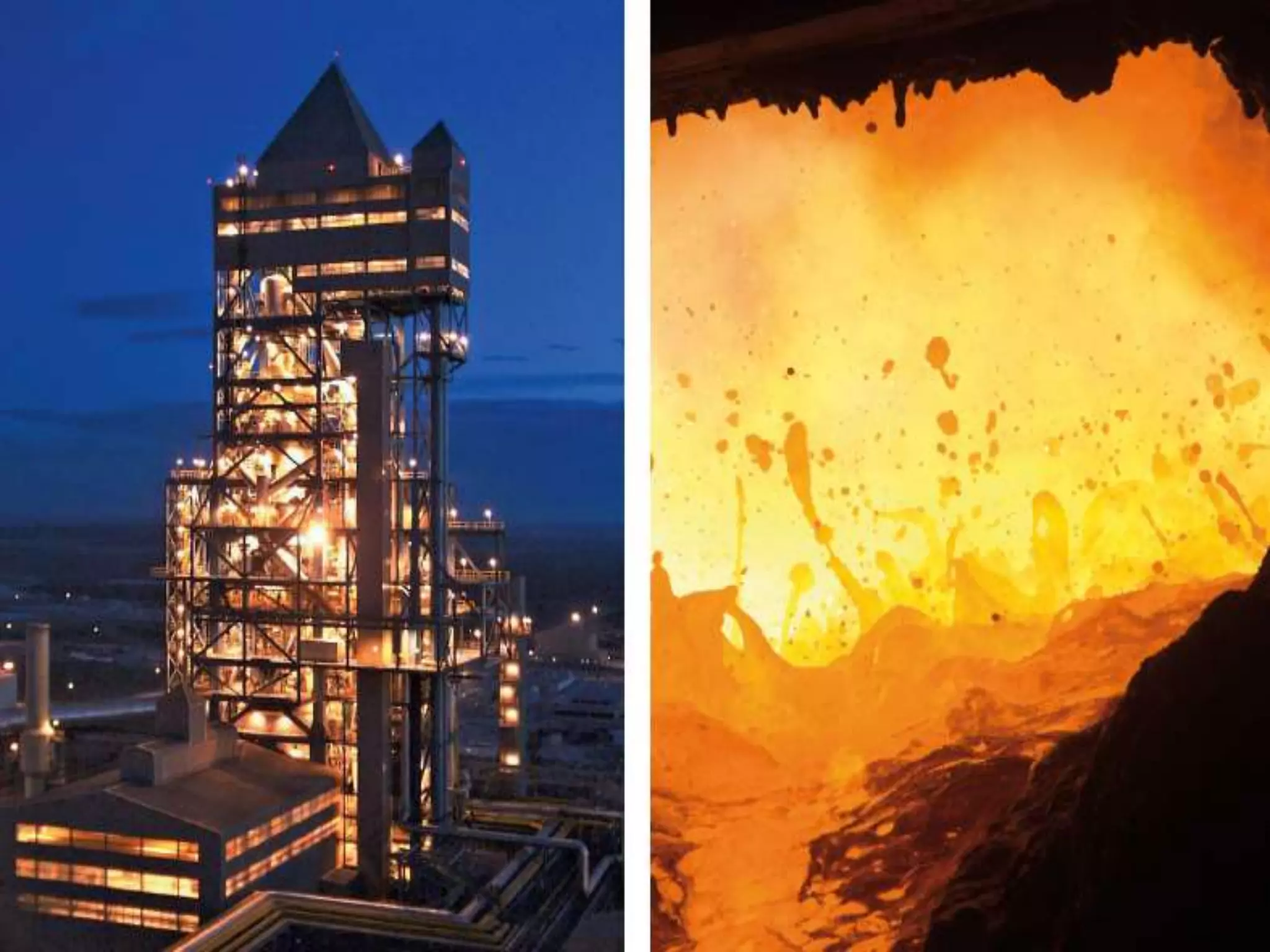
How do Commercial Unit Look Like…?
EXPLAINING THE CONSTRUCTION
WORKING •Charge is chargedintoa
reductionshaftwhere theyare
reducedto directreducediron
(DRI)by a reductiongasmovingin
counterflow.
•DischargescrewsconveytheDRI
fromthereductionshaftintothe
Melter–Gasifier.
•In Melter - Gasifierfinalreduction
and meltingtakesplace.
•Hotmetaland slagtappingare
done as in conventionalblast
furnacepractice.
•The gasleavingthereduction
shaftis cooledand cleanedand is
usedfor a widerangeof
applications.
•Itsexhaustgasesareusedin
MIDREXProcess.
WORKING ELABORATED
▪ ReductionShaft
– Ironore, pelletsand additives(limestoneand dolomite) are continuously
charged fromthe top.
– Some amount of cokeis also addedto the shaft to avoid clustering.
– Thereductiongas is injected throughthe bustle locatedabout 5 meters
above thebottomof theshaftat 850°Cand over3-barpressure.
– Thegas movesin the countercurrent direction to the topof the shaft and
exitsfromthe shaft at around250°C.
– Theironbearingmaterial gets reducedto over 95%metallizationinthe
shaft and is termedas DRI.
– Subsequently, six screws dischargethe DRI fromthe reductionshaft into
the Melter - Gasifier.
WORKING ELABORATED
▪ The Melter- Gasifier can largelybe dividedintothree reaction zones
– Gaseousfreeboardzone(upperpartor dome)
– Charbed(middlepartaboveoxygentuyeres)
– Hearthzone(lowerpartbelowoxygentuyeres)
▪ The hot DRI at around 600-800 °C alongwithlimestoneand
dolomiteare continuouslyfed intothe Melter-GasifierthroughDRI
down pipes.
▪ The DRI down pipes are uniformlydistributed along the
circumference near the top of the melter-gasifier so as to ensure
uniformdistribution of material over thechar bed.
WORKING ELABORATED
▪ Additionallynon-coking coal, quartziteand required quantityof coke
are continuouslychargedby meansof lock hoppersystem.
▪ The operatingpressure,in the melter-gasifier is in excess of 3 bars.
▪ Oxygen plays a vital role in COREXprocessfor generation of heat
and reduction gases. It is injectedthroughthe tuyeres, whichgasifies
the coal char generatesCO.
▪ The hot gases ascend upward throughthe char bed. The sensible heat
of the gases is transferred to the char bed, whichis utilized for
meltingiron and slagand other metallurgical reactions. The hot
metal and slag are collected in the hearth.
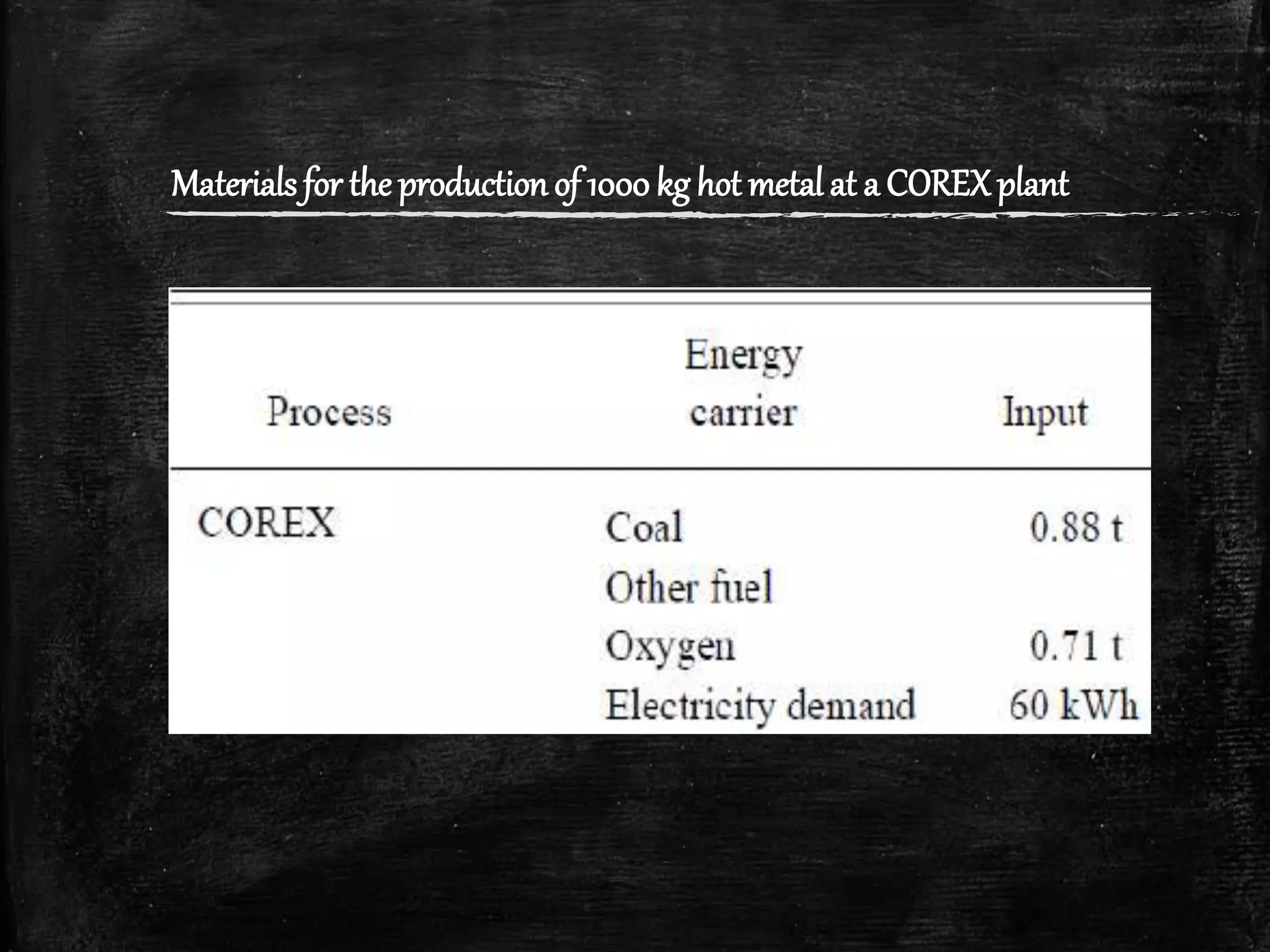
Materials for the productionof 1000 kg hot metal at a COREXplant
Typical analysis of COREX hot metal and slag
ADVANTAGES
▪ It substantiallyreducesspecificinvestmentcostscomparedwithconventionalblast
furnacesteelmakingprocess;lowerstheproductioncosts15%to 25%compared
witha blastfurnace,
▪ Outstandingoverallenvironmentalcompatibility,due to reductioninCO2
generatedpertonof ironproduction;
▪ Useof COREXexportgasfora widerangeof applications,
▪ Useof a widevarietyof ironoresandcoals,
▪ Eliminationof cokingplants,
▪ Hot-metalqualitysuitableforallsteelapplications.
▪ Integratedelectricalpowergenerationpossible.
▪ Combinedproductionof DRIpossible.
DISADVANTAGES
▪ It has the limitationindistributingthecoaland DRI in theoptimised
manner inthe Melter-Gasifier.
▪ Thecoalconsumption in Corexis muchhigherthanin any other iron
makingprocess.
▪ Thesystemis maintenanceoriented,includingcoolinggas compressor for
recyclingpart of COREXgas for cooling the hot gasesfromthe melter-
gasifier.
▪ It is providedwithvery sophisticated gas cleaning facilities. Thereare three
gas cleaningstreamsfor cleaning the total gas generated inthe process.
▪ Theprocessis sensitiveto the qualityof inputs particularlywith respect to
quality
THERE IS ALWAYS A GOOD REASON FOR COREX
▪ Corex fulfils all additional requirements beyond an economical and
reliable iron makingunit. Examples include JSWin India, where two
Corex plantswere erectedfor a steelworks in an isolated areawithno
access to naturalgas or electricity; Baosteel in China, where a new
steelworkswaserected in a waterprotectionareawitha demand for
electricity; and ArcelorMittal SouthAfrica, where a Corex-DR
combination formsthe iron making basis for a steelworks in an
environmentallyrestricted area. The expansionto a Corex-DR
combination plant at JSWunderlines the flexibilityof Corexto
respond to actual market demands in the ironand steel business.
Corex Process - iron Manufacturing Technology

Corex Process - iron Manufacturing Technology

  • 1.
  • 2.
    Metallurgy & MaterialEngineering ▪ Group Members – Usama Hassan(332) – Asfand Shahid(333) – JunaidIllahi (334) – Asad Jamil (335) – Ahmer Ejaz(336)
  • 3.
    COREX PROCESS ▪ SmeltingReduction Process ▪ Combination of Melter Gasifier & Reduction Shaft ▪ Lump iron ore or pellets, non-coking coal, and oxygen as main inputs ▪ Counter Current Principle ▪ Alternative to Blast Furnace
  • 4.
    Why do weseek alternative to Blast Furnace? ▪ CHALLENGES – The conventional blast furnace route is too costly and energy-intensive to keep pace with dynamic market changes, where even short- and medium-term fluctuations show their dramatic impact on iron production. – The need to use coke and sinter makes it much more difficult to fulfil ever stricter environmental regulations and to achieve economical competitiveness . – Rising energy demand, continuous price increases for natural gas and raw materials, and steadily decreasing quality of iron ore.
  • 5.
    Why do weseek alternative to Blast Furnace? ▪ SOLUTION – Corex is besides FINEX the only reliable alternative to the conventional blast furnace route. – Corex will make you less dependent on price trends for raw materials. – Corex provides you with the key technology for producing hot metal in an economically and ecologically sustainable manner. – It frees from the need to invest in the operation and maintenance of coking and sinter plants because these additional facilities are not needed at all.
  • 6.
  • 7.
  • 8.
    Differences between COREX&Blast Furnace The maindifferences betweenCorexand a conventional blast furnace routeare ▪ Non-coking coal can be used directlyas a reducing agent and energy source ▪ Up to 80% of the ironoxide fraction can be lumpore; no sintering is required ▪ Pure oxygeninsteadof nitrogen-richhot blast
  • 9.
    Salient Features ▪ Developedby Siemens VAI. ▪ Commercially most successful among SR technologies. ▪ Work is carriedout in 2 reactors. ▪ Reductionshaft & Melter-gasifier. ▪ Commercial units in operation – Korea: POSCO – India: JSWSteel & Essar Steel ltd – SouthAfrica: Mittal-SALDANHA – China: Baosteel
  • 10.
    How do CommercialUnit Look Like…?
  • 14.
  • 15.
    WORKING •Charge ischargedintoa reductionshaftwhere theyare reducedto directreducediron (DRI)by a reductiongasmovingin counterflow. •DischargescrewsconveytheDRI fromthereductionshaftintothe Melter–Gasifier. •In Melter - Gasifierfinalreduction and meltingtakesplace. •Hotmetaland slagtappingare done as in conventionalblast furnacepractice. •The gasleavingthereduction shaftis cooledand cleanedand is usedfor a widerangeof applications. •Itsexhaustgasesareusedin MIDREXProcess.
  • 16.
    WORKING ELABORATED ▪ ReductionShaft –Ironore, pelletsand additives(limestoneand dolomite) are continuously charged fromthe top. – Some amount of cokeis also addedto the shaft to avoid clustering. – Thereductiongas is injected throughthe bustle locatedabout 5 meters above thebottomof theshaftat 850°Cand over3-barpressure. – Thegas movesin the countercurrent direction to the topof the shaft and exitsfromthe shaft at around250°C. – Theironbearingmaterial gets reducedto over 95%metallizationinthe shaft and is termedas DRI. – Subsequently, six screws dischargethe DRI fromthe reductionshaft into the Melter - Gasifier.
  • 17.
    WORKING ELABORATED ▪ TheMelter- Gasifier can largelybe dividedintothree reaction zones – Gaseousfreeboardzone(upperpartor dome) – Charbed(middlepartaboveoxygentuyeres) – Hearthzone(lowerpartbelowoxygentuyeres) ▪ The hot DRI at around 600-800 °C alongwithlimestoneand dolomiteare continuouslyfed intothe Melter-GasifierthroughDRI down pipes. ▪ The DRI down pipes are uniformlydistributed along the circumference near the top of the melter-gasifier so as to ensure uniformdistribution of material over thechar bed.
  • 18.
    WORKING ELABORATED ▪ Additionallynon-cokingcoal, quartziteand required quantityof coke are continuouslychargedby meansof lock hoppersystem. ▪ The operatingpressure,in the melter-gasifier is in excess of 3 bars. ▪ Oxygen plays a vital role in COREXprocessfor generation of heat and reduction gases. It is injectedthroughthe tuyeres, whichgasifies the coal char generatesCO. ▪ The hot gases ascend upward throughthe char bed. The sensible heat of the gases is transferred to the char bed, whichis utilized for meltingiron and slagand other metallurgical reactions. The hot metal and slag are collected in the hearth.
  • 19.
    Materials for theproductionof 1000 kg hot metal at a COREXplant
  • 20.
    Typical analysis ofCOREX hot metal and slag
  • 21.
    ADVANTAGES ▪ It substantiallyreducesspecificinvestmentcostscomparedwithconventionalblast furnacesteelmakingprocess;lowerstheproductioncosts15%to25%compared witha blastfurnace, ▪ Outstandingoverallenvironmentalcompatibility,due to reductioninCO2 generatedpertonof ironproduction; ▪ Useof COREXexportgasfora widerangeof applications, ▪ Useof a widevarietyof ironoresandcoals, ▪ Eliminationof cokingplants, ▪ Hot-metalqualitysuitableforallsteelapplications. ▪ Integratedelectricalpowergenerationpossible. ▪ Combinedproductionof DRIpossible.
  • 22.
    DISADVANTAGES ▪ It hasthe limitationindistributingthecoaland DRI in theoptimised manner inthe Melter-Gasifier. ▪ Thecoalconsumption in Corexis muchhigherthanin any other iron makingprocess. ▪ Thesystemis maintenanceoriented,includingcoolinggas compressor for recyclingpart of COREXgas for cooling the hot gasesfromthe melter- gasifier. ▪ It is providedwithvery sophisticated gas cleaning facilities. Thereare three gas cleaningstreamsfor cleaning the total gas generated inthe process. ▪ Theprocessis sensitiveto the qualityof inputs particularlywith respect to quality
  • 23.
    THERE IS ALWAYSA GOOD REASON FOR COREX ▪ Corex fulfils all additional requirements beyond an economical and reliable iron makingunit. Examples include JSWin India, where two Corex plantswere erectedfor a steelworks in an isolated areawithno access to naturalgas or electricity; Baosteel in China, where a new steelworkswaserected in a waterprotectionareawitha demand for electricity; and ArcelorMittal SouthAfrica, where a Corex-DR combination formsthe iron making basis for a steelworks in an environmentallyrestricted area. The expansionto a Corex-DR combination plant at JSWunderlines the flexibilityof Corexto respond to actual market demands in the ironand steel business.