
Management Information
Systems
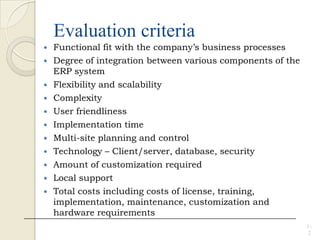
Evaluation criteria
 Functional fit with the company’s business processes
 Degree of integration between various components of the
ERP system
 Flexibility and scalability
 Complexity
 User friendliness
 Implementation time
 Multi-site planning and control
 Technology – Client/server, database, security
 Amount of customization required
 Local support
 Total costs including costs of license, training,
implementation, maintenance, customization and
hardware requirements
1 -
2
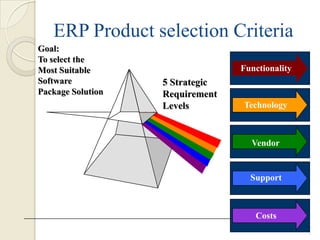
ERP Product selection Criteria
1 -
3
Technology
Support
Costs
5 Strategic
Requirement
Levels
Functionality
Goal:
To select the
Most Suitable
Software
Package Solution
Vendor
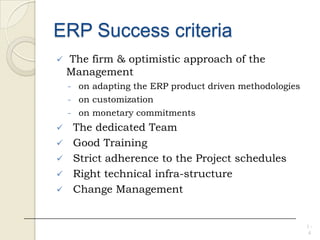
ERP Success criteria
 The firm & optimistic approach of the
Management
- on adapting the ERP product driven methodologies
- on customization
- on monetary commitments
 The dedicated Team
 Good Training
 Strict adherence to the Project schedules
 Right technical infra-structure
 Change Management
1 -
4
ERP Benefits
 Easier access to reliable information
 Automate tasks to perform various
business functions
 Elimination of redundant data and
software packages
 Improved communication between
departments, internal and external
organizations
 Better capabilities of forecasting,
planning, scheduling, and control 1 -
5
Reduced Time
 Reduction of lead-time (Supplier Side)
◦ The elapsed time between placing an order and
receiving is known as the lead time.
 Reduction in cycle time (Customer Side)
◦ The time between receipt of the order and delivery of
the product
 On-time shipment
1 -
6
Improved Customer satisfaction
 Whether the product or service includes
the features that are most important to
the customer
 Whether the company can respond to
the customer’s demands in a timely
manner, a criterion that is especially
important for custom products and
services
 Whether the product or service is free of
defects and performs as expected
1 -
7
Reduction in quality costs
 Internal failures costs – costs of scrap, rework,
re-inspection and low production yields for non-
conforming items that are detected before they
leave the company
 External failure costs – Warranty claims, repairs
and service costs that are result when the
failures are detected in the market place
 Appraisal costs – costs of inspection on arrival,
during manufacturing, in laboratory tests, and
by outside inspectors
 Prevention costs – design and development of
new quality equipment, evaluation costs of a
new product or a service, training of quality
personnel 1 -
8
Improved resource utility
 The efficient functioning of the different
modules in the ERP ensures that
◦ the inventory is kept to a minimum level,
◦ the machine down time is minimum,
◦ the goods are produced only as per the
demand
◦ and the finished goods are delivered to the
customer in the most efficient way
 Thus, the ERP systems help the
organization in drastically improving the
capacity and resource utilization
1 -
9
Increased flexibility
 Flexibility of the organization as a
whole by automating most of the
processes
 Organizations will need to design
new products or redesign existing
products quickly and efficiently
 Product flexibility is the ability of
the operation to efficiently produce
highly customized and unique
products 1 -
10
Improved information accuracy and
decision-making capability
 To survive, thrive and beat the
competition in today’s competitive world,
one has to manage the future
 Managing the future means managing
the information
 organizations have to harness IT’s full
potential
◦ to deliver high quality information to the
decision-makers at the right time
◦ to automate the process of data collection,
collation and refinement
1 -
11
1 -
12

Erp selection criteria - uwsb

  • 1.
  • 2.
    Evaluation criteria  Functionalfit with the company’s business processes  Degree of integration between various components of the ERP system  Flexibility and scalability  Complexity  User friendliness  Implementation time  Multi-site planning and control  Technology – Client/server, database, security  Amount of customization required  Local support  Total costs including costs of license, training, implementation, maintenance, customization and hardware requirements 1 - 2
  • 3.
    ERP Product selectionCriteria 1 - 3 Technology Support Costs 5 Strategic Requirement Levels Functionality Goal: To select the Most Suitable Software Package Solution Vendor
  • 4.
    ERP Success criteria The firm & optimistic approach of the Management - on adapting the ERP product driven methodologies - on customization - on monetary commitments  The dedicated Team  Good Training  Strict adherence to the Project schedules  Right technical infra-structure  Change Management 1 - 4
  • 5.
    ERP Benefits  Easieraccess to reliable information  Automate tasks to perform various business functions  Elimination of redundant data and software packages  Improved communication between departments, internal and external organizations  Better capabilities of forecasting, planning, scheduling, and control 1 - 5
  • 6.
    Reduced Time  Reductionof lead-time (Supplier Side) ◦ The elapsed time between placing an order and receiving is known as the lead time.  Reduction in cycle time (Customer Side) ◦ The time between receipt of the order and delivery of the product  On-time shipment 1 - 6
  • 7.
    Improved Customer satisfaction Whether the product or service includes the features that are most important to the customer  Whether the company can respond to the customer’s demands in a timely manner, a criterion that is especially important for custom products and services  Whether the product or service is free of defects and performs as expected 1 - 7
  • 8.
    Reduction in qualitycosts  Internal failures costs – costs of scrap, rework, re-inspection and low production yields for non- conforming items that are detected before they leave the company  External failure costs – Warranty claims, repairs and service costs that are result when the failures are detected in the market place  Appraisal costs – costs of inspection on arrival, during manufacturing, in laboratory tests, and by outside inspectors  Prevention costs – design and development of new quality equipment, evaluation costs of a new product or a service, training of quality personnel 1 - 8
  • 9.
    Improved resource utility The efficient functioning of the different modules in the ERP ensures that ◦ the inventory is kept to a minimum level, ◦ the machine down time is minimum, ◦ the goods are produced only as per the demand ◦ and the finished goods are delivered to the customer in the most efficient way  Thus, the ERP systems help the organization in drastically improving the capacity and resource utilization 1 - 9
  • 10.
    Increased flexibility  Flexibilityof the organization as a whole by automating most of the processes  Organizations will need to design new products or redesign existing products quickly and efficiently  Product flexibility is the ability of the operation to efficiently produce highly customized and unique products 1 - 10
  • 11.
    Improved information accuracyand decision-making capability  To survive, thrive and beat the competition in today’s competitive world, one has to manage the future  Managing the future means managing the information  organizations have to harness IT’s full potential ◦ to deliver high quality information to the decision-makers at the right time ◦ to automate the process of data collection, collation and refinement 1 - 11
  • 12.