Continuous Distillation with Reflux
Material Balance Diagram
Boiling point Diagram
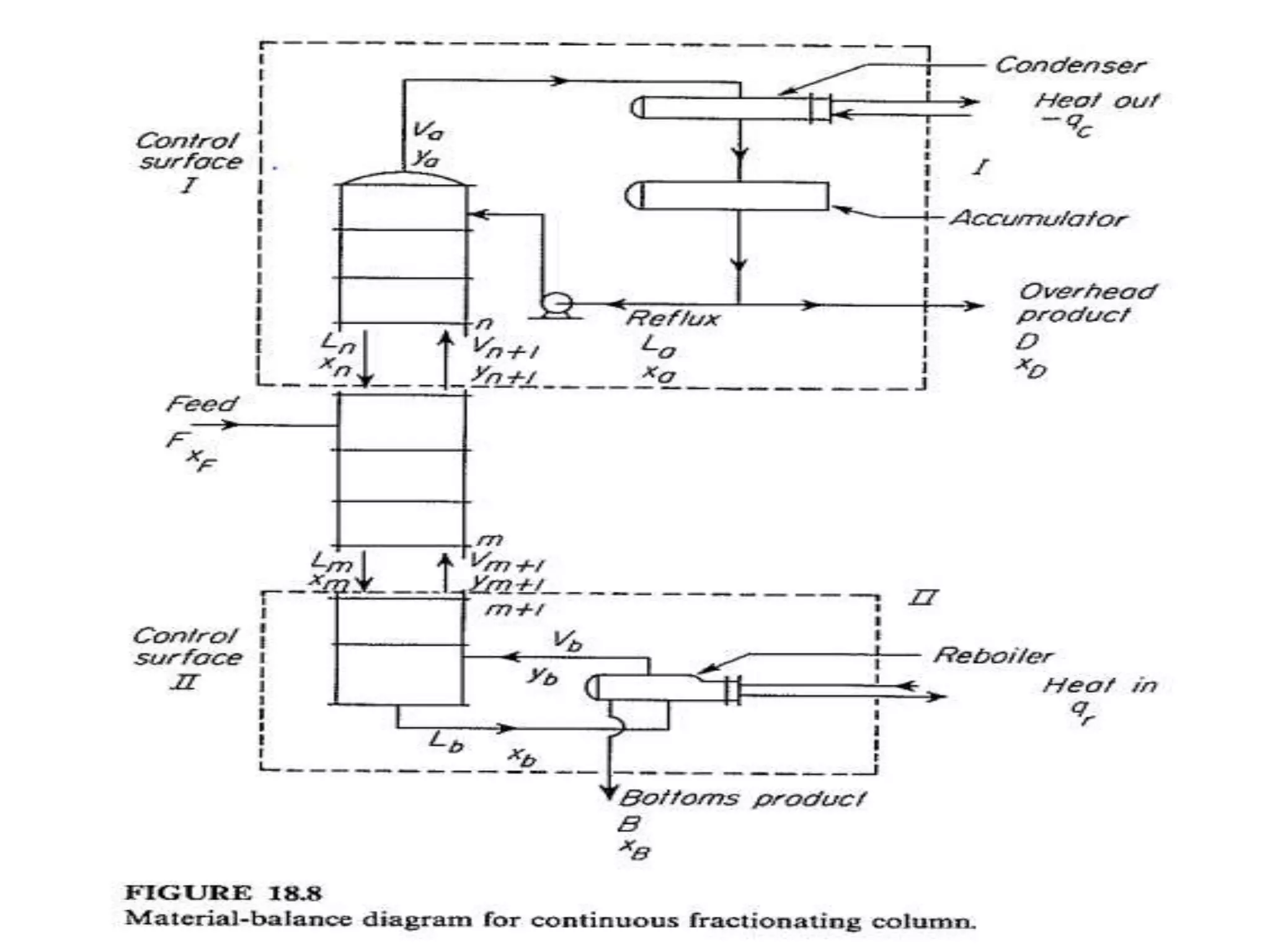
Material Balance Diagram for continuous
fractionation column
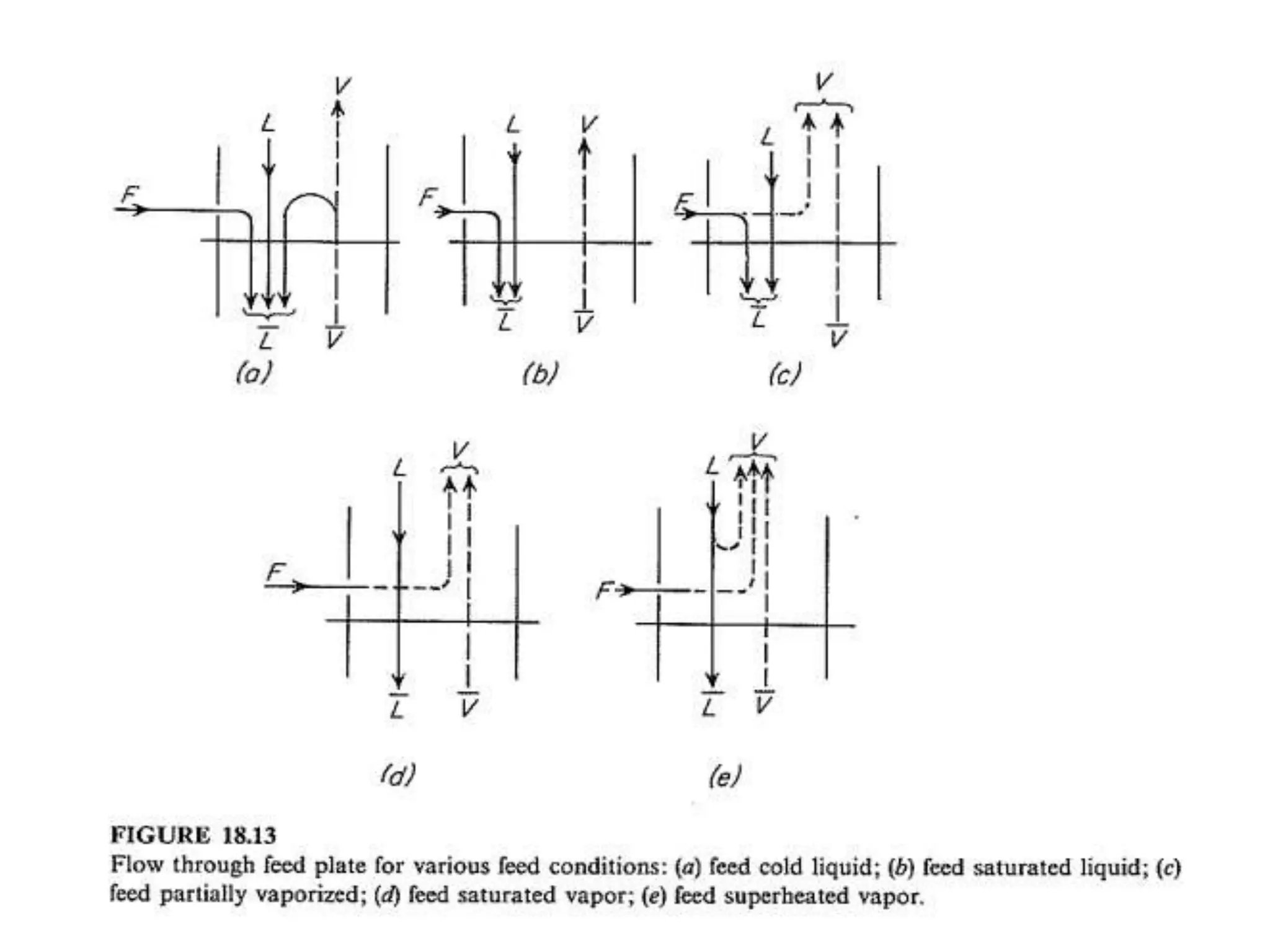
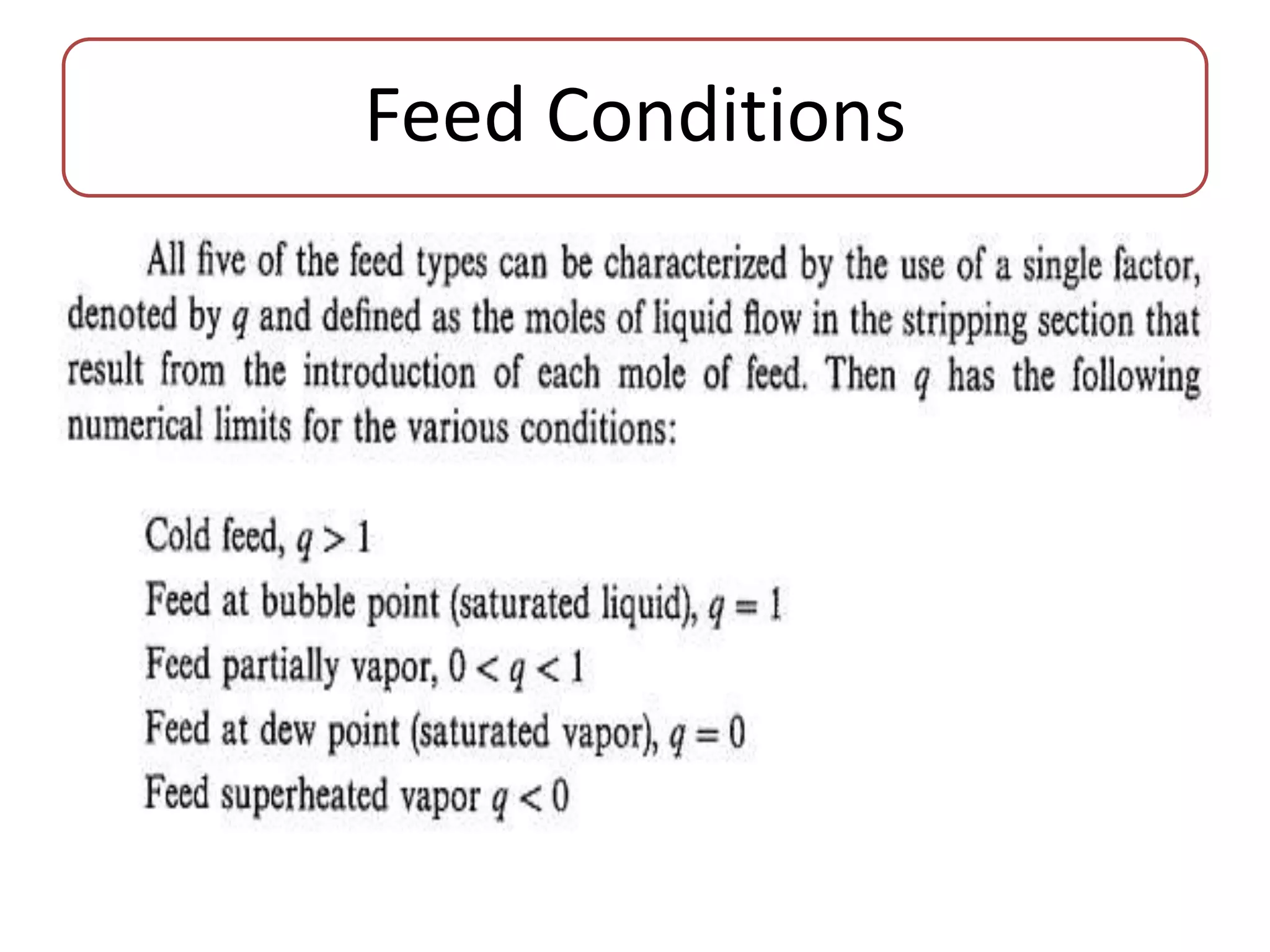
Feed Condition
Pressure Drop and Flooding
Lec No……!
01 to 22th August_2017
Engr. Hafiz Anees Rehman
Quest, nawab shah
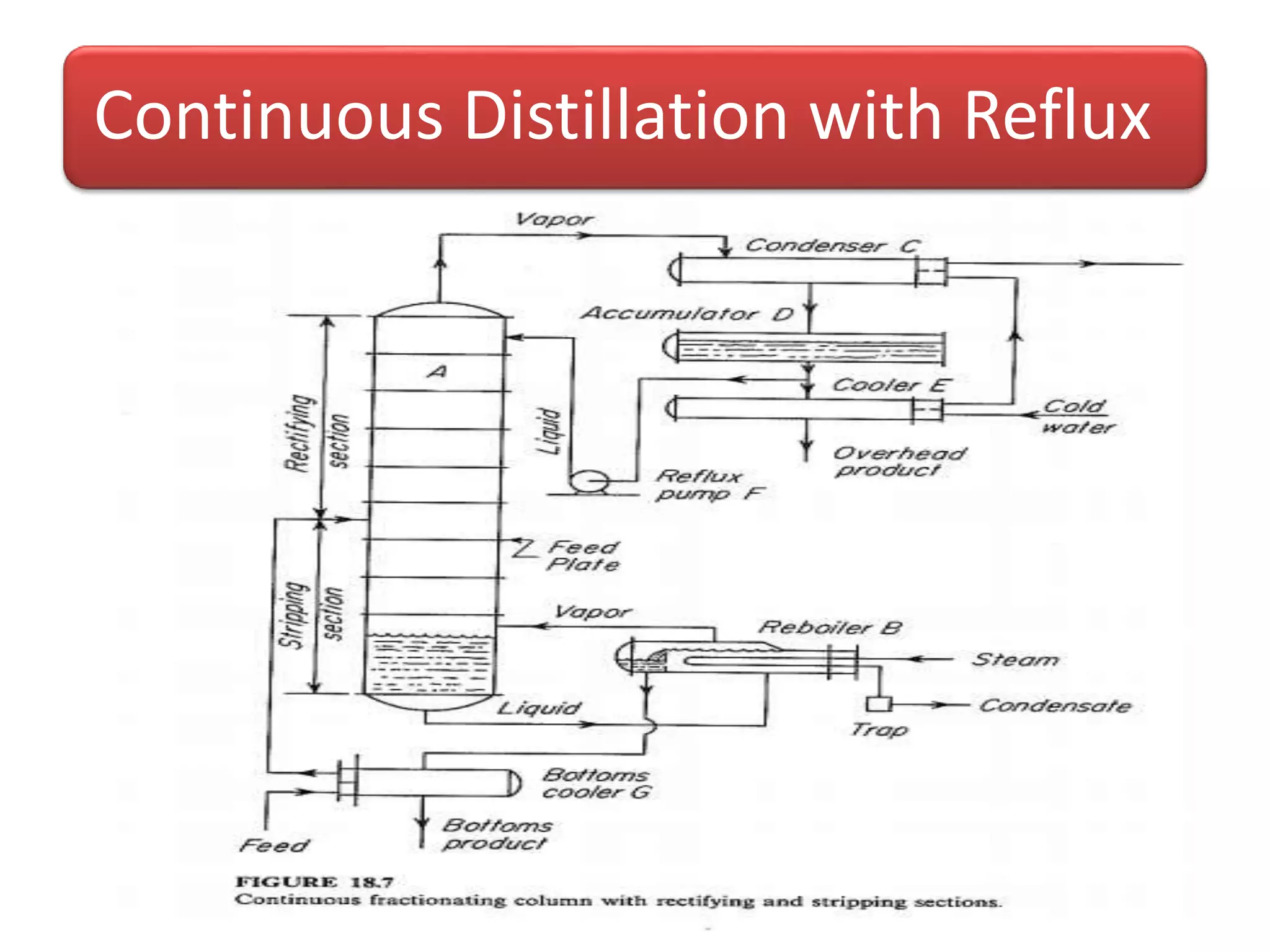
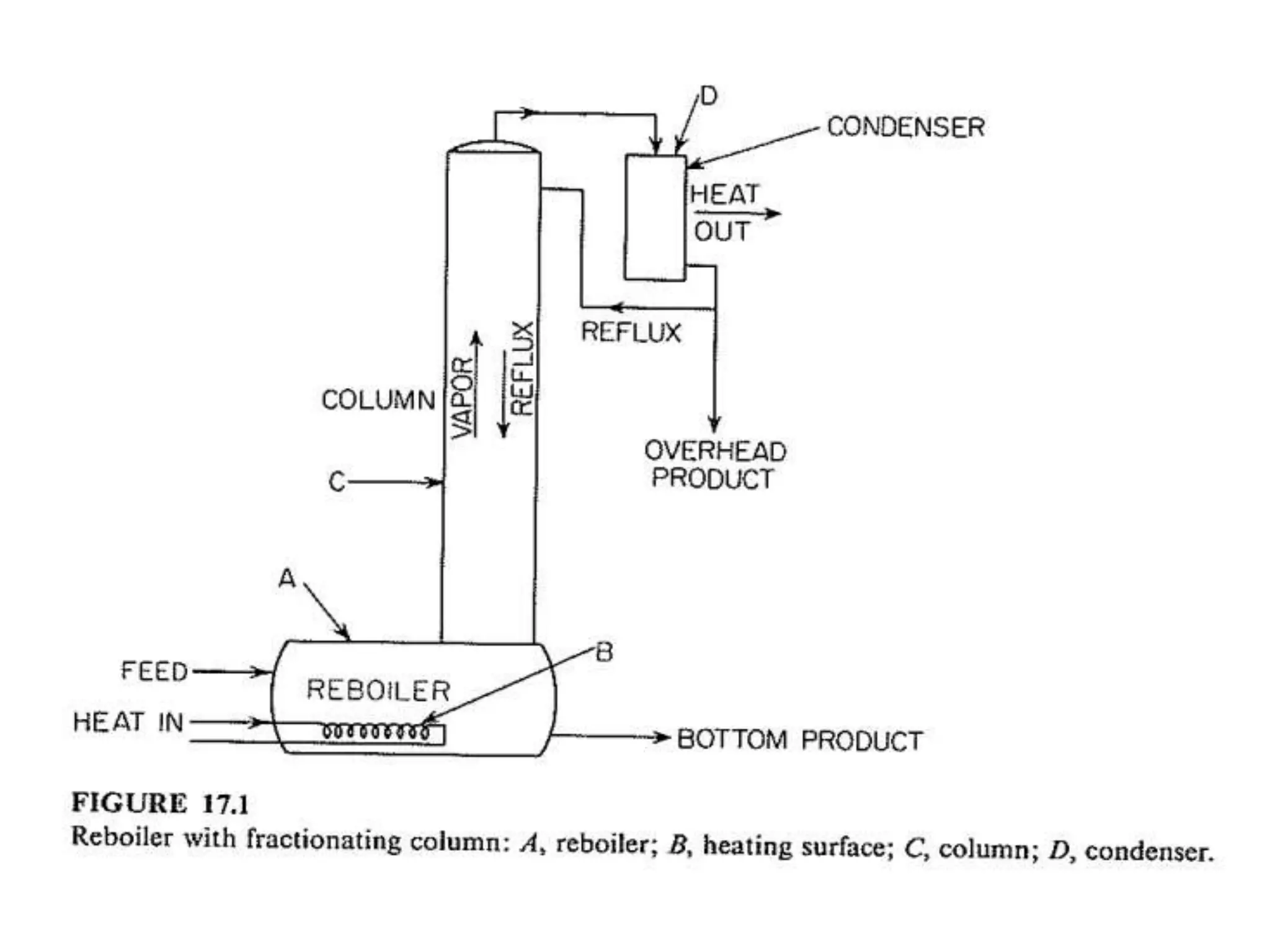
Continuous Distillation with Reflux
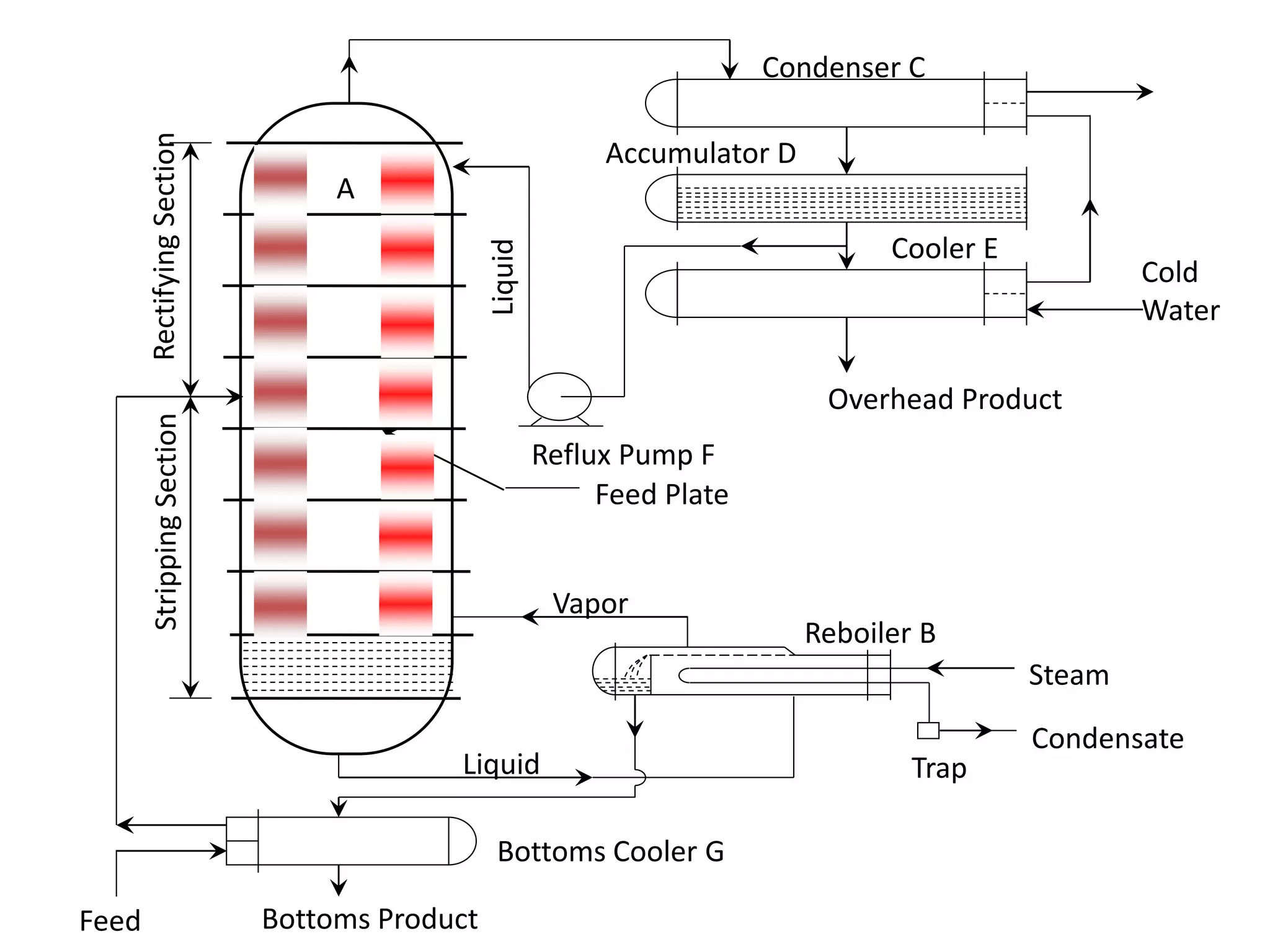
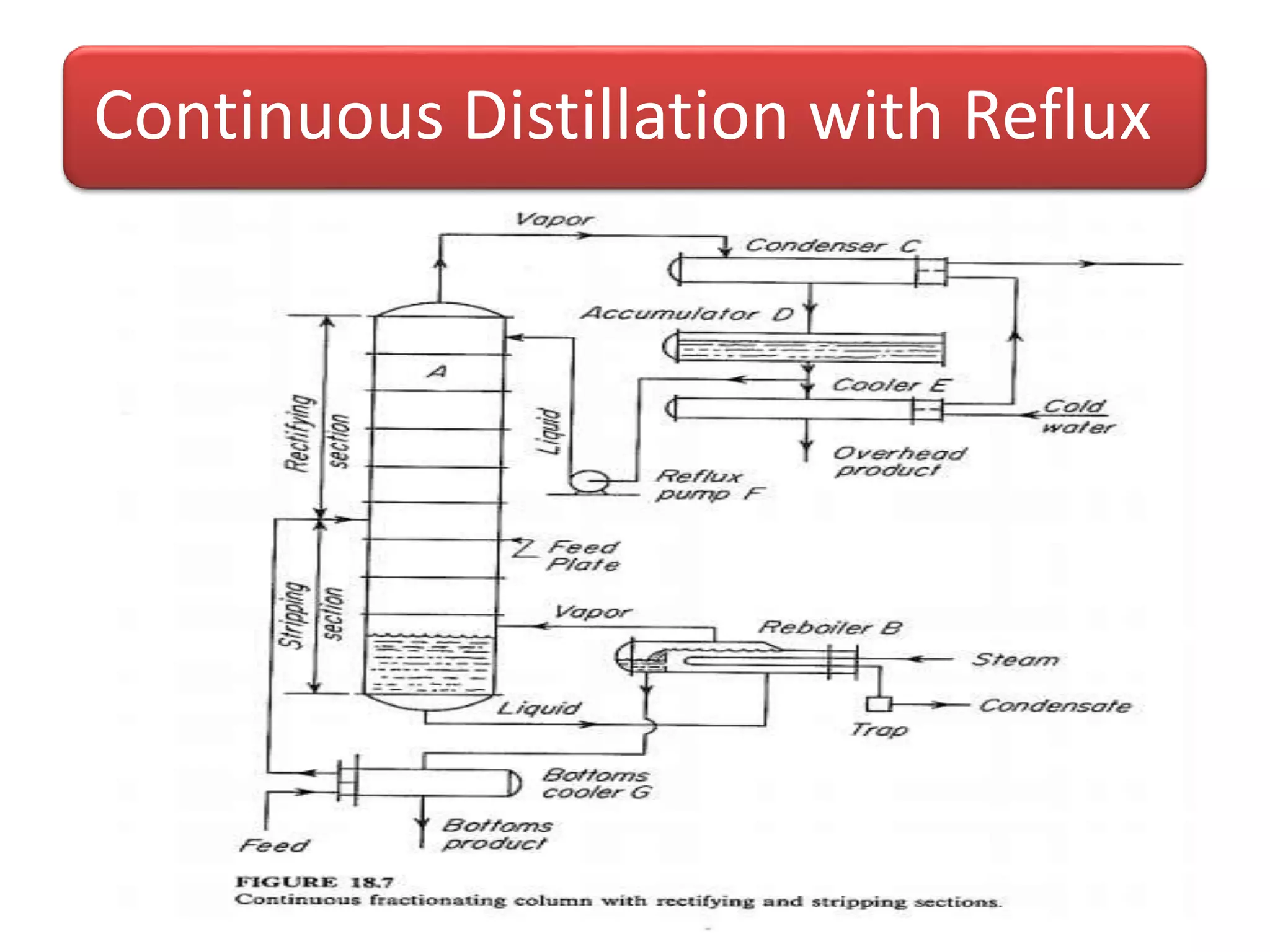
StrippingSectionRectifyingSection
Condenser C
Accumulator D
Cooler E
Overhead Product
Cold
Water
Reflux Pump F
Liquid
Reboiler B
Steam
Condensate
Trap
Vapor
Liquid
Feed Bottoms Product
Bottoms Cooler G
Feed Plate
A
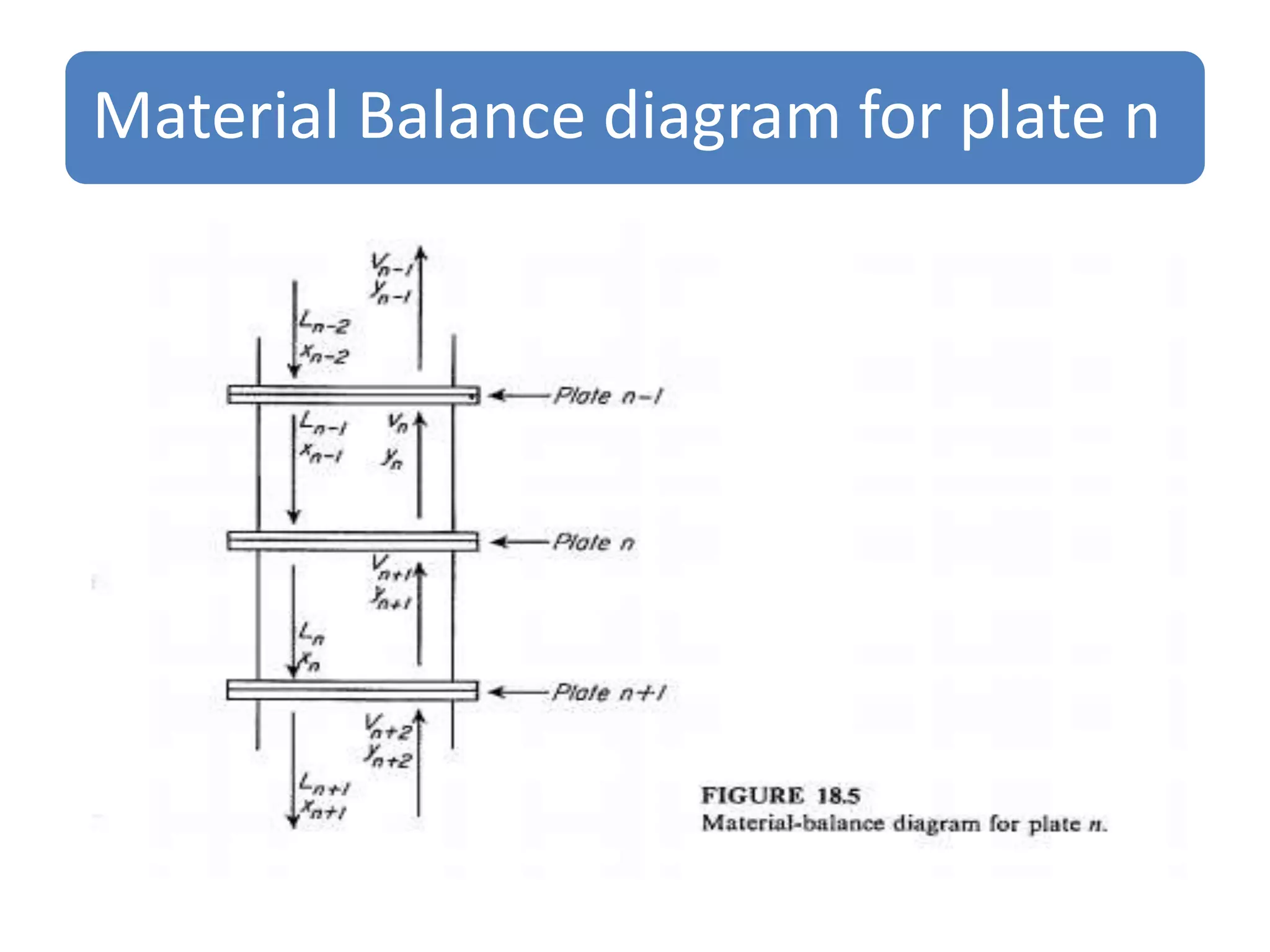
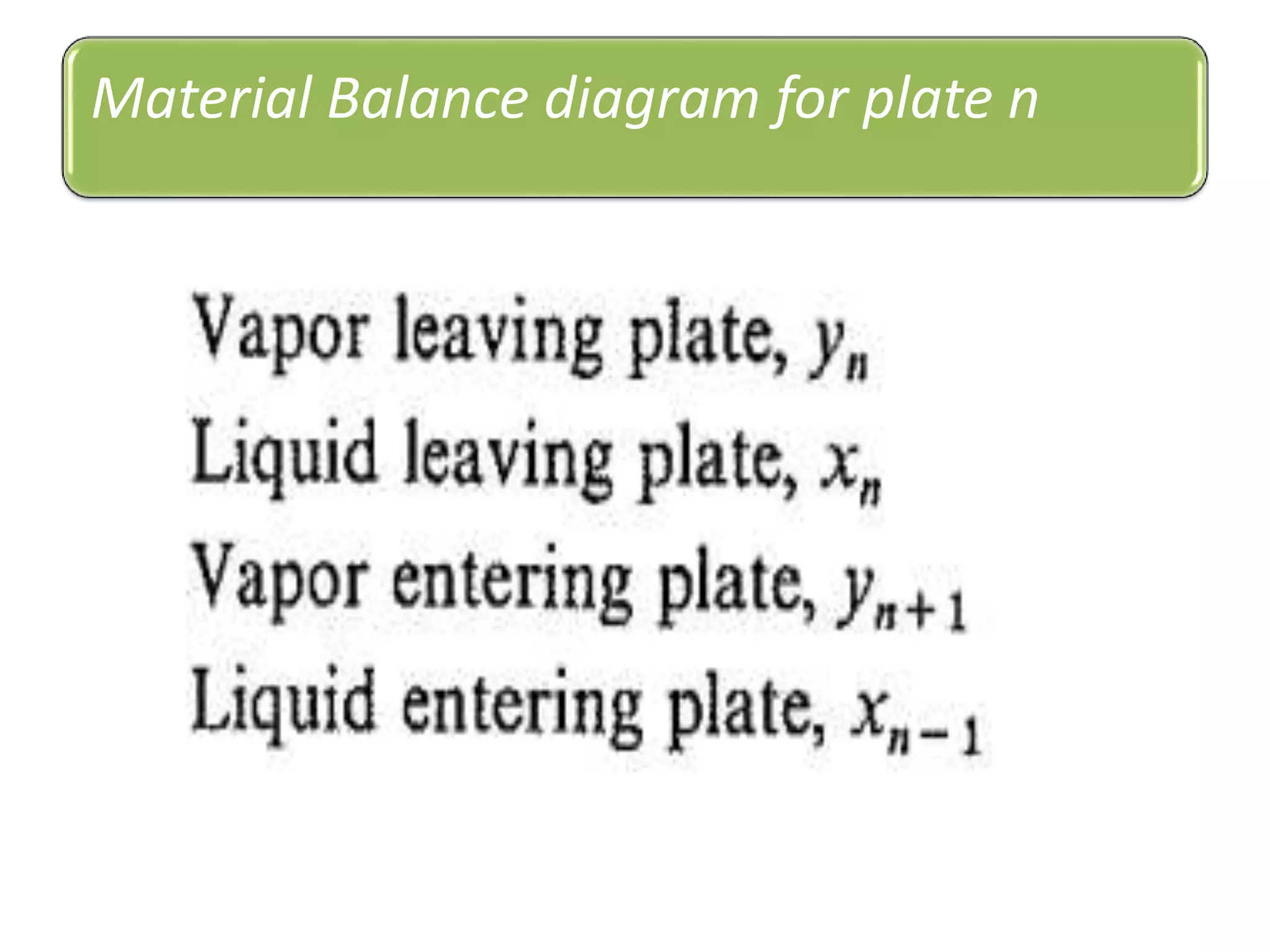
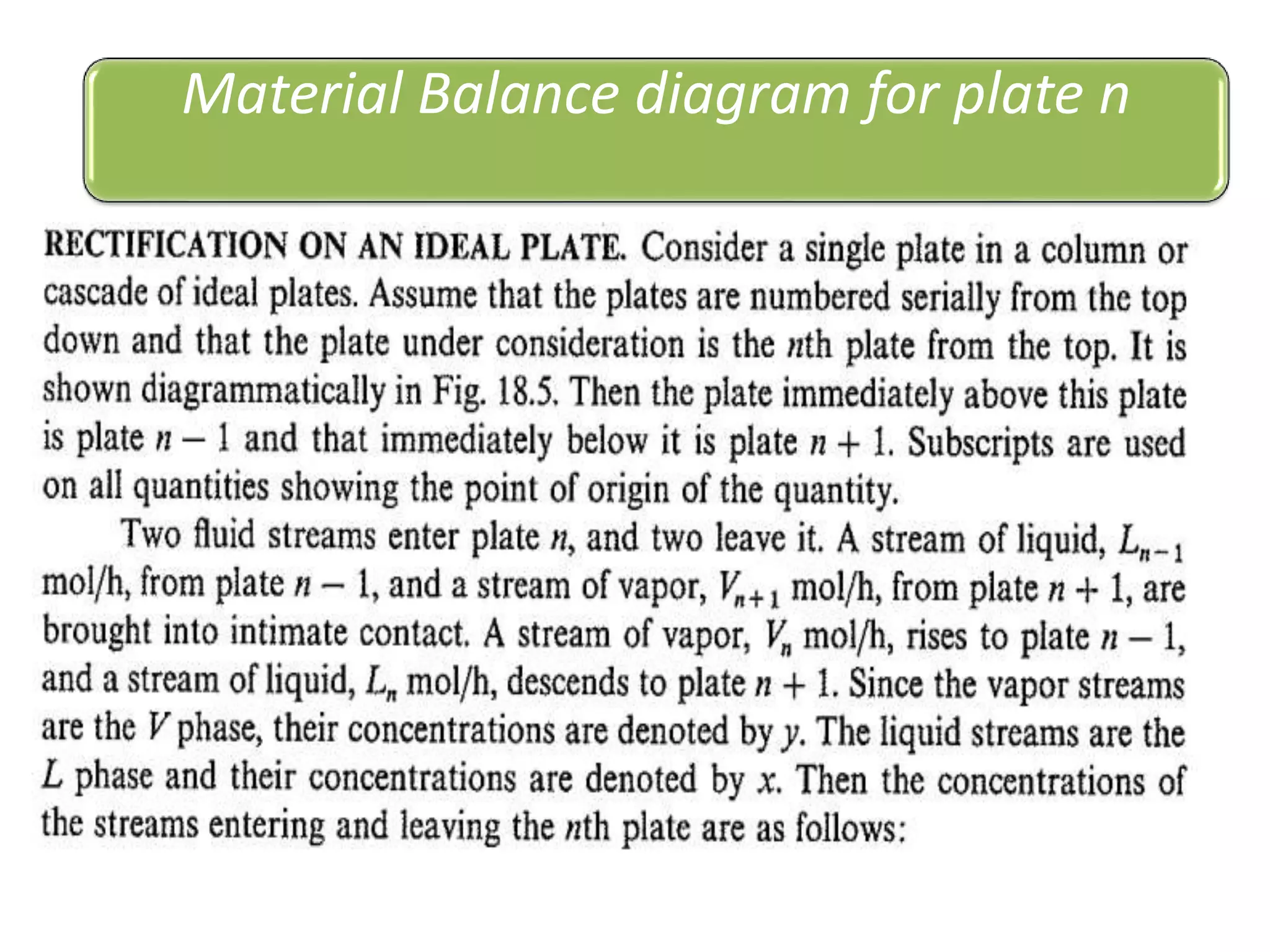
Material Balance diagram for plate n
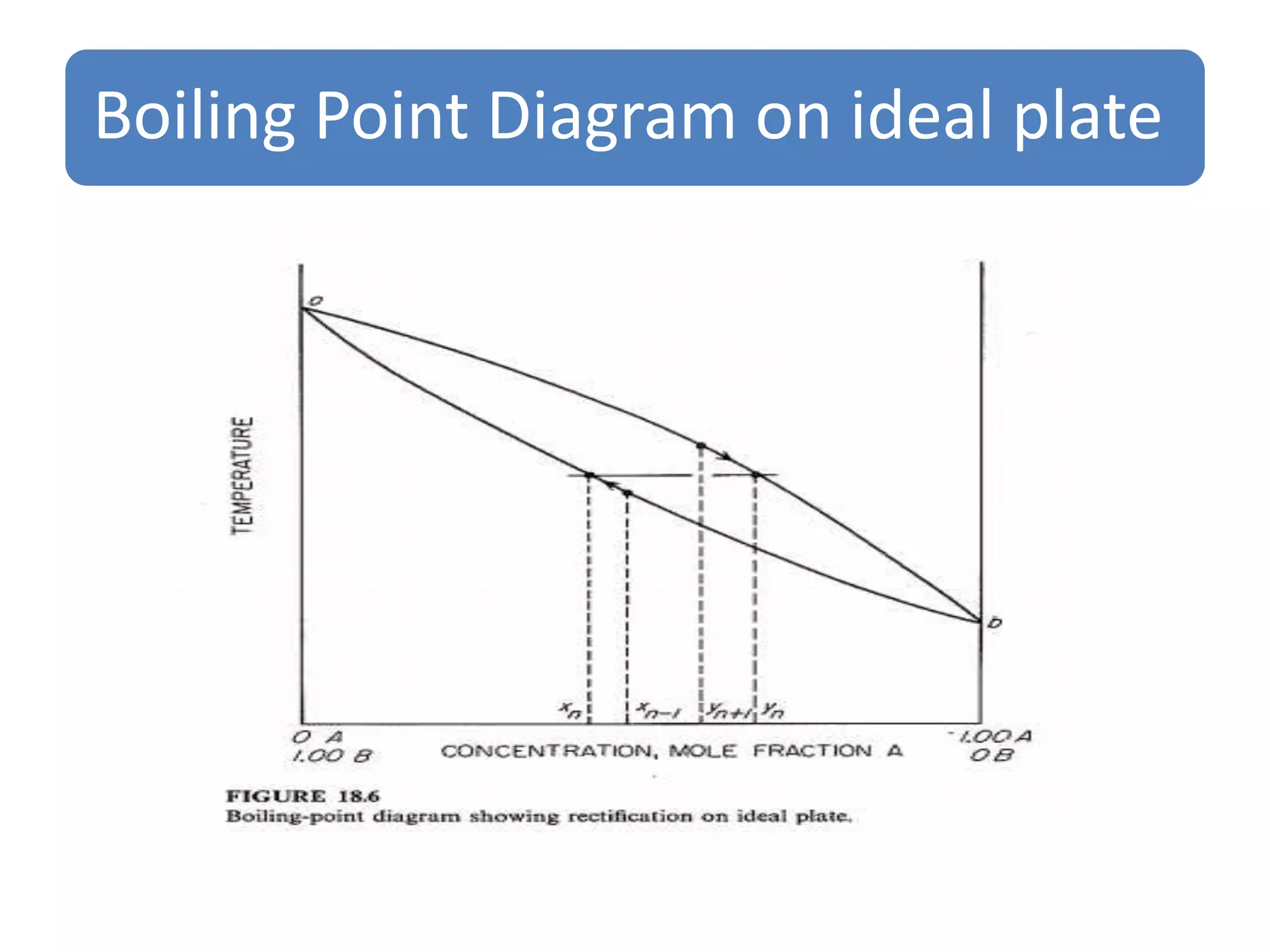
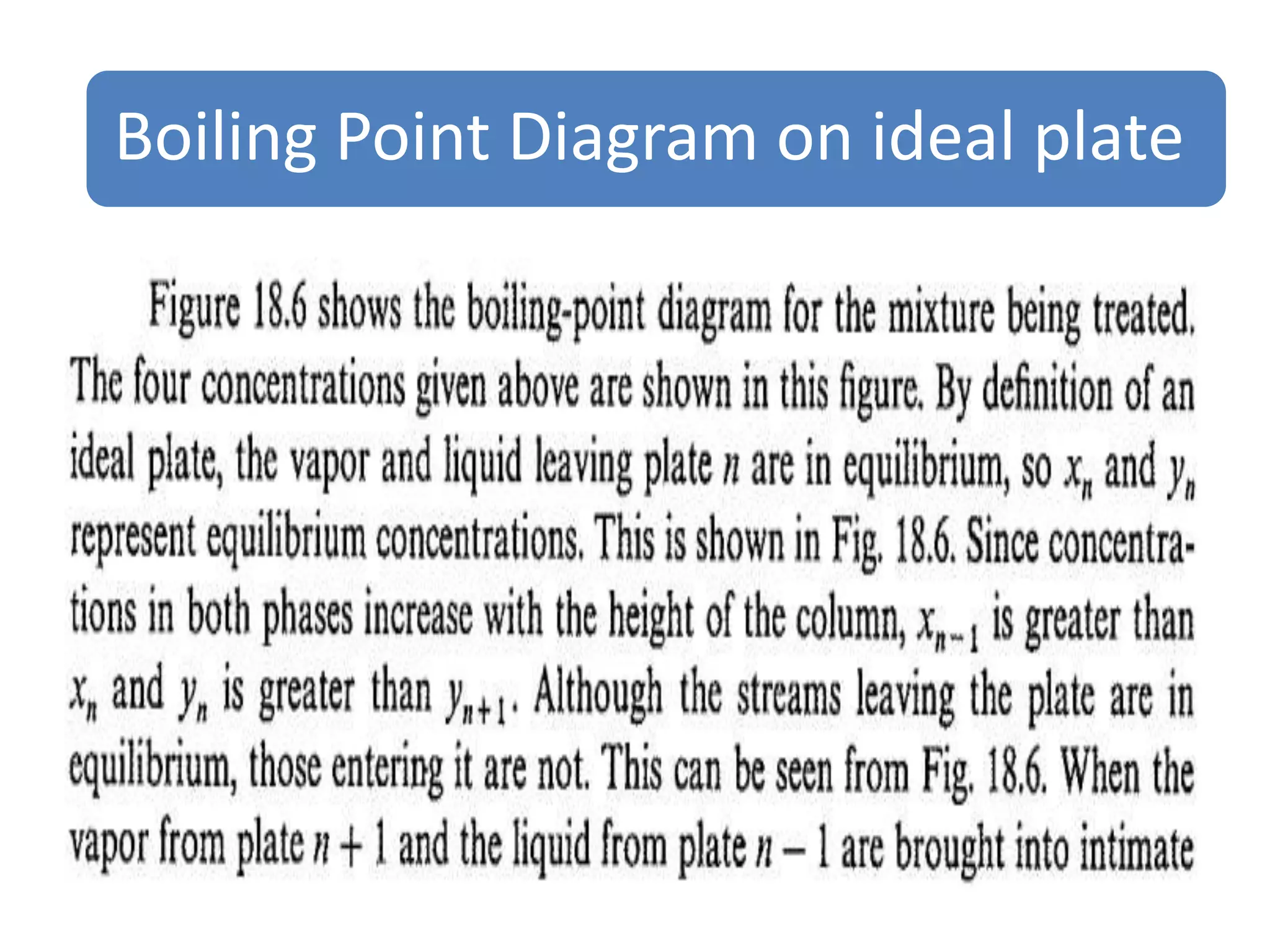
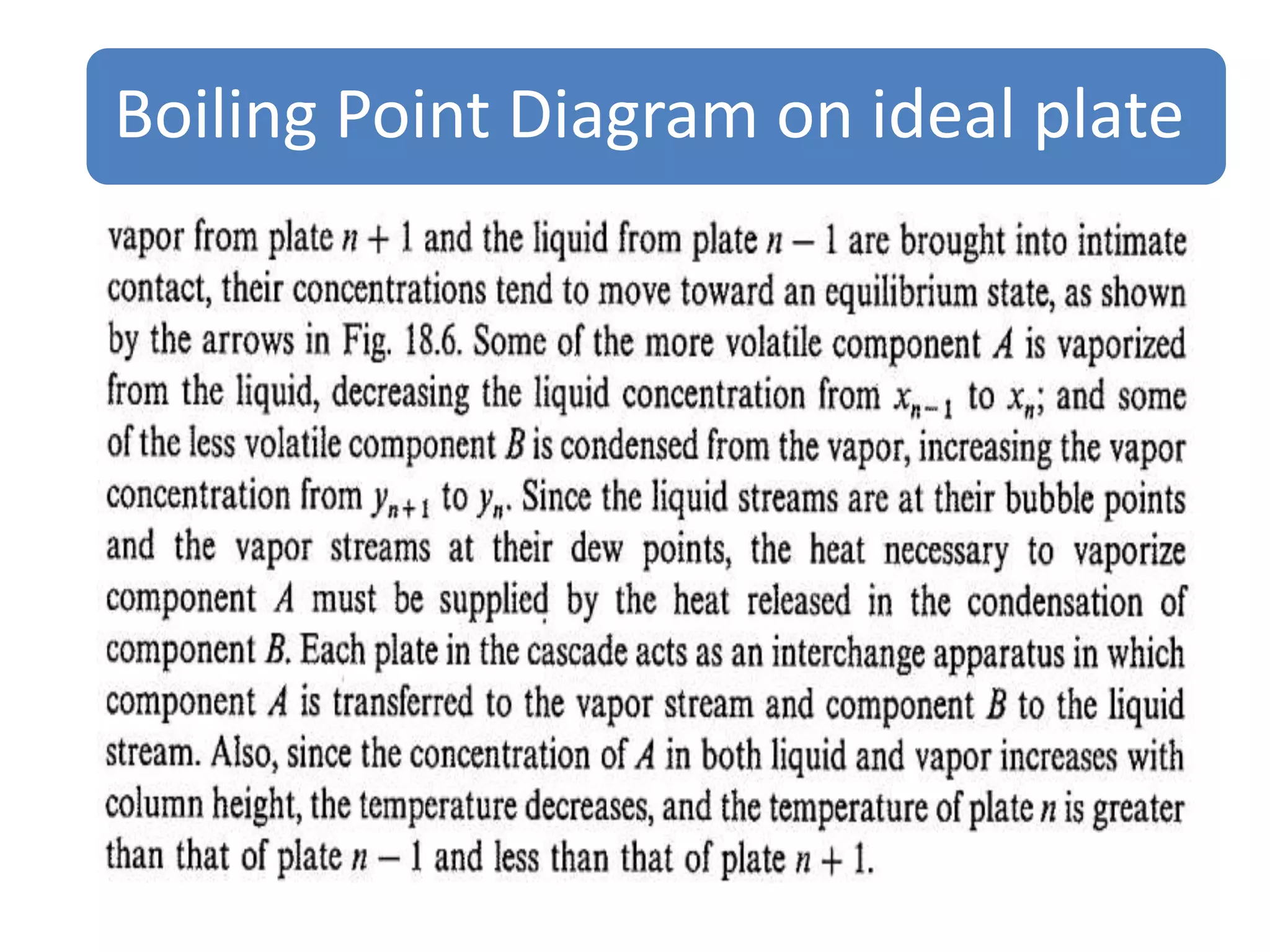
Boiling Point Diagram on ideal plate
Continuous Distillation with Reflux
Lec No …
3rd August 2017…..!
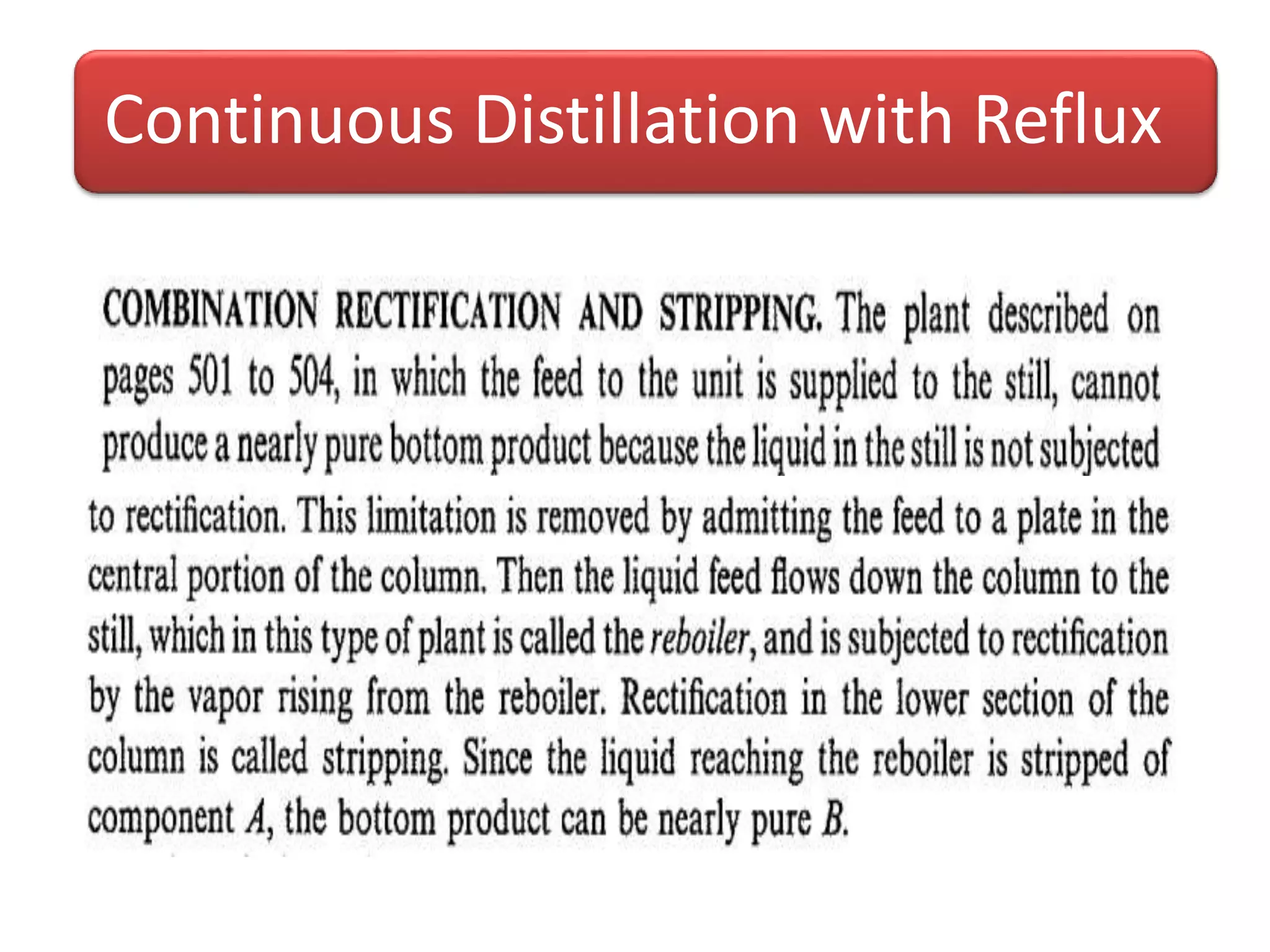
Continuous Distillation with Reflux
Lec No…..!
8th August 2017…..!
Material Balance diagram for
Continuous fractionating column
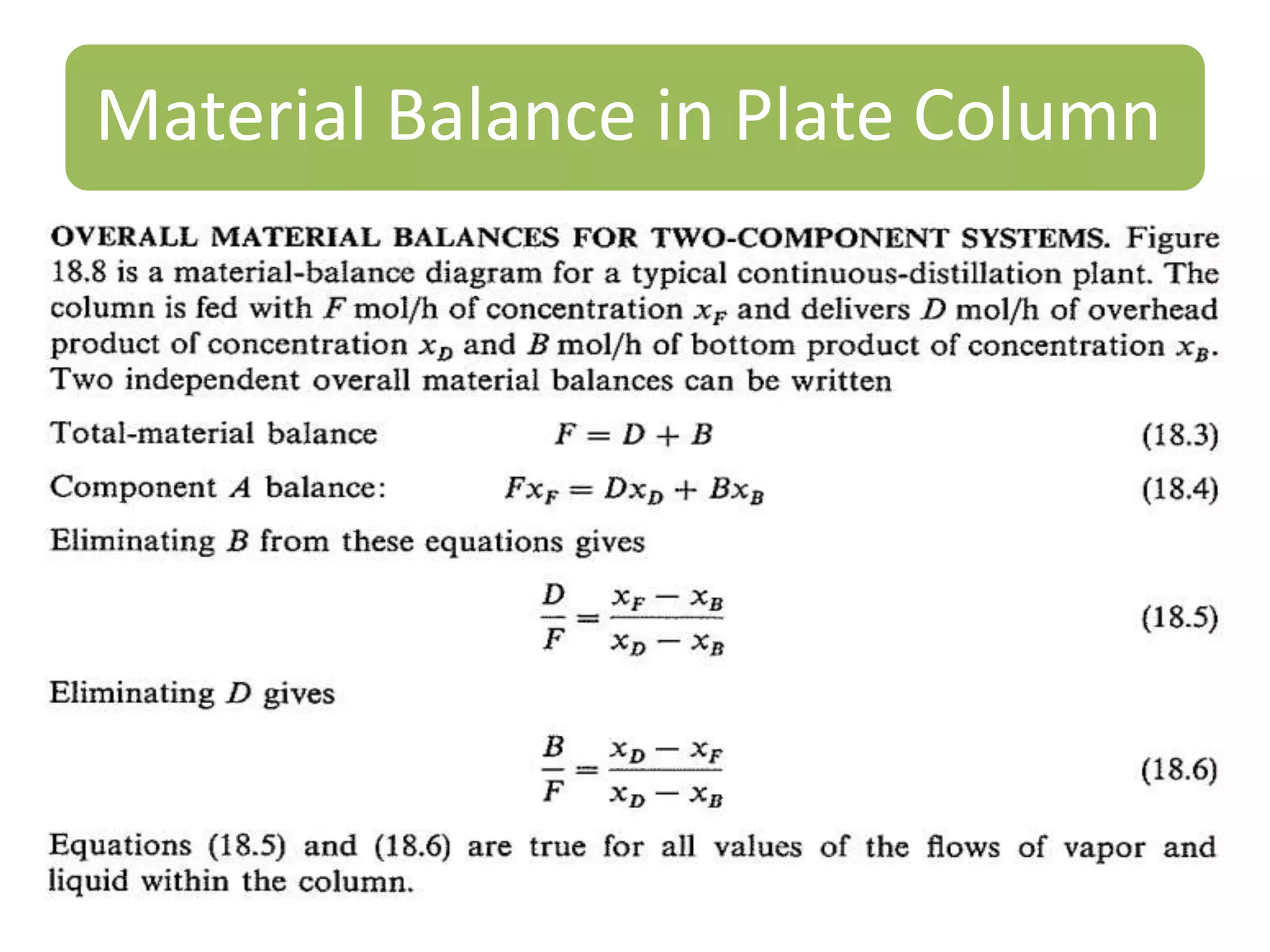
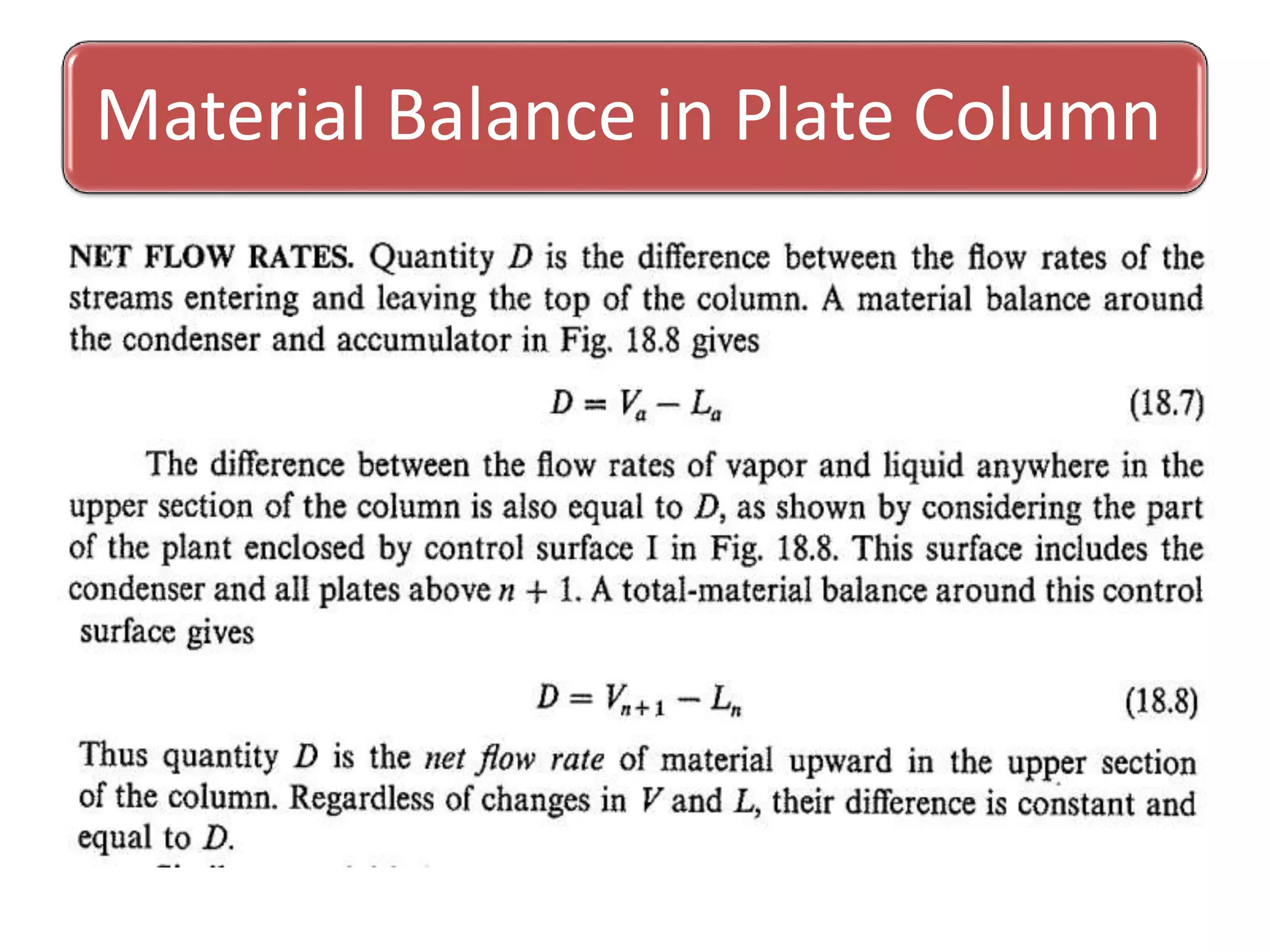
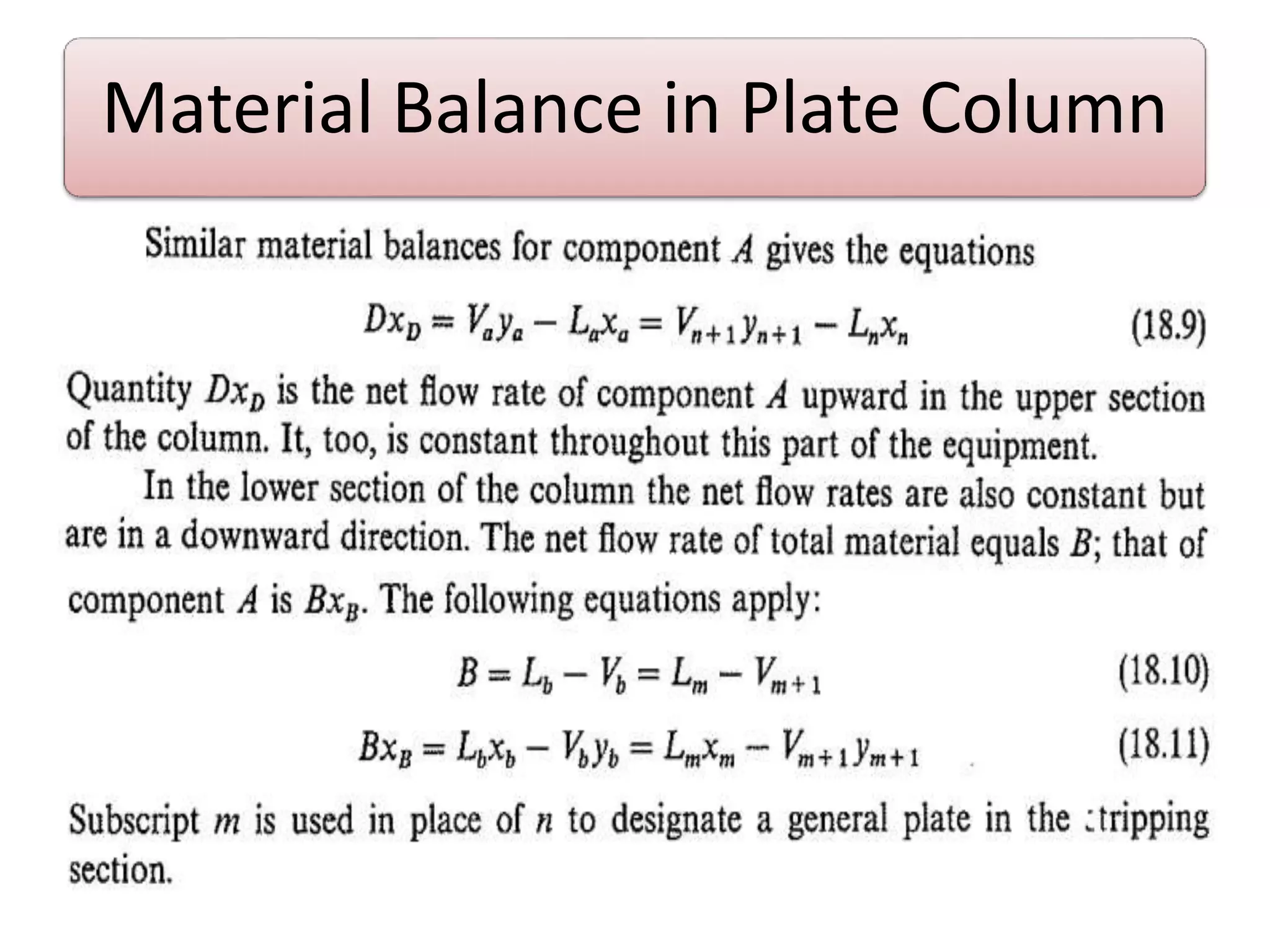
Material Balance in Plate Column
Thank You
Lec No….!
To be continue…Today..
15, 16th August 2017…..!
Tray Design
Bubble-cap Tray
Sieve tray Column
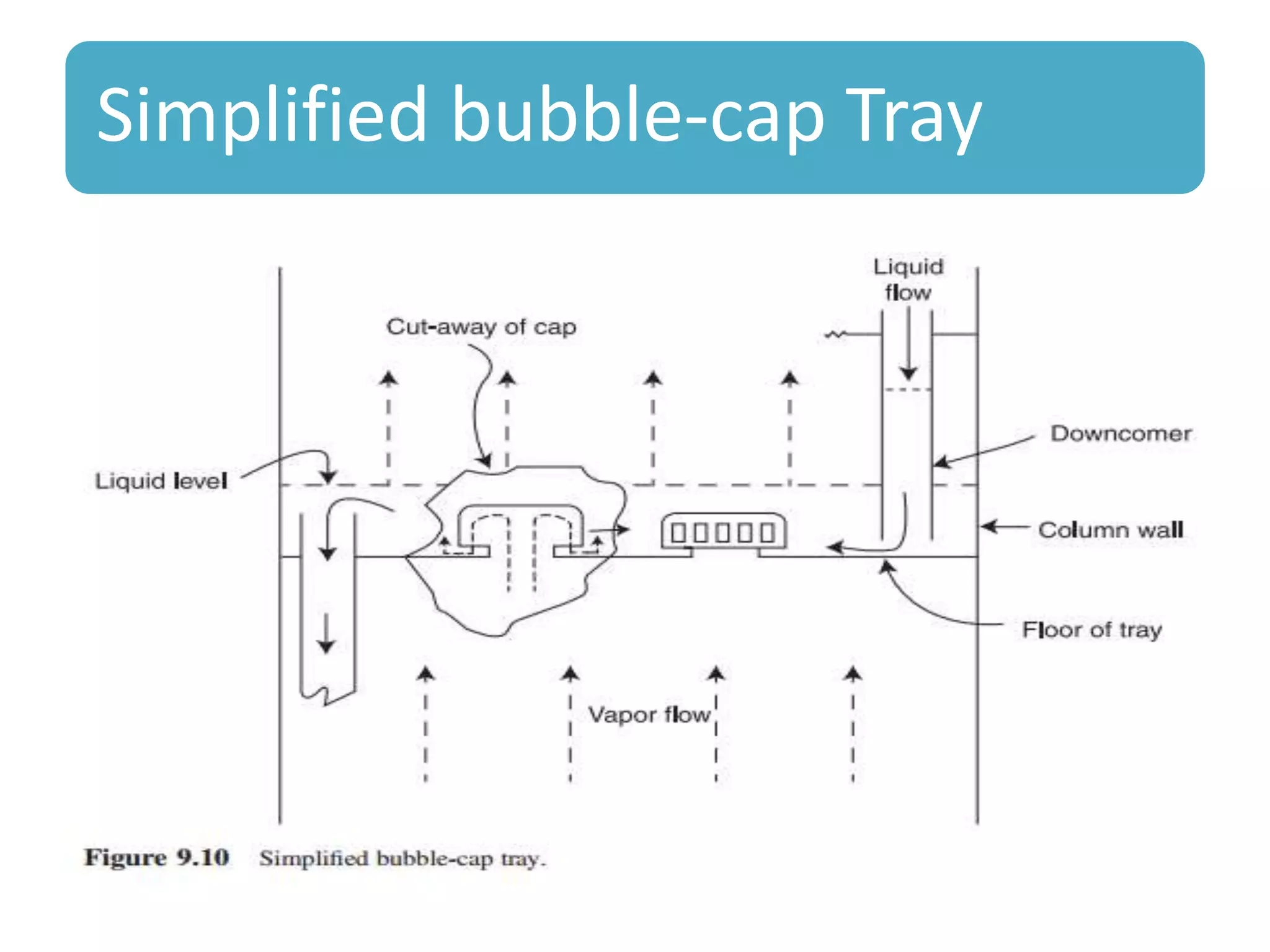
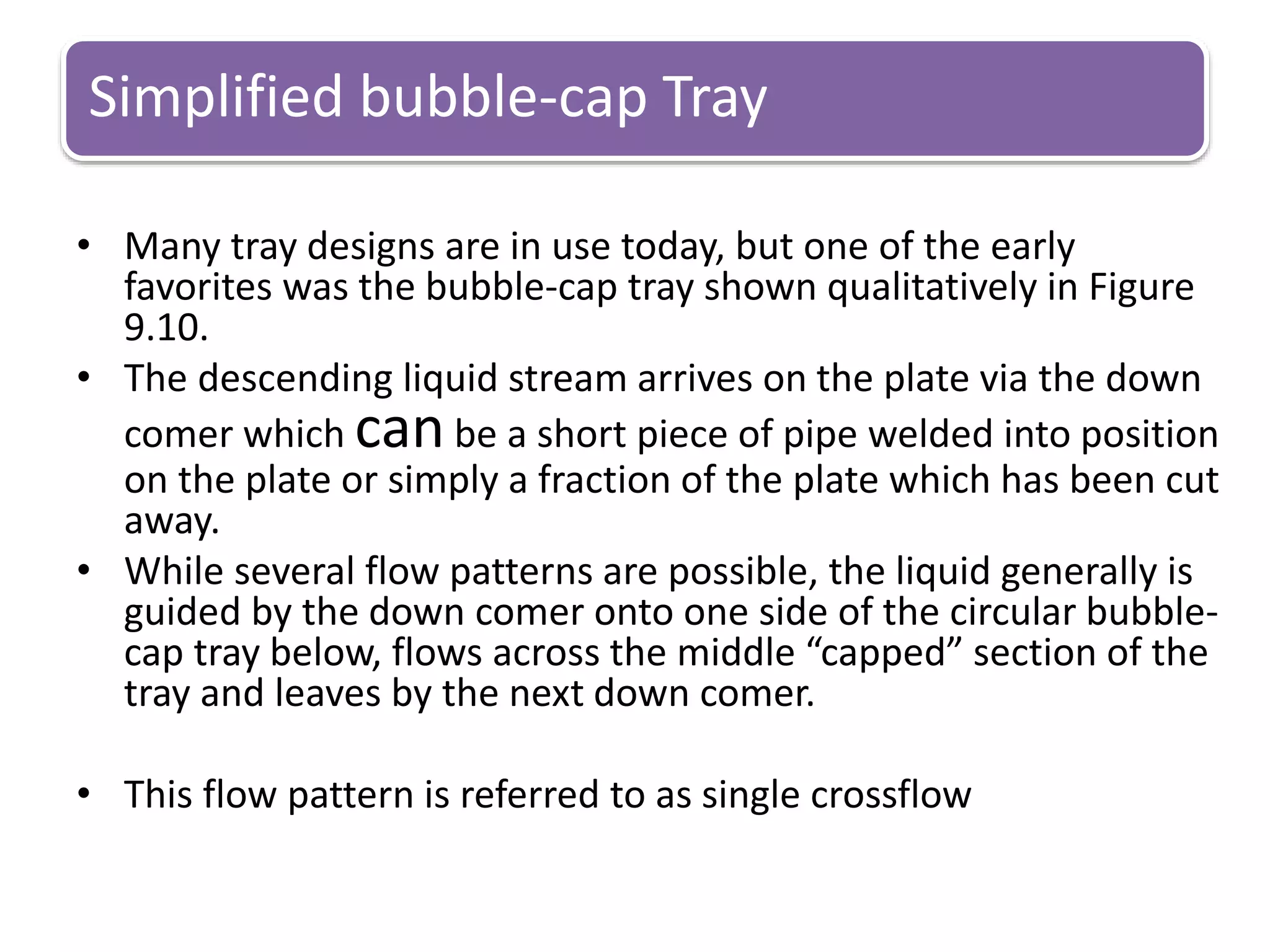
Simplified bubble-cap Tray
• Many tray designs are in use today, but one of the early
favorites was the bubble-cap tray shown qualitatively in Figure
9.10.
• The descending liquid stream arrives on the plate via the down
comer which canbe a short piece of pipe welded into position
on the plate or simply a fraction of the plate which has been cut
away.
• While several flow patterns are possible, the liquid generally is
guided by the down comer onto one side of the circular bubble-
cap tray below, flows across the middle “capped” section of the
tray and leaves by the next down comer.
• This flow pattern is referred to as single crossflow
Simplified bubble-cap Tray
• The exit to each downcomer must be located below the liquid level
on the plate below to create a vapor lock, preventing vapor from
rising in the downcomer.
• The contacting device on a bubble-cap tray is the bubble cap,
which consists of two parts—the riser and the cap.
• The riser is a short piece of pipe welded in place over a hole in the
plate.
• The cap, which surrounds the riser, is a bell-shaped piece containing
vertical slots around the lower periphery.
•
Simplified bubble-cap Tray
• The liquid level on the tray should be maintained
so as to submerge each cap, which also ensures a
vapor lock between trays.
• The vapor flows upward through the riser, makes
a 180 turn, and is forced under the cap and
through the slots to produce intimate contact
with the liquid
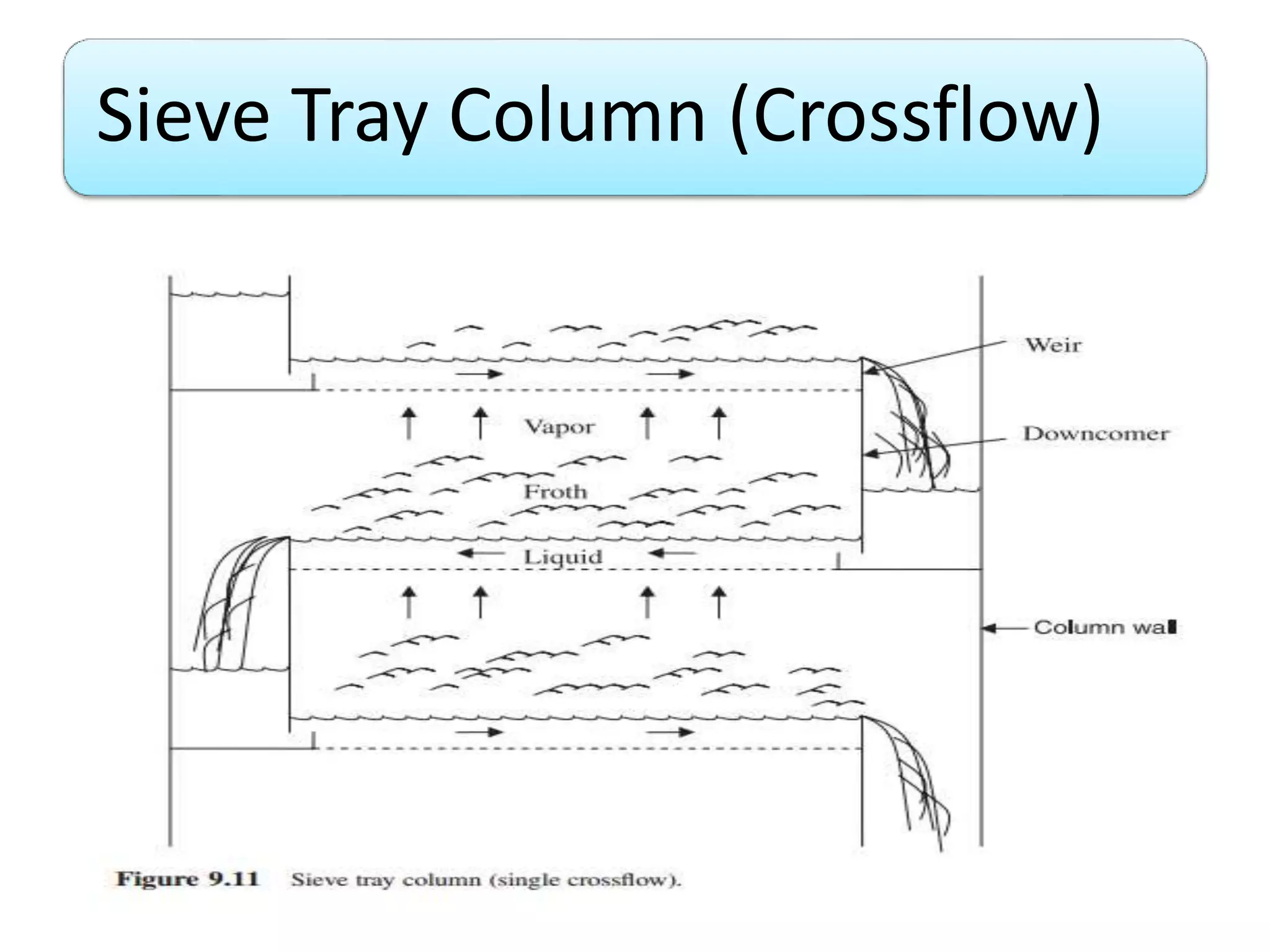
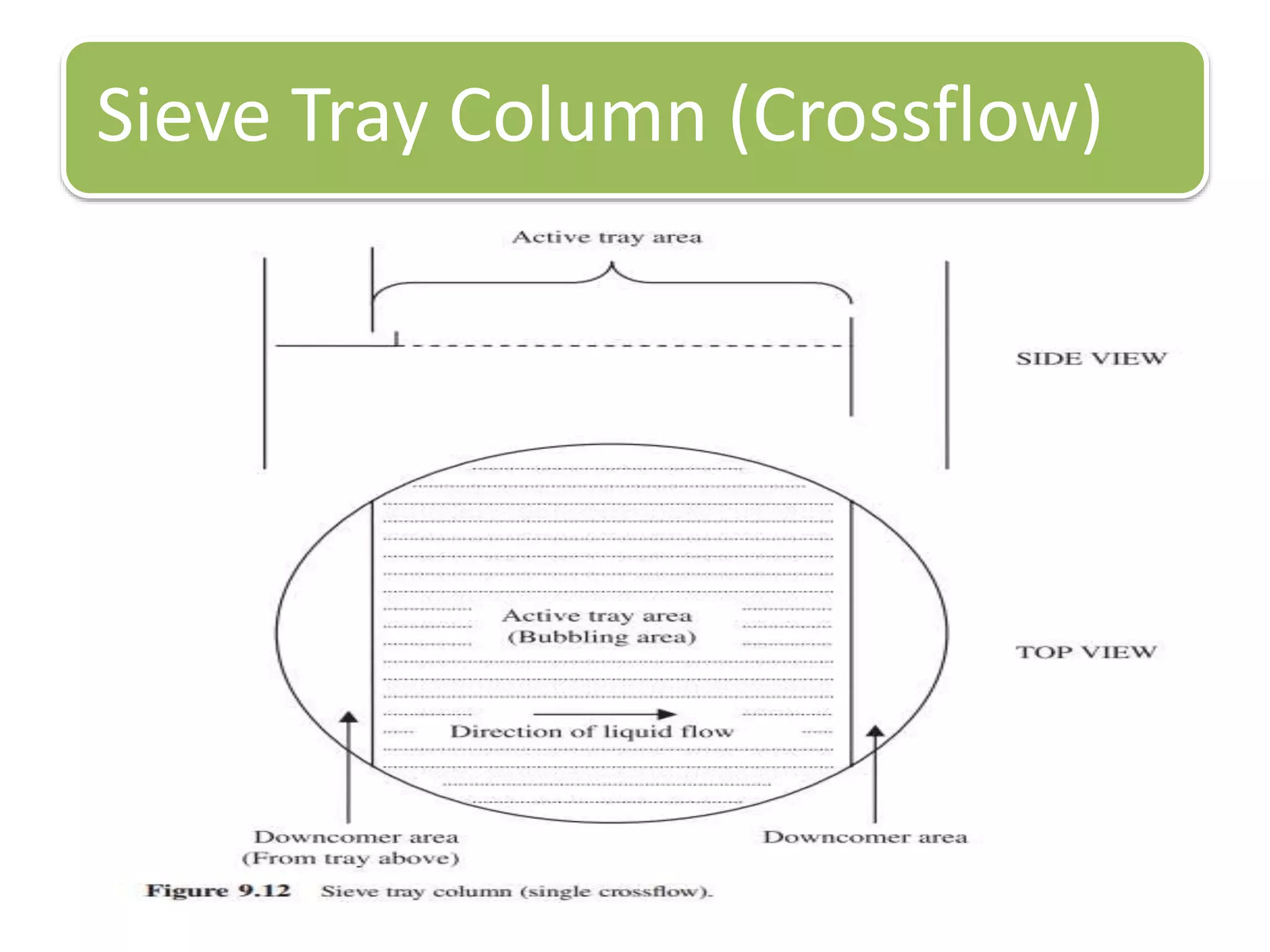
Sieve Tray Column (Crossflow)
Continuous Fractionating Column
Lec No…!
17th August 2017
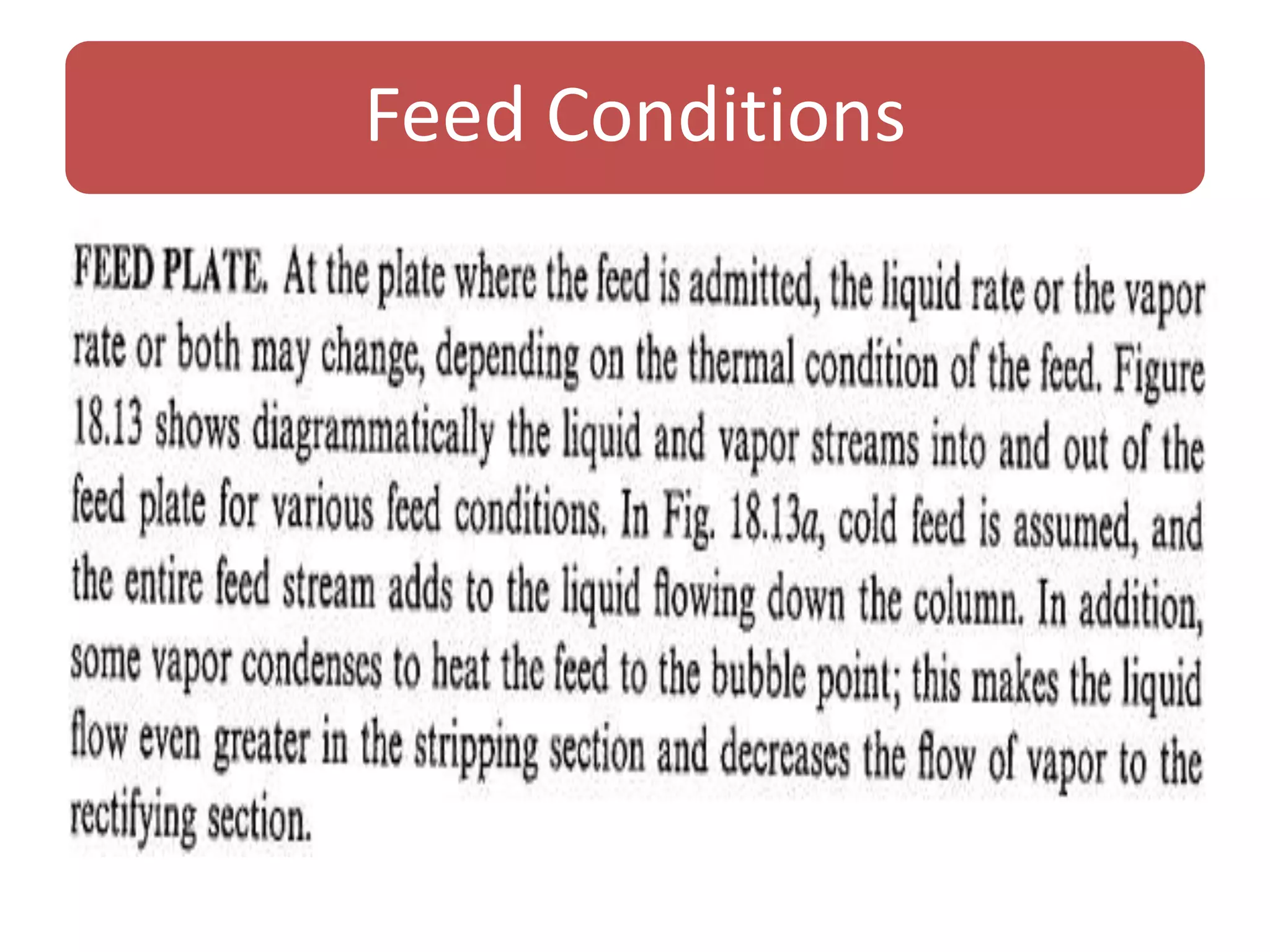
Feed Conditions
Topic
Feed Conditions
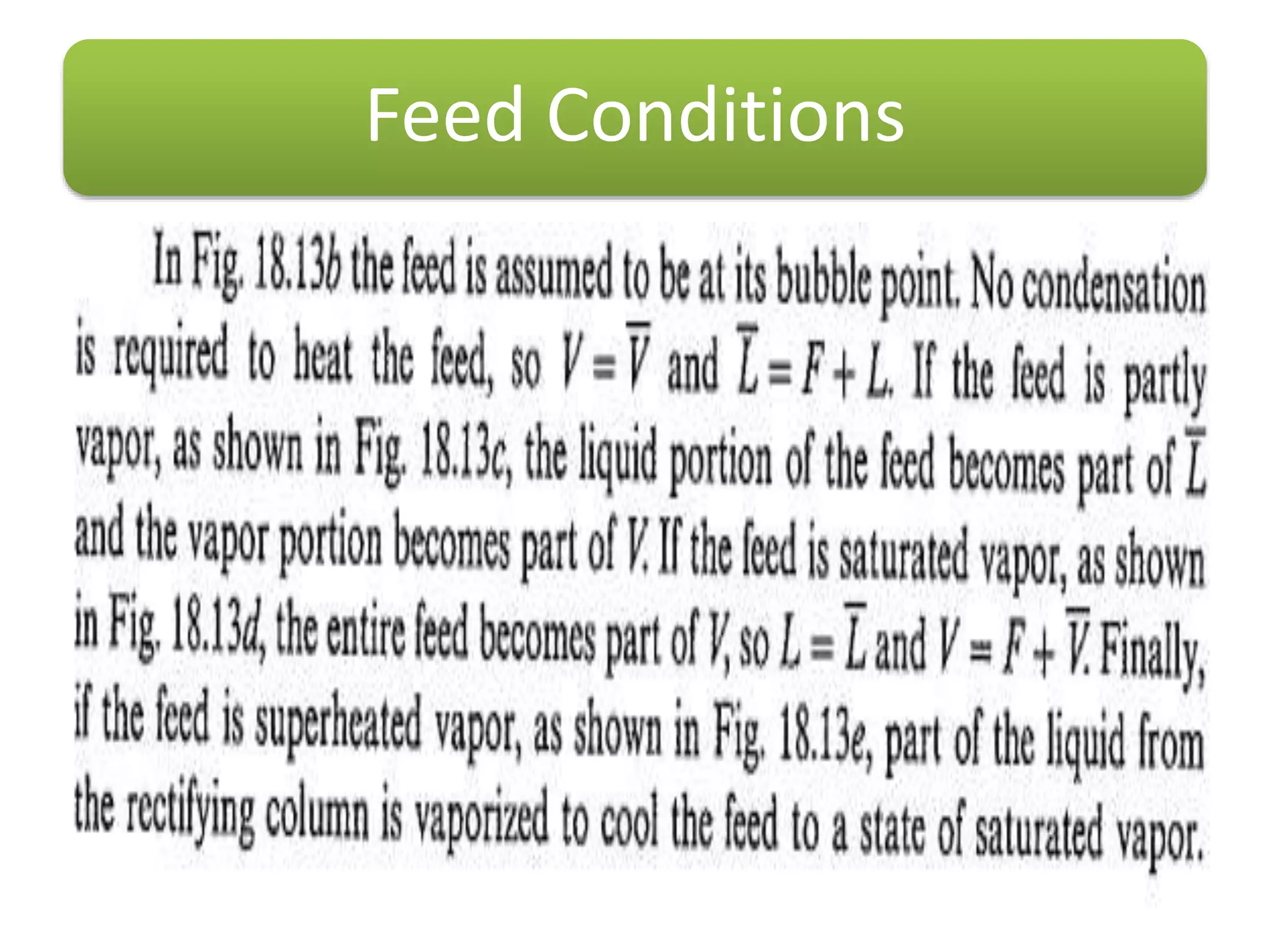
Feed Conditions
Feed Conditions
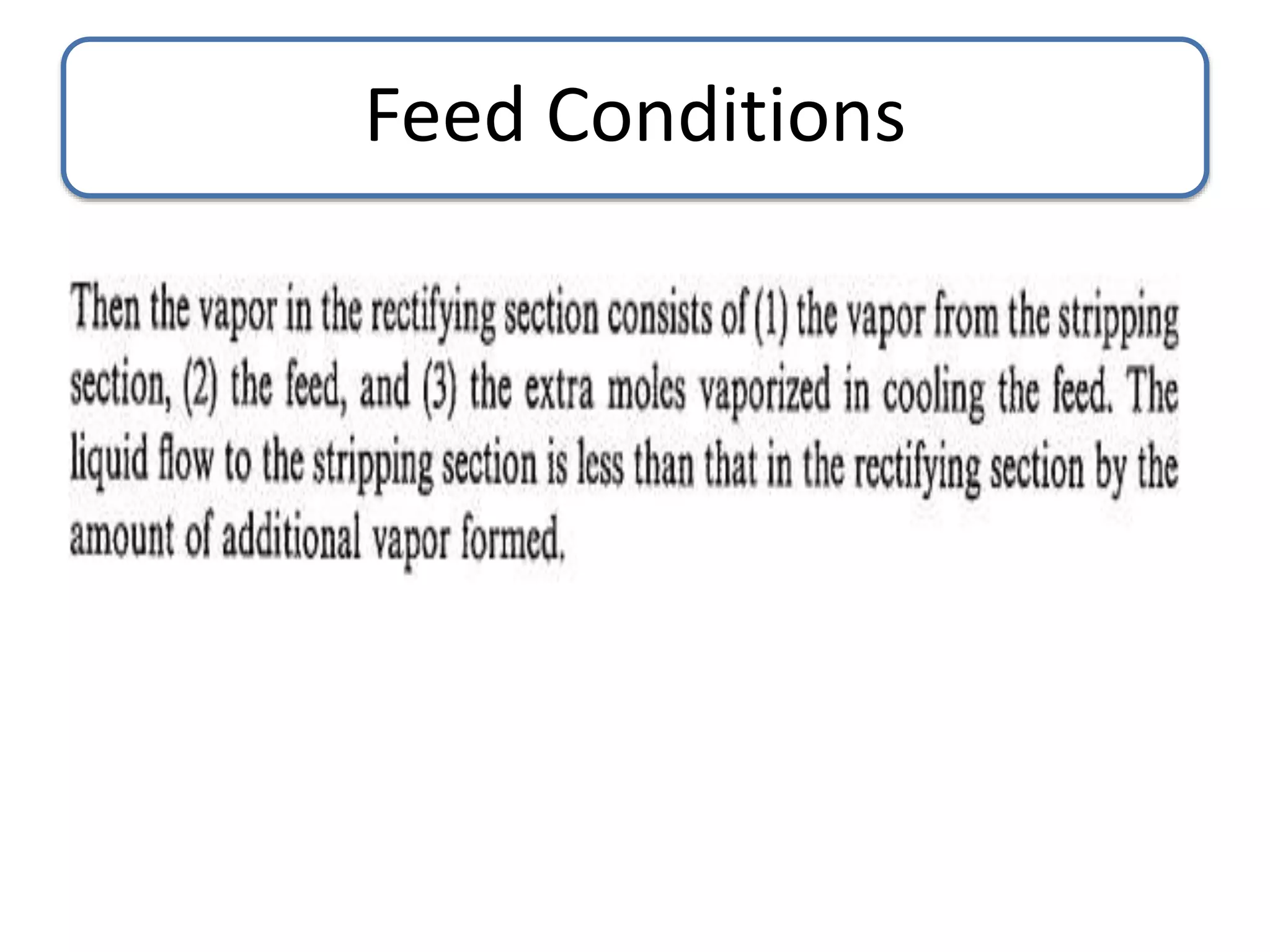
Feed Conditions
Continuous Fractionating Column
Lec No…!
22th August 2017
To be continue Today…..!
Pressure Drop
$
flooding
Topic
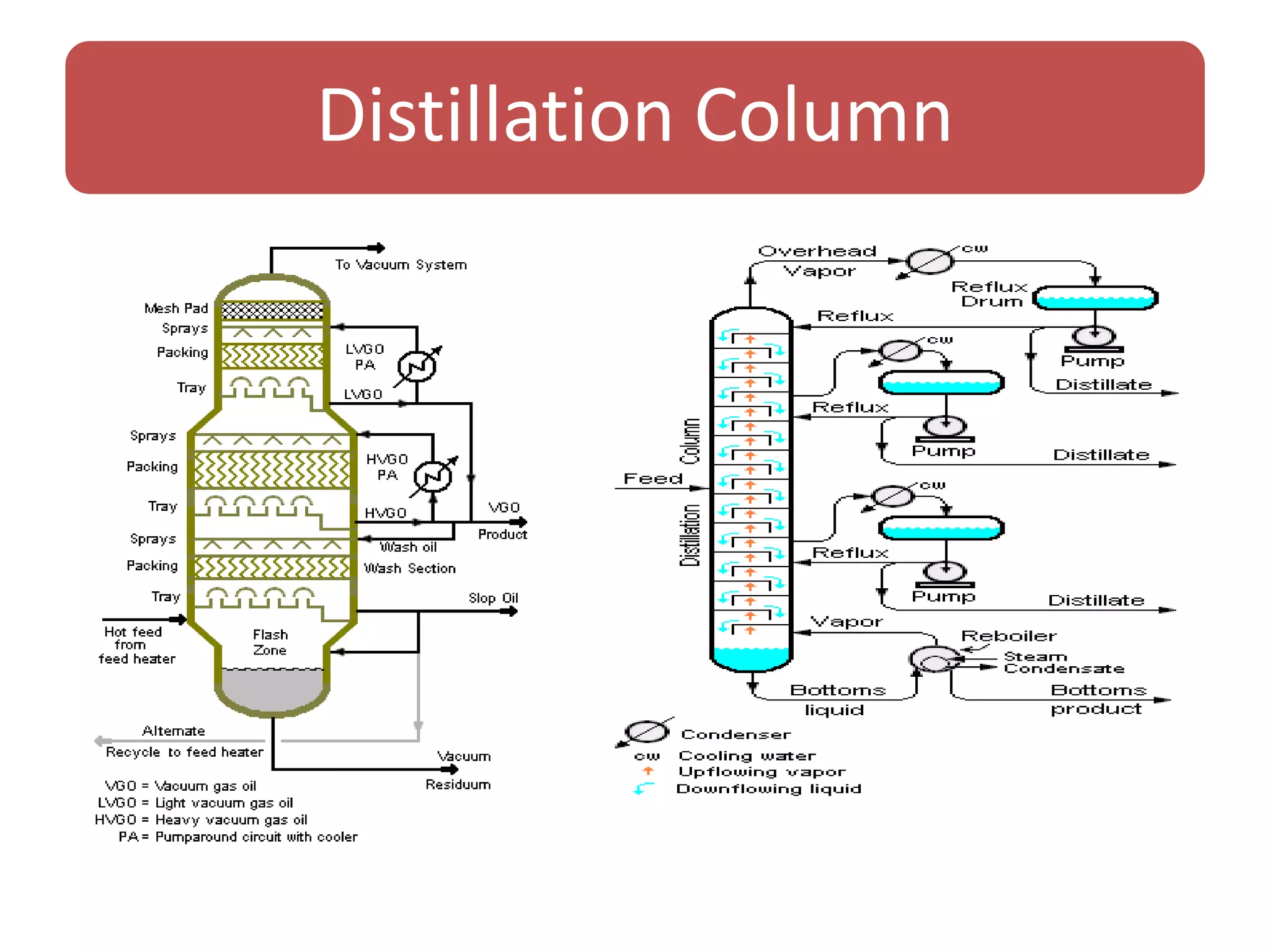
Distillation Column
Pressure Drop $ FloodingPressure Drop $ Flooding
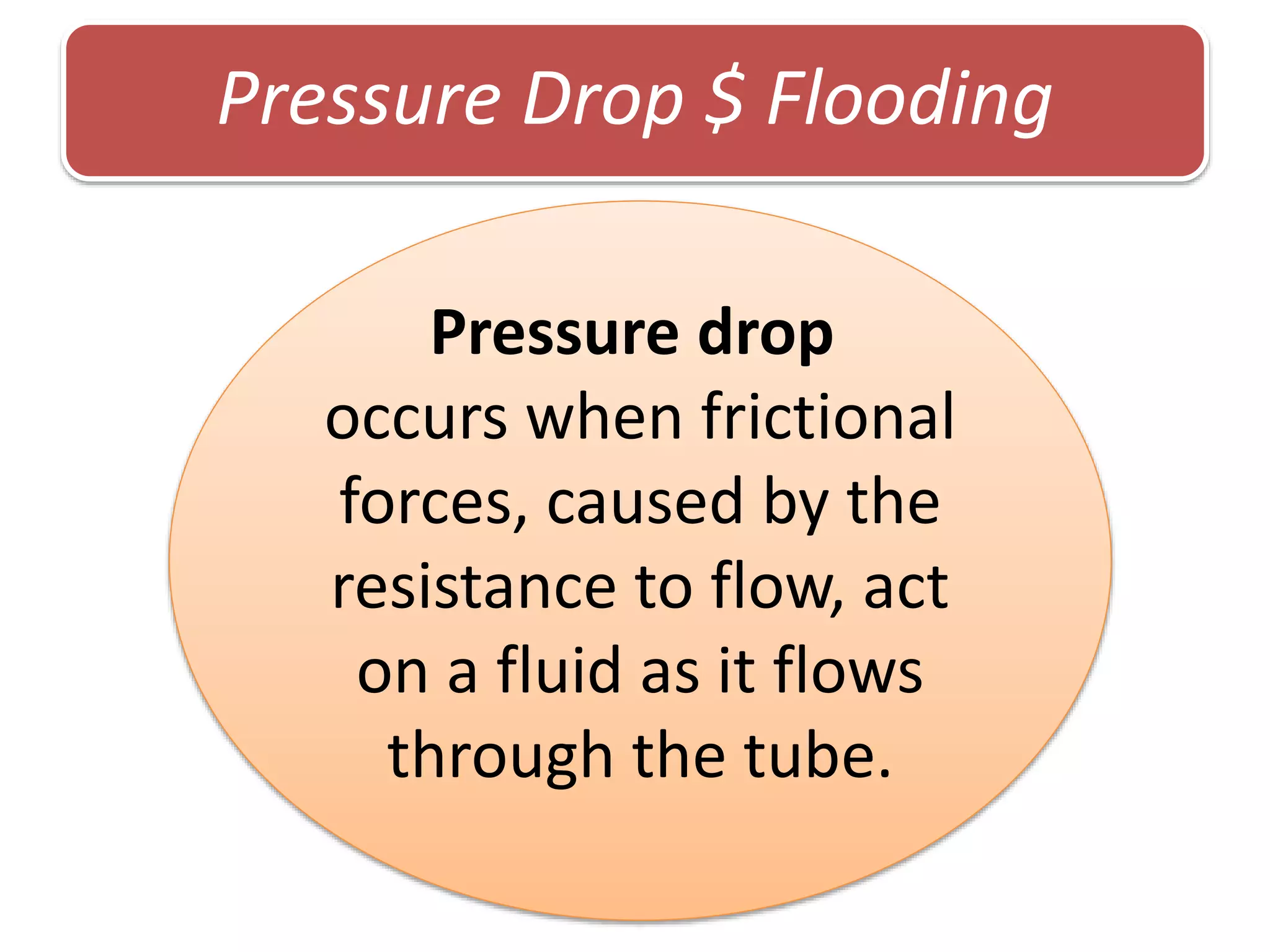
Pressure drop
occurs when frictional
forces, caused by the
resistance to flow, act
on a fluid as it flows
through the tube.
• There are numerous semi-empirical equations that are
available for predicting the pressure drop across tray columns.
• As a preliminary estimate, one may assume the pressure drop
is given by the height of liquid supported on the tray.
• Typically, this liquid height is in the 4–6 inch range.
• Therefore, a reasonable approximation for pressure drop may
be 4–6 inches of H2O per tray, which is approximately 0.1–0.2
psi per tray.
• The lower value applies to smaller diameter columns and the
upper value applying to larger diameter units.
Pressure Drop $ Flooding
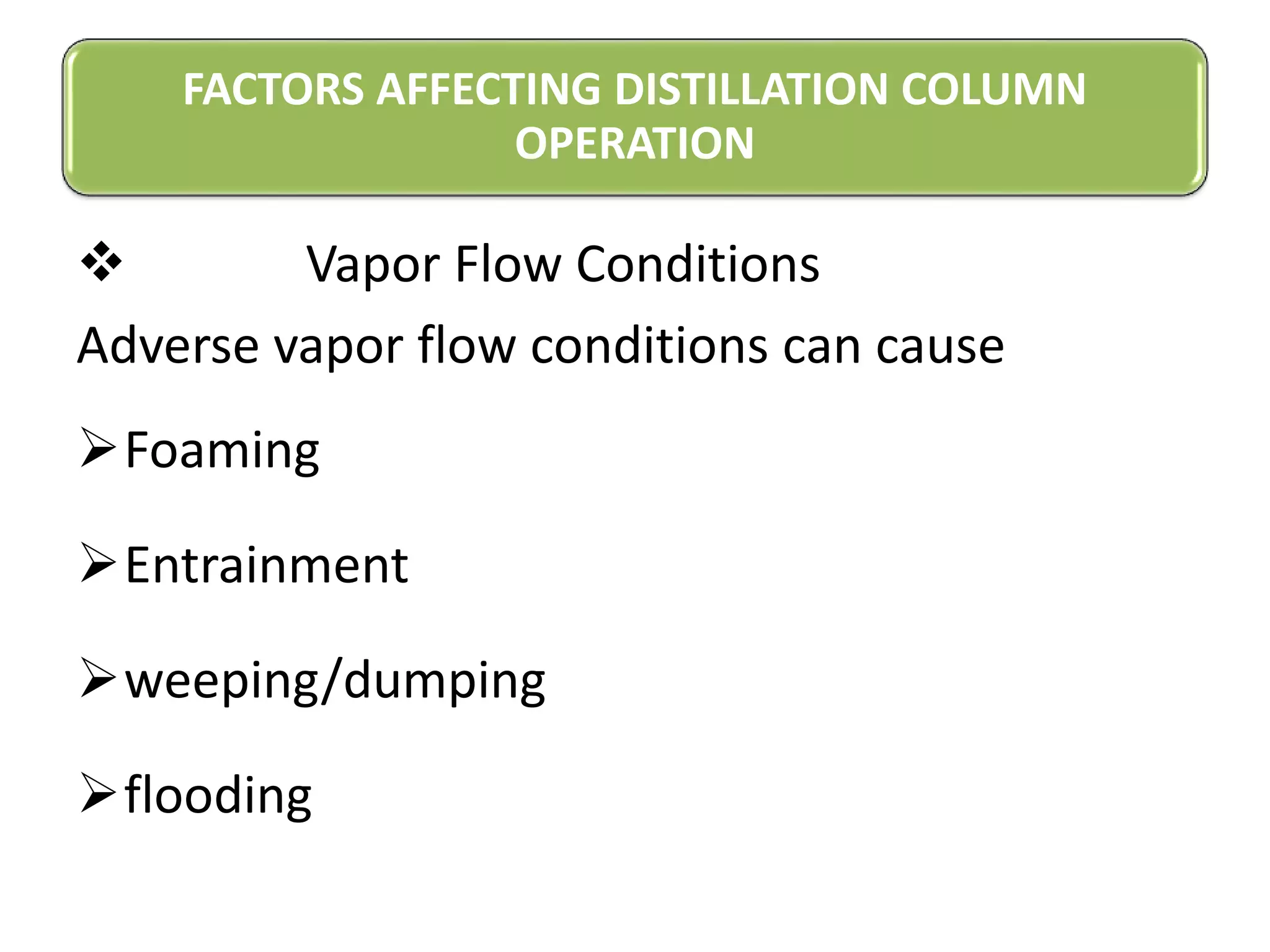
FACTORS AFFECTING DISTILLATION COLUMN
OPERATION
 Vapor Flow Conditions
Adverse vapor flow conditions can cause
Foaming
Entrainment
weeping/dumping
flooding
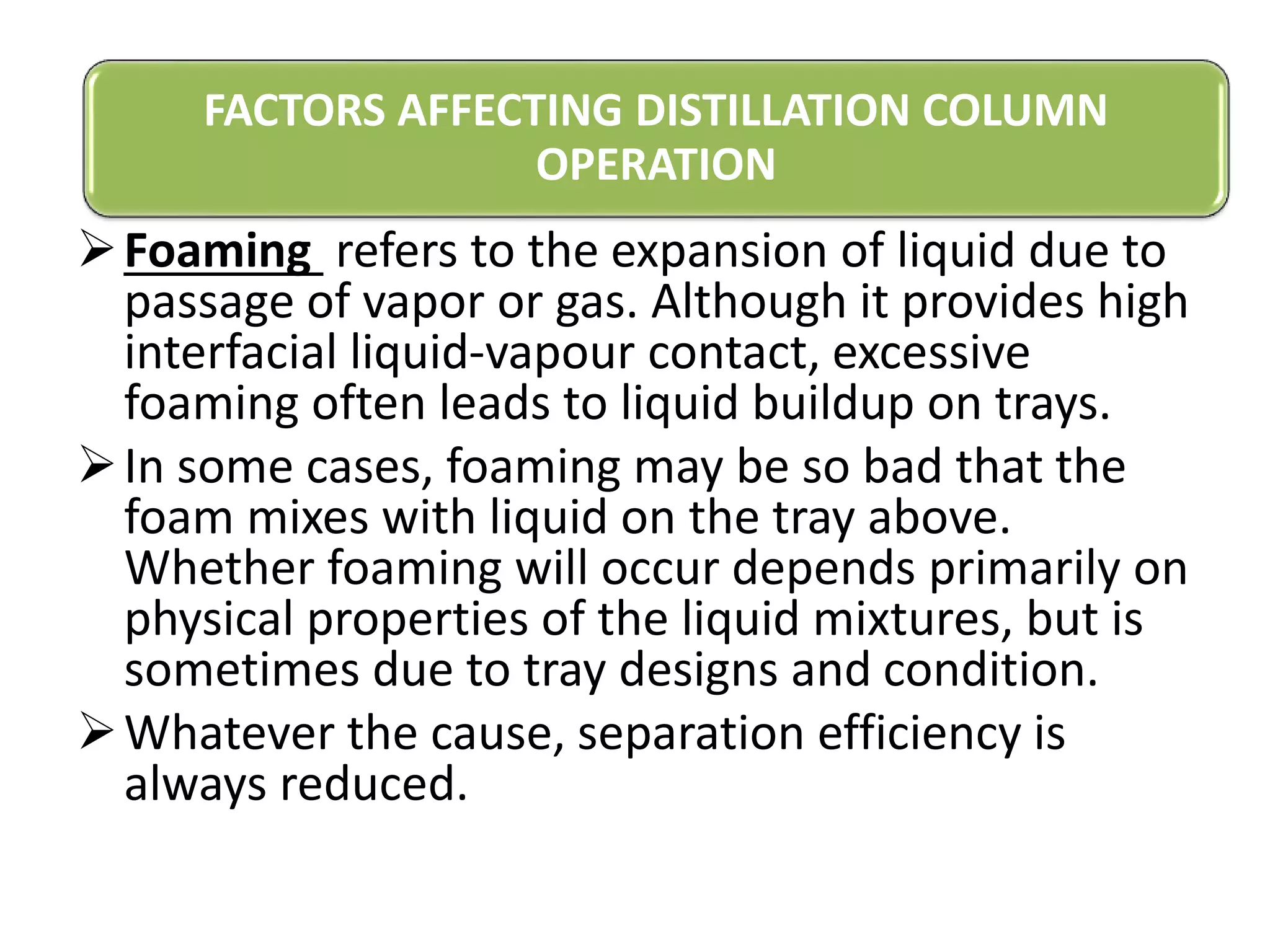
Foaming refers to the expansion of liquid due to
passage of vapor or gas. Although it provides high
interfacial liquid-vapour contact, excessive
foaming often leads to liquid buildup on trays.
In some cases, foaming may be so bad that the
foam mixes with liquid on the tray above.
Whether foaming will occur depends primarily on
physical properties of the liquid mixtures, but is
sometimes due to tray designs and condition.
Whatever the cause, separation efficiency is
always reduced.
FACTORS AFFECTING DISTILLATION COLUMN
OPERATION
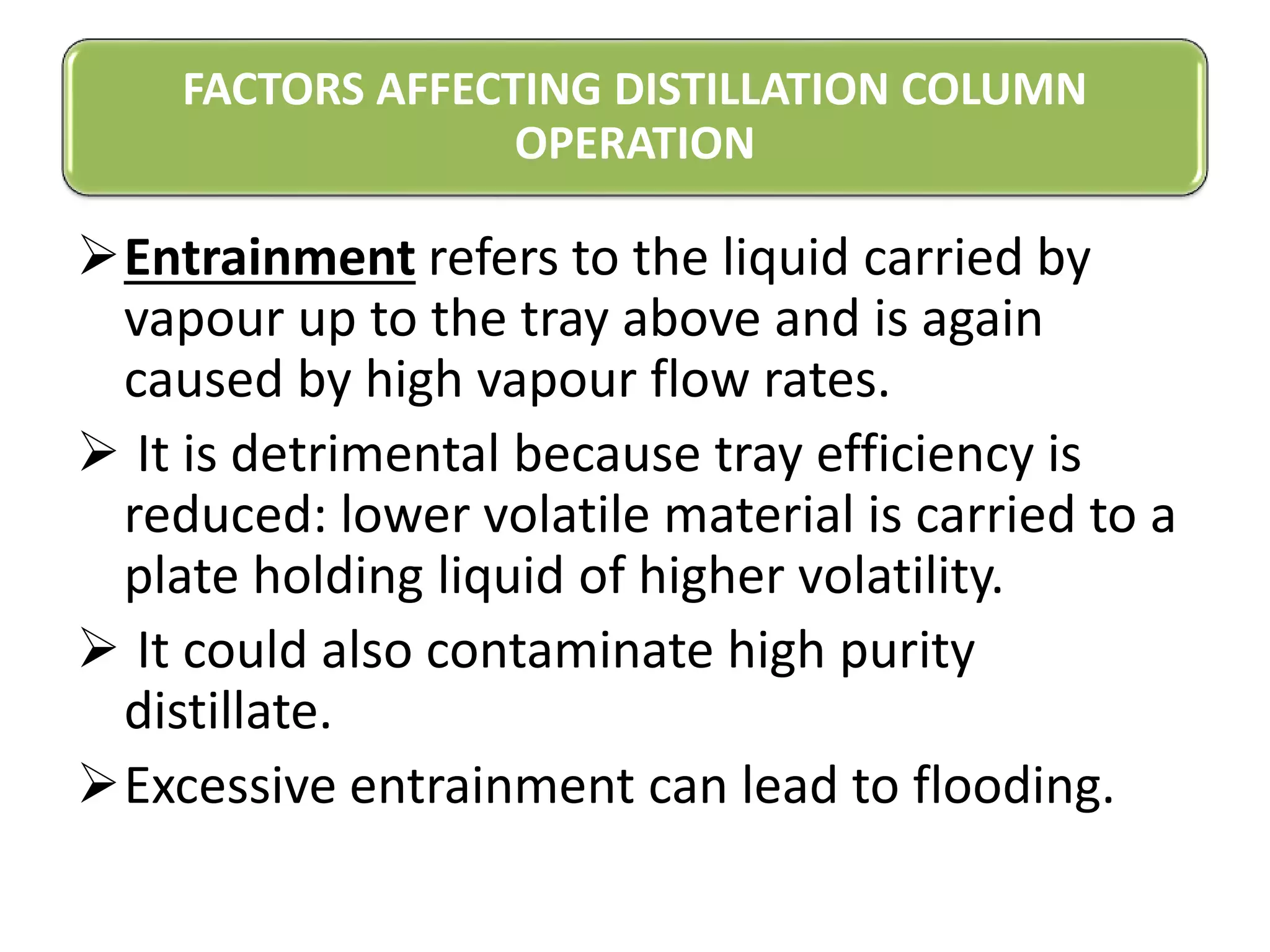
Entrainment refers to the liquid carried by
vapour up to the tray above and is again
caused by high vapour flow rates.
 It is detrimental because tray efficiency is
reduced: lower volatile material is carried to a
plate holding liquid of higher volatility.
 It could also contaminate high purity
distillate.
Excessive entrainment can lead to flooding.
FACTORS AFFECTING DISTILLATION COLUMN
OPERATION
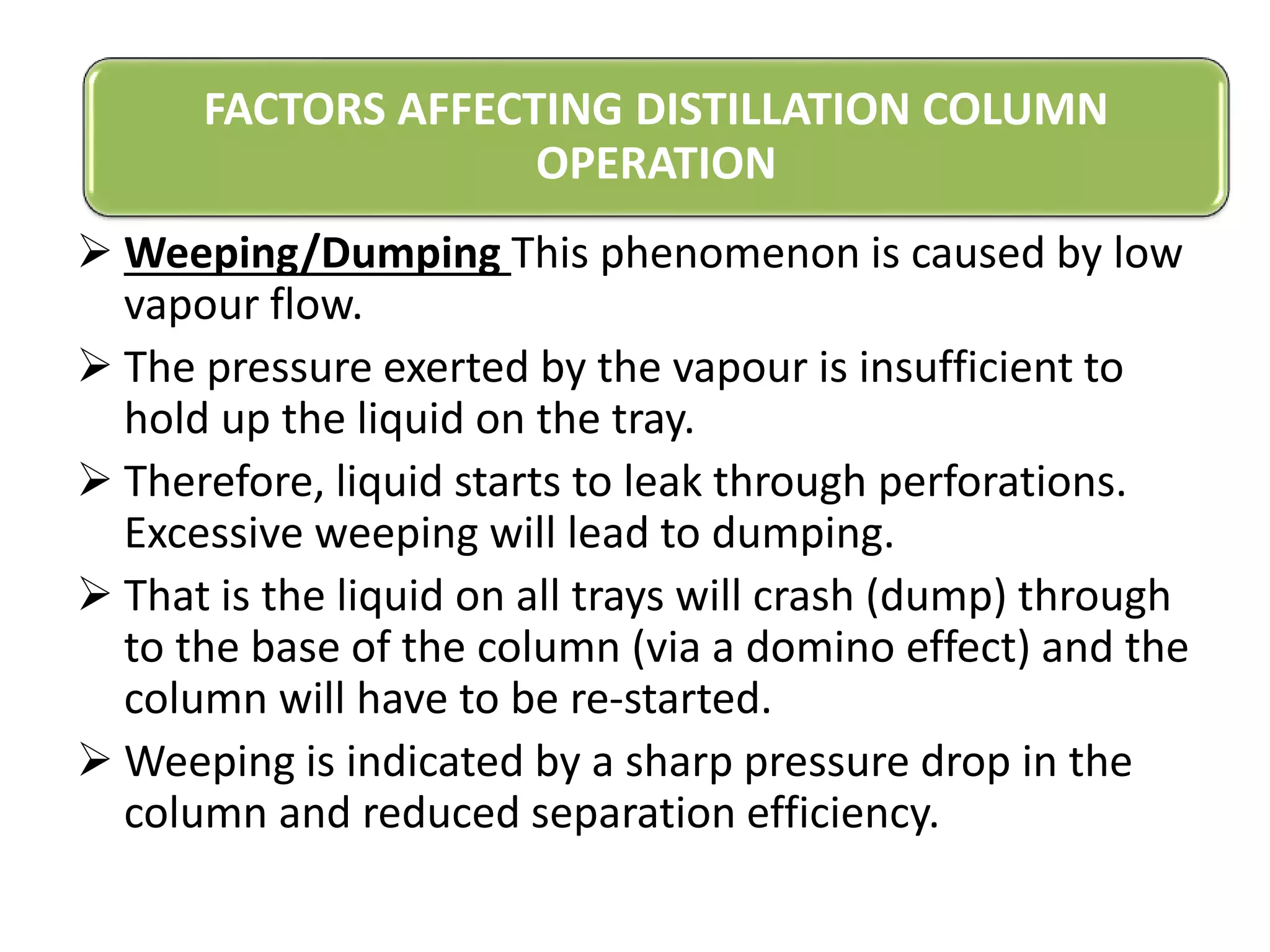
 Weeping/Dumping This phenomenon is caused by low
vapour flow.
 The pressure exerted by the vapour is insufficient to
hold up the liquid on the tray.
 Therefore, liquid starts to leak through perforations.
Excessive weeping will lead to dumping.
 That is the liquid on all trays will crash (dump) through
to the base of the column (via a domino effect) and the
column will have to be re-started.
 Weeping is indicated by a sharp pressure drop in the
column and reduced separation efficiency.
FACTORS AFFECTING DISTILLATION COLUMN
OPERATION
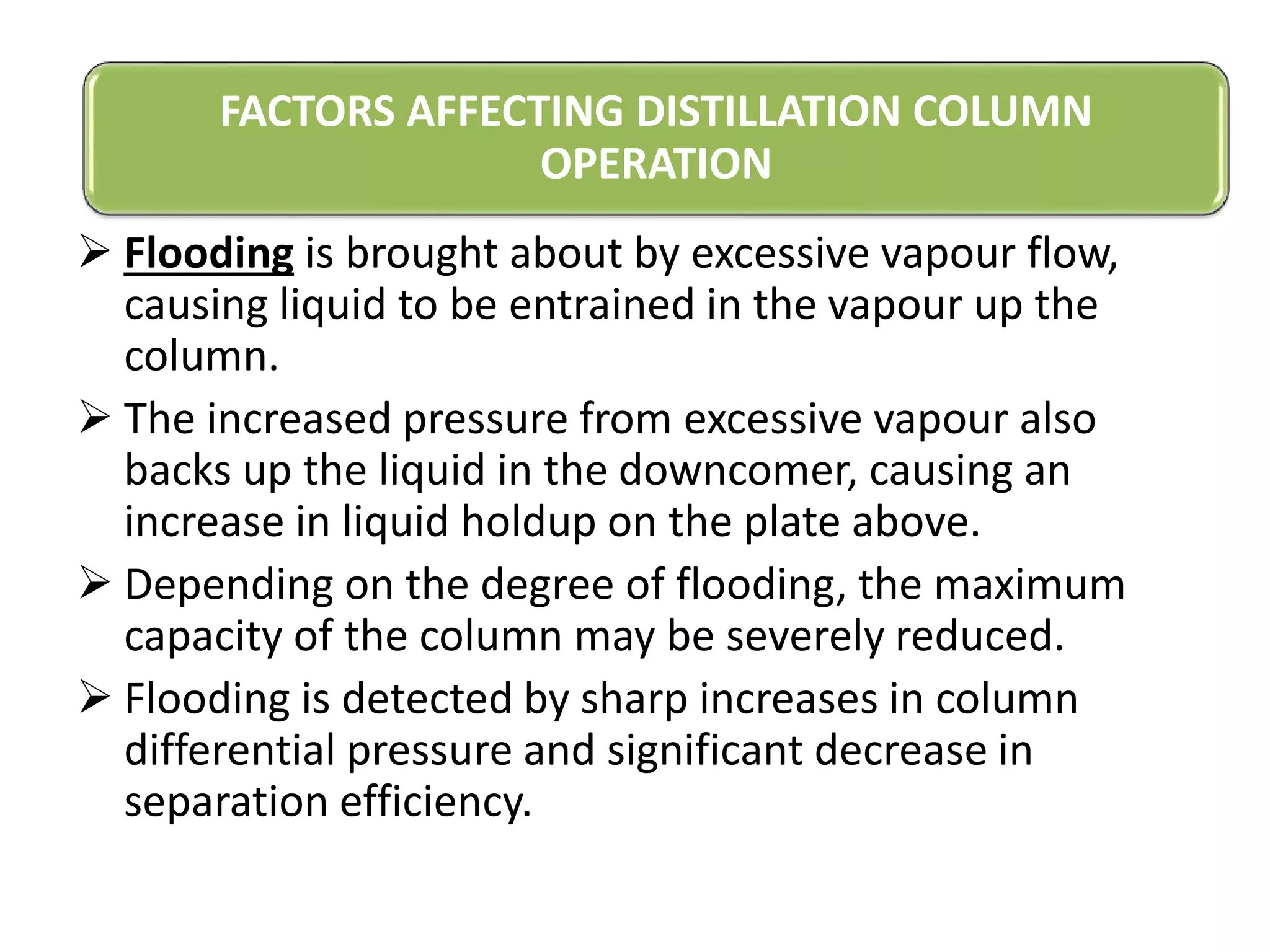
 Flooding is brought about by excessive vapour flow,
causing liquid to be entrained in the vapour up the
column.
 The increased pressure from excessive vapour also
backs up the liquid in the downcomer, causing an
increase in liquid holdup on the plate above.
 Depending on the degree of flooding, the maximum
capacity of the column may be severely reduced.
 Flooding is detected by sharp increases in column
differential pressure and significant decrease in
separation efficiency.
FACTORS AFFECTING DISTILLATION COLUMN
OPERATION
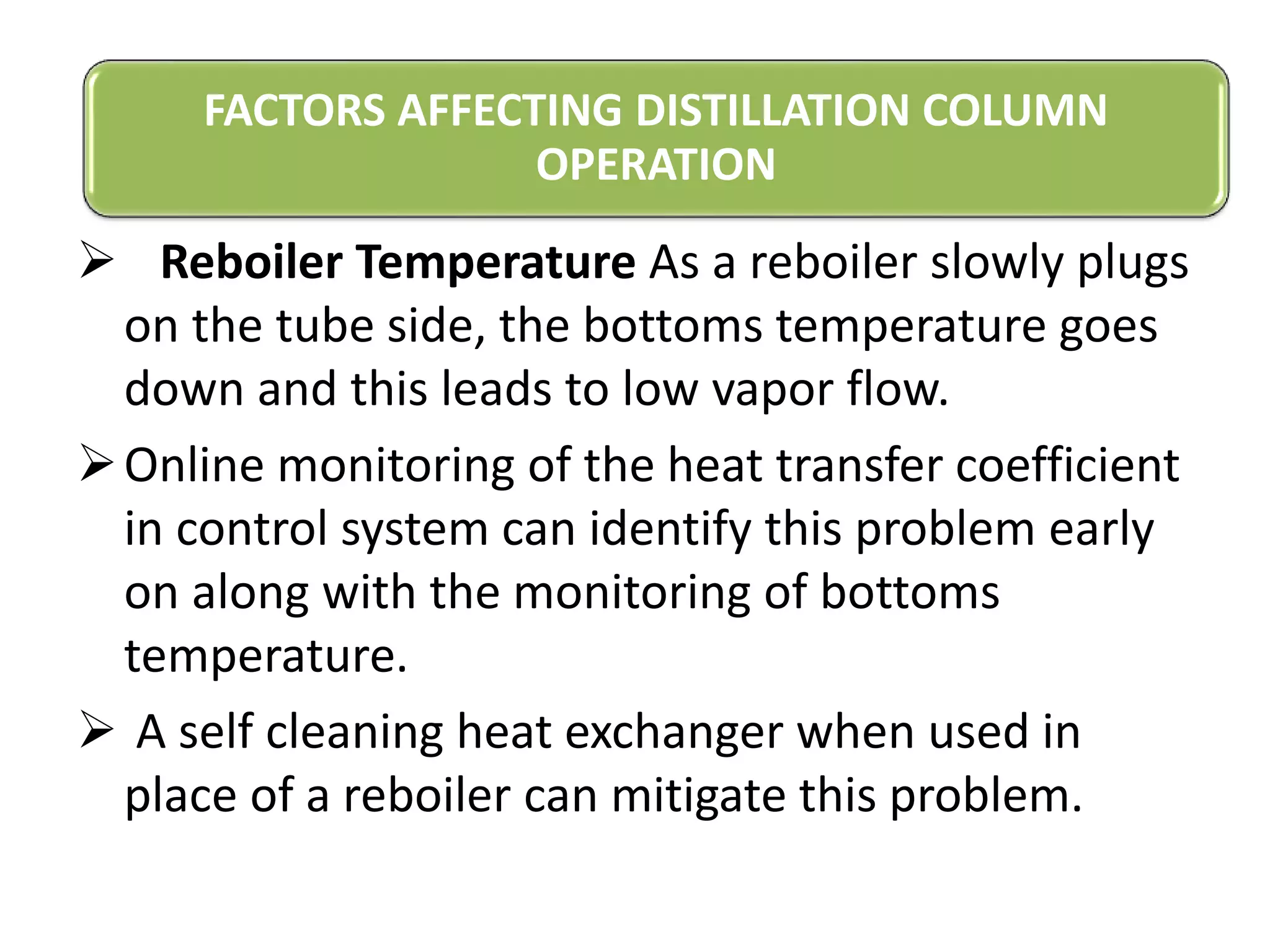
 Reboiler Temperature As a reboiler slowly plugs
on the tube side, the bottoms temperature goes
down and this leads to low vapor flow.
Online monitoring of the heat transfer coefficient
in control system can identify this problem early
on along with the monitoring of bottoms
temperature.
 A self cleaning heat exchanger when used in
place of a reboiler can mitigate this problem.
FACTORS AFFECTING DISTILLATION COLUMN
OPERATION
 Reduction in Vacuum A slight drop in vacuum causes
the boiling point(s) to go up, leading to low vapour
flow, loss of production and and off spec products.
 Wet Feed If a column is typically fed a dry hydrocarbon
feed but the feed becomes contaminated with water
then at some point, when the water/ hydrocarbon
mixture enters the tower the water can vaporize so
rapidly that it causes an over pressure event.
 This can and will damage trays.
 This effects column efficiency and product quality.
FACTORS AFFECTING DISTILLATION COLUMN
OPERATION
COLUMN DIAMETER
 Most of the above factors that affect column
operation is due to vapour flow conditions: either
excessive or too low.
 Vapour flow velocity is dependent on column diameter.
Weeping determines the minimum vapour flow
required while flooding determines the maximum
vapour flow allowed, hence column capacity.
 Thus, if the column diameter is not sized properly, the
column will not perform well.
 Not only will operational problems occur, the desired
separation duties may not be achieved.
FACTORS AFFECTING DISTILLATION COLUMN
OPERATION
• It is important that the vapor stream has the
correct superficial velocity (linear average
velocity, calculated as if the column conduit
was empty) as it flows upwards in the column.
• Should the vapor flow too slowly, liquid may
pass down through the tray perforations
instead of over the weir, a condition known as
weeping.
Pressure Drop $ Flooding
• However, if the vapor has a velocity that is too high,
some liquid may be carried from the
froth to the tray above by the rapidly flowing vapor.
• This condition is known as entrainment.
• Should the vapor velocity be increased further,
entrainment may become excessive such that the
liquid level in the down comer will reach the plate
above.
• At this point, liquid flow from the tray(s) in question
becomes hindered, and the column’s entrainment
flooding point has been reached.
Pressure Drop $ Flooding
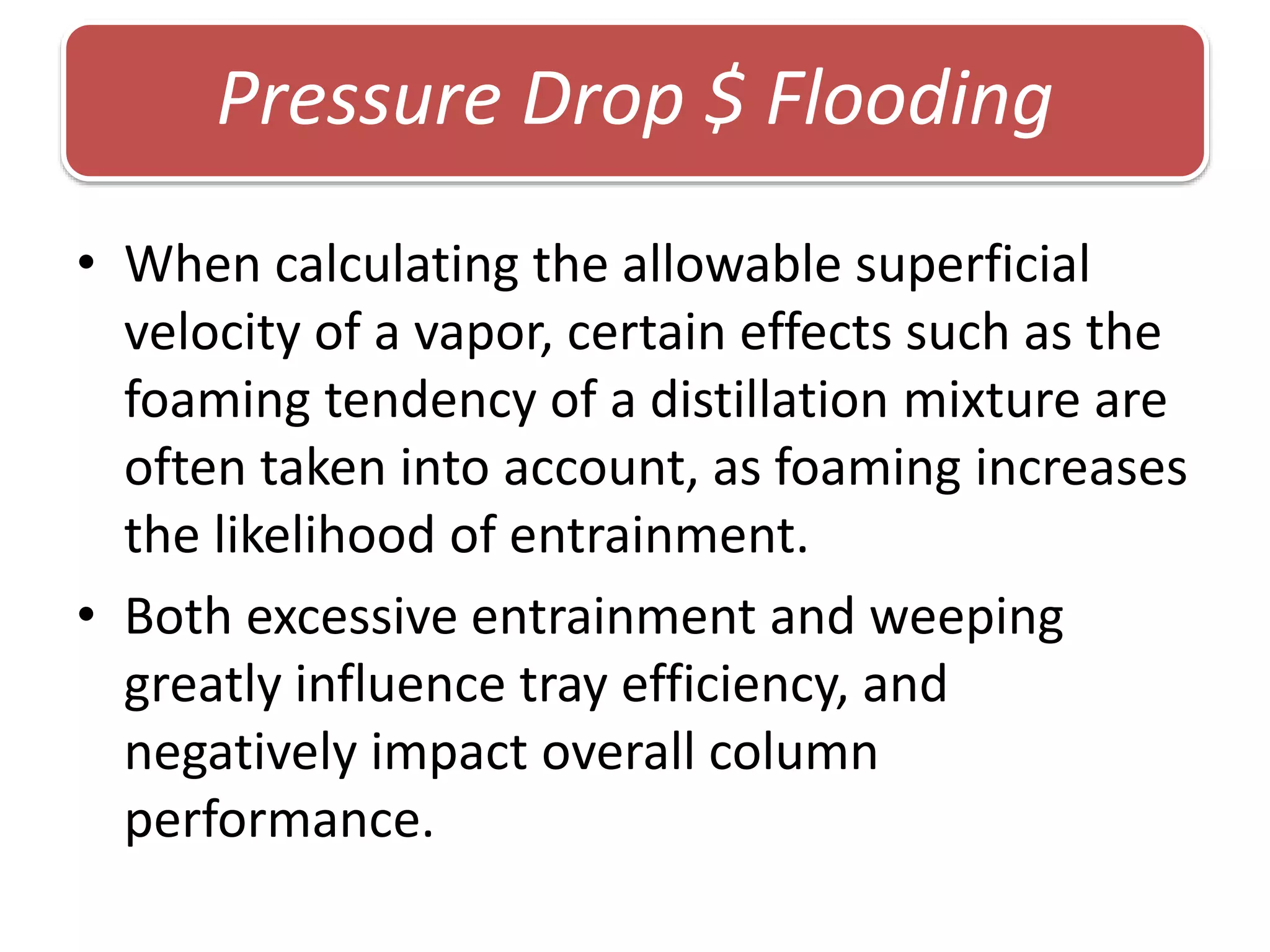
• When calculating the allowable superficial
velocity of a vapor, certain effects such as the
foaming tendency of a distillation mixture are
often taken into account, as foaming increases
the likelihood of entrainment.
• Both excessive entrainment and weeping
greatly influence tray efficiency, and
negatively impact overall column
performance.
Pressure Drop $ Flooding
To be continue
Tomorrow…..!
Thank You

Continuous Distillation with Reflux Ratio

  • 1.
    Continuous Distillation withReflux Material Balance Diagram Boiling point Diagram Material Balance Diagram for continuous fractionation column Feed Condition Pressure Drop and Flooding Lec No……! 01 to 22th August_2017 Engr. Hafiz Anees Rehman Quest, nawab shah
  • 2.
  • 3.
    StrippingSectionRectifyingSection Condenser C Accumulator D CoolerE Overhead Product Cold Water Reflux Pump F Liquid Reboiler B Steam Condensate Trap Vapor Liquid Feed Bottoms Product Bottoms Cooler G Feed Plate A
  • 4.
  • 5.
  • 6.
  • 7.
    Boiling Point Diagramon ideal plate
  • 8.
    Boiling Point Diagramon ideal plate
  • 9.
    Boiling Point Diagramon ideal plate
  • 10.
    Continuous Distillation withReflux Lec No … 3rd August 2017…..!
  • 12.
  • 13.
  • 14.
  • 15.
  • 16.
  • 17.
    Lec No…..! 8th August2017…..! Material Balance diagram for Continuous fractionating column
  • 19.
    Material Balance inPlate Column
  • 20.
    Material Balance inPlate Column
  • 21.
    Material Balance inPlate Column
  • 22.
  • 23.
    Lec No….! To becontinue…Today.. 15, 16th August 2017…..! Tray Design Bubble-cap Tray Sieve tray Column
  • 24.
  • 25.
    Simplified bubble-cap Tray •Many tray designs are in use today, but one of the early favorites was the bubble-cap tray shown qualitatively in Figure 9.10. • The descending liquid stream arrives on the plate via the down comer which canbe a short piece of pipe welded into position on the plate or simply a fraction of the plate which has been cut away. • While several flow patterns are possible, the liquid generally is guided by the down comer onto one side of the circular bubble- cap tray below, flows across the middle “capped” section of the tray and leaves by the next down comer. • This flow pattern is referred to as single crossflow
  • 26.
    Simplified bubble-cap Tray •The exit to each downcomer must be located below the liquid level on the plate below to create a vapor lock, preventing vapor from rising in the downcomer. • The contacting device on a bubble-cap tray is the bubble cap, which consists of two parts—the riser and the cap. • The riser is a short piece of pipe welded in place over a hole in the plate. • The cap, which surrounds the riser, is a bell-shaped piece containing vertical slots around the lower periphery. •
  • 27.
    Simplified bubble-cap Tray •The liquid level on the tray should be maintained so as to submerge each cap, which also ensures a vapor lock between trays. • The vapor flows upward through the riser, makes a 180 turn, and is forced under the cap and through the slots to produce intimate contact with the liquid
  • 28.
    Sieve Tray Column(Crossflow)
  • 29.
    Sieve Tray Column(Crossflow)
  • 30.
    Continuous Fractionating Column LecNo…! 17th August 2017 Feed Conditions Topic
  • 32.
  • 33.
  • 34.
  • 35.
  • 36.
    Continuous Fractionating Column LecNo…! 22th August 2017 To be continue Today…..! Pressure Drop $ flooding Topic
  • 37.
  • 38.
    Pressure Drop $FloodingPressure Drop $ Flooding Pressure drop occurs when frictional forces, caused by the resistance to flow, act on a fluid as it flows through the tube.
  • 39.
    • There arenumerous semi-empirical equations that are available for predicting the pressure drop across tray columns. • As a preliminary estimate, one may assume the pressure drop is given by the height of liquid supported on the tray. • Typically, this liquid height is in the 4–6 inch range. • Therefore, a reasonable approximation for pressure drop may be 4–6 inches of H2O per tray, which is approximately 0.1–0.2 psi per tray. • The lower value applies to smaller diameter columns and the upper value applying to larger diameter units. Pressure Drop $ Flooding
  • 40.
    FACTORS AFFECTING DISTILLATIONCOLUMN OPERATION  Vapor Flow Conditions Adverse vapor flow conditions can cause Foaming Entrainment weeping/dumping flooding
  • 41.
    Foaming refers tothe expansion of liquid due to passage of vapor or gas. Although it provides high interfacial liquid-vapour contact, excessive foaming often leads to liquid buildup on trays. In some cases, foaming may be so bad that the foam mixes with liquid on the tray above. Whether foaming will occur depends primarily on physical properties of the liquid mixtures, but is sometimes due to tray designs and condition. Whatever the cause, separation efficiency is always reduced. FACTORS AFFECTING DISTILLATION COLUMN OPERATION
  • 42.
    Entrainment refers tothe liquid carried by vapour up to the tray above and is again caused by high vapour flow rates.  It is detrimental because tray efficiency is reduced: lower volatile material is carried to a plate holding liquid of higher volatility.  It could also contaminate high purity distillate. Excessive entrainment can lead to flooding. FACTORS AFFECTING DISTILLATION COLUMN OPERATION
  • 43.
     Weeping/Dumping Thisphenomenon is caused by low vapour flow.  The pressure exerted by the vapour is insufficient to hold up the liquid on the tray.  Therefore, liquid starts to leak through perforations. Excessive weeping will lead to dumping.  That is the liquid on all trays will crash (dump) through to the base of the column (via a domino effect) and the column will have to be re-started.  Weeping is indicated by a sharp pressure drop in the column and reduced separation efficiency. FACTORS AFFECTING DISTILLATION COLUMN OPERATION
  • 44.
     Flooding isbrought about by excessive vapour flow, causing liquid to be entrained in the vapour up the column.  The increased pressure from excessive vapour also backs up the liquid in the downcomer, causing an increase in liquid holdup on the plate above.  Depending on the degree of flooding, the maximum capacity of the column may be severely reduced.  Flooding is detected by sharp increases in column differential pressure and significant decrease in separation efficiency. FACTORS AFFECTING DISTILLATION COLUMN OPERATION
  • 45.
     Reboiler TemperatureAs a reboiler slowly plugs on the tube side, the bottoms temperature goes down and this leads to low vapor flow. Online monitoring of the heat transfer coefficient in control system can identify this problem early on along with the monitoring of bottoms temperature.  A self cleaning heat exchanger when used in place of a reboiler can mitigate this problem. FACTORS AFFECTING DISTILLATION COLUMN OPERATION
  • 46.
     Reduction inVacuum A slight drop in vacuum causes the boiling point(s) to go up, leading to low vapour flow, loss of production and and off spec products.  Wet Feed If a column is typically fed a dry hydrocarbon feed but the feed becomes contaminated with water then at some point, when the water/ hydrocarbon mixture enters the tower the water can vaporize so rapidly that it causes an over pressure event.  This can and will damage trays.  This effects column efficiency and product quality. FACTORS AFFECTING DISTILLATION COLUMN OPERATION
  • 47.
    COLUMN DIAMETER  Mostof the above factors that affect column operation is due to vapour flow conditions: either excessive or too low.  Vapour flow velocity is dependent on column diameter. Weeping determines the minimum vapour flow required while flooding determines the maximum vapour flow allowed, hence column capacity.  Thus, if the column diameter is not sized properly, the column will not perform well.  Not only will operational problems occur, the desired separation duties may not be achieved. FACTORS AFFECTING DISTILLATION COLUMN OPERATION
  • 48.
    • It isimportant that the vapor stream has the correct superficial velocity (linear average velocity, calculated as if the column conduit was empty) as it flows upwards in the column. • Should the vapor flow too slowly, liquid may pass down through the tray perforations instead of over the weir, a condition known as weeping. Pressure Drop $ Flooding
  • 49.
    • However, ifthe vapor has a velocity that is too high, some liquid may be carried from the froth to the tray above by the rapidly flowing vapor. • This condition is known as entrainment. • Should the vapor velocity be increased further, entrainment may become excessive such that the liquid level in the down comer will reach the plate above. • At this point, liquid flow from the tray(s) in question becomes hindered, and the column’s entrainment flooding point has been reached. Pressure Drop $ Flooding
  • 50.
    • When calculatingthe allowable superficial velocity of a vapor, certain effects such as the foaming tendency of a distillation mixture are often taken into account, as foaming increases the likelihood of entrainment. • Both excessive entrainment and weeping greatly influence tray efficiency, and negatively impact overall column performance. Pressure Drop $ Flooding
  • 51.
    Pressure Drop $Flooding To be continue Tomorrow…..! Thank You