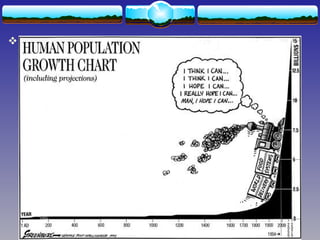
Population Theories and Models 
Mr. O’Kieffe 
Natural Increase= Crude Birth Rate – Crude Death Rate 
How 
you 
doin’?

The Core Principles of Malthus: 
¤ Food is necessary for human 
existence 
¤ Human population tends to grow 
faster than the power in the 
earth to produce subsistence 
¤ The effects of these two 
unequal powers must be kept 
equal 
¤ Since humans tend not to limit 
their population size voluntarily - 
“preventive checks” in Malthus’ 
terminology would be needed 
Old dead guy
Malthus believed that when the 
population level rose above the 
food supply – then nature would 
cause it to decline due to: 
PESTILENCE 
PLAGUE 
FAMINE 
WAR 
Malthus suggested that 
population growth should be 
limited by people marrying later 
– and abstaining from sex 
before and outside of marriage.
Malthus recognised that population if 
unchecked, grows at a geometric rate: 
1 2 4 8 16 32 
However, food only increases at an 
arithmetic rate, as land is finite. 
1 2 3 4 5 6
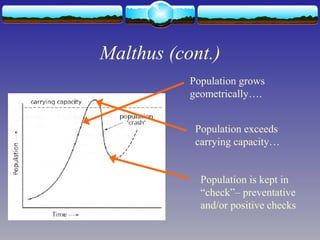
The ‘carrying capacity’ is the potential 
of an area to support life long-term. 
The area must be able to provide: 
• Food and water 
• Space for living and shelter 
• Essential resources for life 
• Able to absorb waste and pollution 
If a population rises above 
the ‘carrying capacity’ of 
an environment – it will 
struggle to survive. There 
is much debate about 
what the carrying capacity 
of Planet Earth is.
Malthus (cont.) 
Population grows 
geometrically…. 
Population exceeds 
carrying capacity… 
Population is kept in 
“check”– preventative 
and/or positive checks
and therefore he said…. 
Malthusian Catastrophe 
food population 
TIME
The Demographic Transition Model 
 The model of demographic transition suggested that a population's 
mortality and fertility would decline as a result of social and 
economic development. It predicted that all countries would over 
time go through four demographic transition stages.
STAGE 1– High Stationary or Pre- 
Industrial 
 HIGH BIRTH RATES 
 Little or no family planning 
 Parents have many children because few survive 
 Many children are needed to work the land 
 Children are a sign of virility 
 Some religious beliefs and cultural traditions encourage large families 
 HIGH DEATH RATES 
 Disease and plague (e.g. bubonic, cholera, kwashiorkor) 
 Famine , uncertain food supplies, and poor diet 
 Poor hygiene, no piped clean water or sewage disposal 
 POPULATION GROWTH-- SLOW
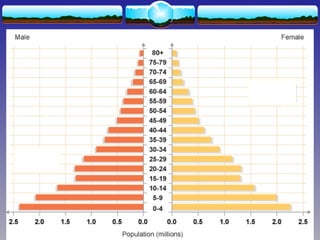
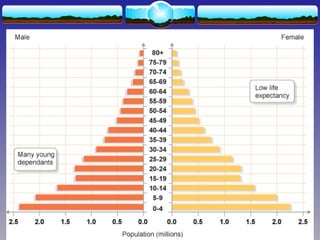
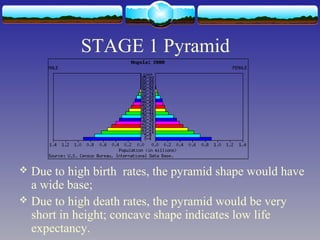
STAGE 1 Pyramid 
 Due to high birth rates, the pyramid shape would have 
a wide base; 
 Due to high death rates, the pyramid would be very 
short in height; concave shape indicates low life 
expectancy.
STAGE 2– Early Expanding or Early 
Industrial 
(Rapid population growth) 
 Ehrlich described this stage as the “population explosion” 
 HIGH BIRTH RATES 
 As STAGE 1 
 FALLING DEATH RATES 
 Improved medical care e.g. vaccinations , hospitals, doctors, new drugs, and 
scientific inventions 
 Improved sanitation and water supply 
 Improvements in food production in terms of quality and quantity 
 Improved transport to move food and doctors 
 A decrease in child mortality 
 POPULATION GROWTH-- RAPID
STAGE 2 Pyramid 
 As death rates are addressed, the population explosion begins; 
 The height of the pyramid grows to reflect the prevention of more 
deaths; shape becomes less concave as life expectancy increases; 
 The width of the base remains large due to the ongoing high birth 
rates
STAGE 3– Late Expanding or Late 
Industrial 
 FALLING BIRTH RATES 
 Family Planning utilized; contraceptives, abortions, sterilization, and other 
government incentives adopted 
 A lower infant mortality rates means less pressure to have children 
 Increased mechanization and industrialization means less need for labour 
 Increased desire for material possessions and less desire for large families 
 Emancipation of women 
 DEATH RATES LOW 
 As Stage 2 
 POPULATION GROWTH– STILL GROWING BUT SLOWING
STAGE 3 Pyramid 
As birth rates begin to be addressed, the base 
begins to stabilize and eventually narrow; 
Death rates are low and stabilized, meaning that 
the pyramid continues to grow higher.
STAGE 4– Low Stationary or Low 
Fluctuating 
 BIRTH RATES LOW 
 Fertility rates plunge to below replacement rate (2.1 children per woman) 
because: 
 Valuation of women beyond childbearing and motherhood becomes important 
 Increasing value is placed on material goods over family size in modern 
industrialized society 
 Widespread choice of contraception by families 
 DEATH RATES LOW 
 Child mortality reduced and life expectancy increased due to: 
 Capital ($$$) investment in medical technology 
 Widespread knowledge of healthy diet and lifestyle 
 POPULATION GROWTH– SLOW OR DECLINING (due to aging 
societies)
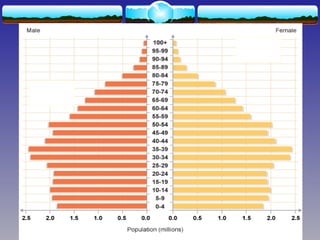
STAGE 4 Pyramid 
 Birth rates and death rates are low; as fertility continues to 
decline, an AGING SOCIETY emerges. 
 Pyramid seems to “invert”…

Malthus population theory

  • 1.
    Population Theories andModels Mr. O’Kieffe Natural Increase= Crude Birth Rate – Crude Death Rate How you doin’?
  • 2.
  • 3.
    The Core Principlesof Malthus: ¤ Food is necessary for human existence ¤ Human population tends to grow faster than the power in the earth to produce subsistence ¤ The effects of these two unequal powers must be kept equal ¤ Since humans tend not to limit their population size voluntarily - “preventive checks” in Malthus’ terminology would be needed Old dead guy
  • 4.
    Malthus believed thatwhen the population level rose above the food supply – then nature would cause it to decline due to: PESTILENCE PLAGUE FAMINE WAR Malthus suggested that population growth should be limited by people marrying later – and abstaining from sex before and outside of marriage.
  • 5.
    Malthus recognised thatpopulation if unchecked, grows at a geometric rate: 1 2 4 8 16 32 However, food only increases at an arithmetic rate, as land is finite. 1 2 3 4 5 6
  • 6.
    The ‘carrying capacity’is the potential of an area to support life long-term. The area must be able to provide: • Food and water • Space for living and shelter • Essential resources for life • Able to absorb waste and pollution If a population rises above the ‘carrying capacity’ of an environment – it will struggle to survive. There is much debate about what the carrying capacity of Planet Earth is.
  • 7.
    Malthus (cont.) Populationgrows geometrically…. Population exceeds carrying capacity… Population is kept in “check”– preventative and/or positive checks
  • 8.
    and therefore hesaid…. Malthusian Catastrophe food population TIME
  • 13.
    The Demographic TransitionModel  The model of demographic transition suggested that a population's mortality and fertility would decline as a result of social and economic development. It predicted that all countries would over time go through four demographic transition stages.
  • 14.
    STAGE 1– HighStationary or Pre- Industrial  HIGH BIRTH RATES  Little or no family planning  Parents have many children because few survive  Many children are needed to work the land  Children are a sign of virility  Some religious beliefs and cultural traditions encourage large families  HIGH DEATH RATES  Disease and plague (e.g. bubonic, cholera, kwashiorkor)  Famine , uncertain food supplies, and poor diet  Poor hygiene, no piped clean water or sewage disposal  POPULATION GROWTH-- SLOW
  • 15.
    STAGE 1 Pyramid  Due to high birth rates, the pyramid shape would have a wide base;  Due to high death rates, the pyramid would be very short in height; concave shape indicates low life expectancy.
  • 16.
    STAGE 2– EarlyExpanding or Early Industrial (Rapid population growth)  Ehrlich described this stage as the “population explosion”  HIGH BIRTH RATES  As STAGE 1  FALLING DEATH RATES  Improved medical care e.g. vaccinations , hospitals, doctors, new drugs, and scientific inventions  Improved sanitation and water supply  Improvements in food production in terms of quality and quantity  Improved transport to move food and doctors  A decrease in child mortality  POPULATION GROWTH-- RAPID
  • 17.
    STAGE 2 Pyramid  As death rates are addressed, the population explosion begins;  The height of the pyramid grows to reflect the prevention of more deaths; shape becomes less concave as life expectancy increases;  The width of the base remains large due to the ongoing high birth rates
  • 18.
    STAGE 3– LateExpanding or Late Industrial  FALLING BIRTH RATES  Family Planning utilized; contraceptives, abortions, sterilization, and other government incentives adopted  A lower infant mortality rates means less pressure to have children  Increased mechanization and industrialization means less need for labour  Increased desire for material possessions and less desire for large families  Emancipation of women  DEATH RATES LOW  As Stage 2  POPULATION GROWTH– STILL GROWING BUT SLOWING
  • 19.
    STAGE 3 Pyramid As birth rates begin to be addressed, the base begins to stabilize and eventually narrow; Death rates are low and stabilized, meaning that the pyramid continues to grow higher.
  • 20.
    STAGE 4– LowStationary or Low Fluctuating  BIRTH RATES LOW  Fertility rates plunge to below replacement rate (2.1 children per woman) because:  Valuation of women beyond childbearing and motherhood becomes important  Increasing value is placed on material goods over family size in modern industrialized society  Widespread choice of contraception by families  DEATH RATES LOW  Child mortality reduced and life expectancy increased due to:  Capital ($$$) investment in medical technology  Widespread knowledge of healthy diet and lifestyle  POPULATION GROWTH– SLOW OR DECLINING (due to aging societies)
  • 21.
    STAGE 4 Pyramid  Birth rates and death rates are low; as fertility continues to decline, an AGING SOCIETY emerges.  Pyramid seems to “invert”…