Softmax Equation
Statistics
Portland Data Science Group
Created by Andrew Ferlitsch
Community Outreach Officer
July, 2017
Max Equation
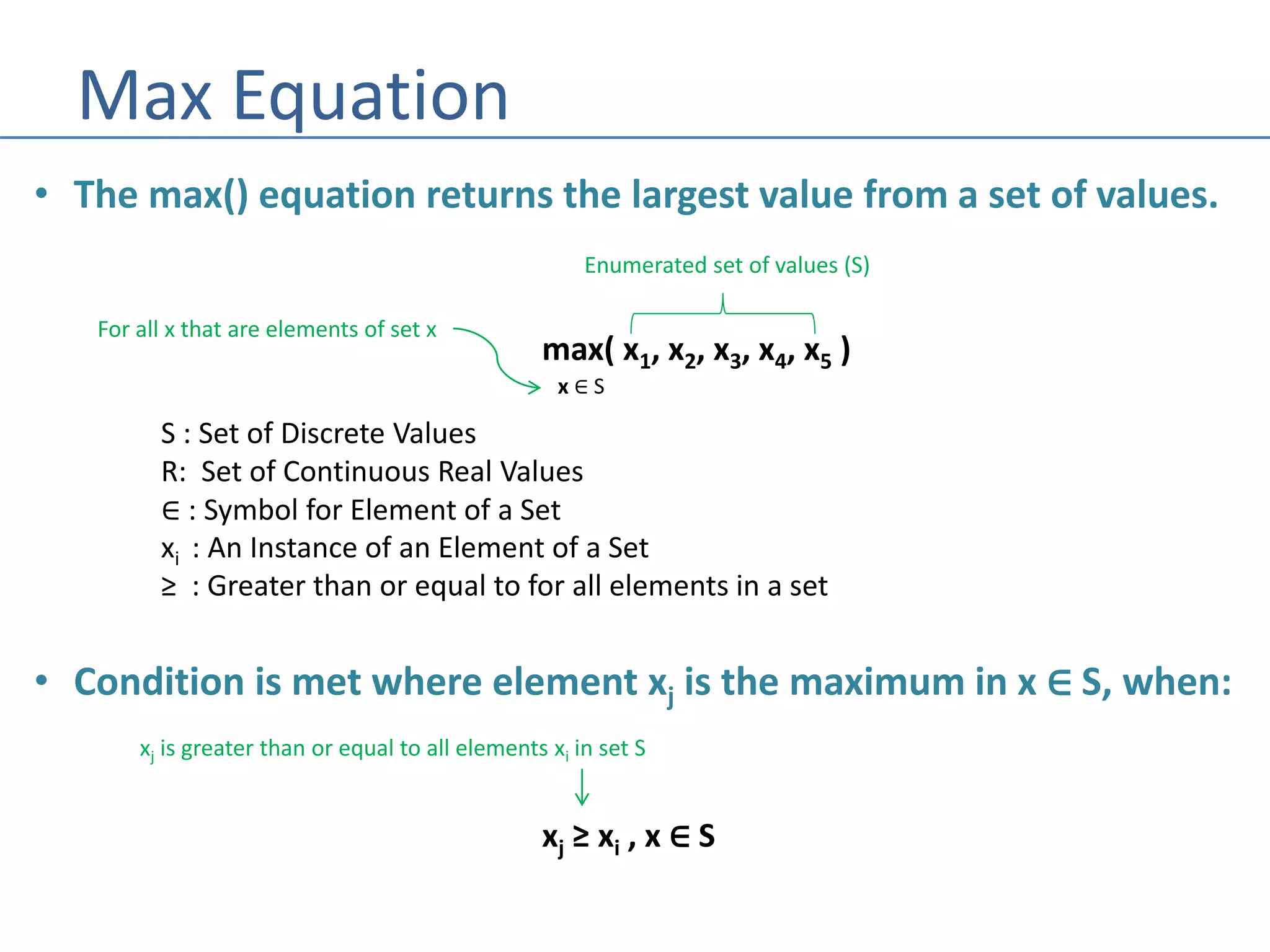
• The max() equation returns the largest value from a set of values.
max( x1, x2, x3, x4, x5 )
x ∈ S
S : Set of Discrete Values
R: Set of Continuous Real Values
∈ : Symbol for Element of a Set
xi : An Instance of an Element of a Set
≥ : Greater than or equal to for all elements in a set
• Condition is met where element xj is the maximum in x ∈ S, when:
xj ≥ xi , x ∈ S
Enumerated set of values (S)
For all x that are elements of set x
xj is greater than or equal to all elements xi in set S
SoftMax Equation
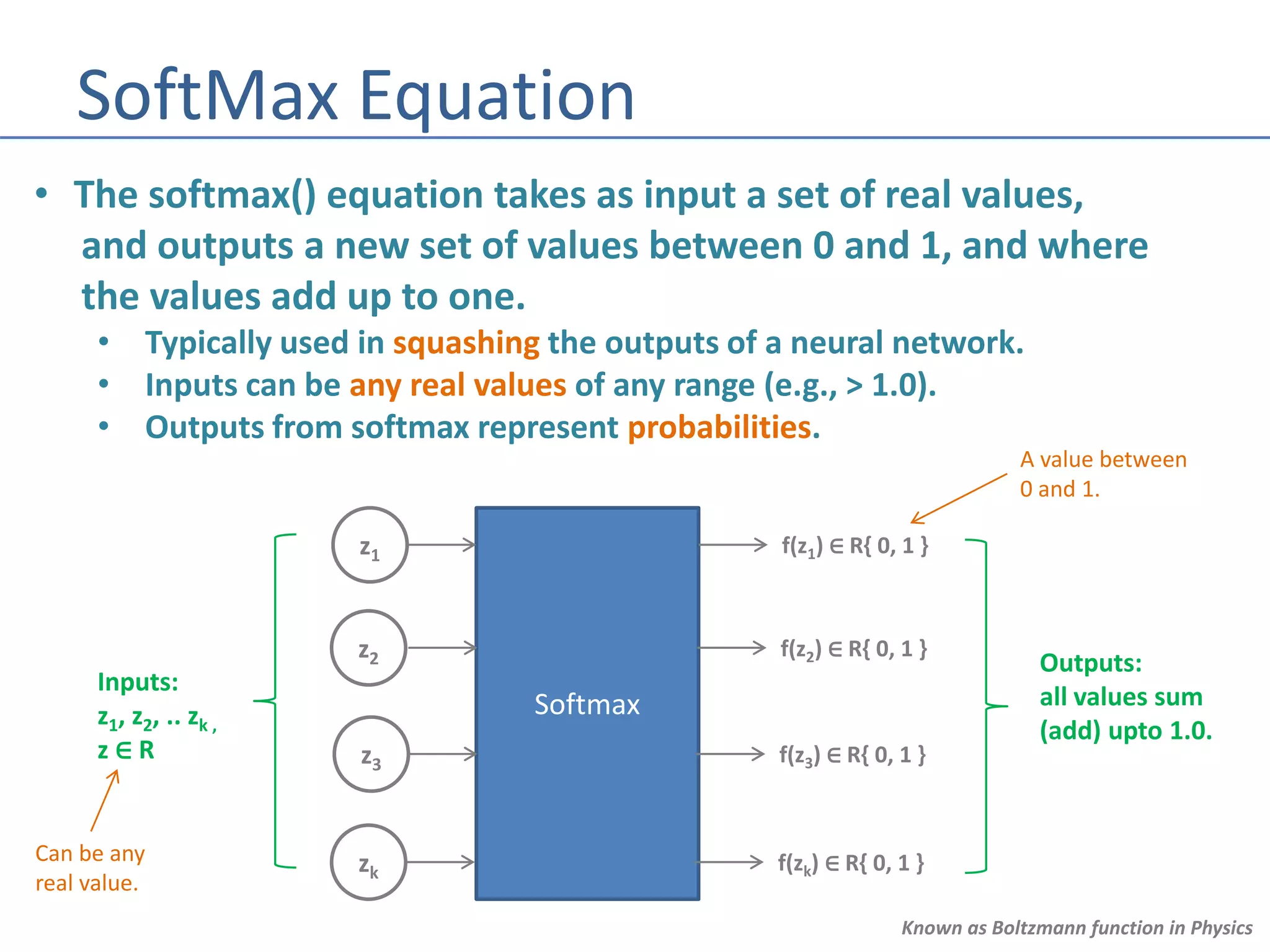
• The softmax() equation takes as input a set of real values,
and outputs a new set of values between 0 and 1, and where
the values add up to one.
• Typically used in squashing the outputs of a neural network.
• Inputs can be any real values of any range (e.g., > 1.0).
• Outputs from softmax represent probabilities.
Softmax
z1
z2
z3
zk
Inputs:
z1, z2, .. zk ,
z ∈ R
f(z1) ∈ R{ 0, 1 }
Can be any
real value.
f(z2) ∈ R{ 0, 1 }
f(z3) ∈ R{ 0, 1 }
f(zk) ∈ R{ 0, 1 }
Outputs:
all values sum
(add) upto 1.0.
A value between
0 and 1.
Known as Boltzmann function in Physics
SoftMax Equation
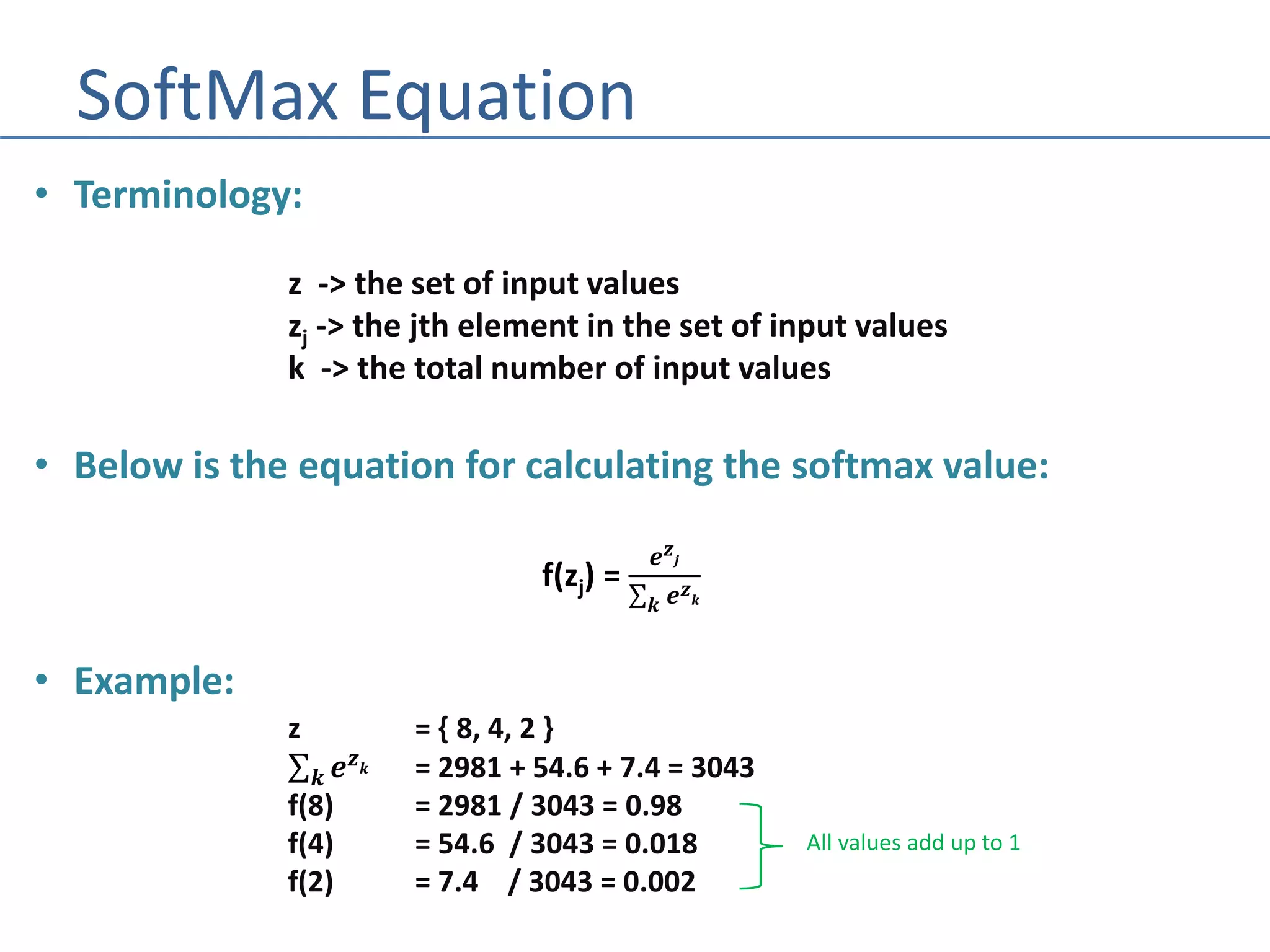
• Terminology:
z -> the set of input values
zj -> the jth element in the set of input values
k -> the total number of input values
• Below is the equation for calculating the softmax value:
f(zj) =
𝒆 𝒛𝒋
𝒌 𝒆 𝒛 𝒌
• Example:
z = { 8, 4, 2 }
𝒌 𝒆 𝒛 𝒌 = 2981 + 54.6 + 7.4 = 3043
f(8) = 2981 / 3043 = 0.98
f(4) = 54.6 / 3043 = 0.018
f(2) = 7.4 / 3043 = 0.002
All values add up to 1
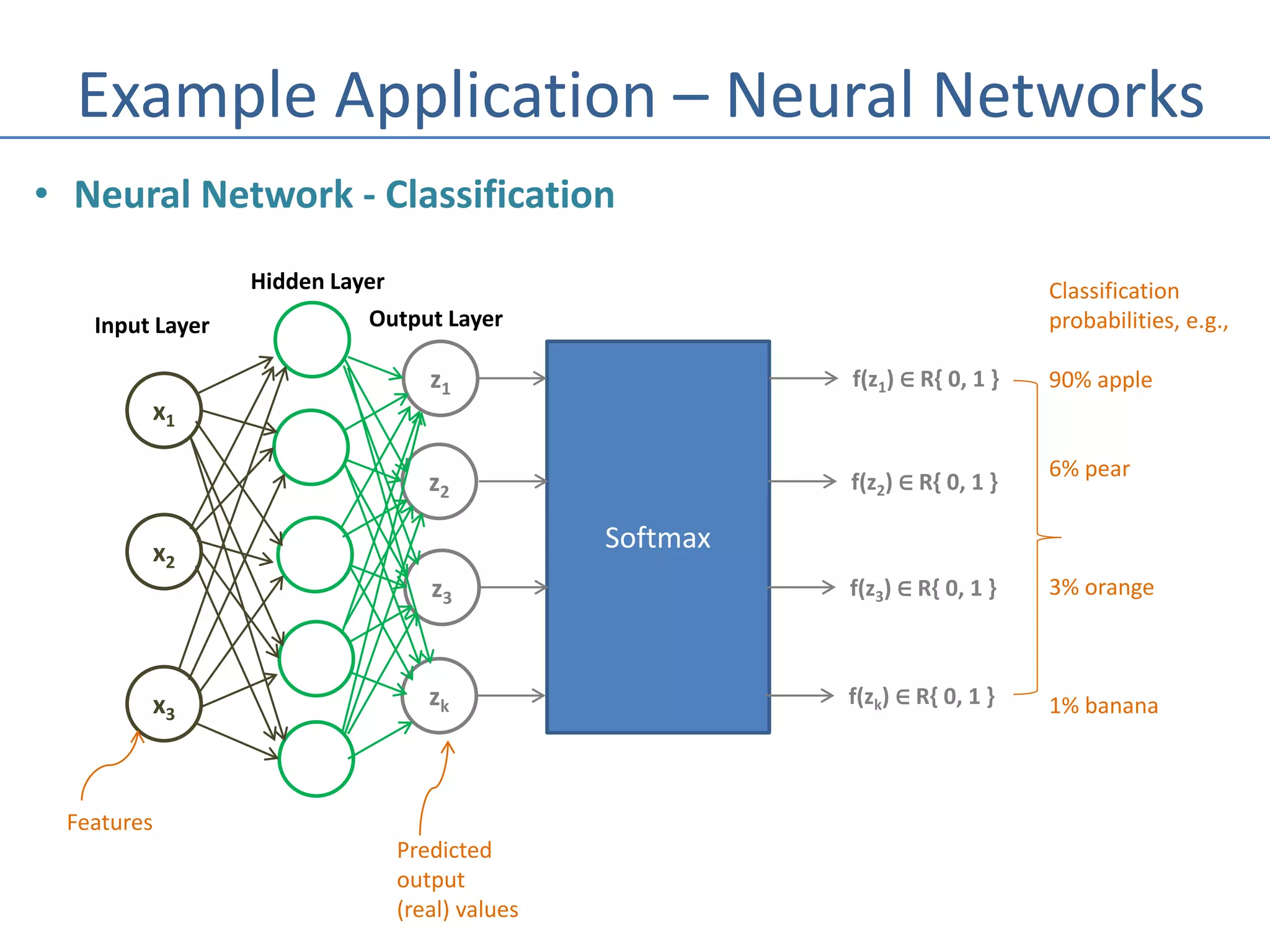
Example Application – Neural Networks
• Neural Network - Classification
Softmax
z1
z2
z3
zk
f(z1) ∈ R{ 0, 1 }
f(z2) ∈ R{ 0, 1 }
f(z3) ∈ R{ 0, 1 }
f(zk) ∈ R{ 0, 1 }
Output Layer
Hidden Layer
x1
x2
x3
Input Layer
Features
Predicted
output
(real) values
Classification
probabilities, e.g.,
90% apple
6% pear
3% orange
1% banana
Torch Library
torch is a python library for machine learning
Neural Networks Support Functions Name Alias
import torch.nn.functional as F
probabilities = F.softmax( list )
Results returned as a list list of values outputted
probabilities adding up to 1 by neural network
Example:
0.98, 0.012, 0.002 = F.softmax( [ 8, 4, 2 ] )

Statistics - SoftMax Equation

  • 1.
    Softmax Equation Statistics Portland DataScience Group Created by Andrew Ferlitsch Community Outreach Officer July, 2017
  • 2.
    Max Equation • Themax() equation returns the largest value from a set of values. max( x1, x2, x3, x4, x5 ) x ∈ S S : Set of Discrete Values R: Set of Continuous Real Values ∈ : Symbol for Element of a Set xi : An Instance of an Element of a Set ≥ : Greater than or equal to for all elements in a set • Condition is met where element xj is the maximum in x ∈ S, when: xj ≥ xi , x ∈ S Enumerated set of values (S) For all x that are elements of set x xj is greater than or equal to all elements xi in set S
  • 3.
    SoftMax Equation • Thesoftmax() equation takes as input a set of real values, and outputs a new set of values between 0 and 1, and where the values add up to one. • Typically used in squashing the outputs of a neural network. • Inputs can be any real values of any range (e.g., > 1.0). • Outputs from softmax represent probabilities. Softmax z1 z2 z3 zk Inputs: z1, z2, .. zk , z ∈ R f(z1) ∈ R{ 0, 1 } Can be any real value. f(z2) ∈ R{ 0, 1 } f(z3) ∈ R{ 0, 1 } f(zk) ∈ R{ 0, 1 } Outputs: all values sum (add) upto 1.0. A value between 0 and 1. Known as Boltzmann function in Physics
  • 4.
    SoftMax Equation • Terminology: z-> the set of input values zj -> the jth element in the set of input values k -> the total number of input values • Below is the equation for calculating the softmax value: f(zj) = 𝒆 𝒛𝒋 𝒌 𝒆 𝒛 𝒌 • Example: z = { 8, 4, 2 } 𝒌 𝒆 𝒛 𝒌 = 2981 + 54.6 + 7.4 = 3043 f(8) = 2981 / 3043 = 0.98 f(4) = 54.6 / 3043 = 0.018 f(2) = 7.4 / 3043 = 0.002 All values add up to 1
  • 5.
    Example Application –Neural Networks • Neural Network - Classification Softmax z1 z2 z3 zk f(z1) ∈ R{ 0, 1 } f(z2) ∈ R{ 0, 1 } f(z3) ∈ R{ 0, 1 } f(zk) ∈ R{ 0, 1 } Output Layer Hidden Layer x1 x2 x3 Input Layer Features Predicted output (real) values Classification probabilities, e.g., 90% apple 6% pear 3% orange 1% banana
  • 6.
    Torch Library torch isa python library for machine learning Neural Networks Support Functions Name Alias import torch.nn.functional as F probabilities = F.softmax( list ) Results returned as a list list of values outputted probabilities adding up to 1 by neural network Example: 0.98, 0.012, 0.002 = F.softmax( [ 8, 4, 2 ] )