 PRESENTED BY - Akshay v. Patil
 B.PHARM.VIIth Semester
2017-18
Guide By- Prof. Miss .S. A .Chavhan madom
Date Of Seminar 12th August 2017
Isolation techniques and characterization
1.Isolation Techniques : General method used for
Isolation and Characterization
Protein.
 Lipids.
2.Isolation and Characterization and Estimation
 Ephedrine.
 Piperine.
 Quinine.
 Caffeine.
 Content:
Protein
• Introduction
Protein also known as polypeptides, are the high molecular weight
polymer of large chain amino acid.
The amino acid in polymer are joined together by peptide bond
between the carboxyl and amino group of adjacent amino acid
residue.
Generally protein are three dimensional in nature due to the fact
that each amino acid which forms protein has its own enantiomeric
structure.
 Properties
 Protein in solution show change in solubility as function of pH,
ionic strength, temperature & the dielectric properties of solvent.
 Excepting the chromo-protein they do not have any characteristic
color odour taste
 Most protein have distinct light absorption maxima at 280nm due
to primarily presence of tyrosine tryptophan & phenylalanine
 Due to denaturation protein usually losses its three dimensional
structure and biological activity
 Function
 Protein from plant are important source in food & feed, protein
are actually the genetic information storing components of plant.
 These are involved in storage transport form structural
component & carry out reaction in the form of enzyme.
 The two step ( translation & transcription) in the biosynthesis of
protein depend on information encoded by gene.
 Each protein has its own unique amino acid sequence that is
specified by nucleotide sequence of the gene encoding this
protein
classification
Based on composition protein can be categorized into general
classes.
1] Simple protein :
These proteins yield only alpha-amino acid on complete hydrolysis.
2] complex or conjugated protein:
These protein give an addition to amino acid an organic or
inorganic non-protein moiety called prosthetic group on hydrolysis.
Example ,
Conjugated
protein
• lipoprotein
• glycoprotein
Prosthetic
group
• lipid
• carbohydrate
Example
• Plasma
lipoprotein
• Immunoglobuli
n
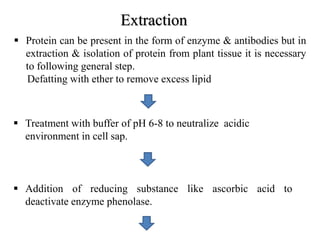
Extraction
 Protein can be present in the form of enzyme & antibodies but in
extraction & isolation of protein from plant tissue it is necessary
to following general step.
Defatting with ether to remove excess lipid
 Treatment with buffer of pH 6-8 to neutralize acidic
environment in cell sap.
 Addition of reducing substance like ascorbic acid to
deactivate enzyme phenolase.
 Addition of polyvinyl pyrrolidone (pvp) to remove tannins.
 Processing as early as fast to avoid action of proteolytic enzymes
preferably at low temperature range.
 Now add ammonium sulphate to obtain precipitate of protein
 Collect precipitate & analyse for molecular weight by gel
chromatography & for composition by gel electrophoresis.
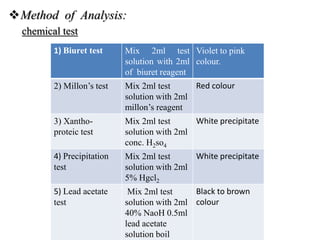
Method of Analysis:
chemical test
1) Biuret test Mix 2ml test
solution with 2ml
of biuret reagent
Violet to pink
colour.
2) Millon’s test Mix 2ml test
solution with 2ml
millon’s reagent
Red colour
3) Xantho-
proteic test
Mix 2ml test
solution with 2ml
conc. H2so4
White precipitate
4) Precipitation
test
Mix 2ml test
solution with 2ml
5% Hgcl2
White precipitate
5) Lead acetate
test
Mix 2ml test
solution with 2ml
40% NaoH 0.5ml
lead acetate
solution boil
Black to brown
colour
Lipids
 Introduction
Lipids are the hydrophobic compound used to supply energy.
Lipids include fixed oil, fats, fatty acid, glycerols, waxes
Monoglycerides , diglycerides & triglycerides.
 Occurrence and distribution.
Fats & oil widely distributed in nature in both plant & animal
tissue.
They occur in relatively high conc. in seed of certain plant (oil
seed) where they function to supply food for use of the growing
seedling.
Animal store deposit of fat in their adipose tissue, these store fat
constitute reserve which can be used as source of energy.
Lipids
Function.
1. Source of energy.
2. Structural component of
the brain and cell
membrane.
3. They carry fat-soluble vit
(A,D,E,K) & are vital part
of cell signaling.
4. They also found to have
potential source of the
antioxidant compound.
 Properties.
1. Soluble in non polar
solvent sparingly soluble in
water.
2. Greasy or fat like in nature
& show transluescent
property
3. The glyceride ester of
saturated fatty acid are
usually liquid at room
temp.
classification
1) Simple Lipids :
These are ester of fatty acid with alcohol saponifiable,
include the most abundant of all lipids such as fats & oil.
2) Compound or complex Lipids :
These are ester of fatty acid containing other group in
addition to alcohol & fatty acid saponifiable include
phosphoglycerides & sphingolipids
3) Derived Lipids :
These are derived from the hydrolysis of above two classes of
lipids, non-saponifiable include fatty acid, sterol, terpenes & fat
soluble vitamin.
 Methods of analysis:
chemical test
1) Filter paper
test
Press the powder
between filter
paper
Permanent oily
spot
2) Solubility test Mix oil in alcohol Insoluble
3) Sudan red iii
test
Treat the solution
with sudan red iii
Red colour
4) Tincture alkana
test
Treat the test
solution with
tincture alkana
Red colour
Biosynthesis:
Acetate pathway build various types of lipid & oil moieties from
acetyl- COA condensation
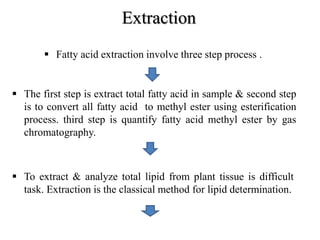
Extraction
 Fatty acid extraction involve three step process .
 The first step is extract total fatty acid in sample & second step
is to convert all fatty acid to methyl ester using esterification
process. third step is quantify fatty acid methyl ester by gas
chromatography.
 To extract & analyze total lipid from plant tissue is difficult
task. Extraction is the classical method for lipid determination.
 Isopropanol is most preferred solvent to deactivate lipases
glycolipid & increase the amount of free fatty acid in the extract.
Recent trend in the use of solvent in combination for extraction of
total lipid from plant tissue.
 Extracted lipid fraction must be stored with addition of 0.005%
butylated hydroxy toluene until next use to avoid degradation.
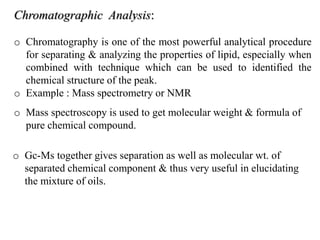
Chromatographic Analysis::
o Chromatography is one of the most powerful analytical procedure
for separating & analyzing the properties of lipid, especially when
combined with technique which can be used to identified the
chemical structure of the peak.
o Example : Mass spectrometry or NMR
o Mass spectroscopy is used to get molecular weight & formula of
pure chemical compound.
o Gc-Ms together gives separation as well as molecular wt. of
separated chemical component & thus very useful in elucidating
the mixture of oils.
Stationary phase – silica gel
Mobile phase – chloroform: methanol : acetic acid :water
(170:25:25:1)
Detection – 50% sulphuric acid.
1] TLC for total lipids :
2] Argentation TLC for triglycerides :
stationary phase - silica gel impregnated with 5% AgNo3
Mobile phase - isopropanol : chloroform (3:197)
Detection - 50 % sulphuric acid.
Identification test :
Isolation, characterization and estimation.
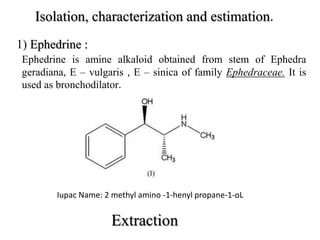
1) Ephedrine :
Ephedrine is amine alkaloid obtained from stem of Ephedra
geradiana, E – vulgaris , E – sinica of family Ephedraceae. It is
used as bronchodilator.
Iupac Name: 2 methyl amino -1-henyl propane-1-oL
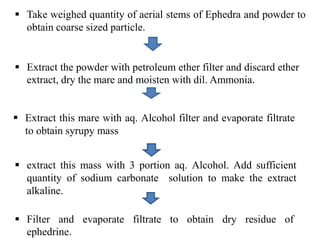
 Extract the powder with petroleum ether filter and discard ether
extract, dry the mare and moisten with dil. Ammonia.
 Extract this mare with aq. Alcohol filter and evaporate filtrate
to obtain syrupy mass
 extract this mass with 3 portion aq. Alcohol. Add sufficient
quantity of sodium carbonate solution to make the extract
alkaline.
 Filter and evaporate filtrate to obtain dry residue of
ephedrine.
 Take weighed quantity of aerial stems of Ephedra and powder to
obtain coarse sized particle.
1)TLC :
Stationary phase – silica gel
Mobile phase – Toluene : chloroform: ethanol ( 29:6:15:)
Detection: Dragendroff of reagent ( orange brown colour or 0.5%
iodine in chloroform)
2) HPLC :
Method – isocratic
Stationary phase – penta fluoro phenyl propyl ( PFPP)
Mobile phase- ammonium acetate (7M) in acetonitrile water(9:1)
Detection-
UV- visible detection at 215 nm
Identification test :
2) Piperine :
Piperine is the major constituent of piper nigrum, piper longum of
family Piperaceae.
It is used as a food flavouring agent and bioavailability enhancer.
IUPAC Name: 1- [ 5-1,3 ( Benzodioxol 5-yl)-
1- oxo -2,4 pentadienyl ] piperidine.
Extraction
 Take the accurately weighed quantity of black pepper powder in
a round bottom flask
 Add sufficient quantity of alcohol and reflux for 6 hr, after 6 hr
allow to cool and filter the alcoholic extract distill off the
alcohol to 1/4th of its original volume. Prepare 50ml of 10%
alcoholic KOH.
 Add the conc. alcoholic extract to this solution and heat for 20
min.
 Add warm water drop wise in the above solution to precipitate
the piperine.
 Allow cooling to room temperature for 12hr & collect the yellow
coloured needle shaped precipitate of piperine.
Recrystallize from acetone, dry and calculate the percentage
yield of piperine.
Identification test :
1)TLC :
Stationary phase – silica gel
Mobile phase - Toluene:ethyl acetate (7:3)
Detection - yellow visible spot.
2) HPLC :
Method- Gradient
Stationary phase – c18
Mobile phase – methanol : water
Detection – PDA detector.
3) Quinine :
Quinine, quinidine, cinchonine and cinchonidine are the popular
quinoline alkaloid obtained from dried bark of cinchona officinalis ,
of family Rubiaceae. all these constituent have anti-malarial
properties.
Quinine
Extraction
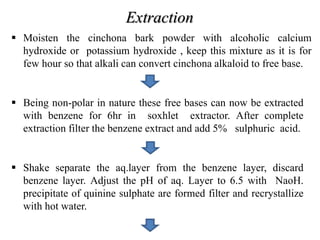
 Moisten the cinchona bark powder with alcoholic calcium
hydroxide or potassium hydroxide , keep this mixture as it is for
few hour so that alkali can convert cinchona alkaloid to free base.
 Being non-polar in nature these free bases can now be extracted
with benzene for 6hr in soxhlet extractor. After complete
extraction filter the benzene extract and add 5% sulphuric acid.
 Shake separate the aq.layer from the benzene layer, discard
benzene layer. Adjust the pH of aq. Layer to 6.5 with NaoH.
precipitate of quinine sulphate are formed filter and recrystallize
with hot water.
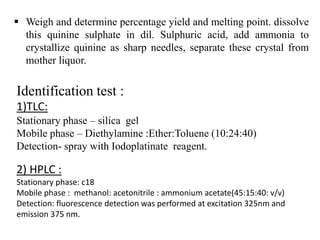
 Weigh and determine percentage yield and melting point. dissolve
this quinine sulphate in dil. Sulphuric acid, add ammonia to
crystallize quinine as sharp needles, separate these crystal from
mother liquor.
Identification test :
1)TLC:
Stationary phase – silica gel
Mobile phase – Diethylamine :Ether:Toluene (10:24:40)
Detection- spray with Iodoplatinate reagent.
2) HPLC :
Stationary phase: c18
Mobile phase : methanol: acetonitrile : ammonium acetate(45:15:40: v/v)
Detection: fluorescence detection was performed at excitation 325nm and
emission 375 nm.
4) Caffeine :
Caffeine, xanthine alkaloid obtained from coffee, cocoa beans, cola
nuts and tea leaves is psychoactive stimulant drug caffeine is pseudo
alkaloid as it is not biosynthesized from amino acid, but gives all
identification test positive.
Extraction
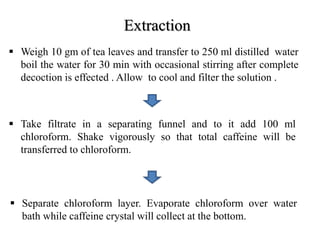
 Weigh 10 gm of tea leaves and transfer to 250 ml distilled water
boil the water for 30 min with occasional stirring after complete
decoction is effected . Allow to cool and filter the solution .
 Take filtrate in a separating funnel and to it add 100 ml
chloroform. Shake vigorously so that total caffeine will be
transferred to chloroform.
 Separate chloroform layer. Evaporate chloroform over water
bath while caffeine crystal will collect at the bottom.
Identification test :
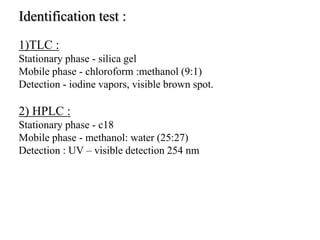
1)TLC :
Stationary phase - silica gel
Mobile phase - chloroform :methanol (9:1)
Detection - iodine vapors, visible brown spot.
2) HPLC :
Stationary phase - c18
Mobile phase - methanol: water (25:27)
Detection : UV – visible detection 254 nm
References :
 Textbook Pharmacognosy and phytochemistry a Comprehensive
Approach by S.S. khadabadi , B.A.Baviskar, S.L.Deore. BS
publication, page No 246 - 250
 www.Wikipidia.com
 Some Review Articles
isolation technique and characterization

isolation technique and characterization

  • 1.
     PRESENTED BY- Akshay v. Patil  B.PHARM.VIIth Semester 2017-18 Guide By- Prof. Miss .S. A .Chavhan madom Date Of Seminar 12th August 2017 Isolation techniques and characterization
  • 2.
    1.Isolation Techniques :General method used for Isolation and Characterization Protein.  Lipids. 2.Isolation and Characterization and Estimation  Ephedrine.  Piperine.  Quinine.  Caffeine.  Content:
  • 3.
    Protein • Introduction Protein alsoknown as polypeptides, are the high molecular weight polymer of large chain amino acid. The amino acid in polymer are joined together by peptide bond between the carboxyl and amino group of adjacent amino acid residue. Generally protein are three dimensional in nature due to the fact that each amino acid which forms protein has its own enantiomeric structure.
  • 4.
     Properties  Proteinin solution show change in solubility as function of pH, ionic strength, temperature & the dielectric properties of solvent.  Excepting the chromo-protein they do not have any characteristic color odour taste  Most protein have distinct light absorption maxima at 280nm due to primarily presence of tyrosine tryptophan & phenylalanine  Due to denaturation protein usually losses its three dimensional structure and biological activity
  • 5.
     Function  Proteinfrom plant are important source in food & feed, protein are actually the genetic information storing components of plant.  These are involved in storage transport form structural component & carry out reaction in the form of enzyme.  The two step ( translation & transcription) in the biosynthesis of protein depend on information encoded by gene.  Each protein has its own unique amino acid sequence that is specified by nucleotide sequence of the gene encoding this protein
  • 6.
    classification Based on compositionprotein can be categorized into general classes. 1] Simple protein : These proteins yield only alpha-amino acid on complete hydrolysis. 2] complex or conjugated protein: These protein give an addition to amino acid an organic or inorganic non-protein moiety called prosthetic group on hydrolysis. Example , Conjugated protein • lipoprotein • glycoprotein Prosthetic group • lipid • carbohydrate Example • Plasma lipoprotein • Immunoglobuli n
  • 7.
    Extraction  Protein canbe present in the form of enzyme & antibodies but in extraction & isolation of protein from plant tissue it is necessary to following general step. Defatting with ether to remove excess lipid  Treatment with buffer of pH 6-8 to neutralize acidic environment in cell sap.  Addition of reducing substance like ascorbic acid to deactivate enzyme phenolase.
  • 8.
     Addition ofpolyvinyl pyrrolidone (pvp) to remove tannins.  Processing as early as fast to avoid action of proteolytic enzymes preferably at low temperature range.  Now add ammonium sulphate to obtain precipitate of protein  Collect precipitate & analyse for molecular weight by gel chromatography & for composition by gel electrophoresis.
  • 9.
    Method of Analysis: chemicaltest 1) Biuret test Mix 2ml test solution with 2ml of biuret reagent Violet to pink colour. 2) Millon’s test Mix 2ml test solution with 2ml millon’s reagent Red colour 3) Xantho- proteic test Mix 2ml test solution with 2ml conc. H2so4 White precipitate 4) Precipitation test Mix 2ml test solution with 2ml 5% Hgcl2 White precipitate 5) Lead acetate test Mix 2ml test solution with 2ml 40% NaoH 0.5ml lead acetate solution boil Black to brown colour
  • 10.
    Lipids  Introduction Lipids arethe hydrophobic compound used to supply energy. Lipids include fixed oil, fats, fatty acid, glycerols, waxes Monoglycerides , diglycerides & triglycerides.  Occurrence and distribution. Fats & oil widely distributed in nature in both plant & animal tissue. They occur in relatively high conc. in seed of certain plant (oil seed) where they function to supply food for use of the growing seedling. Animal store deposit of fat in their adipose tissue, these store fat constitute reserve which can be used as source of energy.
  • 11.
    Lipids Function. 1. Source ofenergy. 2. Structural component of the brain and cell membrane. 3. They carry fat-soluble vit (A,D,E,K) & are vital part of cell signaling. 4. They also found to have potential source of the antioxidant compound.  Properties. 1. Soluble in non polar solvent sparingly soluble in water. 2. Greasy or fat like in nature & show transluescent property 3. The glyceride ester of saturated fatty acid are usually liquid at room temp.
  • 12.
    classification 1) Simple Lipids: These are ester of fatty acid with alcohol saponifiable, include the most abundant of all lipids such as fats & oil. 2) Compound or complex Lipids : These are ester of fatty acid containing other group in addition to alcohol & fatty acid saponifiable include phosphoglycerides & sphingolipids 3) Derived Lipids : These are derived from the hydrolysis of above two classes of lipids, non-saponifiable include fatty acid, sterol, terpenes & fat soluble vitamin.
  • 13.
     Methods ofanalysis: chemical test 1) Filter paper test Press the powder between filter paper Permanent oily spot 2) Solubility test Mix oil in alcohol Insoluble 3) Sudan red iii test Treat the solution with sudan red iii Red colour 4) Tincture alkana test Treat the test solution with tincture alkana Red colour Biosynthesis: Acetate pathway build various types of lipid & oil moieties from acetyl- COA condensation
  • 14.
    Extraction  Fatty acidextraction involve three step process .  The first step is extract total fatty acid in sample & second step is to convert all fatty acid to methyl ester using esterification process. third step is quantify fatty acid methyl ester by gas chromatography.  To extract & analyze total lipid from plant tissue is difficult task. Extraction is the classical method for lipid determination.
  • 15.
     Isopropanol ismost preferred solvent to deactivate lipases glycolipid & increase the amount of free fatty acid in the extract. Recent trend in the use of solvent in combination for extraction of total lipid from plant tissue.  Extracted lipid fraction must be stored with addition of 0.005% butylated hydroxy toluene until next use to avoid degradation.
  • 16.
    Chromatographic Analysis:: o Chromatographyis one of the most powerful analytical procedure for separating & analyzing the properties of lipid, especially when combined with technique which can be used to identified the chemical structure of the peak. o Example : Mass spectrometry or NMR o Mass spectroscopy is used to get molecular weight & formula of pure chemical compound. o Gc-Ms together gives separation as well as molecular wt. of separated chemical component & thus very useful in elucidating the mixture of oils.
  • 17.
    Stationary phase –silica gel Mobile phase – chloroform: methanol : acetic acid :water (170:25:25:1) Detection – 50% sulphuric acid. 1] TLC for total lipids : 2] Argentation TLC for triglycerides : stationary phase - silica gel impregnated with 5% AgNo3 Mobile phase - isopropanol : chloroform (3:197) Detection - 50 % sulphuric acid. Identification test :
  • 18.
    Isolation, characterization andestimation. 1) Ephedrine : Ephedrine is amine alkaloid obtained from stem of Ephedra geradiana, E – vulgaris , E – sinica of family Ephedraceae. It is used as bronchodilator. Iupac Name: 2 methyl amino -1-henyl propane-1-oL
  • 19.
     Extract thepowder with petroleum ether filter and discard ether extract, dry the mare and moisten with dil. Ammonia.  Extract this mare with aq. Alcohol filter and evaporate filtrate to obtain syrupy mass  extract this mass with 3 portion aq. Alcohol. Add sufficient quantity of sodium carbonate solution to make the extract alkaline.  Filter and evaporate filtrate to obtain dry residue of ephedrine.  Take weighed quantity of aerial stems of Ephedra and powder to obtain coarse sized particle.
  • 20.
    1)TLC : Stationary phase– silica gel Mobile phase – Toluene : chloroform: ethanol ( 29:6:15:) Detection: Dragendroff of reagent ( orange brown colour or 0.5% iodine in chloroform) 2) HPLC : Method – isocratic Stationary phase – penta fluoro phenyl propyl ( PFPP) Mobile phase- ammonium acetate (7M) in acetonitrile water(9:1) Detection- UV- visible detection at 215 nm Identification test :
  • 21.
    2) Piperine : Piperineis the major constituent of piper nigrum, piper longum of family Piperaceae. It is used as a food flavouring agent and bioavailability enhancer. IUPAC Name: 1- [ 5-1,3 ( Benzodioxol 5-yl)- 1- oxo -2,4 pentadienyl ] piperidine.
  • 22.
    Extraction  Take theaccurately weighed quantity of black pepper powder in a round bottom flask  Add sufficient quantity of alcohol and reflux for 6 hr, after 6 hr allow to cool and filter the alcoholic extract distill off the alcohol to 1/4th of its original volume. Prepare 50ml of 10% alcoholic KOH.  Add the conc. alcoholic extract to this solution and heat for 20 min.  Add warm water drop wise in the above solution to precipitate the piperine.
  • 23.
     Allow coolingto room temperature for 12hr & collect the yellow coloured needle shaped precipitate of piperine. Recrystallize from acetone, dry and calculate the percentage yield of piperine. Identification test : 1)TLC : Stationary phase – silica gel Mobile phase - Toluene:ethyl acetate (7:3) Detection - yellow visible spot. 2) HPLC : Method- Gradient Stationary phase – c18 Mobile phase – methanol : water Detection – PDA detector.
  • 24.
    3) Quinine : Quinine,quinidine, cinchonine and cinchonidine are the popular quinoline alkaloid obtained from dried bark of cinchona officinalis , of family Rubiaceae. all these constituent have anti-malarial properties. Quinine
  • 25.
    Extraction  Moisten thecinchona bark powder with alcoholic calcium hydroxide or potassium hydroxide , keep this mixture as it is for few hour so that alkali can convert cinchona alkaloid to free base.  Being non-polar in nature these free bases can now be extracted with benzene for 6hr in soxhlet extractor. After complete extraction filter the benzene extract and add 5% sulphuric acid.  Shake separate the aq.layer from the benzene layer, discard benzene layer. Adjust the pH of aq. Layer to 6.5 with NaoH. precipitate of quinine sulphate are formed filter and recrystallize with hot water.
  • 26.
     Weigh anddetermine percentage yield and melting point. dissolve this quinine sulphate in dil. Sulphuric acid, add ammonia to crystallize quinine as sharp needles, separate these crystal from mother liquor. Identification test : 1)TLC: Stationary phase – silica gel Mobile phase – Diethylamine :Ether:Toluene (10:24:40) Detection- spray with Iodoplatinate reagent. 2) HPLC : Stationary phase: c18 Mobile phase : methanol: acetonitrile : ammonium acetate(45:15:40: v/v) Detection: fluorescence detection was performed at excitation 325nm and emission 375 nm.
  • 27.
    4) Caffeine : Caffeine,xanthine alkaloid obtained from coffee, cocoa beans, cola nuts and tea leaves is psychoactive stimulant drug caffeine is pseudo alkaloid as it is not biosynthesized from amino acid, but gives all identification test positive.
  • 28.
    Extraction  Weigh 10gm of tea leaves and transfer to 250 ml distilled water boil the water for 30 min with occasional stirring after complete decoction is effected . Allow to cool and filter the solution .  Take filtrate in a separating funnel and to it add 100 ml chloroform. Shake vigorously so that total caffeine will be transferred to chloroform.  Separate chloroform layer. Evaporate chloroform over water bath while caffeine crystal will collect at the bottom.
  • 29.
    Identification test : 1)TLC: Stationary phase - silica gel Mobile phase - chloroform :methanol (9:1) Detection - iodine vapors, visible brown spot. 2) HPLC : Stationary phase - c18 Mobile phase - methanol: water (25:27) Detection : UV – visible detection 254 nm
  • 30.
    References :  TextbookPharmacognosy and phytochemistry a Comprehensive Approach by S.S. khadabadi , B.A.Baviskar, S.L.Deore. BS publication, page No 246 - 250  www.Wikipidia.com  Some Review Articles

Editor's Notes

  • #3 Content
  • #8 Extraction
  • #11 Lipids
  • #20 Identification test
  • #21 Identification test:
  • #22 Take the accurately weighed quantity of black pepper powder in a round bottom flask.
  • #26 Weigh and determine percentage yeild and melting point.dissolve this quinine sulphate in dil. Sulphuric acid, add ammonia to crystallize quinine as sharp needles,separate these crystal from mother liquor.
  • #28 4) Caffeine Caffeine, xanthin alkaloid obtained from coffee, cocoa beans, cola nuts and tea leaves is psychoactive stimulant drug caffeine is pseudo alkaloid as it is not biosynthesized from amino acid, but gives all identification test positive.
  • #31 www.Wikipidia.com