Phytochemical
fingerprinting
Chetna Kaushik
M.Pharm (Pharmacognosy and
Phytochemistry )1st Semester
17/Mph/DPSRU/2018
CONTENTS
2
 Phytochemical
fingerprinting
 High performance
thin layer
chromatography
 Theoretical
considerations
 HPTLC method
development
 Characterisation
using HPTLC
 Advantages of
HPTLC
 Hyphenated
techniques
 Gas chromatography
– mass spectroscopy
 Advantages of GC-MS
 Characterization using
GC-MS
 Conclusion
 References
3
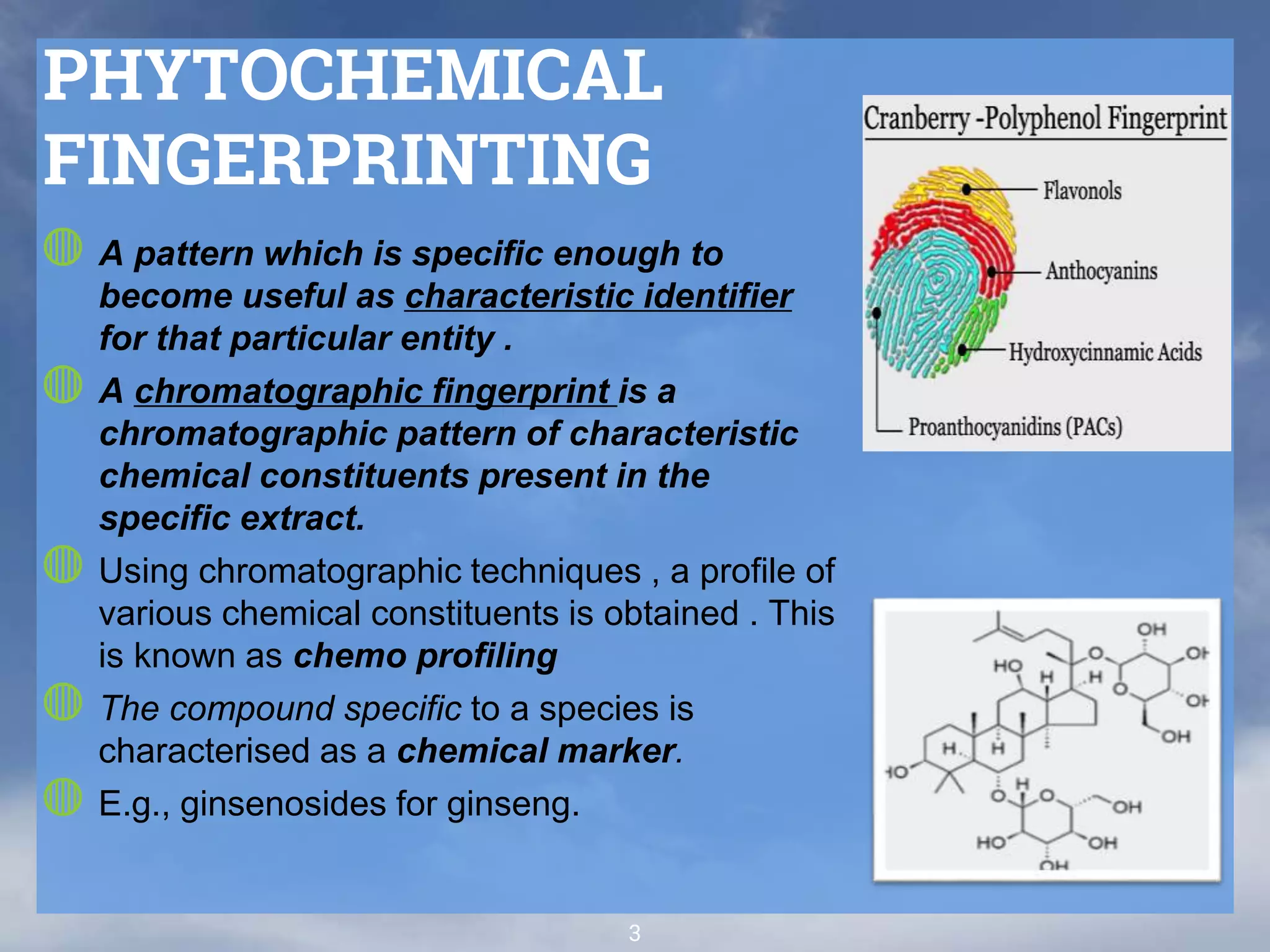
◍ A pattern which is specific enough to
become useful as characteristic identifier
for that particular entity .
◍ A chromatographic fingerprint is a
chromatographic pattern of characteristic
chemical constituents present in the
specific extract.
◍ Using chromatographic techniques , a profile of
various chemical constituents is obtained . This
is known as chemo profiling
◍ The compound specific to a species is
characterised as a chemical marker.
◍ E.g., ginsenosides for ginseng.
PHYTOCHEMICAL
FINGERPRINTING
Contd.
These fingerprints can be obtained by
◍ TLC/HPTLC
◍ HPLC
◍ GC
◍ GC-MS
◍ LC-MS
4
HIGH PERFORMANCE THIN
LAYER CHROMATOGRAPHY
(HPTLC)
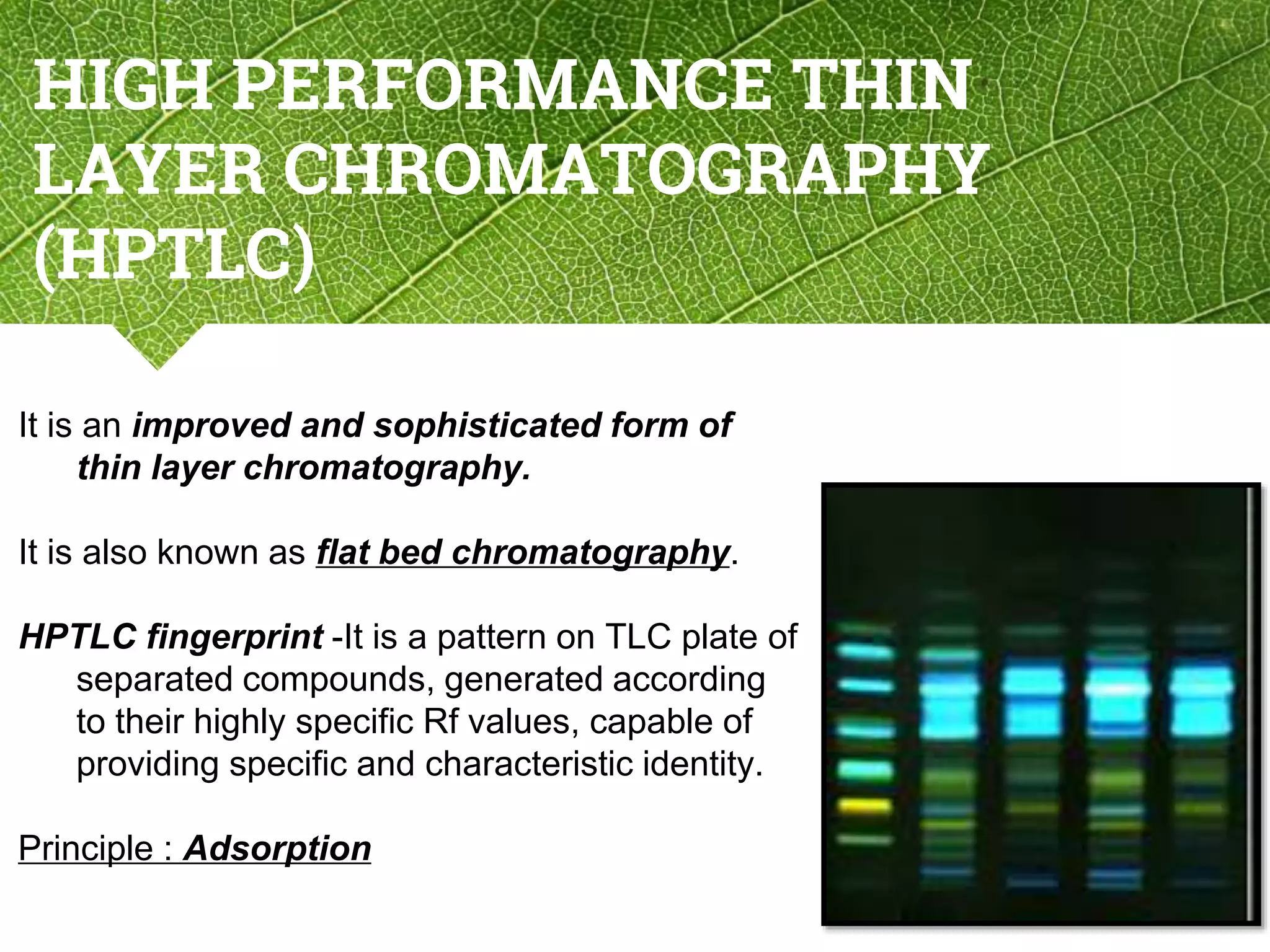
It is an improved and sophisticated form of
thin layer chromatography.
It is also known as flat bed chromatography.
HPTLC fingerprint -It is a pattern on TLC plate of
separated compounds, generated according
to their highly specific Rf values, capable of
providing specific and characteristic identity.
Principle : Adsorption
5
“
Theoretical Considerations
6
RETARDATION/
RETENTION FACTOR
PARTITION
COEFFICIENT
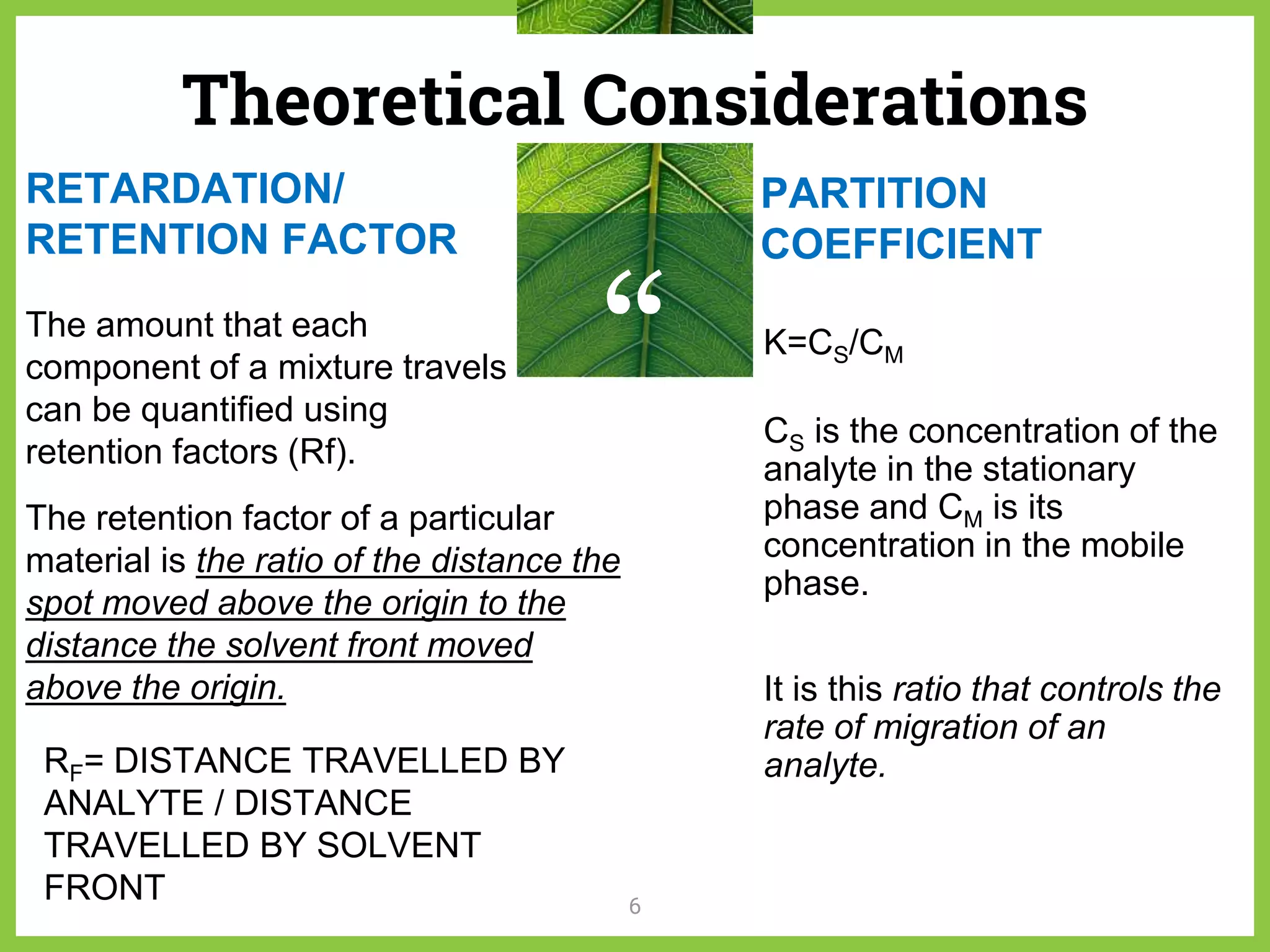
The amount that each
component of a mixture travels
can be quantified using
retention factors (Rf).
RF= DISTANCE TRAVELLED BY
ANALYTE / DISTANCE
TRAVELLED BY SOLVENT
FRONT
The retention factor of a particular
material is the ratio of the distance the
spot moved above the origin to the
distance the solvent front moved
above the origin.
K=CS/CM
CS is the concentration of the
analyte in the stationary
phase and CM is its
concentration in the mobile
phase.
It is this ratio that controls the
rate of migration of an
analyte.
THIS IS A SLIDE TITLE
◍ Here you have a list of items
◍ And some text
◍ But remember not to overload your
slides with content
Your audience will listen to you or read the
content, but won’t do both.
7
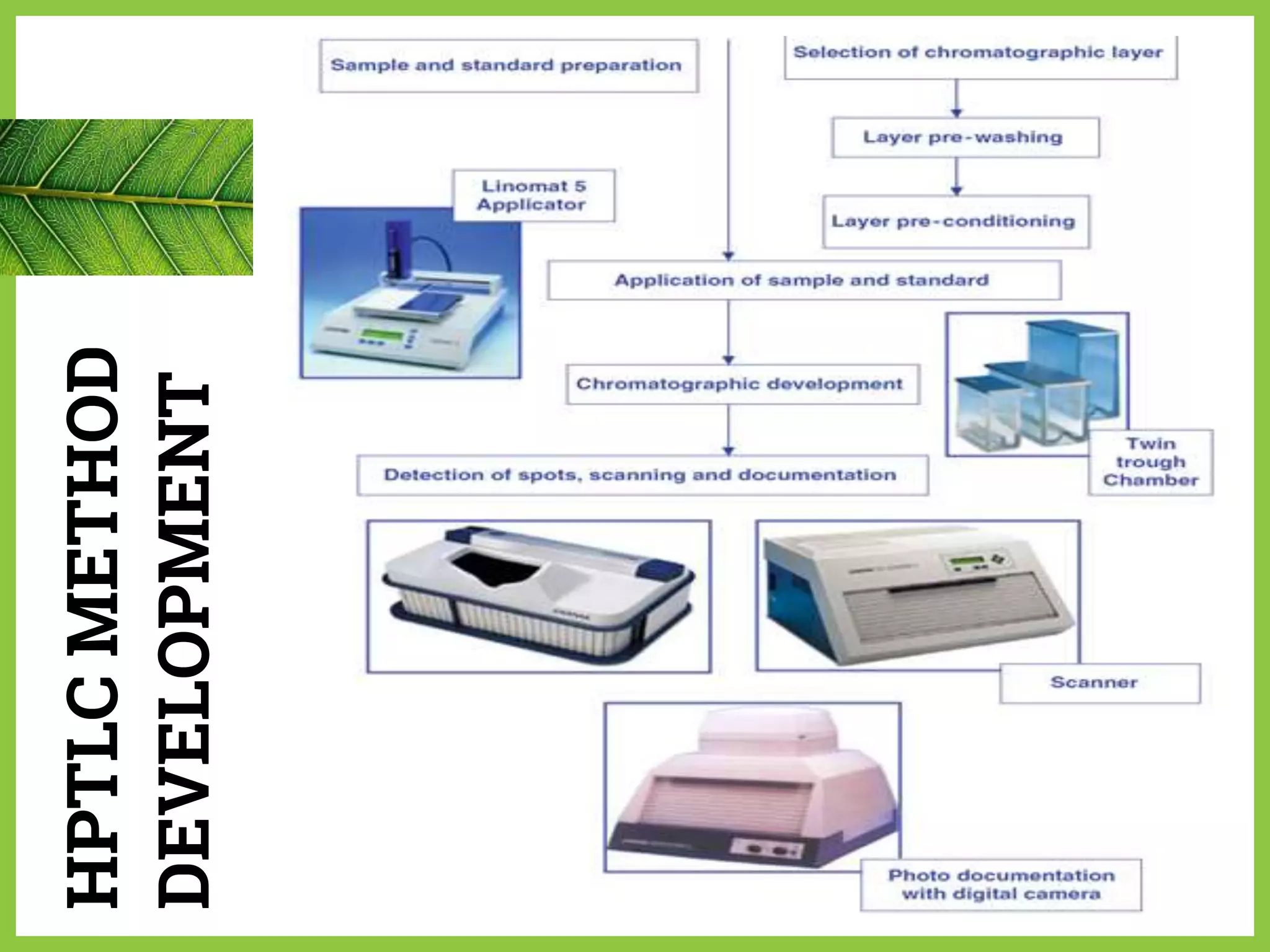
HPTLCMETHOD
DEVELOPMENT
8
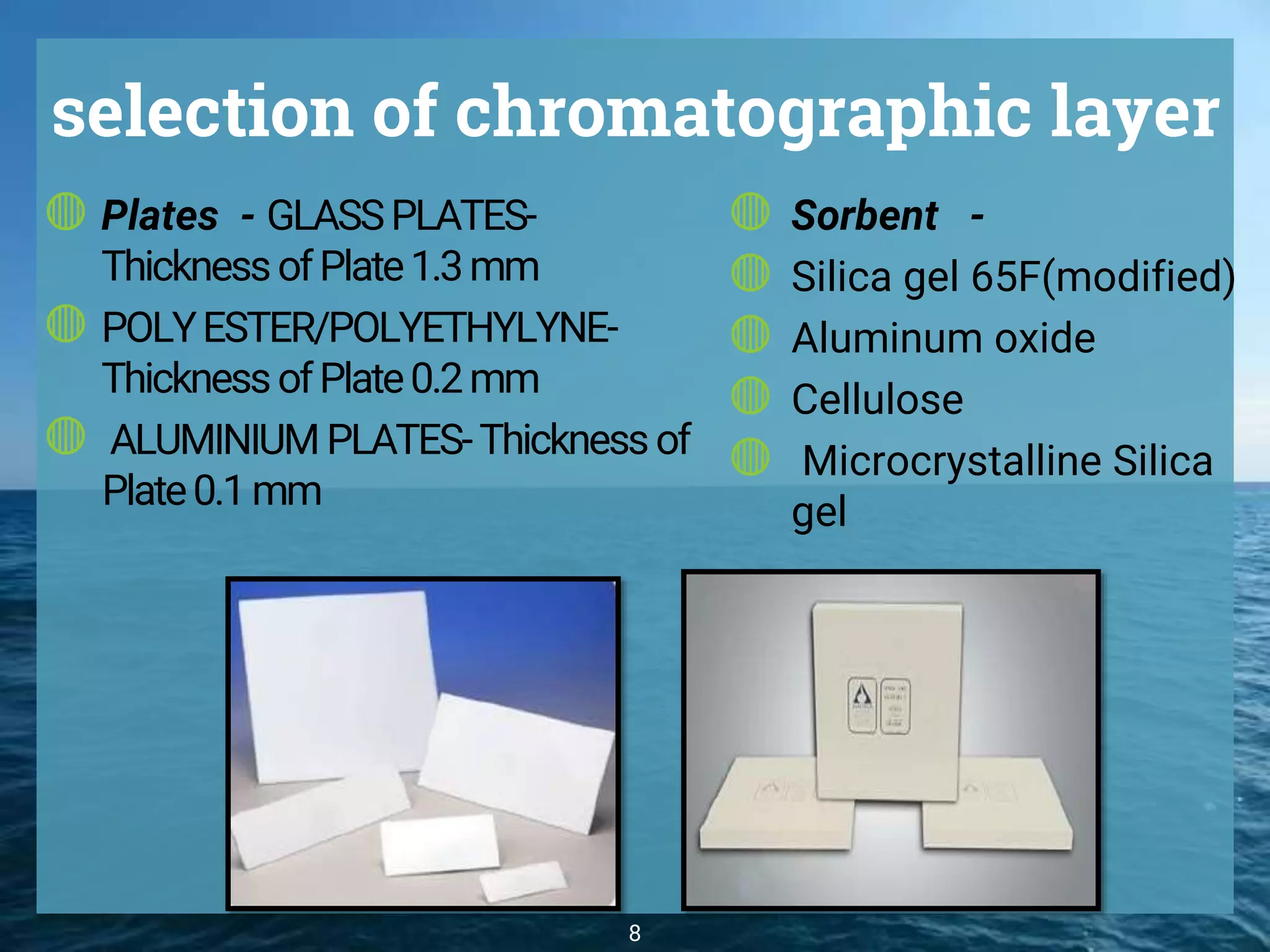
selection of chromatographic layer
◍ Plates - GLASSPLATES-
ThicknessofPlate1.3mm
◍ POLYESTER/POLYETHYLYNE-
ThicknessofPlate0.2mm
◍ ALUMINIUMPLATES-Thicknessof
Plate0.1mm
◍ Sorbent -
◍ Silica gel 65F(modified)
◍ Aluminum oxide
◍ Cellulose
◍ Microcrystalline Silica
gel
◍ Concentration range – 0.1-1 µg / µl
(above this –poor separation )
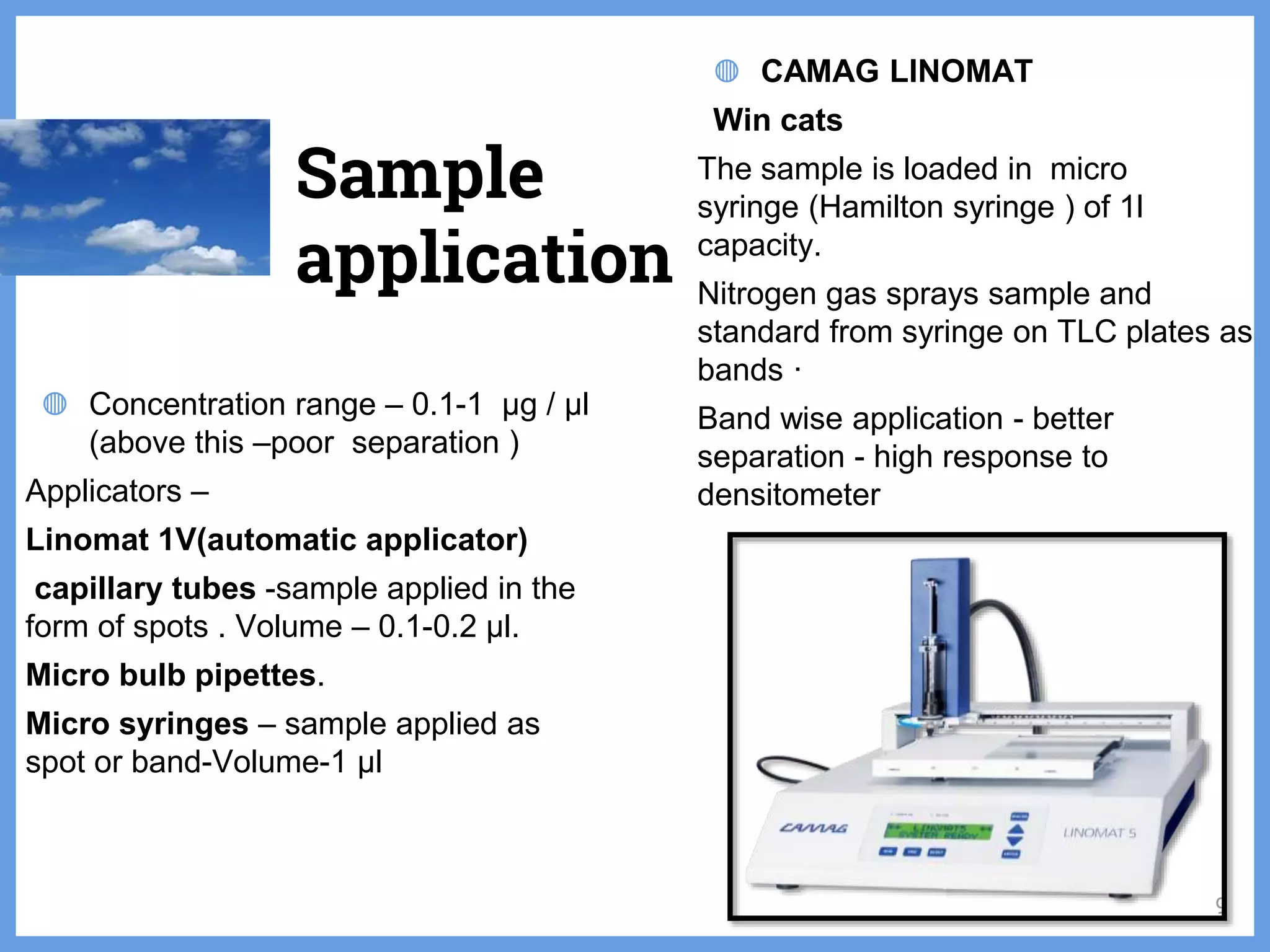
Applicators –
Linomat 1V(automatic applicator)
capillary tubes -sample applied in the
form of spots . Volume – 0.1-0.2 µl.
Micro bulb pipettes.
Micro syringes – sample applied as
spot or band-Volume-1 µl
◍ CAMAG LINOMAT
Win cats
The sample is loaded in micro
syringe (Hamilton syringe ) of 1l
capacity.
Nitrogen gas sprays sample and
standard from syringe on TLC plates as
bands ·
Band wise application - better
separation - high response to
densitometer
Sample
application
9
◍ Detection under UV light is
first choice - non destructive.
◍ Spots of fluorescent
compounds can be seen at
254 nm (short wave length) or
at 366 nm (long wave length) ·
◍ Spots of non fluorescent
compounds can be seen -
fluorescent stationary phase
is used - silica gel GF ·
◍ Non UV absorbing
compounds - dipping
the plates in 0.1% iodine
solution ·
◍ When individual
component does not
respond to UV -
derivatization required
for detection
DETECTION OR
VISULATION OF SPOTS /
BANDS
10
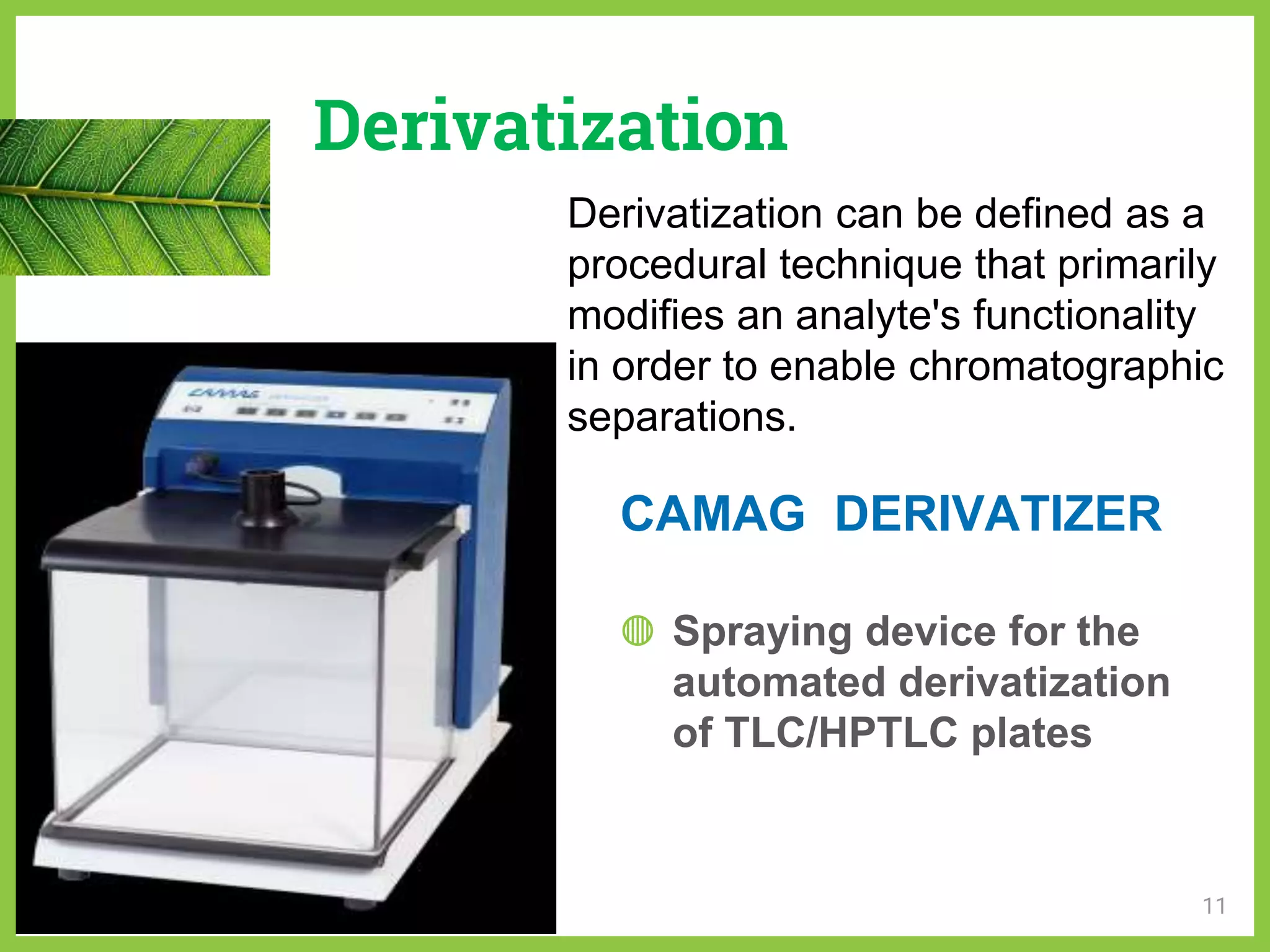
Derivatization
◍ Spraying device for the
automated derivatization
of TLC/HPTLC plates
11
Derivatization can be defined as a
procedural technique that primarily
modifies an analyte's functionality
in order to enable chromatographic
separations.
CAMAG DERIVATIZER
12
Evaluation/
Quantification
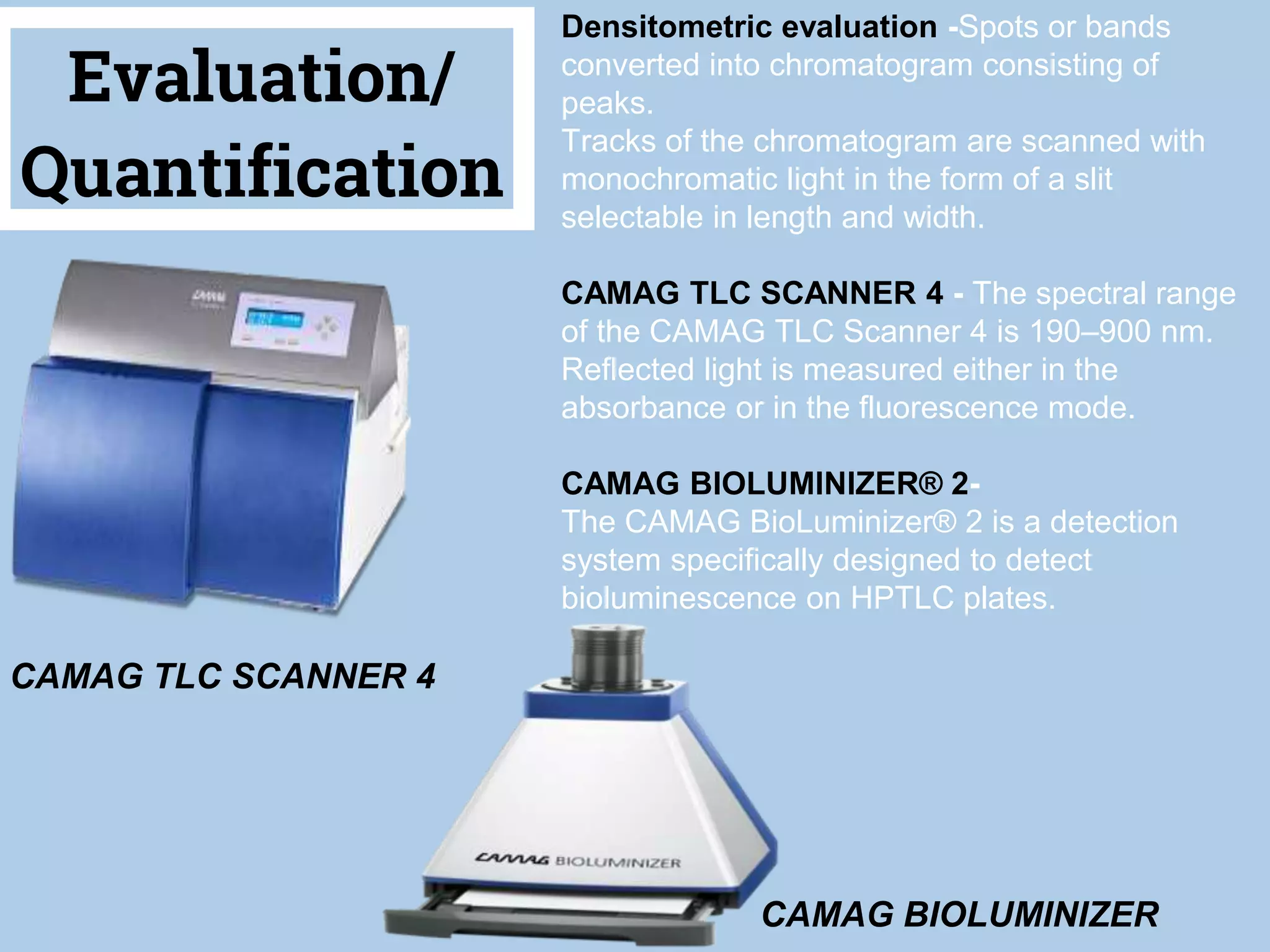
Densitometric evaluation -Spots or bands
converted into chromatogram consisting of
peaks.
Tracks of the chromatogram are scanned with
monochromatic light in the form of a slit
selectable in length and width.
CAMAG TLC SCANNER 4 - The spectral range
of the CAMAG TLC Scanner 4 is 190–900 nm.
Reflected light is measured either in the
absorbance or in the fluorescence mode.
CAMAG BIOLUMINIZER® 2-
The CAMAG BioLuminizer® 2 is a detection
system specifically designed to detect
bioluminescence on HPTLC plates.
CAMAG TLC SCANNER 4
CAMAG BIOLUMINIZER
13
Grounded coconut was heated in
earthern flask for 3 hrs.
The oil was extracted with
ethanol for further study
HPTLC analysis was
performed
CHRACTERISATION USING HPTLC
1. HPTLC profile of coconut shell oil
14
◍ SAMPLE SOLUTION -Ethanol extract
◍ APPLICATOR-Automated CAMAG HPTLC
system
◍ DEVELOPMENT CHAMBER -Twin Trough
glass chamber.
◍ SCANNER- TLC Scanner with WIN CATS
software
◍ ADSORBENT -Aluminum silica gel 60F254 .
◍ MOBILE PHASE- Toluene: Ethyl Acetate:
Glacial Acetic Acid(9:1:0.2)(v/v).
◍ DERIVATIZATION - Vanillin –sulphuric(vs) acid.
◍ EXAMINED UNDER -UV- 254nm and 366nm .
◍ CHARACTERISED BY - Densitometry HPTLC
analysis.
Results
15
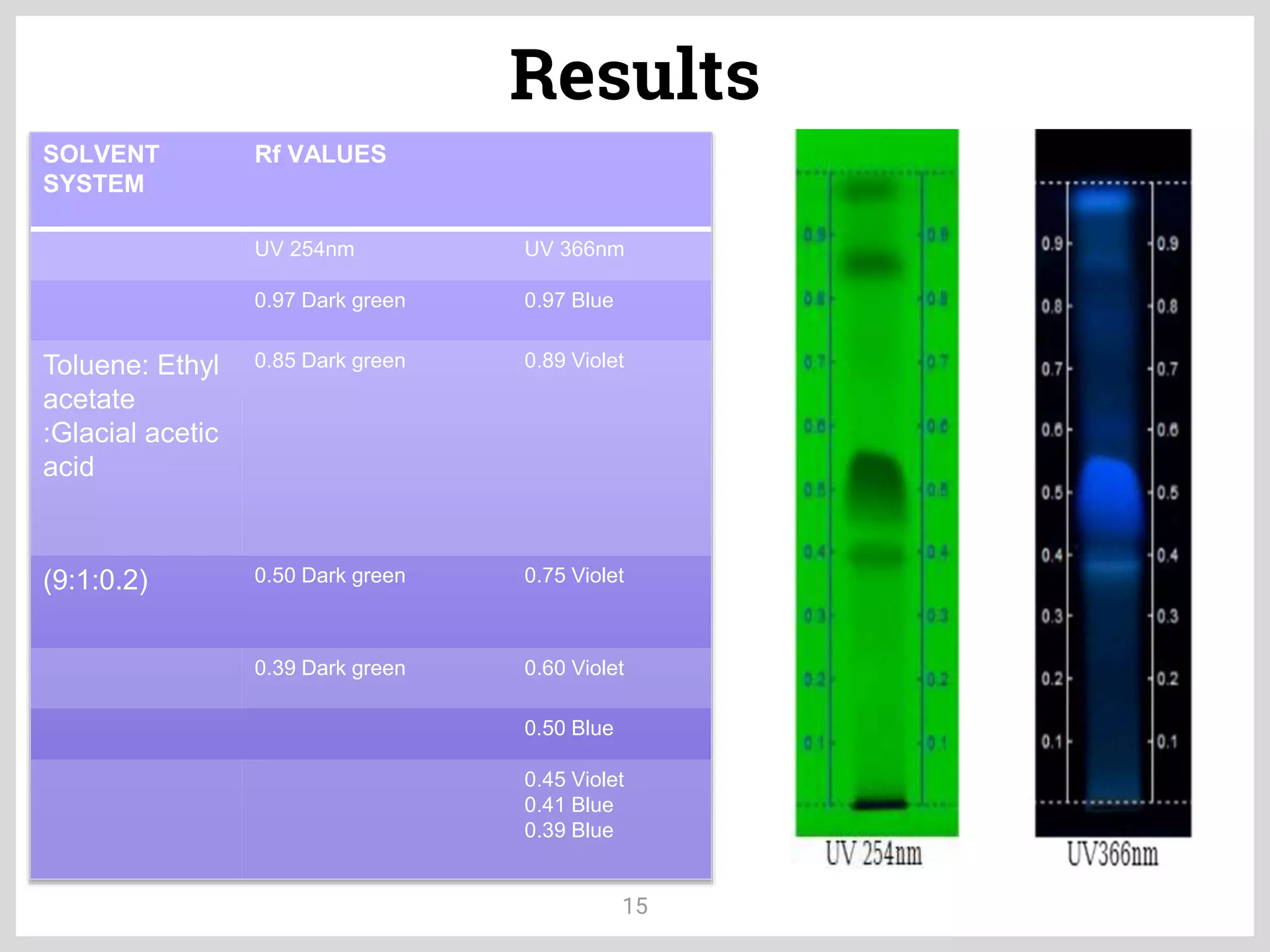
SOLVENT
SYSTEM
Rf VALUES
UV 254nm UV 366nm
0.97 Dark green 0.97 Blue
Toluene: Ethyl
acetate
:Glacial acetic
acid
0.85 Dark green 0.89 Violet
(9:1:0.2) 0.50 Dark green 0.75 Violet
0.39 Dark green 0.60 Violet
0.50 Blue
0.45 Violet
0.41 Blue
0.39 Blue
INTERPRETATION
16
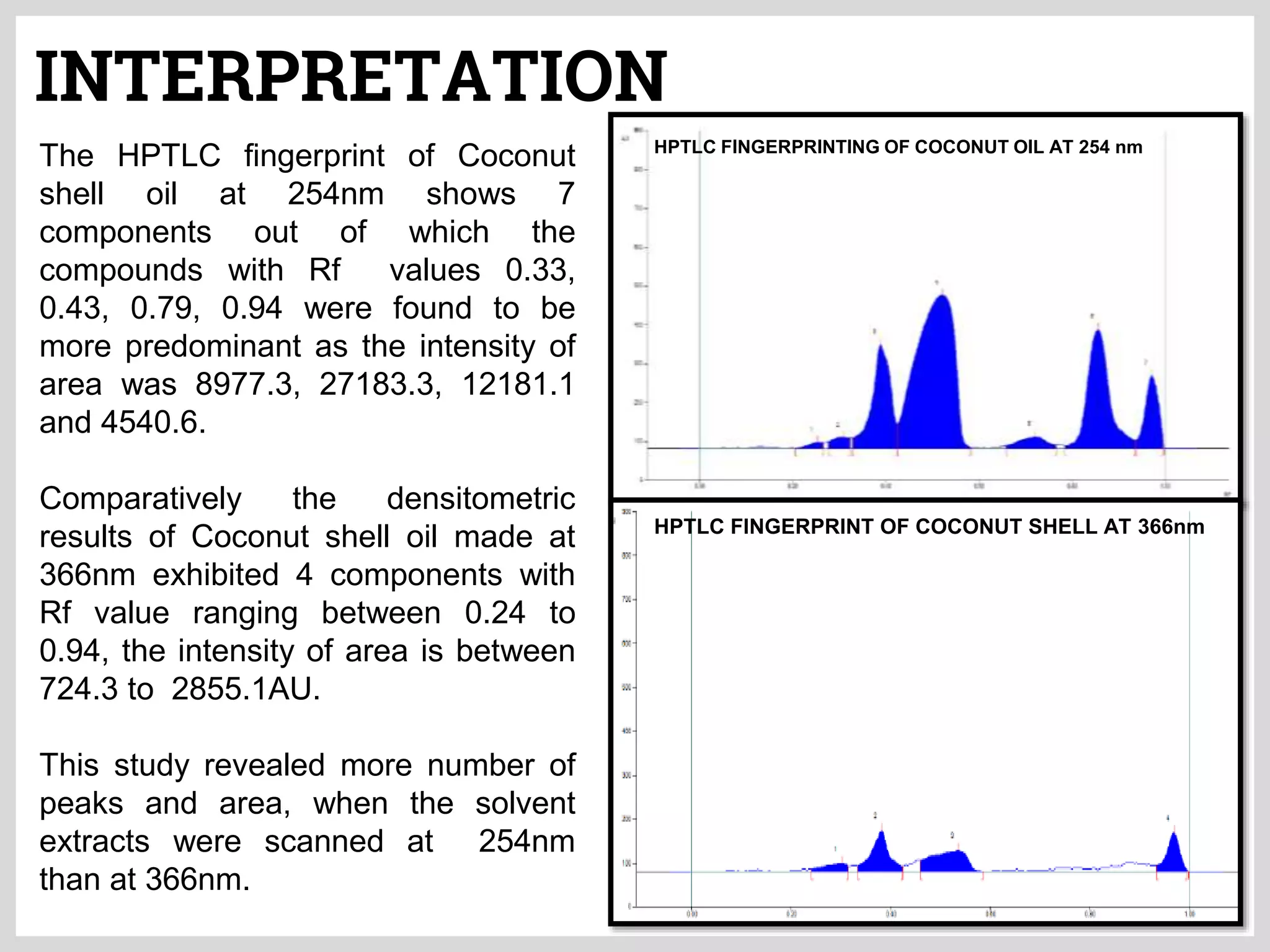
HPTLC FINGERPRINTING OF COCONUT OIL AT 254 nm
HPTLC FINGERPRINT OF COCONUT SHELL AT 366nm
The HPTLC fingerprint of Coconut
shell oil at 254nm shows 7
components out of which the
compounds with Rf values 0.33,
0.43, 0.79, 0.94 were found to be
more predominant as the intensity of
area was 8977.3, 27183.3, 12181.1
and 4540.6.
Comparatively the densitometric
results of Coconut shell oil made at
366nm exhibited 4 components with
Rf value ranging between 0.24 to
0.94, the intensity of area is between
724.3 to 2855.1AU.
This study revealed more number of
peaks and area, when the solvent
extracts were scanned at 254nm
than at 366nm.
ADVANTAGES OF HPTLC
17
• Ability to analyze multicomponent crude
samples
• The separation process is easy to follow
especially with colored compounds.
• Several samples can be separated
parallel to each other on the same plate
resulting in a high output, time saving,
and a rapid low-cost analysis.
• Choice of solvents for the
HPTLC development is wide as
the mobile phases are fully
evaporated before the detection
step.
• HPTLC can combine and
consequently be used for different
modes of evaluation.
◍ combining a
chromatographic separation
system on-line with a
spectroscopic detector in
order to obtain structural
information on the analytes
present in a sample has
become the most important
approach for the identification
and/or confirmation of the
identity of target and unknown
chemical compounds.
◍ For most analytical
problems in the research
field of herbal medicines,
the combination of
column liquid
chromatography with a
mass spectrometer (GC–
MS and LC–MS)
becomes the preferred
approach for the analysis
of herbal medicines.
HYPHENATED TECHNIQUES
18
GAS CHROMATOGRAPHY – MASS
SPECTROSCOPY GC-MS
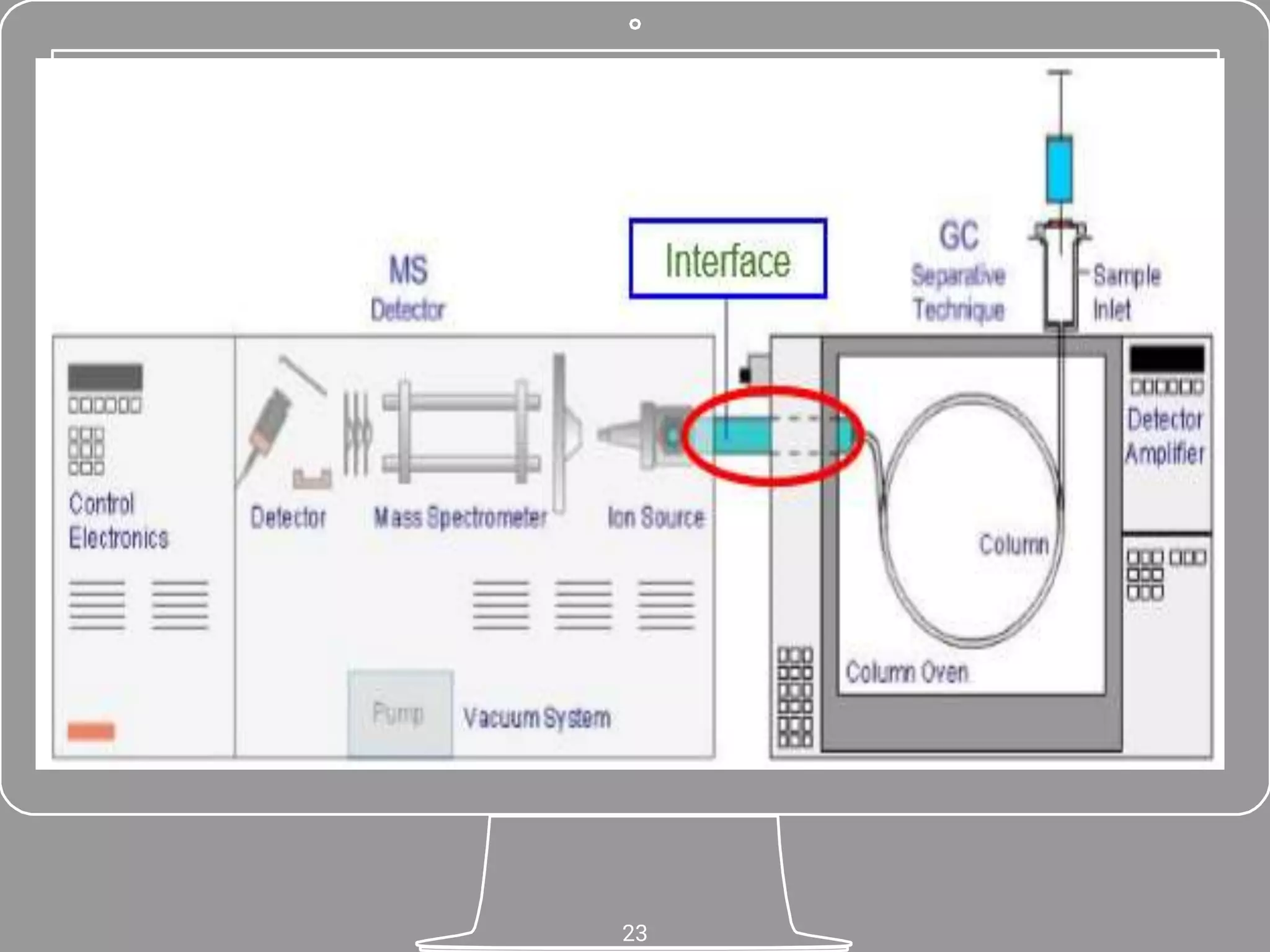
Gas chromatography mass spectrometry (GC/MS) is an instrumental
technique, comprising a gas chromatograph (GC) coupled to a mass
spectrometer (MS), by which complex mixtures may be separated, identified
and quantified.
In order for a compound to be analyzed by GC/MS it must be sufficiently
volatile and thermally stable.
This hybrid instrument provides two separate dimensions of information
about the components in the sample, GC retention times and electron
ionization (EI) mass spectra. GC retention time is related to specific
chemical properties of the molecules in question (e.g. volatility, polarity,
presence of specific functional groups) while molecular weight (derived from
the mass spectrum) is indicative of atomic composition.
19
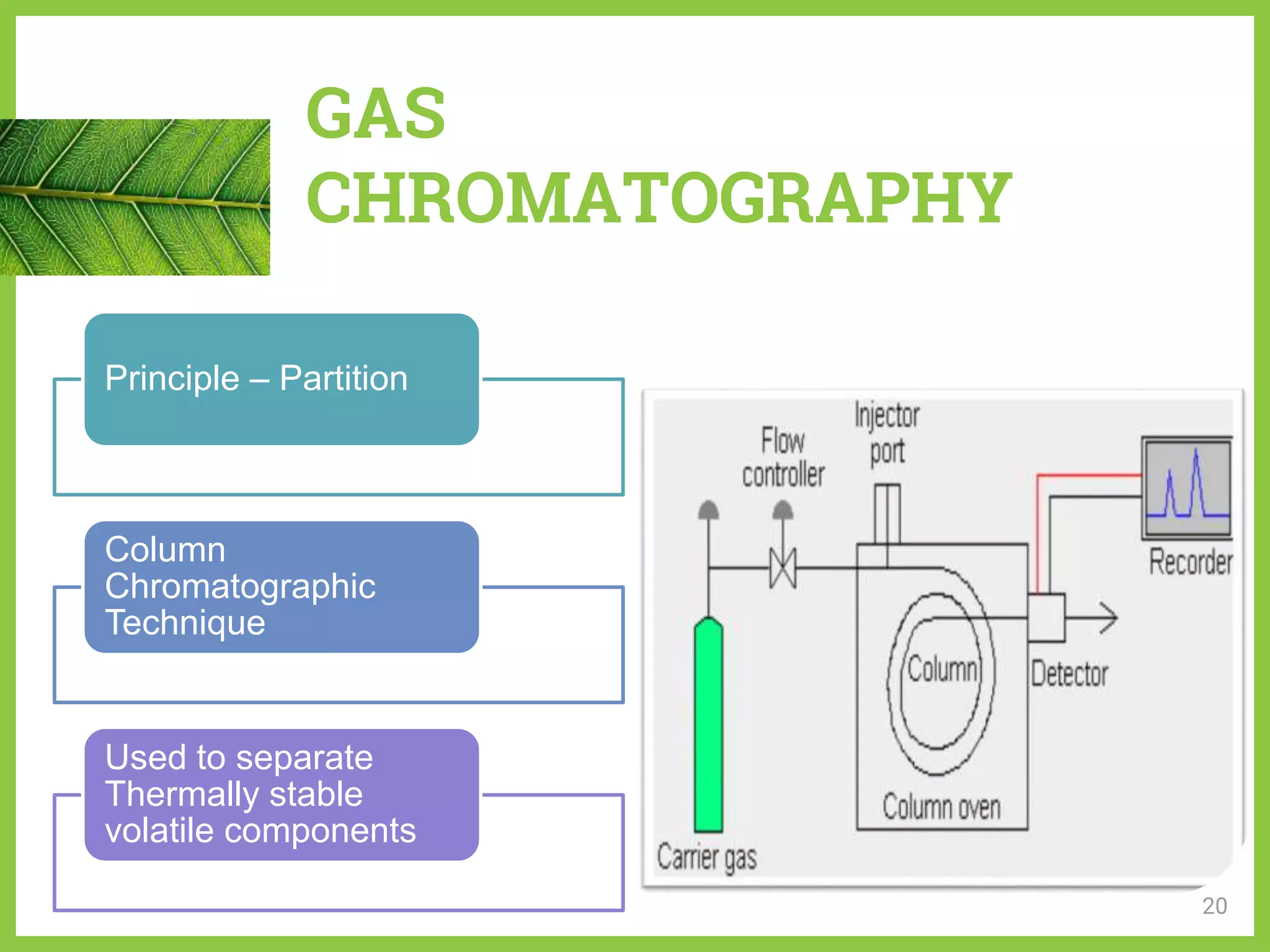
GAS
CHROMATOGRAPHY
20
Principle – Partition
Column
Chromatographic
Technique
Used to separate
Thermally stable
volatile components
MASS
SPECTROSCOPY
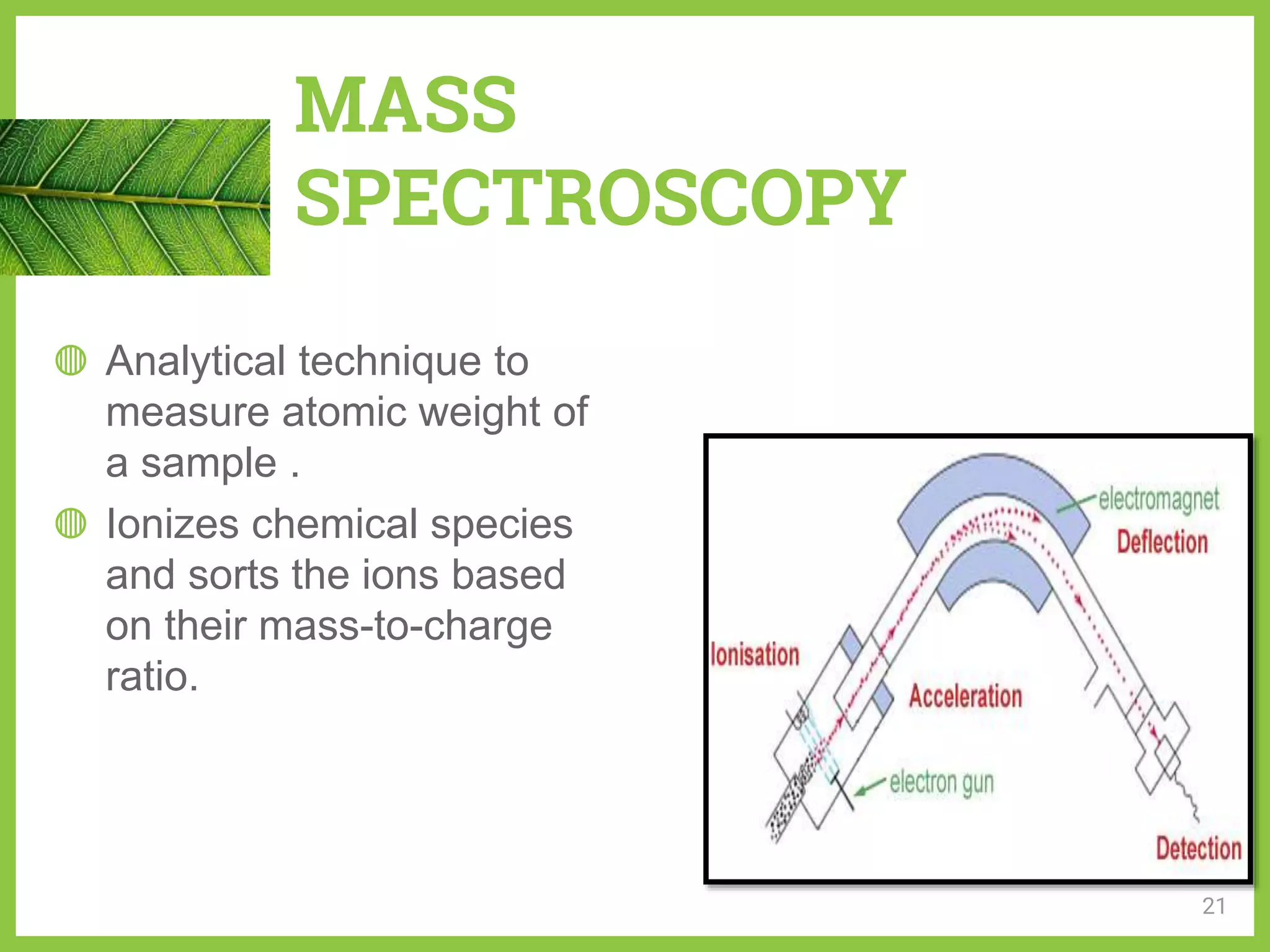
◍ Analytical technique to
measure atomic weight of
a sample .
◍ Ionizes chemical species
and sorts the ions based
on their mass-to-charge
ratio.
21
GAS CHROMATOGRAPHY-MASS
SPECTROSOPY
22
PRINCIPLE
Gas chromatography (GC)
portion separates the
chemical mixture into
pulses of pure chemicals
and the Mass
Spectrometer (MS)
identifies and quantifies the
chemicals.
23
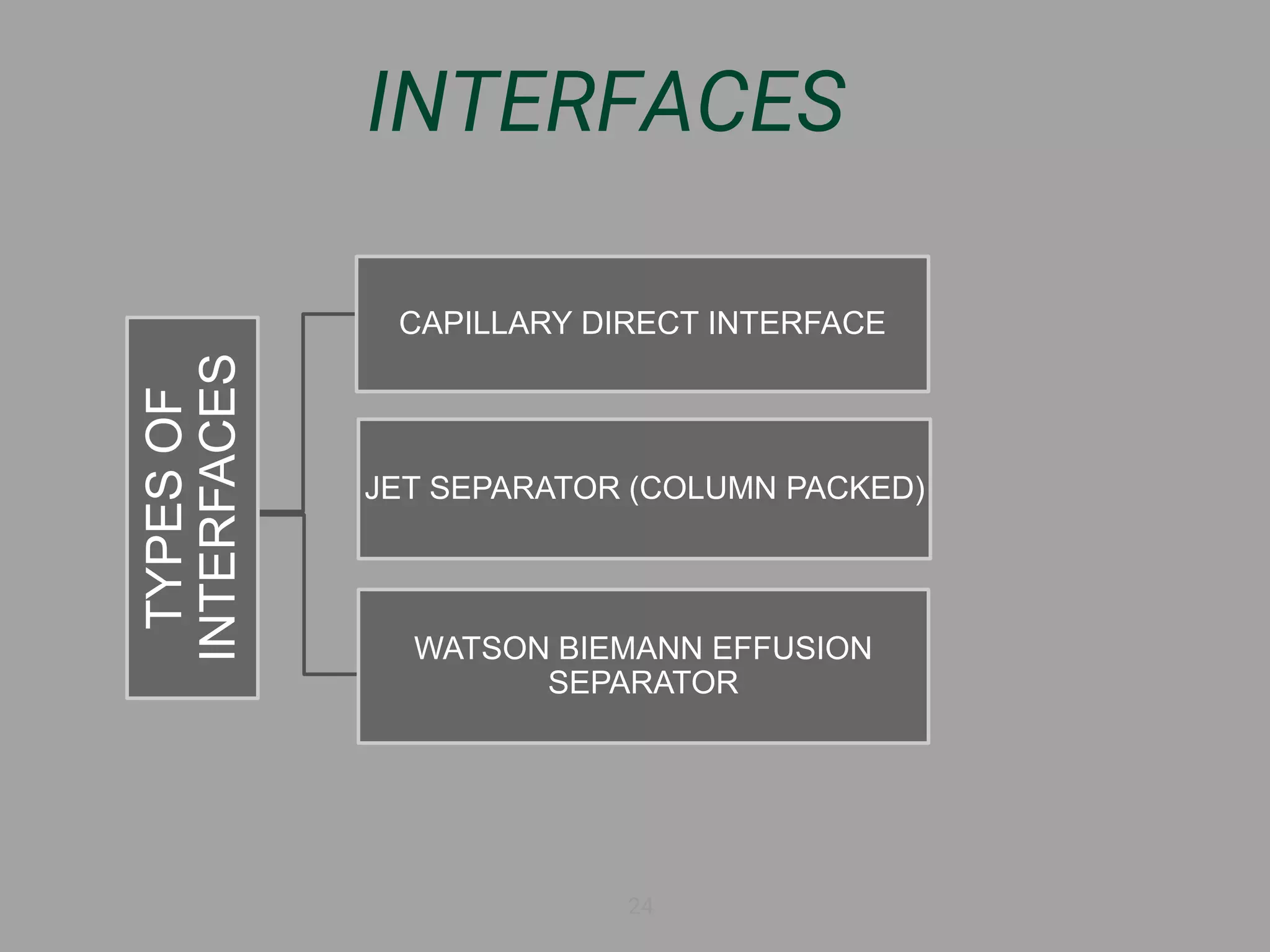
INTERFACES
24
TYPESOF
INTERFACES
CAPILLARY DIRECT INTERFACE
JET SEPARATOR (COLUMN PACKED)
WATSON BIEMANN EFFUSION
SEPARATOR
25
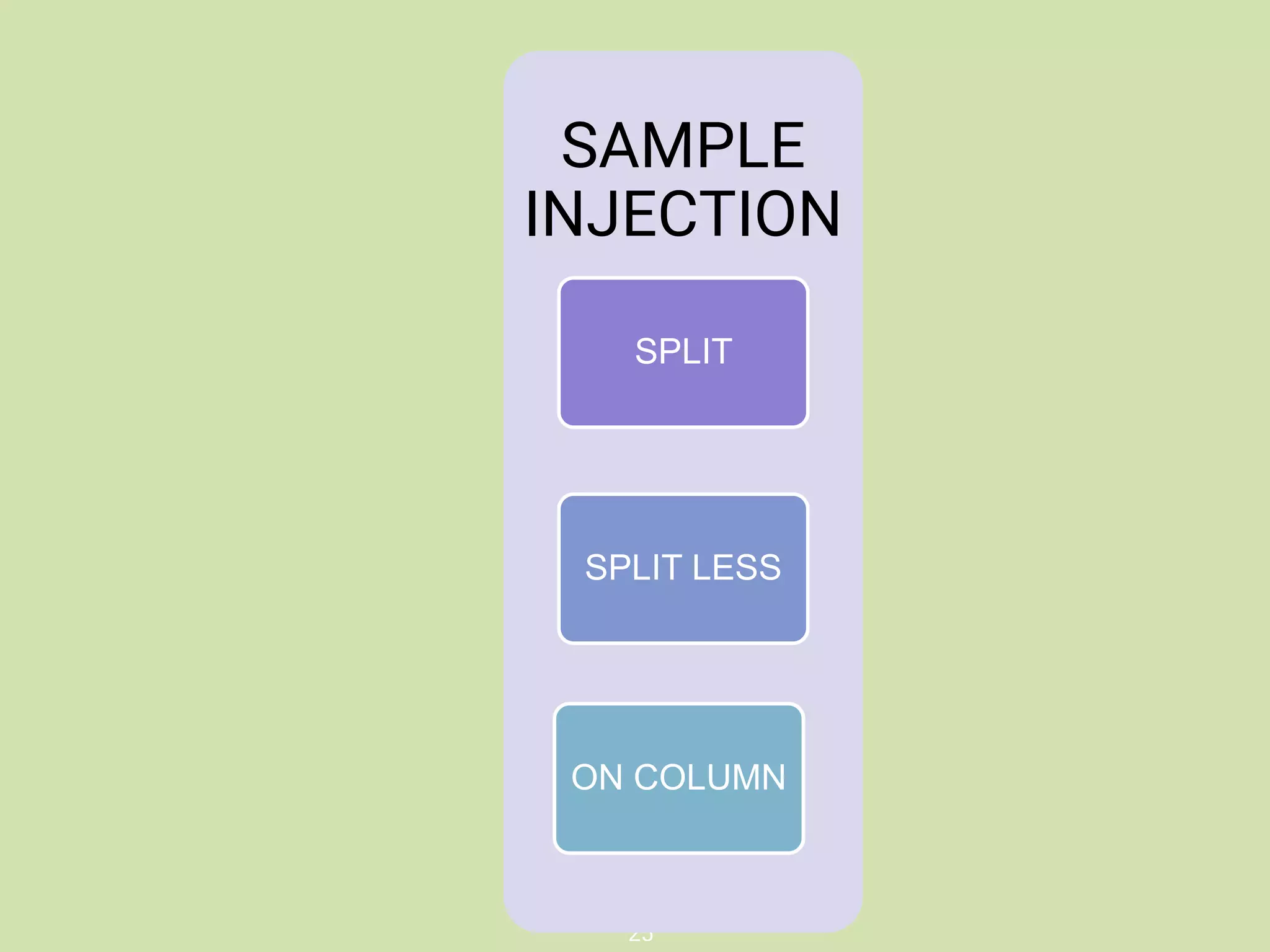
SAMPLE
INJECTION
SPLIT
SPLIT LESS
ON COLUMN
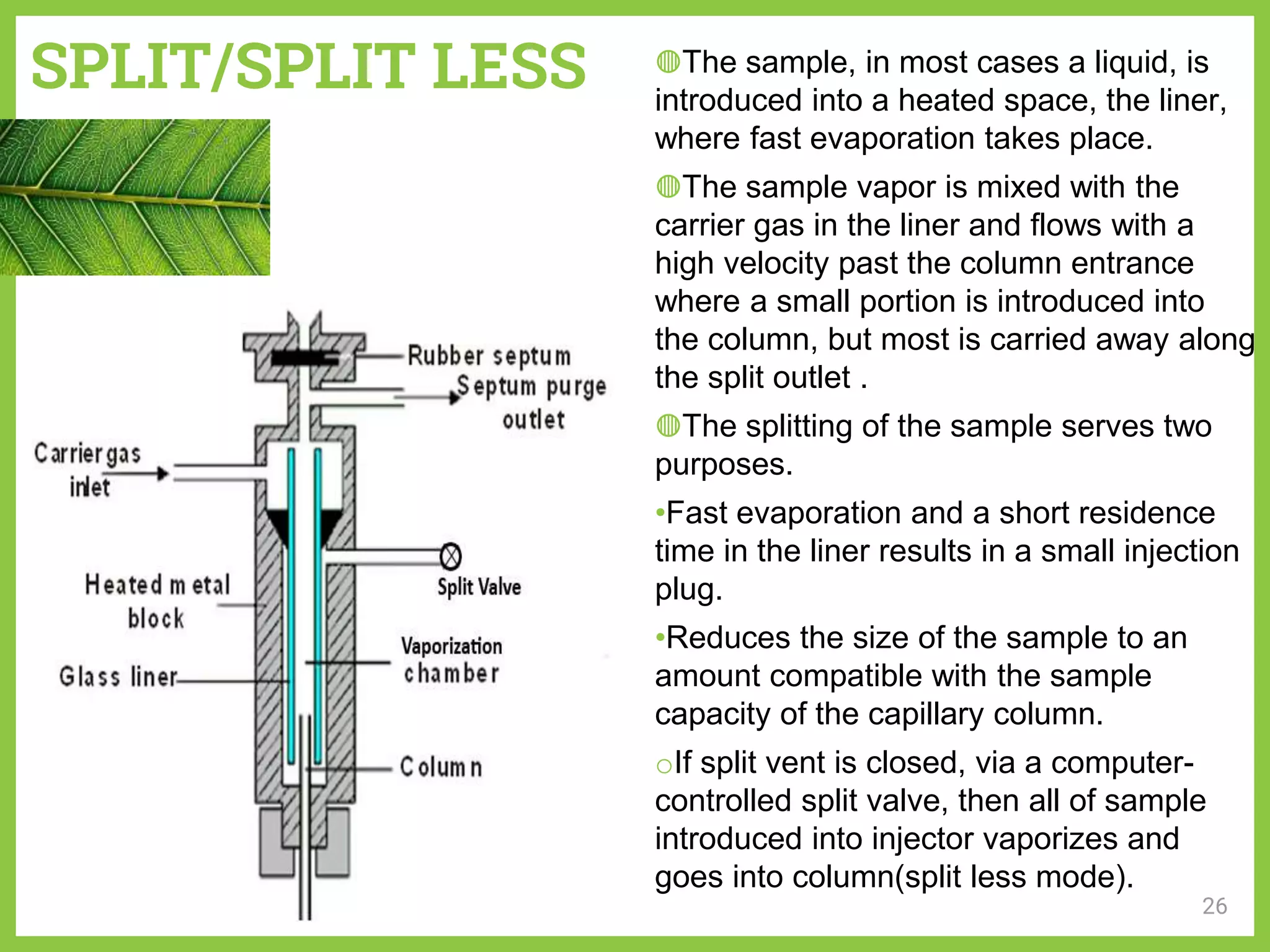
SPLIT/SPLIT LESS
26
◍The sample, in most cases a liquid, is
introduced into a heated space, the liner,
where fast evaporation takes place.
◍The sample vapor is mixed with the
carrier gas in the liner and flows with a
high velocity past the column entrance
where a small portion is introduced into
the column, but most is carried away along
the split outlet .
◍The splitting of the sample serves two
purposes.
•Fast evaporation and a short residence
time in the liner results in a small injection
plug.
•Reduces the size of the sample to an
amount compatible with the sample
capacity of the capillary column.
oIf split vent is closed, via a computer-
controlled split valve, then all of sample
introduced into injector vaporizes and
goes into column(split less mode).
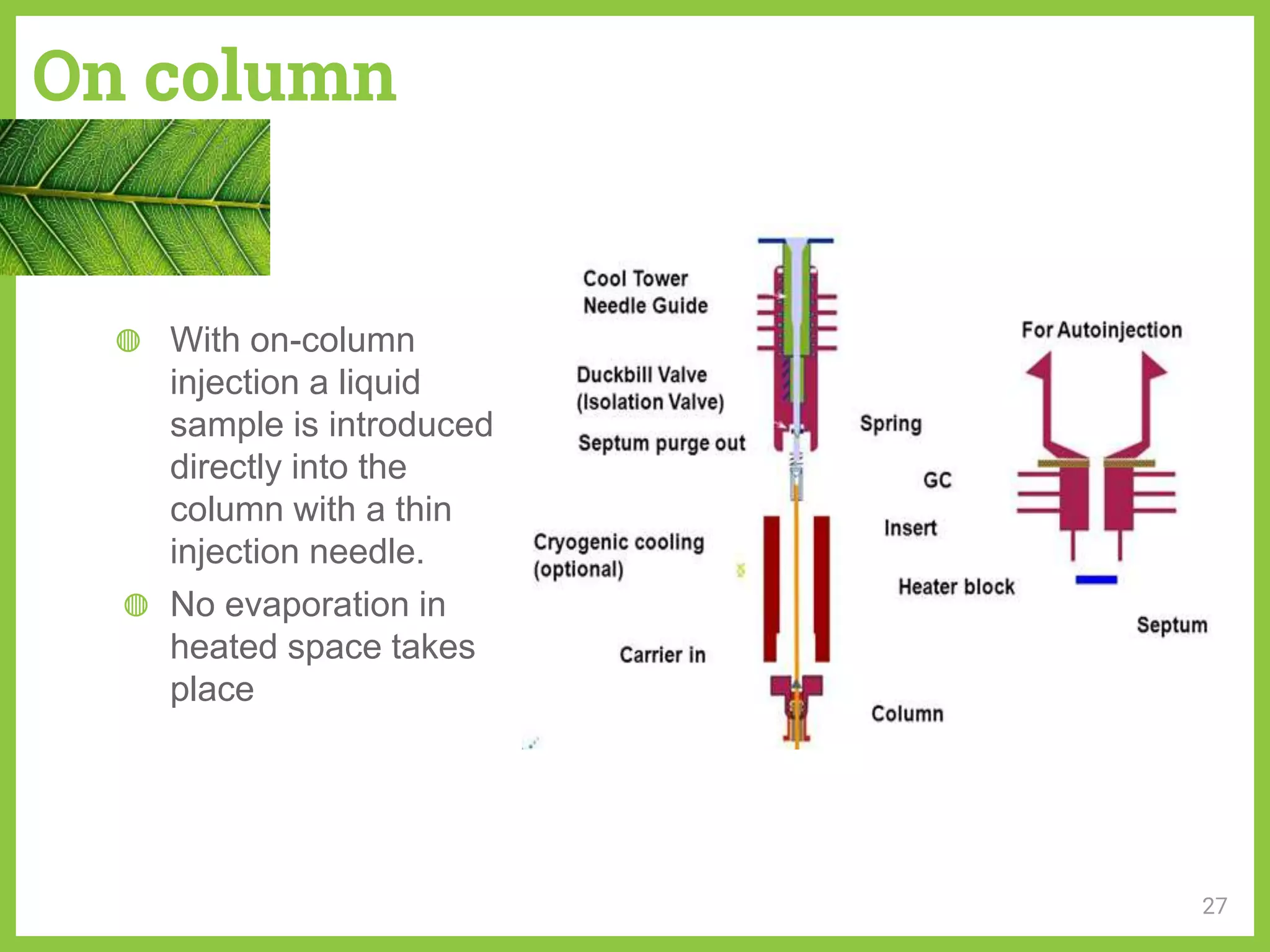
◍ With on-column
injection a liquid
sample is introduced
directly into the
column with a thin
injection needle.
◍ No evaporation in
heated space takes
place
On column
27
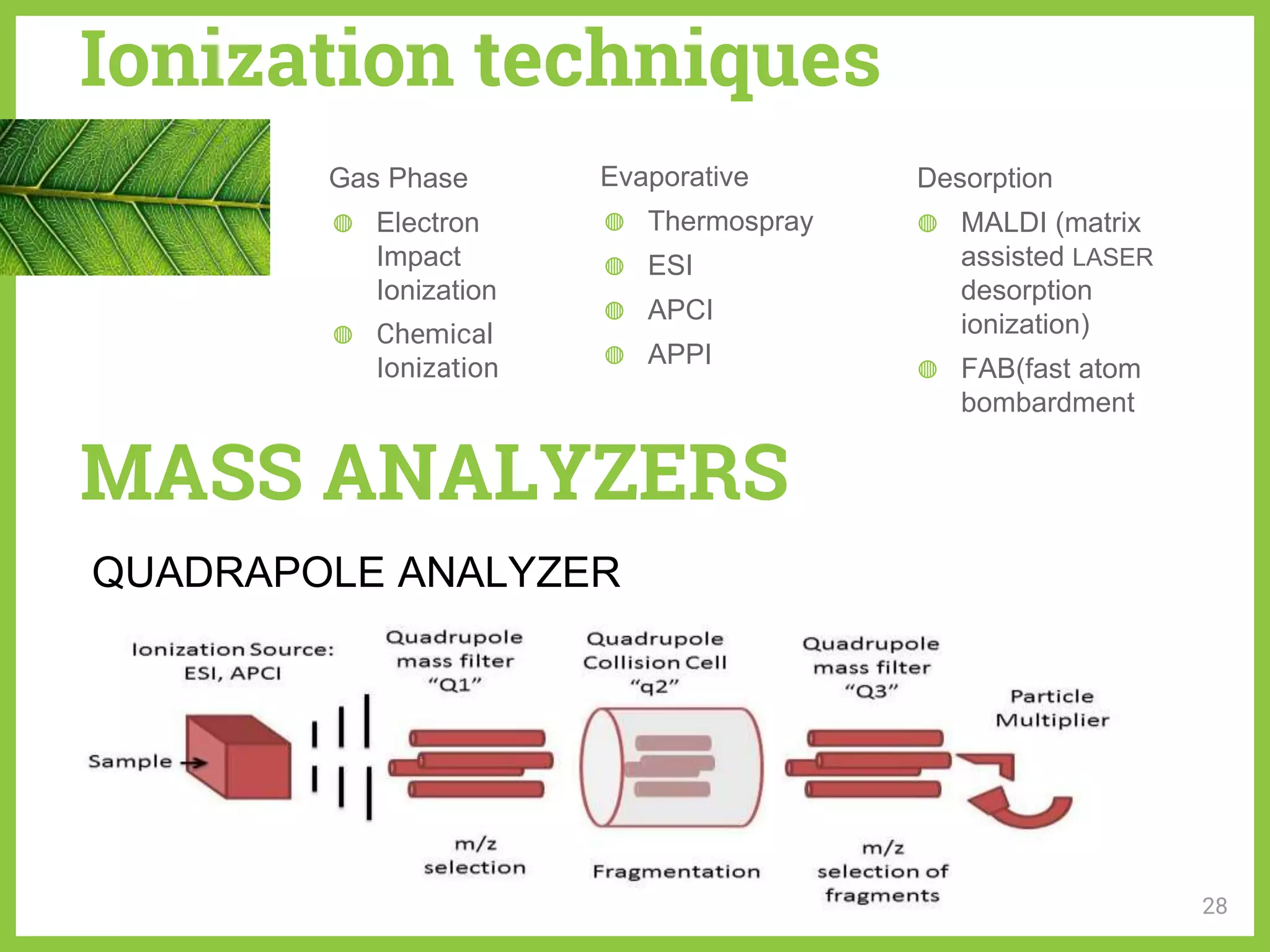
Gas Phase
◍ Electron
Impact
Ionization
◍ Chemical
Ionization
Evaporative
◍ Thermospray
◍ ESI
◍ APCI
◍ APPI
Desorption
◍ MALDI (matrix
assisted LASER
desorption
ionization)
◍ FAB(fast atom
bombardment
Ionization techniques
28
QUADRAPOLE ANALYZER
MASS ANALYZERS
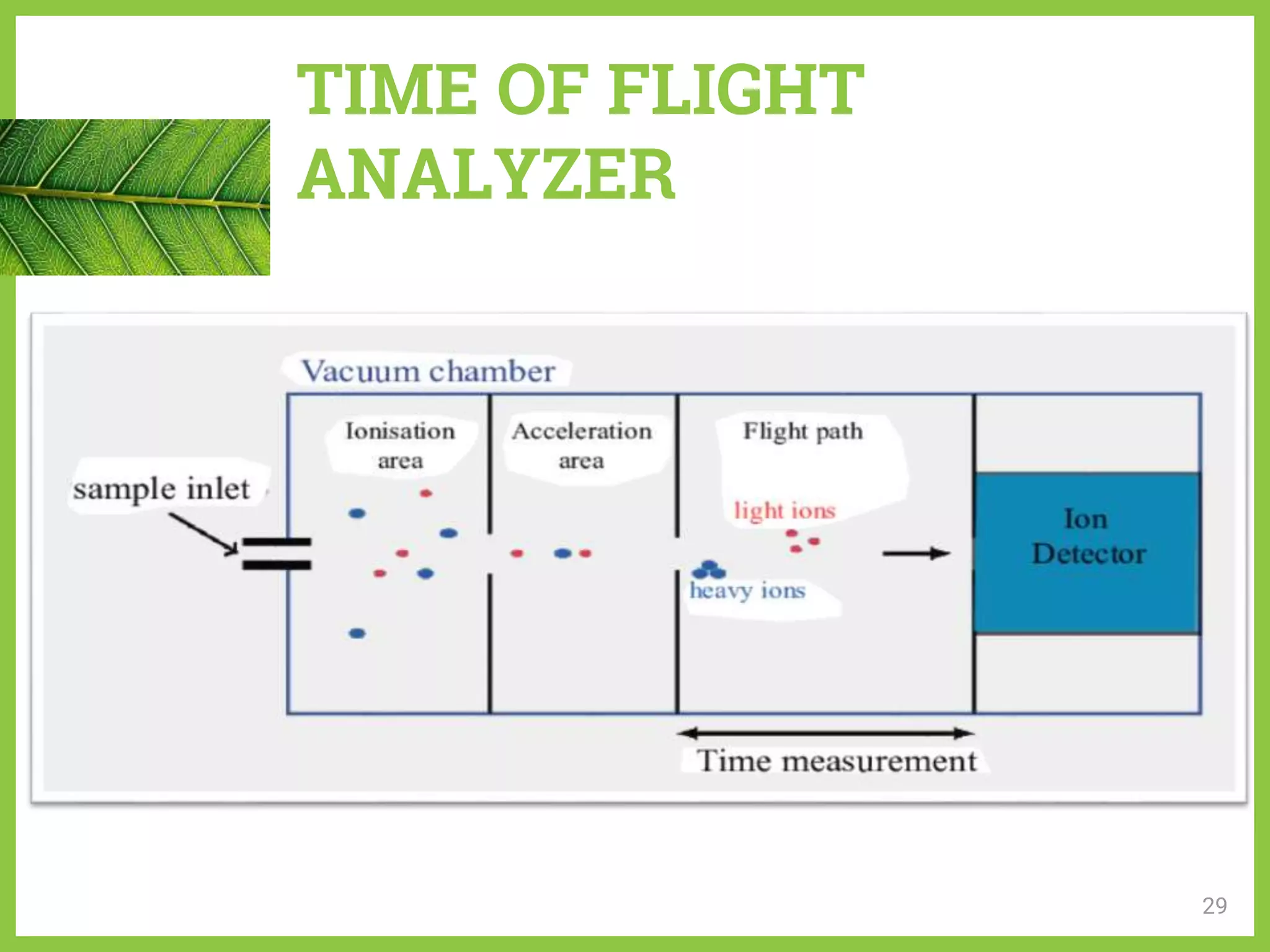
TIME OF FLIGHT
ANALYZER
29
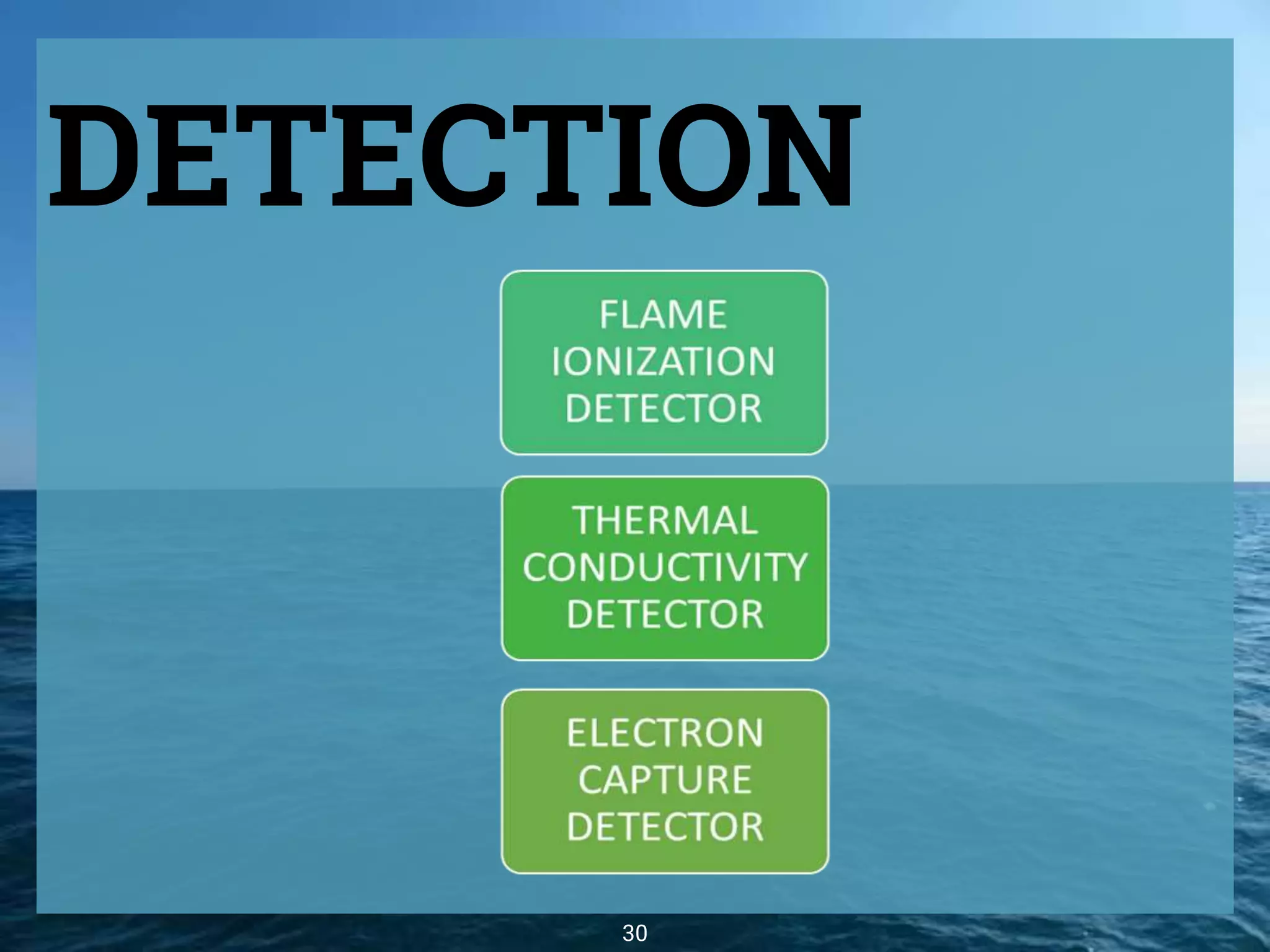
30
DETECTION
31
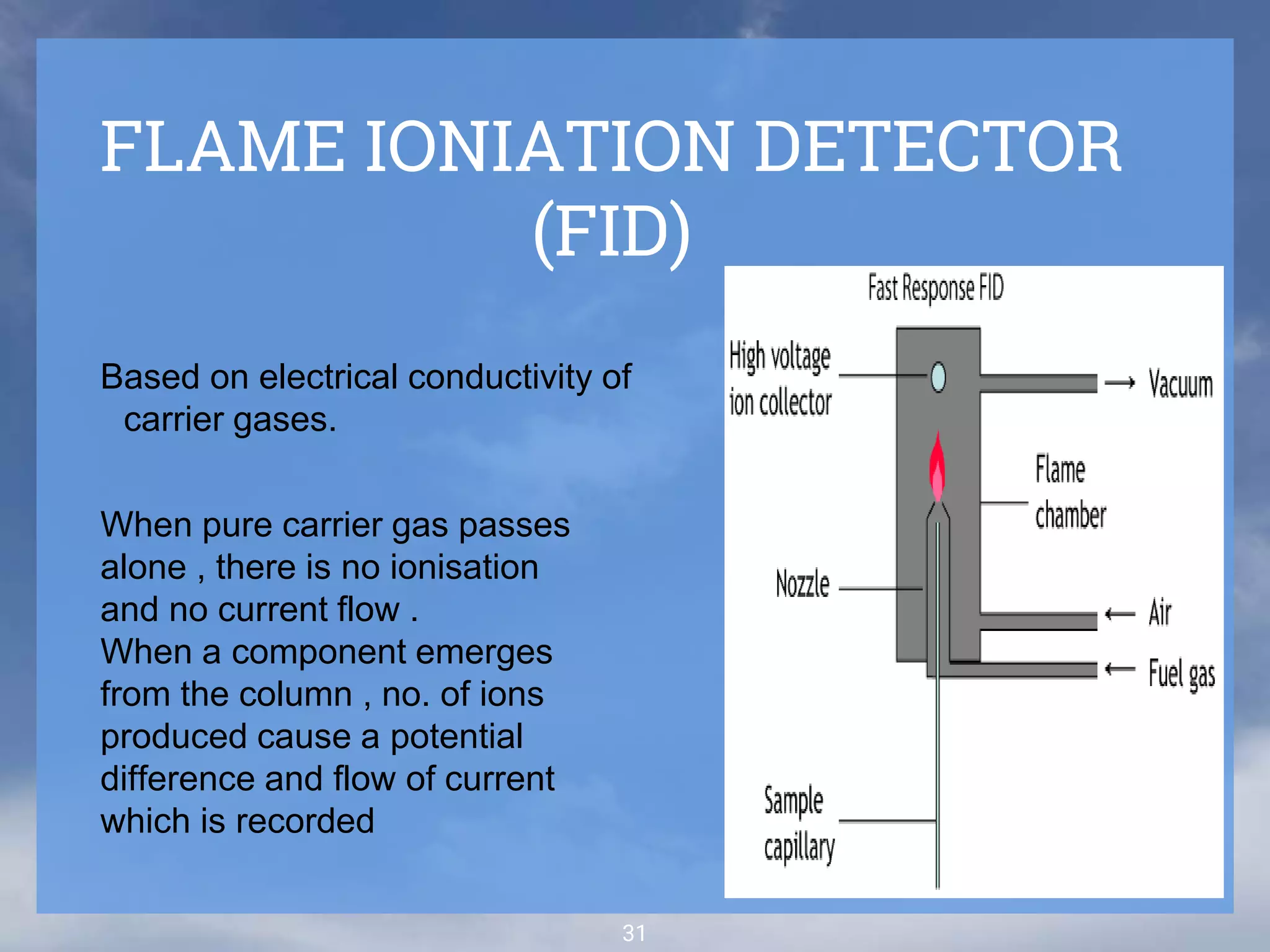
FLAME IONIATION DETECTOR
(FID)
Based on electrical conductivity of
carrier gases.
When pure carrier gas passes
alone , there is no ionisation
and no current flow .
When a component emerges
from the column , no. of ions
produced cause a potential
difference and flow of current
which is recorded
32
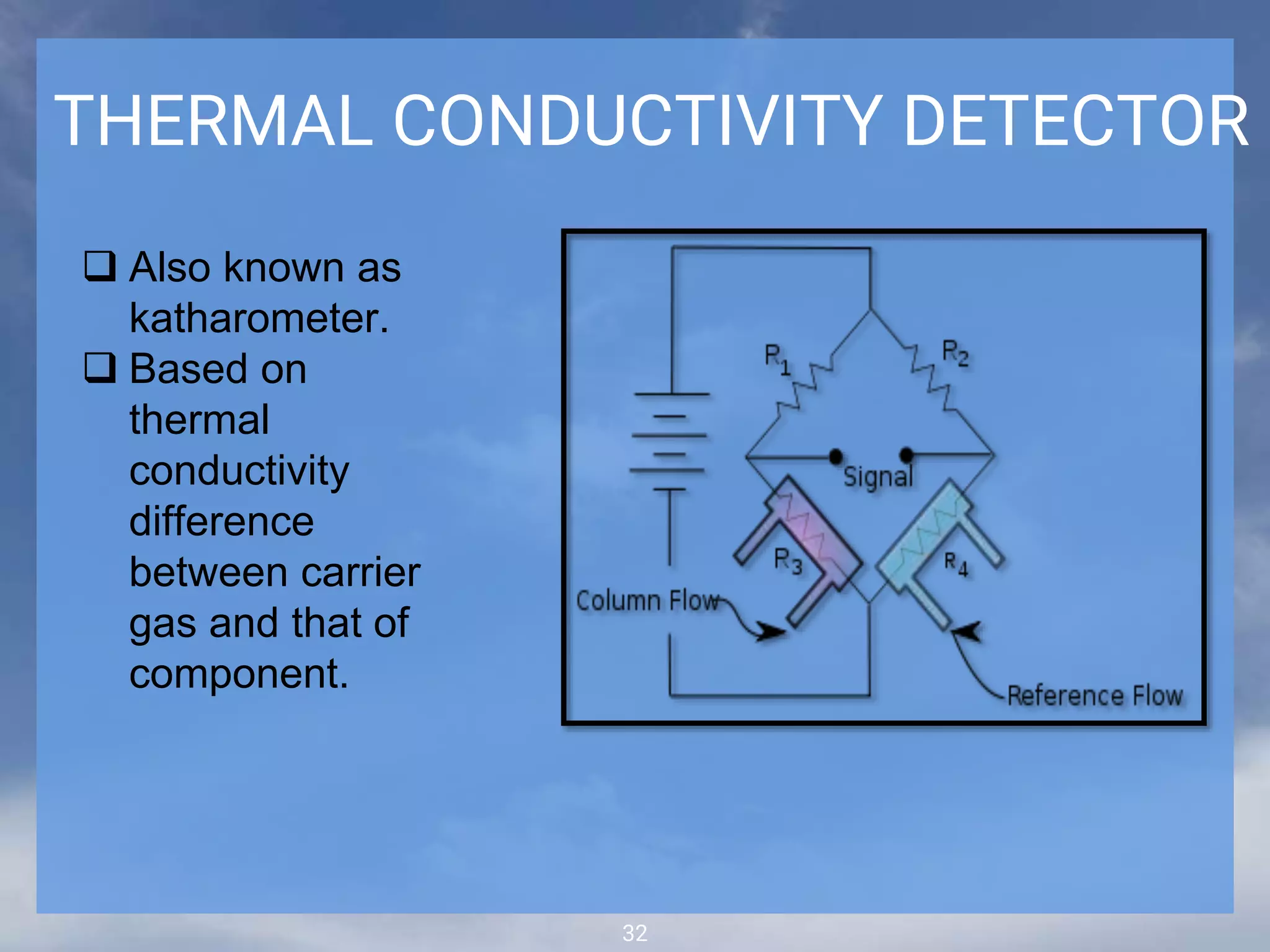
THERMAL CONDUCTIVITY DETECTOR
 Also known as
katharometer.
 Based on
thermal
conductivity
difference
between carrier
gas and that of
component.
33
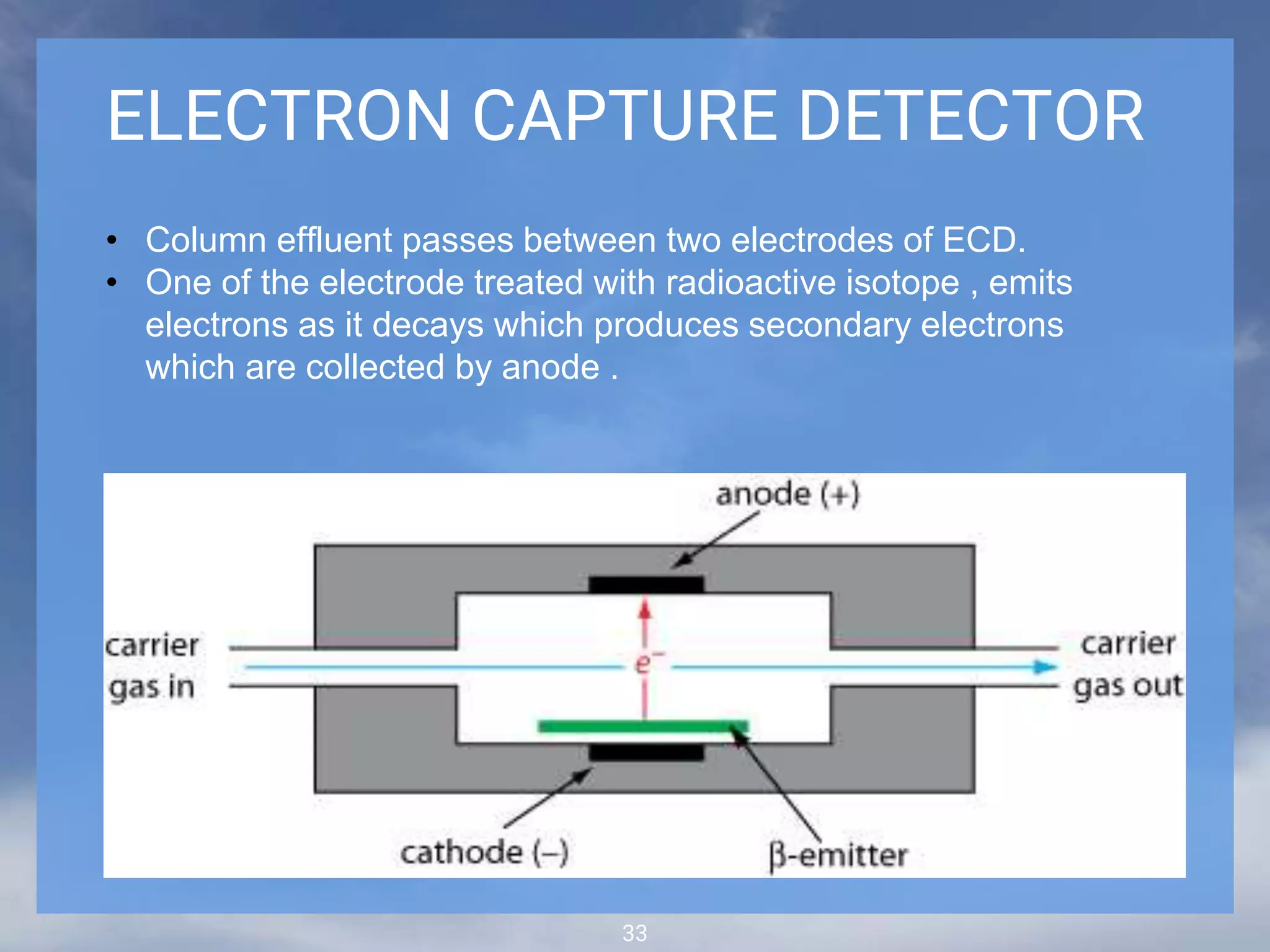
ELECTRON CAPTURE DETECTOR
• Column effluent passes between two electrodes of ECD.
• One of the electrode treated with radioactive isotope , emits
electrons as it decays which produces secondary electrons
which are collected by anode .
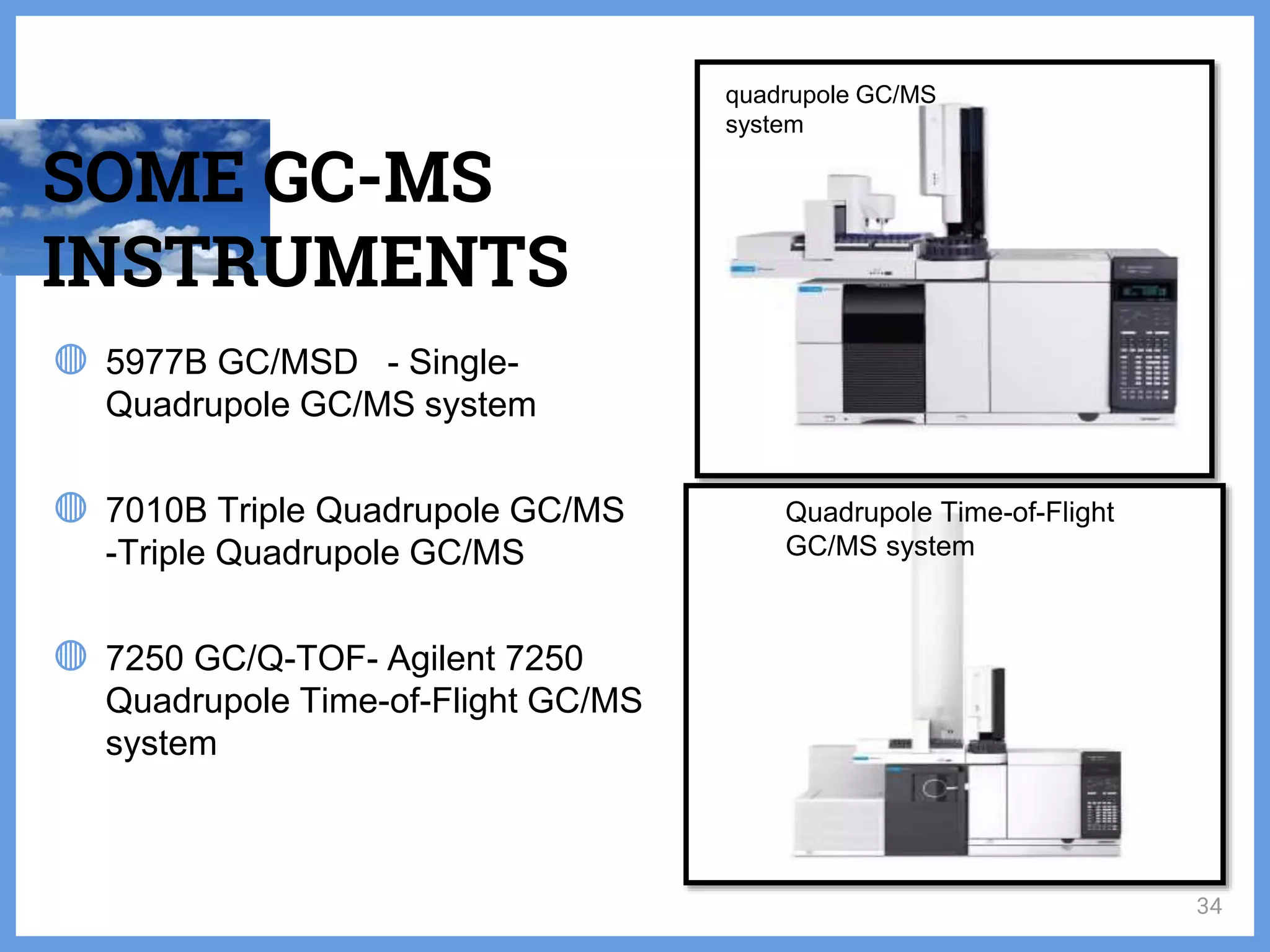
SOME GC-MS
INSTRUMENTS
◍ 5977B GC/MSD - Single-
Quadrupole GC/MS system
◍ 7010B Triple Quadrupole GC/MS
-Triple Quadrupole GC/MS
◍ 7250 GC/Q-TOF- Agilent 7250
Quadrupole Time-of-Flight GC/MS
system
34
quadrupole GC/MS
system
Quadrupole Time-of-Flight
GC/MS system
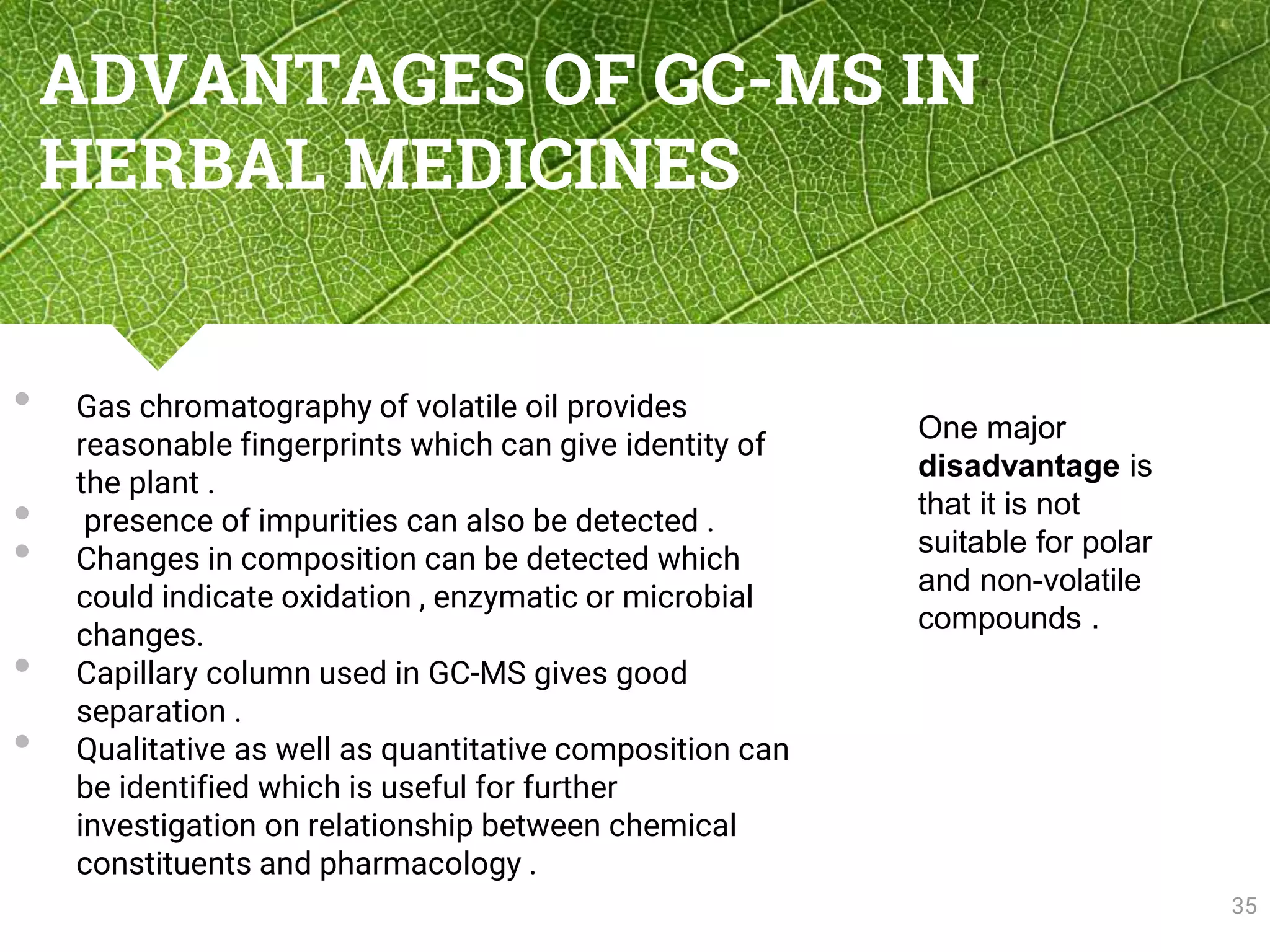
ADVANTAGES OF GC-MS IN
HERBAL MEDICINES
• Gas chromatography of volatile oil provides
reasonable fingerprints which can give identity of
the plant .
• presence of impurities can also be detected .
• Changes in composition can be detected which
could indicate oxidation , enzymatic or microbial
changes.
• Capillary column used in GC-MS gives good
separation .
• Qualitative as well as quantitative composition can
be identified which is useful for further
investigation on relationship between chemical
constituents and pharmacology .
35
One major
disadvantage is
that it is not
suitable for polar
and non-volatile
compounds .
CHARACTERIZATION USING GC-MS
GC-MS profile of Mentha piperita
◍ Instrument -Thermo GC-Trace ultra version 5.0 gas
chromatography interfaced to Thermo MS DSQ II mass
◍ Column -DB5-MS capillary standard non polar
◍ Carrier gas – Helium
◍ Flow rate – (constant) 1ml/min.
◍ Oven temperature -70°C .
◍ Mass range - 50 to 650 (m/z).
◍ The total running -30 min.
◍ The chromatogram obtained from gas chromatography
was then analyzed in mass spectrometry to get the
mass of all fractions. The identification of phytochemical
components was achieved through retention time and
mass spectrometry.
36
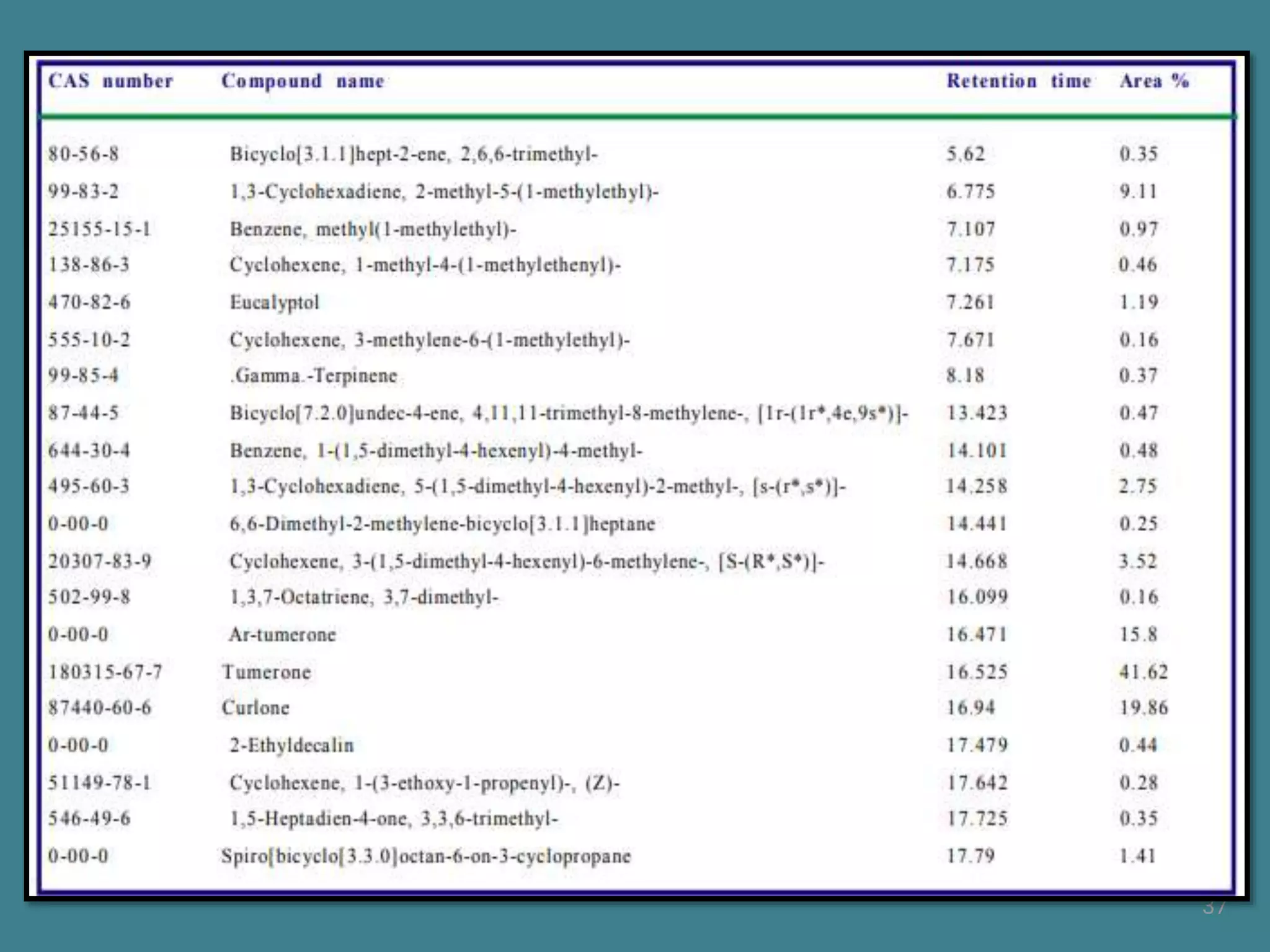
37
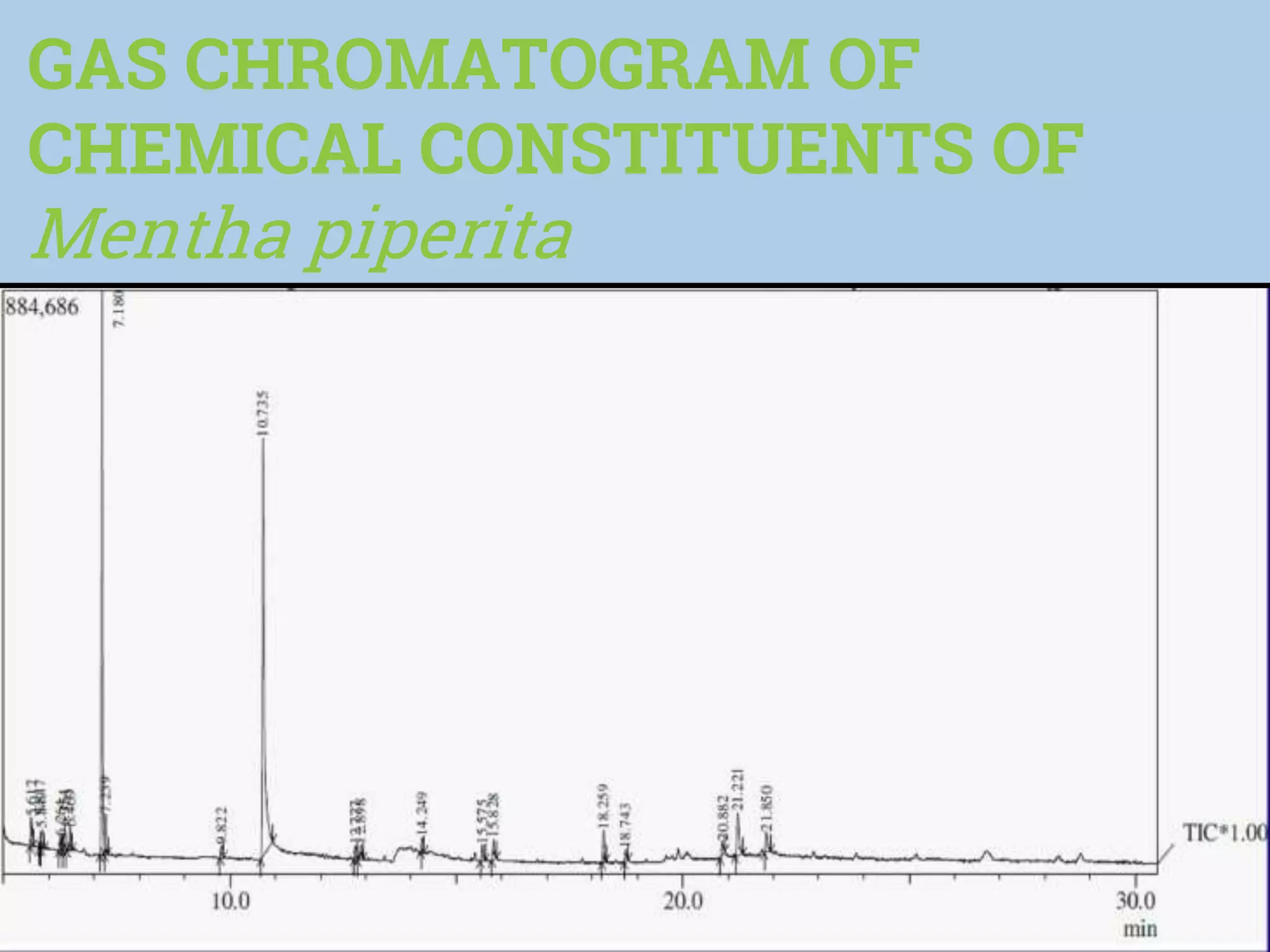
GAS CHROMATOGRAM OF
CHEMICAL CONSTITUENTS OF
Mentha piperita
38
INTERPREATION
39
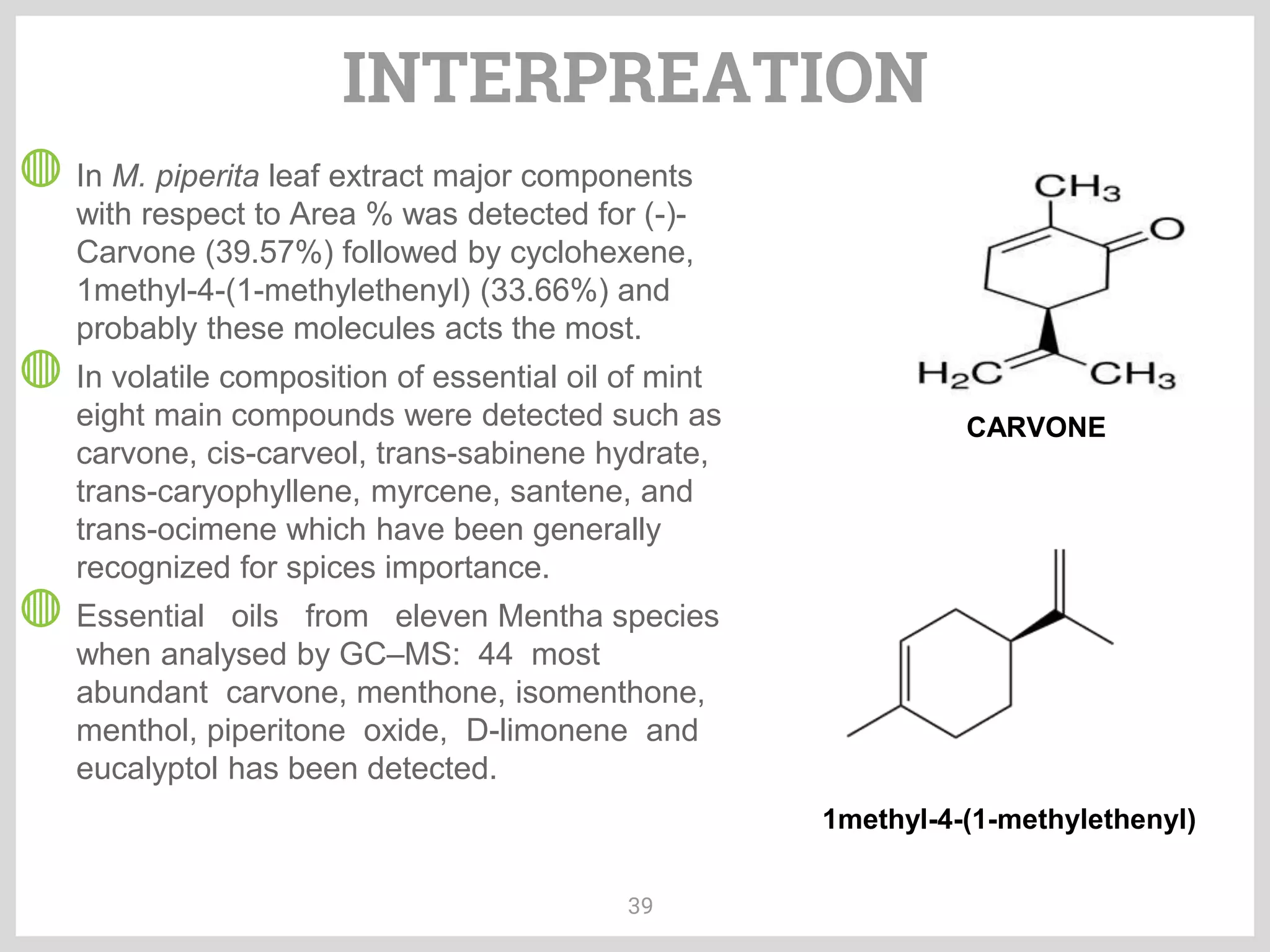
◍ In M. piperita leaf extract major components
with respect to Area % was detected for (-)-
Carvone (39.57%) followed by cyclohexene,
1methyl-4-(1-methylethenyl) (33.66%) and
probably these molecules acts the most.
◍ In volatile composition of essential oil of mint
eight main compounds were detected such as
carvone, cis-carveol, trans-sabinene hydrate,
trans-caryophyllene, myrcene, santene, and
trans-ocimene which have been generally
recognized for spices importance.
◍ Essential oils from eleven Mentha species
when analysed by GC–MS: 44 most
abundant carvone, menthone, isomenthone,
menthol, piperitone oxide, D-limonene and
eucalyptol has been detected.
CARVONE
1methyl-4-(1-methylethenyl)
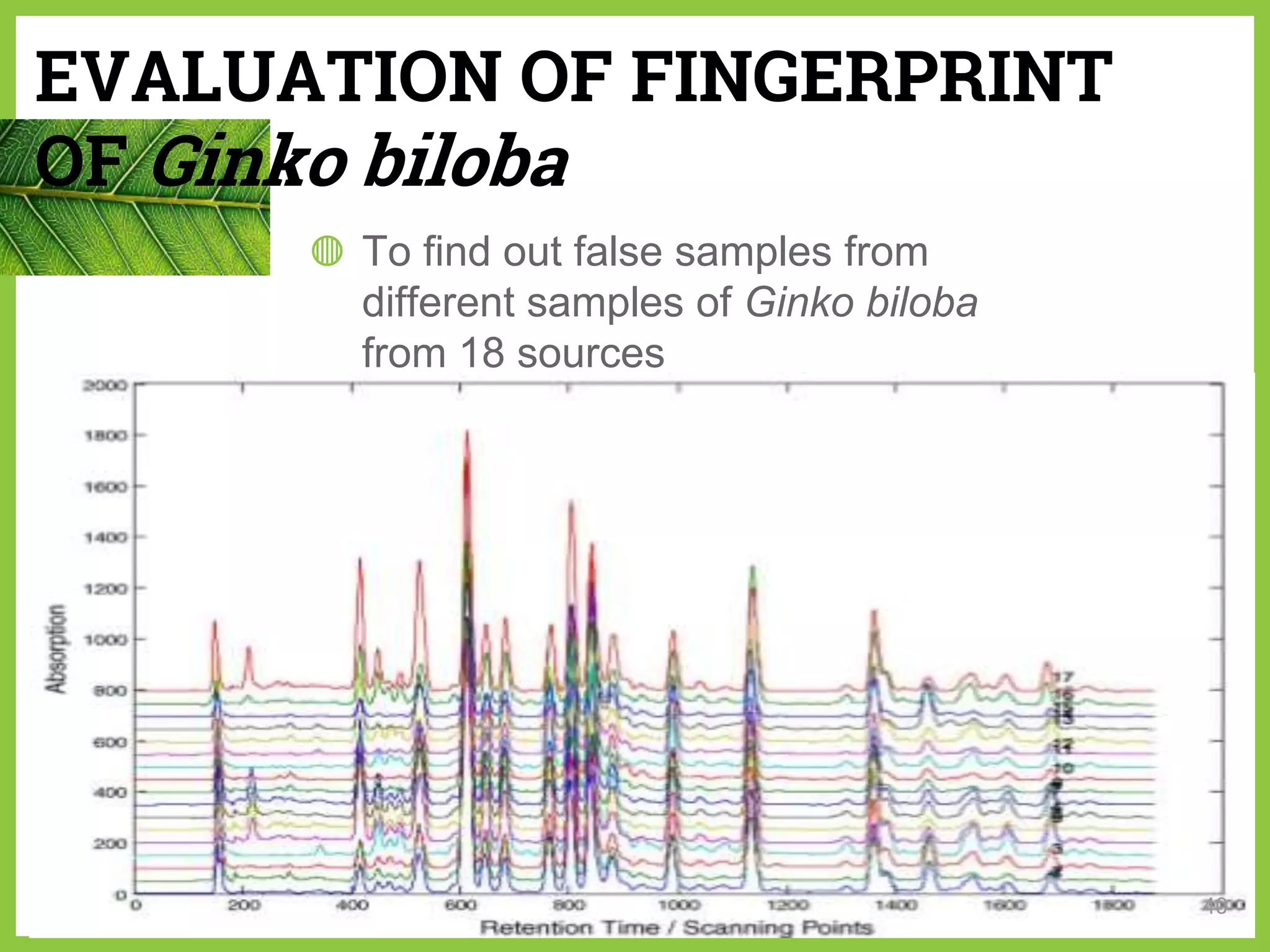
EVALUATION OF FINGERPRINT
OF Ginko biloba
◍ To find out false samples from
different samples of Ginko biloba
from 18 sources
40
◍ Fingerprint of sample 2 and 3 were compared with
standard(no.17) and other samples.
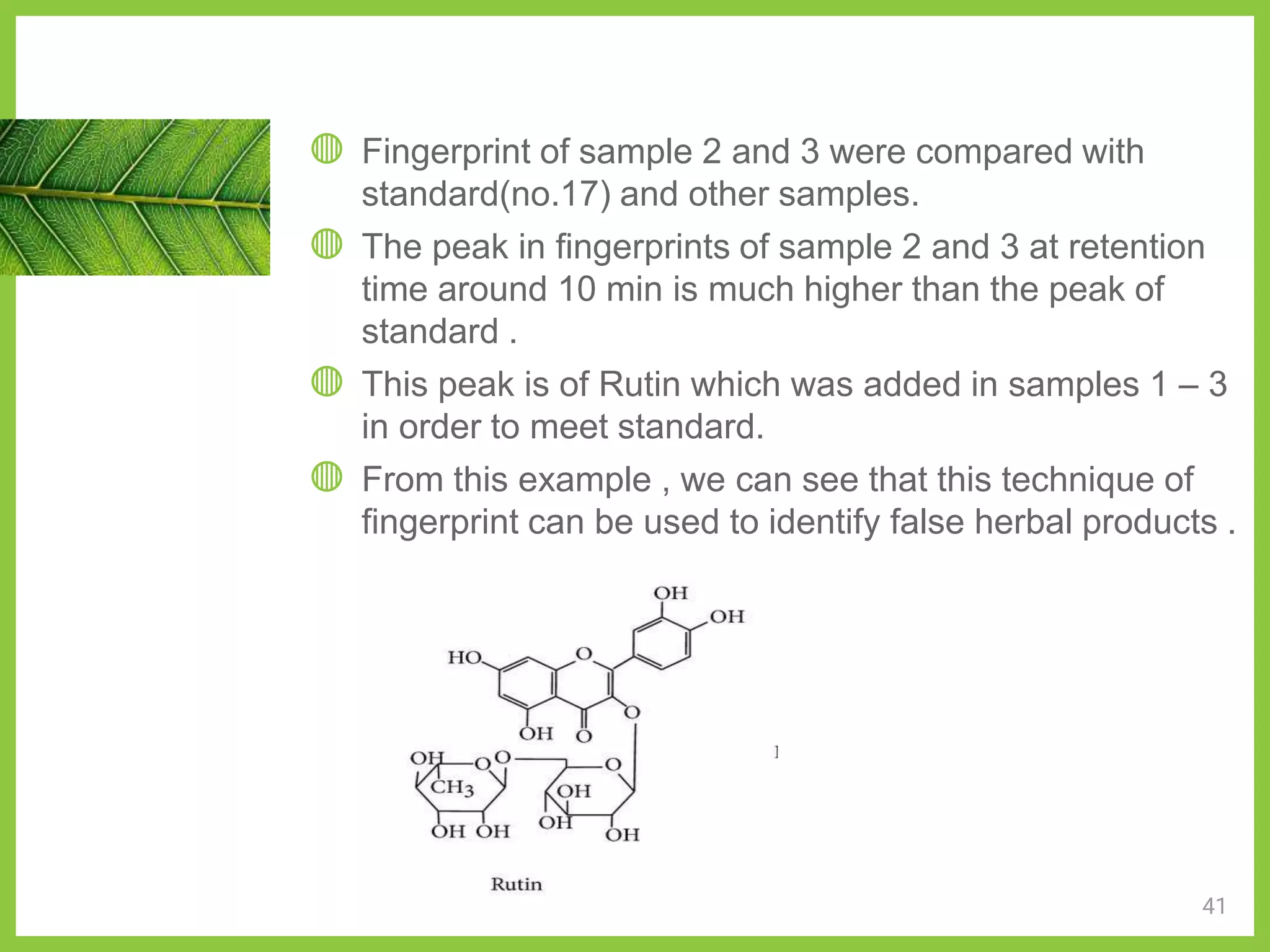
◍ The peak in fingerprints of sample 2 and 3 at retention
time around 10 min is much higher than the peak of
standard .
◍ This peak is of Rutin which was added in samples 1 – 3
in order to meet standard.
◍ From this example , we can see that this technique of
fingerprint can be used to identify false herbal products .
41
Conclusion
Phytochemical fingerprinting is very important for
authentication of herbal products . Fingerprints obtained
from HPTLC and GC-MS analysis could be useful in
authentication and identification of the drug . It can be
used to characterise different constituents present in
compounds.
42
REFERENCES
Prakash R. Itankar, Dattatray B. Sawant, Mohd. Tauqeer, and Sonal S. Charde, High Performance Thi
n Layer Chromatography Fingerprinting, Phytochemical and Physico-chemical studies Of Antidiabetic
herbal extracts, NCBI.
Kirti M. Kulkarni, Leena S. Patil, Mrs. Vineeta V. Khanvilkar, Dr. Vilasrao J. Kadam, Fingerprinting Tech
niques In Herbal Standardization, Indo American Journal Of Pharmaceutical Research, 2014 .
S. Dorathy Selva Jebapritha,s Karpagam, GC-MS And HPTLC Fingerprints Of Various Secondary meta
bolites in the Ethanolic Extract of Coconut Shell Oil, International Journal of Pharmacognosy and Phy
tochemical Research 10(02) · March 2018, Research Gate
N.Deattu , L. Suseela ,N.Narayan,chromatographic Ananlysis of Polyherbal Extracts And Formulation
s by HPTLC and GC-MS Methods ,Elsevier.
43
REFERENCES
 Dr. Shankar Ravi , pharmaceutical analysis , page no . -17-1 – 18-15 fourth
edition .
 Quality control of herbal medicines, Journal of chromatography , ELSEVIER.
44
45
THANKS!

Phytochemical fingerprinting by hptlc and gc ms

  • 1.
    Phytochemical fingerprinting Chetna Kaushik M.Pharm (Pharmacognosyand Phytochemistry )1st Semester 17/Mph/DPSRU/2018
  • 2.
    CONTENTS 2  Phytochemical fingerprinting  Highperformance thin layer chromatography  Theoretical considerations  HPTLC method development  Characterisation using HPTLC  Advantages of HPTLC  Hyphenated techniques  Gas chromatography – mass spectroscopy  Advantages of GC-MS  Characterization using GC-MS  Conclusion  References
  • 3.
    3 ◍ A patternwhich is specific enough to become useful as characteristic identifier for that particular entity . ◍ A chromatographic fingerprint is a chromatographic pattern of characteristic chemical constituents present in the specific extract. ◍ Using chromatographic techniques , a profile of various chemical constituents is obtained . This is known as chemo profiling ◍ The compound specific to a species is characterised as a chemical marker. ◍ E.g., ginsenosides for ginseng. PHYTOCHEMICAL FINGERPRINTING
  • 4.
    Contd. These fingerprints canbe obtained by ◍ TLC/HPTLC ◍ HPLC ◍ GC ◍ GC-MS ◍ LC-MS 4
  • 5.
    HIGH PERFORMANCE THIN LAYERCHROMATOGRAPHY (HPTLC) It is an improved and sophisticated form of thin layer chromatography. It is also known as flat bed chromatography. HPTLC fingerprint -It is a pattern on TLC plate of separated compounds, generated according to their highly specific Rf values, capable of providing specific and characteristic identity. Principle : Adsorption 5
  • 6.
    “ Theoretical Considerations 6 RETARDATION/ RETENTION FACTOR PARTITION COEFFICIENT Theamount that each component of a mixture travels can be quantified using retention factors (Rf). RF= DISTANCE TRAVELLED BY ANALYTE / DISTANCE TRAVELLED BY SOLVENT FRONT The retention factor of a particular material is the ratio of the distance the spot moved above the origin to the distance the solvent front moved above the origin. K=CS/CM CS is the concentration of the analyte in the stationary phase and CM is its concentration in the mobile phase. It is this ratio that controls the rate of migration of an analyte.
  • 7.
    THIS IS ASLIDE TITLE ◍ Here you have a list of items ◍ And some text ◍ But remember not to overload your slides with content Your audience will listen to you or read the content, but won’t do both. 7 HPTLCMETHOD DEVELOPMENT
  • 8.
    8 selection of chromatographiclayer ◍ Plates - GLASSPLATES- ThicknessofPlate1.3mm ◍ POLYESTER/POLYETHYLYNE- ThicknessofPlate0.2mm ◍ ALUMINIUMPLATES-Thicknessof Plate0.1mm ◍ Sorbent - ◍ Silica gel 65F(modified) ◍ Aluminum oxide ◍ Cellulose ◍ Microcrystalline Silica gel
  • 9.
    ◍ Concentration range– 0.1-1 µg / µl (above this –poor separation ) Applicators – Linomat 1V(automatic applicator) capillary tubes -sample applied in the form of spots . Volume – 0.1-0.2 µl. Micro bulb pipettes. Micro syringes – sample applied as spot or band-Volume-1 µl ◍ CAMAG LINOMAT Win cats The sample is loaded in micro syringe (Hamilton syringe ) of 1l capacity. Nitrogen gas sprays sample and standard from syringe on TLC plates as bands · Band wise application - better separation - high response to densitometer Sample application 9
  • 10.
    ◍ Detection underUV light is first choice - non destructive. ◍ Spots of fluorescent compounds can be seen at 254 nm (short wave length) or at 366 nm (long wave length) · ◍ Spots of non fluorescent compounds can be seen - fluorescent stationary phase is used - silica gel GF · ◍ Non UV absorbing compounds - dipping the plates in 0.1% iodine solution · ◍ When individual component does not respond to UV - derivatization required for detection DETECTION OR VISULATION OF SPOTS / BANDS 10
  • 11.
    Derivatization ◍ Spraying devicefor the automated derivatization of TLC/HPTLC plates 11 Derivatization can be defined as a procedural technique that primarily modifies an analyte's functionality in order to enable chromatographic separations. CAMAG DERIVATIZER
  • 12.
    12 Evaluation/ Quantification Densitometric evaluation -Spotsor bands converted into chromatogram consisting of peaks. Tracks of the chromatogram are scanned with monochromatic light in the form of a slit selectable in length and width. CAMAG TLC SCANNER 4 - The spectral range of the CAMAG TLC Scanner 4 is 190–900 nm. Reflected light is measured either in the absorbance or in the fluorescence mode. CAMAG BIOLUMINIZER® 2- The CAMAG BioLuminizer® 2 is a detection system specifically designed to detect bioluminescence on HPTLC plates. CAMAG TLC SCANNER 4 CAMAG BIOLUMINIZER
  • 13.
    13 Grounded coconut washeated in earthern flask for 3 hrs. The oil was extracted with ethanol for further study HPTLC analysis was performed CHRACTERISATION USING HPTLC 1. HPTLC profile of coconut shell oil
  • 14.
    14 ◍ SAMPLE SOLUTION-Ethanol extract ◍ APPLICATOR-Automated CAMAG HPTLC system ◍ DEVELOPMENT CHAMBER -Twin Trough glass chamber. ◍ SCANNER- TLC Scanner with WIN CATS software ◍ ADSORBENT -Aluminum silica gel 60F254 . ◍ MOBILE PHASE- Toluene: Ethyl Acetate: Glacial Acetic Acid(9:1:0.2)(v/v). ◍ DERIVATIZATION - Vanillin –sulphuric(vs) acid. ◍ EXAMINED UNDER -UV- 254nm and 366nm . ◍ CHARACTERISED BY - Densitometry HPTLC analysis.
  • 15.
    Results 15 SOLVENT SYSTEM Rf VALUES UV 254nmUV 366nm 0.97 Dark green 0.97 Blue Toluene: Ethyl acetate :Glacial acetic acid 0.85 Dark green 0.89 Violet (9:1:0.2) 0.50 Dark green 0.75 Violet 0.39 Dark green 0.60 Violet 0.50 Blue 0.45 Violet 0.41 Blue 0.39 Blue
  • 16.
    INTERPRETATION 16 HPTLC FINGERPRINTING OFCOCONUT OIL AT 254 nm HPTLC FINGERPRINT OF COCONUT SHELL AT 366nm The HPTLC fingerprint of Coconut shell oil at 254nm shows 7 components out of which the compounds with Rf values 0.33, 0.43, 0.79, 0.94 were found to be more predominant as the intensity of area was 8977.3, 27183.3, 12181.1 and 4540.6. Comparatively the densitometric results of Coconut shell oil made at 366nm exhibited 4 components with Rf value ranging between 0.24 to 0.94, the intensity of area is between 724.3 to 2855.1AU. This study revealed more number of peaks and area, when the solvent extracts were scanned at 254nm than at 366nm.
  • 17.
    ADVANTAGES OF HPTLC 17 •Ability to analyze multicomponent crude samples • The separation process is easy to follow especially with colored compounds. • Several samples can be separated parallel to each other on the same plate resulting in a high output, time saving, and a rapid low-cost analysis. • Choice of solvents for the HPTLC development is wide as the mobile phases are fully evaporated before the detection step. • HPTLC can combine and consequently be used for different modes of evaluation.
  • 18.
    ◍ combining a chromatographicseparation system on-line with a spectroscopic detector in order to obtain structural information on the analytes present in a sample has become the most important approach for the identification and/or confirmation of the identity of target and unknown chemical compounds. ◍ For most analytical problems in the research field of herbal medicines, the combination of column liquid chromatography with a mass spectrometer (GC– MS and LC–MS) becomes the preferred approach for the analysis of herbal medicines. HYPHENATED TECHNIQUES 18
  • 19.
    GAS CHROMATOGRAPHY –MASS SPECTROSCOPY GC-MS Gas chromatography mass spectrometry (GC/MS) is an instrumental technique, comprising a gas chromatograph (GC) coupled to a mass spectrometer (MS), by which complex mixtures may be separated, identified and quantified. In order for a compound to be analyzed by GC/MS it must be sufficiently volatile and thermally stable. This hybrid instrument provides two separate dimensions of information about the components in the sample, GC retention times and electron ionization (EI) mass spectra. GC retention time is related to specific chemical properties of the molecules in question (e.g. volatility, polarity, presence of specific functional groups) while molecular weight (derived from the mass spectrum) is indicative of atomic composition. 19
  • 20.
  • 21.
    MASS SPECTROSCOPY ◍ Analytical techniqueto measure atomic weight of a sample . ◍ Ionizes chemical species and sorts the ions based on their mass-to-charge ratio. 21
  • 22.
    GAS CHROMATOGRAPHY-MASS SPECTROSOPY 22 PRINCIPLE Gas chromatography(GC) portion separates the chemical mixture into pulses of pure chemicals and the Mass Spectrometer (MS) identifies and quantifies the chemicals.
  • 23.
  • 24.
    INTERFACES 24 TYPESOF INTERFACES CAPILLARY DIRECT INTERFACE JETSEPARATOR (COLUMN PACKED) WATSON BIEMANN EFFUSION SEPARATOR
  • 25.
  • 26.
    SPLIT/SPLIT LESS 26 ◍The sample,in most cases a liquid, is introduced into a heated space, the liner, where fast evaporation takes place. ◍The sample vapor is mixed with the carrier gas in the liner and flows with a high velocity past the column entrance where a small portion is introduced into the column, but most is carried away along the split outlet . ◍The splitting of the sample serves two purposes. •Fast evaporation and a short residence time in the liner results in a small injection plug. •Reduces the size of the sample to an amount compatible with the sample capacity of the capillary column. oIf split vent is closed, via a computer- controlled split valve, then all of sample introduced into injector vaporizes and goes into column(split less mode).
  • 27.
    ◍ With on-column injectiona liquid sample is introduced directly into the column with a thin injection needle. ◍ No evaporation in heated space takes place On column 27
  • 28.
    Gas Phase ◍ Electron Impact Ionization ◍Chemical Ionization Evaporative ◍ Thermospray ◍ ESI ◍ APCI ◍ APPI Desorption ◍ MALDI (matrix assisted LASER desorption ionization) ◍ FAB(fast atom bombardment Ionization techniques 28 QUADRAPOLE ANALYZER MASS ANALYZERS
  • 29.
  • 30.
  • 31.
    31 FLAME IONIATION DETECTOR (FID) Basedon electrical conductivity of carrier gases. When pure carrier gas passes alone , there is no ionisation and no current flow . When a component emerges from the column , no. of ions produced cause a potential difference and flow of current which is recorded
  • 32.
    32 THERMAL CONDUCTIVITY DETECTOR Also known as katharometer.  Based on thermal conductivity difference between carrier gas and that of component.
  • 33.
    33 ELECTRON CAPTURE DETECTOR •Column effluent passes between two electrodes of ECD. • One of the electrode treated with radioactive isotope , emits electrons as it decays which produces secondary electrons which are collected by anode .
  • 34.
    SOME GC-MS INSTRUMENTS ◍ 5977BGC/MSD - Single- Quadrupole GC/MS system ◍ 7010B Triple Quadrupole GC/MS -Triple Quadrupole GC/MS ◍ 7250 GC/Q-TOF- Agilent 7250 Quadrupole Time-of-Flight GC/MS system 34 quadrupole GC/MS system Quadrupole Time-of-Flight GC/MS system
  • 35.
    ADVANTAGES OF GC-MSIN HERBAL MEDICINES • Gas chromatography of volatile oil provides reasonable fingerprints which can give identity of the plant . • presence of impurities can also be detected . • Changes in composition can be detected which could indicate oxidation , enzymatic or microbial changes. • Capillary column used in GC-MS gives good separation . • Qualitative as well as quantitative composition can be identified which is useful for further investigation on relationship between chemical constituents and pharmacology . 35 One major disadvantage is that it is not suitable for polar and non-volatile compounds .
  • 36.
    CHARACTERIZATION USING GC-MS GC-MSprofile of Mentha piperita ◍ Instrument -Thermo GC-Trace ultra version 5.0 gas chromatography interfaced to Thermo MS DSQ II mass ◍ Column -DB5-MS capillary standard non polar ◍ Carrier gas – Helium ◍ Flow rate – (constant) 1ml/min. ◍ Oven temperature -70°C . ◍ Mass range - 50 to 650 (m/z). ◍ The total running -30 min. ◍ The chromatogram obtained from gas chromatography was then analyzed in mass spectrometry to get the mass of all fractions. The identification of phytochemical components was achieved through retention time and mass spectrometry. 36
  • 37.
  • 38.
    GAS CHROMATOGRAM OF CHEMICALCONSTITUENTS OF Mentha piperita 38
  • 39.
    INTERPREATION 39 ◍ In M.piperita leaf extract major components with respect to Area % was detected for (-)- Carvone (39.57%) followed by cyclohexene, 1methyl-4-(1-methylethenyl) (33.66%) and probably these molecules acts the most. ◍ In volatile composition of essential oil of mint eight main compounds were detected such as carvone, cis-carveol, trans-sabinene hydrate, trans-caryophyllene, myrcene, santene, and trans-ocimene which have been generally recognized for spices importance. ◍ Essential oils from eleven Mentha species when analysed by GC–MS: 44 most abundant carvone, menthone, isomenthone, menthol, piperitone oxide, D-limonene and eucalyptol has been detected. CARVONE 1methyl-4-(1-methylethenyl)
  • 40.
    EVALUATION OF FINGERPRINT OFGinko biloba ◍ To find out false samples from different samples of Ginko biloba from 18 sources 40
  • 41.
    ◍ Fingerprint ofsample 2 and 3 were compared with standard(no.17) and other samples. ◍ The peak in fingerprints of sample 2 and 3 at retention time around 10 min is much higher than the peak of standard . ◍ This peak is of Rutin which was added in samples 1 – 3 in order to meet standard. ◍ From this example , we can see that this technique of fingerprint can be used to identify false herbal products . 41
  • 42.
    Conclusion Phytochemical fingerprinting isvery important for authentication of herbal products . Fingerprints obtained from HPTLC and GC-MS analysis could be useful in authentication and identification of the drug . It can be used to characterise different constituents present in compounds. 42
  • 43.
    REFERENCES Prakash R. Itankar,Dattatray B. Sawant, Mohd. Tauqeer, and Sonal S. Charde, High Performance Thi n Layer Chromatography Fingerprinting, Phytochemical and Physico-chemical studies Of Antidiabetic herbal extracts, NCBI. Kirti M. Kulkarni, Leena S. Patil, Mrs. Vineeta V. Khanvilkar, Dr. Vilasrao J. Kadam, Fingerprinting Tech niques In Herbal Standardization, Indo American Journal Of Pharmaceutical Research, 2014 . S. Dorathy Selva Jebapritha,s Karpagam, GC-MS And HPTLC Fingerprints Of Various Secondary meta bolites in the Ethanolic Extract of Coconut Shell Oil, International Journal of Pharmacognosy and Phy tochemical Research 10(02) · March 2018, Research Gate N.Deattu , L. Suseela ,N.Narayan,chromatographic Ananlysis of Polyherbal Extracts And Formulation s by HPTLC and GC-MS Methods ,Elsevier. 43
  • 44.
    REFERENCES  Dr. ShankarRavi , pharmaceutical analysis , page no . -17-1 – 18-15 fourth edition .  Quality control of herbal medicines, Journal of chromatography , ELSEVIER. 44
  • 45.