Dolapo Akindele presented a seminar on using Lactobacillus vini as a fermentation organism for biofuel (bioethanol) production. The presentation covered how biotechnology can improve bioethanol production, described bioethanol and L. vini, and explained the fermentation process. It discussed that bioethanol is made through fermenting plants like corn, produced through a process where sugar is converted to ethanol and CO2 by yeast and L. vini, and then distilled and purified to high purity bioethanol. The presentation concluded that bioethanol is a renewable fuel that can serve as an alternative fuel for Nigeria.
Introduction to Lactobacillus vini's role in bio-ethanol production and its significance.
Biotechnology defined with applications for enhanced bio-ethanol production using engineered microorganisms. Explains bio-fuel types, classification, advantages like environmental benefits, and disadvantages.
Details on Lactobacillus vini, its classification as lactic acid bacteria, and its health benefits.
The bio-ethanol production steps highlighting fermentation, distillation, and the need for local refineries.
Citations of sources utilized in the research and a recommendation for using bio-ethanol in Nigeria.
A SEMINAR PRESENTATION
ON
LACTOBACILLUSVINI AS FERMENTATION
ORGANISM IN PRODUCTION OF BIO-FUEL (BIO-
ETHANOL)
BY
AKINYELE, DOLAPO DIMEJI
MATRIC NO: 140408016
DEPARTMENT: BIOLOGICAL SCIENCES
PROGRAMME: MICROBIOLOGY
MARCH, 2018
2.
Introduction
Application of biotechnologyto Improve
bio-ethanol production
Type of Bio-fuel
Bio-ethanol
Biology and source of Lactobacillus vini
Fermentation process involved in Bio-ethanol
Production
Conclusion
References
1
3.
BIOTECHNOLOGY
Use of livingsystems and organisms to develop or
make products, or any technological application that
uses biological systems, living organisms, make or
modify products or processes for specific use
(Springham et al. 1999).
2
4.
3
BIO-FUEL
• Fuel thatis produced through contemporary biological
processes (agriculture and anaerobic digestion)
• Fuel produced by geological processes (those involved in
the formation of fossil fuels, coal and petroleum, from
prehistoric biological matter.
5.
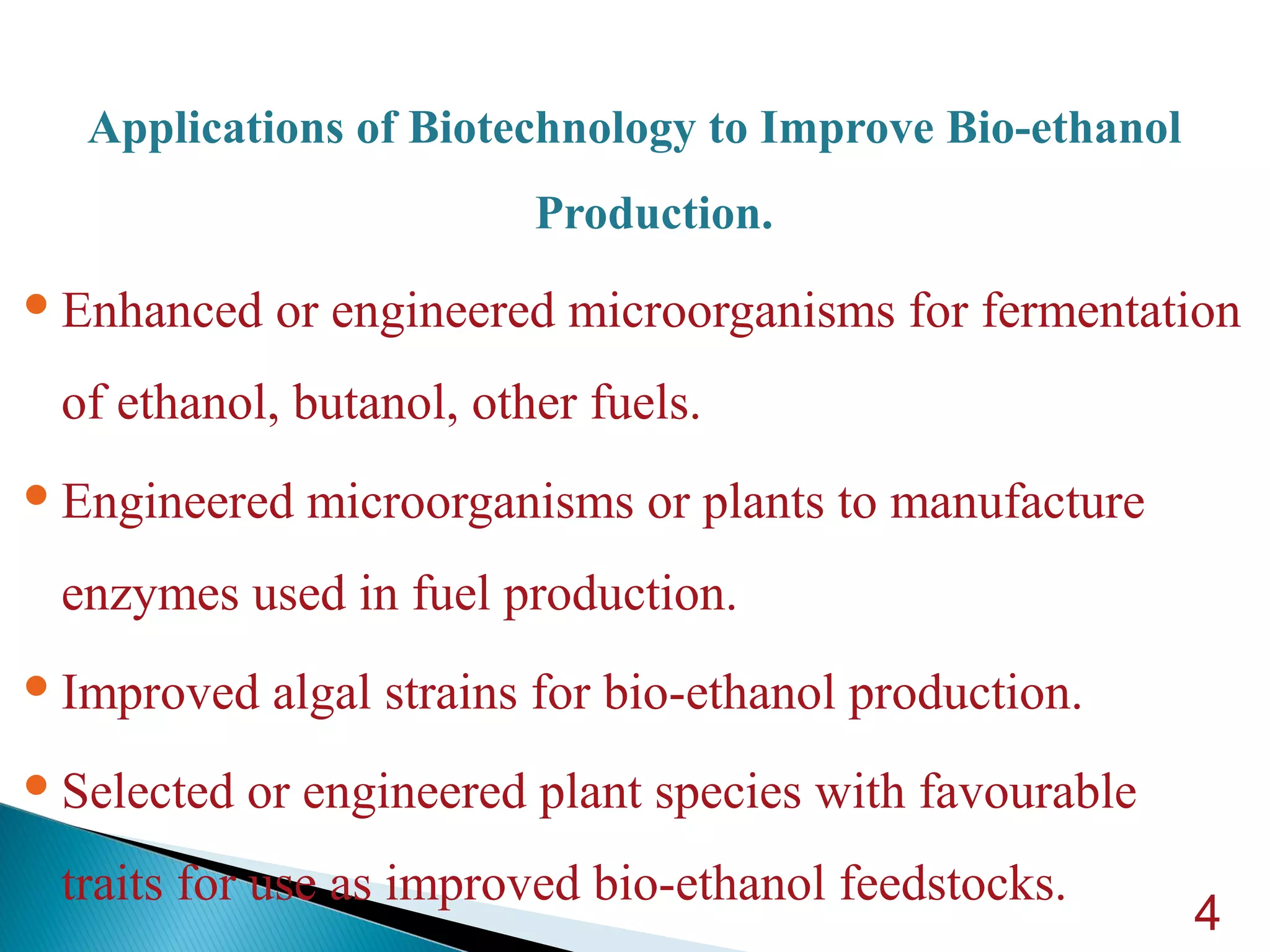
Applications of Biotechnologyto Improve Bio-ethanol
Production.
Enhanced or engineered microorganisms for fermentation
of ethanol, butanol, other fuels.
Engineered microorganisms or plants to manufacture
enzymes used in fuel production.
Improved algal strains for bio-ethanol production.
Selected or engineered plant species with favourable
traits for use as improved bio-ethanol feedstocks.
4
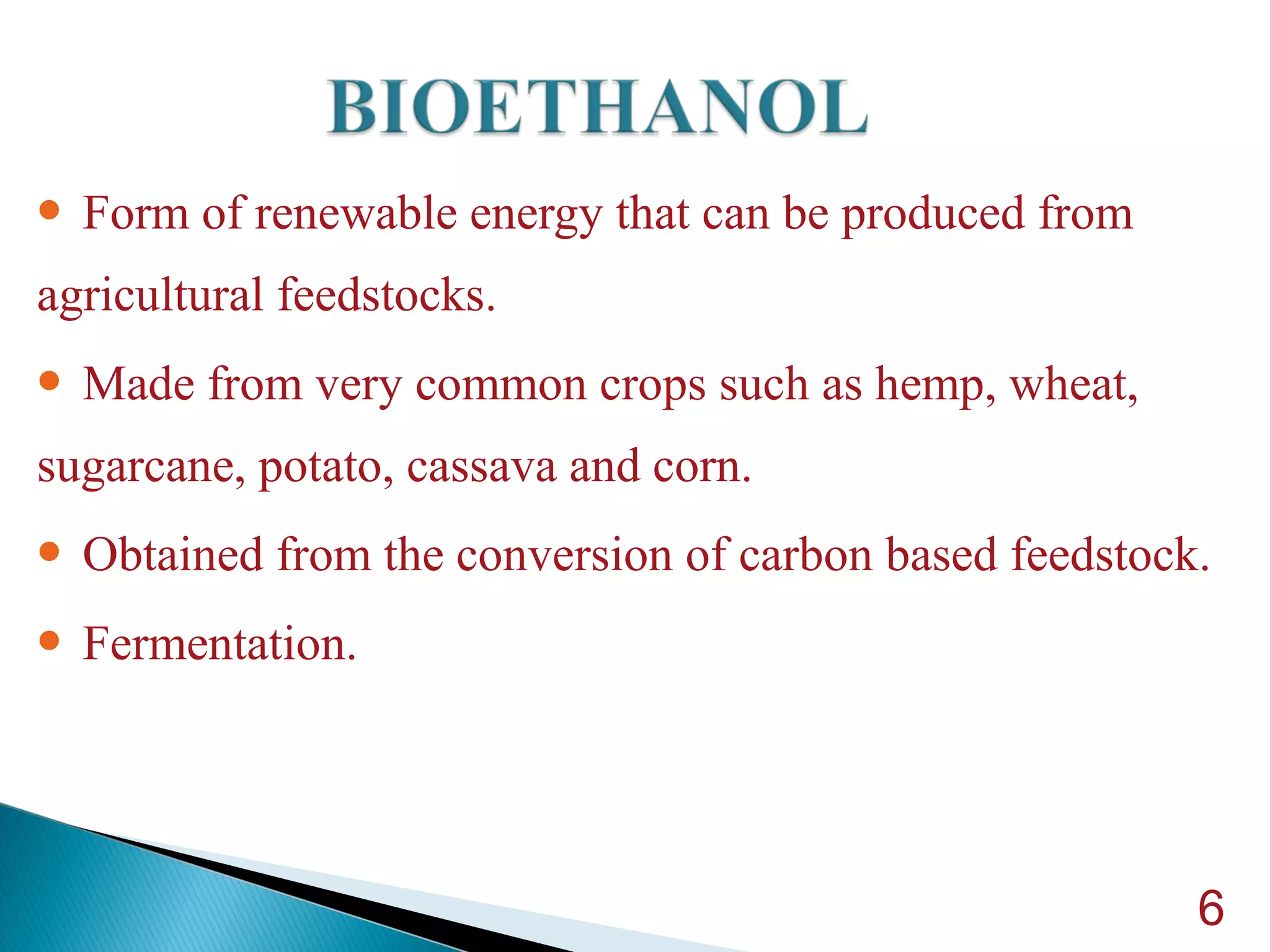
Form ofrenewable energy that can be produced from
agricultural feedstocks.
Made from very common crops such as hemp, wheat,
sugarcane, potato, cassava and corn.
Obtained from the conversion of carbon based feedstock.
Fermentation.
6
8.
ADVANTAGES
EnvironmentalImpact
Spills and Surface Contamination
Sulphur and Atmospheric Contamination
Energy Independence
DISADVANTAGES
Regional Suitability
Food Security
Land Use Changes
7
9.
Gram-positive, facultativeanaerobic, rod shaped and non-spore-
forming bacteria.
Lactic acid bacteria group (i.e they convert sugar to lactic acid).
Constitute a significant component of the micro-biota at a number of
body sites, such as the digestive system, urinary system, and genital
system.
Found as a normal micro-biota in the vaginal and gut of human
Helps to maintain human well being and treat diarrhea, vaginal
infections and skin disorder such as enzema. 8
10.
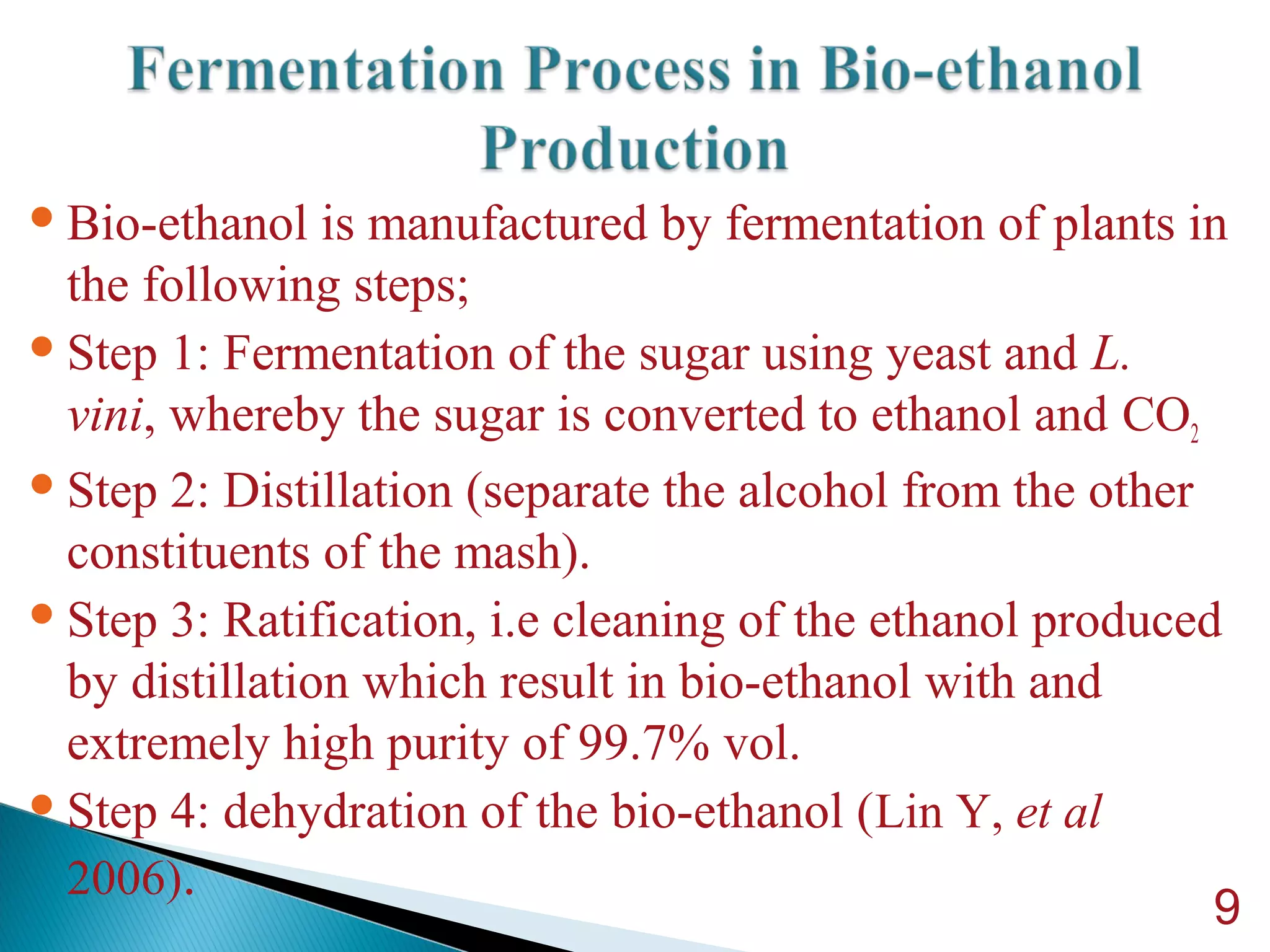
Bio-ethanol is manufacturedby fermentation of plants in
the following steps;
Step 1: Fermentation of the sugar using yeast and L.
vini, whereby the sugar is converted to ethanol and CO2
Step 2: Distillation (separate the alcohol from the other
constituents of the mash).
Step 3: Ratification, i.e cleaning of the ethanol produced
by distillation which result in bio-ethanol with and
extremely high purity of 99.7% vol.
Step 4: dehydration of the bio-ethanol (Lin Y, et al
2006).
9
11.
10
Figure 2: Bio-ethanolProduction Process
Source: Large. stanford.edu
BIO-ETHANOL
PRODUCTION PROCESS
12.
Bio-ethanol isa natural product of
agricultural crops, which made it easy
to get, produce, renewable fuel, and also
serve as cooking and automobile power
source.
The production and fermentation is a
simple process which can be carried out
in any local refinery.
It is recommended that Nigeria adopts
this fuel as an alternative to fossil fuel.
11
13.
“Bio-fuel second generationBiofuel”.www.Biofuel.org.uk
Chisti, Y. (2007). Biodiesel from micro-algae. Bio-ethanol
Advances.25(3), 294-306.
Lin, Y., and Tanaka, S. (2006). Ethanol Fermentation from
Biomass Resources: Current State and Prospects.
Applied Microbiology Biotechnology.69, 627-642.
Springham, D. Moses, V. Cape, R. E. (1999).
Biotechnology; the science and the business. CRC
press. P.I. ISBN 978-90-5702-407-8.
www.large.stanford.edu
12