ACCESS CAVITY
PREPARATION
Dr. Ahmed Negm
Access is the first and most important phase of root canal
treatment. A well-designed access preparation is essential for a
good endodontic result.
Coronal pulp
Radicular pulp
Pulp chamber
Pulp horn
Orifice
Root canal
Lateral canal
Apical foramen
Pulp space morphology
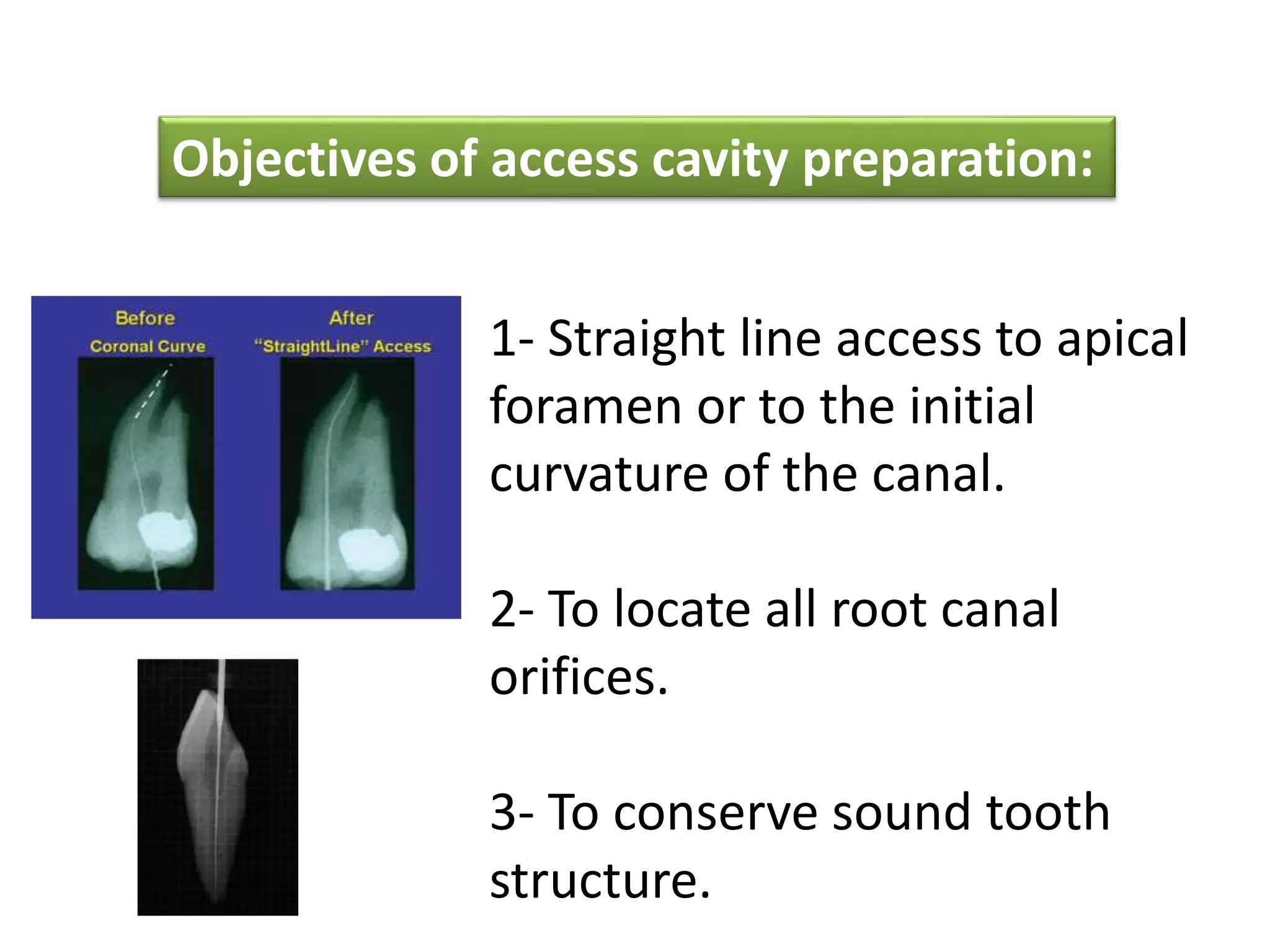
Objectives of access cavity preparation:
1- Straight line access to apical
foramen or to the initial
curvature of the canal.
2- To locate all root canal
orifices.
3- To conserve sound tooth
structure.
Principles of access cavity preparation
1. Outline form.
2. Convenience form.
3. Removal of remaining carious dentin and defective
restorations.
4. Toilet of the cavity.
1.Outline form:
Established by mechanically projecting the internal anatomy
to the external surface.
Three factors regulating the outline form:
a. Size of pulp chamber:
Young patients extensive.
Old patient limited.
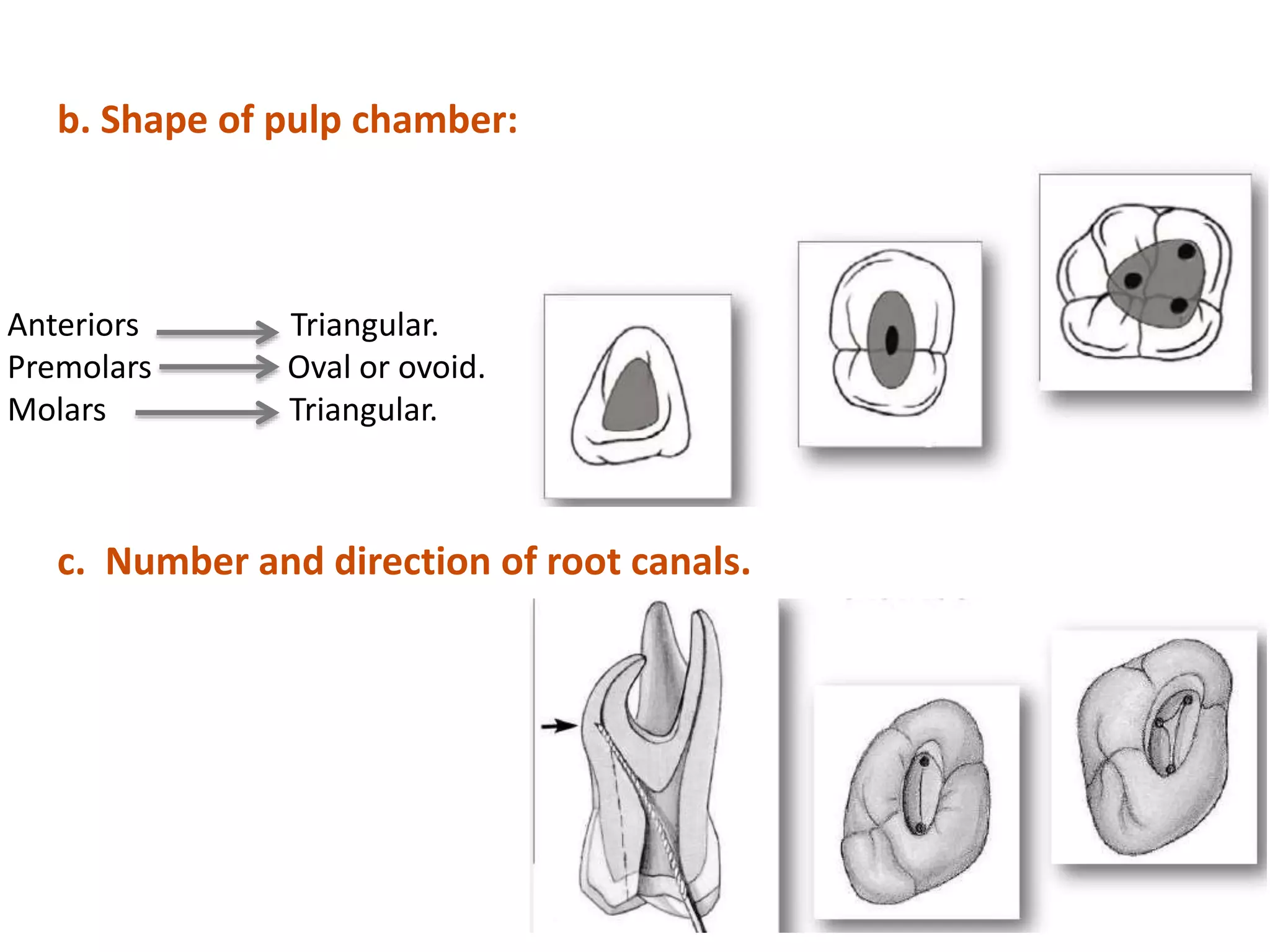
b. Shape of pulp chamber:
Anteriors Triangular.
Premolars Oval or ovoid.
Molars Triangular.
c. Number and direction of root canals.
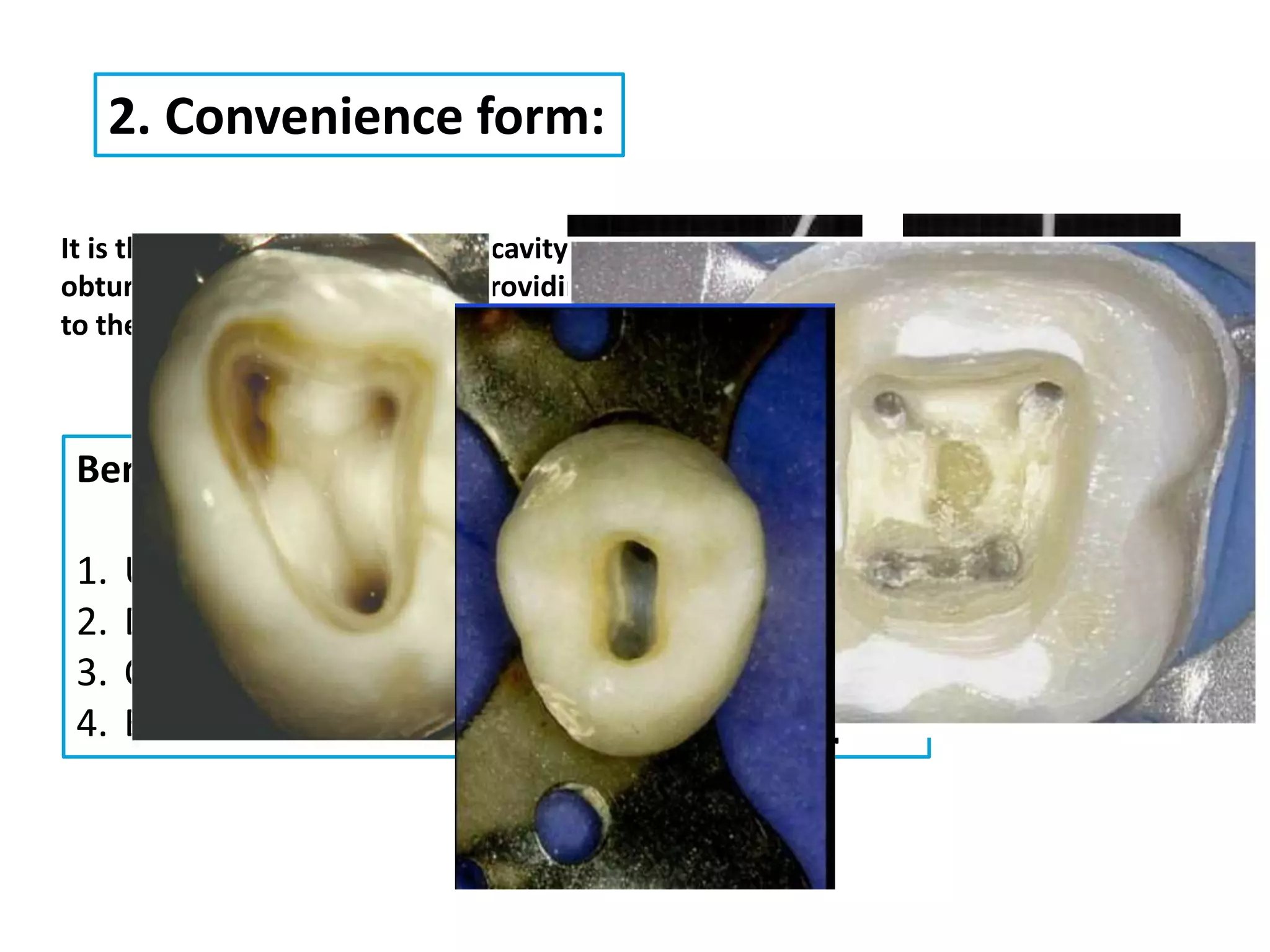
2. Convenience form:
It is the form given to the access cavity to improve visibility, instrumentation and
obturation of the root canal by providing a straight line access from occlusal surface
to the apical foramen.
Benefits:
1. Unobstructed access to the orifices.
2. Direct access to the apical foramina.
3. Complete authority over the instrument.
4. Expansion to accommodate filling techniques.
3- Removal of remaining carious dentin and
defective restorations:
Reasons of removing caries and defective restorations:
1. Elimination of bacteria.
2. Elimination of discolored tooth structure.
3. Elimination of the possibility of coronal leakage.
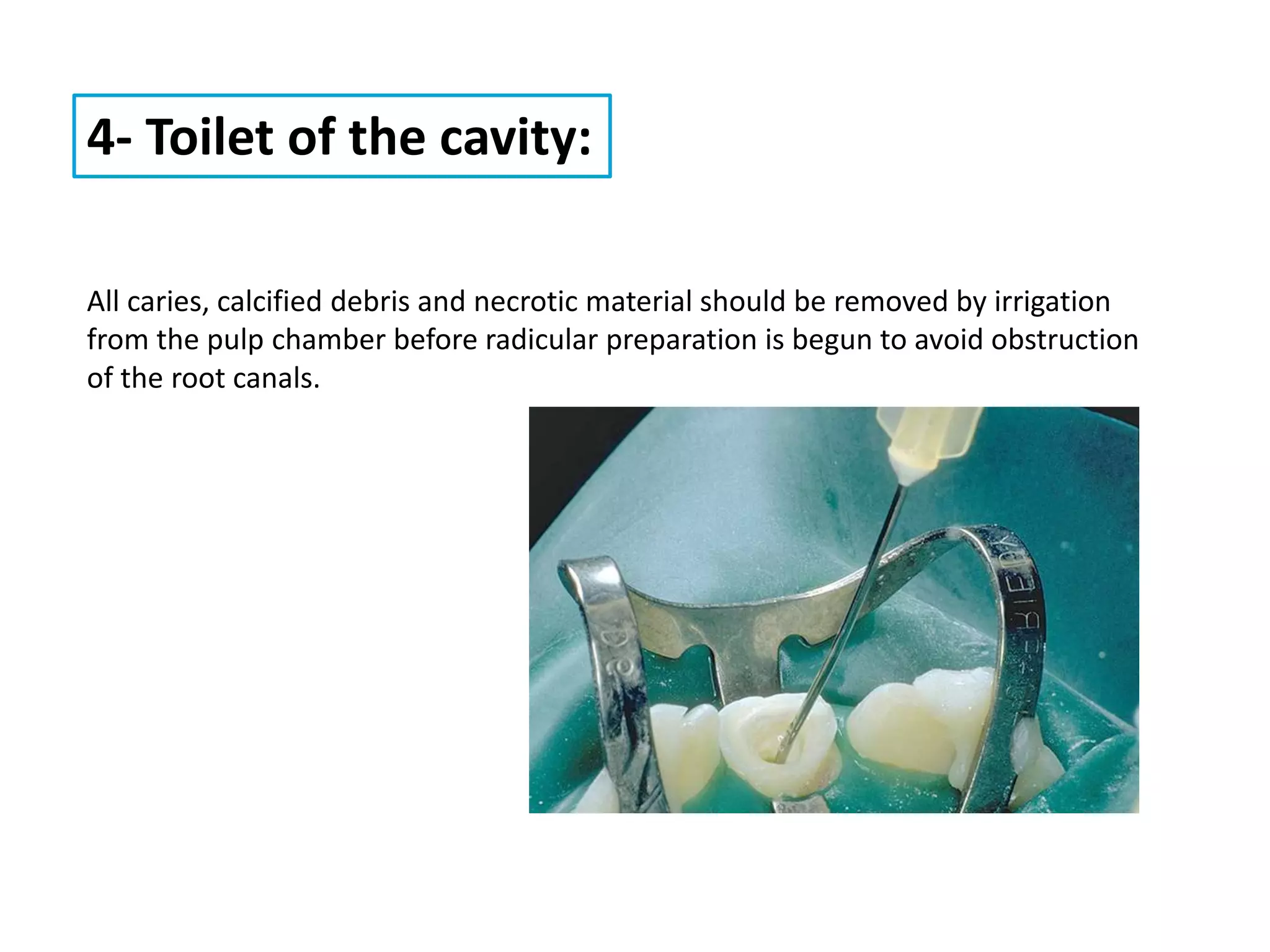
4- Toilet of the cavity:
All caries, calcified debris and necrotic material should be removed by irrigation
from the pulp chamber before radicular preparation is begun to avoid obstruction
of the root canals.
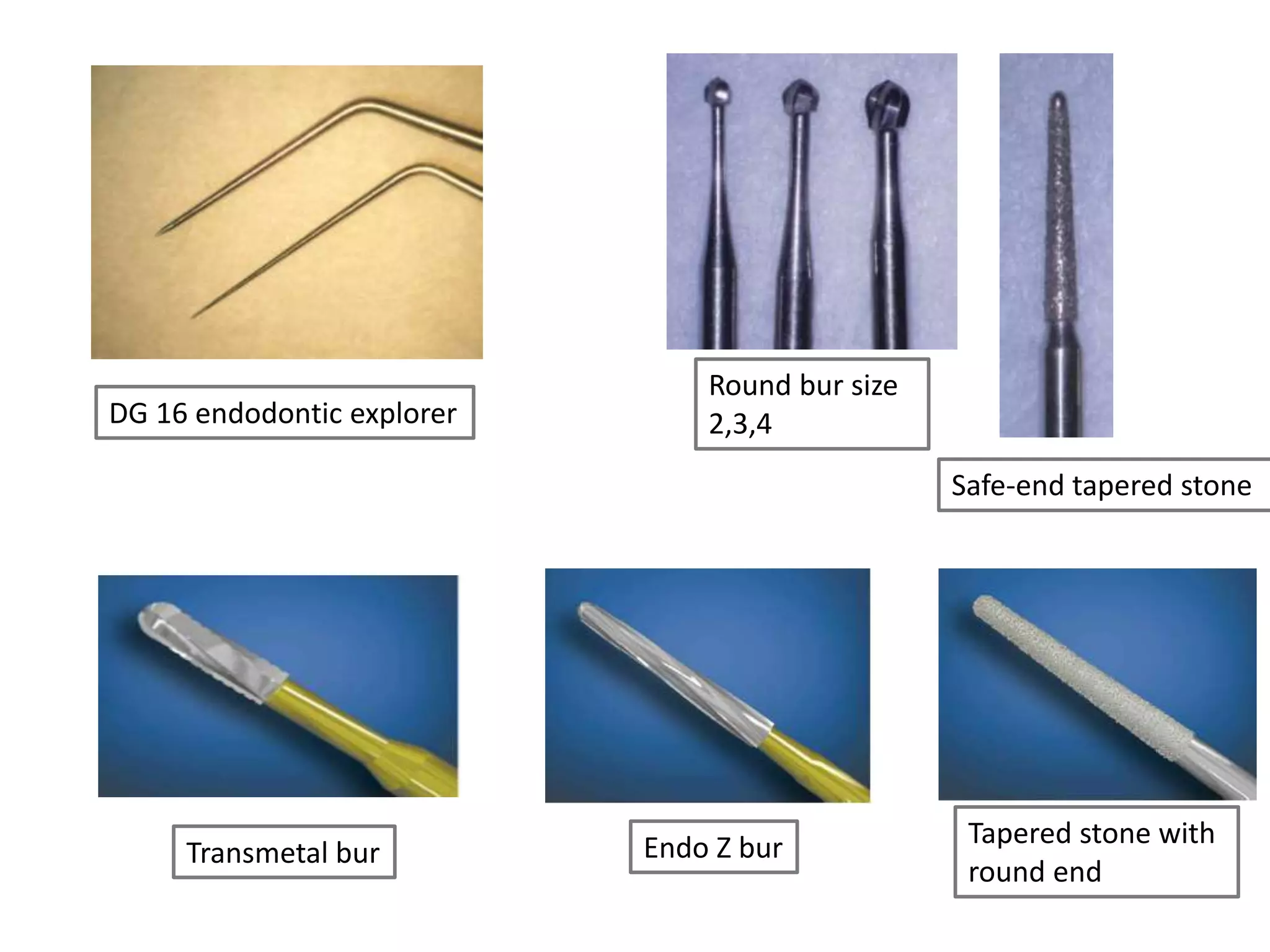
Instruments
Low speed contra High speed contra
Round bur size
2,3,4
Safe-end tapered stone
DG 16 endodontic explorer
Tapered stone with
round end
Endo Z burTransmetal bur
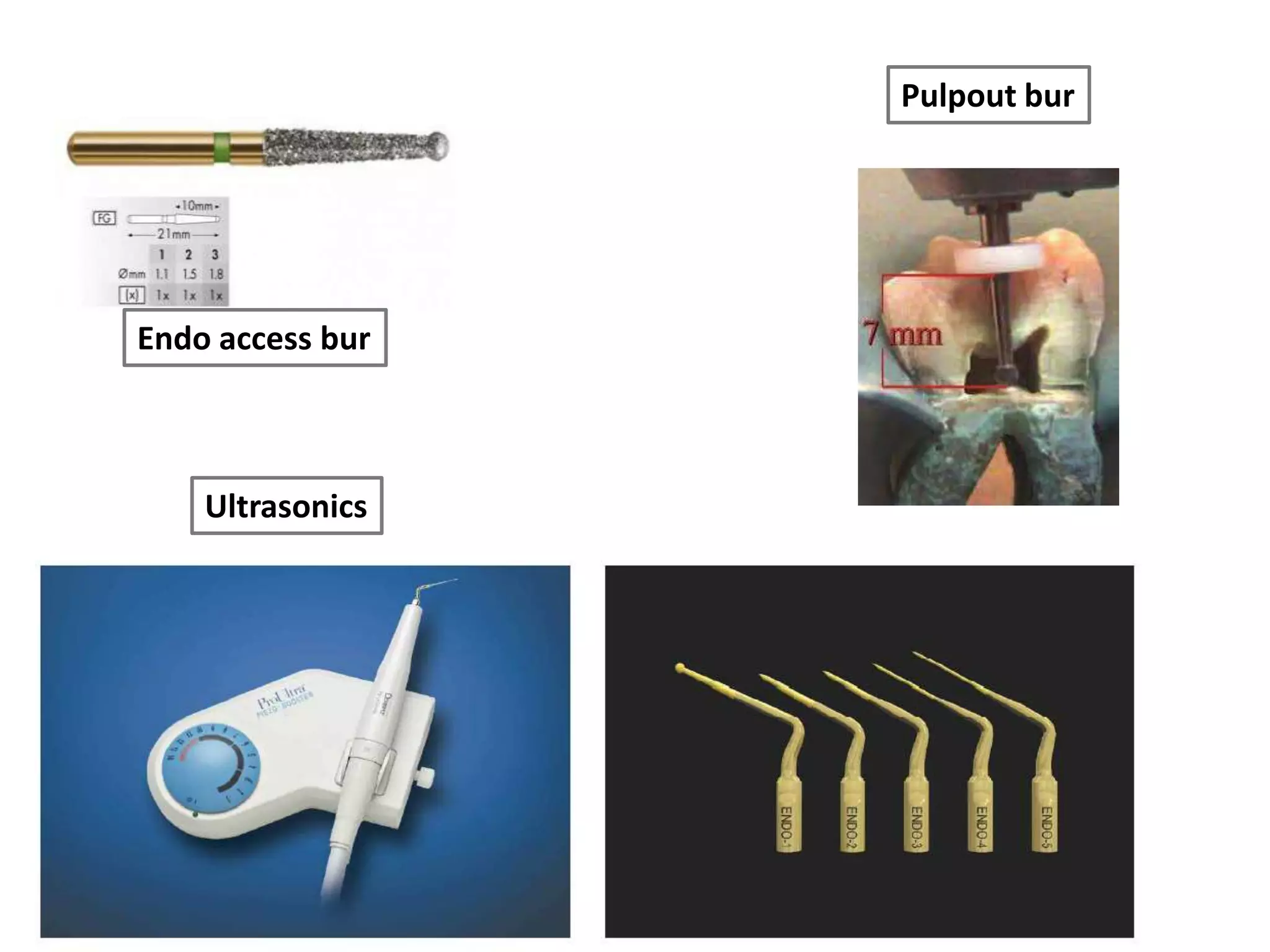
Endo access bur
Pulpout bur
Ultrasonics
Surgical operating microscope
Loupes
Access cavity preparation in anterior teeth
Outline form of central and lateral incisors are triangular with the base of the triangle
towards the incisal edge and the apex towards the cingulum.
Incisal edge
Cervical line
Steps
Entrance is gained through the middle of the middle
third of the palatal surface.
1
Initial entrance Is prepared with a round bur at a high speed
operated at a right angle to the long axis of the tooth. Only
enamel is penetrated.
2
The bur is positioned in a 45 degree to the long axis of the
tooth then advanced to penetrate the pulp chamber.
3
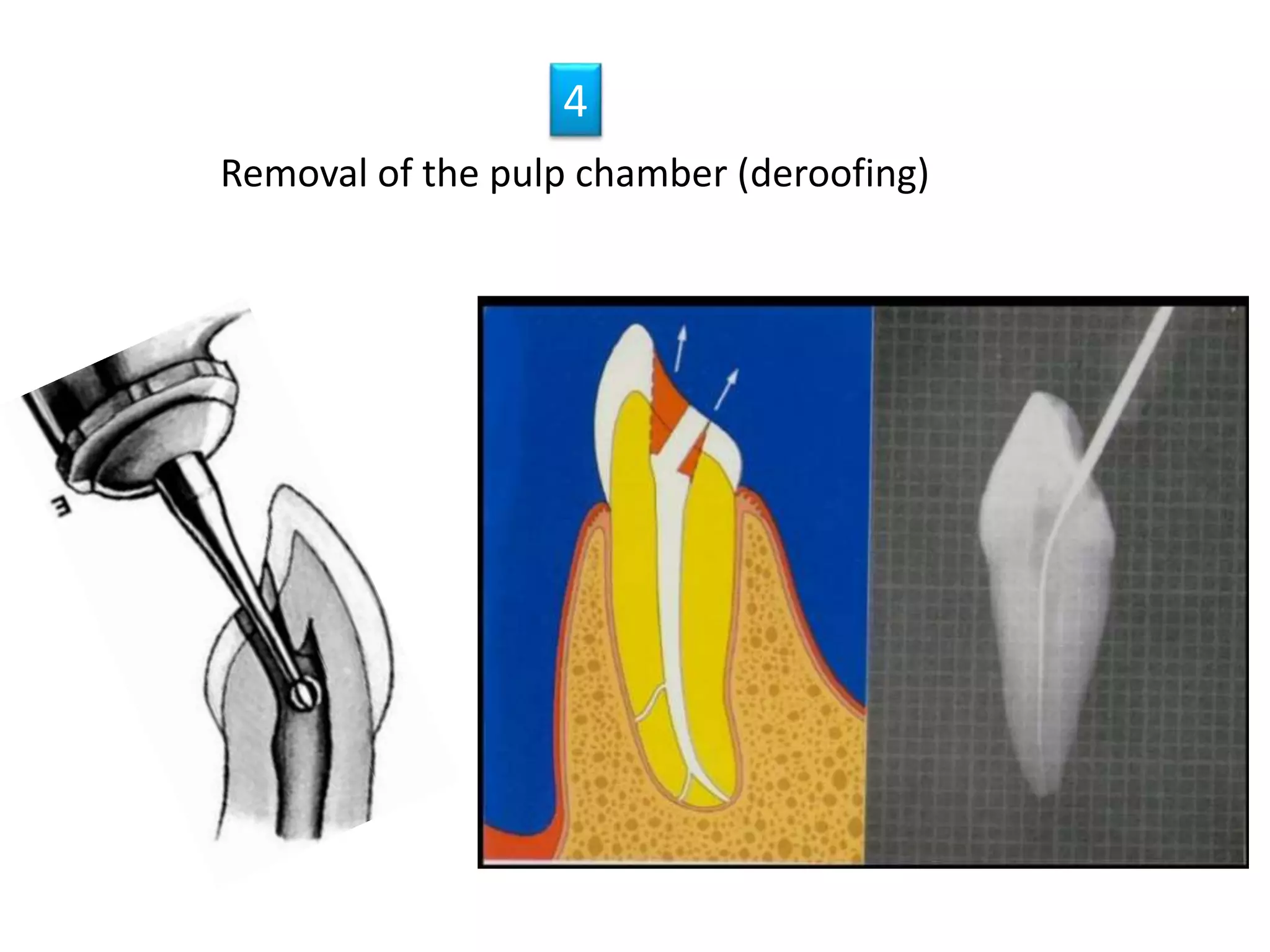
Removal of the pulp chamber (deroofing)
4
Removal of lingual shoulder.
5
In canine the outline is oval
Errors
1- GOUGING of the labial wall caused by failure to
recognize the 29-degree lingual-axial angulation of the
tooth.
2- GOUGING of the distal wall caused by failure to
recognize the 16-degree mesial-axial inclination of
the tooth.
4- Missed canal due to insufficient convenience extension.
3- PERFORATION at the labiocervical caused by failure to
complete convenience extension toward the incisal, prior
to the entrance of the shaft of the bur.
5- DISCOLORATION of the crown caused by failure to remove
pulp debris. The access cavity is too far to the gingival with no
incisal extension.
6- LEDGE formation at the apical-distal curve caused by using
an uncurved instrument too large for the canal. The cavity is
adequate.
Premolars
Upper oval Lower ovoid
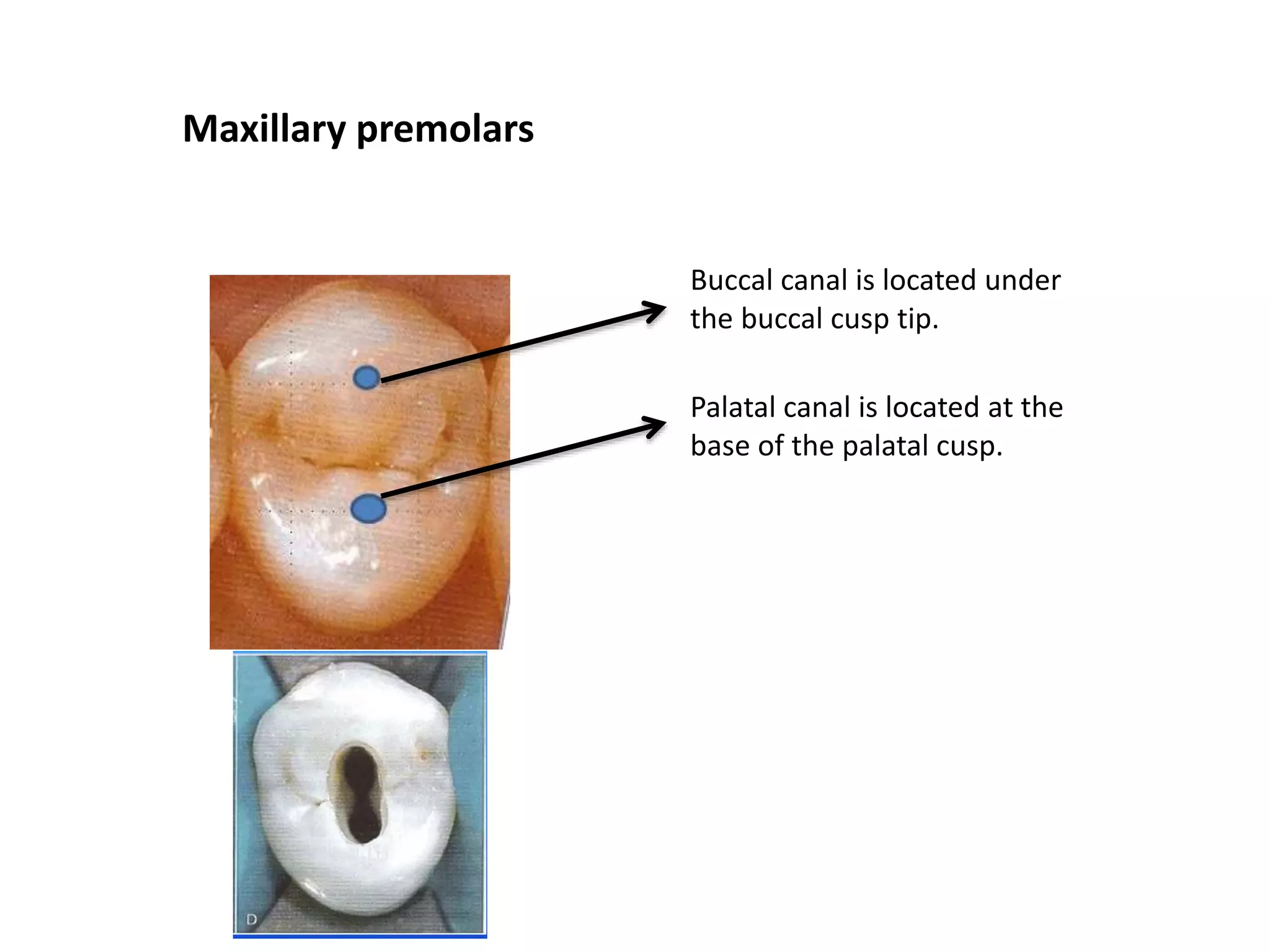
Maxillary premolars
Buccal canal is located under
the buccal cusp tip.
Palatal canal is located at the
base of the palatal cusp.
Initial penetration is made parallel to the long axis of the tooth in
the exact center of the central groove
11
A round bur is used to open into the pulp chamber. The bur will be
felt to “drop” when the pulp chamber is reached.
2
An endodontic explorer is used to locate orifices.
3
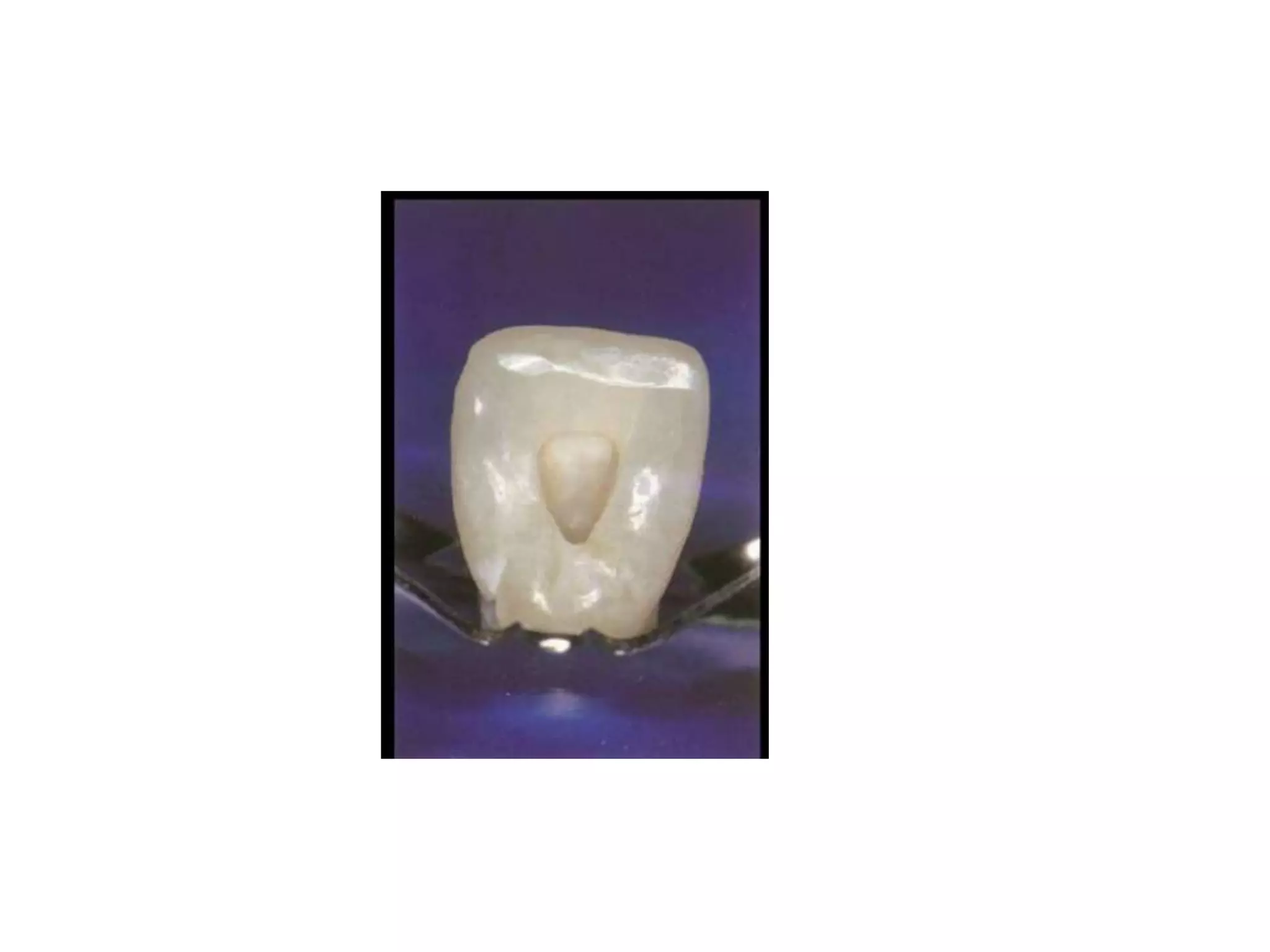
A round bur is used to deroof the pulp chamber.
4
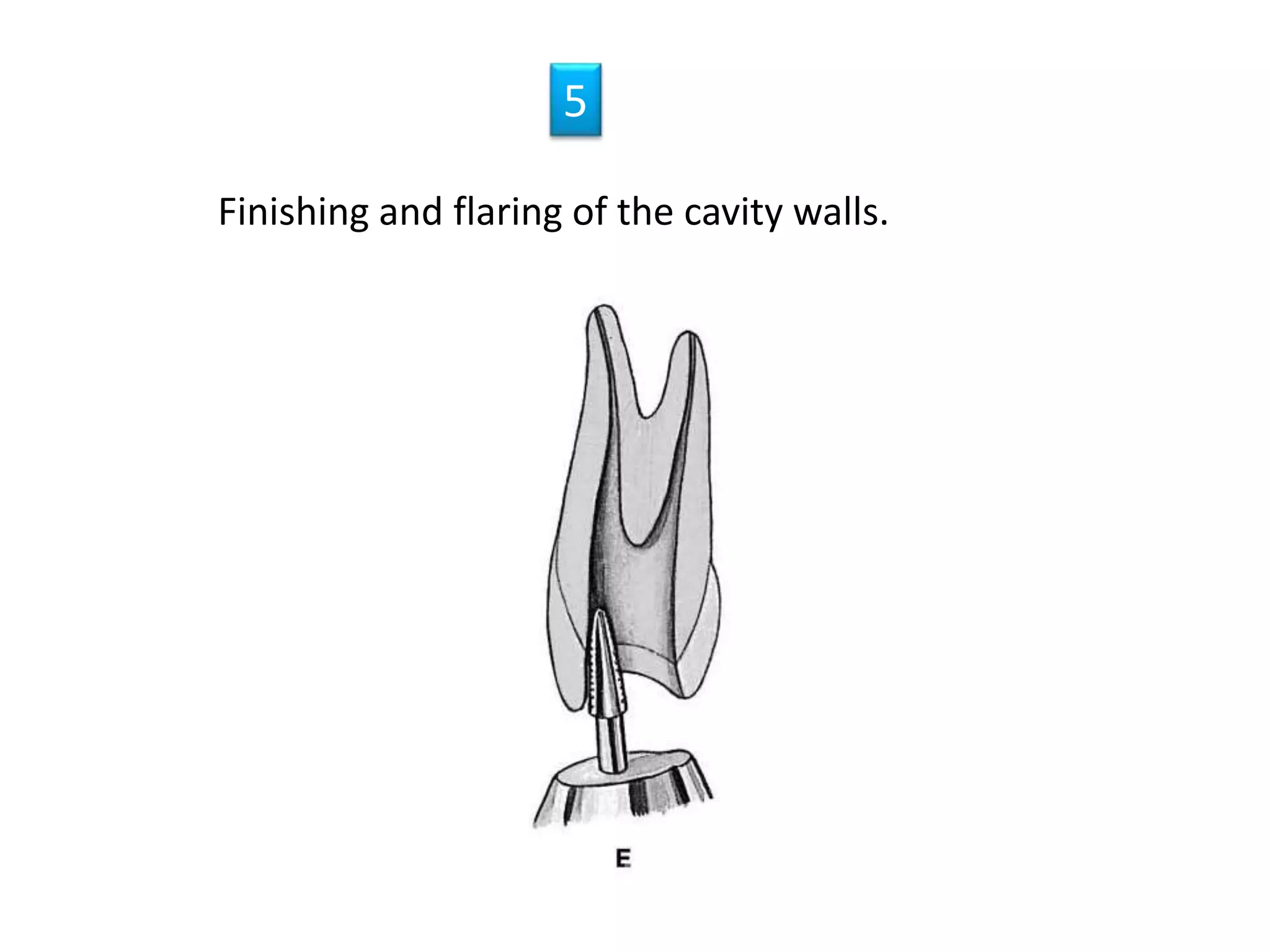
Finishing and flaring of the cavity walls.
5
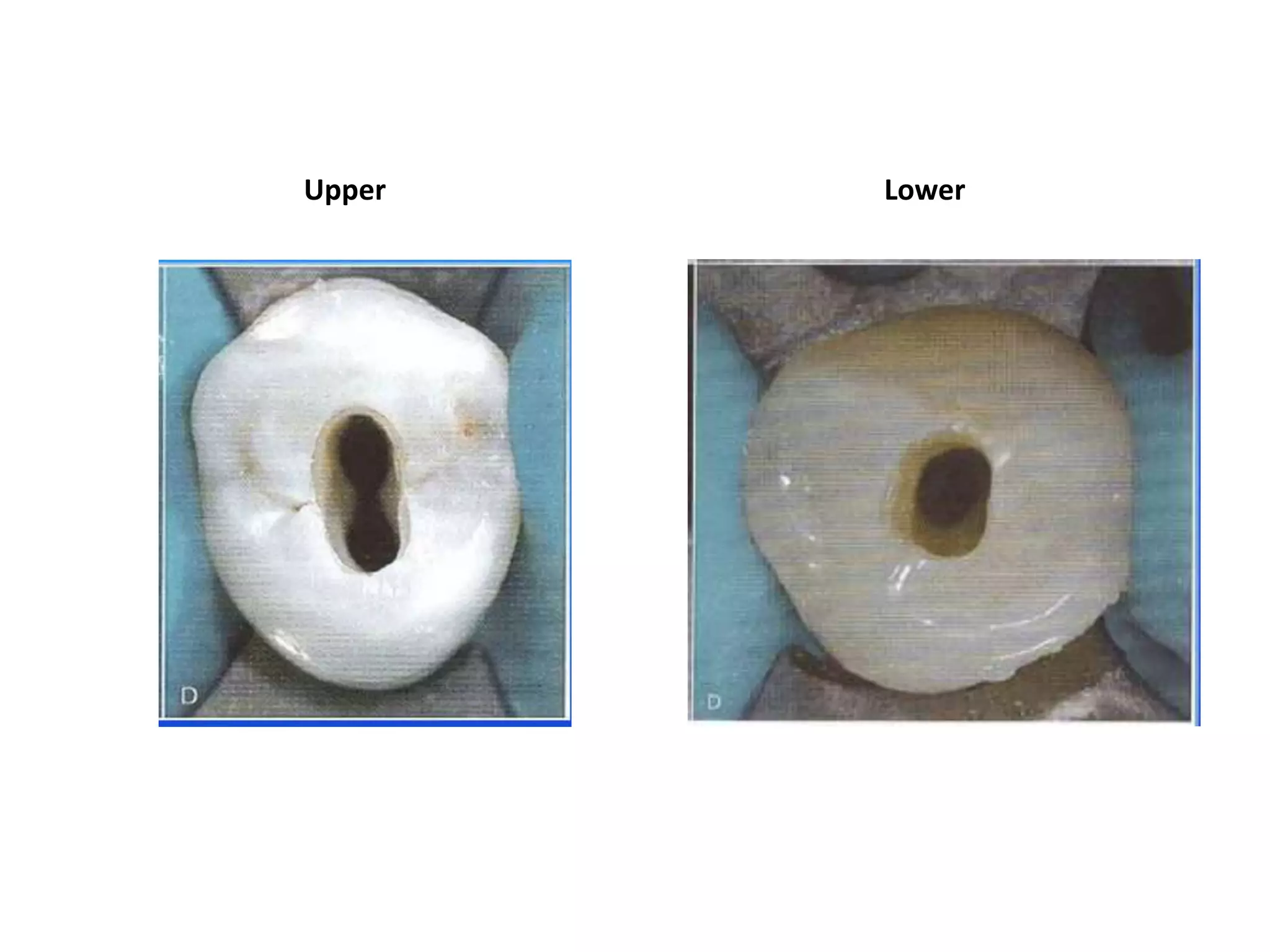
Upper Lower
Errors
Under extended
access cavity
Over extended
access cavity
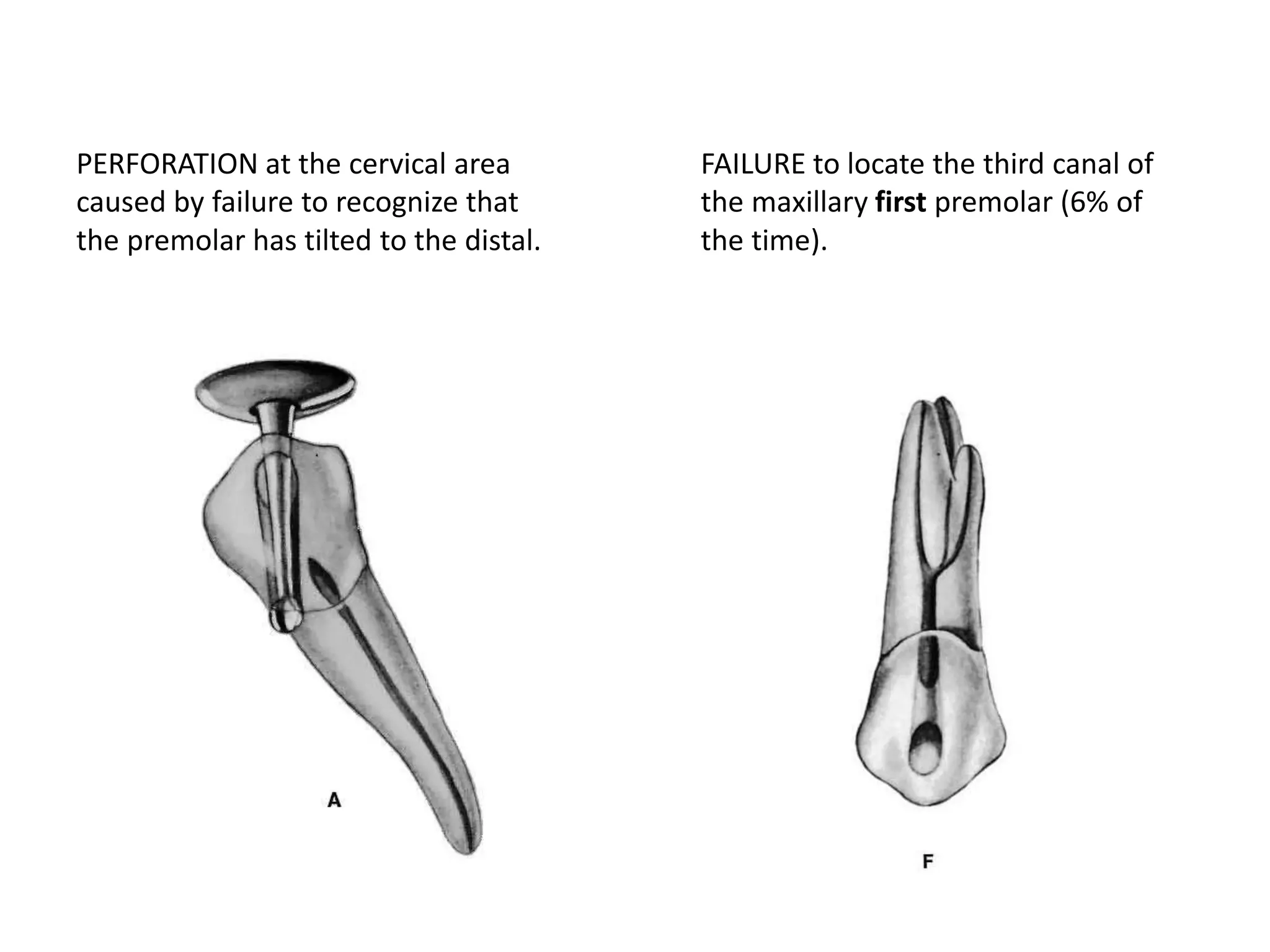
PERFORATION at the cervical area
caused by failure to recognize that
the premolar has tilted to the distal.
FAILURE to locate the third canal of
the maxillary first premolar (6% of
the time).
Molars
Upper Lower
Trapezoid
B
B
P
L
M MD D
MB1
MB2
Palatal
DB
Point of
entry
Upper
• MB1 is located under the buccal cusp tip.
• MB2 is located mesial and palatal to MB1 (at the end of a comma tail).
• DB is located under the central fossa.
• Palatal is located at the junction of mesiopalatal cusp and oblique ridge.
• Point of entry is the center of the occlusal table.
MB
ML
Distal
Point of entry
Lower
• MB is located under the mesiobuccal cusp tip.
• ML is located at the same line lingual to the central fissure.
• Distal is located distal to the central fossa.
• Point of entry is the central fossa.
Errors
Under extended
access cavity
Over extended
access cavity
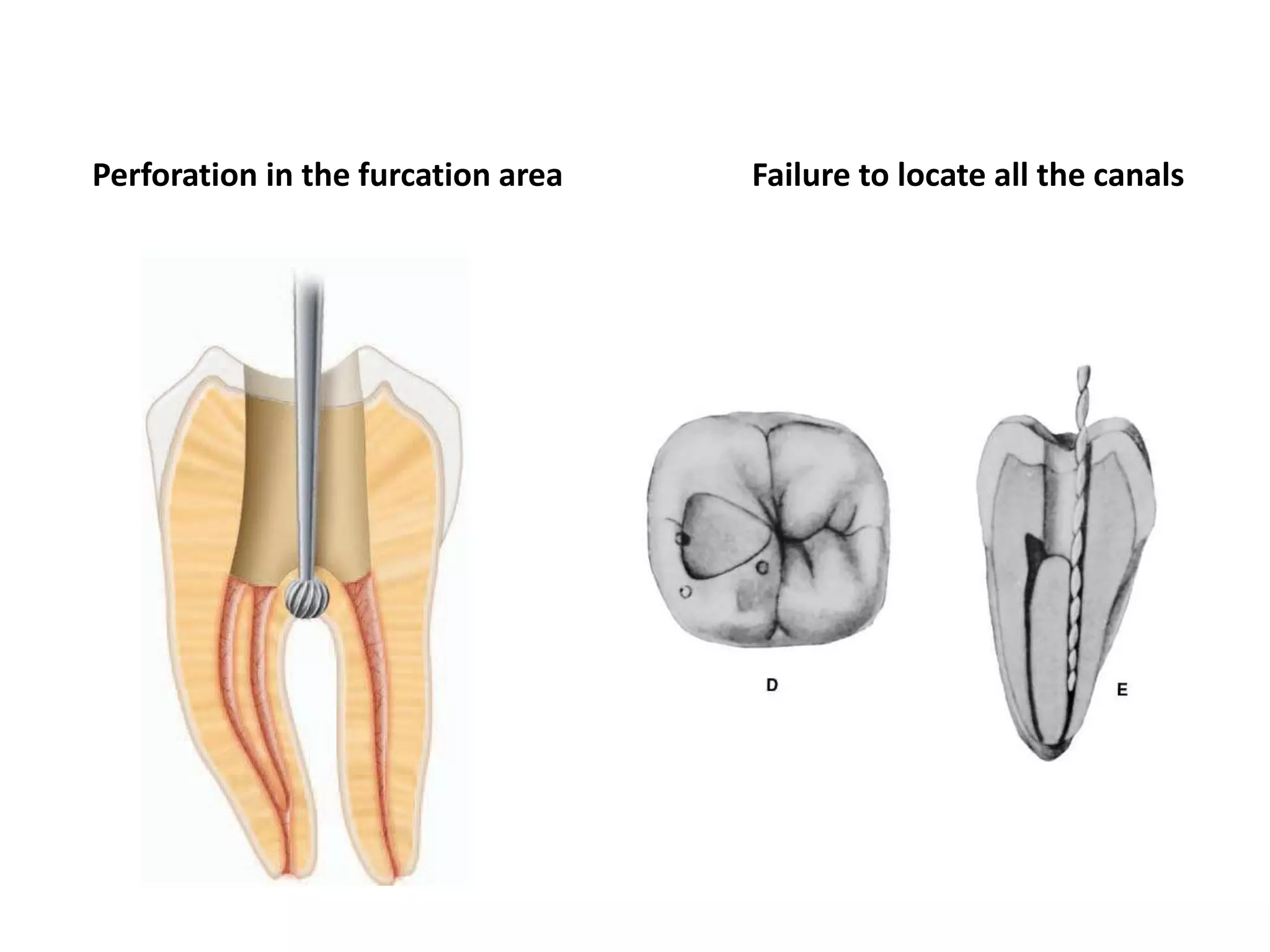
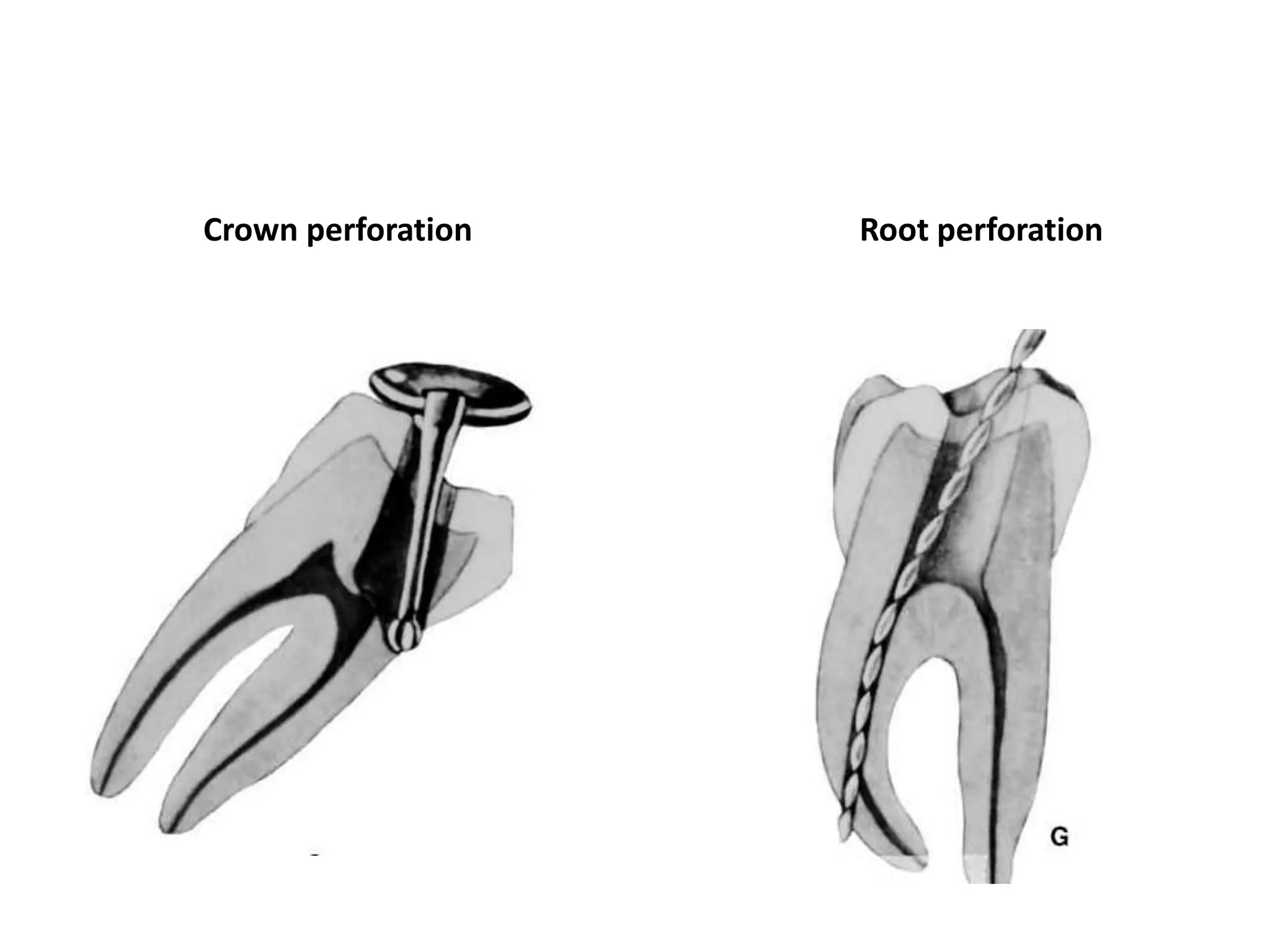
Perforation in the furcation area Failure to locate all the canals
Crown perforation Root perforation
Axioms of pulp anatomy
1- The two orifices of the maxillary first
premolars are further to the buccal.
2- The orifices of the mesio-buccal canals in
molars are well up under the mesio-buccal cusps
and the outline form should be widely extended
into the cusp.
3- The orifices of the palatal canal in maxillary
molars is not too far to the lingual, but is
actually in the center of the mesial half of the
tooth
4- The orifices of the disto-buccal canal in
maxillary molars is not too far to the disto
buccal, but it is almost buccal to the palatal
orifice.
5- The orifice of the distal canal in
mandibular molars is not too far to the
distal, but is actually in the exact center of
the tooth
6- The orifice of the mesio-lingual canal in
mandibular molars is not too far to the
mesio-lingual, but is almost mesial to the
distal orifice.
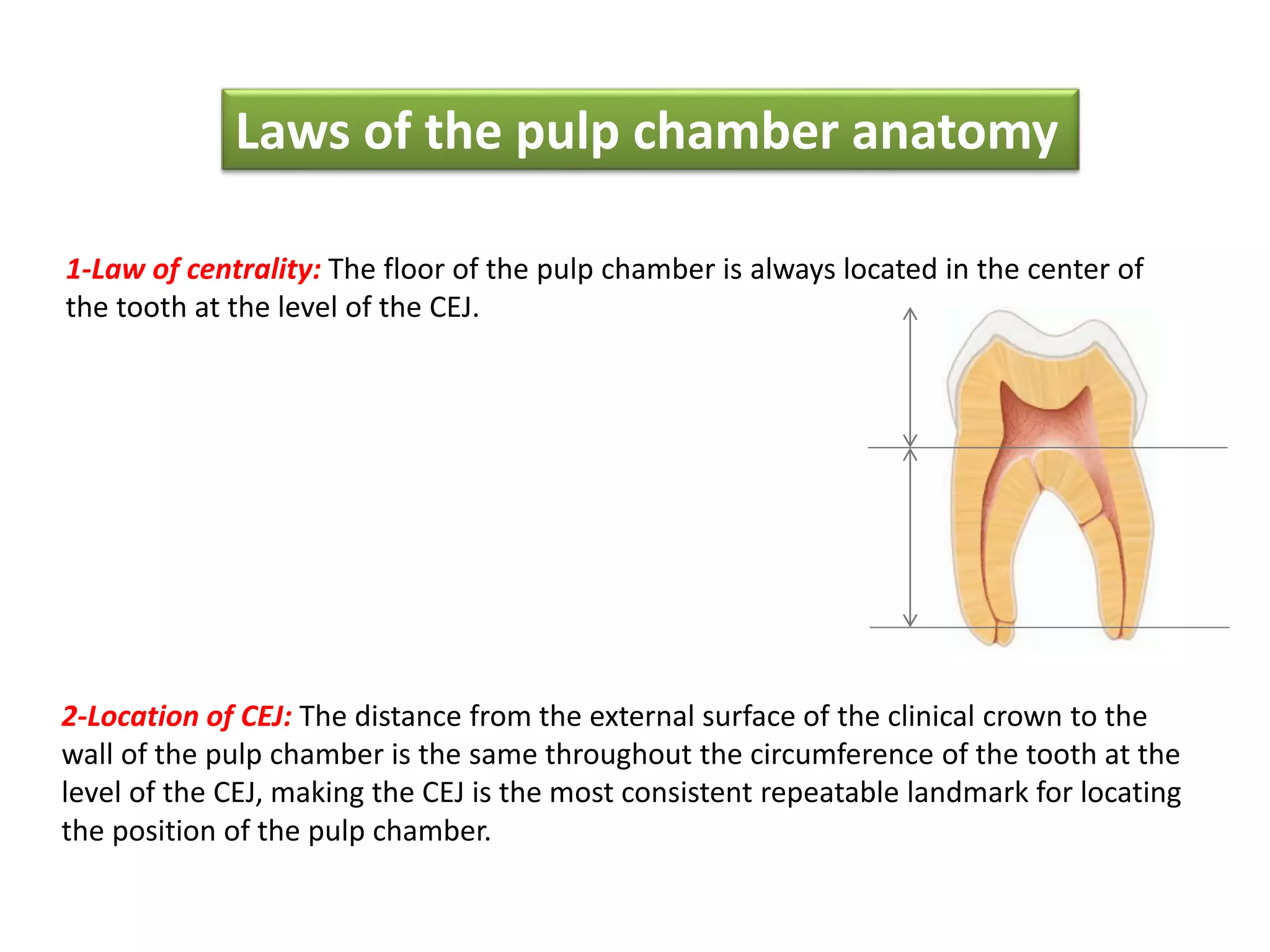
1-Law of centrality: The floor of the pulp chamber is always located in the center of
the tooth at the level of the CEJ.
2-Location of CEJ: The distance from the external surface of the clinical crown to the
wall of the pulp chamber is the same throughout the circumference of the tooth at the
level of the CEJ, making the CEJ is the most consistent repeatable landmark for locating
the position of the pulp chamber.
Laws of the pulp chamber anatomy
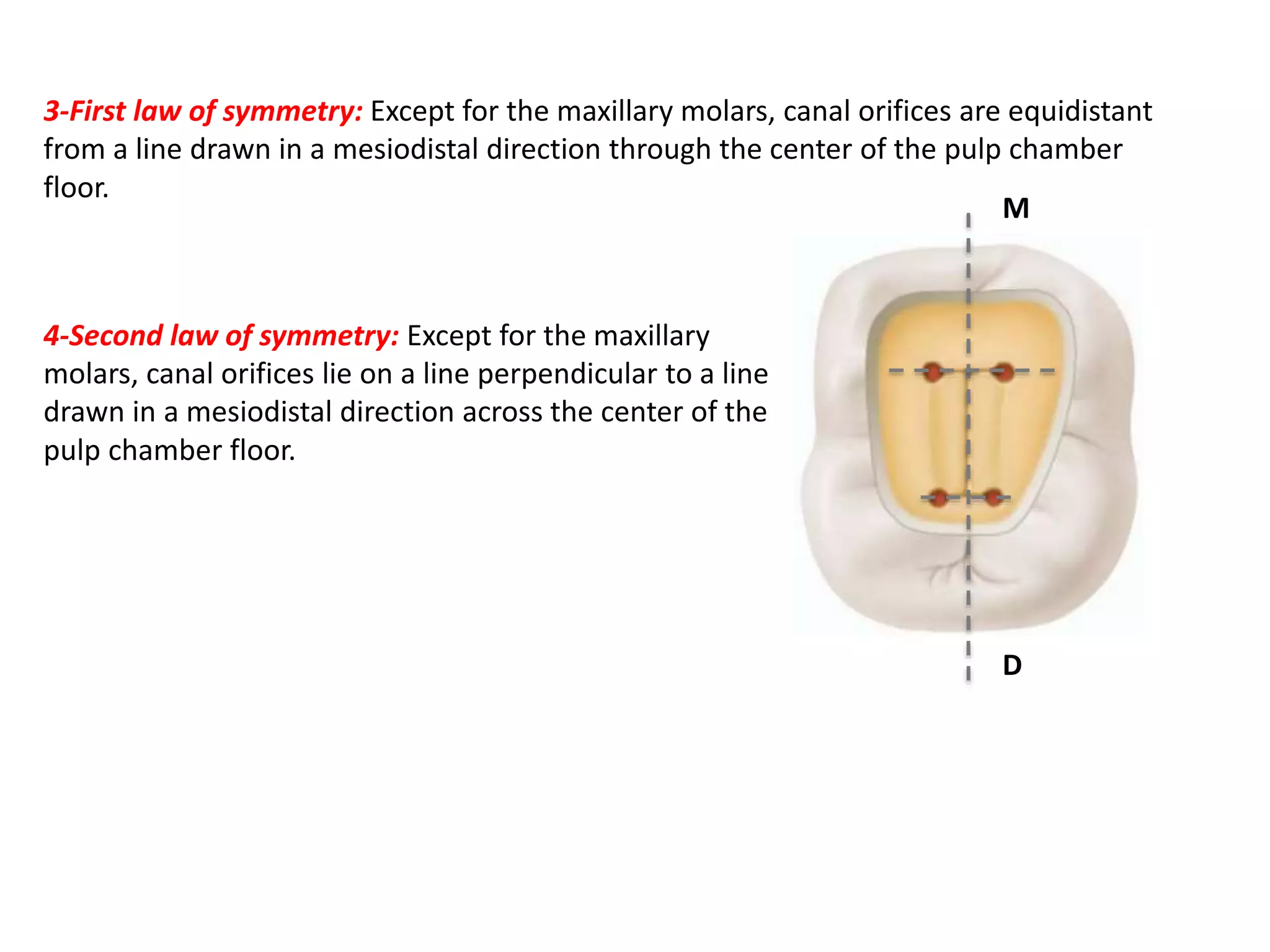
3-First law of symmetry: Except for the maxillary molars, canal orifices are equidistant
from a line drawn in a mesiodistal direction through the center of the pulp chamber
floor.
M
D
4-Second law of symmetry: Except for the maxillary
molars, canal orifices lie on a line perpendicular to a line
drawn in a mesiodistal direction across the center of the
pulp chamber floor.
5-Law of color change: The pulp chamber floor is always darker in color than the walls.
6-First law of orifice location: The orifices of the root canals are always located at the
junction of the walls and the floor.
7-Second law of orifice location: The orifices of the root canals are always located at
the angles in the floor–wall junction.
8-Third law of orifice location: The orifices of the root canals are always located at
the terminus of the roots’ developmental fusion lines.
Thank you

Access cavity preparation

  • 1.
  • 2.
    Access is thefirst and most important phase of root canal treatment. A well-designed access preparation is essential for a good endodontic result.
  • 4.
    Coronal pulp Radicular pulp Pulpchamber Pulp horn Orifice Root canal Lateral canal Apical foramen Pulp space morphology
  • 5.
    Objectives of accesscavity preparation: 1- Straight line access to apical foramen or to the initial curvature of the canal. 2- To locate all root canal orifices. 3- To conserve sound tooth structure.
  • 6.
    Principles of accesscavity preparation 1. Outline form. 2. Convenience form. 3. Removal of remaining carious dentin and defective restorations. 4. Toilet of the cavity.
  • 7.
    1.Outline form: Established bymechanically projecting the internal anatomy to the external surface. Three factors regulating the outline form: a. Size of pulp chamber: Young patients extensive. Old patient limited.
  • 8.
    b. Shape ofpulp chamber: Anteriors Triangular. Premolars Oval or ovoid. Molars Triangular. c. Number and direction of root canals.
  • 9.
    2. Convenience form: Itis the form given to the access cavity to improve visibility, instrumentation and obturation of the root canal by providing a straight line access from occlusal surface to the apical foramen. Benefits: 1. Unobstructed access to the orifices. 2. Direct access to the apical foramina. 3. Complete authority over the instrument. 4. Expansion to accommodate filling techniques.
  • 10.
    3- Removal ofremaining carious dentin and defective restorations: Reasons of removing caries and defective restorations: 1. Elimination of bacteria. 2. Elimination of discolored tooth structure. 3. Elimination of the possibility of coronal leakage.
  • 11.
    4- Toilet ofthe cavity: All caries, calcified debris and necrotic material should be removed by irrigation from the pulp chamber before radicular preparation is begun to avoid obstruction of the root canals.
  • 12.
  • 13.
    Round bur size 2,3,4 Safe-endtapered stone DG 16 endodontic explorer Tapered stone with round end Endo Z burTransmetal bur
  • 14.
    Endo access bur Pulpoutbur Ultrasonics
  • 15.
  • 16.
    Access cavity preparationin anterior teeth Outline form of central and lateral incisors are triangular with the base of the triangle towards the incisal edge and the apex towards the cingulum. Incisal edge Cervical line
  • 17.
  • 18.
    Entrance is gainedthrough the middle of the middle third of the palatal surface. 1
  • 19.
    Initial entrance Isprepared with a round bur at a high speed operated at a right angle to the long axis of the tooth. Only enamel is penetrated. 2
  • 20.
    The bur ispositioned in a 45 degree to the long axis of the tooth then advanced to penetrate the pulp chamber. 3
  • 21.
    Removal of thepulp chamber (deroofing) 4
  • 22.
    Removal of lingualshoulder. 5
  • 24.
    In canine theoutline is oval
  • 25.
    Errors 1- GOUGING ofthe labial wall caused by failure to recognize the 29-degree lingual-axial angulation of the tooth. 2- GOUGING of the distal wall caused by failure to recognize the 16-degree mesial-axial inclination of the tooth.
  • 26.
    4- Missed canaldue to insufficient convenience extension. 3- PERFORATION at the labiocervical caused by failure to complete convenience extension toward the incisal, prior to the entrance of the shaft of the bur.
  • 27.
    5- DISCOLORATION ofthe crown caused by failure to remove pulp debris. The access cavity is too far to the gingival with no incisal extension. 6- LEDGE formation at the apical-distal curve caused by using an uncurved instrument too large for the canal. The cavity is adequate.
  • 28.
  • 29.
    Maxillary premolars Buccal canalis located under the buccal cusp tip. Palatal canal is located at the base of the palatal cusp.
  • 30.
    Initial penetration ismade parallel to the long axis of the tooth in the exact center of the central groove 11
  • 31.
    A round buris used to open into the pulp chamber. The bur will be felt to “drop” when the pulp chamber is reached. 2
  • 32.
    An endodontic exploreris used to locate orifices. 3
  • 33.
    A round buris used to deroof the pulp chamber. 4
  • 34.
    Finishing and flaringof the cavity walls. 5
  • 35.
  • 36.
  • 37.
    PERFORATION at thecervical area caused by failure to recognize that the premolar has tilted to the distal. FAILURE to locate the third canal of the maxillary first premolar (6% of the time).
  • 40.
  • 41.
    MB1 MB2 Palatal DB Point of entry Upper • MB1is located under the buccal cusp tip. • MB2 is located mesial and palatal to MB1 (at the end of a comma tail). • DB is located under the central fossa. • Palatal is located at the junction of mesiopalatal cusp and oblique ridge. • Point of entry is the center of the occlusal table.
  • 42.
    MB ML Distal Point of entry Lower •MB is located under the mesiobuccal cusp tip. • ML is located at the same line lingual to the central fissure. • Distal is located distal to the central fossa. • Point of entry is the central fossa.
  • 44.
  • 45.
    Perforation in thefurcation area Failure to locate all the canals
  • 46.
  • 47.
    Axioms of pulpanatomy 1- The two orifices of the maxillary first premolars are further to the buccal. 2- The orifices of the mesio-buccal canals in molars are well up under the mesio-buccal cusps and the outline form should be widely extended into the cusp.
  • 48.
    3- The orificesof the palatal canal in maxillary molars is not too far to the lingual, but is actually in the center of the mesial half of the tooth 4- The orifices of the disto-buccal canal in maxillary molars is not too far to the disto buccal, but it is almost buccal to the palatal orifice.
  • 49.
    5- The orificeof the distal canal in mandibular molars is not too far to the distal, but is actually in the exact center of the tooth 6- The orifice of the mesio-lingual canal in mandibular molars is not too far to the mesio-lingual, but is almost mesial to the distal orifice.
  • 50.
    1-Law of centrality:The floor of the pulp chamber is always located in the center of the tooth at the level of the CEJ. 2-Location of CEJ: The distance from the external surface of the clinical crown to the wall of the pulp chamber is the same throughout the circumference of the tooth at the level of the CEJ, making the CEJ is the most consistent repeatable landmark for locating the position of the pulp chamber. Laws of the pulp chamber anatomy
  • 51.
    3-First law ofsymmetry: Except for the maxillary molars, canal orifices are equidistant from a line drawn in a mesiodistal direction through the center of the pulp chamber floor. M D 4-Second law of symmetry: Except for the maxillary molars, canal orifices lie on a line perpendicular to a line drawn in a mesiodistal direction across the center of the pulp chamber floor.
  • 52.
    5-Law of colorchange: The pulp chamber floor is always darker in color than the walls.
  • 53.
    6-First law oforifice location: The orifices of the root canals are always located at the junction of the walls and the floor. 7-Second law of orifice location: The orifices of the root canals are always located at the angles in the floor–wall junction.
  • 54.
    8-Third law oforifice location: The orifices of the root canals are always located at the terminus of the roots’ developmental fusion lines.
  • 55.

Editor's Notes