Incipient Carious Lesion
Dr. Akash Ardeshana
1st year MDS
1
Content
 Introduction
 Definition
 Clinical features
 Zone of incipient caries
 Diagnosis
 Management
2
Introduction
 The initial enamel lesion results from an
imbalance between the processes of
demineralisation and remineralisation.
 The first changes in enamel appear at those sites
where there is plaque biofilm retention and
stagnation.
 The demineralisation alters the enamel surface,
which becomes micro-porous, and with an
opaque and matt appearance, characteristic of a
white spot lesion.
Roberson T, Heymann H, Swift E.
Sturdevant’ Art and Science of
Operative dentistry fifth edition 2006. 3
Definition
 The earliest sign of a new carious lesion is the
appearance of a chalky white spot on the surface
of the tooth, indicating an area of
demineralization of enamel. This is referred to
as a white spot lesion, an incipient carious.
Roberson T, Heymann H, Swift E.
Sturdevant’ Art and Science of
Operative dentistry fifth edition 2006.
4
Clinical Features
 Care must be exercised to distinguish white
spots of incipient caries from developmental
white spot hypocalcifications of enamel.
 Incipient caries will partially or totally
disappear visually when the enamel is
hydrated (wet), while hypocalcified enamel
is relatively unaffected by drying and
wetting
Roberson T, Heymann H, Swift E.
Sturdevant’ Art and Science of
Operative dentistry fifth edition 2006.
5
 The surface texture of an incipient lesion is
unaltered and is undetectable by tactile
examination with an explorer.
 A more advanced lesion develops a rough
surface that is softer than the unaffected,
normal enamel.
 Softened chalky enamel that can be
chipped away with an explorer is a sign of
active caries.
Roberson T, Heymann H, Swift E.
Sturdevant’ Art and Science of
Operative dentistry fifth edition 2006.
6
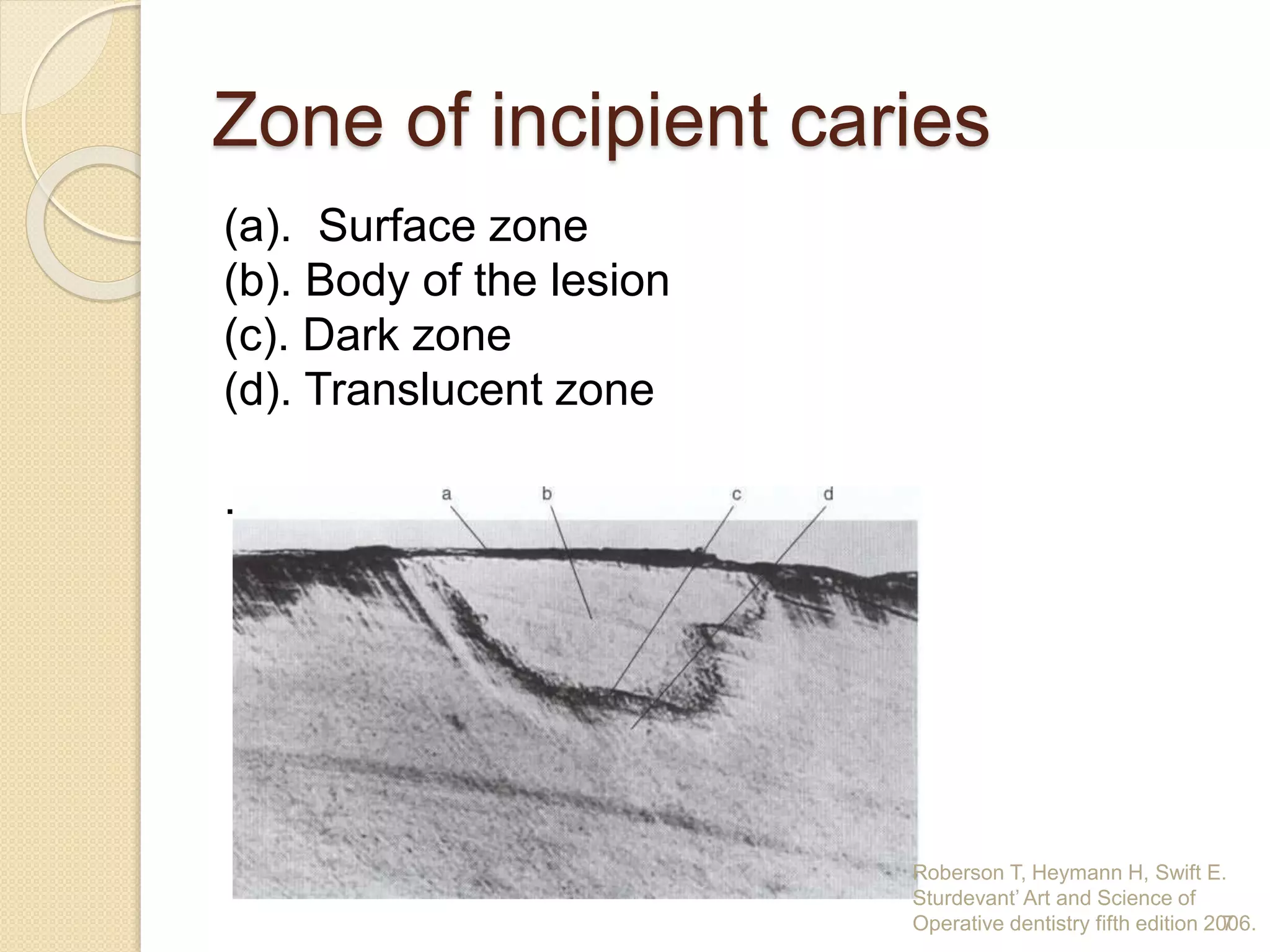
Zone of incipient caries
(a). Surface zone
(b). Body of the lesion
(c). Dark zone
(d). Translucent zone
.
7
Roberson T, Heymann H, Swift E.
Sturdevant’ Art and Science of
Operative dentistry fifth edition 2006.
8
from
Lasfargues and Colon, 2010
Lasfargues JJ, Kaleka R, Louis JJ (2000) Le concept SISTA. Un nouveau guide th_rapeutique en
cariologie. Real Clin 11:103–122 9
Diagnosis
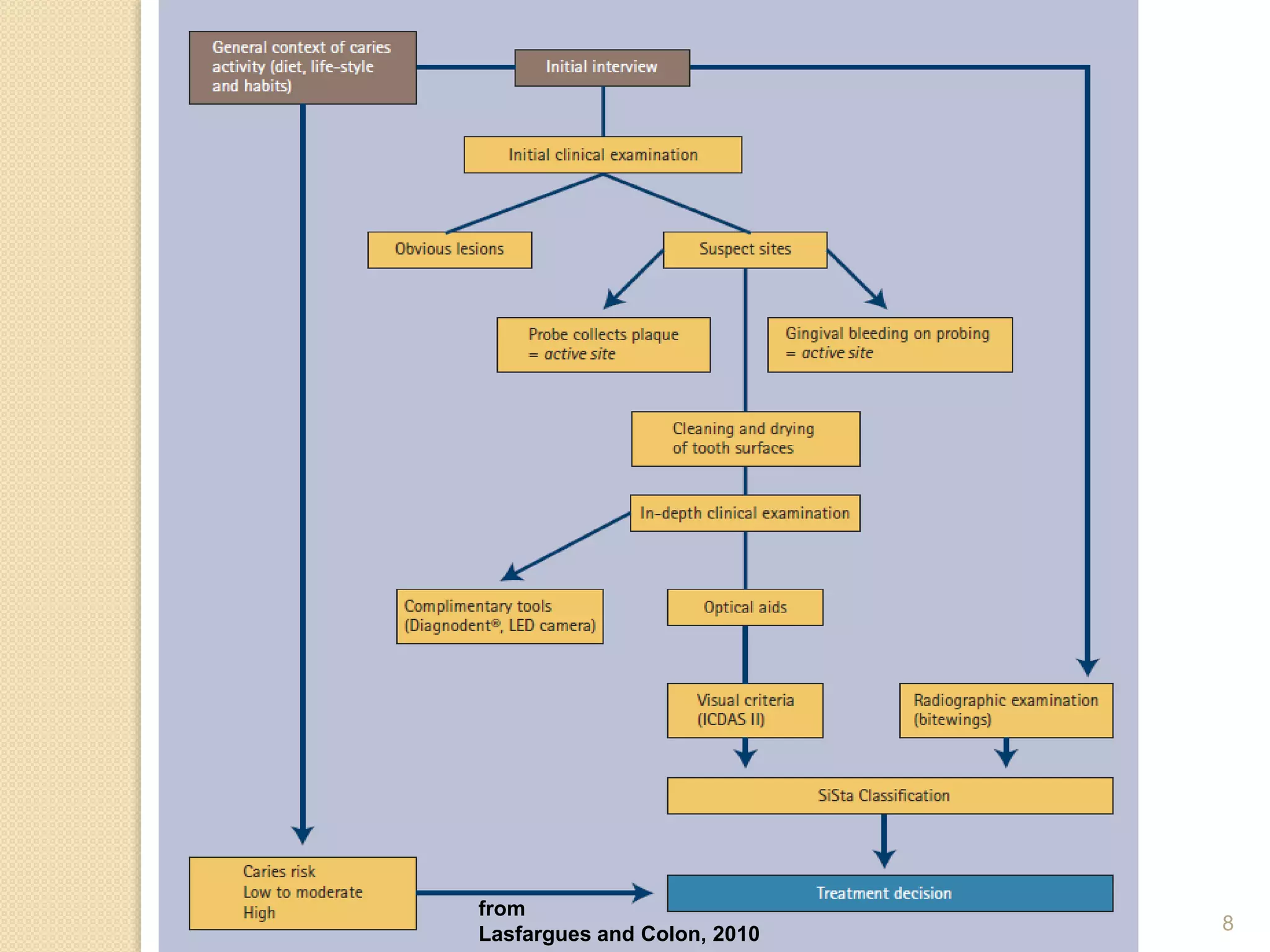
Initial clinical examination:
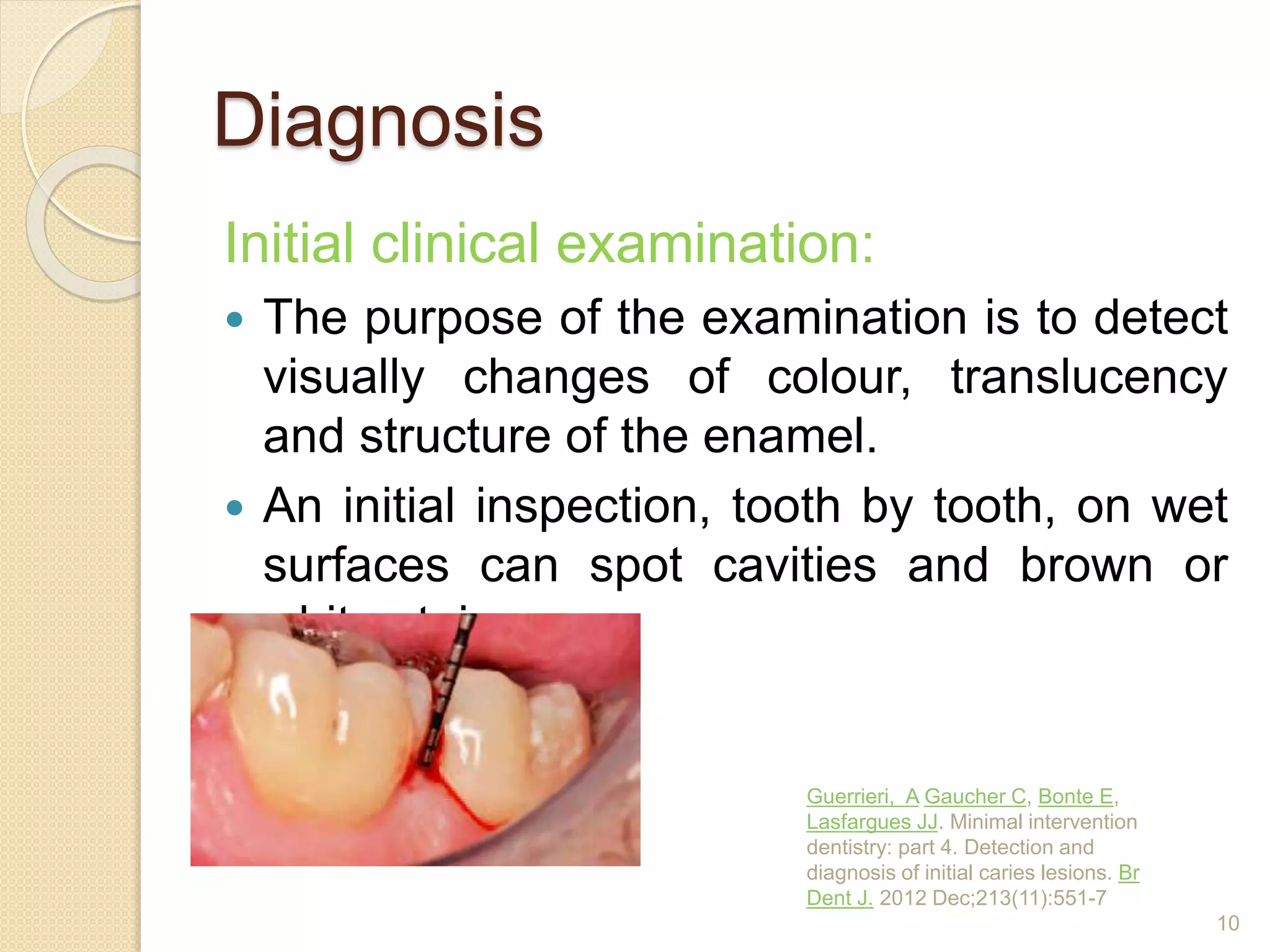
 The purpose of the examination is to detect
visually changes of colour, translucency
and structure of the enamel.
 An initial inspection, tooth by tooth, on wet
surfaces can spot cavities and brown or
white stains.
Guerrieri, A Gaucher C, Bonte E,
Lasfargues JJ. Minimal intervention
dentistry: part 4. Detection and
diagnosis of initial caries lesions. Br
Dent J. 2012 Dec;213(11):551-7
10
Radiographic Evaluation
 Bitewing radiographs are the method of
choice for early detection of carious lesions,
especially on proximal surfaces.
11
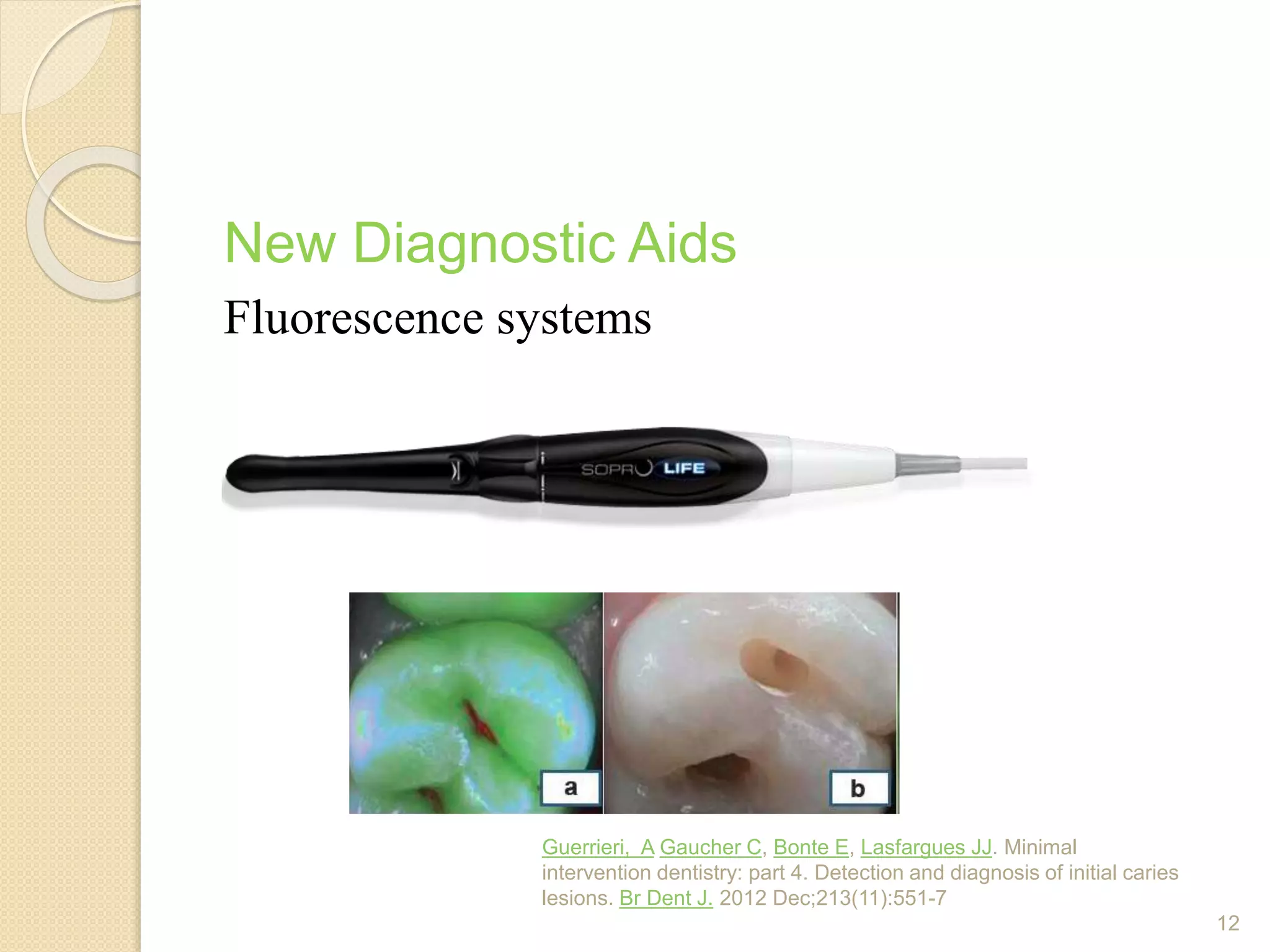
New Diagnostic Aids
Fluorescence systems
Guerrieri, A Gaucher C, Bonte E, Lasfargues JJ. Minimal
intervention dentistry: part 4. Detection and diagnosis of initial caries
lesions. Br Dent J. 2012 Dec;213(11):551-7
12
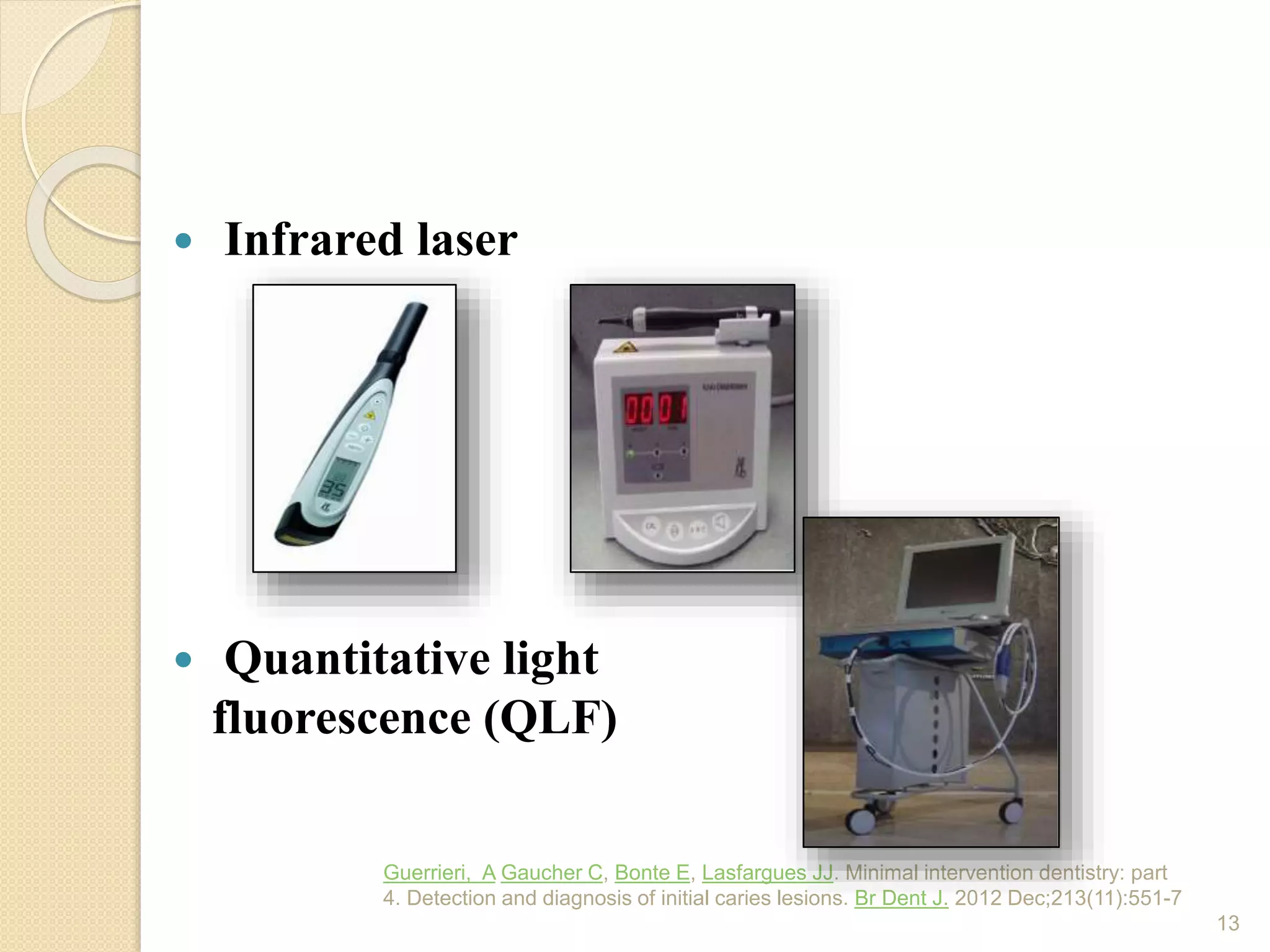
 Infrared laser
 Quantitative light
fluorescence (QLF)
Guerrieri, A Gaucher C, Bonte E, Lasfargues JJ. Minimal intervention dentistry: part
4. Detection and diagnosis of initial caries lesions. Br Dent J. 2012 Dec;213(11):551-7
13
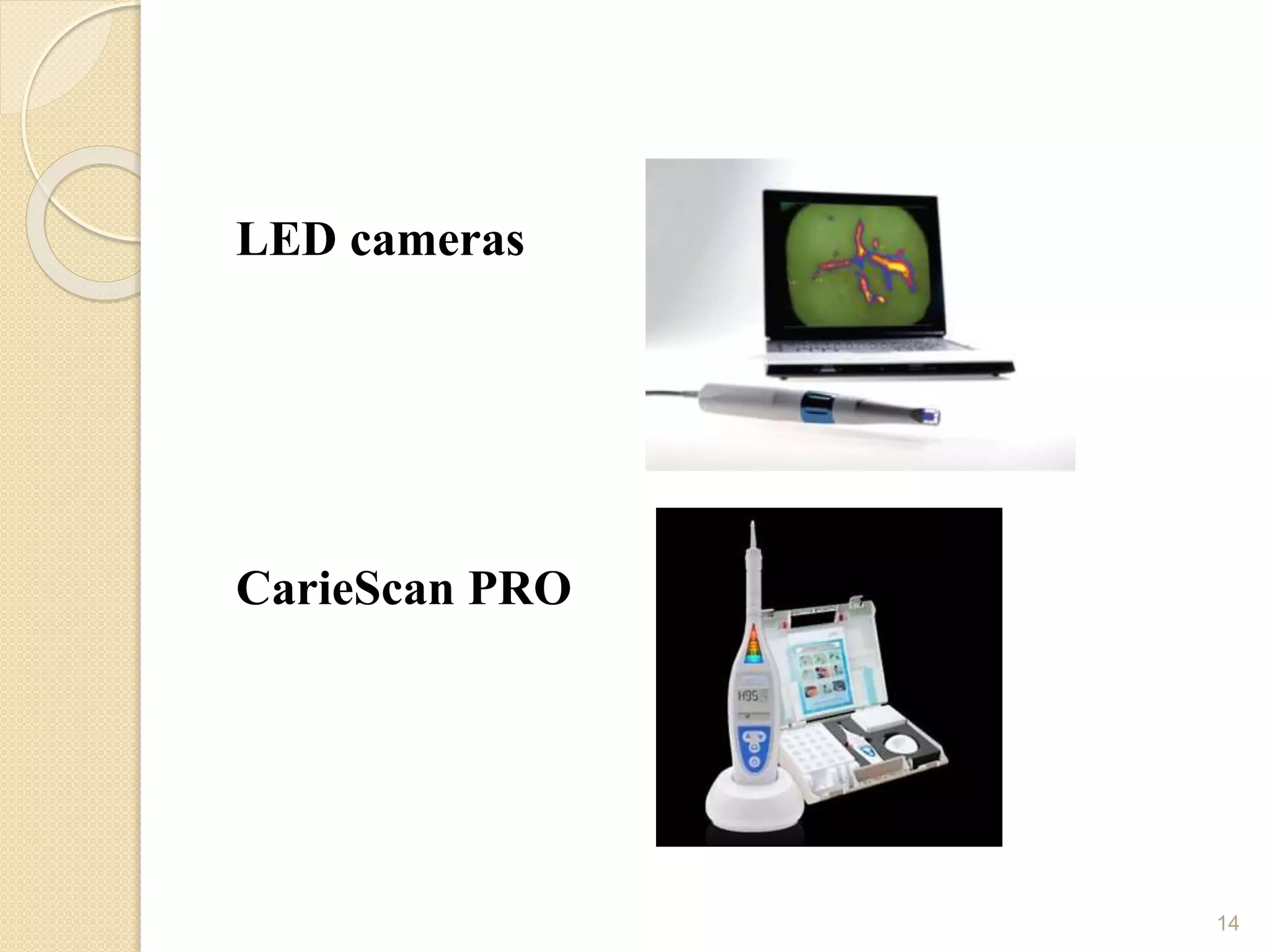
LED cameras
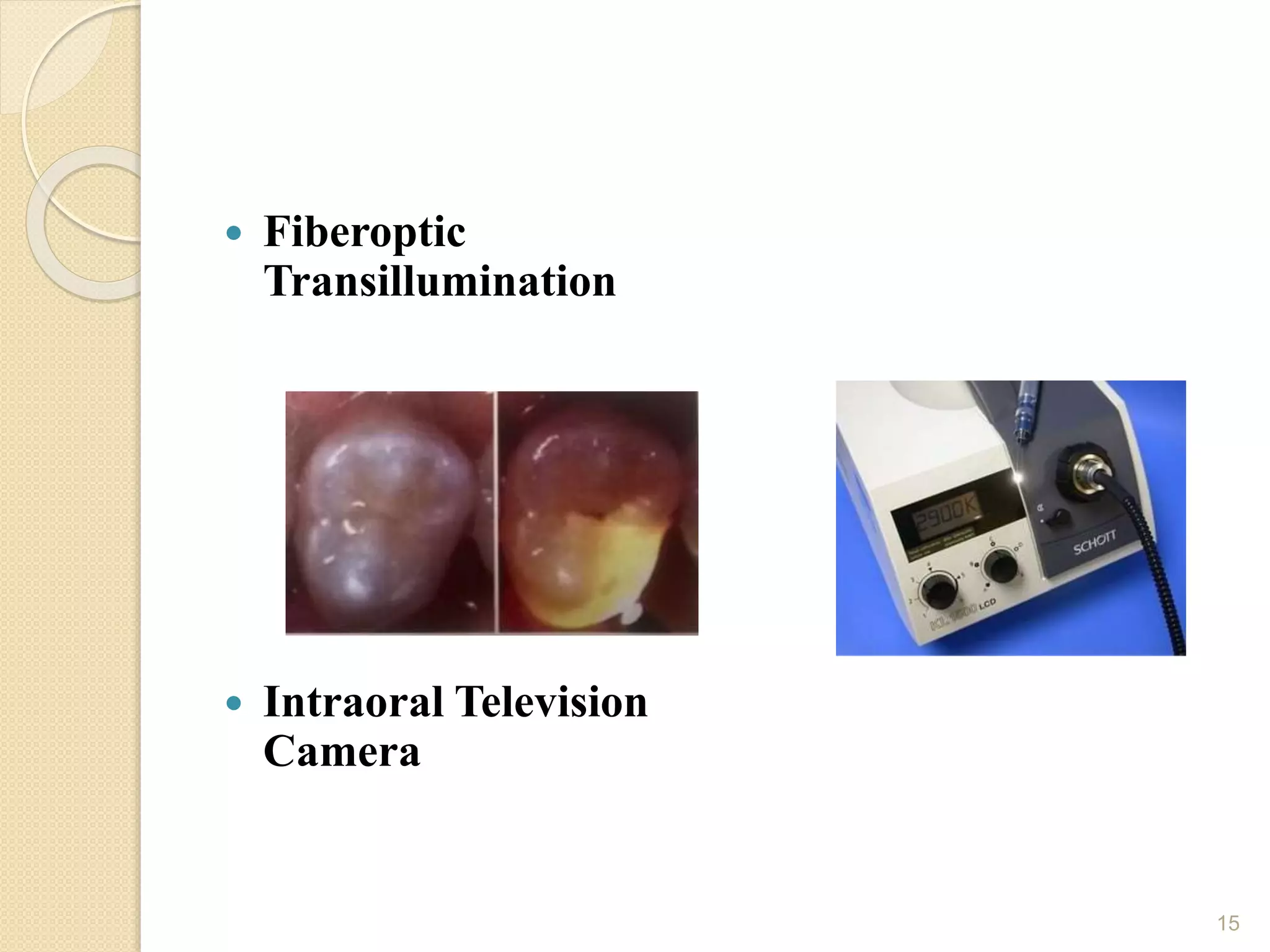
CarieScan PRO
14
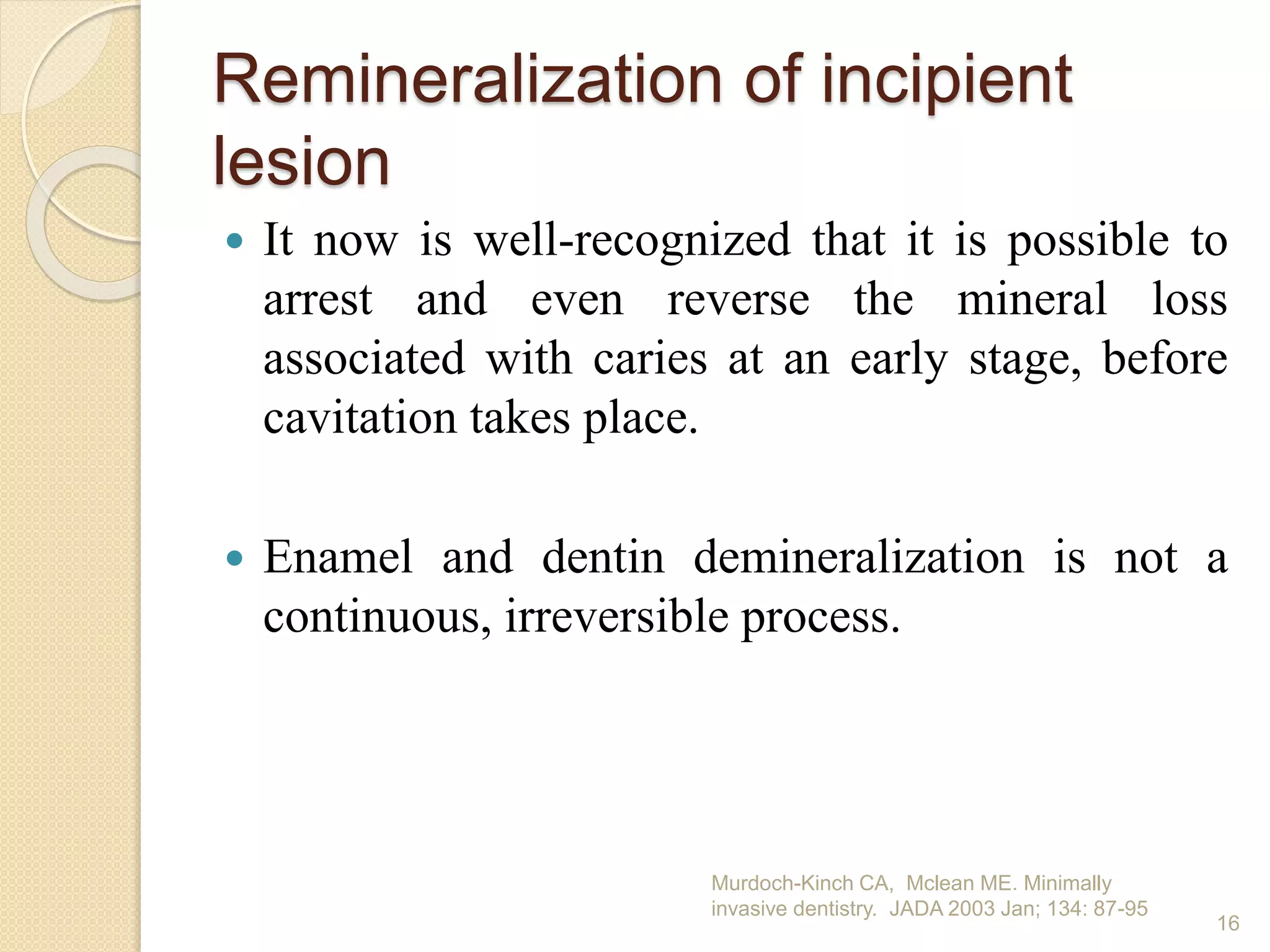
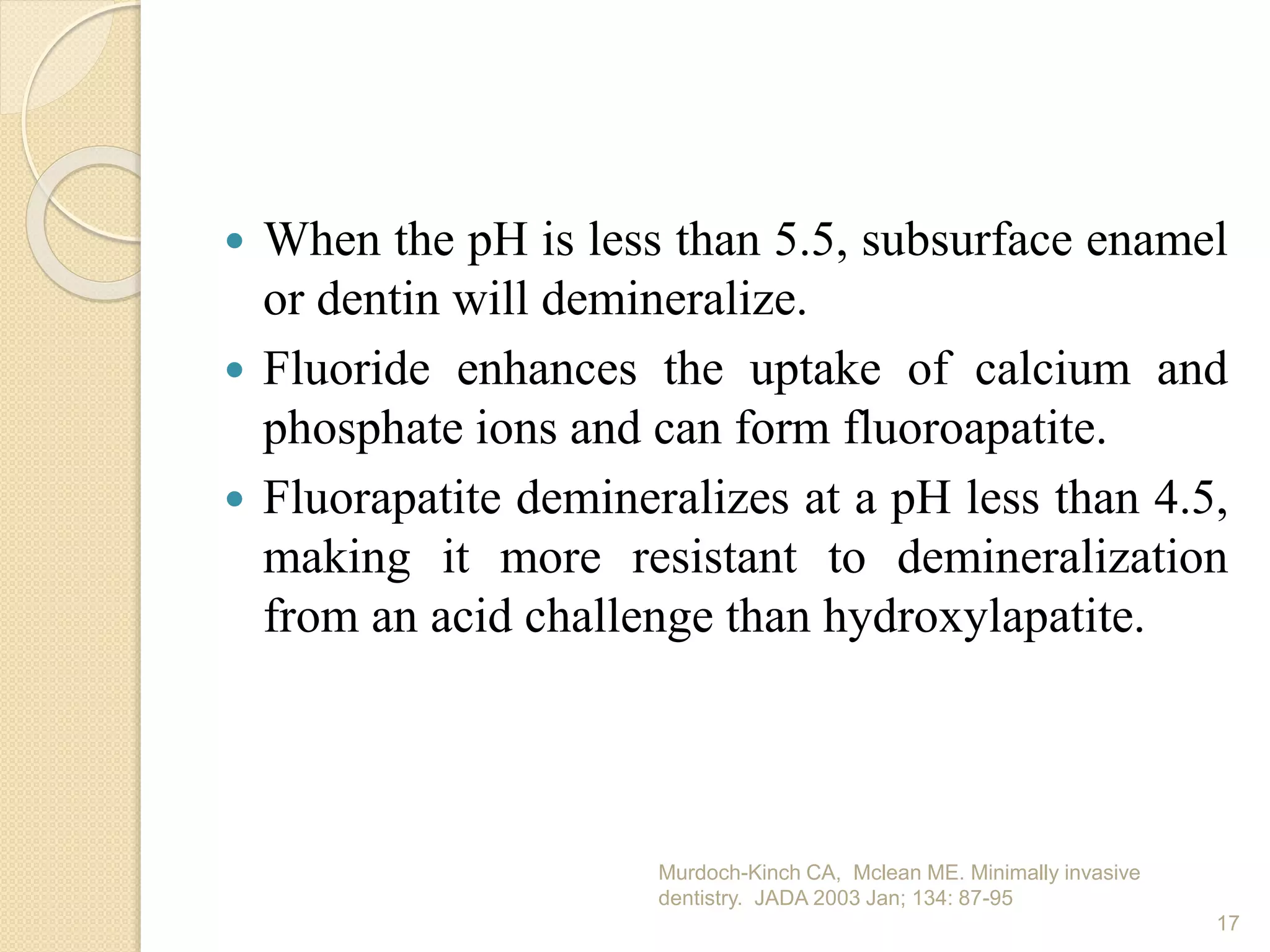
 Fiberoptic
Transillumination
 Intraoral Television
Camera
15
Remineralization of incipient
lesion
 It now is well-recognized that it is possible to
arrest and even reverse the mineral loss
associated with caries at an early stage, before
cavitation takes place.
 Enamel and dentin demineralization is not a
continuous, irreversible process.
Murdoch-Kinch CA, Mclean ME. Minimally
invasive dentistry. JADA 2003 Jan; 134: 87-95
16
 When the pH is less than 5.5, subsurface enamel
or dentin will demineralize.
 Fluoride enhances the uptake of calcium and
phosphate ions and can form fluoroapatite.
 Fluorapatite demineralizes at a pH less than 4.5,
making it more resistant to demineralization
from an acid challenge than hydroxylapatite.
Murdoch-Kinch CA, Mclean ME. Minimally invasive
dentistry. JADA 2003 Jan; 134: 87-95
17
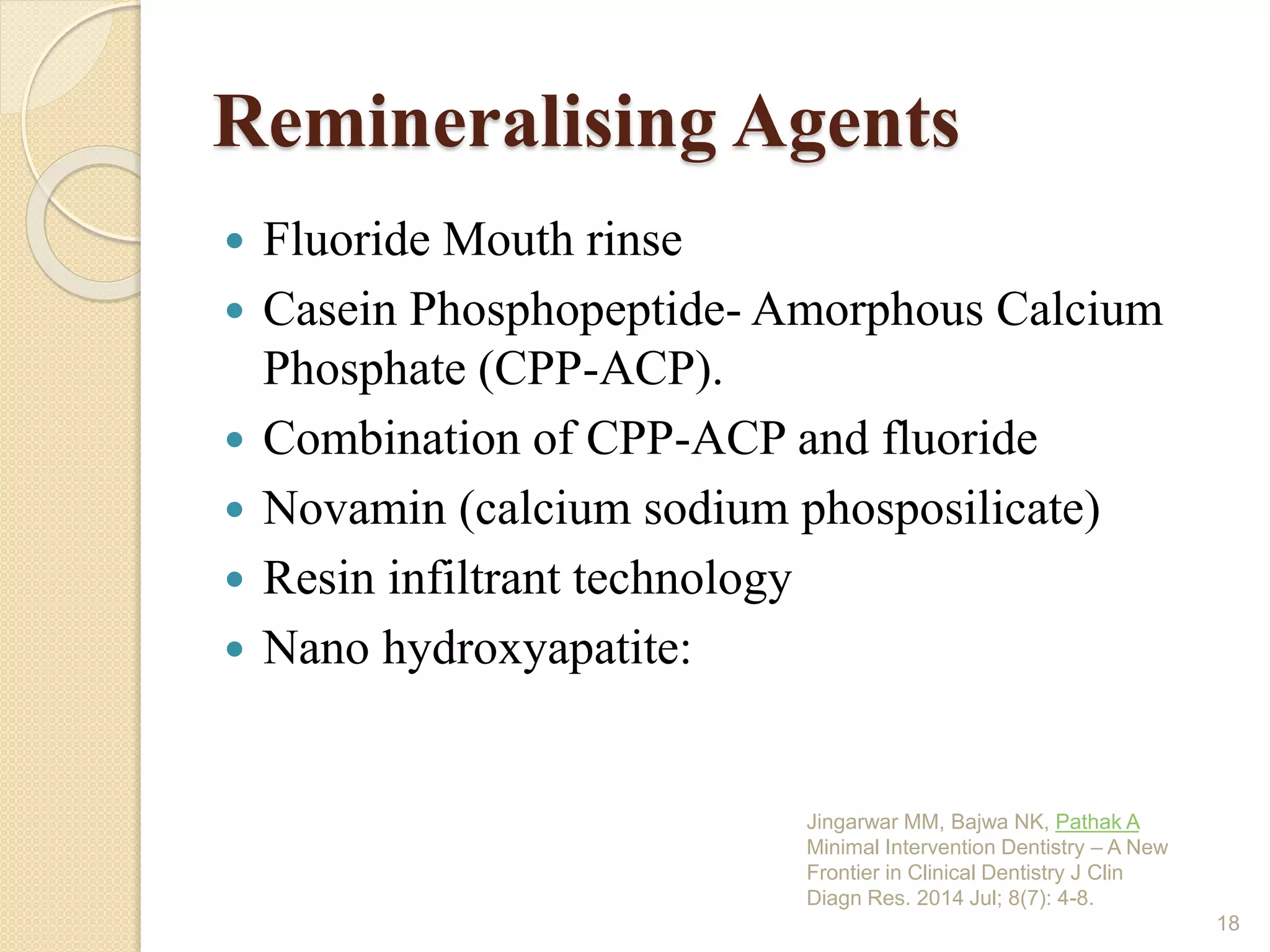
Remineralising Agents
 Fluoride Mouth rinse
 Casein Phosphopeptide- Amorphous Calcium
Phosphate (CPP-ACP).
 Combination of CPP-ACP and fluoride
 Novamin (calcium sodium phosposilicate)
 Resin infiltrant technology
 Nano hydroxyapatite:
Jingarwar MM, Bajwa NK, Pathak A
Minimal Intervention Dentistry – A New
Frontier in Clinical Dentistry J Clin
Diagn Res. 2014 Jul; 8(7): 4-8.
18
19
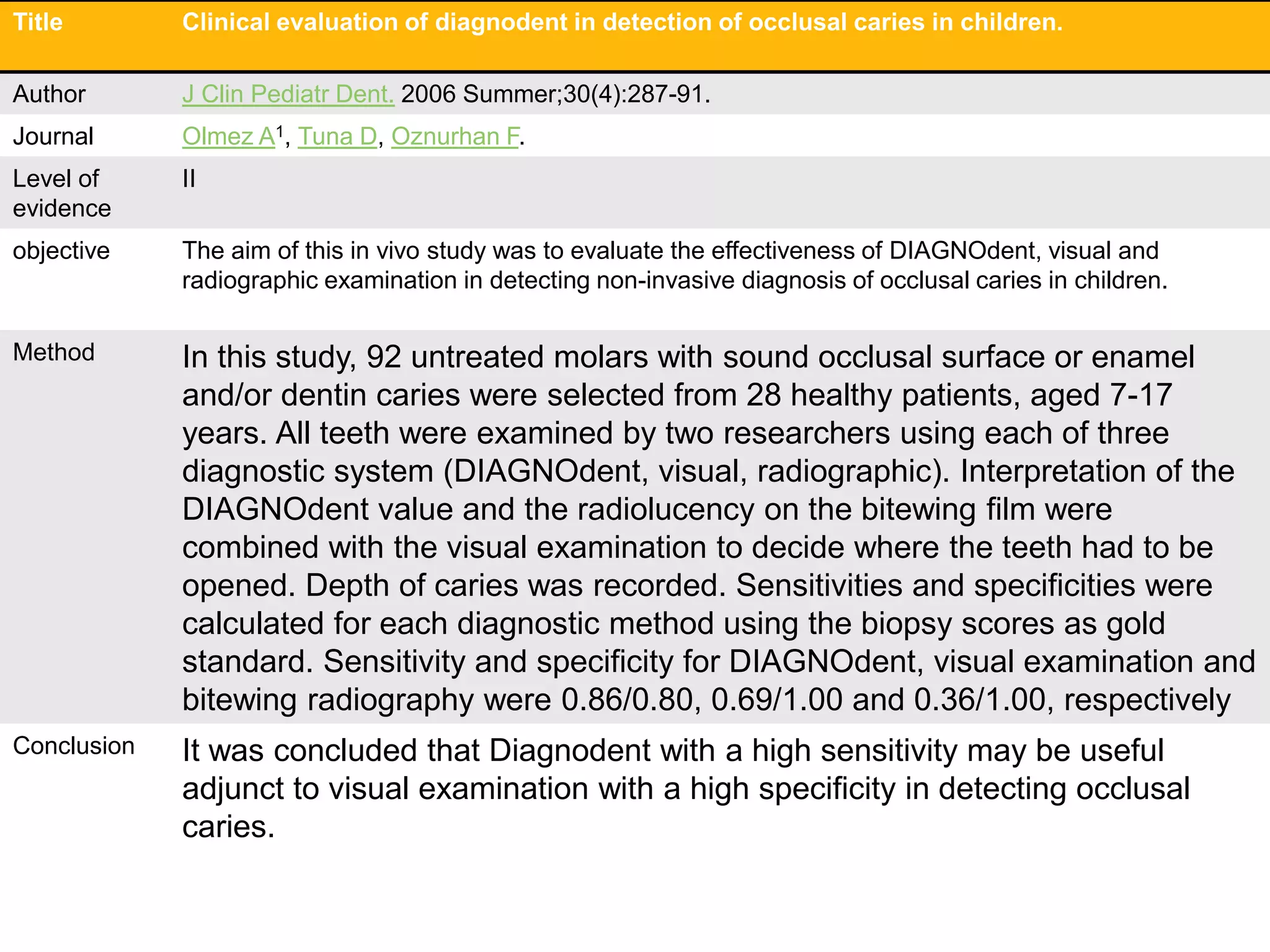
Title Clinical evaluation of diagnodent in detection of occlusal caries in children.
Author J Clin Pediatr Dent. 2006 Summer;30(4):287-91.
Journal Olmez A1, Tuna D, Oznurhan F.
Level of
evidence
II
objective The aim of this in vivo study was to evaluate the effectiveness of DIAGNOdent, visual and
radiographic examination in detecting non-invasive diagnosis of occlusal caries in children.
Method In this study, 92 untreated molars with sound occlusal surface or enamel
and/or dentin caries were selected from 28 healthy patients, aged 7-17
years. All teeth were examined by two researchers using each of three
diagnostic system (DIAGNOdent, visual, radiographic). Interpretation of the
DIAGNOdent value and the radiolucency on the bitewing film were
combined with the visual examination to decide where the teeth had to be
opened. Depth of caries was recorded. Sensitivities and specificities were
calculated for each diagnostic method using the biopsy scores as gold
standard. Sensitivity and specificity for DIAGNOdent, visual examination and
bitewing radiography were 0.86/0.80, 0.69/1.00 and 0.36/1.00, respectively
Conclusion It was concluded that Diagnodent with a high sensitivity may be useful
adjunct to visual examination with a high specificity in detecting occlusal
caries.
20
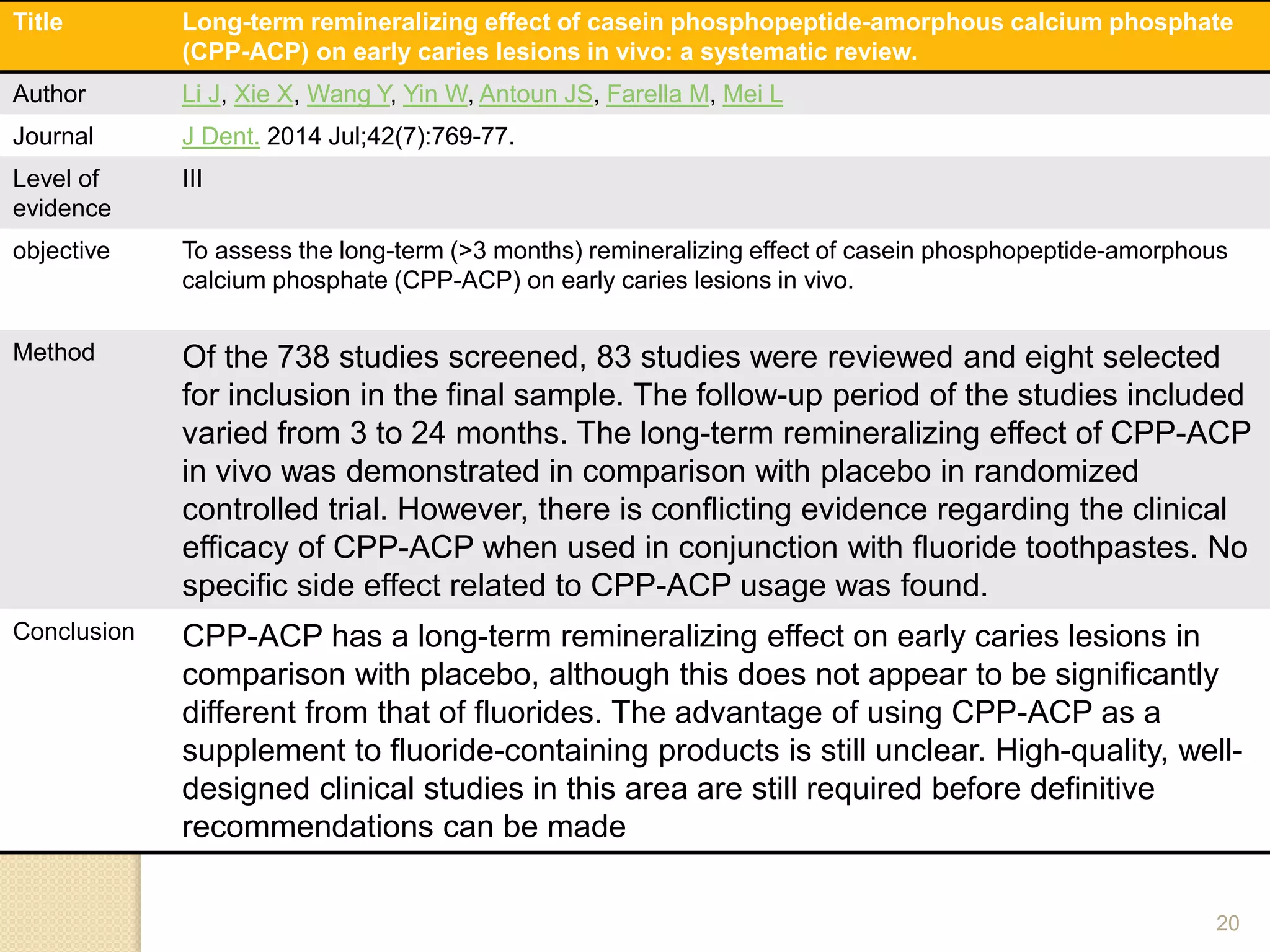
Title Long-term remineralizing effect of casein phosphopeptide-amorphous calcium phosphate
(CPP-ACP) on early caries lesions in vivo: a systematic review.
Author Li J, Xie X, Wang Y, Yin W, Antoun JS, Farella M, Mei L
Journal J Dent. 2014 Jul;42(7):769-77.
Level of
evidence
III
objective To assess the long-term (>3 months) remineralizing effect of casein phosphopeptide-amorphous
calcium phosphate (CPP-ACP) on early caries lesions in vivo.
Method Of the 738 studies screened, 83 studies were reviewed and eight selected
for inclusion in the final sample. The follow-up period of the studies included
varied from 3 to 24 months. The long-term remineralizing effect of CPP-ACP
in vivo was demonstrated in comparison with placebo in randomized
controlled trial. However, there is conflicting evidence regarding the clinical
efficacy of CPP-ACP when used in conjunction with fluoride toothpastes. No
specific side effect related to CPP-ACP usage was found.
Conclusion CPP-ACP has a long-term remineralizing effect on early caries lesions in
comparison with placebo, although this does not appear to be significantly
different from that of fluorides. The advantage of using CPP-ACP as a
supplement to fluoride-containing products is still unclear. High-quality, well-
designed clinical studies in this area are still required before definitive
recommendations can be made
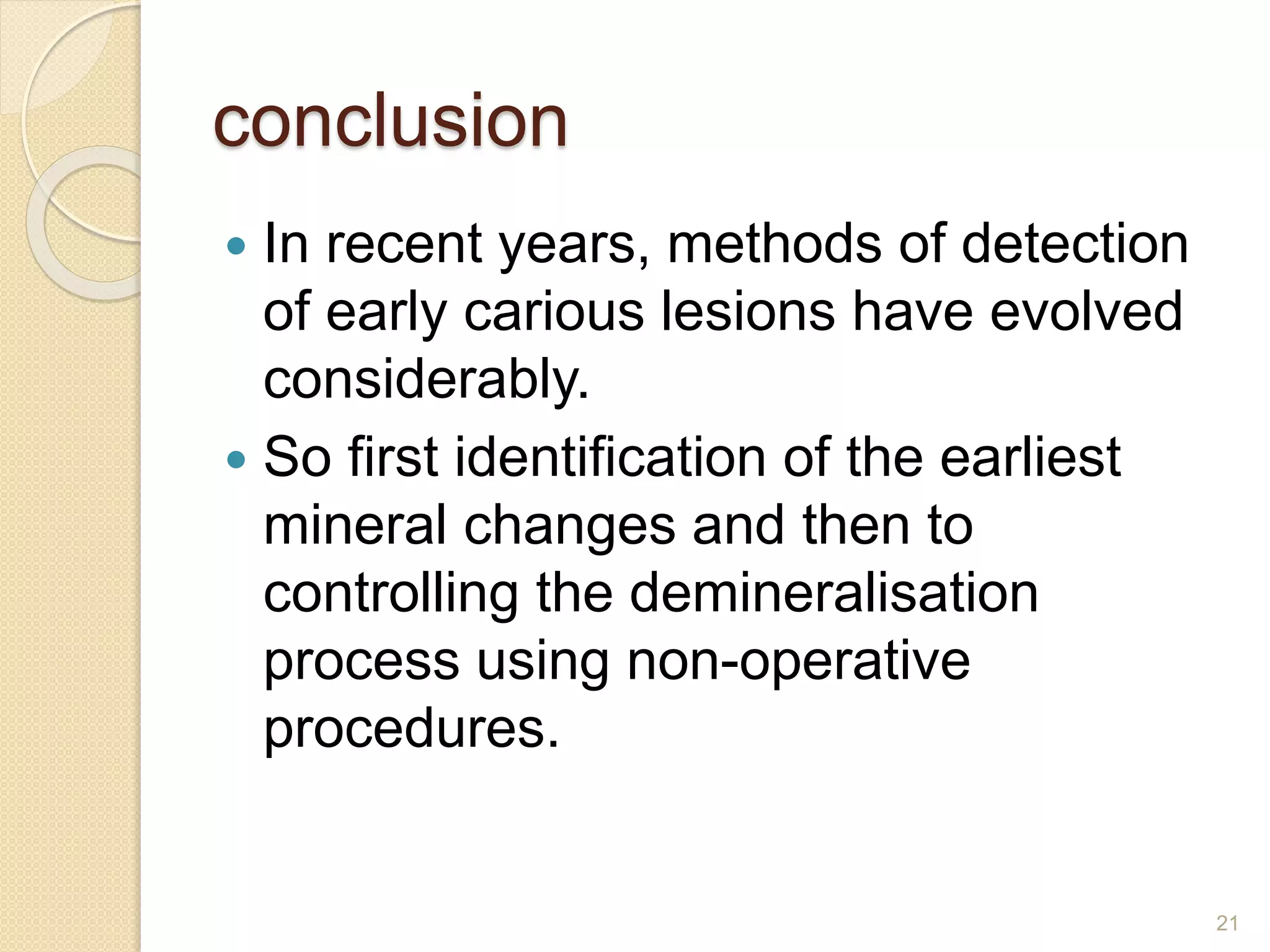
conclusion
 In recent years, methods of detection
of early carious lesions have evolved
considerably.
 So first identification of the earliest
mineral changes and then to
controlling the demineralisation
process using non-operative
procedures.
21
References
 Roberson T, Heymann H, Swift E. Sturdevant’ Art and
Science of Operative dentistry fifth edition 2006.
 Lasfargues JJ, Kaleka R, Louis JJ (2000) Le concept
SISTA. Un nouveau guide th_rapeutique en cariologie.
Real Clin 11:103–122.
 Guerrieri, A Gaucher C, Bonte E, Lasfargues JJ.
Minimal intervention dentistry: part 4. Detection and
diagnosis of initial caries lesions. Br Dent J. 2012
Dec;213(11):551-7.
 Jingarwar MM, Bajwa NK, Pathak A Minimal
Intervention Dentistry – A New Frontier in Clinical
Dentistry J Clin Diagn Res. 2014 Jul; 8(7): 4-8.
22
 Murdoch-Kinch CA, Mclean ME. Minimally
invasive dentistry. JADA 2003 Jan; 134: 87-
95.
 Olmez A, Tuna D, Oznurhan F. Clinical
evaluation of diagnodent in detection of
occlusal caries in children. J Clin Pediatr
Dent. 2006 Summer;30(4):287-91.
 Li J, Xie X, Wang Y, Yin W, Antoun JS,
Farella M, Mei L. Long-term remineralizing
effect of casein phosphopeptide-amorphous
calcium phosphate (CPP-ACP) on early
caries lesions in vivo: a systematic review. J
Dent. 2014 Jul;42(7):769-77. 23
24

Incipient caries

  • 1.
    Incipient Carious Lesion Dr.Akash Ardeshana 1st year MDS 1
  • 2.
    Content  Introduction  Definition Clinical features  Zone of incipient caries  Diagnosis  Management 2
  • 3.
    Introduction  The initialenamel lesion results from an imbalance between the processes of demineralisation and remineralisation.  The first changes in enamel appear at those sites where there is plaque biofilm retention and stagnation.  The demineralisation alters the enamel surface, which becomes micro-porous, and with an opaque and matt appearance, characteristic of a white spot lesion. Roberson T, Heymann H, Swift E. Sturdevant’ Art and Science of Operative dentistry fifth edition 2006. 3
  • 4.
    Definition  The earliestsign of a new carious lesion is the appearance of a chalky white spot on the surface of the tooth, indicating an area of demineralization of enamel. This is referred to as a white spot lesion, an incipient carious. Roberson T, Heymann H, Swift E. Sturdevant’ Art and Science of Operative dentistry fifth edition 2006. 4
  • 5.
    Clinical Features  Caremust be exercised to distinguish white spots of incipient caries from developmental white spot hypocalcifications of enamel.  Incipient caries will partially or totally disappear visually when the enamel is hydrated (wet), while hypocalcified enamel is relatively unaffected by drying and wetting Roberson T, Heymann H, Swift E. Sturdevant’ Art and Science of Operative dentistry fifth edition 2006. 5
  • 6.
     The surfacetexture of an incipient lesion is unaltered and is undetectable by tactile examination with an explorer.  A more advanced lesion develops a rough surface that is softer than the unaffected, normal enamel.  Softened chalky enamel that can be chipped away with an explorer is a sign of active caries. Roberson T, Heymann H, Swift E. Sturdevant’ Art and Science of Operative dentistry fifth edition 2006. 6
  • 7.
    Zone of incipientcaries (a). Surface zone (b). Body of the lesion (c). Dark zone (d). Translucent zone . 7 Roberson T, Heymann H, Swift E. Sturdevant’ Art and Science of Operative dentistry fifth edition 2006.
  • 8.
  • 9.
    Lasfargues JJ, KalekaR, Louis JJ (2000) Le concept SISTA. Un nouveau guide th_rapeutique en cariologie. Real Clin 11:103–122 9
  • 10.
    Diagnosis Initial clinical examination: The purpose of the examination is to detect visually changes of colour, translucency and structure of the enamel.  An initial inspection, tooth by tooth, on wet surfaces can spot cavities and brown or white stains. Guerrieri, A Gaucher C, Bonte E, Lasfargues JJ. Minimal intervention dentistry: part 4. Detection and diagnosis of initial caries lesions. Br Dent J. 2012 Dec;213(11):551-7 10
  • 11.
    Radiographic Evaluation  Bitewingradiographs are the method of choice for early detection of carious lesions, especially on proximal surfaces. 11
  • 12.
    New Diagnostic Aids Fluorescencesystems Guerrieri, A Gaucher C, Bonte E, Lasfargues JJ. Minimal intervention dentistry: part 4. Detection and diagnosis of initial caries lesions. Br Dent J. 2012 Dec;213(11):551-7 12
  • 13.
     Infrared laser Quantitative light fluorescence (QLF) Guerrieri, A Gaucher C, Bonte E, Lasfargues JJ. Minimal intervention dentistry: part 4. Detection and diagnosis of initial caries lesions. Br Dent J. 2012 Dec;213(11):551-7 13
  • 14.
  • 15.
  • 16.
    Remineralization of incipient lesion It now is well-recognized that it is possible to arrest and even reverse the mineral loss associated with caries at an early stage, before cavitation takes place.  Enamel and dentin demineralization is not a continuous, irreversible process. Murdoch-Kinch CA, Mclean ME. Minimally invasive dentistry. JADA 2003 Jan; 134: 87-95 16
  • 17.
     When thepH is less than 5.5, subsurface enamel or dentin will demineralize.  Fluoride enhances the uptake of calcium and phosphate ions and can form fluoroapatite.  Fluorapatite demineralizes at a pH less than 4.5, making it more resistant to demineralization from an acid challenge than hydroxylapatite. Murdoch-Kinch CA, Mclean ME. Minimally invasive dentistry. JADA 2003 Jan; 134: 87-95 17
  • 18.
    Remineralising Agents  FluorideMouth rinse  Casein Phosphopeptide- Amorphous Calcium Phosphate (CPP-ACP).  Combination of CPP-ACP and fluoride  Novamin (calcium sodium phosposilicate)  Resin infiltrant technology  Nano hydroxyapatite: Jingarwar MM, Bajwa NK, Pathak A Minimal Intervention Dentistry – A New Frontier in Clinical Dentistry J Clin Diagn Res. 2014 Jul; 8(7): 4-8. 18
  • 19.
    19 Title Clinical evaluationof diagnodent in detection of occlusal caries in children. Author J Clin Pediatr Dent. 2006 Summer;30(4):287-91. Journal Olmez A1, Tuna D, Oznurhan F. Level of evidence II objective The aim of this in vivo study was to evaluate the effectiveness of DIAGNOdent, visual and radiographic examination in detecting non-invasive diagnosis of occlusal caries in children. Method In this study, 92 untreated molars with sound occlusal surface or enamel and/or dentin caries were selected from 28 healthy patients, aged 7-17 years. All teeth were examined by two researchers using each of three diagnostic system (DIAGNOdent, visual, radiographic). Interpretation of the DIAGNOdent value and the radiolucency on the bitewing film were combined with the visual examination to decide where the teeth had to be opened. Depth of caries was recorded. Sensitivities and specificities were calculated for each diagnostic method using the biopsy scores as gold standard. Sensitivity and specificity for DIAGNOdent, visual examination and bitewing radiography were 0.86/0.80, 0.69/1.00 and 0.36/1.00, respectively Conclusion It was concluded that Diagnodent with a high sensitivity may be useful adjunct to visual examination with a high specificity in detecting occlusal caries.
  • 20.
    20 Title Long-term remineralizingeffect of casein phosphopeptide-amorphous calcium phosphate (CPP-ACP) on early caries lesions in vivo: a systematic review. Author Li J, Xie X, Wang Y, Yin W, Antoun JS, Farella M, Mei L Journal J Dent. 2014 Jul;42(7):769-77. Level of evidence III objective To assess the long-term (>3 months) remineralizing effect of casein phosphopeptide-amorphous calcium phosphate (CPP-ACP) on early caries lesions in vivo. Method Of the 738 studies screened, 83 studies were reviewed and eight selected for inclusion in the final sample. The follow-up period of the studies included varied from 3 to 24 months. The long-term remineralizing effect of CPP-ACP in vivo was demonstrated in comparison with placebo in randomized controlled trial. However, there is conflicting evidence regarding the clinical efficacy of CPP-ACP when used in conjunction with fluoride toothpastes. No specific side effect related to CPP-ACP usage was found. Conclusion CPP-ACP has a long-term remineralizing effect on early caries lesions in comparison with placebo, although this does not appear to be significantly different from that of fluorides. The advantage of using CPP-ACP as a supplement to fluoride-containing products is still unclear. High-quality, well- designed clinical studies in this area are still required before definitive recommendations can be made
  • 21.
    conclusion  In recentyears, methods of detection of early carious lesions have evolved considerably.  So first identification of the earliest mineral changes and then to controlling the demineralisation process using non-operative procedures. 21
  • 22.
    References  Roberson T,Heymann H, Swift E. Sturdevant’ Art and Science of Operative dentistry fifth edition 2006.  Lasfargues JJ, Kaleka R, Louis JJ (2000) Le concept SISTA. Un nouveau guide th_rapeutique en cariologie. Real Clin 11:103–122.  Guerrieri, A Gaucher C, Bonte E, Lasfargues JJ. Minimal intervention dentistry: part 4. Detection and diagnosis of initial caries lesions. Br Dent J. 2012 Dec;213(11):551-7.  Jingarwar MM, Bajwa NK, Pathak A Minimal Intervention Dentistry – A New Frontier in Clinical Dentistry J Clin Diagn Res. 2014 Jul; 8(7): 4-8. 22
  • 23.
     Murdoch-Kinch CA,Mclean ME. Minimally invasive dentistry. JADA 2003 Jan; 134: 87- 95.  Olmez A, Tuna D, Oznurhan F. Clinical evaluation of diagnodent in detection of occlusal caries in children. J Clin Pediatr Dent. 2006 Summer;30(4):287-91.  Li J, Xie X, Wang Y, Yin W, Antoun JS, Farella M, Mei L. Long-term remineralizing effect of casein phosphopeptide-amorphous calcium phosphate (CPP-ACP) on early caries lesions in vivo: a systematic review. J Dent. 2014 Jul;42(7):769-77. 23
  • 24.