INTRODUCTION
 Voltammetry - from the discovery of polarography in 1922
by the chemist Jaroslav Heyrovsky, received the 1959
Nobel Prize in chemistry.
 The earlier voltammetric methods experienced a number
of difficulties, but after in the 1960s and 1970s significant
advances were made in all areas of voltammetry (theory,
methodology, and instrumentation), which enhanced the
sensitivity of analytical methods.
 The common characteristic of all voltammetric
techniques is that they involve:
 the application of a potential (E) to an electrode
 the monitoring of the resulting current (i) flowing
through the electrochemical cell.
 In many cases, the applied potential is varied or
the current is monitored over a period of time (t).
 Thus, all voltammetric techniques can be
described as some function of E, i, and t.
Governing law: Ohm’s law E = ir
WORKING
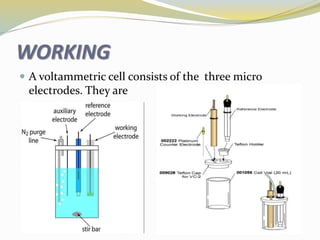
 A voltammetric cell consists of the three micro
electrodes. They are
 The working electrode, The working electrodes are
of various geometries and materials, ranging from
small Hg drops to flat Pt disks.
Mercury - it displays a wide negative potential range
(because it is difficult to reduce hydrogen ion or water at
the mercury surface), its surface is readily regenerated
by producing a new drop or film, and many metal ions
can be reversibly reduced into it.
Other commonly used electrode materials are gold,
platinum, and glassy carbon.
 The auxiliary electrode(counter): passes all the
current needed to balance the current observed at the
working electrode.
 The reference electrode-The reference electrode
should provide a reversible half-reaction with
Nernstian behaviour. Its only role is to act as reference
in measuring and controlling the working electrode’s
potential.
 The most commonly used reference electrodes for
aqueous solutions are the calomel electrode
INSTRUMENTATION
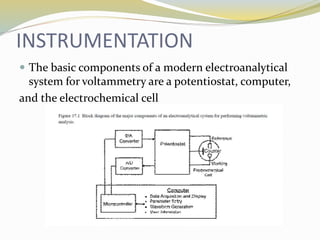
 The basic components of a modern electroanalytical
system for voltammetry are a potentiostat, computer,
and the electrochemical cell
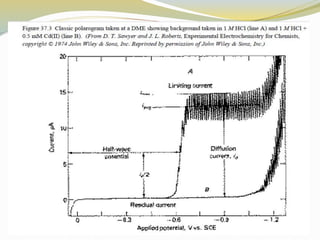
 The minimum potential required to initiate the electrolysis process is called the
decomposition potential.
 The faradaic current is the current generated by the reduction or oxidation of
some chemical substance at an electrode.
 Capacitive current, also called "non-faradaic" or "double-layer" current,
does not involve any chemical reactions (charge transfer), it only causes
accumulation (or removal) of electrical charges on the electrode and in the
electrolyte solution near the electrode
 The limiting current, in electrochemistry, is the limiting value of a faradaic
current that is approached as the rate of charge-transfer to an electrode is
increased The limiting current can be approached, for example, by increasing
the electric potential or decreasing the rate of mass transfer to the electrode.
 The potential at which the current is one half the limiting
current is called half-wave potential E1/2
 Diffusion current is a current in a semiconductor caused by
the diffusion of charge carriers (holes and/or electrons).
 A residual-current device (RCD), or residual-current
circuit breaker (RCCB), is a device to quickly disconnect
current to prevent serious harm from an ongoing electric
shock
CYCLIC VOLTAMMETRY
 An electrochemical technique which measures the
current that develops in an electrochemical cell
under conditions where voltage is applied
 CV is performed by cycling the potential of a
working electrode, and measuring the resulting
current.
 Governing law: Ohm’s law E = ir
Epc
THEORY
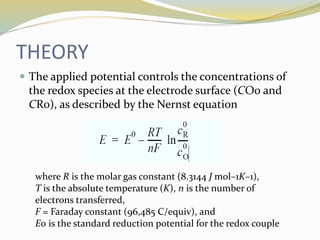
 The applied potential controls the concentrations of
the redox species at the electrode surface (CO0 and
CR0), as described by the Nernst equation
where R is the molar gas constant (8.3144 J mol–1K–1),
T is the absolute temperature (K), n is the number of
electrons transferred,
F = Faraday constant (96,485 C/equiv), and
E0 is the standard reduction potential for the redox couple
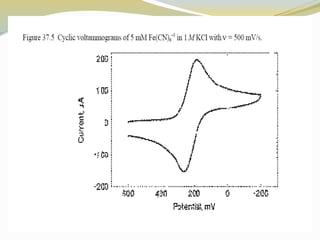
The important parameters in a cyclic voltammogram are the
peak potentials (Epc , Epa) and peak currents (ipc , ipa) of
the cathodic and anodic peaks, respectively.
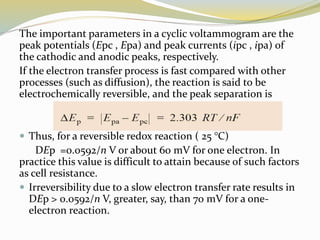
If the electron transfer process is fast compared with other
processes (such as diffusion), the reaction is said to be
electrochemically reversible, and the peak separation is
 Thus, for a reversible redox reaction ( 25 °C)
DEp =0.0592/n V or about 60 mV for one electron. In
practice this value is difficult to attain because of such factors
as cell resistance.
 Irreversibility due to a slow electron transfer rate results in
DEp > 0.0592/n V, greater, say, than 70 mV for a one-
electron reaction.
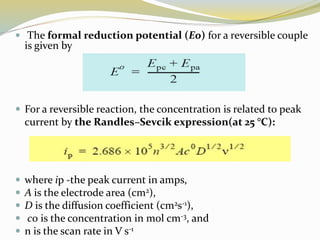
 The formal reduction potential (Eo) for a reversible couple
is given by
 For a reversible reaction, the concentration is related to peak
current by the Randles–Sevcik expression(at 25 °C):
 where ip -the peak current in amps,
 A is the electrode area (cm2),
 D is the diffusion coefficient (cm2s-1),
 c0 is the concentration in mol cm-3, and
 n is the scan rate in V s-1
 Irreversible oxidation or reduction-Activated over potential
(Extra energy applying to the electrode in the form of
increasing potentia).
 Reversibility depends on the relative values of electron
transfer rate constant(ks) and the rate of change of
potential-scan rate(n).
 If the ratio of ks/n is small then nernstian concentration
cannot be maintained then the process is called quasi-
reversible.
 A quasi-reversible process is characterized by DEp > 59.2/n
mV, with the value increasing with increasing n.
APPLICATIONS
 CV is rarely used for quantitative determinations, but
it is widely used for
 the study of redox processes,
 for understanding reaction intermediates, and
 for obtaining stability of reaction
REFERENCES
 Franck A.settle,editor, Handbook of Instrumental
Techniques for Analytical Chemistry,pearson
education, 2004.
 Douglas A.skoog, F. James Holler, Stanley R.Crouch,
Instrumental Analysis,Brooks/cole lengage
learning,2007
 Gary D.Christian, Analytical chemistry,Wiley student
edition,sixth edition.

Cyclic voltammetry

  • 3.
    INTRODUCTION  Voltammetry -from the discovery of polarography in 1922 by the chemist Jaroslav Heyrovsky, received the 1959 Nobel Prize in chemistry.  The earlier voltammetric methods experienced a number of difficulties, but after in the 1960s and 1970s significant advances were made in all areas of voltammetry (theory, methodology, and instrumentation), which enhanced the sensitivity of analytical methods.
  • 4.
     The commoncharacteristic of all voltammetric techniques is that they involve:  the application of a potential (E) to an electrode  the monitoring of the resulting current (i) flowing through the electrochemical cell.  In many cases, the applied potential is varied or the current is monitored over a period of time (t).  Thus, all voltammetric techniques can be described as some function of E, i, and t. Governing law: Ohm’s law E = ir
  • 5.
    WORKING  A voltammetriccell consists of the three micro electrodes. They are
  • 6.
     The workingelectrode, The working electrodes are of various geometries and materials, ranging from small Hg drops to flat Pt disks. Mercury - it displays a wide negative potential range (because it is difficult to reduce hydrogen ion or water at the mercury surface), its surface is readily regenerated by producing a new drop or film, and many metal ions can be reversibly reduced into it. Other commonly used electrode materials are gold, platinum, and glassy carbon.
  • 7.
     The auxiliaryelectrode(counter): passes all the current needed to balance the current observed at the working electrode.  The reference electrode-The reference electrode should provide a reversible half-reaction with Nernstian behaviour. Its only role is to act as reference in measuring and controlling the working electrode’s potential.  The most commonly used reference electrodes for aqueous solutions are the calomel electrode
  • 8.
    INSTRUMENTATION  The basiccomponents of a modern electroanalytical system for voltammetry are a potentiostat, computer, and the electrochemical cell
  • 10.
     The minimumpotential required to initiate the electrolysis process is called the decomposition potential.  The faradaic current is the current generated by the reduction or oxidation of some chemical substance at an electrode.  Capacitive current, also called "non-faradaic" or "double-layer" current, does not involve any chemical reactions (charge transfer), it only causes accumulation (or removal) of electrical charges on the electrode and in the electrolyte solution near the electrode  The limiting current, in electrochemistry, is the limiting value of a faradaic current that is approached as the rate of charge-transfer to an electrode is increased The limiting current can be approached, for example, by increasing the electric potential or decreasing the rate of mass transfer to the electrode.
  • 11.
     The potentialat which the current is one half the limiting current is called half-wave potential E1/2  Diffusion current is a current in a semiconductor caused by the diffusion of charge carriers (holes and/or electrons).  A residual-current device (RCD), or residual-current circuit breaker (RCCB), is a device to quickly disconnect current to prevent serious harm from an ongoing electric shock
  • 12.
    CYCLIC VOLTAMMETRY  Anelectrochemical technique which measures the current that develops in an electrochemical cell under conditions where voltage is applied  CV is performed by cycling the potential of a working electrode, and measuring the resulting current.  Governing law: Ohm’s law E = ir
  • 13.
  • 14.
    THEORY  The appliedpotential controls the concentrations of the redox species at the electrode surface (CO0 and CR0), as described by the Nernst equation where R is the molar gas constant (8.3144 J mol–1K–1), T is the absolute temperature (K), n is the number of electrons transferred, F = Faraday constant (96,485 C/equiv), and E0 is the standard reduction potential for the redox couple
  • 15.
    The important parametersin a cyclic voltammogram are the peak potentials (Epc , Epa) and peak currents (ipc , ipa) of the cathodic and anodic peaks, respectively. If the electron transfer process is fast compared with other processes (such as diffusion), the reaction is said to be electrochemically reversible, and the peak separation is  Thus, for a reversible redox reaction ( 25 °C) DEp =0.0592/n V or about 60 mV for one electron. In practice this value is difficult to attain because of such factors as cell resistance.  Irreversibility due to a slow electron transfer rate results in DEp > 0.0592/n V, greater, say, than 70 mV for a one- electron reaction.
  • 16.
     The formalreduction potential (Eo) for a reversible couple is given by  For a reversible reaction, the concentration is related to peak current by the Randles–Sevcik expression(at 25 °C):  where ip -the peak current in amps,  A is the electrode area (cm2),  D is the diffusion coefficient (cm2s-1),  c0 is the concentration in mol cm-3, and  n is the scan rate in V s-1
  • 18.
     Irreversible oxidationor reduction-Activated over potential (Extra energy applying to the electrode in the form of increasing potentia).  Reversibility depends on the relative values of electron transfer rate constant(ks) and the rate of change of potential-scan rate(n).  If the ratio of ks/n is small then nernstian concentration cannot be maintained then the process is called quasi- reversible.  A quasi-reversible process is characterized by DEp > 59.2/n mV, with the value increasing with increasing n.
  • 19.
    APPLICATIONS  CV israrely used for quantitative determinations, but it is widely used for  the study of redox processes,  for understanding reaction intermediates, and  for obtaining stability of reaction
  • 20.
    REFERENCES  Franck A.settle,editor,Handbook of Instrumental Techniques for Analytical Chemistry,pearson education, 2004.  Douglas A.skoog, F. James Holler, Stanley R.Crouch, Instrumental Analysis,Brooks/cole lengage learning,2007  Gary D.Christian, Analytical chemistry,Wiley student edition,sixth edition.