Nuclear weapons delivery system
Abdus Salam
MS.c International Relations
University of Modern Languages Islamabad
• Nuclear weapons delivery is the technology and
systems used to place a nuclear weapon at the
position of detonation, on or near its target.
Several methods have been developed to carry out this
task.
• Strategic nuclear weapons are used primarily as part
of a doctrine of deterrence by threatening large
targets, such as cities.
• Weapons meant for use in limited military
maneuvers, such as destroying specific military,
communications, or infrastructure targets, are known
as tactical nuclear weapons
Nuclear triad.
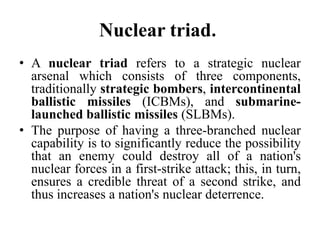
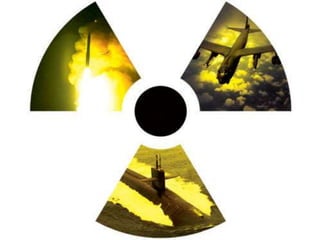
• A nuclear triad refers to a strategic nuclear
arsenal which consists of three components,
traditionally strategic bombers, intercontinental
ballistic missiles (ICBMs), and submarine-
launched ballistic missiles (SLBMs).
• The purpose of having a three-branched nuclear
capability is to significantly reduce the possibility
that an enemy could destroy all of a nation's
nuclear forces in a first-strike attack; this, in turn,
ensures a credible threat of a second strike, and
thus increases a nation's nuclear deterrence.
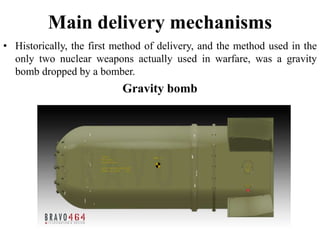
Main delivery mechanisms
• Historically, the first method of delivery, and the method used in the
only two nuclear weapons actually used in warfare, was a gravity
bomb dropped by a bomber.
Gravity bomb
Ballistic missile
• Missiles using a ballistic trajectory usually
deliver a warhead over the horizon, at
distances of thousands of kilometers, as in the
case of intercontinental ballistic
missiles (ICBMs) and submarine-launched
ballistic missiles (SLBMs).
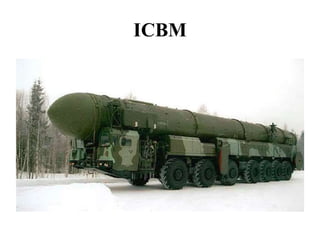
ICBM
• The intercontinental ballistic missile (ICBM)
is a ballistic missile with a range of more than
6,400 kilometers. It is a ground-launched
missile, carries a hydrogen-bomb warhead
over a typical range of around 10,000
kilometers. Together with the SLBM and
strategic bombers, it is one of the "three
pillars" of strategic nuclear weapons.
ICBM
SLBM
• The development of the submarine-launched ballistic missiles
(SLBM) has proceeded in conjunction with the development of
nuclear-powered submarines. The ICBM is based in the possessor's
own territory. Even ICBMs deployed in underground bases can be
detected by other countries using reconnaissance satellites. As a
countermeasure, SLBMs were built to be launched from nuclear
submarines in constant movement around the oceans. Submarines are
difficult to detect and able to enter areas near the enemy's territory.
SLBMs are an important strategic nuclear weapon because they can
escape a nuclear attack by the enemy and launch a counterattack.
Nuclear submarines are classified into the attack-type SSN(nuclear
submarines deployed with nuclear torpedoes targeting the enemy's
warships and the enemy's nuclear submarines) and the strategic SSBN
(loaded with SLBMs that target facilities thousands of kilometers
away on the enemy's territory).
SLBM
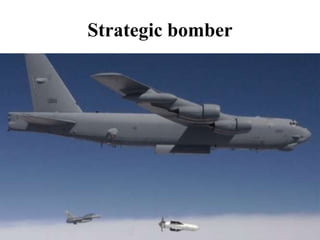
Strategic bomber
• Long-distance bombers played a greater role in the
delivery of strategic weapons prior to the advent of
missile systems such as ICBMs.
• Toward the end of World War II, B-29s (American
strategic bombers) carried atomic bombs to
Hiroshima and Nagasaki. The maximum payload at
that time was five tons.
• The most advanced bomber developed by the US to
date is the B-2. With a maximum speed of Mach 0.9
and a payload of 22 tons, it has a "stealth" structure
that resists radar detection
Strategic bomber
MIRV
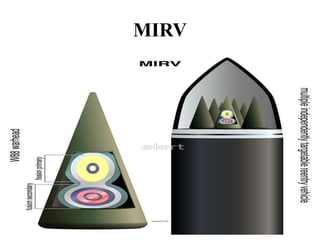
• The Multiple Independently Targetable Reentry Vehicle
(MIRV) carries three to ten nuclear warheads on a
single missile (ICBM or SLBM), each of which can be
set to attack different previously determined targets.
Carrying multiple nuclear warheads (re-entry devices)
and guiding devices, it launches a "bus" loaded with
several small rockets. First, the three-stage booster
rocket launches a bus toward the first target. The bus
uses small rockets to direct individual warheads to the
second, third, and subsequent targets. Like a bus letting
off passengers at successive bus stops, warheads are
launched one after another.
MIRV
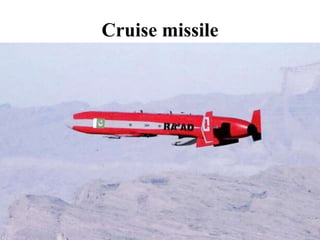
Cruise missile
• While the ICBM and SLBM have rocket engines, the
Cruise Missile has a jet engine. It is actually an
unmanned aircraft that flies at a subsonic speed using
an automatic guidance system. In recent years, the
range of cruise missiles has leaped to almost 5,000
kilometers, making it a strategic weapon.
Cruise missiles include sea-launched cruise missiles
(SLCM), air-launched cruise missiles (ALCM), and
ground-launched cruise missiles (GLCM). Sea-
launched missiles are launched from the torpedo tubes
on submarines or warships. Air-launched missiles are
deployed on strategic bombers where they can be
launched from outside the range of enemy radar.
Cruise missile
Other delivery systems
• Other delivery methods
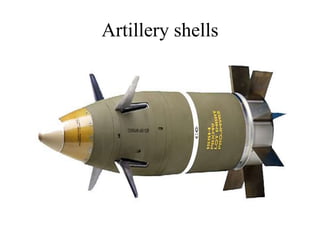
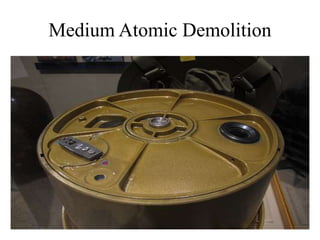
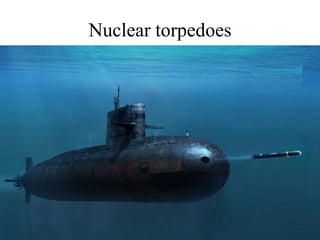
included artillery shells, mines such as the Medium
Atomic Demolition Monition and, nuclear depth
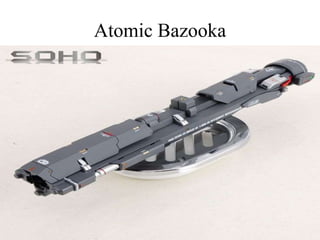
charges, and nuclear torpedoes. An 'Atomic
Bazooka' was also fielded, designed to be used
against large formations of tanks.
Artillery shells
Medium Atomic Demolition
Nuclear torpedoes
Atomic Bazooka

Nuclear weapons delivery system ppt

  • 1.
    Nuclear weapons deliverysystem Abdus Salam MS.c International Relations University of Modern Languages Islamabad
  • 2.
    • Nuclear weaponsdelivery is the technology and systems used to place a nuclear weapon at the position of detonation, on or near its target. Several methods have been developed to carry out this task. • Strategic nuclear weapons are used primarily as part of a doctrine of deterrence by threatening large targets, such as cities. • Weapons meant for use in limited military maneuvers, such as destroying specific military, communications, or infrastructure targets, are known as tactical nuclear weapons
  • 3.
    Nuclear triad. • Anuclear triad refers to a strategic nuclear arsenal which consists of three components, traditionally strategic bombers, intercontinental ballistic missiles (ICBMs), and submarine- launched ballistic missiles (SLBMs). • The purpose of having a three-branched nuclear capability is to significantly reduce the possibility that an enemy could destroy all of a nation's nuclear forces in a first-strike attack; this, in turn, ensures a credible threat of a second strike, and thus increases a nation's nuclear deterrence.
  • 5.
    Main delivery mechanisms •Historically, the first method of delivery, and the method used in the only two nuclear weapons actually used in warfare, was a gravity bomb dropped by a bomber. Gravity bomb
  • 6.
    Ballistic missile • Missilesusing a ballistic trajectory usually deliver a warhead over the horizon, at distances of thousands of kilometers, as in the case of intercontinental ballistic missiles (ICBMs) and submarine-launched ballistic missiles (SLBMs).
  • 7.
    ICBM • The intercontinentalballistic missile (ICBM) is a ballistic missile with a range of more than 6,400 kilometers. It is a ground-launched missile, carries a hydrogen-bomb warhead over a typical range of around 10,000 kilometers. Together with the SLBM and strategic bombers, it is one of the "three pillars" of strategic nuclear weapons.
  • 8.
  • 9.
    SLBM • The developmentof the submarine-launched ballistic missiles (SLBM) has proceeded in conjunction with the development of nuclear-powered submarines. The ICBM is based in the possessor's own territory. Even ICBMs deployed in underground bases can be detected by other countries using reconnaissance satellites. As a countermeasure, SLBMs were built to be launched from nuclear submarines in constant movement around the oceans. Submarines are difficult to detect and able to enter areas near the enemy's territory. SLBMs are an important strategic nuclear weapon because they can escape a nuclear attack by the enemy and launch a counterattack. Nuclear submarines are classified into the attack-type SSN(nuclear submarines deployed with nuclear torpedoes targeting the enemy's warships and the enemy's nuclear submarines) and the strategic SSBN (loaded with SLBMs that target facilities thousands of kilometers away on the enemy's territory).
  • 10.
  • 11.
    Strategic bomber • Long-distancebombers played a greater role in the delivery of strategic weapons prior to the advent of missile systems such as ICBMs. • Toward the end of World War II, B-29s (American strategic bombers) carried atomic bombs to Hiroshima and Nagasaki. The maximum payload at that time was five tons. • The most advanced bomber developed by the US to date is the B-2. With a maximum speed of Mach 0.9 and a payload of 22 tons, it has a "stealth" structure that resists radar detection
  • 12.
  • 13.
    MIRV • The MultipleIndependently Targetable Reentry Vehicle (MIRV) carries three to ten nuclear warheads on a single missile (ICBM or SLBM), each of which can be set to attack different previously determined targets. Carrying multiple nuclear warheads (re-entry devices) and guiding devices, it launches a "bus" loaded with several small rockets. First, the three-stage booster rocket launches a bus toward the first target. The bus uses small rockets to direct individual warheads to the second, third, and subsequent targets. Like a bus letting off passengers at successive bus stops, warheads are launched one after another.
  • 14.
  • 15.
    Cruise missile • Whilethe ICBM and SLBM have rocket engines, the Cruise Missile has a jet engine. It is actually an unmanned aircraft that flies at a subsonic speed using an automatic guidance system. In recent years, the range of cruise missiles has leaped to almost 5,000 kilometers, making it a strategic weapon. Cruise missiles include sea-launched cruise missiles (SLCM), air-launched cruise missiles (ALCM), and ground-launched cruise missiles (GLCM). Sea- launched missiles are launched from the torpedo tubes on submarines or warships. Air-launched missiles are deployed on strategic bombers where they can be launched from outside the range of enemy radar.
  • 16.
  • 17.
    Other delivery systems •Other delivery methods included artillery shells, mines such as the Medium Atomic Demolition Monition and, nuclear depth charges, and nuclear torpedoes. An 'Atomic Bazooka' was also fielded, designed to be used against large formations of tanks.
  • 18.
  • 19.
  • 20.
  • 21.